VA Healthcare Guide
Your disability rating determines which priority group you're in, what you pay, and what's free. This guide explains it all in plain English.

Rating Cliffs: Where Healthcare Changes
Not all rating increases are equal. These are the thresholds where VA healthcare benefits change the most.
Who Can Get VA Health Care
Basic rule: you served in the active military, naval, space or air service and were discharged or released under conditions other than dishonorable. Qualifying Reserve and National Guard members may also qualify.
Minimum service: if you enlisted after September 7, 1980, or entered active duty after October 16, 1981, you must have served 24 continuous months or the full period you were called to active duty. This may not apply if you were discharged for a hardship, an early out, or a disability incurred or aggravated in the line of duty, or if you get care under a special treatment authority, such as care related to military sexual trauma (MST).
Who Does Not Have to Enroll
These four groups can get VA care without enrolling. VA still urges them to enroll so it can plan health resources:
- Veterans with a service-connected disability rated 50% or more
- Veterans seeking care, within 12 months of discharge, for a disability the military found was incurred or aggravated in the line of duty but that VA has not yet rated
- Veterans seeking care only for a service-connected disability, or under a special treatment authority such as MST-related care
- Veterans seeking a registry exam (ionizing radiation, Agent Orange, Gulf War/OEF/OIF/OND depleted uranium, airborne hazards, and the Open Burn Pit Registry)
Priority Groups
The VA assigns every enrolled veteran to a priority group (1-8). Your group determines enrollment priority, copay levels, and access to services.
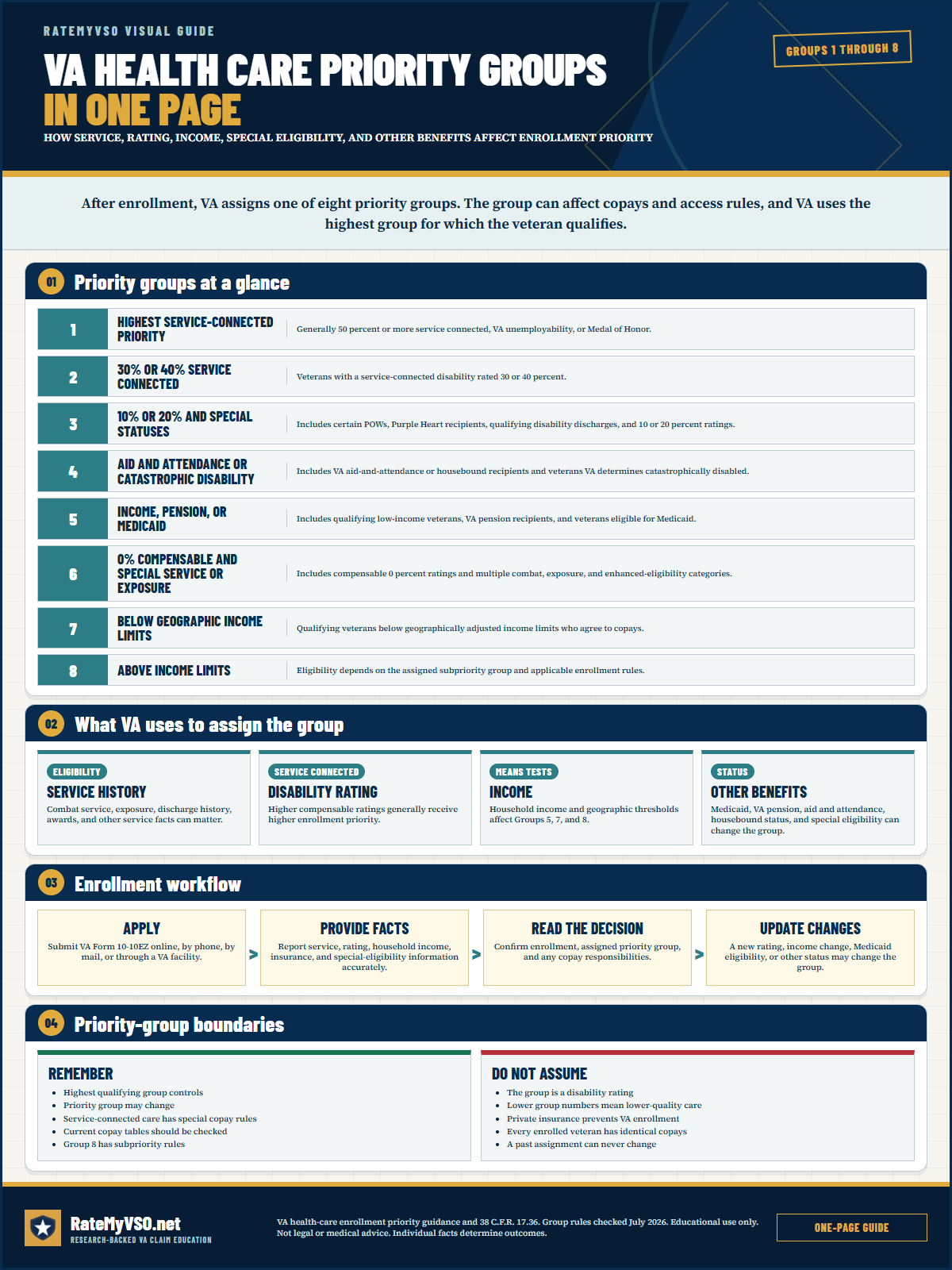 One-page guide: VA Health Care Priority Groups In One Page
See Groups 1 through 8 and the service, rating, income, and special-status factors behind assignment. Opens the full-size chart, free to save or print.
One-page guide: VA Health Care Priority Groups In One Page
See Groups 1 through 8 and the service, rating, income, and special-status factors behind assignment. Opens the full-size chart, free to save or print.
| Group | Who Qualifies | Copays |
|---|---|---|
| 1 | 50%+ SC disability, TDIU, or Medal of Honor recipient | None |
| 2 | 30% or 40% SC disability | None |
| 3 | Former POW; Purple Heart recipient; discharge was for a disability incurred or aggravated in the line of duty; 10% or 20% SC disability; disability compensation suspended because you receive military retired pay; paid at the 10% rate for multiple noncompensable SC disabilities that clearly interfere with normal employability; special eligibility under 38 U.S.C. § 1151 (disabled by VA treatment or vocational rehabilitation) | None |
| 4 | Receiving VA Aid & Attendance or Housebound benefits, catastrophic disability | None |
| 5 | 0% non-compensable SC with income below limits, VA pension, Medicaid-eligible | Reduced |
| 6 | 0% compensable SC; exposed to ionizing radiation during atmospheric testing or the occupation of Hiroshima and Nagasaki; Project 112/SHAD participants; World War II veterans; served in the Republic of Vietnam between January 9, 1962 and May 7, 1975; toxic-exposed veterans who served in specific locations during certain periods (PACT Act); served in the Southwest Asia theater from August 2, 1990 through November 11, 1998; served in a theater of combat operations after November 11, 1998 (for 10 years after discharge); served at least 30 days at Camp Lejeune between August 1, 1953 and December 31, 1987 | Varies |
| 7 | Income below geographic means test (GMT) limits, agrees to copays | Reduced |
| 8 | Income above VA and GMT limits, agrees to copays | Full |
Priority Group 8 Sub-Groups
Group 8 has sub-categories that determine whether you can enroll at all:
- 8a/8c: Enrolled as of January 16, 2003 with continuous enrollment, eligible
- 8b/8d: Income exceeds limits by 10% or less, enrolled on or after June 15, 2009, eligible
- 8e: 0% non-compensable SC, doesn't meet 8a/8b, SC care only
- 8g: No SC condition, doesn't meet 8c/8d, not eligible for enrollment
Copay Rates (2026)
What you actually pay depends on your priority group and the type of care. Indian and Urban Indian Veterans are copay-exempt for all hospital care and medical services.
Outpatient Care
| Service | Copay |
|---|---|
| Primary care visit | $15 |
| Specialty care visit | $50 |
| Specialty tests (MRI, CT scan) | $50 |
| X-rays, lab tests, preventive services | $0 (always free) |
Inpatient Care
| Period | Group 7 (reduced) | Group 8 (full) |
|---|---|---|
| First 90 days per 365-day period | $347.20 + $2/day | $1,736 + $10/day |
| Each additional 90-day period | $173.60 + $2/day | $868 + $10/day |
Urgent Care
| Priority Group | First 3 Visits/Year | Additional Visits |
|---|---|---|
| Groups 1-5 | $0 | $30 |
| Group 6 (SC conditions) | $0 | $30 |
| Group 6 (non-SC conditions) | $30 | $30 |
| Groups 7-8 | $30 | $30 |
Flu shots are always $0 regardless of priority group. Urgent care requires you to have received VA care within the past 24 months.
Prescription Copays
Priority Group 1 (50%+ SC or TDIU): $0 for all medications. All other groups pay tiered copays:
| Tier | 1-30 Days | 31-60 Days | 61-90 Days |
|---|---|---|---|
| Tier 0 (no-copay meds) | $0 | $0 | $0 |
| Tier 1 (preferred generic) | $5 | $10 | $15 |
| Tier 2 (non-preferred generic/OTC) | $8 | $16 | $24 |
| Tier 3 (brand-name) | $11 | $22 | $33 |
Veterans with a 40% or lower SC rating and income at or below national limits may also qualify for free medications.
Services That Are Always Free
These services have no copay regardless of your rating or priority group:
- Mental health care and counseling
- Military Sexual Trauma (MST) counseling and treatment
- Care for service-connected disabilities
- Compensation & Pension (C&P) exams
- Laboratory tests
- X-rays and EKGs
- Preventive health services
- Readjustment counseling (Vet Centers)
- Combat service-related care (post-Nov 11, 1998)
- Smoking cessation programs
- Weight loss programs
- VA research study participation
- Head/neck cancer care from military radium treatments
Care for Women Veterans
- Services: local VA facilities offer women's specific health care, screening and disease prevention, maternity care, fertility care, specialty gynecologic services, and mental health services.
- Community care: women veterans can get care in the community when they meet the community care rules and VA authorizes it. See VA community care.
- Mammograms: all veterans 40 to 74 are eligible for breast cancer screening. Veterans exposed to toxic substances while deployed in certain locations and periods, including those under 40, can get a breast cancer risk assessment and mammograms as clinically appropriate.
- Fertility: IVF and other fertility care can be covered when a service-connected condition causes infertility. See fertility, adoption and birth defect benefits.
- Who to contact: the Women Veterans Program Manager at your local VA facility, or the Women Veterans Call Center, call or text 855-VA-WOMEN (855-829-6636). More at womenshealth.va.gov.
Hearing Aids & Eyeglasses
These two benefits are often confused. Eligibility for hearing aids is broad. Eligibility for eyeglasses is much narrower. Both run through the VA Prosthetics and Sensory Aids department, not the regular medical clinic.
Hearing Aids: Open to Most Enrolled Veterans
You do not need a service-connected hearing loss. Any enrolled veteran can receive hearing aids if a VA audiologist documents medical need at an evaluation. Coverage includes:
- Modern digital, rechargeable, and Bluetooth-capable devices from major manufacturers (ReSound, Phonak, Oticon, Widex, Signia, Starkey)
- All batteries (reorder by phone at 303-273-6200, mail using VA Form 2346, or online via My HealtheVet)
- All repairs, adjustments, re-programming, and follow-up appointments
- Standard replacement cycle of 4-5 years, sooner if medically justified
Cost: Service-connected veterans and Priority Groups 1-6 generally pay nothing. Priority Groups 7-8 may pay a $50 specialty-care copay for the exam itself, but the devices are often still provided at no cost, so ask Prosthetics before declining.
Eyeglasses: Restricted Eligibility (Common Misconception)
Eye exams are covered for all enrolled veterans. Eyeglasses are a separate benefit. Many long-enrolled veterans assume glasses are automatic. They are not.
You qualify for VA-paid eyeglasses if any one of these applies:
- Any compensable service-connected disability (any rating, any condition, does not need to be vision-related)
- Former POW or Purple Heart recipient
- Receiving benefits under 38 U.S.C. § 1151, or increased pension for housebound or aid & attendance
- Vision problems caused by a VA-treated condition: diabetes, stroke, multiple sclerosis, TBI, polytrauma, post-cataract surgery, or medication side effects
- Functional or cognitive impairment severe enough that glasses meaningfully reduce its impact
- Combined vision-and-hearing loss affecting your ability to participate in your own care
What's covered: standard frames, single-vision / bifocal / trifocal / progressive lenses, photochromic and anti-reflective coatings when documented, low-vision rehabilitation equipment (magnifiers, telescopes, CCTV readers). Contact lenses are covered only when medically necessary (primarily for keratoconus). Designer frames and routine convenience contacts are not covered. Backup pairs require specific medical justification.
Services for Blind and Visually Impaired Veterans
Veterans with visual impairments may be eligible for lifetime care coordination at a VA medical center and for services from an inpatient or outpatient VA blind and vision rehabilitation program.
Sources: VA Prosthetics: Hearing Aids · VA.gov: Vision Care · VHA Directive 1034
Medicare & Private Insurance
VA health care and other insurance can be used together. Having other insurance does not affect your VA eligibility.
Key Rules
- VA bills private insurance for non-service-connected care, but you never owe the balance if your insurer underpays. Any payment VA gets from your insurer can offset your VA copay dollar for dollar.
- VA does not bill Medicare directly, but may bill Medicare supplemental insurance.
- VA prescription drug coverage counts as creditable coverage for Medicare Part D, no penalty if you later switch.
- Affordable Care Act: enrollment in VA health care meets the standard for minimum health coverage. If you are enrolled with VA, you cannot get a Marketplace premium tax credit for yourself.
Giving VA Your Insurance Information
VA asks you to report all health insurance, including coverage through a spouse. You can give or update it by showing your insurance card to the VA clinic clerk, at a self-service kiosk in a VA facility, online with VA Form 10-10EZR (Health Benefits Renewal), by phone at 1-877-222-8387 (Monday-Friday, 8am-8pm ET) or 1-800-698-2411 (1-800-MyVA411), or by mailing a paper 10-10EZR to: Health Eligibility Center, Enrollment and Eligibility Division, PO Box 5207, Janesville, WI 53547-5207.
Why Keep Private Insurance?
- VA does not normally cover family members (except CHAMPVA at 100% permanent)
- Private insurance covers non-VA hospitals and doctors
- If your priority group changes or VA budgets shift, you have backup coverage
- Medicare Part B cancellation cannot be reversed until January, with reinstatement penalties
HSA & High-Deductible Plans
If you have a High Deductible Health Plan (HDHP) with an HSA, you can use HSA funds to pay VA copays for non-service-connected care. VA may also bill your HDHP directly.
How to Enroll
You can apply for VA health care in four ways:
- Online: Apply at VA.gov health care application
- By phone: Call 1-877-222-8387 (Monday-Friday, 8am-8pm ET), or 1-800-698-2411 (1-800-MyVA411, live agents 24/7). A VA staff member takes your information and processes the application.
- By mail: Download VA Form 10-10EZ from VA.gov and mail it to: Health Eligibility Center, ATTN: Enrollment Eligibility Division, P.O. Box 5207, Janesville, WI 53547-5207
- In person: Visit most VA medical centers and some clinics
What You'll Need
- Social Security number
- Military discharge papers (DD214 or equivalent)
- Most recent tax return (for income-based enrollment)
- Insurance card(s) if applicable
Financial assessment: most veterans who do not get VA disability compensation or pension give VA their financial information when they first apply. It decides whether you qualify for free care, medications, and travel benefits, and may set your priority group. VA no longer asks enrolled non-service-connected and 0% non-compensable veterans to report it every year. VA confirms it with the IRS and the Social Security Administration instead.
After You Enroll: VA Health Connect
VA Health Connect lets you talk by phone or chat online with a real person, 24/7, to speak with a nurse, schedule, confirm or cancel appointments, talk to a provider by phone or video about an urgent or developing issue, and refill or renew medications. Reach it by calling your local VA medical facility (find the number at va.gov/find-locations). Online chat through the VA Health Chat app is open at most participating locations Monday to Friday, 8 a.m. to 4 p.m. local time, excluding federal holidays, and 24/7 in some locations.
Sharing Your Health Records With Non-VA Providers
VA shares your electronic health information with participating non-VA providers who are part of your care team. To opt out, sign in to My HealtheVet, go to Health Records and select Electronic Sharing Options, then Opt Out; or mail VA Form 10-10164 to the Release of Information (ROI) Office at your local VA medical center; or visit that ROI Office in person. To opt back in at any time, use VA Form 10-10163 or select Opt Back In on My HealtheVet.
What Your Rating Gives You, Full Summary
| Rating | Priority Group | Outpatient | Inpatient | Rx | Key Benefit |
|---|---|---|---|---|---|
| 0% | 5-8 | $15/$50 | Varies | Tiered | Federal hiring preference, SC care only |
| 10% | 3 | $0 | $0 | Tiered* | Free care for ALL conditions |
| 20% | 3 | $0 | $0 | Tiered* | + VR&E eligibility |
| 30% | 2 | $0 | $0 | Tiered* | + Dependent pay |
| 40% | 2 | $0 | $0 | Tiered* | Income-based free Rx possible |
| 50% | 1 | $0 | $0 | $0 | All Rx free + CRDP |
| 60-90% | 1 | $0 | $0 | $0 | + TDIU eligibility |
| 100% | 1 | $0 | $0 | $0 | + Free dental, DEA, CHAMPVA |
*Tiered = $5-$33 per Rx depending on tier. SC prescriptions are always free. Annual cap: $700.
Sources:
- VA Derivative Service Connection Benefits Matrix, official chart of what each rating level provides
- VA Health Care Priority Groups, enrollment priority and eligibility
- VA Copay Rates, 2026 copay schedule by priority group
- VA Health Care and Other Insurance, Medicare, private insurance, and HSA coordination
- VA, Federal Benefits for Veterans, Dependents, Survivors, and Caregivers, 2026 edition (Pamphlet 80-26-1), eligibility, enrollment, priority groups, crisis care, insurance, and information sharing
This guide is for educational purposes only and is not legal or medical advice. For help with VA benefits, find a VSO representative. All RateMyVSO tools are free. We never sell anything. Last reviewed: 2026-04-14.