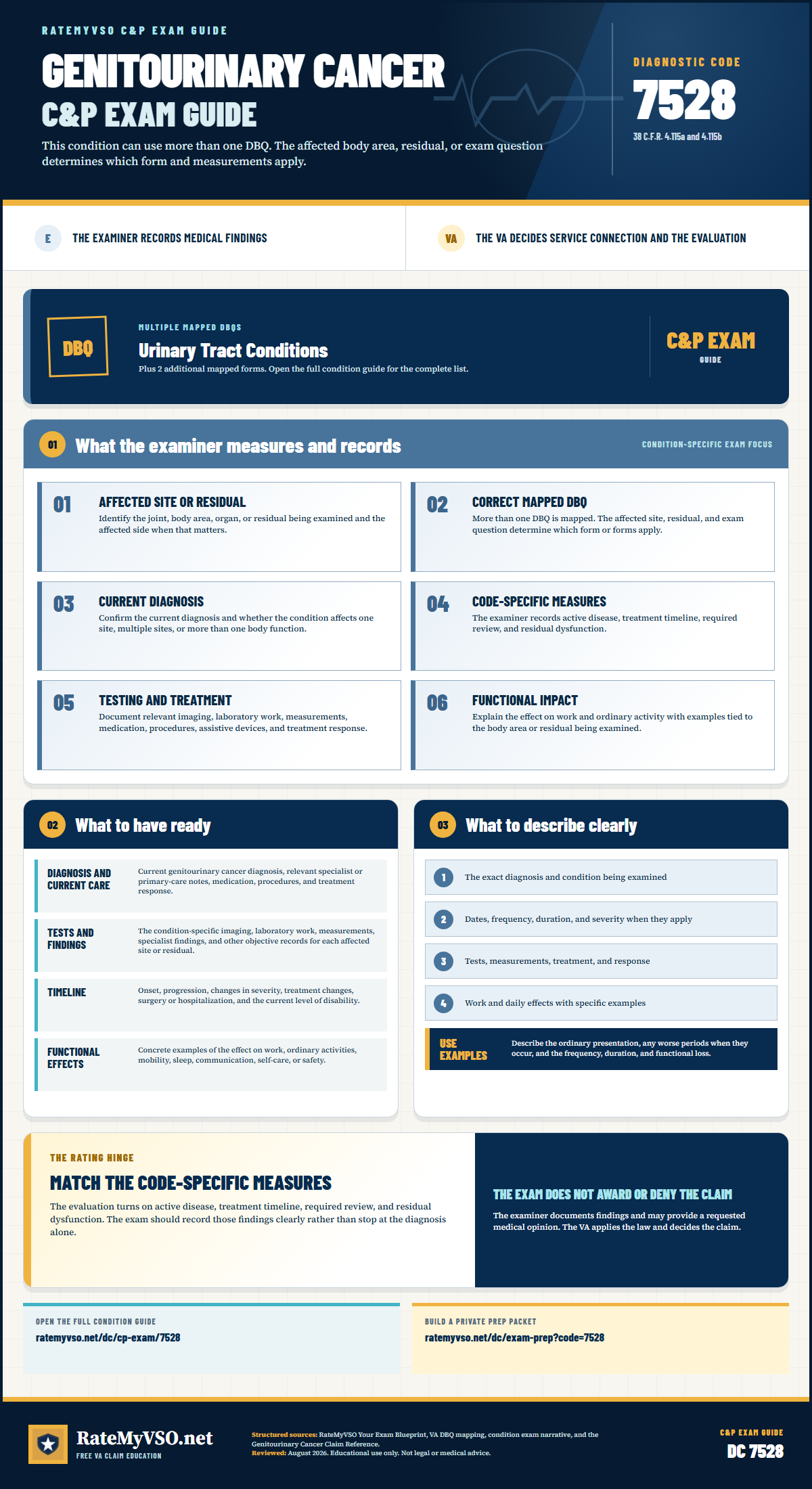
C&P Exam Prep Guide for Malignant neoplasms of the genitourinary system (DC 7528)
YOUR EXAM BLUEPRINT
Malignant neoplasms of the genitourinary system
A urinary-tract exam reviews your symptoms and test results. The rating usually depends on voiding problems (frequency, leakage, or retention), under 38 CFR 4.115b.
DBQ used for this condition
- PPublic formDBQ GU Urinary Tract ConditionsOpen the public DBQ
- PPublic formDBQ GU KidneyOpen the public DBQ
- PPublic formDBQ GU Male Reproductive OrganOpen the public DBQ
What the examination is likely to focus on
Functional-impact topics to describe
- How often you urinate, leakage and pad or catheter use, or trouble emptying the bladder, which set the rating.
- Findings map to the voiding-dysfunction criteria in 38 CFR 4.115b (neurogenic bladder DC 7542).
Which form the examiner uses
For malignant neoplasms of the genitourinary system (DC 7528), the C&P examiner completes the following Disability Benefits Questionnaire (DBQ):
- DBQ GU Urinary Tract Conditions (public PDF on VA.gov)
- DBQ GU Kidney (public PDF on VA.gov)
- DBQ GU Male Reproductive Organ (public PDF on VA.gov)
DBQs are Department of Veterans Affairs Form 21-0960 series documents. Public DBQs are hosted on benefits.va.gov. A handful are examiner-only and are not posted publicly.
What to expect at your C&P exam
A urinary-tract exam reviews your symptoms and test results. The rating usually depends on voiding problems (frequency, leakage, or retention), under 38 CFR 4.115b.
1Initial interview (history)
- How often you urinate, day and night, and any urgency.
- Leakage and whether you need pads or a catheter.
- Trouble emptying the bladder (retention) and any infections.
- The underlying cause and current treatment.
2Physical examination
- Abdominal and genital or pelvic exam.
- Checking for bladder fullness or other signs.
3Diagnostic tests the examiner may rely on
Used to evaluate bladder function and rule out infection.
4Functional assessment
- How often you urinate, leakage and pad or catheter use, or trouble emptying the bladder, which set the rating.
- Findings map to the voiding-dysfunction criteria in 38 CFR 4.115b (neurogenic bladder DC 7542).
A kidney exam is mostly a review of your lab results and history. The rating depends on how well your kidneys work and related symptoms, under 38 CFR 4.115a.
1Initial interview (history)
- Known kidney disease, stones, infections, or removal of a kidney.
- Swelling, changes in urination, fatigue, and high blood pressure.
- Whether you are on dialysis or have a diet restriction.
- The underlying cause (diabetes, high blood pressure) and current treatment.
2Physical examination
- Blood-pressure measurement.
- Checking for swelling (edema) and general signs of kidney strain.
3Diagnostic tests the examiner may rely on
Lab tests and imaging the examiner reviews to gauge kidney function.
4Functional assessment
- Your kidney function (eGFR and creatinine), blood pressure, and whether you require dialysis, which set the rating.
- Findings map to the renal dysfunction criteria in 38 CFR 4.115a (kidney DCs 7500-7541).
A male reproductive exam is an interview and a brief physical, with lab tests as needed. For erectile dysfunction the focus is the cause and treatment; for prostate conditions, the urinary symptoms.
1Initial interview (history)
- For erectile dysfunction: when it started, whether it is constant, the likely cause (medication, diabetes, surgery), and treatments tried.
- For prostate conditions: urinary frequency, urgency, weak stream, getting up at night, leakage, and infections.
- Related conditions and medications.
2Physical examination
- Examination of the genitals.
- A digital rectal exam to check the prostate.
3Diagnostic tests the examiner may rely on
Used to evaluate the prostate or the cause of symptoms.
4Functional assessment
- For erectile dysfunction, whether it is present (often rated 0 percent with special monthly compensation for loss of use).
- For prostate conditions, how often you urinate, get up at night, or leak, and whether you need pads or a catheter, which set the rating.
- Findings map to 38 CFR 4.115a and 4.115b (erectile dysfunction DC 7522; prostate conditions DC 7527).
Test explainers open MedlinePlus (NIH National Library of Medicine), or Wikipedia where MedlinePlus has no matching page. This describes what happens and what is measured, not how to influence a result.
What the examiner records (full DBQ form)
The fields below are reproduced from the DBQ form the examiner completes for this diagnostic code. This is the structural map of the form, showing what the examiner is asked to measure, observe, and record. It is a factual reproduction of the public DBQ, not advice on how to answer.
DBQ GU Urinary Tract Conditions
This DBQ evaluates urinary tract conditions of the bladder and urethra (excluding kidney) including voiding dysfunction, urolithiasis, and bladder/urethral infections.
How DC 7528 maps to this DBQ: for this diagnostic code specifically, the examiner typically completes sections I-II and VII-XI of this form. Section VII is the condition-specific section for this code. Sections III-VI cover unrelated conditions on this DBQ and are skipped.
DIAGNOSIS (Section I)
- Does the Veteran currently have, or have they ever been diagnosed with, a urinary tract condition of the bladder or urethra?
- Diagnosis #1 - ICD code - Date of diagnosis
- Diagnosis #2 - ICD code - Date of diagnosis
- Diagnosis #3 - ICD code - Date of diagnosis
- If there are additional diagnoses that pertain to urinary tract conditions of the bladder or urethra, list using above format
MEDICAL HISTORY (Section II)
- Describe the history (including onset and course) of the Veteran's urinary tract condition - brief summary
VOIDING DYSFUNCTION (Section III)
- Does the Veteran have a voiding dysfunction?
- Etiology of voiding dysfunction, if known
- Does the voiding dysfunction cause urine leakage?
- Does not require the wearing of absorbent material
- Requires absorbent material which must be changed less than 2 times per day
- Requires absorbent material which must be changed 2 to 4 times per day
- Requires absorbent material which must be changed more than 4 times per day
- Does the voiding dysfunction require the use of an appliance? If yes, describe the appliance
- Does the voiding dysfunction cause increased urinary frequency?
- Daytime voiding interval less than 1 hour
- Daytime voiding interval between 1 and 2 hours
- Daytime voiding interval between 2 and 3 hours
- Nighttime awakening to void 2 times
- Nighttime awakening to void 3 to 4 times
- Nighttime awakening to void 5 or more times
- Does the voiding dysfunction cause signs or symptoms of obstructed voiding?
- Hesitancy
- Slow stream
- Weak stream
- Decreased force of stream
- Urinary retention requiring intermittent catheterization
- Urinary retention requiring continuous catheterization
- Uroflowmetry peak flow rate less than 10 cc/sec
- Post void residuals greater than 150 cc
- Recurrent urinary tract infections secondary to obstruction
- Stricture disease
- If selected, indicate frequency of periodic dilatation: Does not require dilatation / Requires dilatation 1 to 2 times per year / Every 2 to 3 months / Other, specify
UROLITHIASIS (Section IV)
- Does the Veteran have a history of bladder calculi (cystolithiasis) or urethral calculi (urethrolithiasis)?
- Indicate location of calculi - Bladder
- Indicate location of calculi - Urethra
- Has the Veteran had treatment for recurrent stone formation in the bladder or urethra?
- Invasive or non-invasive procedures two times or less per year
- Invasive or non-invasive procedures more than two times per year
- Diet therapy
- Drug therapy
- Does the Veteran have signs or symptoms due to cystolithiasis or urethrolithiasis?
- Infection
- Voiding dysfunction
- Impaired kidney function
- Occasional attacks of colic
- Frequent attacks of colic
- Is catheter drainage required?
BLADDER OR URETHRAL INFECTION (Section V)
- Does the Veteran have a history of recurrent, symptomatic bladder or urethral infections?
- Etiology of bladder or urethral infections, if known
- No treatment
- Suppressive drug therapy
- If checked, list medications used and indicate dates for courses of treatment over the past 12 months
- Lasting 6 months or longer
- For less than 6 months
- Hospitalization
- If checked, indicate frequency of hospitalizations: 1 or 2 per year / More than 2 per year
- Drainage by stent or nephrostomy tube
- If checked, indicate dates drainage was performed over the past 12 months
- Continuous intensive management required
- If checked, indicate types of treatment and medications used over the past 12 months
- Recurrent symptomatic infection
OTHER BLADDER OR URETHRAL CONDITIONS (Section VI)
- Does the Veteran have any findings, signs, or symptoms attributable to a bladder fistula?
- Does the Veteran have any findings, signs, or symptoms attributable to diverticulum of the bladder?
- Does the Veteran have suprapubic cystotomy? If yes, provide name of facility and date of procedure
- Does the Veteran have any findings, signs, or symptoms attributable to a urethral fistula?
- Does the Veteran have multiple urethroperineal fistulae?
- Does the Veteran have a neurogenic or severely dysfunctional bladder?
- Does the Veteran have a history of bladder injury?
- Has the Veteran had other bladder surgery?
- Is there any renal dysfunction due to a condition noted in this section?
- 6J. Comments (if any, please identify the question number to which the comment pertains)
TUMORS AND NEOPLASMS (Section VII)
- Does the Veteran currently have, or has had, a benign or malignant neoplasm or metastases related to any condition in the diagnosis section?
- Is the neoplasm: Benign / Malignant
- If malignant: Active / In remission
- If malignant: Primary / Secondary (metastatic); if secondary, indicate the primary site, if known
- Has the Veteran completed treatment or is the Veteran currently undergoing treatment for a benign or malignant neoplasm or metastases?
- Treatment completed
- Surgery - If checked, describe; Date(s) of surgery
- Radiation therapy - Date of most recent treatment; Date of completion of treatment or anticipated date of completion
- Antineoplastic chemotherapy - Date of most recent treatment; Date of completion of treatment or anticipated date of completion
- Other therapeutic procedure - If checked, describe procedure; Date of most recent procedure
- Other therapeutic treatment - If checked, describe treatment; Date of completion of treatment or anticipated date of completion
- Does the Veteran currently have any residuals or complications due to the neoplasm (including metastases) or its treatment, other than those already documented in the report above? If yes, list residuals or complications
- If there are additional benign or malignant neoplasms or metastases related to any of the diagnoses in the diagnosis section, describe using the above format
OTHER PERTINENT PHYSICAL FINDINGS, COMPLICATIONS, CONDITIONS, SIGNS, SYMPTOMS, AND SCARS (Section VIII)
- Does the Veteran have any other pertinent physical findings, complications, conditions, signs, and/or symptoms related to any of the conditions listed in the Diagnosis Section? If yes, describe - brief summary
- Does the Veteran have any scars or other disfigurement of the skin related to any conditions, or to the treatment of any of the conditions, listed in the Diagnosis Section?
- 8C. Comments, if any
DIAGNOSTIC TESTING (Section IX)
- Has the Veteran had diagnostic testing in conjunction with this exam?
- If yes, provide significant findings and/or results (type of test or procedure, date and results) - brief summary
- Are there any other significant diagnostic test findings or results related to the claimed condition(s) and/or diagnosis(es), that were reviewed in conjunction with this examination?
- If yes, provide type of test or procedure, date and results - brief summary
FUNCTIONAL IMPACT (Section X)
- Does the Veteran's condition of the bladder or urethra impact his or her ability to work?
- If yes, describe the impact of each of the Veteran's bladder or urethra condition(s), providing one or more examples
REMARKS (Section XI)
- 11A. Remarks (if any - please identify the section to which the remark pertains when appropriate)
DBQ GU Kidney
This DBQ evaluates kidney conditions including renal dysfunction, urolithiasis, infections, kidney removal, and transplant.
How DC 7528 maps to this DBQ: for this diagnostic code specifically, the examiner typically completes sections I-II and VII-XI of this form. Section VII is the condition-specific section for this code. Sections III-VI cover unrelated conditions on this DBQ and are skipped.
DIAGNOSIS (Section I)
- 1A. List the claimed conditions that pertain to this questionnaire:
- 1B. Select diagnoses associated with the claimed condition(s) (check all that apply): The Veteran does not have a current diagnosis associated with any claimed condition listed above.
- Diabetic nephropathy - ICD Code / Date of diagnosis
- Glomerulonephritis - ICD Code / Date of diagnosis
- Hydronephrosis - ICD Code / Date of diagnosis
- Interstitial nephritis - ICD Code / Date of diagnosis
- Kidney transplant - ICD Code / Date of diagnosis
- Nephrosclerosis - ICD Code / Date of diagnosis
- Nephrolithiasis (kidney stones) - ICD Code / Date of diagnosis
- Renal artery stenosis - ICD Code / Date of diagnosis
- Ureterolithiasis - ICD Code / Date of diagnosis
- Neoplasm of the kidney - ICD Code / Date of diagnosis
- Cholesterol emboli - ICD Code / Date of diagnosis
- Cystic kidney disease - ICD Code / Date of diagnosis
- Nephrocalcinosis - ICD Code / Date of diagnosis
- Renal cortical necrosis due to disseminated intravascular coagulation - ICD Code / Date of diagnosis
- Renal tubular disorders - Specify / ICD Code / Date of diagnosis
- Kidney abscess - ICD Code / Date of diagnosis
- Pyelonephritis, chronic - ICD Code / Date of diagnosis
- Kidney removal - ICD Code / Date of diagnosis
- Nephritis, chronic - ICD Code / Date of diagnosis
- Atherosclerotic renal disease - ICD Code / Date of diagnosis
- Ureter, stricture - ICD Code / Date of diagnosis
- Renal involvement in diabetes mellitus - ICD Code / Date of diagnosis
- Renal disease caused by viral infection such as HIV, Hepatitis B, and Hepatitis C - ICD Code / Date of diagnosis
- Papillary necrosis - ICD Code / Date of diagnosis
- Renal amyloid disease - ICD Code / Date of diagnosis
- Congenital or inherited kidney disorder - Specify / ICD Code / Date of diagnosis
- Other kidney condition - Other diagnosis #1: ICD Code / Date of diagnosis
- Other kidney condition - Other diagnosis #2: ICD Code / Date of diagnosis
- 1C. If there are additional diagnoses that pertain to kidney condition(s), list using above format:
- 1D. Comments:
MEDICAL HISTORY (Section II)
- 2A. Describe the history (including cause, onset and course) of the Veteran's kidney condition(s) (give a brief summary):
- 2B. Does the Veteran's treatment plan include taking continuous medication for the diagnosed condition?
- If yes, list medications taken for the diagnosed condition:
- 2C. Does the Veteran have hypertension and/or heart disease due to renal dysfunction or caused by any kidney condition?
RENAL DYSFUNCTION (Section III)
- 3A. Does the Veteran have renal dysfunction?
- 3B. Does the Veteran require regular dialysis?
- 3C. Does the Veteran have a cystic, obstructive, or glomerular structural kidney abnormality for at least 3 consecutive months during the past 12 months?
- If yes, check all that apply: Cystic / Obstructive / Glomerular
- Tests/evidence discussion:
- 3D. Is there a renal tubular disorder?
- If yes, is the renal tubular disorder symptomatic?
- 3E. Does the Veteran have any signs or symptoms of hydronephrosis due to obstruction other than upper urinary tract urolithiasis?
- If yes, indicate severity: Requires catheter drainage / Causing infection (pyonephrosis) / Causing impaired kidney function / Other, describe:
- 3F. Does the Veteran have attacks of renal colic due to obstruction other than upper urinary tract urolithiasis?
- If yes, indicate frequency: Occasional attacks of colic / Frequent attacks of colic
UROLITHIASIS (Section IV)
- 4A. Does the Veteran now have or has he/she ever had kidney or ureteral calculi (urolithiasis)?
- 4B. Indicate current/past location of calculi (check all that apply): Kidney / Ureter
- 4C. Does the stone formation cause stricture of the ureter?
- If yes, discuss test(s)/evidence used to confirm ureteral stricture:
- 4D. Has the Veteran had treatment for recurrent stone formation in the kidney or ureter?
- If yes, indicate treatment: Diet therapy required - specify diet and dates of use
- Drug therapy required - list medication and dates of use
- Invasive or non-invasive procedures - indicate average number of times per year: 0 to 1 per year / 2 per year / more than 2 per year
- Date and facility of most recent invasive or non-invasive procedure:
- 4E. Does the Veteran have any signs or symptoms due to upper urinary tract urolithiasis?
- If yes, indicate severity: Requiring catheter drainage / Causing infections (pyonephrosis) / Causing hydronephrosis / Causing impaired kidney function / Other, describe:
- 4F. Does the Veteran have attacks of colic due to upper urinary tract urolithiasis?
- If yes, indicate frequency: Occasional attacks of colic / Frequent attacks of colic
URINARY TRACT/KIDNEY INFECTION (Section V)
- 5A. Does the Veteran have a history of recurrent symptomatic urinary tract or kidney infections?
- 5B. Etiology of recurrent urinary tract or kidney infections:
- 5C. Indicate all treatment modalities used for recurrent urinary tract or kidney infections (check all that apply): No treatment
- Suppressive drug therapy - Lasting 6 months or longer / For less than 6 months
- If checked, list medications used and indicate dates for courses of treatment over the past 12 months:
- Hospitalization - indicate frequency: 1 or 2 per year / More than 2 per year
- Drainage by stent or nephrostomy tube - indicate dates when drainage was performed over the past 12 months:
- Continuous intensive management required - indicate types of treatment and medications used over the past 12 months:
- Other, describe:
KIDNEY REMOVAL OR TRANSPLANT (INCLUDING ELIGIBILITY) (Section VI)
- 6A. Has the Veteran had a kidney removed, is eligible for a kidney transplant, or has had a kidney transplant?
- 6B. Has the Veteran had a kidney removed?
- If yes, provide reason: Kidney donation / Due to disease / Due to trauma or injury / Other, describe
- 6C. Is the Veteran's renal disease course such that it is medically determined that the Veteran warrants transplant consideration?
- If yes, provide the date the Veteran's renal function was noted to have declined enough to warrant transplant consideration:
- 6D. Has the Veteran had a kidney transplant?
- Date of transplant:
- Date Veteran became eligible, if known:
- Name of treatment facility, date of admission, and date of discharge for transplant:
- 6E. If the Veteran underwent kidney removal, is the remaining kidney affected by nephritis, infection, or other pathology?
- 6F. If the Veteran underwent a kidney transplant, is there nephritis, infection, or other pathology of the transplanted kidney?
TUMORS AND NEOPLASMS (Section VII)
- 7A. Does the Veteran currently have, or has had, a benign or malignant neoplasm or metastases related to any condition in the diagnosis section?
- 7B. Is the neoplasm: Benign / Malignant
- If malignant: Active / In remission
- Primary / Secondary (metastatic) - If secondary, indicate the primary site, if known:
- 7C. Does the Veteran have a voiding dysfunction related to the neoplasm of the kidney (benign or malignant)?
- 7D. Has the Veteran completed treatment or is the Veteran currently undergoing treatment for a benign or malignant neoplasm or metastases?
- If yes, indicate type of treatment: Treatment completed
- Surgery - describe / Date(s) of surgery:
- Radiation therapy - Date of most recent treatment / Date of completion or anticipated date of completion:
- Antineoplastic chemotherapy - Date of most recent treatment / Date of completion or anticipated date of completion:
- Other therapeutic procedure - describe procedure / Date of most recent procedure:
- Other therapeutic treatment - describe treatment / Date of completion or anticipated date of completion:
- 7E. Does the Veteran currently have any residuals or complications due to the neoplasm (including metastases) or its treatment, other than those already documented in the report above?
- If yes, list residuals or complications (brief summary):
- 7F. If there are additional benign or malignant neoplasms or metastases related to any of the diagnoses in the diagnosis section, describe using the above format:
OTHER PERTINENT PHYSICAL FINDINGS, COMPLICATIONS, CONDITIONS, SIGNS, SYMPTOMS, AND SCARS (Section VIII)
- 8A. Does the Veteran have any other pertinent physical findings, complications, conditions, signs or symptoms related to any conditions listed in the diagnosis section above?
- If yes, describe (brief summary):
- 8B. Does the Veteran have any scars or other disfigurement (of the skin) related to any conditions or to the treatment of any conditions listed in the diagnosis section?
DIAGNOSTIC TESTING (Section IX)
- 9A. Are there laboratory or other diagnostic studies in the medical records?
- If yes, provide most recent results (if available):
- 9B. Were laboratory or other diagnostic studies performed in conjunction with this examination?
- If yes, provide most recent results (if available):
- 9C. GFR - Date / Result (up to three entries)
- 9D. Has the Veteran had albumin/creatinine ratio (ACR) greater than or equal to 30mg/g, RBC casts, WBC casts, or granular casts present for at least 3 consecutive months during the past 12 months?
- If yes, check all that apply: RBC casts / WBC casts / Granular casts / ACR greater than or equal to 30mg/g
- Tests/evidence used to confirm their presence to include dates:
- 9E. Are there any other significant diagnostic test findings and/or results?
- If yes, provide type of test or procedure, date and results (brief summary):
FUNCTIONAL IMPACT (Section X)
- 10A. Regardless of the Veteran's current employment status, do the conditions listed in the diagnosis section impact his/her ability to perform any type of occupational task (such as standing, walking, lifting, sitting, etc.)?
- If yes, describe the functional impact of each condition, providing one or more examples:
REMARKS (Section XI)
- 11A. Remarks (if any – please identify the section to which the remark pertains when appropriate).
DBQ GU Male Reproductive Organ
This DBQ evaluates male reproductive organ conditions including erectile dysfunction, retrograde ejaculation, voiding dysfunction, and infections of the male reproductive organ.
How DC 7528 maps to this DBQ: for this diagnostic code specifically, the examiner typically completes sections I-II and VII-XII of this form. Section VIII is the condition-specific section for this code. Sections III-VI cover unrelated conditions on this DBQ and are skipped.
DIAGNOSIS (Section I)
- 1A. List the claimed condition(s) that pertain to this questionnaire:
- 1B. Does the Veteran now have or has he ever been diagnosed with any conditions of the male reproductive system?
- 1C. Select diagnoses associated with the claimed condition(s). Check all that apply.
- Erectile dysfunction, with or without penile deformity - ICD code / Date of diagnosis
- Testis, atrophy, one or both - ICD code / Date of diagnosis
- Testis, removal, one or both - ICD code / Date of diagnosis
- Epididymitis, chronic - ICD code / Date of diagnosis
- Orchitis (unilateral or bilateral), chronic only - ICD code / Date of diagnosis
- Urethritis - ICD code / Date of diagnosis
- Varicocele/Hydrocele - ICD code / Date of diagnosis
- Prostatitis - ICD code / Date of diagnosis
- Prostate gland injuries, infections, hypertrophy, postoperative residuals, bladder outlet obstruction - ICD code / Date of diagnosis / Specify specific diagnosis
- Neoplasms of the male reproductive system, including prostate cancer - ICD code / Date of diagnosis
- Other diagnosis #1 - ICD code / Date of diagnosis
- Other diagnosis #2 - ICD code / Date of diagnosis
- 1D. If there are any additional diagnoses that pertain to male reproductive organ conditions, list using above format:
MEDICAL HISTORY (Section II)
- 2A. Describe the history, including onset and course, of the Veteran's male reproductive organ condition(s), including prostate cancer. Brief summary:
- 2B. Does the Veteran's treatment plan include taking continuous medication for the diagnosed condition?
- List medications taken for the male reproductive organ condition:
- 2C. Has the Veteran had an orchiectomy?
- Indicate testicle removed: Right / Left / Both
- Indicate reason for removal: Undescended / Congenitally underdeveloped / Other, provide reason for removal:
- 2D. Is there any renal dysfunction due to any conditions listed in the diagnosis section?
VOIDING DYSFUNCTION (Section III)
- 3A. Does the Veteran have a voiding dysfunction?
- 3B. Etiology of voiding dysfunction:
- 3C. Does the voiding dysfunction cause urine leakage?
- Indicate severity: Does not require the wearing of absorbent material / Requires absorbent material which must be changed less than 2 times per day / Requires absorbent material which must be changed 2 to 4 times per day / Requires absorbent material which must be changed more than 4 times per day / Other
- 3D. Does the voiding dysfunction require the use of an appliance?
- If yes, describe the appliance:
- 3E. Does the voiding dysfunction cause increased urinary frequency?
- Daytime voiding interval between 2 and 3 hours
- Daytime voiding interval between 1 and 2 hours
- Daytime voiding interval less than 1 hour
- Nighttime awakening to void 2 times
- Nighttime awakening to void 3 to 4 times
- Nighttime awakening to void 5 or more times
- 3F. Does the voiding dysfunction cause signs or symptoms of obstructed voiding?
- Hesitancy
- Slow stream
- Weak stream
- Decreased force of stream
- Obstructive symptomatology without stricture disease requiring dilatation 1 to 2 times per year
- Stricture disease requiring dilatation 1 to 2 times per year
- Stricture disease requiring periodic dilatation every 2 to 3 months
- Recurrent urinary tract infections secondary to obstruction
- Uroflowmetry peak flow rate less than 10 cc/sec
- Post void residuals greater than 150 cc
- Urinary retention requiring intermittent catheterization
- Urinary retention requiring continuous catheterization
- Other - Describe other:
ERECTILE DYSFUNCTION (Section IV)
- 4A. Does the Veteran have erectile dysfunction?
- If yes, provide etiology, if known.
- Etiology unknown
RETROGRADE EJACULATION (Section V)
- 5A. Does the Veteran have retrograde ejaculation?
- If yes, provide etiology, if known.
- Etiology unknown
MALE REPRODUCTIVE ORGAN INFECTIONS, INCLUDING URINARY TRACT INFECTIONS (Section VI)
- 6A. Does the Veteran have a history of chronic prostatitis, urethritis, epididymitis, orchitis, or urinary tract infections?
- No treatment
- Recurrent symptomatic infection requiring drainage by stent or nephrostomy tube - indicate dates drainage was performed over the past 12 months
- Recurrent symptomatic infection requiring hospitalization - indicate frequency: 1 or 2 per year / Greater than 2 times per year
- Recurrent symptomatic infection requiring continuous intensive management - indicate types of treatment and medications used over the past 12 months
- Recurrent symptomatic infection requiring suppressive drug therapy - For less than 6 months / Lasting 6 months or longer - list medications used and indicate dates for courses of treatment over the past 12 months
- Other - Describe other:
PHYSICAL EXAM (Section VII)
- 7A. Penis: Normal / Not examined per Veteran's request / Not examined per Veteran's request; Veteran reports normal anatomy with no penile deformity or abnormality / Not examined; penis exam not relevant to condition / Abnormal
- If abnormal: Loss/removal of less than half / Loss/removal of half or more / Loss/removal of glans / Penis deformity - If checked, describe:
- 7B. Testes: Normal (Indicate side: Right / Left / Both) / Not examined per Veteran's request / Not examined per Veteran's request; Veteran reports normal anatomy with no testicular deformity or abnormality / Not examined; testicular exam not relevant to condition / Abnormal
- Right testicle: Complete atrophy of / Size 1/3 or less of normal / Size 1/2 or less, but more than 1/3 of normal / Considerably harder than the contralateral (corresponding) normal testicle / Considerably softer than the contralateral (corresponding) normal testicle / Absent / Other abnormality - Describe:
- Left testicle: Complete atrophy of / Size 1/3 or less of normal / Size 1/2 or less, but more than 1/3 of normal / Considerably harder than the contralateral (corresponding) normal testicle / Considerably softer than the contralateral (corresponding) normal testicle / Absent / Other abnormality - Describe:
- 7C. Epididymis: Normal (Indicate side: Right / Left / Both) / Not examined per Veteran's request / Not examined per Veteran's request; Veteran reports normal anatomy of epididymis with no deformity or abnormality / Not examined; epididymis exam not relevant to condition / Abnormal
- Right epididymis: Tender to palpation / Other - Describe other:
- Left epididymis: Tender to palpation / Other - Describe other:
- 7D. Prostate: Normal / Not examined per Veteran's request / Not examined; not medically advisable - Please provide brief description: / Not examined; prostate exam not relevant to condition / Abnormal - If abnormal, describe.
TUMORS AND NEOPLASMS (Section VIII)
- 8A. Does the Veteran currently have, or has had, a benign or malignant neoplasm or metastases related to any condition in the diagnosis section?
- 8B. Is the neoplasm: Benign / Malignant - Active / In remission - Primary / Secondary (metastatic) - If secondary, indicate the primary site, if known.
- 8C. Has the Veteran completed treatment or is the Veteran currently undergoing treatment for a benign or malignant neoplasm or metastases?
- Treatment completed
- Surgery - If checked, describe: / Date(s) of surgery:
- Prostatectomy: Radical prostatectomy - Date of surgery: / Other - Describe other: / Date of surgery:
- Transurethral resection of the prostate (TURP) - Date of surgery:
- Radiation therapy - Date of completion of treatment or anticipated date of completion:
- Antineoplastic chemotherapy - Date of completion of treatment or anticipated date of completion:
- Brachytherapy - Date of completion of treatment or anticipated date of completion:
- Androgen deprivation therapy (hormonal therapy) - Date of completion of treatment or anticipated date of completion:
- Other therapeutic procedure and/or treatment. Describe: / Date of procedure, if applicable: / Date of completion of treatment or anticipated date of completion, if applicable:
- 8D. Does the Veteran currently have any residuals or complications due to the neoplasm (including metastases) or its treatment, other than those already documented in the report above? - If yes, list residuals or complications (brief summary)
- 8E. If there are additional benign or malignant neoplasms or metastases related to any of the diagnoses in the diagnosis section, describe using the above format.
OTHER PERTINENT PHYSICAL FINDINGS, COMPLICATIONS, CONDITIONS, SIGNS, SYMPTOMS, AND SCARS (Section IX)
- 9A. Does the Veteran have any other pertinent physical findings, complications, conditions, signs or symptoms related to any conditions listed in the diagnosis section above? - If yes, describe. Brief summary:
- 9B. Does the Veteran have any scars or other disfigurement (of the skin) related to any conditions or to the treatment of any conditions listed in the diagnosis section?
DIAGNOSTIC TESTING (Section X)
- 10A. Has a biopsy been performed?
- Date of biopsy:
- Results:
- 10B. Are there any other significant diagnostic test findings or results related to the claimed condition(s) and/or diagnosis(es) that were reviewed in conjunction with this examination? - If yes, provide type of test or procedure, date and results. Brief summary:
FUNCTIONAL IMPACT (Section XI)
- 11A. Regardless of the Veteran's current employment status, do the conditions listed in the diagnosis section impact his/her ability to perform any type of occupational task (such as standing, walking, lifting, sitting, etc.)?
- If yes, describe the functional impact of each condition, providing one or more examples:
REMARKS (Section XII)
- 12A. Remarks (if any - please identify the section to which the remark pertains when appropriate).
Rating Levels for DC 7528
The following tiers are reproduced from 38 CFR Part 4, the VA Schedule for Rating Disabilities. Toggle between the official VA criteria and a Plain English explanation.
Plain-English summaries are AI-generated to explain the official criteria. The official 38 CFR language is the binding legal standard. When in doubt, ask a VSO.
Evidence cited in published BVA decisions for DC 7528
The counts below are aggregated from published Board of Veterans Appeals decisions for this diagnostic code, among issues the Board granted or denied (remanded issues are not included). Each row reports how often a given evidence type was discussed in the decision text, broken down by outcome. This is a factual aggregate of the public record, not a prediction or recommendation about any specific claim.
- Service treatment records: appeared in 2479 granted decisions (5151 denied; 7630 decided total)
- Buddy / lay statements: appeared in 1945 granted decisions (3027 denied; 4972 decided total)
- Medical literature: appeared in 545 granted decisions (644 denied; 1189 decided total)
What the Board discussed in granted decisions for DC 7528
The themes below were extracted by clustering 500 grant-factor sentences from published Board of Veterans Appeals decisions for this diagnostic code. Frequencies indicate how often each theme appeared in the sample. This is a factual aggregate of the public record, not advice or strategy for any specific claim.
- 27% Benefit of the doubt doctrine legal standard citedThe Board or decision cited the statutory and regulatory standard requiring VA to resolve approximate balance of positive and negative evidence in the claimant's favor.134 of 500 sample sentences
- 22% Positive nexus opinion linking cancer to in-service toxic exposureA medical examiner or physician opined that a genitourinary or related cancer was at least as likely as not caused by in-service exposure to herbicide agents, contaminated water, asbestos, PFAS, or other toxic substances.112 of 500 sample sentences
- 14% Herbicide exposure conceded based on service location or dutyThe Board found, after affording the benefit of the doubt, that the Veteran was exposed to herbicide agents based on service at a Thai air base perimeter, Korean DMZ, Vietnam, or other documented location.68 of 500 sample sentences
- 11% Evidence found in equipoise supporting grant of service connectionThe Board found the evidence at least in relative equipoise on the question of service connection for a genitourinary or related disability and resolved the doubt in the Veteran's favor.56 of 500 sample sentences
- 8% Preponderance of evidence against claim; benefit of doubt inapplicableThe Board found that the evidence persuasively weighed against the claim, rendering the benefit of the doubt doctrine inapplicable and requiring denial.42 of 500 sample sentences
- 6% Secondary service connection opinion for erectile dysfunction or related conditionA medical examiner or treatment record noted that erectile dysfunction, urinary incontinence, or another residual condition was at least as likely as not proximately due to service-connected prostate cancer or its treatment.28 of 500 sample sentences
- 4% Rating level supported by equipoise or benefit of doubtThe Board resolved an approximate balance of evidence in the Veteran's favor to assign or maintain a specific disability rating percentage for a genitourinary condition or related residuals.22 of 500 sample sentences
- 4% TDIU or unemployability supported by at-least-as-likely standardA vocational expert or medical examiner opined, or the Board found, that service-connected disabilities at least as likely as not precluded the Veteran from securing or following substantially gainful employment.18 of 500 sample sentences
- 2% Veteran credibility and lay statements triggered benefit of doubtThe Board found the Veteran's lay statements credible and consistent with service circumstances, triggering the benefit of the doubt on exposure or service location.12 of 500 sample sentences
- 2% Examiner instructions or remand questions citing at-least-as-likely standardThe decision recorded examiner instructions or remand directives asking whether a genitourinary or related disability was at least as likely as not related to service or a service-connected condition.8 of 500 sample sentences
When the Board found the exam inadequate (DC 7528)
In 1,883 published Board of Veterans' Appeals decisions involving this condition, the Board found a C&P examination or medical opinion inadequate. Where the defect could be read from the decision, it was most often one of the following (counts are a floor from the decisions on file, not a total):
- 483 Conclusion given without a supporting rationale
- 474 Failed to address a contention or part of the condition
- 206 Veteran's lay statements not considered
- 92 Opinion relied on the absence of records instead of the evidence
- 79 Claims file or records not reviewed
- 66 Examiner said an opinion would require speculation
- 22 Flare-ups or functional loss not addressed
- 17 Exam too old to reflect current severity
- 8 Wrong legal standard or question applied
An inadequate exam is usually sent back for a new one rather than decided against the veteran. This is a factual report of published decisions, not advice about any exam or claim; whether an exam is adequate is decided case by case.
Disclaimer: This page reproduces public Department of Veterans Affairs forms (DBQs) and verbatim text from 38 CFR Part 4 (the VA Schedule for Rating Disabilities). It is informational only and is not legal or medical advice. For guidance on a specific claim, contact a VA-accredited representative.