C&P Exam Prep Guide for Diabetes mellitus (DC 7913)
YOUR EXAM BLUEPRINT
Diabetes mellitus
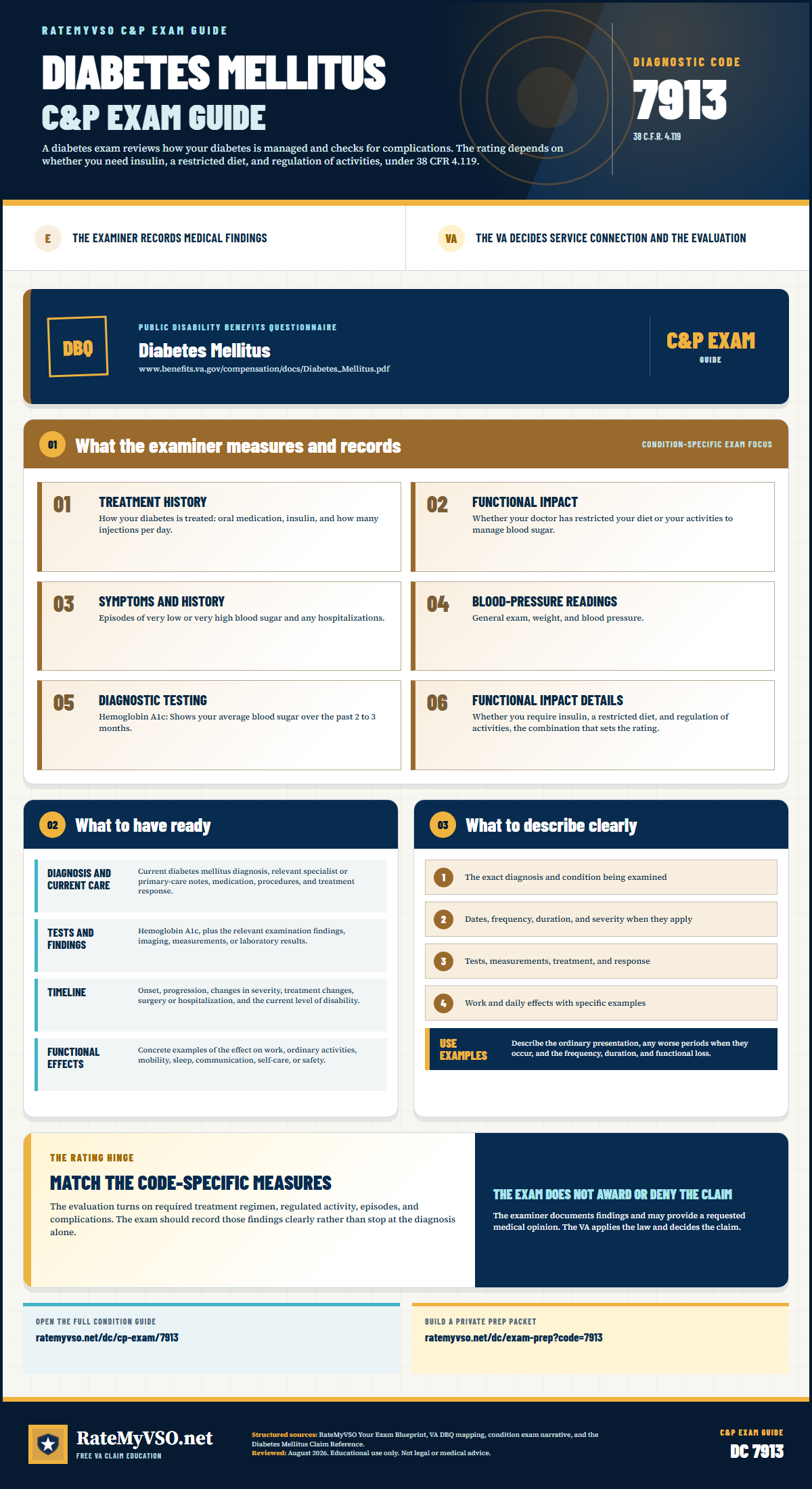
A diabetes exam reviews how your diabetes is managed and checks for complications. The rating depends on whether you need insulin, a restricted diet, and regulation of activities, under 38 CFR 4.119.
DBQ used for this condition
- PPublic formDBQ ENDO Diabetes MellitusOpen the public DBQ
What the examination is likely to focus on
Functional-impact topics to describe
- Whether you require insulin, a restricted diet, and regulation of activities, the combination that sets the rating.
- Complications (eye, kidney, nerve) are often rated separately under their own codes.
- Findings map to the tiers in 38 CFR 4.119, DC 7913.
Which form the examiner uses
For diabetes mellitus (DC 7913), the C&P examiner completes the following Disability Benefits Questionnaire (DBQ):
- DBQ ENDO Diabetes Mellitus (public PDF on VA.gov)
DBQs are Department of Veterans Affairs Form 21-0960 series documents. Public DBQs are hosted on benefits.va.gov. A handful are examiner-only and are not posted publicly.
What to expect at your C&P exam
A diabetes exam reviews how your diabetes is managed and checks for complications. The rating depends on whether you need insulin, a restricted diet, and regulation of activities, under 38 CFR 4.119.
1Initial interview (history)
- How your diabetes is treated: oral medication, insulin, and how many injections per day.
- Whether your doctor has restricted your diet or your activities to manage blood sugar.
- Episodes of very low or very high blood sugar and any hospitalizations.
- Complications: eyes, kidneys, nerves (neuropathy), heart, and skin.
2Physical examination
- General exam, weight, and blood pressure.
- Checking the feet, skin, and sensation for complications.
3Diagnostic tests the examiner may rely on
Used to confirm the diagnosis and track control.
4Functional assessment
- Whether you require insulin, a restricted diet, and regulation of activities, the combination that sets the rating.
- Complications (eye, kidney, nerve) are often rated separately under their own codes.
- Findings map to the tiers in 38 CFR 4.119, DC 7913.
Test explainers open MedlinePlus (NIH National Library of Medicine), or Wikipedia where MedlinePlus has no matching page. This describes what happens and what is measured, not how to influence a result.
What the examiner records (full DBQ form)
The fields below are reproduced from the DBQ form the examiner completes for this diagnostic code. This is the structural map of the form, showing what the examiner is asked to measure, observe, and record. It is a factual reproduction of the public DBQ, not advice on how to answer.
This DBQ evaluates the diagnosis, treatment, management, complications, and functional impact of diabetes mellitus.
How DC 7913 maps to this DBQ: for this diagnostic code specifically, the examiner typically completes sections I-VII of this form. Section III is the condition-specific section for this code.
DIAGNOSIS (Section I)
- Is there an official diagnosis of Diabetes Mellitus Type I?
- ICD code: (Diabetes Mellitus Type I)
- Date of diagnosis: (Diabetes Mellitus Type I)
- Is there an official diagnosis of Diabetes Mellitus Type II?
- ICD code: (Diabetes Mellitus Type II)
- Date of diagnosis: (Diabetes Mellitus Type II)
- Impaired fasting glucose
- Does not meet criteria for diagnosis of diabetes
- Other (Specify below, providing only diagnoses that pertain to Diabetes Mellitus or its complications)
- Diagnosis #1: / ICD code: / Date of diagnosis:
- Diagnosis #2: / ICD code: / Date of diagnosis:
- Diagnosis #3: / ICD code: / Date of diagnosis:
- 1B. If there are additional diagnoses that pertain to Diabetes Mellitus list using above format
MEDICAL HISTORY (Section II)
- 2A. Treatment (Check all that apply): None
- 2A. Treatment (Check all that apply): Managed by restricted diet
- 2A. Treatment (Check all that apply): Prescribed oral hypoglycemic agent(s)
- 2A. Treatment (Check all that apply): Insulin required
- Insulin required: 1 injection per day / More than 1 injection per day
- 2A. Treatment (Check all that apply): Other: / Describe other:
- 2B. Does the Veteran require regulation of activities as part of medical management of Diabetes Mellitus?
- If yes, provide one or more examples of how the Veteran must regulate his or her activities:
- 2C. How frequently does the Veteran visit his or her diabetic care provider for episodes of ketoacidosis? (Less than 2 times per month / 2 times per month / Weekly)
- 2C. How frequently does the Veteran visit his or her diabetic care provider for episodes of hypoglycemia? (Less than 2 times per month / 2 times per month / Weekly)
- 2D. How many episodes of ketoacidosis required hospitalization over the past 12 months? (0 / 1 / 2 / 3 or more)
- 2D. How many episodes of hypoglycemic reactions required hospitalization over the past 12 months? (0 / 1 / 2 / 3 or more)
- 2E. Has the Veteran had progressive unintentional weight loss and loss of strength attributable to Diabetes Mellitus?
- If yes, provide percent of loss of individual's baseline weight: %
COMPLICATIONS OF DIABETES MELLITUS (Section III)
- 3A. Does the Veteran have any of the following recognized complications of Diabetes Mellitus?
- 3A. Diabetic peripheral neuropathy
- 3A. Diabetic nephropathy or renal dysfunction caused by Diabetes Mellitus
- 3A. Diabetic retinopathy
- 3B. Does the Veteran have any of the following conditions that are at least as likely as not the result of Diabetes Mellitus?
- 3B. Erectile dysfunction
- 3B. Female Sexual Arousal Disorder (FSAD)
- 3B. Cardiac condition(s)
- 3B. Hypertension (in the presence of diabetic renal disease)
- 3B. Peripheral vascular disease
- 3B. Stroke
- 3B. Skin conditions
- 3B. Eye conditions other than diabetic retinopathy
- 3B. Other complication(s): / Describe other complication(s):
- 3C. Does the Veteran have any of the following conditions that are at least as likely as not aggravated by Diabetes Mellitus?
- 3C. Erectile Dysfunction
- 3C. Female Sexual Arousal Disorder (FSAD)
- 3C. Cardiac condition(s)
- 3C. Hypertension
- 3C. Renal disease other than diabetic nephropathy or renal dysfunction caused by diabetes mellitus
- 3C. Peripheral vascular disease
- 3C. Eye condition(s) other than diabetic retinopathy
- 3C. Skin conditions
- 3C. Other permanently aggravated condition(s): / Describe other permanently aggravated condition(s):
OTHER PERTINENT PHYSICAL FINDINGS, COMPLICATIONS, CONDITIONS, SIGNS, SYMPTOMS, AND SCARS (Section IV)
- 4A. Does the Veteran have any other pertinent physical findings, complications, conditions, signs or symptoms related to any conditions listed in the diagnosis section above?
- If yes, describe (brief summary):
- 4B. Does the Veteran have any scars or other disfigurement (of the skin) related to any conditions or to the treatment of any conditions listed in the diagnosis section?
DIAGNOSTIC TESTING (Section V)
- 5A. Fasting plasma glucose test (FPG) of ≥126 mg/dl on 2 or more occasions / Dates:
- 5A. A1C of 6.5% or greater on 2 or more occasions / Dates:
- 5A. 2-hr plasma glucose of ≥ 200 mg/dl on glucose tolerance test / Dates:
- 5A. Random plasma glucose of ≥ 200 mg/dl with classic symptoms of hyperglycemia / Dates:
- 5A. Other: / Describe other:
- 5B. Most recent A1C, if available: / Date:
- 5B. Most recent fasting plasma glucose, if available: / Date:
FUNCTIONAL IMPACT (Section VI)
- 6A. Regardless of the Veteran's current employment status, do the conditions listed in the diagnosis section impact his/her ability to perform any type of occupational task (such as standing, walking, lifting, sitting, etc.)?
- If yes, describe the functional impact of each condition, providing one or more examples:
REMARKS (Section VII)
- 7A. Remarks (if any – please identify the section to which the remark pertains when appropriate).
Rating Levels for DC 7913
The following tiers are reproduced from 38 CFR Part 4, the VA Schedule for Rating Disabilities. Toggle between the official VA criteria and a Plain English explanation.
Plain-English summaries are AI-generated to explain the official criteria. The official 38 CFR language is the binding legal standard. When in doubt, ask a VSO.
Evidence cited in published BVA decisions for DC 7913
The counts below are aggregated from published Board of Veterans Appeals decisions for this diagnostic code, among issues the Board granted or denied (remanded issues are not included). Each row reports how often a given evidence type was discussed in the decision text, broken down by outcome. This is a factual aggregate of the public record, not a prediction or recommendation about any specific claim.
- Service treatment records: appeared in 5101 granted decisions (15150 denied; 20251 decided total)
- Buddy / lay statements: appeared in 3720 granted decisions (8732 denied; 12452 decided total)
- Medical literature: appeared in 725 granted decisions (1016 denied; 1741 decided total)
What the Board discussed in granted decisions for DC 7913
The themes below were extracted by clustering 500 grant-factor sentences from published Board of Veterans Appeals decisions for this diagnostic code. Frequencies indicate how often each theme appeared in the sample. This is a factual aggregate of the public record, not advice or strategy for any specific claim.
- 40% Benefit of the doubt doctrine explained or appliedThe Board cited, explained, or applied the benefit-of-the-doubt rule, noting that when evidence is in approximate balance the veteran prevails, or conversely that the doctrine was inapplicable because the preponderance of evidence was against the claim.198 of 500 sample sentences
- 30% Nexus opinion recorded at 'at least as likely as not' thresholdA VA examiner, private physician, or other clinician provided a medical opinion stating that a veteran's condition was at least as likely as not caused by, related to, or aggravated by service or a service-connected disability.148 of 500 sample sentences
- 14% Evidence found in equipoise on a material factThe Board found the competent evidence to be at least in relative equipoise on a specific factual question, such as diagnosis, herbicide exposure, nexus, or rating criteria, warranting resolution in the veteran's favor.72 of 500 sample sentences
- 9% Benefit of the doubt applied to grant service connection or ratingThe Board affirmatively extended the benefit of the doubt to the veteran and granted service connection, a higher disability rating, TDIU, or an earlier effective date based on approximate balance of evidence.45 of 500 sample sentences
- 4% Herbicide or Agent Orange exposure found credible or presumedThe Board found the evidence at least in equipoise or sufficient to establish that the veteran was exposed to herbicide agents, including in Thailand, Vietnam, or other locations, supporting presumptive or direct service connection.22 of 500 sample sentences
- 4% Secondary service connection nexus opinion documentedA medical examiner opined that a condition such as hypertension, peripheral neuropathy, erectile dysfunction, or kidney disease was at least as likely as not caused or permanently aggravated by the veteran's service-connected diabetes mellitus or other primary disability.20 of 500 sample sentences
- 4% Examiner opinion request for 'at least as likely as not' nexusThe Board recorded instructions remanding the case for a VA or private examiner to opine whether a current disability was at least as likely as not related to service or a service-connected condition.18 of 500 sample sentences
- 3% Diabetes mellitus rating criteria and regulation of activities notedThe Board found the evidence sufficient to support a specific disability rating for diabetes mellitus, including findings regarding regulation of activities, insulin use, restricted diet, or complications such as neuropathy or nephropathy.15 of 500 sample sentences
- 3% Preponderance of evidence against claim; benefit of the doubt inapplicableThe Board concluded that the weight of evidence was persuasively against the veteran's claim, the evidence was not in approximate balance, and the benefit-of-the-doubt doctrine therefore did not apply.14 of 500 sample sentences
- 2% Legal standard for service connection determination citedThe Board cited the governing legal standard requiring VA to determine whether evidence supports the claim, is in relative equipoise with the veteran prevailing in either event, or whether a preponderance is against the claim.12 of 500 sample sentences
- 1% Lost or missing records and heightened benefit-of-the-doubt duty notedThe Board recorded that where service records were lost or destroyed through no fault of the veteran, a heightened obligation existed to consider the benefit-of-the-doubt rule, assist in claim development, and explain findings.4 of 500 sample sentences
- 1% Evidence supports specific rating level or factual findingThe Board found the objective medical or lay evidence sufficient to support a particular disability rating level or specific factual finding without primary reliance on the benefit-of-the-doubt doctrine.4 of 500 sample sentences
When the Board found the exam inadequate (DC 7913)
In 5,061 published Board of Veterans' Appeals decisions involving this condition, the Board found a C&P examination or medical opinion inadequate. Where the defect could be read from the decision, it was most often one of the following (counts are a floor from the decisions on file, not a total):
- 1,463 Failed to address a contention or part of the condition
- 1,345 Conclusion given without a supporting rationale
- 579 Veteran's lay statements not considered
- 302 Opinion relied on the absence of records instead of the evidence
- 224 Claims file or records not reviewed
- 153 Examiner said an opinion would require speculation
- 91 Flare-ups or functional loss not addressed
- 69 Exam too old to reflect current severity
- 60 Wrong legal standard or question applied
An inadequate exam is usually sent back for a new one rather than decided against the veteran. This is a factual report of published decisions, not advice about any exam or claim; whether an exam is adequate is decided case by case.
Disclaimer: This page reproduces public Department of Veterans Affairs forms (DBQs) and verbatim text from 38 CFR Part 4 (the VA Schedule for Rating Disabilities). It is informational only and is not legal or medical advice. For guidance on a specific claim, contact a VA-accredited representative.