C&P Exam Prep Guide for Posttraumatic stress disorder (DC 9411)
YOUR EXAM BLUEPRINT
Posttraumatic stress disorder
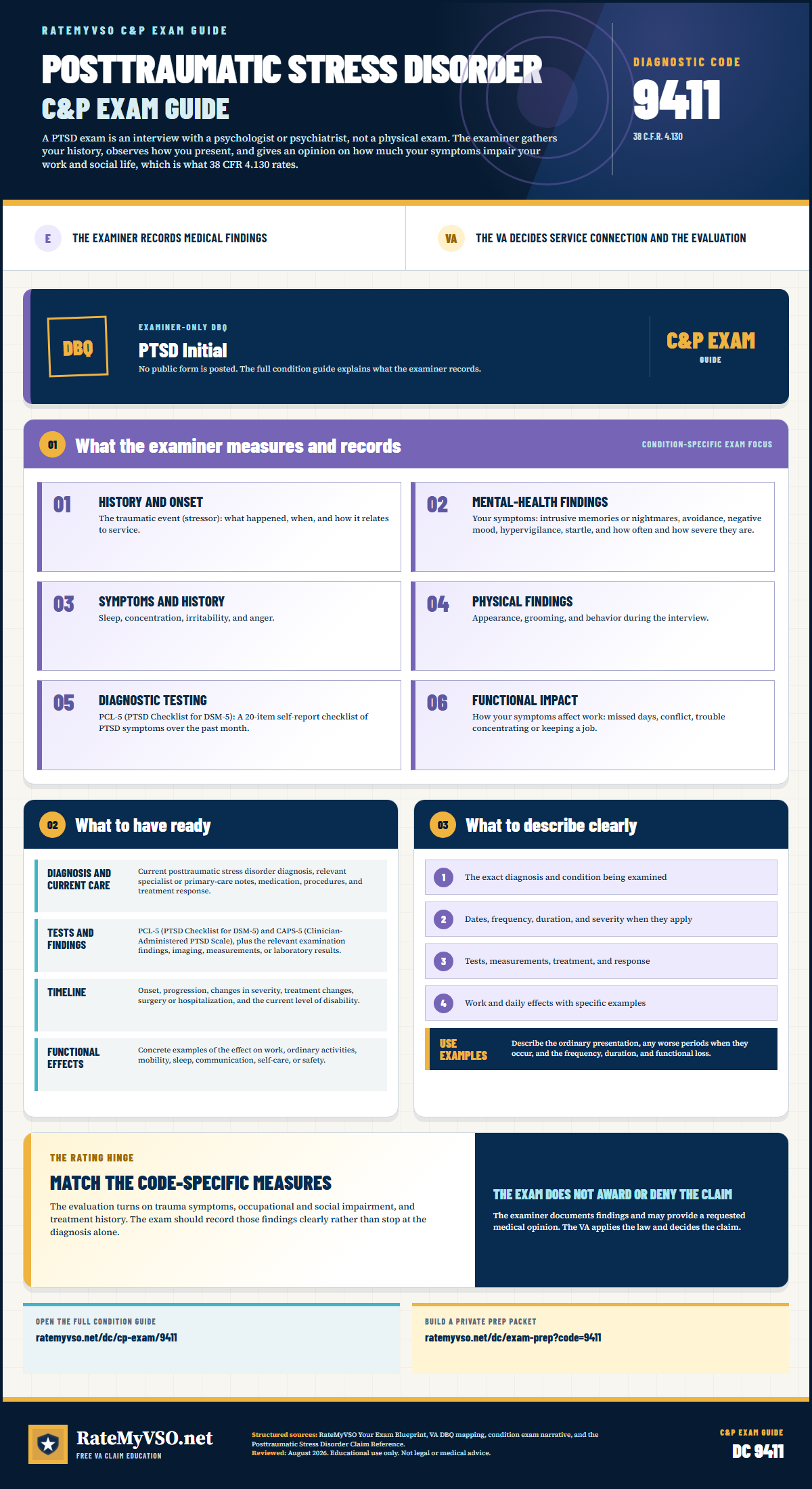
A PTSD exam is an interview with a psychologist or psychiatrist, not a physical exam. The examiner gathers your history, observes how you present, and gives an opinion on how much your symptoms impair your work and social life, which is what 38 CFR 4.130 rates.
DBQ used for this condition
- PPublic formDBQ PSYCH PTSD InitialOpen the public DBQ
What the examination is likely to focus on
Functional-impact topics to describe
- How your symptoms affect work: missed days, conflict, trouble concentrating or keeping a job.
- How they affect relationships, family, and social activities.
- Your ability to handle daily routines and self-care.
- The examiner gives an overall opinion on your level of occupational and social impairment, the scale 38 CFR 4.130 uses to set the rating from 0 to 100 percent.
Which form the examiner uses
For posttraumatic stress disorder (DC 9411), the C&P examiner completes the following Disability Benefits Questionnaire (DBQ):
- DBQ PSYCH PTSD Initial (public PDF on VA.gov. Public PTSD DBQ (Review variant). The Initial PTSD DBQ itself is examiner-only; the Review variant uses the same DSM-5 criteria the examiner applies at the initial exam.)
DBQs are Department of Veterans Affairs Form 21-0960 series documents. Public DBQs are hosted on benefits.va.gov. A handful are examiner-only and are not posted publicly.
What to expect at your C&P exam
A PTSD exam is an interview with a psychologist or psychiatrist, not a physical exam. The examiner gathers your history, observes how you present, and gives an opinion on how much your symptoms impair your work and social life, which is what 38 CFR 4.130 rates.
1Initial interview (history)
- The traumatic event (stressor): what happened, when, and how it relates to service.
- Your symptoms: intrusive memories or nightmares, avoidance, negative mood, hypervigilance, startle, and how often and how severe they are.
- Sleep, concentration, irritability, and anger.
- Treatment history: therapy, medications, hospital or ER visits.
- Alcohol or substance use.
- Relationships, family, and social life.
- Work history and how symptoms affect your job.
- Any thoughts of self-harm or suicide.
2Mental status examination
- Appearance, grooming, and behavior during the interview.
- Speech, mood, and affect (emotional expression).
- Thought process and content, and any delusions or hallucinations.
- Orientation, memory, and concentration.
- Insight, judgment, and impulse control.
- Whether you report thoughts of harming yourself or others.
3Diagnostic tests the examiner may rely on
The examiner may use validated questionnaires or a structured interview. These are scored tools, not pass/fail tests.
4Functional assessment
- How your symptoms affect work: missed days, conflict, trouble concentrating or keeping a job.
- How they affect relationships, family, and social activities.
- Your ability to handle daily routines and self-care.
- The examiner gives an overall opinion on your level of occupational and social impairment, the scale 38 CFR 4.130 uses to set the rating from 0 to 100 percent.
If you are in crisis or thinking about suicide, call the Veterans Crisis Line at 988 and press 1, or text 838255. It is free, confidential, and available 24/7.
Test explainers open MedlinePlus (NIH National Library of Medicine), or Wikipedia where MedlinePlus has no matching page. This describes what happens and what is measured, not how to influence a result.
What the examiner records (full DBQ form)
The fields below are reproduced from the DBQ form the examiner completes for this diagnostic code. This is the structural map of the form, showing what the examiner is asked to measure, observe, and record. It is a factual reproduction of the public DBQ, not advice on how to answer.
This DBQ evaluates the current severity of Post-Traumatic Stress Disorder (PTSD) and other co-occurring mental health diagnoses in a Veteran for VA disability rating purposes, based on DSM-5 criteria.
How DC 9411 maps to this DBQ: for this diagnostic code specifically, the examiner typically completes sections I and VIII of this form. Section I is the condition-specific section for this code. Sections II-VII and IX-XI cover unrelated conditions on this DBQ and are skipped.
DIAGNOSTIC SUMMARY (Section I)
- Does the Veteran now have or has he/she ever been diagnosed with PTSD?
- ICD Code:
2. Current Diagnoses (Section II)
- 2A. Mental Disorders Diagnosis #1:
- ICD Code: (Diagnosis #1)
- Comments, if any: (Diagnosis #1)
- Mental Disorders Diagnosis #2:
- ICD Code: (Diagnosis #2)
- Comments, if any: (Diagnosis #2)
- Mental Disorders Diagnosis #3:
- ICD Code: (Diagnosis #3)
- Comments, if any: (Diagnosis #3)
- Mental Disorders Diagnosis #4:
- ICD Code: (Diagnosis #4)
- Comments, if any: (Diagnosis #4)
- If additional diagnoses, describe using above format:
- 2B. Medical diagnoses relevant to the understanding or management of the mental health disorder (to include TBI):
- ICD Code: (medical diagnosis)
- Comments, if any: (medical diagnosis)
3. Differentiation of Symptoms (Section III)
- 3A. Does the Veteran have more than one mental disorder diagnosed?
- 3B. Is it possible to differentiate what symptom(s) is/are attributable to each diagnosis?
- If "No," provide reason:
- If "Yes," list which symptoms are attributable to each diagnosis and discuss whether there is any clinical association between these diagnoses:
- 3C. Does the evidence of record show a diagnosis of Traumatic Brain Injury (TBI) for the Veteran?
- Comments, if any: (TBI)
- 3D. Is it possible to differentiate what symptom(s) is/are attributable to TBI and any non-TBI mental health diagnosis?
- If "No," provide reason: (TBI differentiation)
- If "Yes," list which symptoms are attributable to TBI and which symptoms are attributable to a non-TBI mental health diagnosis:
4. Occupational and Social Impairment (Section IV)
- 4A. Which of the following best summarizes the Veteran's level of occupational and social impairment with regards to all mental diagnoses? (Check only one)
- No mental disorder diagnosis
- A mental condition has been formally diagnosed, but symptoms are not severe enough either to interfere with occupational and social functioning or to require continuous medication
- Occupational and social impairment due to mild or transient symptoms which decrease work efficiency and ability to perform occupational tasks only during periods of significant stress, or symptoms controlled by medication
- Occupational and social impairment with occasional decrease in work efficiency and intermittent periods of inability to perform occupational tasks, although generally functioning satisfactorily, with normal routine behavior, self-care and conversation
- Occupational and social impairment with reduced reliability and productivity
- Occupational and social impairment with deficiencies in most areas, such as work, school, family relations, judgment, thinking and/or mood
- Total occupational and social impairment
- 4B. For the indicated occupational and social impairment, is it possible to differentiate which impairment is caused by each mental disorder?
- If "No," provide reason: (occupational/social impairment differentiation)
- If "Yes," list which occupational and social impairment is attributable to each diagnosis:
- 4C. If a diagnosis of TBI exists, is it possible to differentiate which occupational and social impairment indicated above is caused by the TBI?
- If "No," provide reason: (TBI occupational/social impairment differentiation)
- If "Yes," list which impairment is attributable to TBI and which is attributable to any non-TBI mental health diagnosis:
2. Recent History (since prior exam) (Section V)
- 2A. Relevant social/marital/family history:
- 2B. Relevant occupational and educational history:
- 2C. Relevant mental health history, to include prescribed medications and family mental health:
- 2D. Relevant legal and behavioral history:
- 2E. Relevant substance abuse history:
- 2F. Other, if any:
3. PTSD Diagnostic Criteria (Section VI)
- Criterion A: Directly experiencing the traumatic event(s)
- Criterion A: Witnessing, in person, the traumatic event(s) as they occurred to others
- Criterion A: Learning that the traumatic event(s) occurred to a close family member or close friend; cases of actual or threatened death must have been violent or accidental; or, experiencing repeated or extreme exposure to aversive details of the traumatic event(s)
- Criterion A: No criterion in this section met.
- Criterion B: Recurrent, involuntary, and intrusive distressing memories of the traumatic event(s).
- Criterion B: Recurrent distressing dreams in which the content and/or affect of the dream are related to the traumatic event(s).
- Criterion B: Dissociative reactions (e.g., flashbacks) in which the individual feels or acts as if the traumatic event(s) were recurring.
- Criterion B: Intense or prolonged psychological distress at exposure to internal or external cues that symbolize or resemble an aspect of the traumatic event(s).
- Criterion B: Marked physiological reactions to internal or external cues that symbolize or resemble an aspect of the traumatic event(s).
- Criterion B: No criterion in this section met.
- Criterion C: Avoidance of or efforts to avoid distressing memories, thoughts, or feelings about or closely associated with the traumatic event(s).
- Criterion C: Avoidance of or efforts to avoid external reminders (people, places, conversations, activities, objects, situations) that arouse distressing memories, thoughts, or feelings about or closely associated with the traumatic event(s).
- Criterion C: No criterion in this section met.
- Criterion D: Inability to remember an important aspect of the traumatic event(s) (typically due to dissociative amnesia and not to other factors such as head injury, alcohol, or drugs).
- Criterion D: Persistent and exaggerated negative beliefs or expectations about oneself, others, or the world.
- Criterion D: Persistent, distorted cognitions about the cause or consequences of the traumatic event(s) that lead to the individual to blame himself/herself or others.
- Criterion D: Persistent negative emotional state (e.g., fear, horror, anger, guilt, or shame).
- Criterion D: Markedly diminished interest or participation in significant activities.
- Criterion D: Feelings of detachment or estrangement from others.
- Criterion D: Persistent inability to experience positive emotions (e.g., inability to experience happiness, satisfaction, or loving feelings.)
- Criterion D: No criterion in this section met.
- Criterion E: Irritable behavior and angry outbursts (with little or no provocation) typically expressed as verbal or physical aggression toward people or objects.
- Criterion E: Reckless or self-destructive behavior.
- Criterion E: Hypervigilance.
- Criterion E: Exaggerated startle response.
- Criterion E: Problems with concentration.
- Criterion E: Sleep disturbance (e.g., difficulty falling or staying asleep or restless sleep).
- Criterion E: No criterion in this section met.
- Criterion F: Duration of the disturbance (Criteria B, C, D, and E) is more than 1 month.
- Criterion F: Veteran does not meet full criteria for PTSD
- Criterion G: The PTSD symptoms described above cause clinically significant distress or impairment in social, occupational, or other important areas of functioning.
- Criterion G: The PTSD symptoms described above do NOT cause clinically significant distress or impairment in social, occupational, or other important areas of functioning.
- Criterion G: Veteran does not meet full criteria for PTSD
- Criterion H: The disturbance is not attributable to the physiological effects of a substance (e.g., medication, alcohol) or another medical condition.
- Criterion H: No criterion in this section met.
4. Symptoms (Section VII)
- Depressed mood
- Anxiety
- Suspiciousness
- Panic attacks that occur weekly or less often
- Panic attacks more than once a week
- Near-continuous panic or depression affecting the ability to function independently, appropriately and effectively
- Chronic sleep impairment
- Mild memory loss, such as forgetting names, directions or recent events
- Impairment of short and long term memory, for example, retention of only highly learned material, while forgetting to complete tasks
- Memory loss for names of close relatives, own occupation, or own name
- Flattened affect
- Circumstantial, circumlocutory or stereotyped speech
- Speech intermittently illogical, obscure, or irrelevant
- Difficulty in understanding complex commands
- Impaired judgment
- Impaired abstract thinking
- Gross impairment in thought processes or communication
- Disturbances of motivation and mood
- Difficulty in establishing and maintaining effective work and social relationships
- Difficulty adapting to stressful circumstances, including work or a work like setting
- Inability to establish and maintain effective relationships
- Suicidal ideation
- Obsessional rituals which interfere with routine activities
- Impaired impulse control, such as unprovoked irritability with periods of violence
- Spatial disorientation
- Persistent delusions or hallucinations
- Grossly inappropriate behavior
- Persistent danger of hurting self or others
- Neglect of personal appearance and hygiene
- Intermittent inability to perform activities of daily living, including maintenance of minimal personal hygiene
- Disorientation to time or place
5. Behavioral Observations (Section VIII)
- Behavioral Observations
6. Other Symptoms (Section IX)
- Does the Veteran have any other symptoms attributable to PTSD (and other mental disorders) that are not listed above?
- If "Yes," describe:
7. Competency (Section X)
- Is the Veteran capable of managing his or her financial affairs?
- If "No," specify each injury or disease resulting in incompetency and provide a rationale to support this finding:
8. Remarks (Section XI)
- Remarks, (including any testing results) if any:
Rating Levels for DC 9411
The following tiers are reproduced from 38 CFR Part 4, the VA Schedule for Rating Disabilities. Toggle between the official VA criteria and a Plain English explanation.
Plain-English summaries are AI-generated to explain the official criteria. The official 38 CFR language is the binding legal standard. When in doubt, ask a VSO.
Evidence cited in published BVA decisions for DC 9411
The counts below are aggregated from published Board of Veterans Appeals decisions for this diagnostic code, among issues the Board granted or denied (remanded issues are not included). Each row reports how often a given evidence type was discussed in the decision text, broken down by outcome. This is a factual aggregate of the public record, not a prediction or recommendation about any specific claim.
- Buddy / lay statements: appeared in 31964 granted decisions (37023 denied; 68987 decided total)
- Service treatment records: appeared in 30712 granted decisions (41921 denied; 72633 decided total)
- Medical literature: appeared in 1475 granted decisions (1651 denied; 3126 decided total)
Standardized screening instruments at the C&P exam
The following standardized screens are administered at the C&P exam for this diagnostic code. Questions and scoring are reproduced verbatim from VA's General Medical Separation Health Assessment DBQ (the same instruments are used at compensation and pension exams).
Primary Care PTSD Screen for DSM-5 (PC-PTSD-5)
Five-item self-report screen administered when PTSD is suspected. Positive screen = 'yes' to any three of five items.
- In the past month, have you had nightmares about the event(s) or thought about the event(s) when you did not want to?
- In the past month, have you tried hard not to think about the event(s) or went out of your way to avoid situations that reminded you of the event(s)?
- In the past month, have you been constantly on guard, watchful, or easily startled?
- In the past month, have you felt numb or detached from people, activities, or your surroundings?
- In the past month, have you felt guilty or unable to stop blaming yourself or others for the event(s) or any problems the event(s) may have caused?
Scoring: Positive screen if 'yes' to any three items.
Patient Health Questionnaire-2 (PHQ-2) Depression Screen
Two-item depression screen. Each item scored 0-3 (0 = Not at all, 1 = Several days, 2 = More than half the days, 3 = Nearly every day). Total range 0-6.
- Over the past two weeks, how often have you been bothered by little interest or pleasure in doing things?
- Over the past two weeks, how often have you been bothered by feeling down, depressed, or hopeless?
Scoring: Positive screen if total score is 3 or greater.
Suicide Risk Secondary Screen (Columbia-style)
Eight-item secondary screen administered when the primary suicide-risk question elicits any response above 'Not at all'. Positive screen = 'yes' to questions 3, 4, 5, or 8.
- Over the past month, have you wished you were dead or wished you could go to sleep and not wake up?
- Have you actually had any thoughts of killing yourself?
- Over the past month, have you been thinking about how you might do this?
- Over the past month, have you had these thoughts and had some intention of acting on them?
- Over the past month, have you started to work out or worked out the details of how to kill yourself?
- If yes to question 5: At any time in the past month, did you intend to carry out this plan?
- In your lifetime, have you ever done anything, started to do anything, or prepared to do anything to end your life?
- If yes to question 7: Was this within the past three months?
Scoring: Positive screen if 'yes' to question 3, 4, 5, or 8. Immediate emergency response procedures apply when there is concern about an immediate threat.
Alcohol Use Disorders Identification Test - Consumption (AUDIT-C)
Three-item alcohol-use screen. Items scored 0-4 each. Mental-health screening commonly includes AUDIT-C because substance use frequently co-occurs with PTSD, depression, and anxiety.
- How often did you have a drink containing alcohol? (Never / Monthly or less / 2-4 times per month / 2-3 times per week / 4 or more times per week)
- How many drinks containing alcohol did you have on a typical day when you were drinking? (1 or 2 / 3 or 4 / 5 or 6 / 7 to 9 / 10 or more)
- How often did you have six or more drinks on one occasion in the past year? (Never / Less than monthly / Monthly / Weekly / Daily, or almost daily)
Scoring: Positive screen if total score is 5 or more (men). Women's threshold uses a four-or-more-drinks variant of question 3.
What the Board discussed in granted decisions for DC 9411
The themes below were extracted by clustering 500 grant-factor sentences from published Board of Veterans Appeals decisions for this diagnostic code. Frequencies indicate how often each theme appeared in the sample. This is a factual aggregate of the public record, not advice or strategy for any specific claim.
- 32% Benefit of the doubt doctrine cited as legal standardThe Board cited the statutory or regulatory benefit-of-the-doubt rule, noting that when positive and negative evidence is in approximate balance on a material issue, the claimant prevails.162 of 500 sample sentences
- 20% Medical nexus opinion cited at least-as-likely-as-not thresholdA VA or private examiner opined that a current disability was at least as likely as not incurred in, caused by, or aggravated by military service or a service-connected condition.102 of 500 sample sentences
- 20% Evidence found in equipoise supporting grant of claimThe Board found the evidence at least in relative equipoise on the disputed issue and resolved that balance in the Veteran's favor to grant service connection, an increased rating, or TDIU.98 of 500 sample sentences
- 10% Preponderance of evidence against claim; benefit of doubt inapplicableThe Board found the weight of evidence persuasively against the claim, determined the evidence was not in approximate balance, and accordingly found the benefit-of-the-doubt doctrine inapplicable.51 of 500 sample sentences
- 8% Specific PTSD rating level found warranted by evidenceThe Board concluded that the Veteran's PTSD symptoms more nearly approximated a particular schedular rating percentage (30, 50, 70, or 100 percent) based on the totality of the evidence.38 of 500 sample sentences
- 4% TDIU entitlement found supported by service-connected disabilitiesThe Board found that the evidence, including medical opinions and employment history, supported a conclusion that the Veteran's service-connected disabilities, particularly PTSD, precluded substantially gainful employment.22 of 500 sample sentences
- 3% Secondary service connection nexus opinion noted in recordA medical examiner or provider opined that a secondary condition was at least as likely as not caused or aggravated by an already service-connected disability such as PTSD.17 of 500 sample sentences
- 2% In-service stressor occurrence found credibly establishedThe Board found that the Veteran's reported in-service stressor was credibly corroborated by service records, lay statements, or other evidence, satisfying the stressor-verification element for PTSD.8 of 500 sample sentences
- 0% Examiner instructions on at-least-as-likely-as-not standard notedRemand or examination requests recorded the at-least-as-likely-as-not evidentiary standard that examining physicians were directed to apply when formulating nexus opinions.2 of 500 sample sentences
When the Board found the exam inadequate (DC 9411)
In 14,202 published Board of Veterans' Appeals decisions involving this condition, the Board found a C&P examination or medical opinion inadequate. Where the defect could be read from the decision, it was most often one of the following (counts are a floor from the decisions on file, not a total):
- 3,222 Failed to address a contention or part of the condition
- 2,769 Conclusion given without a supporting rationale
- 1,704 Veteran's lay statements not considered
- 753 Claims file or records not reviewed
- 669 Opinion relied on the absence of records instead of the evidence
- 424 Flare-ups or functional loss not addressed
- 408 Examiner said an opinion would require speculation
- 216 Exam too old to reflect current severity
- 102 Wrong legal standard or question applied
An inadequate exam is usually sent back for a new one rather than decided against the veteran. This is a factual report of published decisions, not advice about any exam or claim; whether an exam is adequate is decided case by case.
Disclaimer: This page reproduces public Department of Veterans Affairs forms (DBQs) and verbatim text from 38 CFR Part 4 (the VA Schedule for Rating Disabilities). It is informational only and is not legal or medical advice. For guidance on a specific claim, contact a VA-accredited representative.