Inside Your VA Claim
Most veterans watch their claim sit in "Review of Evidence" for months and have no idea what's actually happening. Here's the truth, stage by stage, who's looking at your file, what they're checking for, what causes the delays you can't see, and what you can do to help your claim move.

Who you talk to vs who decides your rating
The most expensive mistake veterans make is fighting the wrong person. Four different people touch your claim, and only one of them sets your rating.
Your advocate at a VFW, American Legion, or county veterans office. Helps you file, gathers evidence, and argues your case. Has zero authority over the percentage. A low rating is not something your VSO decided.
A National Call Center agent. Reads your file to answer status questions and update your contact info. They never worked your decision and cannot change a rating. Yelling at them changes nothing but your blood pressure.
The Veterans Service Representative builds your file: orders records and exams, and sends the "we need more evidence" letters. They set the table for the decision but do not assign any percentage.
The Rating Veterans Service Representative opens your claims file, applies the rating schedule (38 CFR Part 4), assigns each percentage, and writes the decision. The only person who sets your rating, and they work only from what is in your file the day it reaches their desk.
Intake & Date Stamping
The moment VA receives your claim packet, online, by mail, or through a VSO, it's logged into the intake system. This is where the effective date of any future award gets locked in. An administrative team checks that basic information (your name, Social Security number, service dates, discharge status) matches what's already on file, and they open or update your electronic claims folder.
Your claim gets a date stamp, your power of attorney (if you have one) is verified, and your digital file gets flagged "open" in the VA's tracking system.
If you want to preserve an earlier effective date, file an Intent to File first. That gives you up to a year to gather evidence while locking in today's date.
Development Begins (VSR)
Your claim is assigned to a VSR (Veterans Service Representative). Their job is to build the evidence file, request records from your service treatment files, order any needed examinations, send required notices, and track what's still missing. They don't decide your rating. They prepare the file for the person who does.
Reads every condition you claimed, reviews your service treatment records page by page for in-service events or complaints, orders medical examinations (C&P exams) when needed, and sends you a formal notice describing what evidence is needed.
Respond quickly to any VA letters requesting information. Missing a 30-day response window can delay your claim by months while the VSR waits and re-sends.
When the VSR orders an exam, you'll hear from a contracted examiner or a VA clinic. Show up to every exam. Missing one is the fastest way to get denied, the VA is legally allowed to rate you on the evidence already in file, which is rarely enough on its own.
Evidence Gathering
This is the longest and most opaque stage. The VA is waiting on: your service treatment records (STRs) from the National Personnel Records Center, civilian medical records you've authorized the VA to request, C&P exam reports from contracted providers, and any buddy statements or lay evidence you're submitting. Each of these has its own timeline.
- STRs: Usually already scanned. A few days to a few weeks. If records were destroyed in the 1973 NPRC fire, this can take longer and the VA has a heightened duty to assist you.
- Civilian medical records: VA sends requests. Providers take anywhere from 2 weeks to 2 months to respond.
- C&P exam: Typically scheduled 3–6 weeks out; the examiner's report lands in your file a week after the exam.
- DBQs you submit yourself: Instant, they arrive in your file within days of upload.
If you want to pull your own copies in parallel, see the Records Request Guide for the right form and office for each record type.
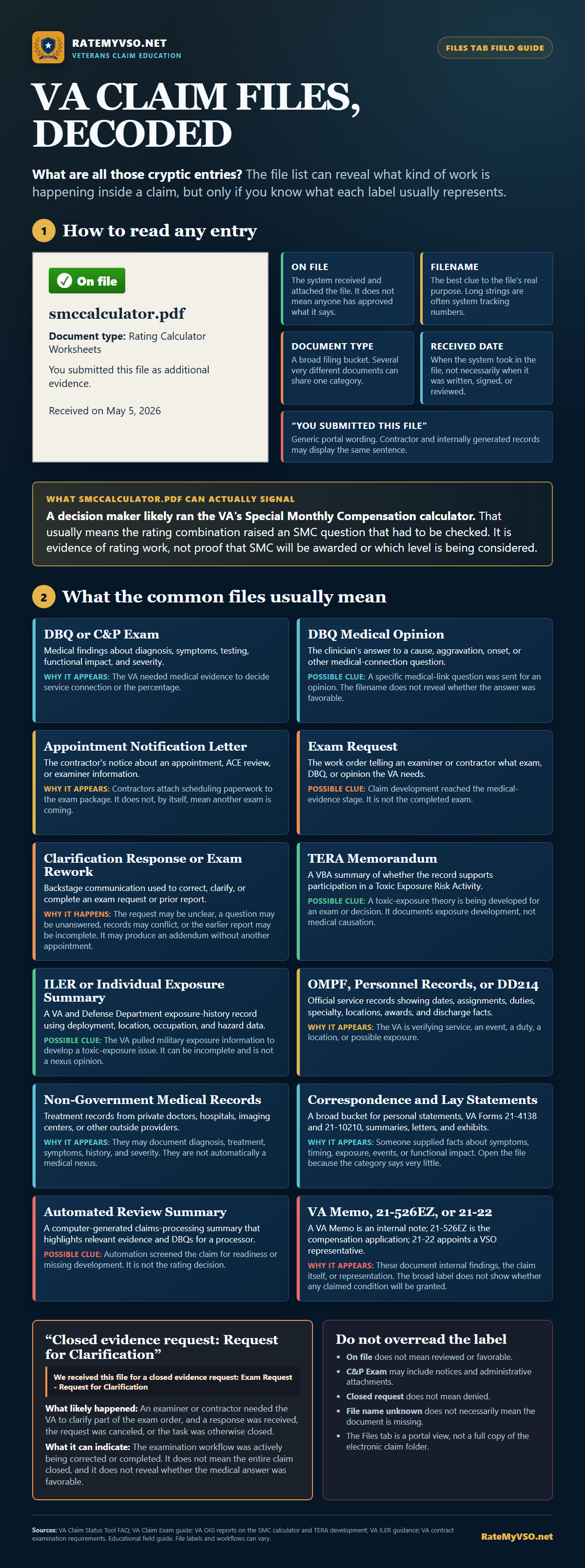
What Those Files in Your VA Claim Mean
Seeing DBQs, clarification requests, TERA records, or smccalculator.pdf in your Files tab? This guide explains what each entry usually represents and what it may reveal about the work happening inside your claim.
Ready for Decision
The VSR marks your claim "Ready for Decision" once at least one of your conditions has enough evidence to decide. This does not mean every condition is fully developed, the VA's policy encourages moving claims forward if any issue is ready, with other issues potentially deferred for more work.
From here, your claim goes back into a national queue and waits to be picked up by a rater. How long that wait is depends on your regional office's workload, whether you have a priority flag, and how complex your claim looks.
Rating Decision (RVSR)
A Rating Veterans Service Representative (RVSR), usually called "the rater", takes your claim off the queue and actually decides it. An experienced rater completes 3–4 claims in an 8-hour day. Simple claims take about 30 minutes, complex ones can take 15+ hours spread across days. The rater verifies that every development task was completed correctly, re-reads your evidence file, and enters decisions for each condition you claimed.
🎯 The 3 things the rater is actually checking
For every claimed condition, the rater is looking for three specific pieces of evidence. If all three are clearly documented, you typically win. If even one is missing or ambiguous, you typically lose, this is where most denials come from.
The rater also applies legal rules you'd expect, the bilateral factor for paired limbs, pyramiding rules so the same symptom isn't rated twice, staged evaluations if severity changed during the claim period, and special monthly compensation if you qualify. For most conditions, the rating calculator built into the system produces a recommended evaluation the rater can't override. Mental health is different, the rater picks from three adjacent evaluation levels based on how they weigh the evidence.
Quality Review
Once the rater submits their draft decision, a Post-VSR and a Senior VSR review it for obvious errors, missing notices, math mistakes, conditions left undecided, required benefits that weren't granted (like automatic dependents at 30%+). They're looking for procedural flaws, not re-rating the medical evidence.
Authorization & Notification
Once the decision clears quality review, it's authorized in the VA's system. If you were granted benefits, payments are scheduled. If your combined rating hit 30% or higher, a dedicated team processes any dependents you have on file so they're added to your payment automatically. A decision letter is generated and mailed to you.
Why claims slow down (and what you can do)
Most delays are procedural, not personal. Some are avoidable. Others are built into the system.
- Deferrals. A rater sends the claim back for more development, maybe an exam the VSR missed, maybe a records request that got overlooked. Each deferral can add weeks or months. If your claim has been deferred multiple times, ask your VSO what's missing.
- Missed notice response. If the VA sent you a letter asking for clarification and you didn't respond within 30 days, your claim is on hold. Check your VA.gov inbox regularly.
- C&P no-show or incomplete exam. Missing an exam often triggers denial; an exam where you downplayed symptoms ("I'm doing okay, ma'am") often leads to an under-rated condition. Answer honestly about your worst days, not your average.
- Civilian records delays. Private providers are slow. If you can pull records yourself and upload them directly to VA.gov, do it.
- Conditions with thin evidence. A single doctor's note saying "knee pain" isn't enough. The rater needs a diagnosis, an in-service connection, and a medical opinion linking them, which is almost always the gap that kills claims.
- Regional office workload. Some regional offices run 30–60 days behind others. This is entirely outside your control.
What actually helps your claim move
- Make the three elements obvious. Submit a current diagnosis, evidence of the in-service event, and an explicit nexus opinion, ideally in that order, with each clearly labeled. Don't make the rater hunt.
- Use DBQs. Disability Benefits Questionnaires are the format raters know best. A private provider completing the DBQ for your condition gives the rater exactly what they need to decide. See our DBQ library.
- File an Intent to File the moment you're considering a claim. It locks in today's date for up to a year, any eventual award backdates to the ITF.
- Write a clear personal statement. Describe in plain language when symptoms started, how often they hit, and how they affect work, sleep, and daily life. Two or three paragraphs beats a 50-page medical dump every time.
- Get buddy statements. A spouse, coworker, or battle buddy describing what they actually see, pain behavior, mood changes, mobility limits, is strong lay evidence.
- Go to every C&P exam and answer honestly about your worst days. Examiners ask "how are you today?" and rate you based on how you describe yourself. Describe your flares, not your best hours.
- Read your denial letter carefully. It tells you exactly which element is missing. The right response is targeted evidence to fill that gap, not a brand-new claim and definitely not 400 pages of unrelated records.
Where to go next
Educational reference based on publicly documented VA adjudication procedures, 38 CFR, and the VA M21-1 Adjudication Manual. Individual claims can vary, this walkthrough describes the typical path. For representation on your specific claim, find a VSO representative.