VA's Proposed Mental Health Rating Changes
VA proposed rebuilding how it rates PTSD, depression, anxiety, and other mental disorders, moving from a symptom checklist to five domains of functioning. Here is what would change, who could gain or lose, and where the proposal stands today.
Where This Stands Today
In February 2022, VA published a proposed rule to overhaul the General Rating Formula for Mental Disorders. A proposed rule is a draft. It goes through a public comment period, and the agency then decides whether to issue a final rule, change it first, or withdraw it.
The comment period for this proposal closed on April 18, 2022. VA's regulatory agenda later projected a final rule, but no final rule has published, and the live regulation still contains the current symptom-based formula. Until a final rule is signed and given an effective date, nothing on this page governs any claim. (see the Federal Register notice, 87 FR 8498, RIN 2900-AQ82)
Why VA Proposed a Change
The current rating levels for mental disorders date to 1996. VA argued they are out of step with modern psychiatry and with how the fifth edition of the Diagnostic and Statistical Manual of Mental Disorders (DSM-5) describes mental illness.
The proposal draws on several outside recommendations:
- The Institute of Medicine (2007): recommended VA judge mental-disorder disability by a veteran's ability to function at work, not by counting symptoms alone.
- The DSM-5 (2013): replaced the old symptom-checklist and Global Assessment of Functioning score with a functional, dimensional approach that weighs how severe and how frequent difficulties are.
- Earnings-loss studies (2007-2008): two federal studies found veterans with mental disorders were, on average, undercompensated relative to their actual loss of earning capacity, and recommended VA update the criteria.
VA said its goal was a formula that measures real-world occupational and social functioning and creates a shared language between the clinicians who examine veterans and the adjudicators who rate them.
The Core Change: Five Domains of Functioning
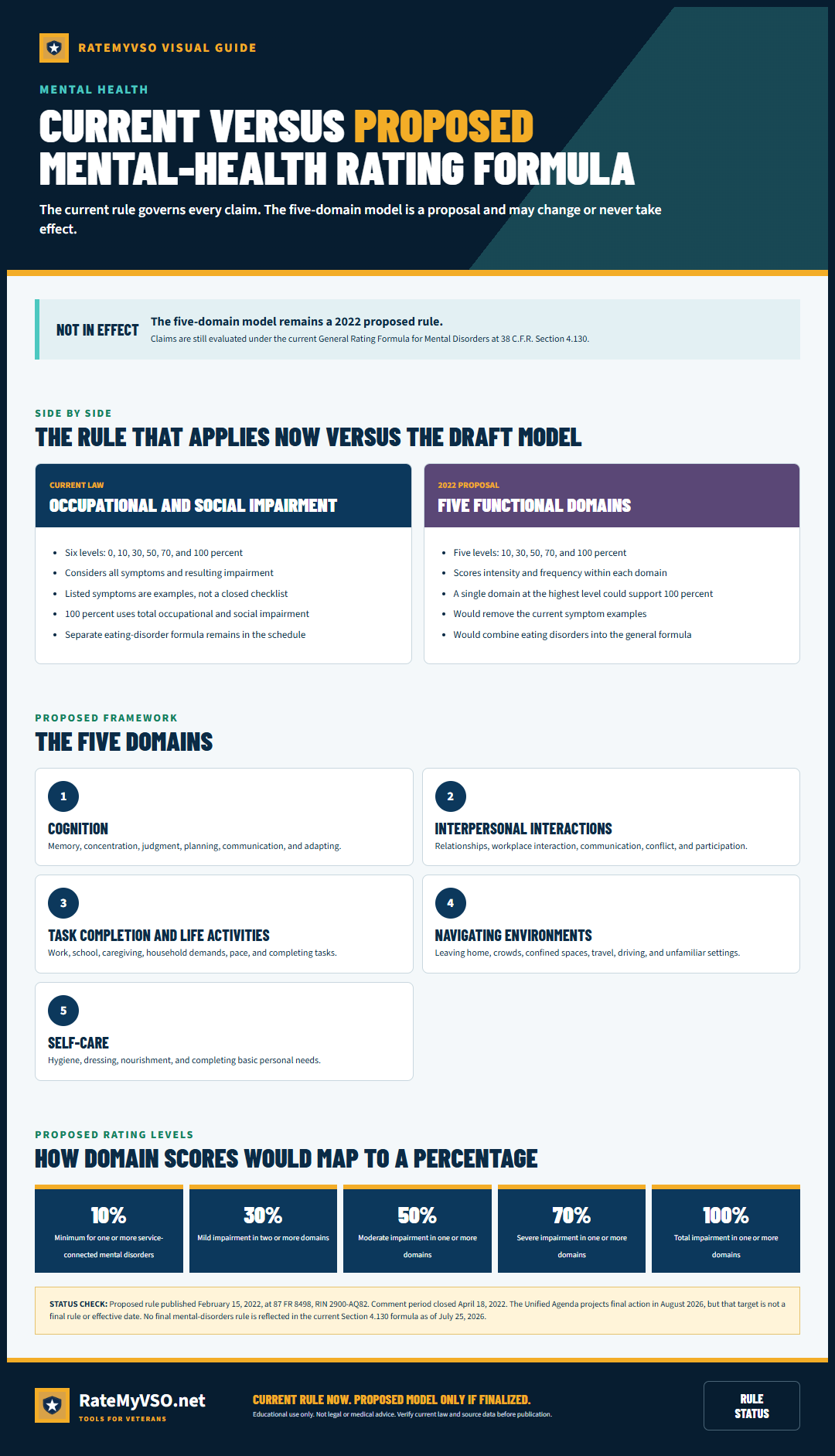
Today, VA rates a mental disorder by matching a veteran's symptoms to a level on a checklist ("total occupational and social impairment," "deficiencies in most areas," and so on). The proposal would drop that checklist and instead score functioning across five domains, an approach adapted from the World Health Organization's disability assessment (WHODAS 2.0).
1. Cognition
Understanding and communicating: memory, concentration, attention, processing speed, planning, organizing, problem solving, judgment, and decision making.
2. Interpersonal interactions and relationships
Getting along with people and participating in society, both informal (social) and formal (coworkers, supervisors).
3. Task completion and life activities
Managing task demands: vocational, educational, domestic, social, or caregiving activities.
4. Navigating environments
The ability to get around: leaving home, crowded or confined spaces, new environments, driving, or using public transportation.
5. Self-care
Caring for oneself: hygiene, dressing appropriately, and taking nourishment.
A diagnosis would still have to be established under the DSM-5, exactly as it is now. The change is in how the level of disability is measured after a diagnosis is set. (see 38 CFR § 4.125)
How Each Domain Would Be Scored
Each of the five domains would get a score from 0 to 4, built from two things: how much difficulty a veteran has (intensity) and how often it happens (frequency).
Intensity
None, mild, moderate, severe, or total, based on how much the difficulty interferes with tasks, activities, and relationships.
Frequency
Whether the difficulty occurs less than 25% of the time over the past month, or 25% of the time or more. Problems that happen 25% or more of the time count as more disabling.
The 0 to 4 scale
| Score | What it means |
|---|---|
| 0 | No difficulties. |
| 1 | Mild difficulty at any frequency, or moderate difficulty less than 25% of the time. |
| 2 | Moderate difficulty 25% or more of the time, or severe difficulty less than 25% of the time. |
| 3 | Severe difficulty 25% or more of the time, or total difficulty less than 25% of the time. |
| 4 | Total difficulty 25% or more of the time. |
Turning Domain Scores Into a Percentage
Once every domain has a 0-to-4 score, the overall rating would be set by the highest scores and how many domains are affected. There would be no 0% rating: 10% would be the floor for any mental disorder.
| Rating | Proposed criteria |
|---|---|
| 100% | Score of 4 in one or more domains, or score of 3 in two or more domains. |
| 70% | Score of 3 in one domain, or score of 2 in two or more domains. |
| 50% | Score of 2 in one domain. |
| 30% | Score of 1 in two or more domains. |
| 10% | Minimum rating for any diagnosed mental disorder. |
A single domain scored at 4 would reach 100%, and a single domain scored at 3 would reach 70%. VA noted this is a lower bar than the current formula, which requires "total occupational and social impairment" for 100% and deficiencies in "most areas" for 70%.
Current Formula vs Proposed Formula
Current (in effect today)
- Rated against a list of example symptoms.
- Levels: 0, 10, 30, 50, 70, 100%.
- 100% requires total occupational and social impairment.
- Named symptoms appear in the criteria (for example, suicidal ideation at the 70% level).
- Eating disorders use a separate weight-loss formula.
- A 0% (noncompensable) rating is possible.
Proposed (not in effect)
- Rated on functioning across five domains.
- Levels: 10, 30, 50, 70, 100%.
- 100% reachable with total impairment in one domain.
- Scored on intensity and frequency, not a named-symptom list.
- Eating disorders folded into the same formula.
- 10% minimum, no 0% rating.
Who Could Gain, and Who Could Lose
VA ran a proof-of-concept study on 100 veterans with service-connected mental disorders, rating each under both formulas. Under the proposed formula, fewer veterans landed at or below 50%, more landed above 50%, and more reached 100%. The two formulas produced similar results at 70%. On its face, the proposal would raise the average rating.
Veterans advocates and service organizations, however, flagged parts of the proposal that could cut the other way for some veterans:
- Counting medication. The proposal would rate a veteran's condition after the helpful effects of medication, which could lower the rating for someone whose symptoms are controlled by medicine.
- One rating for multiple conditions. A veteran with several diagnosed mental disorders would receive a single combined evaluation, not separate ones.
- No named symptoms. Removing specific symptoms from the criteria (such as the current reference to suicidal ideation at 70%) shifts more weight onto how an examiner scores functioning.
Because these effects pull in different directions, the proposal's real-world outcome would depend heavily on the final rule text, examiner training, and how the domains are scored in practice. The comment record reflects that debate.
The Three Proposed Notes
The proposal would add three notes to the formula:
- Note 1, one evaluation for coexisting disorders. Comorbid mental disorders would receive a single rating, consistent with the rule against pyramiding. (see 38 CFR § 4.14)
- Note 2, medication effects. VA would rate the disability that remains after the helpful effects of prescribed medication. This would reverse the effect of Jones v. Shinseki (2012), in which the court held VA should not count medication effects unless the criteria clearly say to.
- Note 3, measuring frequency. Frequency would be judged by the percentage of time, in a given month, that impairment occurs.
Eating Disorders Would Be Folded In
Today, eating disorders (anorexia at DC 9520, bulimia at DC 9521) use a separate formula based on weight loss, incapacitating episodes, and hospitalization. The proposal would delete that separate formula and rate eating disorders on the same five domains as every other mental disorder, on the reasoning that the DSM-5 no longer treats weight as the central measure for most eating disorders.
Would Existing Ratings Change?
The proposal did not spell out whether veterans already rated under the current formula would be re-evaluated. As a general matter, new rating criteria apply to claims decided after the effective date, and VA has long-standing protections that guard against a new rating schedule automatically lowering an existing rating without an examination showing actual improvement. (see 38 CFR § 3.951 and § 3.344)
None of this is settled, because it is a proposal. The final rule, if there is one, would state its own effective date and transition rules. Treat any claim that "the new formula will raise (or lower) my current rating" as speculation until a final rule publishes.
How to Follow the Rulemaking
The proposal moves through the federal rulemaking process, and the record is public. To check its status yourself:
- The Federal Register notice (the full proposed rule text).
- The Regulations.gov docket (public comments and any updates).
- The live regulation at 38 CFR § 4.130 (if the text there changes, the rule has taken effect).
Frequently Asked Questions
Is the new formula in effect?
Does this apply to my claim right now?
Would the change raise or lower my rating?
Would VA re-rate veterans already receiving benefits?
What is the biggest single change?
When would it take effect?
Related Tools and Guides
Sources
- Schedule for Rating Disabilities: Mental Disorders, proposed rule, 87 FR 8498 (Feb. 15, 2022), RIN 2900-AQ82
- Regulations.gov docket VA-2022-VBA-0010, public comments and rulemaking record
- 38 CFR § 4.130, current Schedule of Ratings, Mental Disorders
- 38 CFR § 4.126, Evaluation of disability from mental disorders
- 38 CFR § 4.14, Avoidance of pyramiding
- Jones v. Shinseki, 26 Vet. App. 56 (2012), on the effects of medication in rating
- Institute of Medicine, "A 21st Century System for Evaluating Veterans for Disability Benefits" (2007)
- DSM-5, American Psychiatric Association (2013)