VA Mental Health Rating Formula
How the General Rating Formula for Mental Disorders at 38 CFR § 4.130 works: the six rating levels, the whole-symptom rule, the pyramiding rule, and the diagnostic codes that use it. The foundational reference behind every VA mental-health rating, in plain language.

Section 1: Overview
Nearly all VA mental health disability ratings use a single shared framework called the General Rating Formula for Mental Disorders, codified at 38 CFR § 4.130. Rather than disease-specific criteria, this formula evaluates the degree to which any mental health condition impairs occupational and social functioning.
Conditions rated under this formula include PTSD (DC 9411), major depressive disorder (DC 9434), generalized anxiety disorder (DC 9400), bipolar disorder (DC 9432), schizophrenia and related psychotic disorders (DC 9201, 9210, 9211), obsessive-compulsive disorder (DC 9404), panic disorder (DC 9412), and most other psychiatric diagnoses recognized in the DSM-5. The diagnostic codes for these conditions appear at 38 CFR § 4.130 and span DC 9201 through DC 9440.
Two conditions use a separate formula: eating disorders (DC 9520 and DC 9521) use the General Rating Formula for Eating Disorders, and they are not covered here.
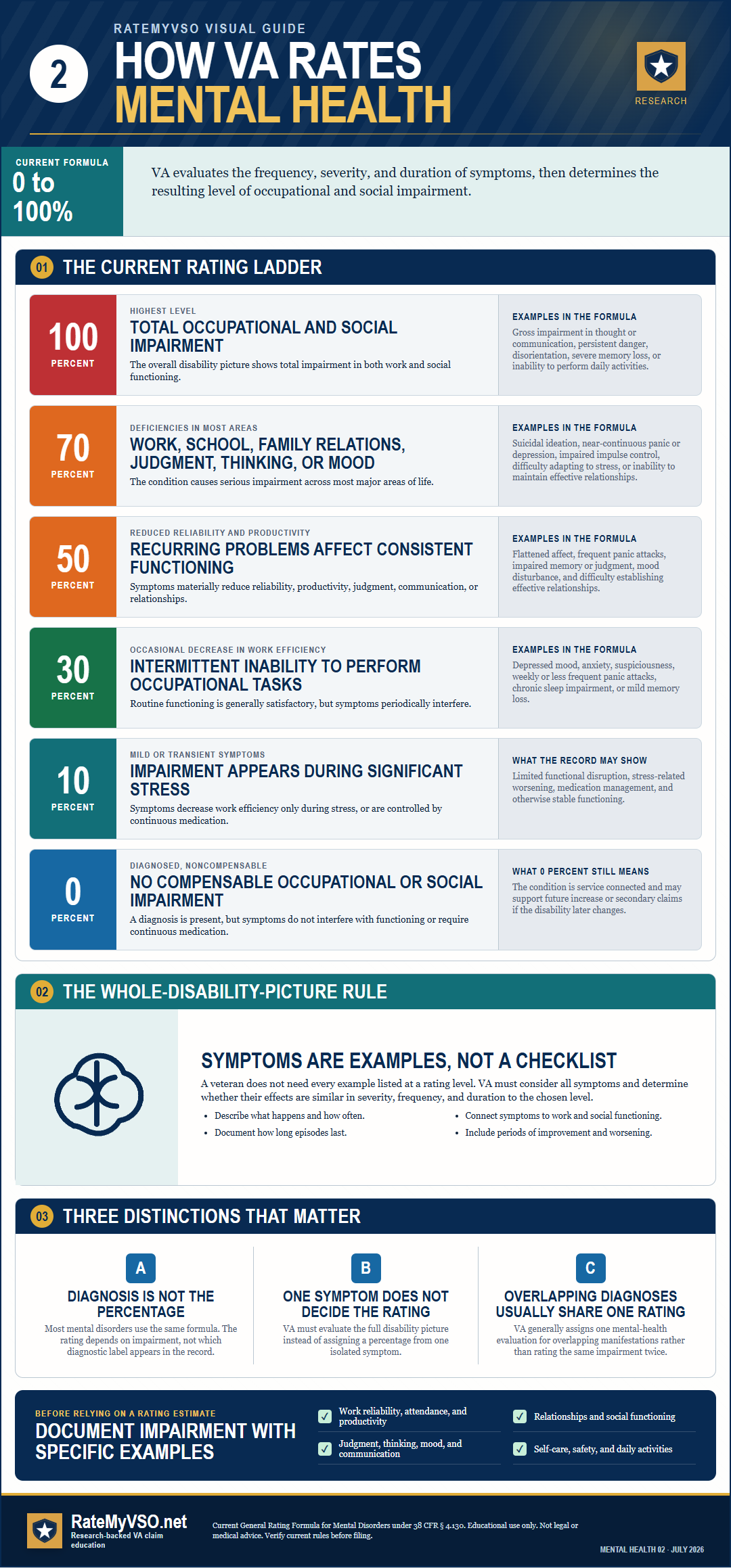 One-page guide: How VA Rates Mental Health
Current VA mental-health rating guide showing the 0, 10, 30, 50, 70, and 100 percent impairment levels. Opens the full-size chart, free to save or print.
One-page guide: How VA Rates Mental Health
Current VA mental-health rating guide showing the 0, 10, 30, 50, 70, and 100 percent impairment levels. Opens the full-size chart, free to save or print.
Section 2: The Core Principle, Occupational and Social Impairment
The formula rates the combined impact on two life domains.
Occupational functioning refers to the ability to maintain employment, perform job duties reliably, manage workplace relationships, and adapt to job-related stress. Functional limitations on work are assessed through attendance, reliability, and the ability to handle the cognitive and interpersonal demands of a job.
Social functioning refers to the ability to maintain personal relationships, participate in community activities, manage household responsibilities, and engage in normal daily interaction.
Rating agencies are directed to assess all symptoms and all relevant evidence of occupational and social impairment. The presence or absence of any single symptom is not determinative. The rating reflects the overall picture across both domains. (see 38 CFR § 4.126)
Section 3: The Six Rating Levels
The General Rating Formula produces six ratings: 0%, 10%, 30%, 50%, 70%, and 100%. These are the only available rating values. Mental health conditions do not produce ratings of 20%, 40%, 60%, 80%, or 90%.
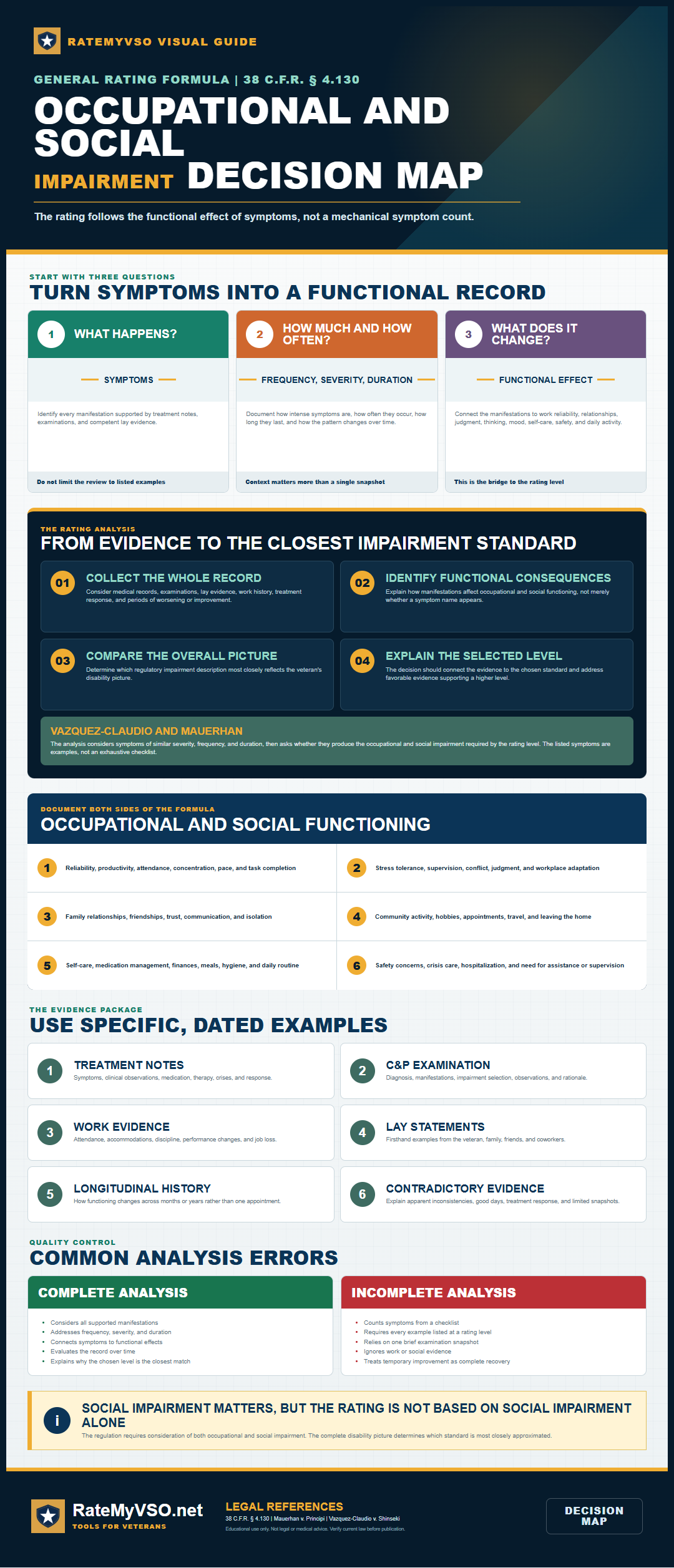
Section 4: The Whole-Symptom Evaluation Requirement
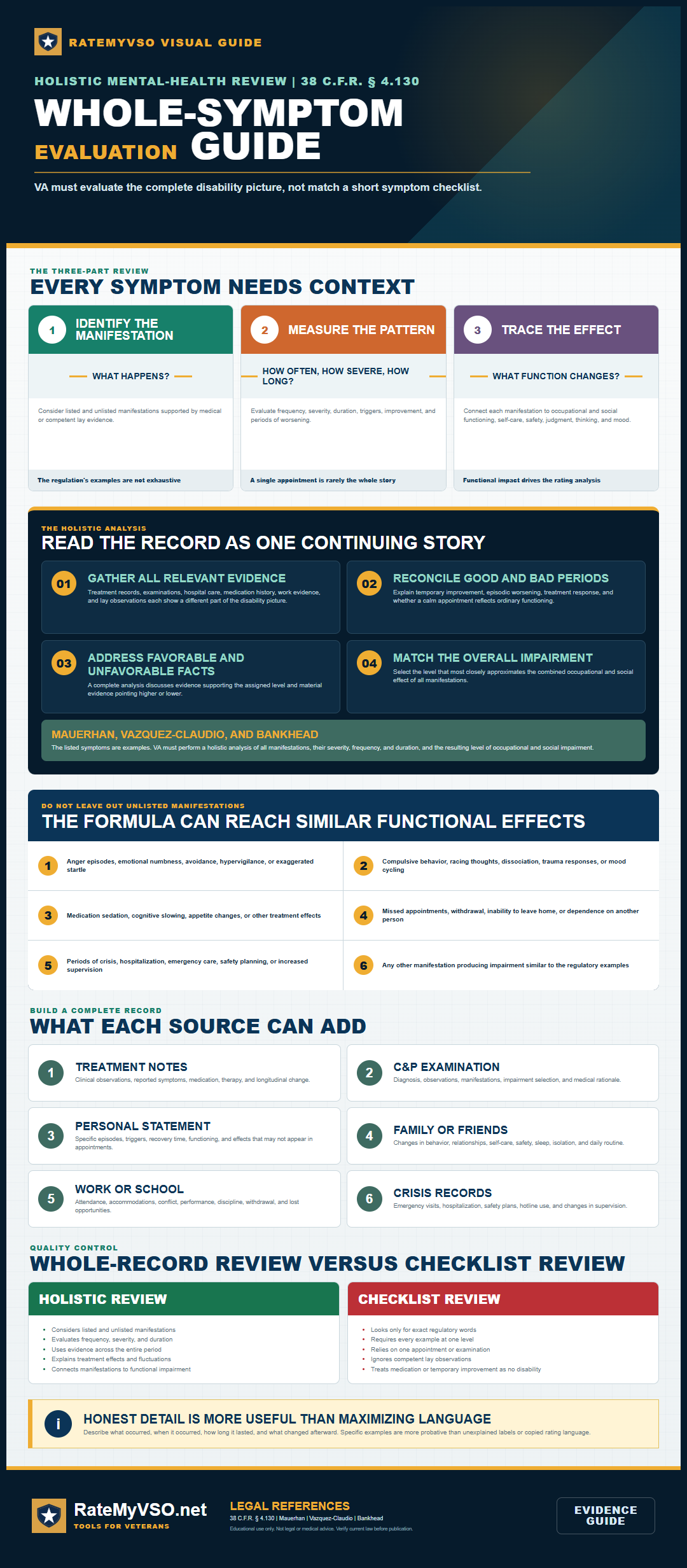
Rating agencies evaluate mental disorders on the basis of the degree of social and occupational impairment shown by all reported symptoms, not only the specific enumerated symptoms listed at each rating level. A symptom not explicitly named in the criteria can still support a higher rating if it contributes to overall impairment at that level. (see 38 CFR § 4.126(a))
The symptom lists in 38 CFR § 4.130 are examples, not an exhaustive checklist (Mauerhan v. Principi, 2002). The question is whether the overall picture of occupational and social impairment corresponds to a rating level, not whether a specific listed symptom is present.
Section 5: The Diagnosis Requirement, DSM-5
To receive a VA mental health rating, the condition must be diagnosed by a qualified mental health professional using the criteria in the DSM-5. VA examiners must use DSM-5 criteria, and private treatment records using DSM-5 diagnoses are acceptable supporting evidence. (see 38 CFR § 4.125)
When a mental disorder diagnosis does not conform to DSM-5 criteria, the examiner is directed to return the examination for clarification (see 38 CFR § 4.125(a)). Lay reports of symptoms alone do not produce a compensable rating without an underlying clinical diagnosis.
Section 6: The Automatic 50% Provision
When VA grants service connection for a mental disorder related to a traumatic event, it assigns a minimum 50% rating and schedules a mandatory examination within the six-month period following the veteran's release from active service (see 38 CFR § 4.129). After the examination, the rating is adjusted based on current symptom severity.
This provision functions as a floor during the initial post-trauma evaluation period. It does not apply to all mental health claims. It applies specifically when the mental disorder is linked to a traumatic event recognized under the regulatory definition. The six-month exam allows for re-evaluation when the acute reaction stabilizes or worsens.
Section 7: The Pyramiding Rule and Single-Rating Practice
VA may not evaluate the same disability, or the same manifestation of disability, under different diagnostic codes (see 38 CFR § 4.14). For mental health conditions, this generally means that when a veteran has multiple mental health diagnoses (for example, PTSD and major depressive disorder), VA assigns one combined mental health rating using the formula.
Overlapping symptoms (depression appearing in both a PTSD diagnosis and a separate depressive disorder diagnosis) produce only one rating because assigning separate ratings for the same symptoms would constitute improper pyramiding. The rating is based on the combined severity of all mental health symptoms together.
When two mental health conditions produce distinct, non-overlapping symptom clusters, separate ratings are theoretically available, but this determination requires careful clinical review and is relatively uncommon in practice.
The pyramiding rule does not prevent a veteran from holding a mental health rating and separate ratings for physical conditions that are secondary to the mental health diagnosis (such as sleep apnea, hypertension, or gastrointestinal disorders secondary to PTSD). See our Pyramiding Guide for more.
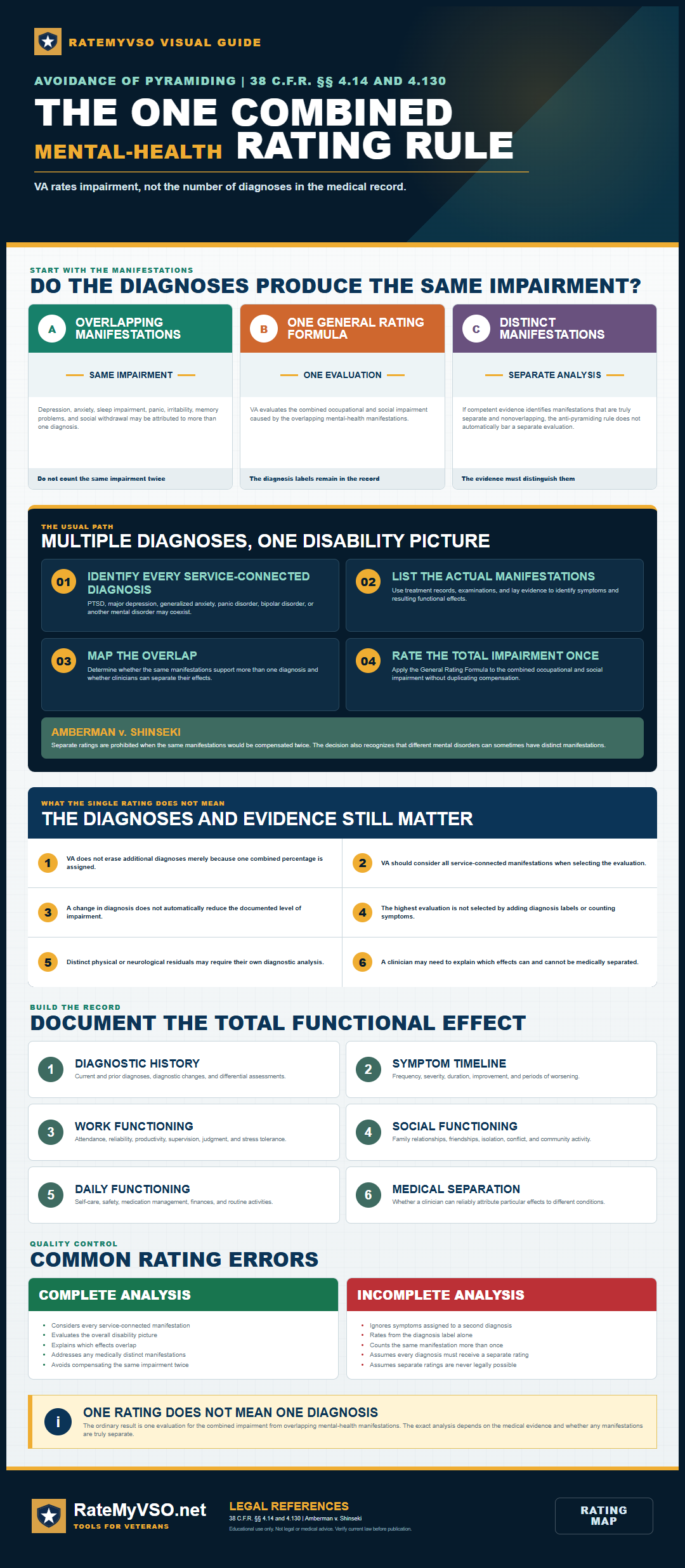 One-page guide: The One Combined Mental-Health Rating Rule
Guide explaining why overlapping service-connected mental-health symptoms usually receive one combined evaluation. Opens the full-size chart, free to save or print.
One-page guide: The One Combined Mental-Health Rating Rule
Guide explaining why overlapping service-connected mental-health symptoms usually receive one combined evaluation. Opens the full-size chart, free to save or print.
Section 8: How the C&P Examiner Applies the Formula
C&P mental health examinations use a Disability Benefits Questionnaire (DBQ) for mental disorders that prompts the examiner to address:
- Current symptoms and their frequency, severity, and duration
- Impact on employment (reliability, productivity, ability to handle job demands)
- Impact on social relationships and daily activities
- History of hospitalizations, crisis episodes, and treatment response
- Global Assessment of Functioning (GAF) score, now supplemental under DSM-5, and functional assessment using the WHODAS 2.0 framework
The examiner records the overall level of occupational and social impairment and matches it to one of the six rating levels in the formula. The examiner's opinion carries significant weight in the rating decision but is not the only evidence considered. Treatment records, lay statements, and prior examination findings are also part of the record. See our DBQ Library and Buddy & Lay Statements Guide.
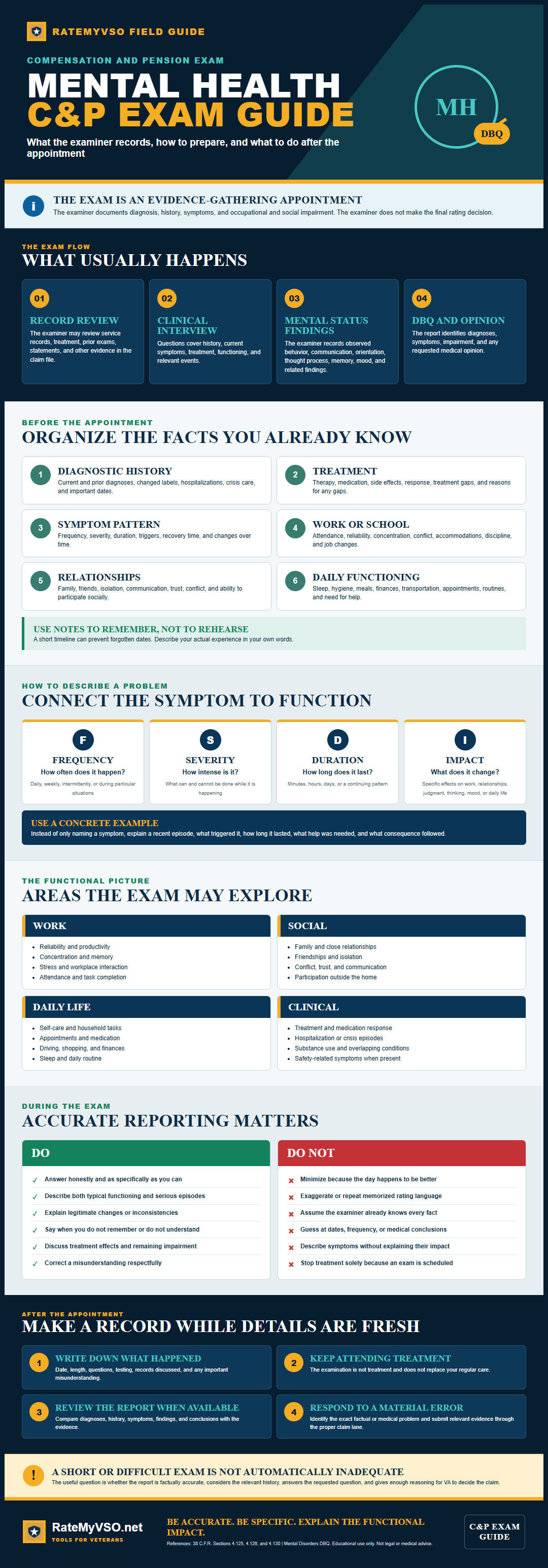 One-page guide: Mental Health C&P Exam Guide
Mental-health C&P exam guide covering preparation, exam flow, functional domains, accurate reporting, and post-exam review. Opens the full-size chart, free to save or print.
One-page guide: Mental Health C&P Exam Guide
Mental-health C&P exam guide covering preparation, exam flow, functional domains, accurate reporting, and post-exam review. Opens the full-size chart, free to save or print.
Section 9: One Key Misunderstanding About the Formula
The formula does not rate based on diagnosis severity in the clinical sense. A veteran with a "mild" clinical diagnosis who is unemployable because of PTSD symptoms rates higher than a veteran with a "severe" clinical diagnosis who maintains full employment and social function.
The relevant inquiry under 38 CFR § 4.126 is the degree of social and occupational impairment produced by all current symptoms in ordinary conditions of daily life. The diagnosis label is only the entry point. The impairment level determines the rating.
Section 10: Quick Reference Tables
General Rating Formula (38 CFR § 4.130)
| Rating | Functional Standard | Key Symptom Examples |
|---|---|---|
| 0% | Diagnosed, no functional impairment | Symptoms asymptomatic or controlled by medication |
| 10% | Mild/transient, impairment only under significant stress | Mild anxiety, managed sleep disturbance |
| 30% | Occasional decrease in efficiency, generally functional | Depressed mood, anxiety, chronic sleep impairment, mild memory loss |
| 50% | Reduced reliability and productivity | Panic attacks >1/week, short-term memory impairment, flattened affect, work/social relationship difficulties |
| 70% | Deficiencies in most areas | Suicidal ideation, near-continuous panic or depression, impaired impulse control, hygiene neglect |
| 100% | Total impairment | Persistent hallucinations or delusions, danger to self/others, inability to perform ADLs, memory loss for own name/occupation |
Source: 38 CFR § 4.130, General Rating Formula for Mental Disorders.
Applicable Diagnostic Codes (Selected)
| Condition | DC |
|---|---|
| Schizophrenia and related psychotic disorders | DC 9201, DC 9210, DC 9211 |
| Bipolar disorder | DC 9432 |
| PTSD | DC 9411 |
| Panic disorder | DC 9412 |
| Generalized anxiety disorder | DC 9400 |
| Obsessive-compulsive disorder | DC 9404 |
| Major depressive disorder | DC 9434 |
| Persistent depressive disorder (dysthymia) | DC 9433 |
| Somatic symptom disorder | DC 9421 |
| Eating disorders | DC 9520, DC 9521 (separate formula) |
Related Tools and Guides
Schizophrenia and Psychotic Disorders Research
Evidence Cited in Published Schizophrenia and psychotic disorders Decisions
We analyzed 8,922 published Board decisions involving schizophrenia and psychotic disorders for condition-specific evidence, counting only case-specific mentions (boilerplate recitations excluded). "Favorable" is the share of decisions citing that evidence where every issue was granted or the outcome was mixed; the baseline across all these decisions is 49.2%, combining every diagnostic code below. Evidence appearing in a decision does not mean it decided the case. Descriptive of the published record, not a prediction.
Bar length shows decisions citing the evidence.
By diagnostic code
These codes are grouped together above. They do not perform the same, so find your own code here rather than reading the combined figure. A code retired in the schedule rewrites appears without a link, because its decisions were judged under criteria that no longer apply.
Bar length shows published decisions reviewed.
Detected by phrase-reading the decision text with condition-specific vocabularies. Source: Board of Veterans' Appeals decisions, RateMyVSO analysis.
Symptoms Recorded in Granted Schizophrenia and psychotic disorders Decisions
We analyzed 1,842 granted Board decisions involving schizophrenia and psychotic disorders for symptoms named in sentences about the condition (rating-criteria recitations excluded). Descriptive of the published record, what the Board wrote down, not a checklist of what to report.
Bar length shows decisions. Percentages remain context.
Detected by phrase-reading the decision text with condition-specific vocabularies. Source: Board of Veterans' Appeals decisions, RateMyVSO analysis.
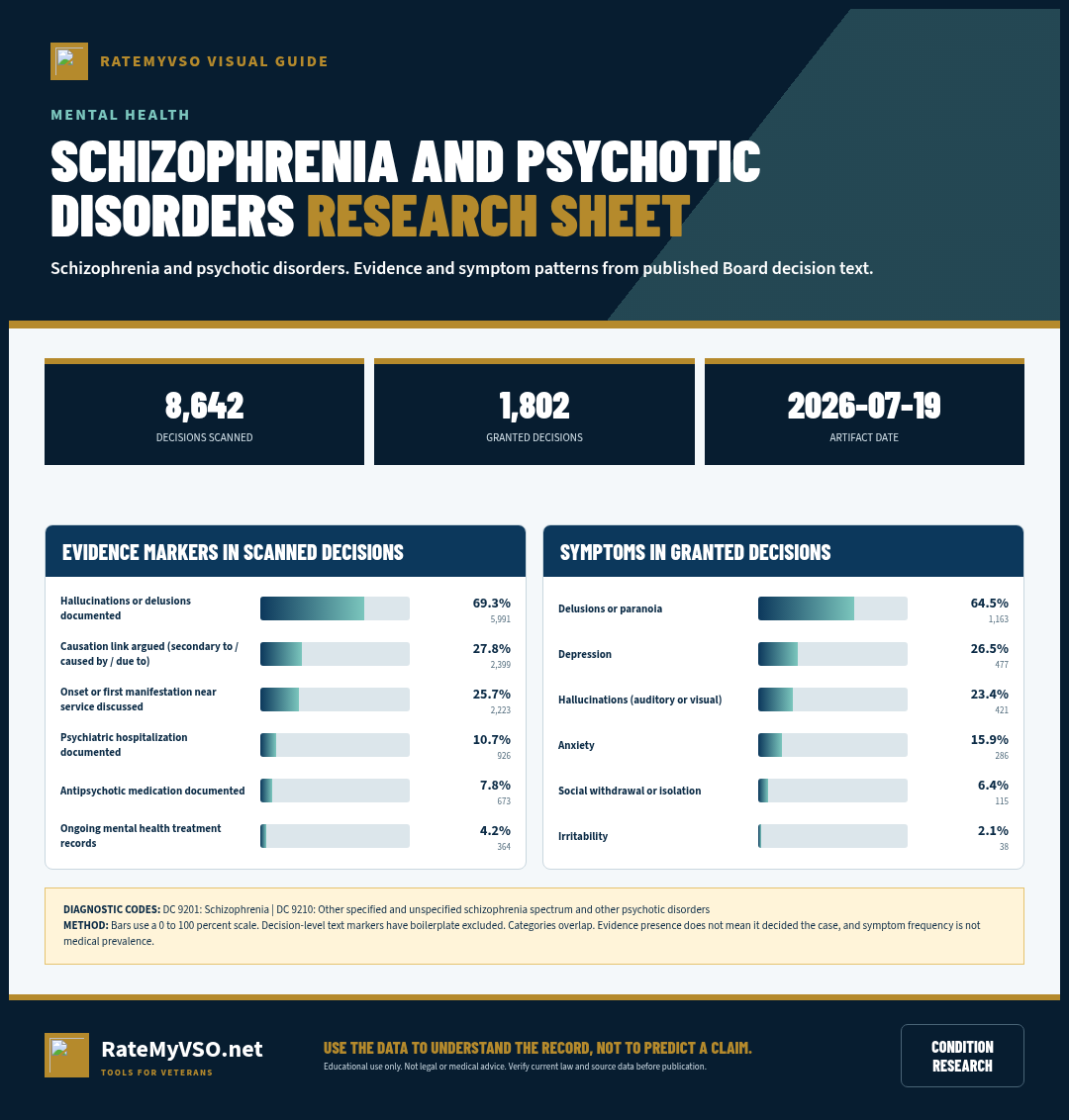 One-page guide: Schizophrenia and Psychotic Disorders Research Sheet
Research sheet showing evidence and symptom patterns across 8,922 scanned schizophrenia and psychotic-disorder Board decisions, of which 1,842 were granted. Opens the full-size chart, free to save or print.
One-page guide: Schizophrenia and Psychotic Disorders Research Sheet
Research sheet showing evidence and symptom patterns across 8,922 scanned schizophrenia and psychotic-disorder Board decisions, of which 1,842 were granted. Opens the full-size chart, free to save or print.
Bipolar Disorder Research
Evidence Cited in Published Bipolar disorder Decisions
We analyzed 5,130 published Board decisions involving bipolar disorder for condition-specific evidence, counting only case-specific mentions (boilerplate recitations excluded). "Favorable" is the share of decisions citing that evidence where every issue was granted or the outcome was mixed; the baseline across all these decisions is 59.2%. Evidence appearing in a decision does not mean it decided the case. Descriptive of the published record, not a prediction.
Bar length shows decisions citing the evidence.
Detected by phrase-reading the decision text with condition-specific vocabularies. Source: Board of Veterans' Appeals decisions, RateMyVSO analysis.
Symptoms Recorded in Granted Bipolar disorder Decisions
We analyzed 905 granted Board decisions involving bipolar disorder for symptoms named in sentences about the condition (rating-criteria recitations excluded). Descriptive of the published record, what the Board wrote down, not a checklist of what to report.
Bar length shows decisions. Percentages remain context.
Detected by phrase-reading the decision text with condition-specific vocabularies. Source: Board of Veterans' Appeals decisions, RateMyVSO analysis.
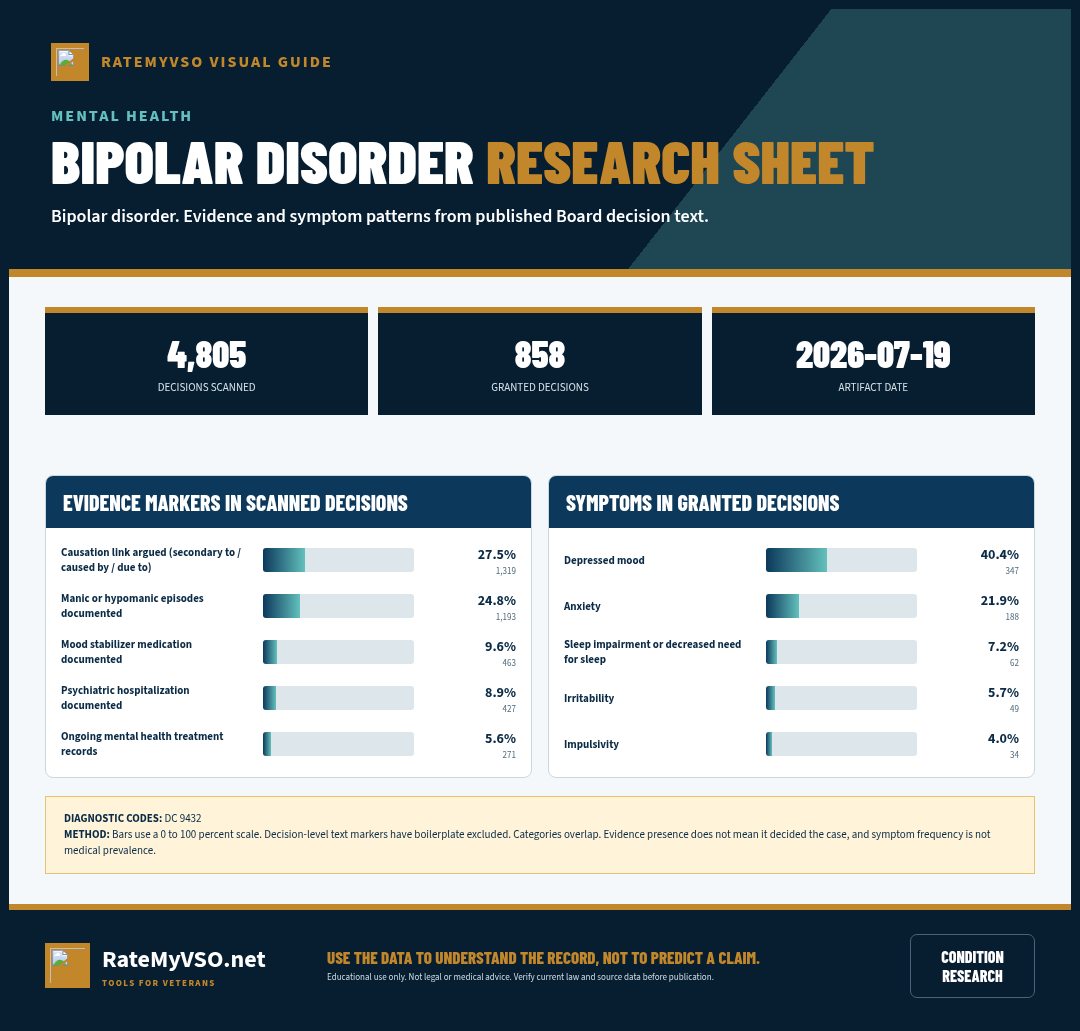 One-page guide: Bipolar Disorder Research Sheet
Research sheet showing evidence and symptom patterns across 5,130 scanned bipolar-disorder Board decisions, of which 905 were granted. Opens the full-size chart, free to save or print.
One-page guide: Bipolar Disorder Research Sheet
Research sheet showing evidence and symptom patterns across 5,130 scanned bipolar-disorder Board decisions, of which 905 were granted. Opens the full-size chart, free to save or print.
Sources
- 38 CFR § 4.130, Schedule of Ratings, Mental Disorders (General Rating Formula)
- 38 CFR § 4.125, Diagnosis of Mental Disorders
- 38 CFR § 4.126, Evaluation of Disability from Mental Disorders
- 38 CFR § 4.129, Mental Disorders Due to Traumatic Stress
- 38 CFR § 4.14, Avoidance of Pyramiding
- Mauerhan v. Principi, 16 Vet. App. 436 (2002), Symptom lists in rating formula are examples, not exhaustive checklists
- DSM-5, American Psychiatric Association (2013), Diagnostic and Statistical Manual of Mental Disorders, Fifth Edition