How the VA Evaluates Buddy and Lay Statements
Buddy statements (formally called lay evidence) are written accounts from people with personal knowledge of a veteran's symptoms, in-service events, or functional limitations. Federal law requires the VA to consider them, but the VA does not automatically credit them. This guide explains the legal framework adjudicators use to weigh these statements, including the two-step competency and credibility test that determines whether a statement helps a claim or is set aside.

What Is a Lay or Buddy Statement?
A lay statement is any written account from someone with personal knowledge of facts relevant to a VA disability claim. The most common types include:
- Fellow service member statements (the classic "buddy statement") describing an in-service event, injury, or condition the witness personally observed
- Spouse or family statements describing symptoms, behavioral changes, or functional limitations the witness has observed over time
- Friend, neighbor, coworker, or employer statements describing how the condition affects daily life or work
- The veteran's own personal statement about their symptoms, in-service events, and how the condition affects them
The legal term for all of these is "lay evidence." The VA's regulatory definition (38 C.F.R. § 3.159(a)(2)) describes competent lay evidence as a statement of fact that a person without specialized education, training, or experience is capable of making, provided by someone without that specialized background. The witness must have direct personal knowledge of what they describe. Second-hand accounts carry little weight.
The Legal Mandate: Lay Evidence Must Be Considered
Two layers of federal authority require the VA to consider lay evidence in every disability claim.
The Statutory Foundation
The governing statute requires that the VA give "due consideration" to "all pertinent medical and lay evidence" when deciding a service-connection claim. Lay evidence is not optional or supplementary. It is part of the evidence record by statute. (see 38 U.S.C. § 1154(a))
The Implementing Regulation
The primary service-connection regulation directs adjudicators to consider "the places, types and circumstances of service as shown by service records, the official history of each organization in which the veteran served, medical records, and all pertinent medical and lay evidence." (see 38 C.F.R. § 3.303(a)) Subsection (b) of the same regulation establishes the continuity-of-symptomatology pathway (covered below), which is one of the most important uses of lay evidence.
Sources: 38 U.S.C. § 1154 (Cornell LII) · 38 C.F.R. § 3.303 (eCFR) · 38 C.F.R. § 3.159 (eCFR)
What Lay Evidence Can (and Cannot) Establish
Direct service connection requires three elements: a current disability, an in-service event or injury, and a medical link (called the "nexus") between the two. Lay evidence has different weight for each element.
| Element | Role of lay evidence | Notes |
|---|---|---|
| 1. Current disability | Partial | Lay witnesses can describe observable symptoms (limping, tremor, visible skin lesions, behavioral changes). They generally cannot diagnose acquired psychiatric conditions, internal organ pathology, or other conditions that require clinical evaluation (see Davidson v. Shinseki). |
| 2. In-service incurrence | Strong | This is where lay evidence is most powerful. A credible buddy statement from a fellow service member who personally witnessed an in-service injury can establish this element even when service treatment records are silent. Lack of contemporaneous records does not automatically defeat lay testimony (Buchanan v. Nicholson). |
| 3. Nexus (medical link) | Generally weak | Medical causation typically requires a medical opinion from a qualified clinician. Lay opinions on etiology (what caused a condition medically) receive little probative weight under the M21-1 manual and Federal Circuit caselaw. |
| Continuity of symptoms (alternate path to nexus) | Strong | Lay evidence of unbroken symptoms from service to the present can serve as the nexus for direct service connection under 38 C.F.R. § 3.303(b). This pathway is recognized in Barr v. Nicholson and works best for conditions with observable symptoms. |
The Two-Step Analysis: Competency, Then Credibility
Every lay statement is evaluated in two distinct steps. Most denials based on lay evidence cite one of these two steps. Understanding the difference matters because the legal arguments to challenge each are different.
Step 1: Competency (a threshold legal question)
Competency asks: is this witness capable of making this specific observation? The leading case is Jandreau v. Nicholson, 492 F.3d 1372 (Fed. Cir. 2007), which established that lay testimony is competent to identify a medical condition when one of three things is true:
- 1 The condition has readily observable and identifiable features that do not require medical training (for example: a dislocated shoulder, varicose veins, a rash, hearing loss).
- 2 The witness is reporting a contemporaneous diagnosis made by a medical professional (telling the VA what a doctor told the veteran at the time).
- 3 The lay description of symptoms at the time supports a later diagnosis made by a medical professional (a buddy statement describing symptoms in service that line up with a diagnosis years later).
An earlier case, Layno v. Brown, 6 Vet. App. 465 (1994), set the foundation: a lay witness may testify to "that which he has actually observed and is within the realm of his personal knowledge." A more recent case, Kahana v. Shinseki (CAVC 2011), held that the Board cannot deny lay competency and at the same time rely on its own lay judgment about what "should have been documented" in service records. The Board must be consistent in how it treats lay observation.
Step 2: Credibility (a factual question)
If a witness is competent, the Board next assesses whether the statement is believable. The leading case is Caluza v. Brown, 7 Vet. App. 498 (1995), which established the factors adjudicators use:
- Internal consistency. Does the statement contradict itself? Do later statements from the same witness contradict earlier ones?
- Facial plausibility. Does the account make sense given what we know about the witness's circumstances and the veteran's service?
- Consistency with other evidence. Does the statement align with service treatment records, post-service medical records, and the veteran's own prior statements?
- Interest and bias. The witness's relationship to the veteran is one factor, but it is not an automatic disqualifier. A spouse can be credible. A non-relative can be biased.
- Demeanor at hearings (where applicable).
A separate case, Colvin v. Derwinski, 1 Vet. App. 171 (1991), holds that the Board cannot substitute its own unsubstantiated medical conclusions for independent medical evidence when rejecting lay testimony on medical grounds. If the Board says "this lay statement is not credible because medically a person could not have those symptoms," it must point to actual medical evidence saying so, not the Board's own informal medical view.
The Continuity-of-Symptomatology Pathway
One of the most important uses of lay evidence is establishing continuity of symptoms under 38 C.F.R. § 3.303(b). When a condition was not formally diagnosed as chronic during service, the veteran can still establish direct service connection by showing that symptoms have been continuous from service to the present.
Lay evidence is particularly suited to this pathway because the question is whether the veteran has experienced ongoing symptoms, not whether a doctor diagnosed a specific disease at a specific time. The leading case is Barr v. Nicholson, 21 Vet. App. 303 (2007), in which the veteran's lay testimony of varicose veins beginning in service and continuing without interruption was sufficient to establish continuity, with no contemporaneous medical records required.
What strengthens a continuity statement
- Specific identification of when the symptoms began (a particular event or time in service)
- Description of how the symptoms have appeared since (frequency, severity, what triggers them)
- Multiple witnesses across different time periods (a buddy from service, a spouse from after discharge, a coworker from later years)
- Consistent reporting in any medical records, even if the records do not contain a formal diagnosis
What weakens a continuity statement
- Long unexplained gaps in symptom documentation (a credible explanation, such as no access to care, can blunt this)
- Medical records during the gap that reflect different complaints or affirmatively note absence of the condition
- The veteran sought treatment for unrelated issues during the gap but never mentioned the claimed condition
Source: 38 C.F.R. § 3.303(b) (eCFR); Barr v. Nicholson, 21 Vet. App. 303 (2007).
Combat Veterans: The Enhanced Standard
Veterans who engaged in combat with the enemy receive an elevated lay-evidence standard (see 38 U.S.C. § 1154(b)). The statute requires the VA to "accept as sufficient proof of service-connection of any disease or injury alleged to have been incurred in or aggravated by such service satisfactory lay or other evidence" if the claimed condition is consistent with the circumstances of combat.
Two important features of this standard:
- Records are not required. Lay testimony alone can establish in-service incurrence even when service treatment records do not document the event.
- The rebuttal standard is high. The VA may rebut combat-related lay evidence only with "clear and convincing evidence to the contrary," a much higher bar than the preponderance-of-evidence standard used in most claims.
For PTSD claims specifically, 38 C.F.R. § 3.304(f) further provides that lay testimony alone can establish a stressor when the veteran engaged in combat, was a prisoner of war, was diagnosed with PTSD during service, or the stressor involves "fear of hostile military or terrorist activity" confirmed by a VA mental-health professional.
Source: 38 U.S.C. § 1154(b) (Cornell LII); 38 C.F.R. § 3.304(f) (eCFR).
What Has Made Lay Statements Persuasive at the Board
The patterns below are drawn from published Board of Veterans' Appeals decisions and CAVC caselaw. They reflect what adjudicators have found persuasive (or unpersuasive) when weighing lay evidence, not a prescriptive checklist.
Found persuasive
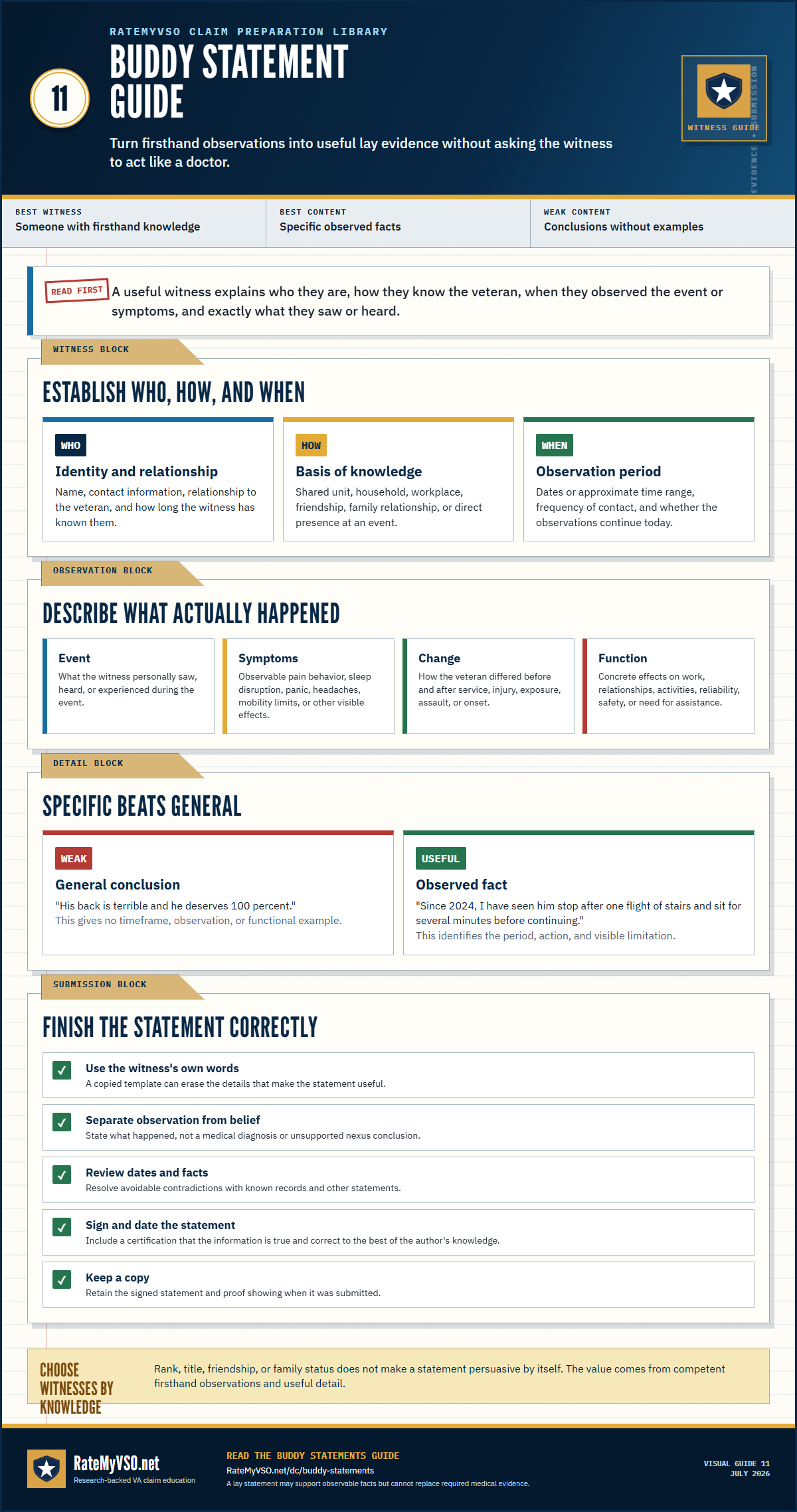
- Clear personal-knowledge foundation (unit, dates of service together, how the witness knew the veteran)
- Specific in-service observations with dates and locations ("I was present on [date] when [event] occurred")
- Description of observable facts: limping, visible wounds, breathing difficulty, behavioral changes, sleep disruption
- Before-and-after contrast describing how the veteran functioned before vs. after a specific event or exposure
- Continuity testimony from a witness who knew the veteran in service and after discharge
- Multiple independent statements describing the same event from different vantage points
- Consistency with what is in the service records and what the veteran has previously said
- The witness signs and dates the statement and provides contact information
Found unpersuasive or set aside
- Vague emotional appeals without factual specifics ("he is a hero and deserves benefits")
- Medical conclusions or diagnoses from witnesses without medical training ("he definitely has PTSD from what I saw")
- Second-hand accounts: what the veteran told the witness, rather than what the witness personally observed
- Inconsistencies with the veteran's own prior statements or contemporaneous medical records
- "All or nothing" exaggeration ("he can never do anything at all")
- Statements with no dates, no location, no unit identification, no description of how the witness knew the events
- Unsigned or undated statements, or statements that appear to be templated copies of other statements in the same claim
How Often Lay Evidence Comes Up at the Board
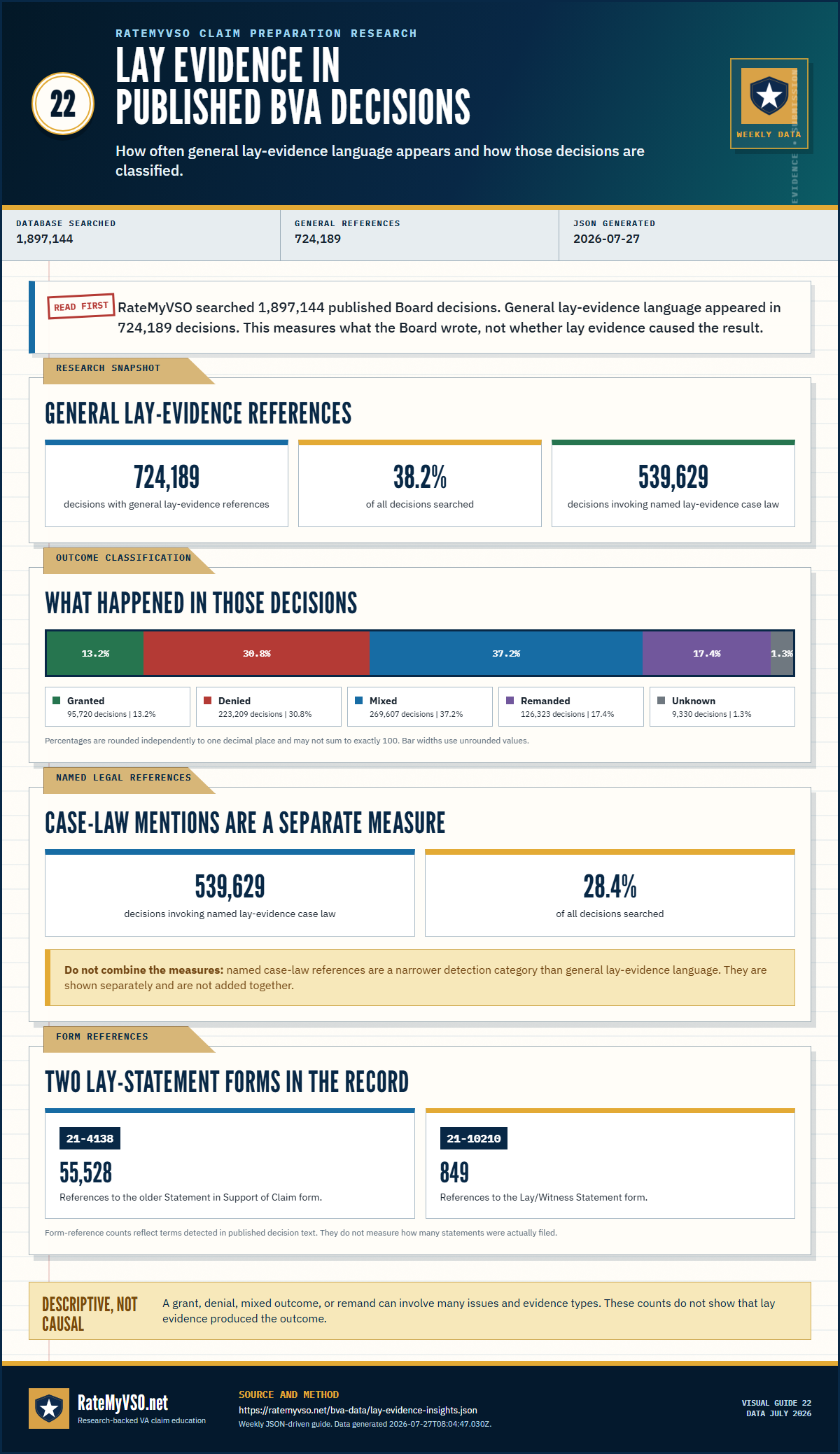
To give a sense of how often these statements actually appear in the record, we analyzed the RateMyVSO BVA dataset (1,897,144 published Board of Veterans' Appeals decisions) for references to lay or buddy statements and the leading case names.
Lay-evidence references across 1,897,144 BVA decisions
Form 21-10210 was introduced in recent years. Older decisions in the corpus pre-date it, which is why 21-4138 references vastly outnumber 21-10210 references in the historical record.
Disposition split (decisions referencing lay or buddy statements)
Of the 724,189 decisions referencing lay or buddy statements, roughly 13.2% had every issue granted, 37.2% had mixed outcomes, 17.4% were remanded, and 30.8% had every issue denied. Combining grants and mixed outcomes, 50.4% of decisions citing lay evidence resulted in at least one issue going in the veteran’s favor. A reference means the Board wrote about lay evidence in the decision. It does not show that the lay evidence was found competent or credible, or that it caused the outcome.
Diagnostic codes where lay evidence shows up most
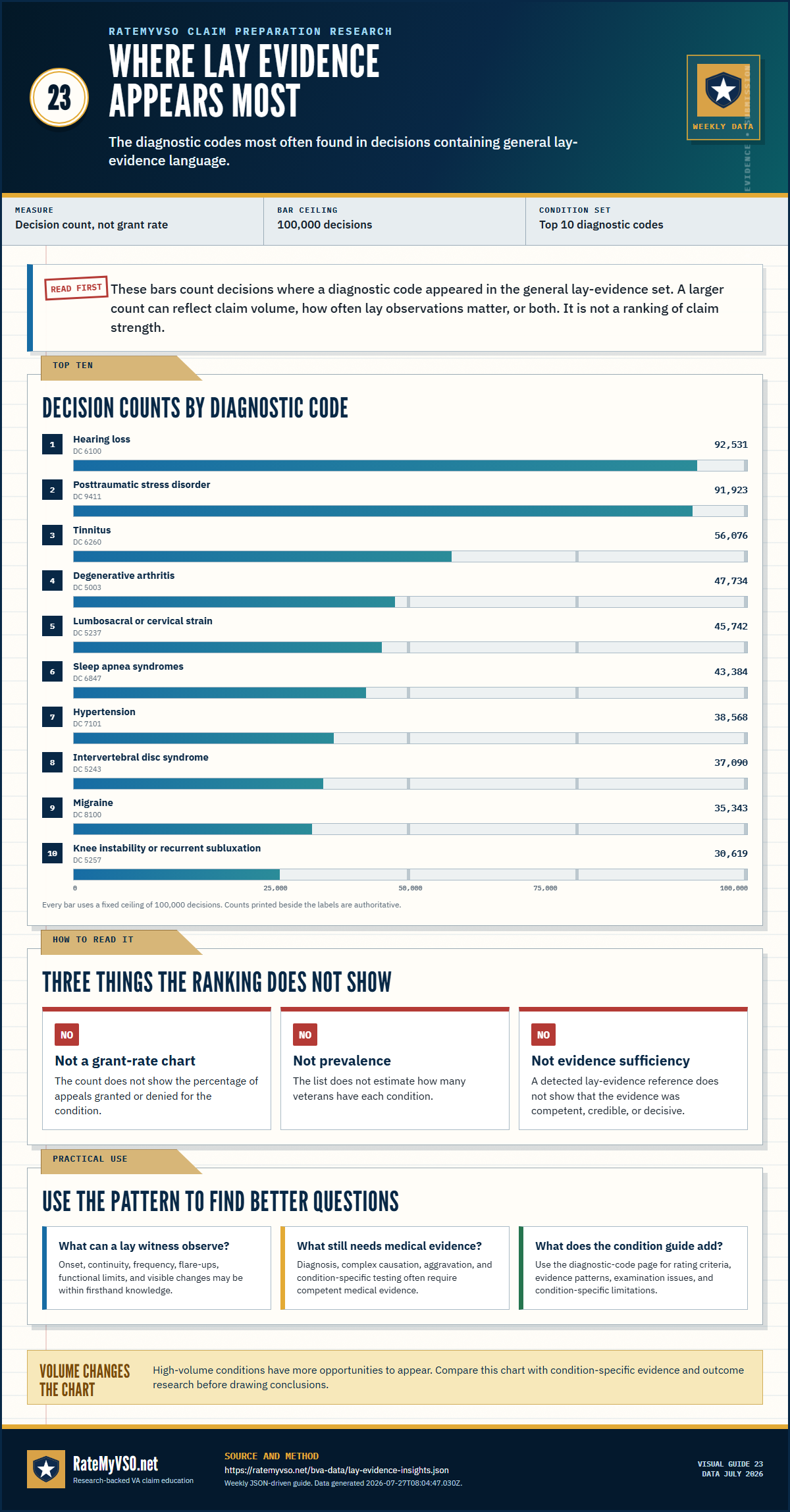
These are the diagnoses where in-service events, continuity of symptoms, or functional impact are most often documented through witness testimony rather than contemporaneous medical records.
Source: RateMyVSO BVA dataset, 1,897,144 Board of Veterans' Appeals decisions (all available years through current).
Which Form to Use
The VA provides specific forms for lay statements. A typed and signed statement on plain paper is also legally acceptable, but the official forms create a clearer paper trail and reduce the risk that the statement is misfiled or overlooked.
VA Form 21-10210: Lay/Witness Statement
The VA's standardized form for third-party witness statements (fellow service members, family, friends, employers, neighbors). Each individual witness should submit a separate 21-10210 in their own words. The form asks for the witness's contact information, relationship to the claimant, and a narrative description of facts based on personal knowledge.
VA Form 21-4138: Statement in Support of Claim
The historical multipurpose statement form. Many veterans use it for their own personal statement about symptoms, in-service events, and how the condition affects them. The VA continues to accept it for any claim purpose.
Key Cases Adjudicators Apply
| Case | Court / Year | Key holding |
|---|---|---|
| Layno v. Brown 6 Vet. App. 465 | CAVC, 1994 | A lay witness may testify to what they have actually observed within the realm of personal knowledge. |
| Caluza v. Brown 7 Vet. App. 498 | CAVC, 1995 | Established the credibility factors (internal consistency, plausibility, consistency with other evidence, interest, demeanor). Board must explain rejection of lay evidence. |
| Colvin v. Derwinski 1 Vet. App. 171 | CAVC, 1991 | Board cannot substitute its own unsubstantiated medical conclusions for independent medical evidence when weighing lay testimony. |
| Buchanan v. Nicholson 451 F.3d 1331 | Fed. Cir., 2006 | Lack of contemporaneous medical records does not, by itself, make lay evidence not credible. |
| Jandreau v. Nicholson 492 F.3d 1372 | Fed. Cir., 2007 | Three-pathway framework for when lay evidence is competent to identify a medical condition. |
| Barr v. Nicholson 21 Vet. App. 303 | CAVC, 2007 | Lay evidence is competent for conditions with readily observable and identifiable features (varicose veins). |
| Davidson v. Shinseki 581 F.3d 1313 | Fed. Cir., 2009 | Lay person cannot diagnose an acquired psychiatric condition without medical training. |
| Kahana v. Shinseki | CAVC, 2011 | Board cannot simultaneously deny lay competency and rely on its own informal lay-medical judgment about what "should have been documented." |
Find an accredited VSO representative near you →
Your statement notes
Prepare your statement notes
Start with what you remember, how the condition affects you, and what someone else actually observed.
These are your preparation notes. A witness writes their own account of what they observed.
Your statement
Write the statement itself
Your own words, saved to your account and reopened any time. A buddy draft is for the person named as author to review; the site never writes or signs a statement for anyone.
Claim Quest: Quick Check
Five questions based only on this guide.
This checks what you understood from this guide. It is not a claim-readiness score, a prediction, an official test, or a record on your account.
Related Tools and Guides
Sources and references:
- 38 U.S.C. § 1154: Consideration to be accorded time, place, and circumstances of service (Cornell LII)
- 38 C.F.R. § 3.303: Principles relating to service connection (eCFR)
- 38 C.F.R. § 3.304: Direct service connection; PTSD stressor evidence (eCFR)
- 38 C.F.R. § 3.159: Definition of competent lay evidence (eCFR)
- VA Form 21-10210: Lay/Witness Statement
- VA Form 21-4138: Statement in Support of Claim
- M21-1, Part III, Subpart iv, Chapter 5, Section A: Principles of Reviewing Evidence and Decision Making (VA KnowVA)
- Jandreau v. Nicholson, 492 F.3d 1372 (Fed. Cir. 2007); Buchanan v. Nicholson, 451 F.3d 1331 (Fed. Cir. 2006); Barr v. Nicholson, 21 Vet. App. 303 (2007); Caluza v. Brown, 7 Vet. App. 498 (1995); Layno v. Brown, 6 Vet. App. 465 (1994); Colvin v. Derwinski, 1 Vet. App. 171 (1991); Davidson v. Shinseki, 581 F.3d 1313 (Fed. Cir. 2009); Kahana v. Shinseki, No. 09-3525 (Vet. App. 2011)
This guide is for educational purposes only and is not legal advice. Regulations, forms, and caselaw change over time. Always verify at va.gov, ecfr.gov, or law.cornell.edu before relying on any rule. For individualized help with a VA claim, find an accredited VSO representative. All RateMyVSO tools are free. We never sell anything.
Related: VA Supporting Forms guide covers 21-10210, 21-4138, and the other attachments that go in a claim file.