VA CUE Claims: Clear and Unmistakable Error
Clear and Unmistakable Error (CUE) is the only way to attack a final, unappealable VA decision and recover the original effective date, sometimes decades of back pay. The standard is strict and the bar is high. Authority: 38 CFR § 3.105(a) for regional-office decisions and 38 USC § 5109A for the statutory basis. CUE in a final Board decision runs on a separate track under 38 USC § 7111.

What Is CUE?
A CUE motion attacks the validity of a prior final VA decision. Unlike a Supplemental Claim or appeal (which look forward and require new evidence), CUE looks backward at what the VA did at the time and argues the decision was wrong on its face, based on the law and evidence as they existed when the decision was made.
If a CUE motion succeeds, the original decision is reversed and the effective date moves back to the date that decision should have used. Some CUE awards exceed $500,000 in retroactive pay because they recover decades of back compensation.
The Three-Part Test (Russell v. Principi)
The Veterans Court set out the controlling CUE test in Russell v. Principi, 3 Vet. App. 310 (1992), refined by Bustos v. West, 179 F.3d 1378 (Fed. Cir. 1999):
- Either the correct facts as known at the time were not before the adjudicator, OR the statutory or regulatory provisions extant at the time were incorrectly applied.
- The error must be "undebatable", not merely a different conclusion that reasonable adjudicators could disagree about.
- The error must be of the sort which, had it not been made, would have manifestly changed the outcome at the time it was made.
All three prongs must be satisfied. Failure on any one defeats the CUE motion.
What Counts as CUE
Examples of arguments that have succeeded as CUE in BVA and Veterans Court decisions:
- Misapplication of an express regulatory rule. VA assigned a 30% rating when the schedular criteria for the symptoms of record clearly required 50%.
- Ignoring evidence in the file. A nexus letter from a private physician was in the C-file at the time, addressed every element of service connection, and the rating decision failed to discuss it.
- Using the wrong rating schedule edition. VA applied the 2005 rating criteria when the 1995 version (more favorable) was in effect at the time of claim.
- Failure to apply a presumption. Veteran was a Vietnam in-country boots-on-ground veteran with a presumptive Agent Orange condition, and VA failed to apply the § 3.309(e) presumption.
- Math error on the rating schedule. VA combined a 50% and a 30% rating and assigned 60%. The § 4.25 combined-ratings table gives 65, which rounds up to 70%. The undebatable arithmetic error cost a full 10-point step, exactly the kind of manifest, outcome-changing mistake CUE is meant to fix.
What Does NOT Count as CUE
| Argument | Why It Fails CUE |
|---|---|
| "A new doctor today reaches a different conclusion." | New evidence is not CUE. CUE is based on the record as it existed at the time of the original decision. |
| "The law has since changed in my favor." | CUE is judged under the law at the time of the original decision. Subsequent legal developments don't apply (use a Supplemental Claim or liberalizing-law claim instead). |
| "VA didn't help me develop my claim adequately." | Failure-to-assist arguments are not CUE per Cook v. Principi, 318 F.3d 1334 (Fed. Cir. 2003) (en banc). |
| "VA weighed the evidence wrong." | A reasonable difference of opinion about how to weigh conflicting evidence is not "undebatable" error. |
| "VA didn't get an exam they should have." | Failure to obtain a duty-to-assist exam is not CUE per Cook (above). |
| "My representative was bad / I didn't know to file." | Procedural complaints are not CUE. |
The Federal Circuit's Cook v. Principi case is the leading authority that breach of the duty to assist cannot constitute CUE. This narrows the field of viable CUE motions significantly.
CUE in BVA Decisions
CUE in regional-office decisions follows § 3.105(a). CUE in BVA decisions follows a parallel but separate process: the statute is 38 USC § 7111, implemented by 38 CFR § 20.1400-1411 (§ 5109A governs RO decisions only). The substantive standard is the same (Russell three-part test), but the motion is filed directly with the Board, not the regional office.
If a regional-office decision was affirmed by the BVA, the appropriate target is usually the BVA decision (since it superseded the RO decision). Filing CUE against the RO decision when the BVA already ruled on the same issue may be procedurally improper.
How to File a CUE Motion
- Obtain your full C-file. See the Records Request Guide. CUE depends on what was in the file at the time, so you need the contemporaneous record.
- Identify the specific final decision being attacked by date and rating-decision identifier.
- State the specific error in writing. Generic "VA got it wrong" pleadings fail. Identify exactly which fact or which regulation, and exactly how it was misapplied.
- Explain why the error meets all three Russell prongs, undebatable, manifestly changed outcome, based on contemporaneous law and evidence.
- For RO decisions, file with the RO. For final Board decisions, file a written motion for revision directly with the Board under 38 CFR § 20.1404. There is no standard form, it is a written motion, not VA Form 10182 (that form is the Notice of Disagreement used to appeal an RO decision to the Board, a different process).
- Specify the relief sought, usually reversal of the original decision and assignment of an earlier effective date.
Evidence Patterns
Successful CUE motions almost always involve:
- Side-by-side comparison of the original rating decision and the relevant regulation/statute as it existed at the time, showing the misapplication.
- Direct citation to evidence in the C-file at the time that the original decision overlooked or contradicted.
- Citation to controlling case law from the Veterans Court or Federal Circuit interpreting the relevant regulation in the way the CUE motion proposes.
- Old M21-1 manual provisions that were in effect at the time, these often establish the duty the original decision violated.
Effect of a Successful CUE
A successful CUE motion reverses the original decision and substitutes the decision that should have been made. Effects:
- Original effective date restored, back pay calculated to the date the original decision should have used.
- If the rating was understated: the higher rating is awarded retroactively to the original effective date.
- If the claim was denied: service connection is granted with the original effective date.
- Compensation is recalculated using historical pay rates with COLA adjustments. Use the Back Pay Estimator to model.
CUE awards routinely exceed $100,000-$500,000 because they often recover decades of back pay.
When a CUE Correction Cuts Benefits, M21-1 X.ii.5.C (May 2026)
CUE motions are usually filed BY veterans to fix a past underpayment. But VA itself can also find a CUE that runs the other way, an erroneous grant, an erroneously early effective date, or a too-high rating. M21-1, Part X, Subpart ii, Chapter 5, Section C was updated 2026-05-13 with refined procedures for these adverse-CUE corrections. Knowing the procedure protects you when one of these letters arrives.
When the full proposal-and-grant process applies (X.ii.5.C.1.a)
VA must follow the proposal-and-final-rating sequence whenever a CUE correction would:
- Assign a lower disability evaluation, or
- Sever service connection, or
- Correct an effective date so that benefits are not payable until later (functionally akin to severance for a closed period).
The 9-step procedure tracks the standard rating-reduction process under 38 CFR § 3.105:
- VA establishes end product (EP) 930 to track the CUE review.
- Rating activity prepares a proposed rating decision with the required CUE approvals (per M21-1 X.ii.5.A.3.e), then VA clears EP 930 and opens EP 600.
- VA sends a notice of proposed adverse action. Except when the CUE is effective-date-only, the notice states the effective date of the proposed action will be the first day of the month following a 60-day period beginning on the date of the notice of the FINAL rating decision (not the proposal). If you are a veteran and basic pension eligibility exists, VA must invite a pension claim.
- If you request a hearing within 30 days of the proposal, VA holds the hearing and obtains any evidence you identify before moving forward.
- Once 65 days have passed since the proposal notice, the case goes back to the rating activity for a final decision. If the final decision confirms the original rating, VA tells you no action will be taken and the matter closes. If the final decision adopts the CUE correction, the process continues.
- The $40,000 overpayment safeguard. If the resulting overpayment equals or exceeds $40,000, the case cannot be promulgated until Compensation Service or Pension & Fiduciary Service approves it. This is a senior-review gate against catastrophic retroactive debt.
- VA establishes EP 960 (using the date VA discovered the error as the date of claim) and promulgates the final EP 600 rating decision. Inappropriate overpayment attributable to administrative error must be eliminated under M21-1 VI.iii.2.B.3.e or prevented per the procedural exceptions at M21-1 X.ii.5.B.2.d. Your current rate of payment continues until the first day of the month following a 60-day period that begins on the date of the notice of the final rating decision.
- VA notifies you of the action, clears EP 960, and adds the Clear and Unmistakable Error flash to the corporate record.
- VA updates the CUE Tracker.
The lighter exception (X.ii.5.C.1.b)
If the CUE correction does NOT reduce the current or any prior combined disability evaluation, VA skips the full proposal-and-60-day track. Example: VA fixes a single-condition rating downward but your combined rating stays the same because other conditions offset it. Or: VA corrects a 0-percent effective date that was clerically wrong. In these cases the procedure is short, EP 930 → corrected rating with approval → EP 960 → promulgate → notify → close.
Cross-program coordination (X.ii.5.C.1.c)
If a proposed adverse CUE action would affect your benefits under another VA program, VA must send a copy of the proposal to the appropriate program contact. Concrete example: a proposed severance of SC must be copied to your local Veteran Readiness and Employment (VR&E) office if you are training under 38 U.S.C. Chapter 31. Notable exception: VA never sends an adverse-CUE proposal copy to a VA medical center, even when the CUE would affect healthcare eligibility.
Combined-issues rule (X.ii.5.C.1.d)
If multiple rating issues are pending and one of them is a CUE, VA must combine all of them into a single rating decision. VA cannot peel the CUE off into a separate decision. So if your file has a pending increase claim AND a proposed CUE correction, both land in one decision document. Effective-date selection for any concurrent grant follows 38 CFR § 3.400.
Jurisdiction split for severance of service connection (X.ii.5.C.2)
Two different VA activities handle SC severance depending on the type of CUE:
- Rating activity handles severance under 38 CFR § 3.105(d) when the CUE is in the underlying SC analysis (no plausible basis in the law or facts, error must be undebatable, not a mere difference in judgment). Follows the X.ii.5.C.1 procedure above.
- Authorization activity initiates severance when the CUE is in a decision about character of discharge (COD), line of duty (LOD), or willful misconduct. Even if severance under one of these grounds would not actually reduce benefits, VA still follows the full X.ii.5.C.1 procedure with the notice and 60-day clock.
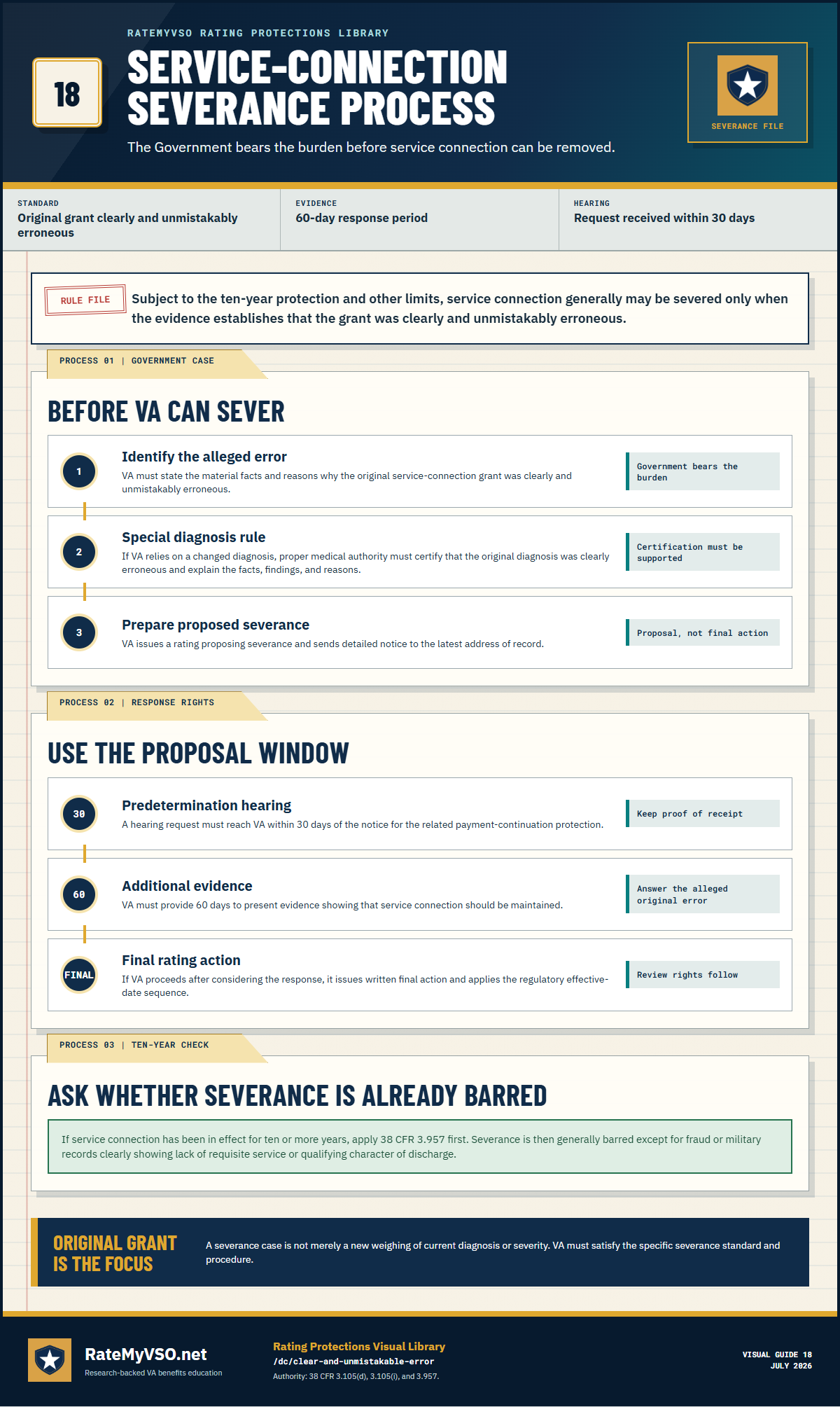
What to do if you receive an adverse-CUE proposal
- Read the proposal carefully and check the dates. The 30-day hearing-request window and the 60-day post-final-decision benefit-cut date should both be stated.
- Request the hearing in writing within 30 days. This pauses the clock and gives you a chance to present evidence the rater missed.
- FOIA your C-file immediately. See what VA's evidence base actually was at the time of the original decision. CUE has to be evident from the record at that time.
- Engage an accredited VSO representative or attorney. Adverse-CUE corrections can wipe out decades of compensation. If VA's reasoning has any gap, that gap is your best argument.
- Verify the $40,000 overpayment safeguard was applied. If the correction will create an overpayment of $40,000 or more and the file shows no Compensation Service or P&F approval, that is a procedural defect you can raise.
- Track the protections. Service connection itself cannot be severed after 10 years except for fraud, or where military records clearly show the person lacked the requisite service or character of discharge (38 CFR § 3.957). A 100% rating that has been in effect for 20 years is similarly protected.
Source: M21-1, Part X, Subpart ii, Chapter 5, Section C (effective 2026-05-13). Read the live text at KnowVA.
Common Mistakes
- Filing CUE based on new evidence. If you have new evidence, file a Supplemental Claim, not CUE.
- Filing CUE based on subsequent legal developments. Use a liberalizing-law claim or Supplemental Claim. CUE is judged under the law at the time of the original decision.
- Vague pleadings. "VA was wrong" is not a CUE motion. Identify the exact error, the exact regulation, the exact evidence ignored or misapplied.
- Failing to obtain the C-file. CUE depends on what was in the file at the time. File a FOIA / Privacy Act request first.
- Confusing CUE with the duty to assist. Per Cook v. Principi, breach of duty to assist is not CUE.
- Targeting the wrong decision. If a BVA decision affirmed the RO, target the BVA decision under § 20.1400, not the RO under § 3.105.
Related Tools and Guides
This page is educational and is not legal advice. CUE motions are legally complex and most are filed by accredited attorneys or VSO representatives. Work with a VA-accredited representative.