TERA Exam Exceptions
When VA can deny a toxic-exposure claim without ordering an exam, what those four exceptions are, and how to overcome them with your own evidence.

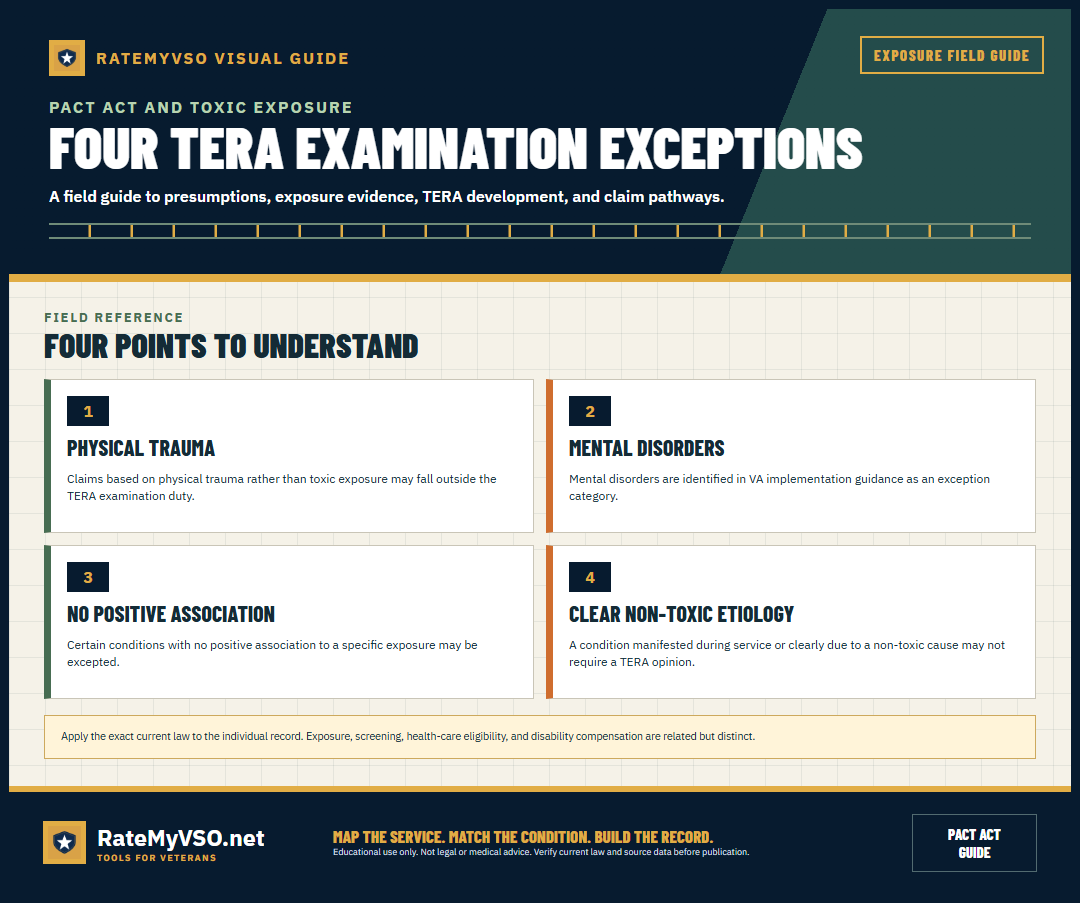
The Four Exceptions
If your claim falls under any of these, VA can deny it without ordering a TERA exam. You can still win, but you'll have to bring evidence VA wouldn't have generated for you.
1Non-presumptive claims based on physical trauma
If you're claiming a non-presumptive disability that was caused by physical trauma in service (blunt force, repetitive use, penetrating injury), VA won't order a TERA exam. The theory of service connection is direct trauma, not toxic exposure.
Note: hearing loss is not considered physical trauma under this exception.
2Mental disorders
Claims for any mental disorder rated under 38 CFR §4.130 (PTSD, depression, anxiety, etc.) don't get a TERA exam. These are evaluated under direct or secondary service connection instead.
3Conditions with no positive association with herbicide exposure
The Secretary maintains a list of conditions determined to have no positive association with herbicide exposure, based on cumulative scientific reports from the National Academy of Sciences (1993–present). If your only established TERA is herbicide exposure (Agent Orange, etc.) and your condition is on this list, VA won't order an exam.
Important scoping rule (per the June 2024 VBA guidance update): this exception only applies when herbicide exposure is the only TERA on record. If you also had burn-pit, particulate-matter, contaminated-water, or other TERA exposures, the exam requirement still applies for those.
Malignant conditions (cancers) on the no-association list:
- Melanoma
- Nonmelanoma skin cancer (basal cell & squamous cell)
- Hepatobiliary cancers (liver, gallbladder, bile ducts) and pancreatic cancer
- Cancers of the pleura, mediastinum, and other unspecified sites within the respiratory system and intrathoracic organs
- Bone and connective tissue cancer
- Endocrine cancers (including thyroid and thymus)
- Cancers of the reproductive organs (cervix, uterus, ovary, testes, penis, excluding prostate)
- Cancers of the digestive organs (esophageal, stomach, colorectal, small intestine, anus)
- Renal cancer (kidney and renal pelvis) PACT Act presumptive for covered vets
- Cancers of the brain and nervous system (including eye) PACT Act presumptive for covered vets
- Leukemia (other than chronic B-cell leukemias, including chronic lymphocytic leukemia and hairy cell leukemia, which are Agent Orange presumptive)
- Cancers of the oral cavity (lips, tongue), pharynx (tonsils), and nasal cavity (ears, sinuses) PACT Act presumptive for covered vets
- Bladder cancer Agent Orange presumptive (added)
- Breast cancer Added to no-association list since 2022
Non-malignant conditions on the no-association list:
- Osteoporosis
- Asthma PACT Act presumptive for covered vets
- Endometriosis
- Farmer's lung
- Hearing loss
- Diseases of the eye
- Chronic obstructive pulmonary disease (COPD) PACT Act presumptive for covered vets
- Neurobehavioral disorders (cognitive and neuropsychiatric)
- Gastrointestinal, metabolic, and digestive disorders
- Immune system disorders (immune suppression, allergy, autoimmunity)
- Circulatory disorders (other than hypertension, ischemic heart disease, and stroke)
- Chronic peripheral nervous system disorders (other than early-onset peripheral neuropathy)
- Neurodegenerative diseases including ALS (but excluding Parkinson's and Parkinsonism, which are Agent Orange presumptive)
- Hypothyroidism Agent Orange presumptive (added)
- Hypertension Agent Orange presumptive Jan 2025
- MGUS (monoclonal gammopathy of undetermined significance) Agent Orange presumptive Jan 2025
- First, check if your condition is now presumptive, see our PACT Act page and the presumptive eligibility checker. Conditions tagged above with green badges may already qualify, in which case you don't need to fight the exception at all.
- If not presumptive, submit competent medical or scientific evidence linking your condition to the toxic exposure. A private nexus letter from a qualified physician citing peer-reviewed studies can overcome Exception 3, see our Nexus Letters guide.
- If you have other TERAs on record (burn pits, PM2.5, contaminated water), the exception doesn't apply, VA still has to order the exam. Make sure those exposures are documented in your claim.
4Disabilities that manifested in service or have a non-toxic etiology
If your condition clearly manifested during military service (with documented chronicity or continuity in your STRs) or the evidence shows a non-toxic cause (a post-service event, an unrelated disease process), VA doesn't need a TERA exam to decide service connection.
How to overcome a TERA exception
Exceptions 1, 2, and 3 can be defeated by submitting competent medical or scientific evidence indicating an association between your disability and the in-service toxic exposure. In practice that means:
- A private nexus opinion from a qualified physician (not a chiropractor or LPN) that uses the required phrase "at least as likely as not" and explains the medical reasoning.
- Peer-reviewed studies the physician cites or attaches, ideally post-dating the most recent National Academy of Sciences review for your condition.
- A clear exposure narrative documenting where, when, and what you were exposed to, not just "I served in Vietnam," but specific units, dates, locations, and the toxic substance.
Once submitted, VA must consider the new evidence and (per Exception 4's reasonable-doubt rule, which courts have applied broadly) order the exam if the evidence creates an approximate balance.
What's changed since the 2022 Job Aid
The framework on this page is based on VA's December 2022 TERA Exception Job Aid, but several material updates have happened since:
- June 17, 2024 VBA Letter, refined the herbicide-only scoping rule for Exception 3. The exception only applies when herbicide is the only established TERA.
- October 1, 2024 Final Rule, codified TERA adjudication procedures into 38 CFR §3.320, expanded the section to cover all toxic-substance exposures (was previously fine-particulate-matter only). What used to be policy is now regulation.
- Breast cancer added to the no-positive-association list for herbicide-only TERAs.
- Several conditions promoted to presumptive, bladder cancer, hypothyroidism, Parkinsonism (earlier additions), then hypertension and MGUS (Jan 8, 2025). For Vietnam-era veterans these are now Agent Orange presumptive under §3.309(e).
- Geographic expansions for Agent Orange exposure presumption (added US, Canada, India locations on top of Vietnam, Cambodia, Korea, etc.).
Bottom line: if your condition has a green badge above, check the presumptive lists first, you may not need to fight the exception at all.
Keeping Your TERA Memorandum Current
A Toxic Exposure Risk Activity memorandum is the VA's internal document summarizing the locations and periods of a veteran's potential toxic exposure. VA adjudicators consult it when deciding whether a TERA exam is required under 38 USC 1168. The memorandum is not static. As VA recognizes additional exposure locations, periods, and hazard categories, existing memoranda can be updated to reflect that expanded recognition.
Why this matters: a TERA memorandum that was written before VA expanded a geographic presumption or added a new exposure site may not reflect your actual exposure history. An outdated memorandum could support an Exception 3 or Exception 4 finding when updated information would support an exam requirement instead.
The reference for current locations and periods: VA's public health website at publichealth.va.gov/exposures/locations publishes the current list of locations and periods recognized for various toxic exposures, including Agent Orange, burn pits and airborne hazards, radiation, and contaminated water at specific installations. Comparing that list against what is in your memorandum can reveal gaps.
- If your service history includes locations now on VA's recognized list but not on your memorandum, you can submit a request to have the memorandum reviewed and updated. Document the specific location, dates of service, and the hazard category from the publichealth.va.gov reference.
- If a new geographic expansion was announced after your claim was decided (for example, the 2021-2023 Agent Orange geographic additions), a Supplemental Claim with a request to update the memorandum and reconsider the TERA exam requirement may be appropriate.
- Unit records, deployment orders, and buddy statements can corroborate presence at a recognized location if service records do not already reflect it.
Bottom line: check the publichealth.va.gov location list against your own service history before assuming your TERA memorandum is complete. Gaps in the memorandum can determine whether the four exceptions apply to your claim.
Disclaimer: This page is educational and is not legal or medical advice. The exception framework is based on 38 USC §1168, the December 2022 VA TERA Exception Job Aid, the June 2024 VBA processing guidance, and the October 2024 final rule codified at 38 CFR §3.320. Presumptive status changes frequently, always verify with the current presumptive checker and consult a VA-accredited representative before relying on this content for your specific claim.