Barry’s Ripple
How one 2024 Federal Circuit ruling is reshaping the top of the SMC ladder, and where Board judges are quietly splitting.
How one 2024 Federal Circuit ruling is reshaping the top of the SMC ladder, and where Board judges are quietly splitting.
Special monthly compensation, or SMC, is the part of the VA disability system that pays extra when a veteran’s losses go beyond what an ordinary percentage rating can capture. The rates climb a lettered ladder, from (k) at the bottom through (l), (m), (n), and (o) at the top. Most veterans never climb past the lower rungs. This piece is about a rare one near the top, the intermediate step between (m) and (n), known informally as “M-Half.” A set of Board of Veterans’ Appeals decisions from 2025 and 2026 shows that reaching it has become both more possible and more contested, and the reason is a single court case.
The engine: Barry v. McDonough
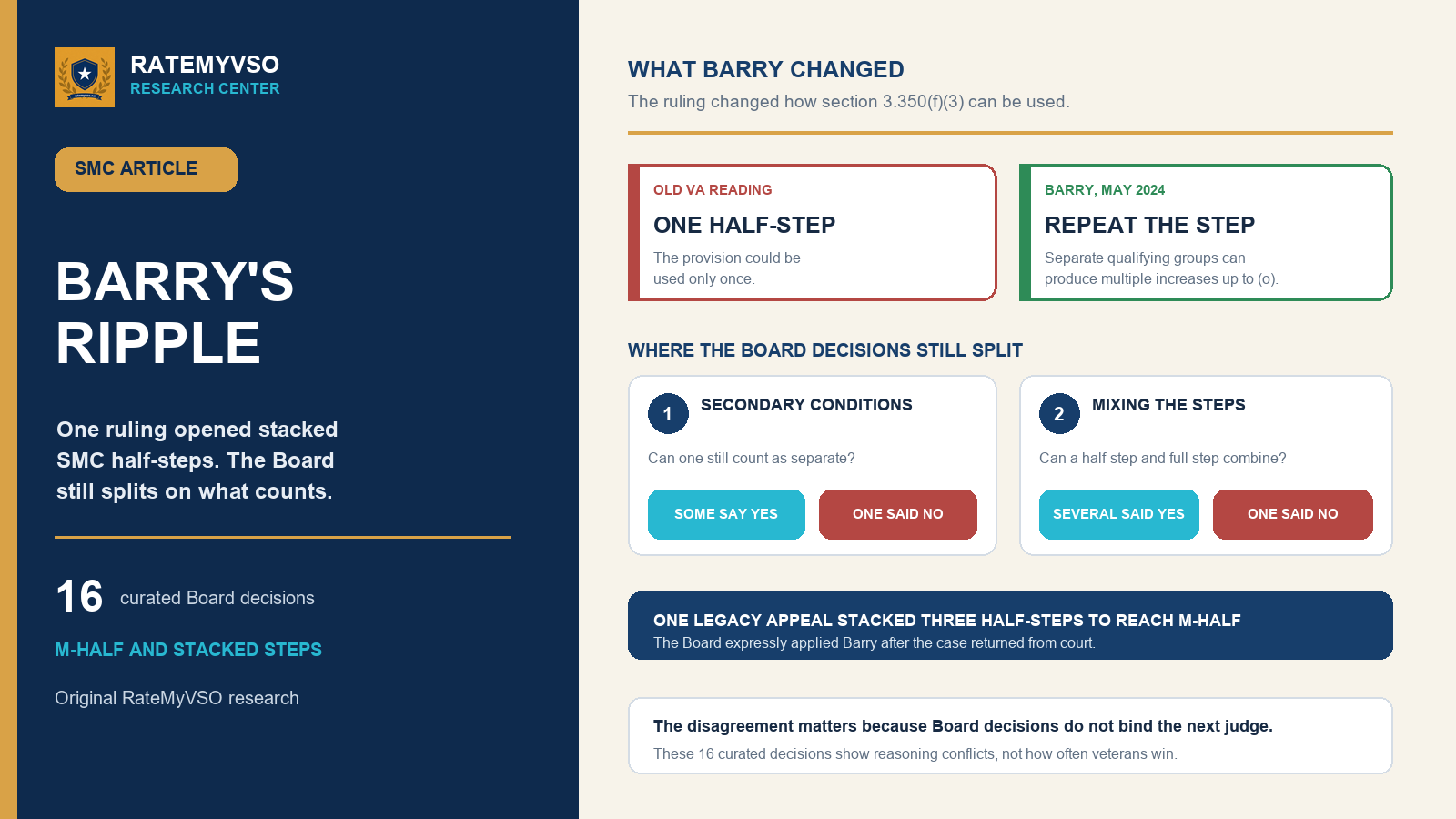
For years, the VA read the rule that lets a veteran climb from one rung to the next intermediate rung as working only once. Under that reading, section 3.350(f)(3) could add only one half-step, even when a veteran had more than one qualifying group of additional disabilities. In May 2024 the U.S. Court of Appeals for the Federal Circuit rejected that reading. In Barry v. McDonough, 101 F.4th 1348 (Fed. Cir. 2024), the court held that the half-step regulation, 38 C.F.R. section 3.350(f)(3), can be applied more than once, so separate qualifying groups can produce multiple half-step increases up to the (o) ceiling.
Barry drives the decisions that stack more than one half-step increase under section 3.350(f)(3), but not every grant in this set depends on it. You can watch the uneven transition in the record. In one December 2025 decision, the judge quoted the older, now-reversed version of the rule, describing the regulation as one that “permits only one intermediate increase” (Picton, A25107497, Dec. 12, 2025). Other judges applied the new reading to stack multiple half-step increases (Nichols, A26029893, Apr. 2, 2026; Brenningmeyer, A26006789, Jan. 26, 2026; Reiss, 25009598, Jul. 24, 2025; Burton, 25005981, May 1, 2025). The clearest example is a legacy appeal in which the veteran had already been to the Veterans Court more than once; on return, the Board layered three separate intermediate increases to reach M-Half, expressly because of Barry (Reiss, 25009598, Jul. 24, 2025).
A related pattern rides along with Barry. In several decisions in this set, the regional office said no and the Board said yes, sometimes invoking the VA’s duty to maximize a claimant’s benefits (Hachey, A25104241, Dec. 4, 2025; Brenningmeyer, A26006789, Jan. 26, 2026). These cases show that raising Barry on appeal can matter. Because every decision in this set is a Board appeal, however, the set cannot show how often regional offices apply Barry correctly without an appeal.
The spine: “separate and distinct”
If Barry is the engine, the phrase that steers every case is “separate and distinct, and involving different anatomical segments or bodily systems.” To count toward a higher step, an additional disability has to be genuinely different from the ones already used to build the base rate. The winning decisions read like arithmetic. The judge identifies the base, usually aid and attendance or loss of use, then adds either a single permanent disability or a qualifying combination of permanent disabilities rated at 50 percent or more for a half-step, or a separate single permanent disability rated at 100 percent for a full step (Nichols, A26029893; Daknis, A25056278, Jun. 30, 2025). One decision walks through a veteran’s changing disability picture period by period, re-doing the tally each time a rating changed (Martz Ames, A25037222, Apr. 23, 2025).
The claims that stall almost always stall on overlap. The same disability cannot be counted twice under different labels. And conditions that come from the same disease may not count separately if they affect the same body system. A veteran’s diabetes, the neuropathy it caused, and the vascular disease behind his amputations were treated as one system, so they could not lift him above (m) until a separate psychiatric condition entered the picture (Michael Martin, A26028124, Mar. 27, 2026). Cancers that had spread from prostate cancer were not “separate” from it (Nichols, A26029893; Stepanick, A25100015, Nov. 18, 2025). There is a narrow rule for loss-of-use cases: the disease or injury that caused the loss of use can support another half-step or full step only if its rating does not already include that loss of use (Reiss, 25009598, applying section 3.350(f)(4)(i)).
Split one: secondary conditions, opposite results
Here the decisions start to disagree with one another, and this is where the story gets interesting. A “secondary” condition is one VA has linked to another service-connected condition. By regulation, a secondary condition is considered part of the original. So the question is whether a secondary condition can ever be “separate and distinct” enough to earn its own step.
In one denial, the answer is no. The Board refused to count obstructive sleep apnea toward a higher rate because the sleep apnea was secondary to the veteran’s PTSD, which meant, in the judge’s view, that the two were not separate and distinct (O’Shay, A26030489, Apr. 2, 2026). Yet in other decisions the answer is yes. One judge counted migraine headaches that were secondary to a traumatic brain injury, relying on their separate rating and on the TBI rating rule that permits separate ratings for clearly separable residuals (Donnelly, A25072861, Aug. 28, 2025). Another counted sleep apnea and migraines associated with PTSD because they had separate ratings and affected different bodily systems (Daknis, A25056278, Jun. 30, 2025). The conflict is not simply whether the secondary condition has its own rating: O’Shay’s sleep apnea was separately rated too. The decisions reflect competing readings of how section 3.310(a), which treats a secondary condition as part of the original condition, fits with section 3.350(f)’s separate-and-distinct test.
Split two: can a half-step and a full step be combined?
The second disagreement is more technical but just as concrete. There are two ways to climb: a half-step for an added condition rated at 50 percent, and a full step for one rated at 100 percent. Can a veteran use both at the same time?
One denial says no, reading VA’s internal adjudication manual to prohibit using the half-step and full-step provisions concurrently (O’Shay, A26030489, Apr. 2, 2026). But several grants do exactly that without hesitation. One combines a 60 percent condition and a 100 percent condition to reach M-Half (Auer, A25028504, Mar. 27, 2025). Others do the same, pairing a full-step 100 percent condition with a half-step condition (Hachey, A25104241, Dec. 4, 2025; Martin, A25015650, Feb. 20, 2025). On the face of these decisions, judges are reaching opposite conclusions about the same combination.
Why the inconsistency survives
None of this gets resolved from case to case, and there is a structural reason. Every one of these decisions carries the same line at the bottom: it is binding only on the matter decided, is not precedential, and does not establish VA policy (38 C.F.R. section 20.1303). Board decisions are, in effect, one judge reading the rules for one veteran. That is exactly the setting in which two judges can read the same regulation two different ways and both move on. For an advocate, the practical lesson is that the framing of a claim matters as much as the facts: whether an added condition is presented as truly separate, whether it carries its own rating, and whether Barry is put squarely in front of the Board.
The cases behind this piece
The following decisions are the source material. All are non-precedential Board decisions from the 2025 to 2026 period.
| Decision | Date | What it shows |
|---|---|---|
| O’Shay, A26030489 | Apr. 2, 2026 | Denial. Secondary condition not separate; manual bars combining half and full steps. |
| Knope, A26039775 | Apr. 28, 2026 | Higher rates and licensed-care rate denied; step-by-step half-step tally. |
| Nichols, A26029893 | Apr. 2, 2026 | Clean three-combination stack; metastatic cancers not separate. |
| Michael Martin, A26028124 | Mar. 27, 2026 | Same-etiology overlap caps the rate until a separate condition appears. |
| Brenningmeyer, A26006789 | Jan. 26, 2026 | Barry used to stack to (n); duty to maximize. |
| Stepanick, A25109980 | Dec. 22, 2025 | Grant of M-Half; higher levels remanded on a medication issue. |
| Picton, A25107497 | Dec. 12, 2025 | Quotes the reversed, pre-Barry version of the rule. |
| Hachey, A25104241 | Dec. 4, 2025 | Full step plus half step combined to reach M-Half. |
| Stepanick, A25100015 | Nov. 18, 2025 | Metastasis not separate; effective-date and rating denials. |
| Donnelly, A25072861 | Aug. 28, 2025 | Secondary migraines counted because separately rated. |
| Reiss, 25009598 | Jul. 24, 2025 | Three stacked steps; same-etiology exception applied. |
| Daknis, A25056278 | Jun. 30, 2025 | Two secondary conditions counted; separately-rated logic. |
| Burton, 25005981 | May 1, 2025 | Multiple steps on reconsideration. |
| Martz Ames, A25037222 | Apr. 23, 2025 | Recalculates the step increases period by period as the disability ratings changed. |
| Auer, A25028504 | Mar. 27, 2025 | Full step plus half step combined; prior decision vacated. |
| Martin, A25015650 | Feb. 20, 2025 | Full step plus half step combined to reach M-Half. |
A note on method and confidence
This piece draws on 16 Board decisions collected because they involve the M-Half rate. Several decisions contain mixed outcomes, so a single grant-versus-denial count would be misleading. This is a curated set, not a random sample, so it supports statements about the reasoning judges are using, not about how often veterans win or lose. The Barry holding is verified against the Federal Circuit opinion (No. 22-1747, decided May 16, 2024). The two “splits” are described here as genuine tensions in the decisions; whether each is a true conflict or is reconcilable on a closer reading is itself arguable, and is flagged as such rather than asserted as settled. Regulatory language is quoted as the decisions themselves state it.