When the DBQ Check Box and the Story Don’t Match
What 982,888 Board decisions reveal about C&P examinations that contradict themselves

The examiner wrote that she had suicidal thoughts. Then the examiner checked the box indicating that the Veteran had no suicidal thoughts.
That contradiction sat inside the same C&P examination. The Board finally acknowledged it. They raised the Veteran’s mental-health rating from 50 percent to 70 percent. A search of 982,888 published Board of Veterans’ Appeals decisions since 2016 showed she wasn't the only Veteran. Many had written exams that told one story, while the forms said something different.
RateMyVSO confirmed at least 49 decisions with a material conflict in one exam or Disability Benefits Questionnaire (DBQ). Sometimes the written explanation supported the Veteran while the checkbox did not. Sometimes the box appeared to favor the Veteran more than the supporting details did. Sometimes, the form was so confusing that the Board called for another review or opinion.
This is not a national DBQ error rate. It is a recorded floor based on cases that went to the Board. In these cases, a judge clearly discussed the conflict. The decisions highlight why you should read a completed DBQ from start to finish. It shouldn't be simplified to just its diagnosis, final opinion, or a single checked box.
Highlights
- One examination can contain two answers to the same question. Symptoms, measurements, diagnoses, or medical reasoning in one section may conflict with those in another.
- The error does not always cut against the Veteran. The Board may reject an unsupported favorable box just as it may correct an unfavorable one.
- A conflict can mean more delay. If the Board is unsure of the examiner's intended answer, it can return the claim for clarification or a new examination.
- Federal regulations already address this problem. Under 38 C.F.R. § 4.2, the rating specialist must read the examination in light of the Veteran’s full history. If the report lacks enough detail, the VA must return it.
- The whole DBQ matters. All elements must align: medical history, symptom inventories, measurements, functional impact findings, remarks, and the written rationale.
She said it. The examiner wrote it down. The box still said no.
In Board decision 21012703, the Veteran sought a higher rating for generalized anxiety disorder with depressive symptoms.
Her March 2018 examination for mental disorders documented far more than ordinary worry. She reported feeling constantly tired. She had trouble concentrating. She experienced verbal outbursts and panic attacks. She also faced depression and suicidal thoughts. The examiner noted that she struggled to handle stress. Suicidal ideation is one of the symptoms listed in the criteria for a 70-percent mental-health rating.
But the examiner did not select suicidal ideation on the symptom checklist.
The conflict was not subtle. In one part of the examination, the Veteran’s suicidal thoughts were written into the record. In another part, someone left the corresponding box unmarked.
The Board called the unchecked box an apparent error. It accepted the report on suicidal thoughts. It also looked at this along with other evidence, including a later private exam.
That later examination showed how the Veteran’s symptoms affected ordinary life. She repeatedly checked her doors and closets because she feared someone was inside. Before she left home, she unplugged appliances. She thought her apartment might catch fire. If she thought she had missed one, she turned the car around. At times, she locked herself in a dark bathroom to calm down. She slept around four hours. She struggled to concentrate while driving. Then, she isolated herself and kept calling her boyfriend. She feared he might have died.
The Board increased the rating from 50 percent to 70 percent for the entire period under review. The unchecked box was not the only reason. The Board evaluated the full disability picture. The decision highlights how a small choice can clash with important evidence.
Bankhead v. Shulkin adds an important boundary. Suicidal ideation does not require a plan, intent, or preparatory behavior. Its presence doesn't automatically ensure a 70-percent rating. The VA must still assess the severity, frequency, duration, and the impact on work and social life.
The checkbox can contradict the medical opinion too
The lists of mental-health symptoms do not limit the problem.
In decision 20073236, the examiner used canned language. They said the Veteran’s ankle condition was less likely than not linked to service. The examiner’s reasoning stated the opposite. It said the current ankle pain matched a chronic, severe sprain and was at least as likely as not caused by the in-service injury.
The Board treated the negative checkbox entry as a clerical error. It relied on the individualized written explanation and granted the claim.
A 2025 knee decision shows the less favorable outcome. The medical-opinion box said the left knee strain was less likely than not caused by service. The rationale said the condition was likely caused by the in-service injury. The Board could not resolve the contradiction. It sent the claim back for clarification.
Another 2025 decision involved a left ankle. The examiner checked the negative nexus box, then wrote a favorable explanation. The Board also remanded that case.
For the Veteran, when they say “the Board corrected it” or “the Board sent it back,” it can mean a new exam, another opinion, and more waiting for a decision.
Some DBQs contained contradictory measurements and diagnoses
The 49 confirmed decisions were not the result of a single clerical mistake. They involved different forms and different parts of the examination.
In one knee exam, the examiner found no joint instability. However, measurable instability appeared in every plane tested.
In a chronic-fatigue examination, the examiner concluded that the Veteran did not have chronic fatigue syndrome but chose the option indicating that continuous medication was required to control it.
In a spine examination, the diagnosis section did not identify intervertebral disc syndrome. The examiner later noted that the Veteran had intervertebral disc syndrome. The report also documented incapacitating episodes totaling at least six weeks.
One foot examination said the examiner reviewed the Veteran’s electronic claims file. Elsewhere, the examiner said no records were reviewed. The report also listed foot pain as a current symptom but indicated that the Veteran did not report pain.
These aren’t arguments about whether a doctor should have made a different choice. They are conflicts inside the same report.
The problem cuts both ways
It’s not right to say the story is always positive and the checkbox is always wrong.
In one scar examination, a checked box suggested that the scars were painful or unstable, or covered more than 39 square centimeters. But the measurements showed much smaller scars. The examiner also described them as healed, nontender, and nonadherent.
A private examiner stated on a DBQ that the Veteran has frequent, severe, and long-lasting migraine attacks. Elsewhere, the same examiner described one prostrating headache per month. The Board found the DBQ internally inconsistent.
In another psychiatric case, a private examiner noted severe symptoms. These included issues with speech, personal hygiene, and daily activities. However, the examiner's own observations did not back up these findings. The Board assigned no probative weight to the report.
The lesson is not to believe the paragraph instead of the box. The lesson is to find the conflict. Then, check if the report gives a clear and supported answer when read as a whole.
What nearly one million Board decisions showed
Our research used three separate full-text indexes:
- The complete decision, including the Board’s reasoning.
- The formal Findings of Fact.
- The formal Order or ruling.
Many searches included checkbox language with terms like contradictory, inconsistent, narrative, rationale, error, elsewhere, and left unchecked. They also looked for reports containing both positive and negative nexus language.
Those searches produced 1,579 unique candidates. A narrower proximity screen reduced the group to 68. Reading those decisions confirmed 49 cases where one exam or DBQ contradicted itself.

That's about five confirmed decisions for every 100,000 published decisions. So, that's one in 20,059.
Those numbers do not show that only one out of every 20,059 DBQs contains an internal conflict. The denominator is Board decisions, not examinations. Most C&P examinations never become part of a published Board decision. Even if a claim goes to the Board, the judge can decide without detailing every issue in each report.
The 49 decisions are a documented minimum. Each case passed several search filters and was then confirmed by reading the decision.
The three search lanes revealed something else. All 49 medical-examination conflicts appeared in the Board’s reasoning. None appeared in the formal Order. The Findings of Fact searches found just two unrelated cases about appeal form selections.
In other words, the explanation usually buries this problem. It is almost never reported in the result line.
The government tracks DBQ errors, but not this exact type
The Government Accountability Office reported that contractors conducted more than three million VA disability exams in fiscal year 2024. Those examinations represented 93 percent of all VA disability examinations that year.
The VA’s Medical Disability Examination Office checks DBQs with a ten-question checklist. This helps ensure the forms are filled out correctly and fully.
In the third quarter of fiscal year 2024, that office found around 1,200 errors. According to an analysis by the VA, as reported by GAO:
- 88 percent did not affect the claim decision;
- 6 percent required a new examination; and
- 6 percent affected the outcome but could be fixed without a new examination.

GAO also reported that the knee and lower-leg DBQ was the form most often found incomplete or unclear for one contractor during that quarter. In another quarter, the back DBQ produced the most errors in the VA’s analysis.
Those federal numbers cannot be combined with RateMyVSO’s Board count. The VA’s checklist looks at many types of errors. The Board research looks at one main issue: a DBQ or exam that shows two very different accounts in the same report.
Together, however, the two sources establish that examination errors are not hypothetical. The VA maintains a formal review system for them, and some errors require a new examination or affect the result of the claim.
What the VA should do with an unclear examination
The governing regulation is clear.
38 C.F.R. § 4.2 requires the rating specialist to read the examination in light of the Veteran’s full history. If the findings do not support the diagnosis, or the report lacks enough detail, the rating board must return it as inadequate.
The Court of Appeals for Veterans Claims ruled that when the VA gives an exam, it must make sure the exam is adequate. That rule comes from Barr v. Nicholson.
Neither rule means every typo requires another examination. Some conflicts can be resolved by reading the report as a whole. Decision 20073236 shows that the Board viewed canned negative language as a clerical error. This happened because the examiner’s specific reasoning provided a clear, favorable opinion.
Other conflicts cannot be resolved by the Board. A judge cannot invent the medical conclusion the examiner meant to give. When both answers seem possible, the VA may need clarification or a new examination.
How to read your DBQ for an internal contradiction
A DBQ should be read horizontally across the form, not vertically down one column of boxes. Compare these seven parts:
- Medical history and onset. What did the examiner record about when the condition began, how it changed, and what you reported?
- Diagnosis sections. Is the same diagnosis identified consistently at the beginning and in later condition-specific sections?
- Symptoms. Do the documented symptoms appear in the corresponding inventory?
- Tests and measurements. Do the range-of-motion measurements, stability tests, imaging, lab results, or other findings match the chosen answers?
- Functional impact. Does the report describe the work and daily limits? Does it match the selection on whether the condition affects function?
- Medical-opinion box. Does “at least as likely as not” or “less likely than not” align with the written rationale?
- Remarks and explanation. Does the final explanation resolve earlier ambiguities, or create a new one?

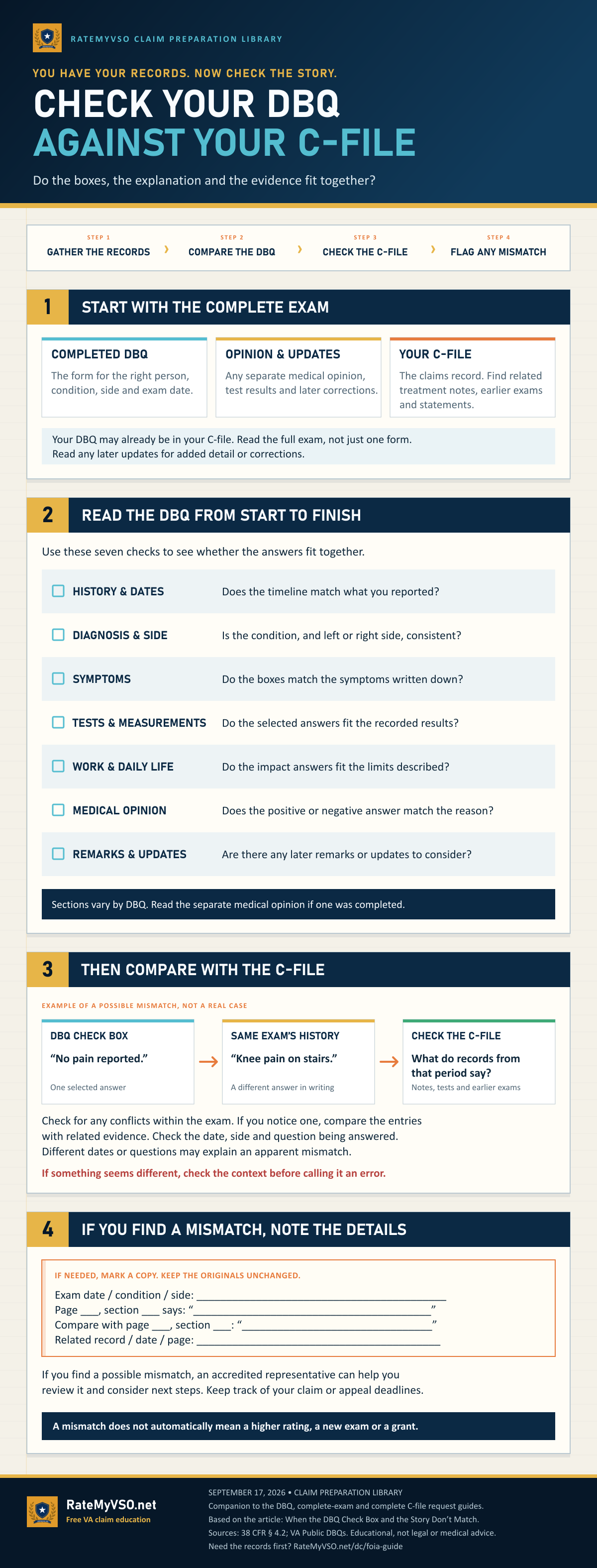
Use this guide to compare the exam's answers with your records and note any possible mismatch.
Download PDF Read the guide and request your recordsDo not stop after finding one favorable sentence. Check the report to see if another section limits, explains, or contradicts it.
What to do if the sections do not match
First, preserve the exact language. Identify the page, section, selected answer, and sentence involved in the conflict. “The examination was bad” is difficult to check. “Section III states there’s no instability, but Section VI shows 1+ instability in every tested plane.”
Second, compare the conflicting entries with the evidence already in the file. Treatment records, imaging, tests, past exams, and clear statements help identify which entry fits the rest of the record.
Third, discuss the conflict with an accredited representative. The right response depends on where the claim is in the process. It also depends on if the process requires new evidence. A contradiction may need clarification, a fresh look, a private DBQ, a medical opinion, or an argument for a specific reading of the current report. It does not automatically determine which review option is appropriate.
If you don't have the completed examination report, the VA says you can request it. Veterans can get examination reports and other compensation records by submitting a Privacy Act or Freedom of Information Act request. Use VA Form 20-10206 for this.
RateMyVSO’s DBQ Guide explains the organization of these forms. The Bad C&P Examiner Guide shows the difference between an unfavorable and an inadequate exam. How the VA Weighs Medical Opinions explains why a solid rationale is usually more important than a bare conclusion.
What this research can and cannot prove
The 49 confirmed decisions show that internal DBQ conflicts exist across various conditions, types of medical findings, and years. They show several consequences: the Board may resolve the conflict, discount the examination, or remand the claim.
The research does not show how often examiners make these mistakes nationwide. It also does not show that contract examiners make them more often than VA clinicians or private providers. The decisions often don’t reveal who hired the examiner. Also, published Board decisions represent only a small part of the claims system.
Individual Board decisions are also nonprecedential. A result in one Veteran’s case does not need the same result in another case.
What this research tells us
A DBQ is not one answer. Its history, symptoms, measurements, functional-impact findings, medical opinion, rationale, and remarks are supposed to fit together.
Decision 21012703 shows why that matters. The examiner recorded suicidal thoughts in the report but did not select suicidal ideation on the symptom checklist. The Board read the full record and resolved that conflict in the Veteran’s favor.
The other decisions did not all end that way. The Board sometimes accepted the explanation over the selected box. It sometimes rejected a favorable selection that the rest of the examination did not support. When the intended answer remained unclear, the Board sent the claim back for clarification or another examination.
The practical lesson is simple: do not stop at the diagnosis, the final paragraph, or the box that appears to help the claim. Compare the sections. If they tell different stories, identify the exact conflict and compare it with the evidence in the C-file.
Questions Veterans commonly ask
Does a contradictory DBQ automatically need a new examination?
No. Some conflicts can be solved by reading the entire report. This is true when the examiner’s intended answer is clear through their reasoning. If the VA can’t understand what the examiner meant or if some rating info is missing, they may need clarification or a new exam.
Should the narrative always take precedence over a checkbox?
No. The Board evaluates the entire report and the rest of the evidence. A well-supported explanation often matters more than a simple choice. However, a narrative might still be lacking or not backed up. The question is whether the examination presents a consistent, medically supported picture.
Can someone still reject a favorable check box?
Yes. Some decisions included choices that didn't fit the measurements, observations, or other findings from the examiner. The Board discounted those boxes because the rest of the report did not support them.
How can I get a copy of my completed C&P examination report or DBQ?
Veterans can ask for copies of claim exams, C-files, and other records. They can do this through a Privacy Act or Freedom of Information Act request. Just use VA Form 20-10206. An accredited representative may also review records in the claims file.
Are the 49 Board decisions proof that DBQ contradictions are common?
They prove the problem recurs, but they do not establish a national prevalence rate. The search examined published Board decisions, not all DBQs. The 49 cases represent a documented minimum from the decisions reviewed.
Illustrative Board decisions
| Citation | Internal conflict | Board treatment relevant to this Article |
|---|---|---|
| 21012703 | Suicidal ideation documented in prose but absent from symptom checklist | Board recognized apparent error and awarded a 70-percent rating |
| 20073236 | Negative nexus selection; positive individualized rationale | Board treated negative language as clerical error and granted |
| A25034016 | Negative knee nexus box; positive nexus rationale | Remanded for clarification |
| 20031051 | “No” instability selected; measurable instability recorded | Examination found self-contradictory; remand included |
| 20053382 | No chronic fatigue syndrome diagnosis; continuous medication for it selected | Board required clarification |
| A26022561 | PTSD symptoms documented in narrative; corresponding criteria marked absent | Examination found internally inconsistent and remanded |
| 18110541 | Favorable scar selection contradicted by measurements and observations | Board treated the selection as error and denied a compensable rating |
Primary sources
- 38 C.F.R. § 4.2: Interpretation of examination reports
- Public Disability Benefits Questionnaires: Veterans Benefits Administration
- VA claim examinations
- Request personal records with VA Form 20-10206
- GAO-25-107483: VA Disability Benefits: Additional Oversight and Information Could Improve Quality of Contracted Exams for Veterans
- Bankhead v. Shulkin, 29 Vet. App. 10 (2017)
- Barr v. Nicholson, 21 Vet. App. 303 (2007)
Research disclosure
RateMyVSO searched a local indexed collection of published Board decisions using separate full-decision, findings, and ruling indexes. Candidate decisions were identified through multiple phrase and proximity searches, deduplicated by decision, and then reviewed against the complete decision text. The research count is reproducible within the collection but remains subject to publication, wording, and search-method limitations.
Individual Board decisions are nonprecedential and apply only to the cases decided. This Article provides general educational information, not legal or medical advice.