How VA Raters Weigh Medical Opinions
The single most-misunderstood part of the VA claims process is what happens when a Compensation and Pension (C&P) examiner says one thing and a private doctor's nexus letter or Disability Benefits Questionnaire (DBQ) says the opposite. Veterans often assume the C&P examiner wins by default. The regulation says otherwise. This guide explains the five-factor probative-value test the rater is supposed to apply, the controlling caselaw, what makes a private opinion beat a C&P (and vice versa), and two worked examples.

Section 1: The Governing Rule, 38 CFR 4.6
The rater's command is in 38 CFR § 4.6:
The instruction is to weigh, not count. There is no presumption favoring either the C&P examiner or a private provider. The statutory layer at 38 U.S.C. § 5107(b) adds the benefit-of-the-doubt rule: when the evidence is in approximate balance, the issue resolves in the veteran's favor.
The companion regulation at 38 CFR § 3.326 says explicitly that VA may accept a private examination or nexus opinion in lieu of a C&P exam when the private report is "otherwise adequate for rating purposes." A well-prepared private DBQ is not a second-class document. It is a primary evidence source the rater is required to weigh on the same terms as the VA's own exam.
Section 2: The Five Nieves-Rodriguez Factors
The Veterans Court spelled out the probative-value test in Nieves-Rodriguez v. Peake, 22 Vet. App. 295 (2008). The Court's killer line:
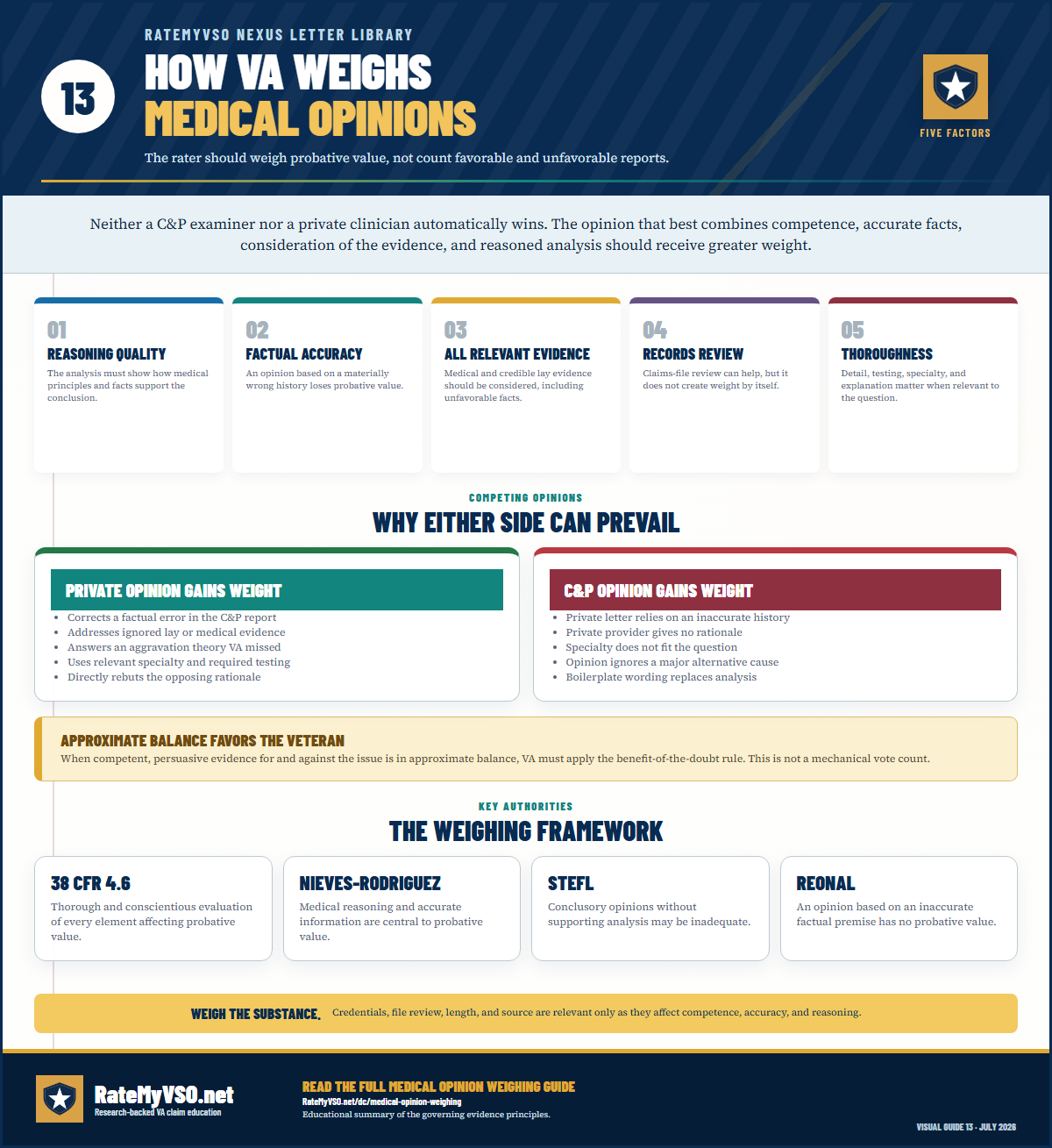
The factors apply equally to a VA examiner and a private provider:
Reasoning quality
The opinion must connect data to conclusion through a reasoned medical explanation. Bare conclusions ("less likely than not, based on my evaluation") get no probative weight on their own.
Factual accuracy
The opinion must be built on a factually correct premise. An opinion that assumes the veteran reported no in-service complaints when service treatment records actually show three entries has no probative value under Reonal v. Brown, 5 Vet. App. 458 (1993).
Consideration of all evidence
The opinion must address the lay and medical evidence in the record. Selective reading lowers the weight. An examiner who ignores credible buddy statements about ongoing symptoms can be challenged under Buchanan v. Nicholson, 451 F.3d 1331 (Fed. Cir. 2006).
Claims-file review
Helpful but not required for private opinions. Nieves-Rodriguez expressly rejected the idea that claims-file review by itself gives an opinion probative value. What matters is whether the provider had enough information to write a factually accurate, reasoned opinion. A private opinion that lists the records reviewed (STRs, prior C&P, civilian medical, lay statements) satisfies this factor without literal possession of the full C-file.
Thoroughness and detail
Definitive opinions with detailed rationale beat conclusory ones. The C&P examiner who writes a single sentence loses to the private specialist who writes a paragraph of mechanism, continuity, and literature citations, even if the C&P examiner has stronger credentials.
Section 3: The Other Controlling Cases
The rater applies a cluster of CAVC and Federal Circuit holdings alongside Nieves-Rodriguez:
| Case | Holding (one line) |
|---|---|
| Reonal v. Brown, 5 Vet. App. 458 (1993) | Opinion based on a factually inaccurate premise has no probative value at all. Applies to either side. |
| Stefl v. Nicholson, 21 Vet. App. 120 (2007) | Conclusory opinions without supporting rationale are inadequate. The rater must order a new exam or weigh the conclusory opinion at zero. |
| Monzingo v. Shinseki, 26 Vet. App. 97 (2012) | The reasoning of the opinion must be visible to the rater. "I considered the evidence" without explaining how is not enough. |
| Acevedo v. Shinseki, 25 Vet. App. 286 (2012) | Examiners are not held to the full Board reasons-or-bases standard. Their reports must still be intelligible enough to weigh. |
| Wise v. Shinseki, 26 Vet. App. 517 (2014) | When the medical evidence is in approximate balance, the benefit-of-the-doubt rule controls. Scientific certainty is not required; a plausible link with reasoned support carries the burden. |
| Bloom v. West, 12 Vet. App. 185 (1999) | Speculative or equivocal medical opinions ("it could be related") generally cannot establish nexus on their own. |
| Buchanan v. Nicholson, 451 F.3d 1331 (Fed. Cir. 2006) | The rater may not categorically reject lay statements about observable symptoms simply because they lack medical-records support. |
Section 4: How M21-1 Codifies the Test
VA's adjudication procedures manual translates the caselaw into rater checkpoints:
- M21-1 Part IV, Subpart i, Chapter 1, Section A: Duty to Assist With Providing a Medical Examination or Opinion. Defines when VA is obligated to order a C&P.
- M21-1 Part IV, Subpart i, Chapter 1, Section B: Evidentiary Standards for Finding an Examination or Opinion Necessary. Governs when a new exam is required if a private opinion raises an issue the prior C&P did not address.
- M21-1 Part IV, Subpart i, Chapter 3, Section A: General Criteria for Sufficiency of Examination Reports. The rater's sufficiency checklist for both VA and private reports.
- M21-1 Part IV, Subpart i, Chapter 3, Section B: Examination Sufficiency for Specific Disabilities. Per-condition required findings (range of motion for orthopedic, audiograms for hearing, sleep study for sleep apnea, etc.).
- M21-1 Part IV, Subpart i, Chapter 3, Section C: Insufficient Examinations. Rater's options when a C&P exam fails the sufficiency criteria.
- M21-1 Part V, Subpart ii, Chapter 1, Section A: Principles of Reviewing and Weighing Evidence. The rater-side weighing playbook.
- M21-1 Part V, Subpart iv, Chapter 1, Section A: Completing the Rating Decision Narrative. Tells raters to document the weighing of competing opinions in the Reasons and Bases. A bare-conclusion narrative ("we found the C&P opinion more persuasive") is itself appealable.
Examiner credential rules that come up most
Some DBQs have hard credential requirements that act as a floor on probative value:
- Hearing loss DBQ: must be completed by a state-licensed audiologist. Anyone else is presumed inadequate.
- Tinnitus DBQ: may be completed by an audiologist or, if a hearing-loss exam is already of record, by a non-audiologist clinician.
- Mental-health DBQ: psychiatrist, psychologist, or other doctorate-level mental-health professional. The 2024 revision of VA Form 21-0781 expanded the qualifying clinician list slightly but the C&P side still uses the same credential floor.
- TBI DBQ: must be a neurologist, neurosurgeon, physiatrist, or psychiatrist, per the residual-rating regulation at 38 CFR § 4.124a.
Section 5: When the C&P Examiner Wins
Patterns from rating decisions and Board opinions where the rater chose the C&P examiner over the private evidence:
- The private opinion is conclusory. "Based on my evaluation, this veteran's condition is service-connected." No rationale. Stefl-bad. Low or zero probative weight.
- No claims-file review documented. Not strictly required, but the absence of any indication the provider knew what was in the record (no recital of STR entries, no mention of prior C&P, no MOS context) makes the opinion look like it was written without the record.
- Factually inaccurate premise. "Veteran reports no in-service treatment" when STRs actually show three entries. Reonal-bad. Discounted entirely.
- Wrong legal standard. "Possible," "probable," "consistent with," or "could be related" instead of "at least as likely as not." Bloom-style speculative language fails to establish nexus.
- Generalist opinion on a specialist condition. A family-medicine NP opining on combat-related PTSD diagnostic criteria, or a chiropractor opining on neurosurgical pathology, loses to a board-certified specialist on the VA side.
- No symptom-specific functional analysis. Particularly for mental-health and orthopedic claims where the rating formula keys off occupational and social impairment or functional limitation, a private opinion that doesn't address those measures loses to a C&P examiner who did.
- Internal contradiction. Private letter concludes service-connection but cites symptoms beginning 15 years post-discharge with no continuity rationale. Internal inconsistency = reduced weight.
- Boilerplate template language. Identical language across multiple veterans' nexus letters from the same provider flags the opinion as form-driven rather than file-specific.
Section 6: When the Private Doctor Wins
Inverse patterns where the rater chose the private opinion over the C&P examiner:
- C&P opinion is conclusory. Examiner wrote "less likely than not" with no rationale. Stefl-bad on the VA side. A well-reasoned private opinion controls.
- C&P examiner relied on a wrong fact. Common: examiner misread a date in the STRs, or assumed a post-service onset when the records show in-service complaints. Reonal-bad on the VA side.
- C&P examiner ignored lay evidence. Credible buddy statements or veteran statements aren't mentioned in the report. Buchanan-style failure. Private opinion that integrates the lay evidence beats it.
- C&P examiner failed to consider an aggravation theory. Examiner addressed only direct service connection. Private opinion addresses aggravation by a service-connected condition under 38 CFR § 3.310. Raises a theory the C&P never reached.
- Specialist outranks generalist. Private board-certified specialist with peer-reviewed citations beats a VA examiner who is a general medical officer or contract nurse practitioner on a condition outside their specialty.
- C&P examiner did not perform a required test. Sleep apnea claim without a sleep study, hearing loss claim without an audiogram, knee claim without goniometer ROM measurement. The VA exam is insufficient under M21-1 IV.i.3.B. A complete private DBQ controls.
- Private DBQ aligns with VA's own template. Standardized DBQ format makes the private opinion legible to the rater. A private psychiatrist who completes the official PTSD Initial DBQ and answers every functional-impairment question is in the rater's preferred format.
- Private opinion explicitly rebuts the C&P reasoning. The strongest private evidence identifies the C&P's error in fact-gathering, analysis, or legal framing. Doesn't merely disagree.
Section 7: A Tie Is a Grant
When the rater concludes both opinions are well-reasoned, factually accurate, and credentialed, and they reach opposite conclusions, the case is in approximate balance. Under 38 U.S.C. § 5107(b) and 38 CFR § 3.102, the rater must resolve the question in the veteran's favor.
A well-drafted private nexus letter does not need to "beat" the C&P. It only needs to tie. This is the most important strategic insight from the Veterans Court's caselaw and the one that veterans most often miss.
Section 8: What a Winning Private Nexus Letter Looks Like
Based on the patterns above, a private nexus letter that prevails (or ties) a C&P examiner generally has these seven features:
- Provider identification with credentials. "Dr. Jane Smith, MD, Board-Certified Orthopedic Surgeon, FAAOS, 22 years post-residency." Specialty matches the condition.
- Explicit records-review statement. "I reviewed the following: service treatment records dated 2003 to 2008, post-service primary-care records 2008 to 2024, three prior C&P examinations, and lay statements from PFC Doe and SGT Roe." Tracking what was reviewed proves the opinion was built on the record.
- Recitation of the pertinent facts. Two or three sentences summarizing the veteran's history in the provider's own words. Demonstrates factual accuracy under Reonal.
- The legal-standard sentence, verbatim. "It is my opinion that the veteran's [condition] is at least as likely as not (50 percent probability or greater) related to [in-service event]." No softer language.
- A rationale paragraph that links the facts. Service history, then mechanism, then continuity, then current diagnosis. Cite peer-reviewed literature when the link is non-obvious. This is the Nieves-Rodriguez core.
- Direct engagement with the C&P examiner's contrary opinion. "The prior C&P examiner concluded [X], but that conclusion overlooks [Y] documented at [STR cite] and assumes [Z], which is inconsistent with the medical literature on [topic]."
- Signed, dated, with provider's NPI and contact information. Authenticity markers.
See the Nexus Letters Guide for sample templates and the DBQ Guide for the standardized form layouts a private provider can use.
Section 9: Two Worked Examples
Both examples are fictional. The facts are illustrative and resemble patterns from many real Board decisions, but no real veteran is described.
Example 1: Private orthopedic surgeon beats a contract nurse practitioner Private Wins
Facts. Veteran Carlos, an infantry sergeant 2003 to 2010, claims service connection for chronic right-knee pain. STRs show two sick-call entries (2006 and 2008) for "knee pain after PT" and one entry for a 6-week light-duty profile. Veteran did not pursue treatment after discharge until 2024 when a new civilian orthopedist diagnosed early degenerative joint disease and recommended a partial meniscectomy.
The C&P examiner. A contract nurse practitioner performed a 12-minute exam, did not perform goniometer range-of-motion testing, and concluded: "Less likely than not related to service. No continuity documented in claims file." No further rationale.
The private opinion. Dr. Patel, MD, board-certified orthopedic surgeon with 18 years post-residency, completed VA Form 21-0960M (the standard knee DBQ), reviewed the STRs and the C&P report, performed goniometer ROM testing (flexion 105 degrees, extension 0 degrees, with painful motion at 95), documented MRI findings consistent with chronic loading injury, and wrote a one-paragraph rationale connecting the 2006 and 2008 in-service injuries to the current degenerative pattern. Concluded with: "It is my opinion that the veteran's right-knee degenerative joint disease is at least as likely as not (50 percent probability or greater) related to the in-service knee injuries documented at STR entries 2006-04 and 2008-09."
Why the private opinion wins. The C&P report is conclusory under Stefl, missed the required ROM testing under M21-1 IV.i.3.B (knee claims), and ignored the favorable lay evidence. The private opinion satisfies all five Nieves-Rodriguez factors: board-certified specialist, explicit records review, accurate facts, the legal standard verbatim, and a reasoned rationale. The rater grants service connection and assigns at least 10 percent for painful motion under 38 CFR 4.59.
Example 2: VA examiner beats a generalist nexus letter C&P Wins
Facts. Veteran Renee, a logistics specialist 1995 to 2003, claims service connection for sleep apnea. STRs are silent. Veteran was diagnosed with obstructive sleep apnea in 2022 via a sleep study and is now on CPAP. Veteran also has a 70 percent service-connected PTSD rating since 2015.
The C&P examiner. A board-certified pulmonologist conducted the exam, reviewed the entire claims file including the prior PTSD C&P, addressed both direct service connection and secondary service connection under 38 CFR 3.310. Concluded: "Direct service connection less likely than not (no in-service evidence of sleep disturbance documented in STRs). Secondary service connection also less likely than not, because the veteran's BMI increased from 24 to 36 between 2010 and 2020, well after PTSD onset, and peer-reviewed literature identifies BMI as the dominant risk factor in this population." Cited two studies.
The private opinion. Veteran's family-medicine nurse practitioner wrote a one-page letter: "Based on my evaluation of this patient, her sleep apnea is service-connected. She has PTSD from her service, and sleep apnea is often related to PTSD." No record-review statement, no specialty in pulmonology or psychiatry, no functional analysis, no engagement with the BMI question, no legal-standard sentence ("at least as likely as not" not used).
Why the C&P opinion wins. The C&P examiner satisfies all five Nieves-Rodriguez factors: specialist credentials, explicit records review, accurate facts, reasoned rationale, and direct engagement with the secondary theory. The private opinion fails on credentials (generalist), records review (not documented), reasoning (conclusory), and legal standard (missing). Under Stefl and Nieves-Rodriguez, the rater assigns the private opinion low probative weight and denies. The cure is not more lay testimony, it is a new private opinion from a pulmonologist or sleep-medicine specialist that directly rebuts the BMI argument. See the Sleep Apnea Claims Guide and the Supplemental Claim Guide.
Section 10: BVA Outcomes on Opinion Conflicts
Source: RateMyVSO Board of Veterans' Appeals index, decisions 2022 to present.
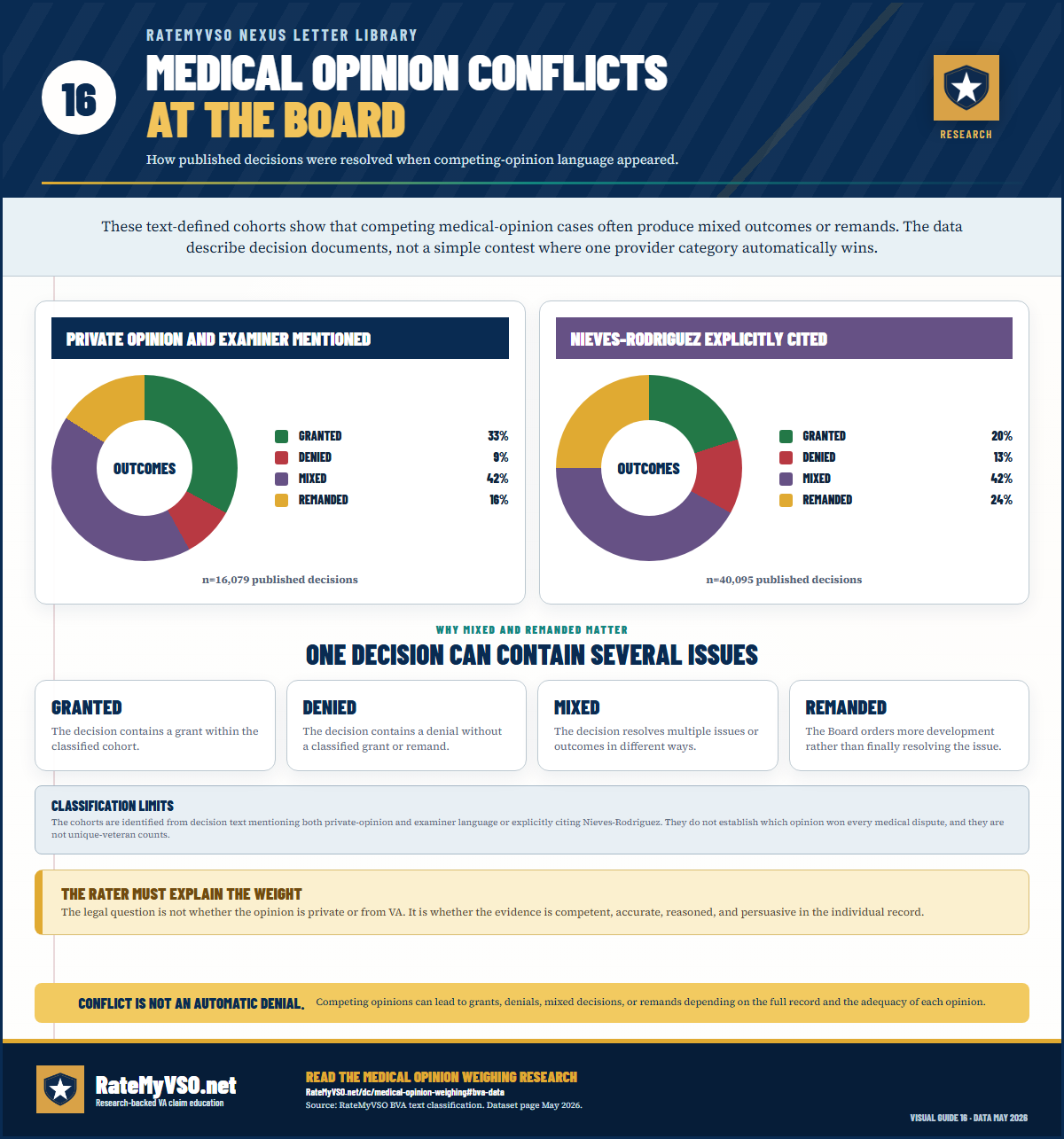
Decisions mentioning both "private opinion" and "examiner" (n = 16,079)
75 percent full or partial grant (granted plus mixed). The 9 percent straight-denial rate is materially lower than the general-claims baseline, indicating that when the dispute is explicitly framed as private versus VA opinion at the Board, the veteran's odds are good.
Decisions explicitly citing Nieves-Rodriguez (n = 40,095)
The 24 percent remand rate is the notable number, roughly double the overall stressor-claims remand rate. When Nieves-Rodriguez is in play, the Board often finds the Regional Office's weighing analysis insufficient and sends the case back for a more rigorous treatment of the competing opinions.
Search the corpus at BVA Search. Methodology at BVA Insights.
Sources
- 38 U.S.C. § 5107(b): Benefit-of-the-doubt rule.
- 38 CFR § 3.102: Reasonable doubt.
- 38 CFR § 3.159: VA's duty to assist.
- 38 CFR § 3.326: Private examination may be accepted in lieu of a VA exam when adequate for rating purposes.
- 38 CFR § 3.310: Secondary service connection.
- 38 CFR § 4.6: Evaluation of evidence (weigh, do not count).
- 38 CFR § 4.59: Painful motion minimum 10 percent.
- 38 CFR § 4.124a: TBI residual rating and examiner-credential requirement.
- M21-1 Part IV, Subpart i, Chapter 1, Section A: Duty to Assist With Providing a Medical Examination or Opinion.
- M21-1 Part IV, Subpart i, Chapter 1, Section B: Evidentiary Standards for Finding an Examination or Opinion Necessary.
- M21-1 Part IV, Subpart i, Chapter 3, Section A: General Criteria for Sufficiency of Examination Reports.
- M21-1 Part IV, Subpart i, Chapter 3, Section B: Examination Sufficiency for Specific Disabilities.
- M21-1 Part IV, Subpart i, Chapter 3, Section C: Insufficient Examinations.
- M21-1 Part V, Subpart ii, Chapter 1, Section A: Principles of Reviewing and Weighing Evidence.
- M21-1 Part V, Subpart iv, Chapter 1, Section A: Completing the Rating Decision Narrative.
- Nieves-Rodriguez v. Peake, 22 Vet. App. 295 (2008): five-factor probative-value test.
- Reonal v. Brown, 5 Vet. App. 458 (1993): factually inaccurate premise has no probative value.
- Stefl v. Nicholson, 21 Vet. App. 120 (2007): conclusory opinions inadequate.
- Monzingo v. Shinseki, 26 Vet. App. 97 (2012): reasoning must be visible.
- Acevedo v. Shinseki, 25 Vet. App. 286 (2012): examiner not held to Board reasons-or-bases standard.
- Wise v. Shinseki, 26 Vet. App. 517 (2014): benefit-of-the-doubt in approximate-balance cases.
- Bloom v. West, 12 Vet. App. 185 (1999): speculative opinions cannot establish nexus.
- Buchanan v. Nicholson, 451 F.3d 1331 (Fed. Cir. 2006): lay testimony is competent evidence of observable symptoms.