The Canceled Surgery That Rewrote VA’s Secondary-Claim Rule
“But for” is now the standard for secondary service connection, and it covers conditions a service-connected disability keeps you from treating. Here is what the rule says, where it came from, and what the Board’s numbers show.
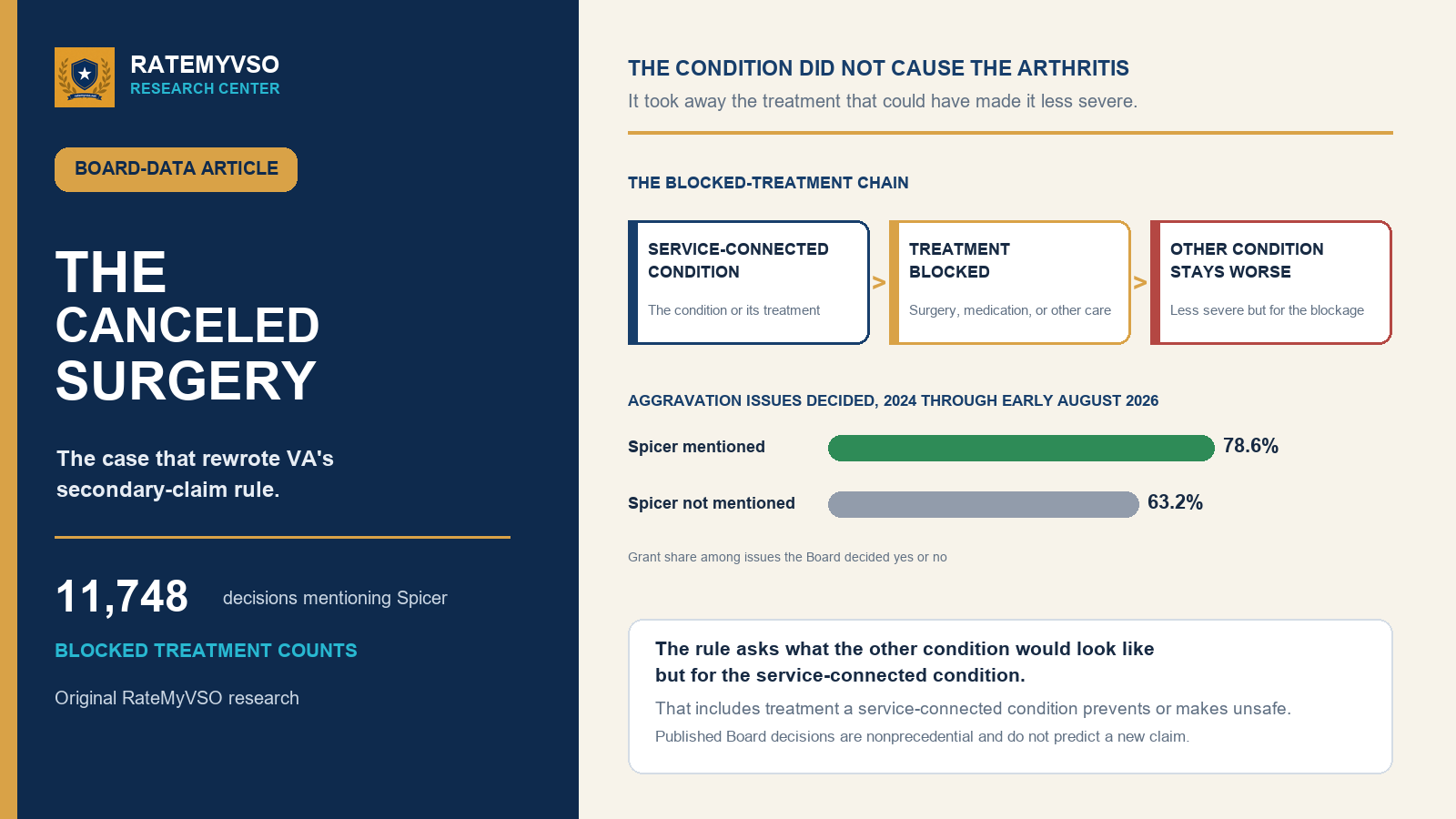
In May 2026, VA revised the section of its adjudication manual that tells raters how to decide secondary service-connection claims. The new instruction: award service connection for disabilities that “would not have occurred but for” a service-connected disability, and for any condition that “would have been less severe but for” one, explicitly including the situation where a service-connected disability “has interfered with or impeded treatment” for the other condition.
That sentence traces back to one veteran, one canceled knee surgery, and a March 2023 decision of the Federal Circuit whose name now appears in more than 11,700 published Board of Veterans’ Appeals decisions.
One veteran, one canceled surgery
Luther D. Spicer, Jr. served in the Air Force in the late 1950s and was exposed to benzene in aircraft fuel. Decades later he developed chronic myeloid leukemia, which VA service-connected at 100 percent. He also developed arthritis in both knees, unrelated to service, severe enough that he used a wheelchair.
Knee replacement surgery would have helped. It was scheduled, then canceled: his leukemia medication keeps his red blood cell level permanently below what surgeons require, and he will take that medication for life. His service-connected cancer did not cause his knee arthritis. It took away the treatment for it.
VA denied secondary service connection for the knees. The Board agreed, writing that an inability to undergo surgery because of a service-connected condition was not something the secondary-connection rules contemplated. The Court of Appeals for Veterans Claims affirmed. The Federal Circuit did not.
What the court held
In Spicer v. McDonough, 61 F.4th 1360 (Fed. Cir. 2023), the court read the basic compensation statute, 38 U.S.C. § 1110, and stopped at three words: “resulting from.” Compensation is paid for “disability resulting from” injury or disease in service. The court held that “resulting from” means but-for causation, a deliberately broad standard: if the disability would not be what it is but for the service-connected condition, the statute reaches it.
Two sentences carry the holding. Section 1110 “plainly requires compensation when a service-connected disease or injury is a but-for cause of a present-day disability,” and that language “applies to the natural progression of a condition not caused by a service-connected injury or disease, but that nonetheless would have been less severe were it not for the service-connected disability.” Compensation covers a worsening of functionality whether it arrives “through an inability to treat or a more direct, etiological cause.”
The court also addressed VA’s counterargument that measuring a never-performed surgery’s benefit is speculative: imagining the world without the cause is what but-for causation is, and VA already does exactly this kind of analysis elsewhere, for example when it rates around the improving effect of medication or assesses what would have happened absent medical negligence. And where VA’s regulation on aggravation, 38 CFR 3.310(b), was applied to block the theory, the court called the regulation “unlawful as inconsistent with 38 U.S.C. § 1110.”
As a precedential ruling interpreting a compensation statute, this holding bound VA as an agency from the date it issued, March 8, 2023, not only the Board of Veterans’ Appeals. The manual catch-up described below is a guidance lag, not a statement that the old, narrower rule was legally correct in the meantime.
What the rule covers now
VA’s revised manual section (M21-1, Part V, Subpart ii, Chapter 2, Section D, change date May 1, 2026) instructs raters to grant secondary service connection in three situations:
- Caused: the second condition is the result of, or would not have occurred but for, a service-connected disability. This is the classic secondary claim, and it does not require the primary condition to have been service-connected, or even diagnosed, when the secondary condition began.
- Worsened: a non-service-connected condition increased in severity because of a service-connected disability. Under the manual, VA “will no longer consider natural progress” of the non-service-connected condition in these claims, and the worsening does not have to be permanent.
- Less severe but for, including blocked treatment: the non-service-connected condition would be less severe but for the service-connected disability, expressly including interference with or impediment of its treatment. Medication conflicts, surgery ineligibility, and treatment contraindications now have a named home in the manual.
Two older mechanics survive intact. Aggravation claims still require a baseline: evidence of how severe the condition was before the worsening began, because the rating pays only the difference between baseline and current severity. If no baseline can be established after VA meets its duty to assist, the manual directs denial, and it forbids assuming a zero-percent baseline. And a grant can be worth zero percent: if the worsening is real but does not move the condition into a higher rating bracket, the manual instructs raters to grant service connection at a noncompensable rate rather than deny.
The manual also spells out what an adequate examiner’s report must now contain in an aggravation claim: the current severity of the condition, an opinion on whether any increase would not have occurred but for the service-connected disability or whether the condition would be less severe but for it (including blocked treatment), and a reasoned medical analysis behind the opinion.
What the Board’s numbers show
The manual change is only three months old, but the standard it adopts has been binding since 2023, and the published decisions show it arriving at the Board over that period.
Mentions of Spicer in Board decisions went from essentially zero before 2023 to 1,267 that year, 3,088 in 2024, 5,295 in 2025, and 1,993 through early August 2026. Nearly one in four Board decisions that decide a secondary or aggravation issue now mentions the case. (That count is a full-text search for the case name; a stricter count of decisions citing the controlling reporter, 61 F.4th 1360, is 10,789.)
Outcomes on the theory closest to Spicer’s facts have shifted with it. Of aggravation-theory issues the Board decided from 2024 through early August 2026 in decisions mentioning Spicer, 78.6 percent were granted. In decisions not mentioning it, 63.2 percent. Across all secondary and aggravation issues in that window, issues in Spicer-citing decisions were granted 48.4 percent of the time against 32.9 percent otherwise, an association that partly reflects which cases reach the merits, but a large one.
The chains the standard reaches can be long. The Federal Circuit itself pointed to examples VA already accepted: medication for a service-connected condition causing a new disability, and a service-connected disability preventing exercise, leading to obesity, leading to hypertension. The court’s point was that multi-link causation was never foreign to this system; Spicer made the outer boundary explicit.
The gap worth knowing about
There is a three-year gap in this story, but it is a guidance gap, not a legal one. Spicer bound VA, as an agency, from March 2023. The cited M21-1 section used by regional-office raters, the people who decide claims first, did not spell out the broader but-for and blocked-treatment standard until May 2026. Appeals decided during that window increasingly reached the Board, where Spicer mentions rose sharply, visible in the citation curve above.
What the data cannot show is how often, or how correctly, individual regional offices applied Spicer before their manual caught up. It can only show the timing: a growing share of secondary claims arriving at the Board across 2023 to 2026 came from a period when the rater-facing manual had not yet been updated, and the Board’s own citation rate climbed steeply over that same window.
Sources
- Spicer v. McDonough, 61 F.4th 1360 (Fed. Cir. Mar. 8, 2023), No. 2022-1239
- 38 U.S.C. § 1110; 38 U.S.C. § 1131; 38 CFR 3.310
- M21-1, Part V, Subpart ii, Chapter 2, Section D (change date May 1, 2026), VA KnowVA article 554400000180484
- Allen v. Brown, 7 Vet. App. 439 (1995); Ward v. Wilkie, 31 Vet. App. 233 (2019); Frost v. Shulkin, 29 Vet. App. 131 (2017)
- RateMyVSO analysis of the full published Board of Veterans’ Appeals corpus (1,902,270 decisions), verified against production August 10, 2026. Board-decision counts are full-text mentions of the case name, concentrated entirely in the discussion section of each decision (not the ORDER or FINDINGS OF FACT blocks); see the companion article, “The Spicer Split,” for the reporter-citation breakdown and full counting methodology.