The Spicer Split: One Ruling, Three Boards
Since a 2023 Federal Circuit ruling, Board citations of the case have grown every year, and how it lands depends on which judge signs the decision. We read the data on 11,748 decisions that mention it.
In March 2023, a federal appeals court decided a case about a canceled knee surgery. Three years later, the case’s name appears in nearly one out of every four Board of Veterans’ Appeals decisions that decide at least one secondary or aggravation issue, and its use varies sharply by judge. Some judges cite it almost every time they take up a secondary claim. Some have never cited it once. Among judges who cite it regularly, one group grants when they cite it, another remands, and a smaller third group denies.
This article reports what 1,902,270 published Board decisions show about Spicer v. McDonough: where the wave came from, what outcomes look like when the case is cited versus when it is not, and how differently individual judges put the same precedent to work.
The surgery that never happened
Luther D. Spicer, Jr. served in the Air Force from May 1958 to September 1959, where he was exposed to benzene in aircraft fuel. Decades later he developed chronic myeloid leukemia. The VA service-connected the leukemia and rated it at 100 percent.
Mr. Spicer also had arthritis in both knees, bad enough to put him in a wheelchair. The knee arthritis had nothing to do with his service. He was scheduled for knee replacement surgery, and the surgery was canceled: the medication that keeps his leukemia in check suppresses his red blood cell count below the level surgeons require. Because he is expected to stay on that medication for life, the surgery is not delayed. It is never happening.
He filed for secondary service connection for the knees. The VA regional office denied. The Board denied, writing that an inability to undergo surgery because of a service-connected condition “is not contemplated by the applicable laws or regulations to fall within the meaning of secondary service connection.” The Court of Appeals for Veterans Claims affirmed in a split decision, with the majority warning that measuring what his knees would have been after a surgery that never happened would require “conjecture or speculation.”
The Federal Circuit disagreed. In Spicer v. McDonough, 61 F.4th 1360 (Fed. Cir. 2023), a unanimous panel held that the compensation statute, 38 U.S.C. § 1110, “plainly requires compensation when a service-connected disease or injury is a but-for cause of a present-day disability.” The court wrote that this “broad language applies to the natural progression of a condition not caused by a service-connected injury or disease, but that nonetheless would have been less severe were it not for the service-connected disability.” Compensation, the court said, covers a worsening of functionality whether it comes “through an inability to treat or a more direct, etiological cause.” And to the extent VA’s own regulation, 38 CFR 3.310(b), was applied to reject that theory, the court declared the regulation “unlawful as inconsistent with 38 U.S.C. § 1110.”
The court vacated and remanded. As a precedential ruling on the meaning of a compensation statute, the decision bound VA as an agency the day it issued, not only the Board. The “but for” standard is broader than the proximate-cause standard VA had been applying to secondary claims, and it explicitly reaches situations where the service-connected condition blocks treatment for something else.
The wave
We searched the full text of every published Board decision for the case name. Before 2023, “Spicer” appears roughly 30 times a year, almost entirely as a surname in unrelated files. Then:
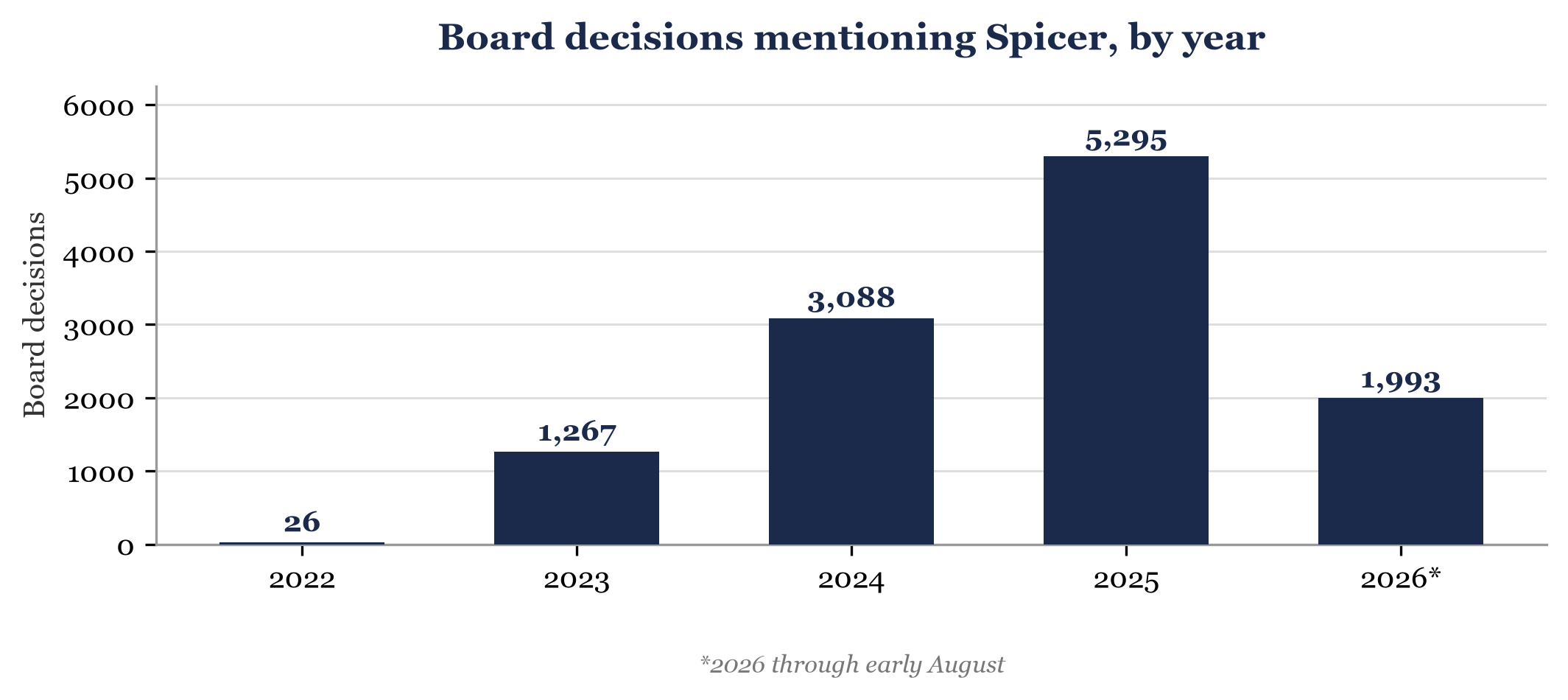
The growth was not a straight multiple: 2023 to 2024 is a 2.4-times increase, 2024 to 2025 is 1.7 times. Growth is slowing in relative terms even as raw volume keeps climbing, consistent with a precedent that is still spreading but has already reached a large share of the docket where it applies.
Measured against the decisions where it matters most, the curve is steeper. Among Board decisions that decide at least one secondary or aggravation issue, the share mentioning Spicer went from 4.9 percent in 2023 to 12.2 percent in 2024, 20.7 percent in 2025, and 23.5 percent so far in 2026. Nearly one in four.
The 11,748 figure above is a full-text search: any decision whose text contains the name “Spicer.” That is broader than a clean citation count. Of those decisions, 10,789 cite the Federal Circuit’s reporter (61 F.4th 1360), and 109 cite the lower-court reporter (34 Vet. App. 310), the opinion the Federal Circuit vacated; 64 decisions cite both. The remainder mention the case without a full reporter cite, commonly by docket number and date alone (“No. 2022-1239 (Fed. Cir. March 8, 2023)”), a pattern visible in the earliest 2023 remands, before the reporter citation had stabilized in Board drafting practice.
Our database does not treat a Board decision as one undifferentiated block of text. Every decision is split into three legally distinct zones: the ORDER (the terse disposition, “the appeal is granted”), the FINDINGS OF FACT (the Board’s numbered factual findings), and everything else, the discussion and legal reasoning that explains the ruling. We checked where Spicer citations actually live. The answer: all 11,748 of them fall in the discussion section. None appear in the ORDER block or the FINDINGS OF FACT block on their own. That makes sense once you see how the case is used, as a standard the Board applies and explains, not as a fact it finds or a one-line disposition, but it is also a useful check on the method: this article’s numbers come from decisions where Spicer is doing legal work in the reasoning, not from a stray mention in a boilerplate heading.
What happens when it is cited
We looked at every secondary or aggravation issue the Board decided from 2024 through early August 2026 and split them by whether the deciding decision mentions Spicer.
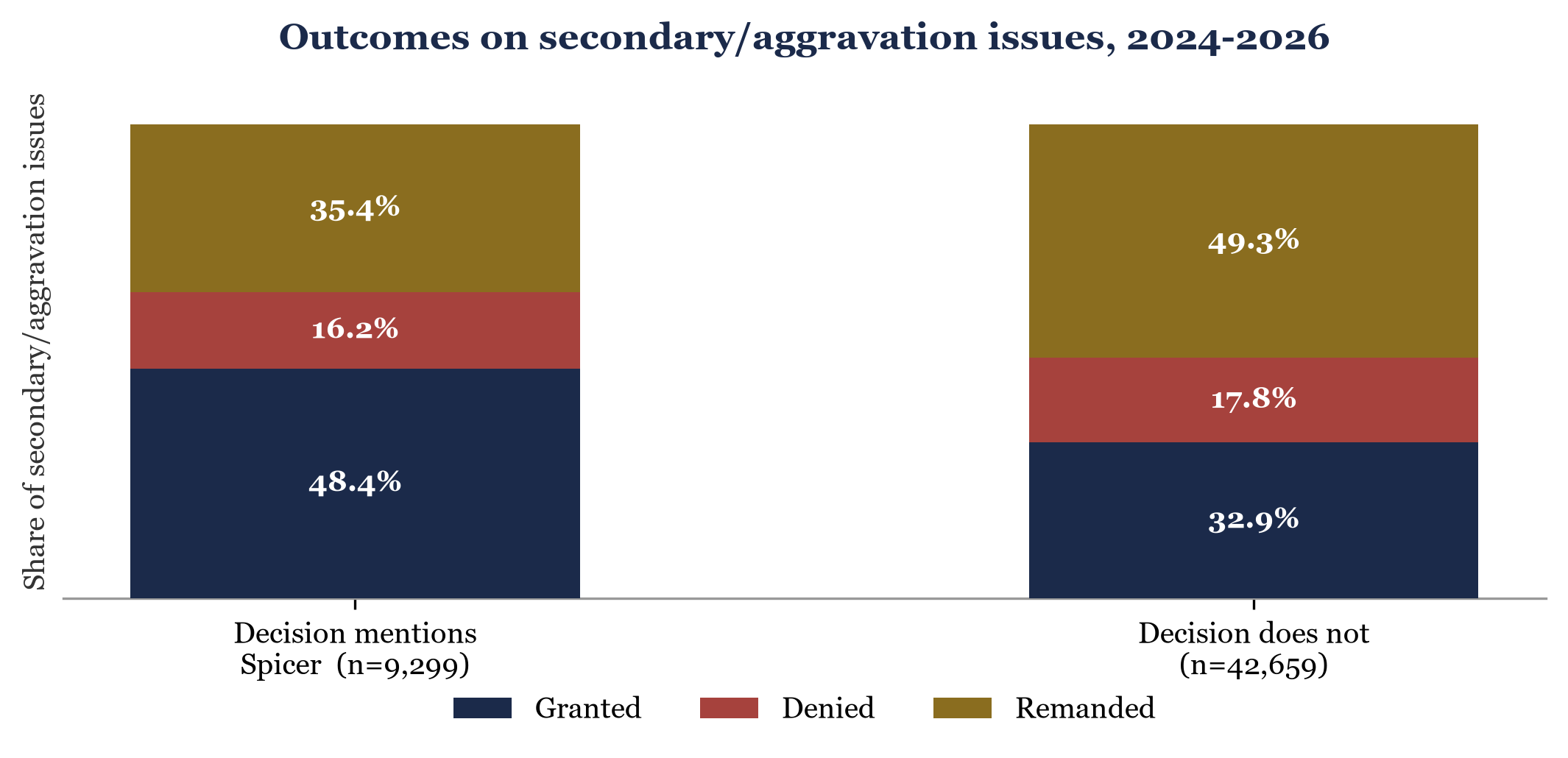
The grant gap is 15.5 points. The denial rates are nearly identical. What moves is the remand column: Spicer-citing decisions remand far less, which is consistent with the case being cited most often in decisions that reach the merits rather than send the file back for development.
On aggravation-theory issues specifically, the claims closest to Spicer’s facts, the gap is larger: 78.6 percent of aggravation issues in Spicer-citing decisions were granted (of 206 decided), against 63.2 percent when the case is not cited (of 1,181).
One honest caution before anyone reads causation into this: the citation is a property of the decision, and judges choose when to cite. A judge who engages a secondary claim on the merits is both more likely to cite the controlling precedent and more likely to produce a grant or denial instead of a remand. The gap is real; what drives it cannot be settled by counting alone.
The split
The sharper finding is not whether Spicer helps. It is how unevenly the precedent is applied across the Board’s judges.
Among the 126 Veterans Law Judges who decided at least 150 secondary or aggravation issues from 2024 through early August 2026, the share of their secondary issues decided in a Spicer-citing decision ranges from 0 percent to 75 percent. The median is 10 percent. A quarter of these judges are at 4 percent or below. At the other end, a handful cite the case in most of their secondary work.
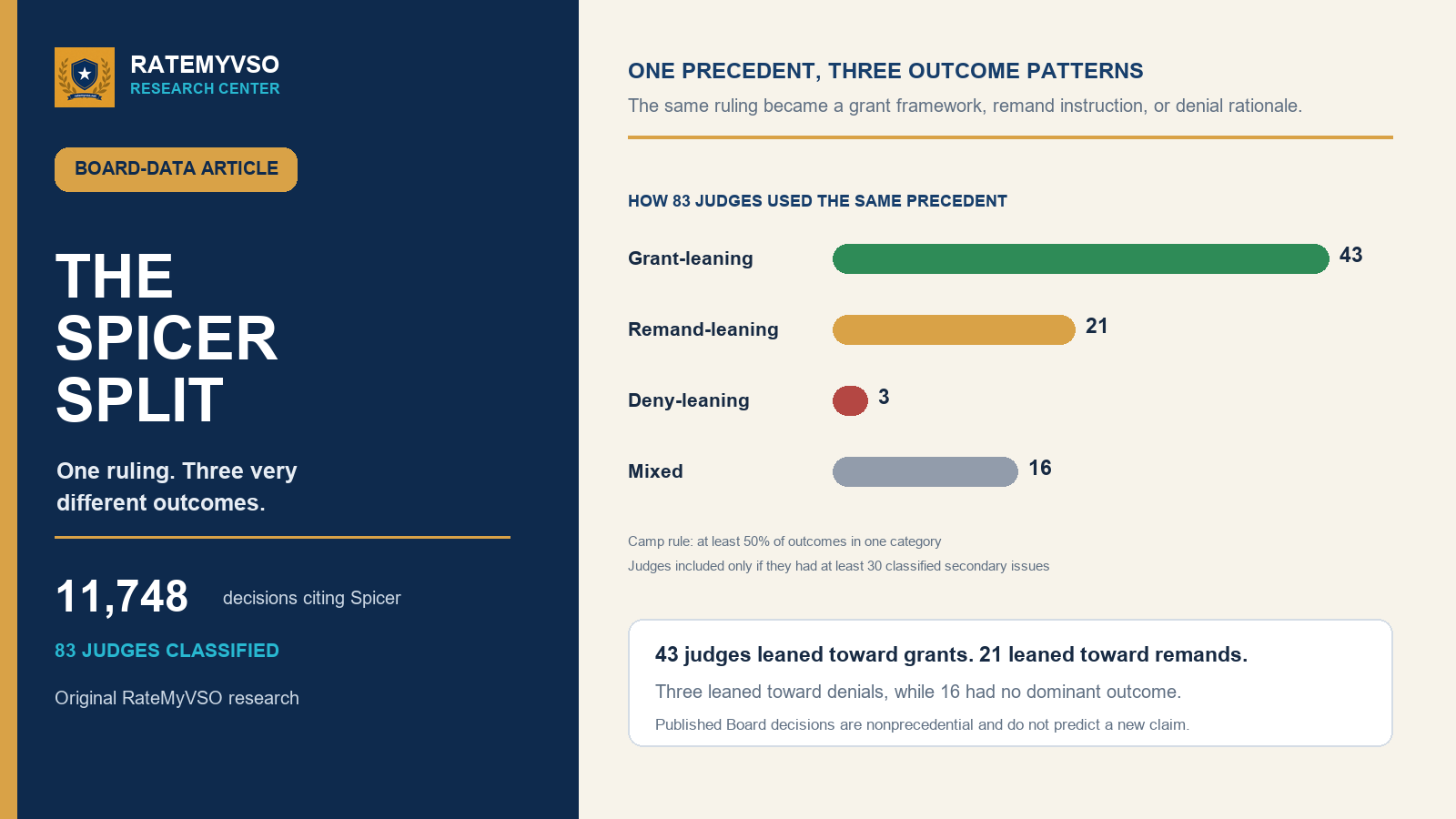
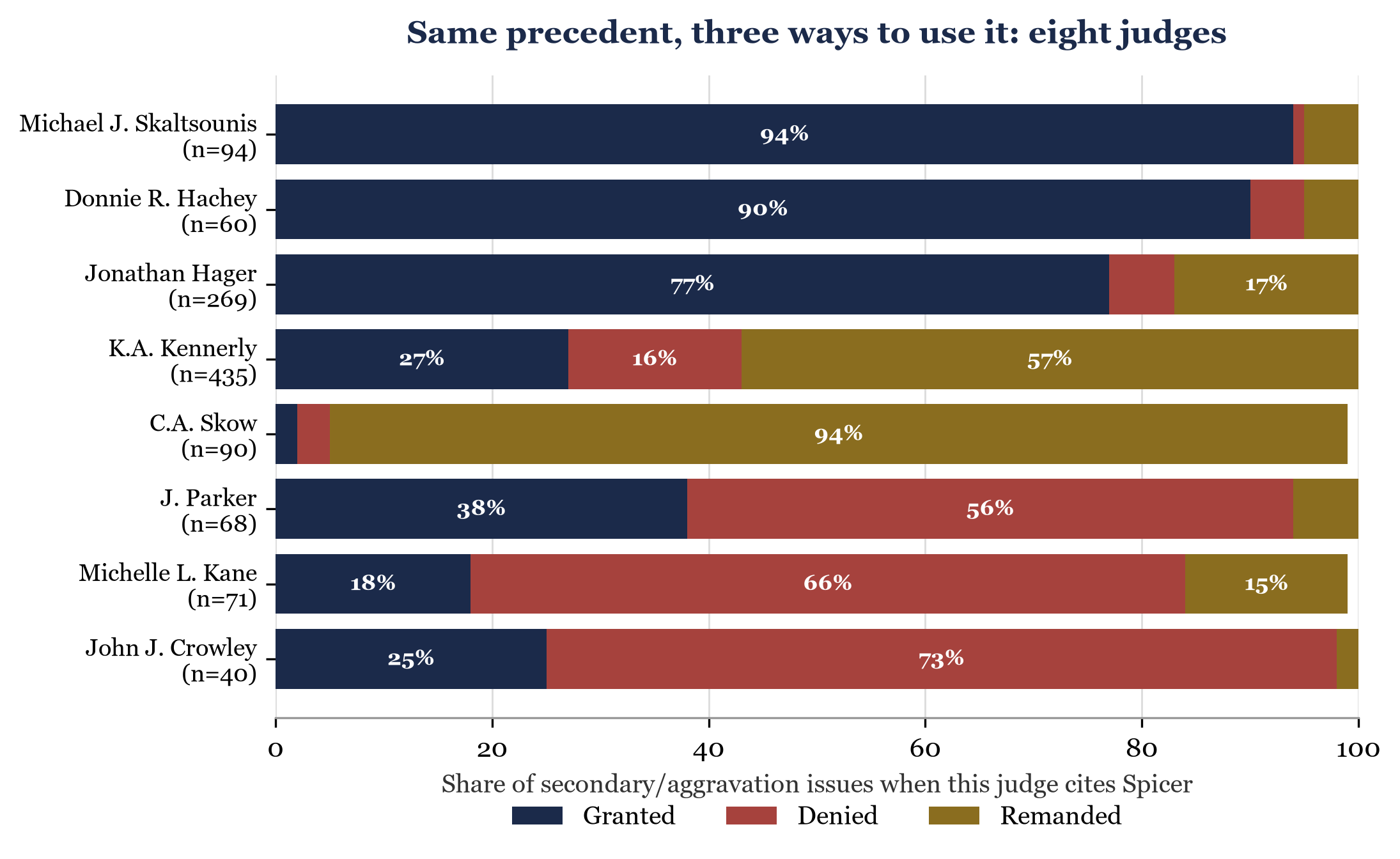
Then there is what happens when they cite it. We took the 83 judges with at least 30 secondary issues inside their own Spicer-citing decisions and sorted them by the outcome mix of those issues, using a plain majority rule: 50 percent or more granted is the grant camp, 50 percent or more remanded is the remand camp, 50 percent or more denied is the deny camp, and everyone else is mixed.
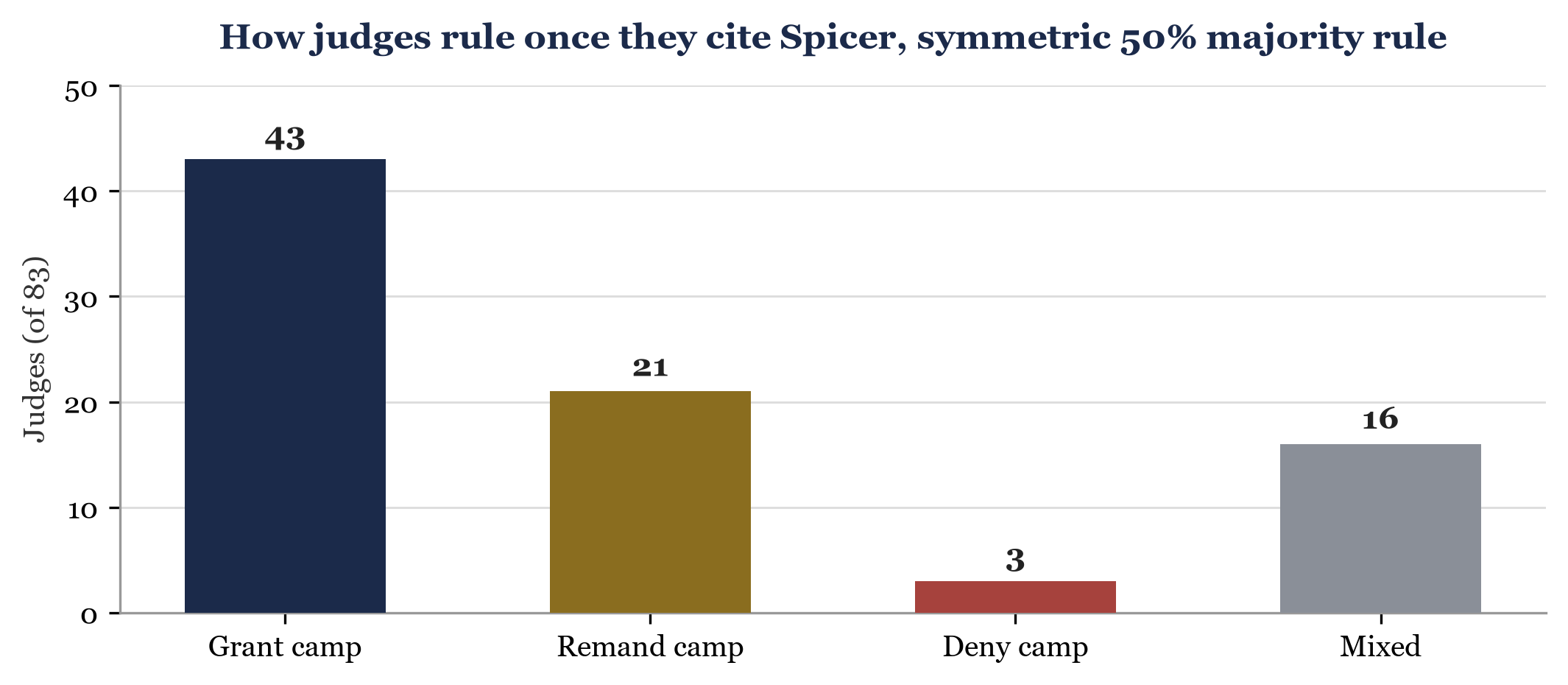
The deny camp is the smallest of the three under a plain majority rule, but the judges in it are not borderline. When Judge John J. Crowley’s decisions cite Spicer, 73 percent of the secondary issues are denied (of 40 issues). Judge Michelle L. Kane’s run 66 percent denied (of 71). Judge J. Parker’s run 56 percent denied (of 68). At the other pole, when Judge Michael J. Skaltsounis cites Spicer, the issue is granted 94 percent of the time (94 issues); Judge Donnie R. Hachey, 90 percent (60 issues); Judge Jonathan Hager, 77 percent (269 issues). And a distinct remand pattern: Judge C.A. Skow’s Spicer-citing decisions remand 94 percent of the time (90 issues); Judge K.A. Kennerly’s run 57 percent remand (435 issues).
These are all public, published, non-precedential decisions by named Veterans Law Judges, and the differences partly reflect docket composition, decision style, and when in a case’s life a judge sees it. But the spread is the story: the same two-sentence holding is functioning as a grant rationale in one office, a remand instruction generator in a second, and a denial rationale in a third.
Three ways to use one precedent
Reading the decisions shows the three modes directly.
As a grant framework. The grant camp recites Spicer as the governing standard and applies it to the record. A typical formulation, from a 2024 decision: Spicer “held that secondary service connection under 38 U.S.C. § 1110 is warranted for any increase in a nonservice-connected disability that is due to a service-connected disability, including where a service-connected disability precludes treatment for a nonservice-connected disability.”
As a remand instruction. The remand camp uses Spicer to rewrite the questions VA examiners must answer. From a 2023 remand: the examiner must say whether “current functional impairment resulting from a neurological disorder would be less severe but-for the Veteran’s service-connected PTSD.” That phrasing, “less severe but for,” is Spicer’s language turned into an exam template. Veterans in these dockets do not win or lose on Spicer; they get a new examination shaped by it.
As a denial rationale. A smaller set of decisions cites Spicer for the proposition that speculative medical opinions cannot support an award: “Speculative assessments that would require conjecture as to whether a service-connected disability caused or worsened another medical condition cannot serve as the basis for an award of disability compensation.” Decisions in this mode typically fault an opinion that says a service-connected condition “can contribute” to another condition, and deny or remand for something firmer.
That third mode carries a detail worth surfacing on its own: the “conjecture” language quoted above comes from the 2021 Veterans Court opinion in Spicer, the decision the Federal Circuit vacated, and 109 Board decisions cite that vacated reporter. The underlying evidentiary point survives through other, independent cases (Hood v. Shinseki among them), so the reasoning itself is not wrong. But the citation choice is telling: the same case name is being invoked both for the broad causation standard the Federal Circuit adopted and, in a much smaller number of decisions, for the caution-heavy framing of the opinion it vacated.
The manual catches up, three years later
The Federal Circuit decided Spicer in March 2023, and its precedential holding bound VA from that date, as an agency, not only the Board. But VA’s adjudication manual, the M21-1 that guides the regional-office raters who make the first decision on every claim, was not revised to state the broader but-for and blocked-treatment standard until May 1, 2026.
The revised manual section (M21-1, Part V, Subpart ii, Chapter 2, Section D) now instructs raters to award service connection for disabilities “that are the result of, or would not have occurred but for,” a service-connected disability, and for aggravation “where an NSC disability would have been less severe but for the SC disability, including where the SC disability has interfered with or impeded treatment for the NSC disability.” It states that VA “will no longer consider natural progress of the NSC disability” when deciding aggravation claims, and confirms that permanent worsening is not required. The baseline rules survive: a claim based on aggravation still requires establishing the pre-aggravation severity of the condition, and if no baseline can be established after VA’s duty to assist is met, the manual directs denial.
For most of this period, Spicer was visible in the Board’s published decisions before it was spelled out in the cited M21-1 section. That is a guidance lag, not a legal one: the data shows when appeals reached the Board and when the Board’s decisions started citing Spicer, and a growing share of appeals reached the Board during a period when the cited manual section did not yet state the broader standard. The data cannot show what standard any individual regional office actually applied to a given claim; it can only show that the guidance regional-office raters were handed lagged the controlling law by three years, and that the Board’s own citation rate rose sharply over exactly that window.
How we counted
Corpus: RateMyVSO’s BVA research database, currently 1,902,270 published Board decisions and growing every week. Every figure above was independently re-run against the live production database on August 10, 2026.
- Full-text mentions vs. reporter citations. “11,748 decisions” is a full-text search for the string “Spicer” across the entire decision. “10,789” and “109” are stricter substring matches for the two reporter forms (61 F.4th 1360 and 34 Vet. App. 310 respectively); 64 decisions match both. The gap between 11,748 and the reporter-form union reflects docket-only citations and other non-reporter references to the case.
- Section-scoped, not a blind text blob. Our database splits every decision into an ORDER block, a FINDINGS OF FACT block, and the discussion section, and we can search each independently. All 11,748 Spicer mentions land in the discussion section; zero appear in the ORDER or FINDINGS OF FACT blocks searched on their own. Every outcome figure in this article comes from decisions where the case is doing legal work in the Board’s reasoning.
- Decision-level vs. issue-level. Whether a decision “cites” or “mentions” Spicer is a property of the whole decision (its full text contains the name). Outcome percentages are counted at the issue level: each secondary or aggravation issue the Board decided inside that document, which can number more than one per decision.
- Outcomes counted. Granted, denied, and remanded only. Dismissed and other outcomes are excluded from the rate denominators in every table above.
- Camp thresholds. A single, symmetric rule for all three outcomes: 50 percent or more of a judge’s own cited secondary/aggravation issues in one outcome category. Judges who reach no majority are “mixed.” We tested this against an earlier asymmetric version (50/50/40) and report only the symmetric result here; the deny camp is smaller under the stricter rule (3 judges instead of 9) but the judges who remain are clear majorities (56 to 73 percent), not borderline cases.
- Minimum denominators. The citation-rate distribution (0 to 75 percent) includes judges with at least 150 secondary/aggravation issues, 2024 through early August 2026. The camp census includes judges with at least 30 such issues decided inside their own Spicer-citing decisions. Individual judge rows as low as 40 issues carry the usual small-sample caution.
- Judge names. Not normalized in the underlying database; a small number of judges appear under more than one spelling or capitalization. Named examples in this article were checked by hand.
- 2026 figures are partial. The corpus runs through early August 2026.
What this data can and cannot say
This is an observational read of published decisions. It cannot say that citing Spicer causes grants; judges select which cases to cite and which claims reach the merits. It cannot fully separate docket composition from judicial approach in the per-judge numbers, and it cannot show what legal standard any individual regional office applied to a claim before the manual caught up. Issue outcomes come from our extraction layer over the Board’s published decisions, at the confidence tiers we publish site-wide.
What it can say: a 2023 Federal Circuit decision about one veteran’s canceled knee surgery is now the most consequential citation in secondary service-connection law at the Board, its use has grown every year, its presence coincides with a 15-point higher grant rate on secondary issues, and the judges of the Board have not converged on what to do with it.
Sources
- Spicer v. McDonough, 61 F.4th 1360 (Fed. Cir. Mar. 8, 2023), No. 2022-1239 (opinion PDF, cafc.uscourts.gov)
- Spicer v. McDonough, 34 Vet. App. 310 (2021) (vacated)
- 38 U.S.C. § 1110; 38 U.S.C. § 1131; 38 CFR 3.310
- M21-1, Part V, Subpart ii, Chapter 2, Section D (change date May 1, 2026), VA KnowVA article 554400000180484
- Allen v. Brown, 7 Vet. App. 439 (1995); Ward v. Wilkie, 31 Vet. App. 233 (2019); Hood v. Shinseki, 23 Vet. App. 295 (2009)
- RateMyVSO analysis of the full published Board of Veterans’ Appeals corpus (1,902,270 decisions), verified against production August 10, 2026; quoted Board decisions A23005012, A23005130, A24021358