How the VA Medication Rule May Impact Your Claim
What Ingram means for your examination and what 6,348 Board citations can tell us

What if the medication that helps you get through the day also makes your disability look less severe on paper? In Ingram, the Court ruled that the VA cannot use that improvement against you if the rating criteria do not account for the effects of medication.
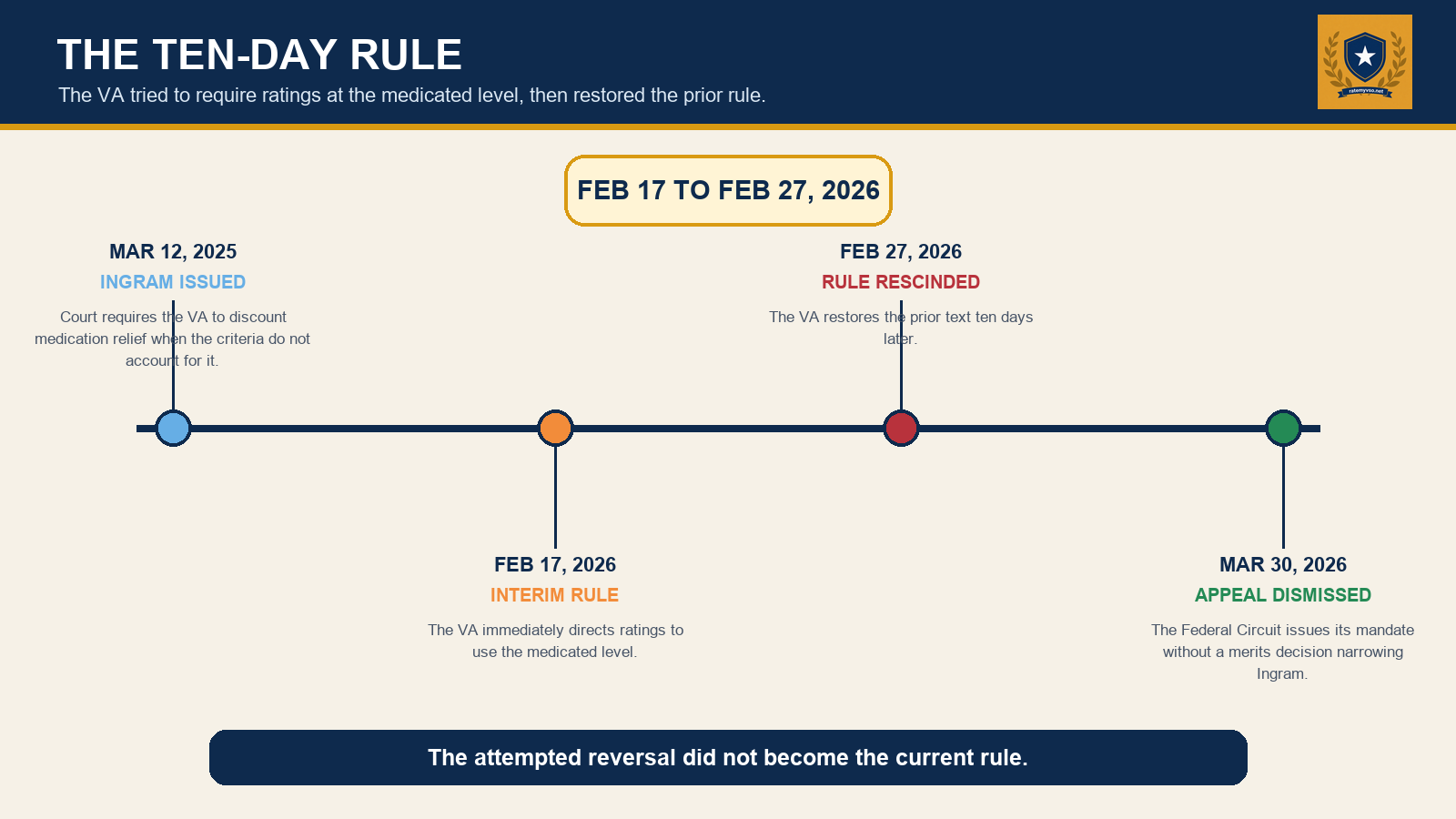
The VA briefly tried to change that standard in February 2026. It withdrew the regulation, not the court decision. For a condition whose rating criteria do not account for medication, the VA must evaluate the underlying disability without counting the improvement medication provides against the Veteran.
That is why an examiner may ask how your condition functions without medication. It is a question about the severity the VA needs to evaluate, not an instruction to stop treatment. Your account of what happens before relief, when a dose wears off, and during flare-ups can help answer it. A clinician may need to interpret that history and estimate the medical findings.
The main findings
- The medication regulation was rescinded; Ingram was not. The VA halted enforcement on February 19, 2026, then formally restored the prior regulation on February 27. The government's appeal of Ingram was dismissed on March 30.
- A medication list is only the starting point. The useful evidence identifies what treatment changes and connects that change to the symptoms or functional limits the rating criteria measure.
- Applying Ingram, the Board increased the VA's initial migraine rating from 0 percent to 10 percent on appeal. It discounted the relief provided by over-the-counter medication, but the evidence did not support 30 percent.
- Our August 28 research snapshot found 6,348 Board decisions citing Ingram. Five selected decisions show different applications of the rule. Neither the citation count nor those five examples establishes a success rate.
What the medication rule would have changed
On February 17, 2026, the VA issued an immediately effective interim final rule titled Evaluative Rating: Impact of Medication. It amended 38 CFR 4.10, the regulation describing how disability evaluations account for functional impairment.
The added language directed examiners not to estimate or remove the improvement supplied by medication or treatment. If treatment reduced a disability's severity, the rating would reflect that improved condition. In practical terms, the VA was trying to require ratings based on the treated condition even when the diagnostic code did not list medication as a rating factor. The rule expressly targeted the line of decisions culminating in Ingram. February 17 rule
The rule was withdrawn but the court decision remains
Following opposition from Veterans and other stakeholders, Secretary Doug Collins announced on February 19 that the VA would halt enforcement of the new rule. The formal rescission followed on February 27, effective that day, restoring the previous wording of section 4.10. Those are different events: enforcement stopped first; the regulatory language was removed eight days later. Senate Veterans' Affairs statement on the February 19 halt Formal rescission
Ingram is a court decision. It was not rescinded. The VA tried to change the regulation governing the issue and then withdrew that change. Removing the regulation did not remove the court's medication effects analysis.
There is also an important update to older reports about the litigation. The Secretary appealed Ingram, but the parties later agreed to dismiss that appeal. The Federal Circuit dismissed case 2025-1972 and issued its mandate on March 30, 2026. It did not issue a decision overturning or narrowing Ingram. Describing that appeal as still pending is outdated. Dismissal and mandate
The February rule is no longer in effect. The restored regulation and the Jones and Ingram decisions remain the basis for this medication analysis. A future court decision or a properly adopted regulation could change the law; that possibility does not make the withdrawn rule operative today. 38 CFR 4.10
What Jones and Ingram require
In Jones v. Shinseki, 26 Vet. App. 56 (2012), the Court of Appeals for Veterans Claims held that the VA cannot deny a higher rating because medication improves a disability when the applicable rating criteria do not contemplate medication. The case involved irritable bowel syndrome. The Board had used the improvement supplied by treatment without a basis in the criteria for doing so. Jones
Ingram v. Collins, 38 Vet. App. 130 (2025), applied that principle to musculoskeletal disabilities. Decided March 12, 2025, it concerned Carlton Ingram's back and left ankle ratings. His record documented pain medication and serious limitations with bending, lifting, sitting, standing, and walking.
The examinations identified medication as something that relieved his flare-ups. They did not establish whether it improved his motion, reduced the frequency or severity of flares, or changed those limitations enough to affect a rating. The Board denied ratings above 20 percent for the back and 10 percent for the ankle without resolving that gap.
The Court set aside those denials and sent the ratings back for additional development and a new decision. It required the VA to address the disability apart from medication relief; it did not award Mr. Ingram a particular percentage. Ingram
In everyday terms, the question is how disabling the condition is without the help medication provides. A symptom controlled by treatment does not necessarily mean the underlying disability has disappeared. But the evidence still has to establish the severity required by the applicable rating criteria.
When medication can still be part of the rating
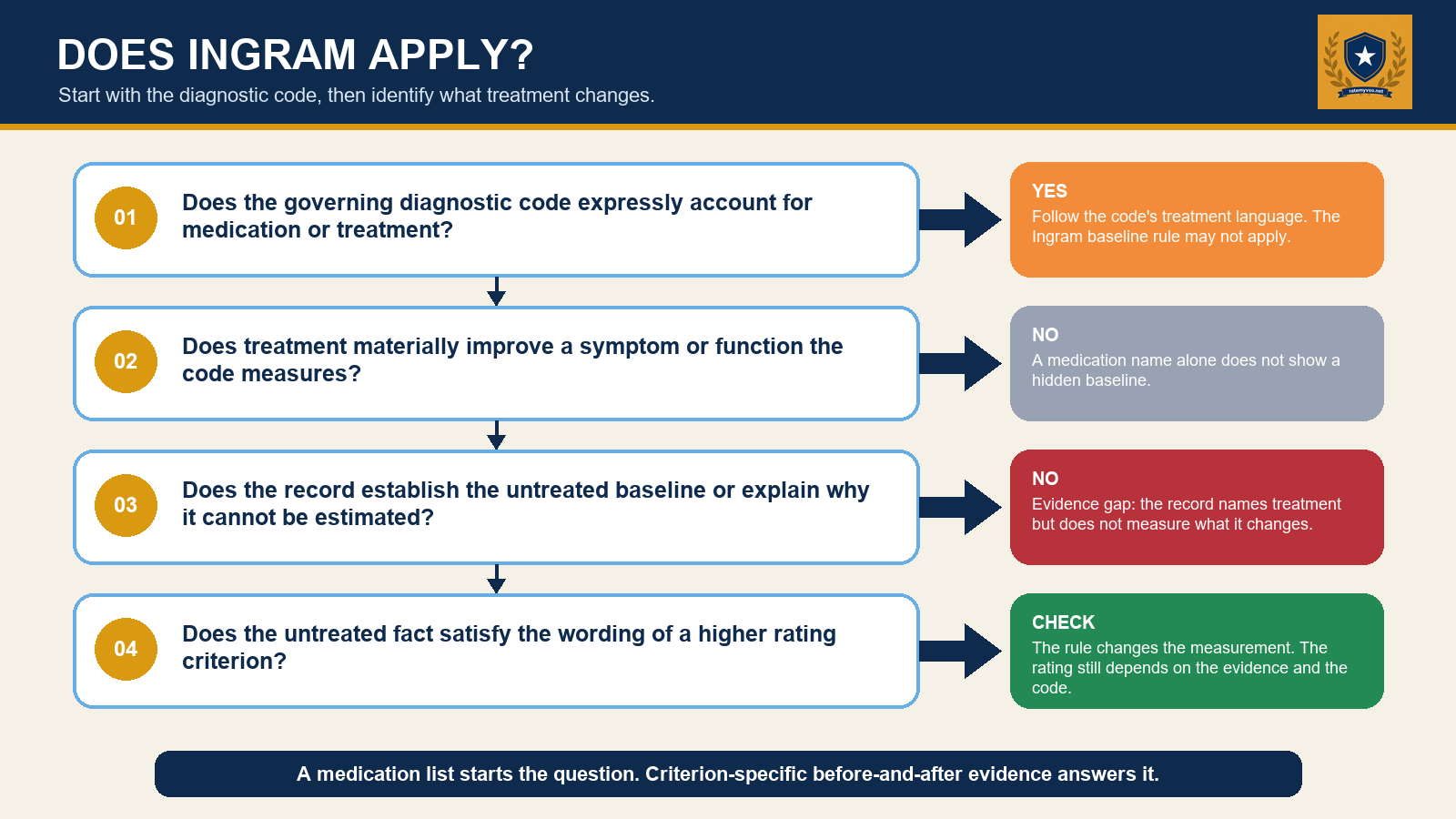
The rule has an important boundary: read the criteria for the condition and the period being rated. A diagnostic code is the numbered set of criteria the VA uses to evaluate a disability. Some codes expressly account for medication or treatment.
Hypertension is one example. Diagnostic Code 7101 includes continuous medication for control in one route to a 10 percent rating. That route also requires a qualifying history of diastolic pressure; taking blood-pressure medication alone does not establish it. In McCarroll v. McDonald, the Court held that the VA could consider medication's beneficial effects under that code. McCarroll
Do not assume the Ingram analysis applies identically to every diagnosis or every version of a rating schedule. It applies when the governing criteria do not account for the medication effects at issue.
Why this matters in joint and spine examinations
Many joint and spine ratings depend on restricted movement and functional loss. Pain medication may change how far you can move, how long you can use the joint, or how severe a flare becomes. An examination that records only your condition while medication is helping may leave those differences unexplained.
Ingram rejected the idea that discussing flare-ups automatically solves the medication question. You can have a flare while medicated, and the same flare might be worse without that relief. Medication effects, flare-ups, and loss after repeated use all need to be considered when relevant; they are not interchangeable descriptions.
Under Sharp v. Shulkin and the functional-loss principles discussed in Ingram, an examiner should use the available history and medical evidence to estimate additional limitation during flares or repeated use where feasible. An examiner cannot decline an estimate merely because a flare did not happen during the appointment. A genuine inability to estimate must be explained after considering reasonably available information. Sharp
What to tell the examiner
You can ask the examiner to address your condition apart from medication relief. The examiner documents medical findings; the VA adjudicator assigns the rating. The useful request is for a complete account of your impairment, not for the examiner to promise a percentage.
- Identify what you take and when. Include prescription and over-the-counter medication, the condition each treats, and what you took before the appointment. Explain whether it was helping during the examination.
- Describe what you actually experience before relief. That may include the period before treatment began, symptoms before the next scheduled dose, or symptoms that return as a dose wears off. If you do not know what your condition would be like without a long-term medication, say so.
- Explain what improves and what remains difficult. Describe concrete activities such as getting dressed, climbing stairs, reaching, standing, or completing work. Use your own experience and honest estimates, not a description borrowed from someone else's claim.
- Describe flares and repeated use. Explain their frequency, duration, triggers, and effect on your activity. If you have flare-ups, make that clear even when today is a better day. Include what happens after doing the same activity for a while.
- Keep taking medication as prescribed. Do not skip doses or stop treatment to make symptoms visible at the examination. Discuss any treatment change with your clinician.
For example, if accurate for you, an explanation might be: “Before my morning dose takes effect, I need help putting on my socks. After it starts working, I can dress myself, but standing to cook still makes me stop and sit down.” That describes a treatment-related difference without pretending to know an unmeasured range of motion.
You do not need to guess degrees of movement, percentages of nasal obstruction, or other medical measurements. Describe your observations. The clinician's role is to assess what can reliably be measured or estimated from them.
How to document the difference medication makes
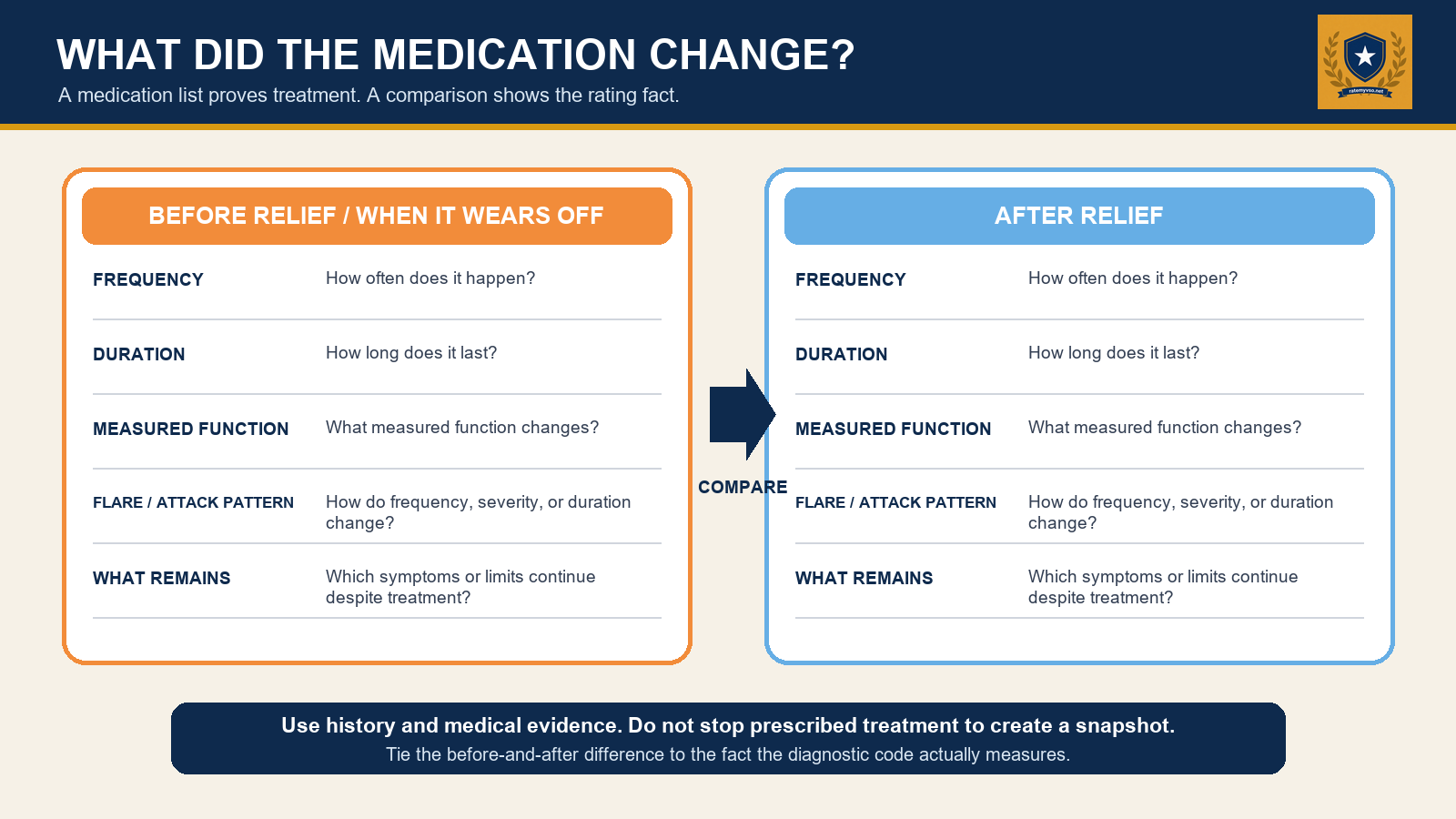
A useful record lets someone compare the condition before relief with the condition after relief. Notes made over time may be more informative than trying to remember everything during an appointment.
- Record the medication, timing, and symptom it treats. Note which treatments help and which do not.
- Describe symptoms before relief, when relief wears off, and during breakthrough symptoms. Use prior records if they document the condition before treatment began.
- Note how often the problem occurs, how long it lasts, and what it prevents you from doing. Record both worse periods and improvement so the comparison is accurate.
- Identify what still happens despite medication. Treatment may reduce the disability without resolving it.
- Include all medications that materially affect the condition. An opinion addressing one drug but overlooking another may leave the comparison incomplete.
- Bring the relevant history to your clinician. Ask whether it supports a reasoned estimate of the impairment apart from medication relief and how that estimate relates to the applicable rating criteria.
A clinician-completed Disability Benefits Questionnaire, or DBQ, can organize relevant findings. A separate medical opinion or addendum may be needed to explain medication effects and the basis for an estimate. A completed form is not automatically sufficient if it still leaves the medication question unanswered. The VA explains that public DBQs are intended for a health care provider to complete. Public DBQs
Your preparation notes are different from an official DBQ. They help you explain your experience and point the clinician to useful records; they do not replace the clinician's findings or authorize you to invent clinical measurements.
If the report only describes you while medication is working
Look for a specific missing explanation. Does the report list medication and say it helps, yet give only the improved findings? Does it address the impairment without that relief, or explain why a reliable estimate cannot be made? Where the criteria do not account for medication and the existing record leaves this issue unresolved, clarification or additional medical evidence may be needed.
That does not make every examination performed while you are medicated inadequate. The question is whether the evidence available to the VA is sufficient to apply the correct rating standard.
You can identify the omission in a written statement and point to relevant treatment records or symptoms you reported. Depending on the stage of the claim, an addendum, another examination, or a private opinion may address it. If a decision has already been issued, ask an accredited representative about the appropriate review option and its evidence rules and deadline. An informal request for another examination does not itself preserve a review deadline.
For the distinction between an incomplete examination and an unfavorable opinion, see our guide to challenging an inadequate C&P exam.
What five Board decisions show
Our research examined five published Board decisions selected to test different applications of the medication rule. They are examples, not binding precedent or a representative sample of all appeals.
Rhinitis and the missing untreated findings
The earliest matching decision in our search was dated March 13, 2025, one day after Ingram. It involved allergic rhinitis rather than a joint or spine condition.
The Veteran used Claritin and Flonase. The examination found no polyps and no qualifying level of nasal obstruction, the findings Diagnostic Code 6522 measures. But it did not address whether those findings would be different without medication.
The Board remanded for an opinion estimating whether the Veteran would have polyps, more than 50 percent obstruction on both sides, or complete obstruction on one side without medication relief. The medication list did not establish entitlement to a compensable rating; it raised an unanswered question about the facts the code required. A25023745
GERD and an opinion that did not go far enough
In a March 17, 2025, GERD decision, the record showed Tums and omeprazole use. A private clinician said symptoms would become substantially worse without daily Tums. That was favorable, but it did not identify the untreated level of impairment and did not account for omeprazole.
The Board sent the rating back for an examination addressing the beneficial effects of both medications. Saying the condition would worsen did not explain how often symptoms would occur, how severe they would be, or whether they would meet a higher rating's requirements. A25024551
There is an important date limit to this example. The digestive rating schedule changed effective May 19, 2024. The applicable version depends on the period and claim being evaluated; this decision's reasoning should not be transferred automatically to every newer GERD rating. Digestive schedule revision
Migraine and an increase from the regional office rating
In the March 24, 2025, decision, the Veteran was appealing regional office rating decisions. The Board increased the initial migraine evaluation from 0 percent to 10 percent after applying Ingram to the examination evidence. It was reviewing the regional office's rating, not correcting an earlier Board rating.
The examinations documented migraine symptoms and over-the-counter medication use but found no characteristic prostrating attacks. The Board discounted medication relief and found the disability more nearly approximated the 10 percent level. It denied a higher rating because the evidence did not approach the frequency of prostrating attacks required for 30 percent. A25027103
The decision does not expressly declare the examiners' work erroneous. It shows the Board applying the medication rule when weighing that evidence. It is not a promise of 10 percent for every Veteran who uses over-the-counter migraine medication.
A knee rating where the record did not show medication relief
An April 28, 2026, decision provides a different result. The Veteran reported Tylenol, constant knee pain, swelling, instability, and weekly flares. A prior court remand required the Board to address Jones and Ingram.
The Board found no evidence that Tylenol actually relieved the symptoms or concealed additional functional loss. The Veteran had identified sitting and massage, rather than medication, as relieving the flares. The Board denied higher ratings. A26039702
That finding concerned this record. It does not mean Tylenol cannot help knee pain. It shows why identifying a medication alone does not establish how much impairment its benefit may be masking.
Hypertension and criteria that expressly include medication
The fifth decision illustrates the boundary discussed earlier. Applying Diagnostic Code 7101 and McCarroll, the Board granted 10 percent based on the Veteran's qualifying pressure history and continuous medication for control.
Because the code expressly accounts for medication, the Board did not reconstruct hypothetical untreated blood-pressure readings under Ingram. It denied a higher rating because the recorded pressures did not satisfy the higher thresholds. A26038997
What this research means
For a condition whose rating criteria do not account for medication, the VA must consider the underlying impairment without using medication relief to understate its severity. The February 2026 regulation that would have changed that approach was withdrawn. Ingram remains a court decision the VA must account for, not a rescinded benefit or an automatic increase.
The five examples show why the evidence matters. Missing untreated findings led to more development in the rhinitis and GERD appeals. Applying the rule supported a limited increase in the migraine appeal. The knee record did not establish medication relief to remove, and hypertension followed medication-specific criteria.
For your own examination, the useful preparation is a clear account of what medication changes, what limitations remain, and where the medical record supports that history. Keep taking treatment as prescribed. Give the clinician enough information to evaluate the missing comparison, and keep the rating argument tied to the criteria that actually govern your condition.
What we searched
On August 28, 2026, we used the authenticated BVA True Count function against the RateMyVSO production search index. At that time it contained roughly 1.9 million published Board decisions from 1992 through 2026: 347,233 AMA decisions and roughly 1.6 million legacy decisions.
The exact phrase query was "Ingram v Collins". It returned 4,425 matching decisions from 2025 and 1,923 from partial-year 2026, a total of 6,348 decision rows. These are the August 28 research figures, not a new September 8 count.
The earliest match located through an oldest-first review was March 13, 2025. We selected five decisions for detailed review because they illustrated distinct questions: early uptake, application outside joint ratings, an increased rating, insufficient medication evidence, and a code that expressly accounts for medication.
How we counted
The unit counted was a published Board decision containing the exact citation phrase. It was not a count of individual Veterans, disabilities, or separately decided issues. One decision can contain multiple issues.
The 6,348 matches show the citation's presence in the indexed decisions. They do not establish how many Veterans received a higher rating because of Ingram, how many issues were remanded, or how consistently the Board applied the rule.
The five examples were deliberately selected for legal-pattern review, not randomly sampled. They cannot support a success rate or an estimate of how your claim will turn out.
Illustrative Board decisions
| Decision | Condition | Article-relevant result | Source |
|---|---|---|---|
| A25023745 (2025) | Allergic rhinitis | Remanded for an estimate of polyps and obstruction without Claritin and Flonase | VA decision |
| A25024551 (2025) | GERD | Remanded because the opinion did not establish the untreated baseline or address both medications | VA decision |
| A25027103 (2025) | Migraine | Increased the regional office's initial 0 percent rating to 10 percent; denied a higher rating | VA decision |
| A26039702 (2026) | Left knee | Higher ratings denied; the record did not establish beneficial Tylenol effects concealing additional loss | VA decision |
| A26038997 (2026) | Hypertension | Granted 10 percent under medication-specific criteria; denied more | VA decision |
Primary sources and research record
- Ingram v. Collins, 38 Vet. App. 130 (2025)
- Jones v. Shinseki, 26 Vet. App. 56 (2012)
- McCarroll v. McDonald, 28 Vet. App. 267 (2016)
- Sharp v. Shulkin, 29 Vet. App. 26 (2017)
- February 17, 2026 interim final rule
- February 19, 2026 Senate Veterans' Affairs statement recording the enforcement halt
- February 27, 2026 rescission
- March 30, 2026 Federal Circuit dismissal and mandate
- 38 CFR 4.10
- The VA's public DBQ guidance
- May 19, 2024 digestive rating schedule revision
Corpus research date: August 28, 2026. Article revision and legal-status check: September 8, 2026.
About this Article
This Article explains a precedential court decision and selected nonprecedential Board applications. It is educational information, not individualized legal or medical advice. Nothing here predicts the outcome of a claim. An accredited representative can help apply the law to a particular record; a treating clinician should guide medication decisions.