Joint Motion Claims Guide
Limited range of motion in the knee, shoulder, ankle, hip, and foot make up some of the most common VA disability claims, and most are rated the same basic way: how far the joint moves, how much pain and functional loss it causes, and what happens on flare-ups and repeated use. This guide covers that shared framework plus the rating tables for each joint, the rules that quietly raise (or lose) a rating, the bilateral factor, and the evidence that wins. It also walks the whole filing path: how service connection works, direct and secondary pathways, why these claims get denied, a checklist before you file, the claims process step by step, how to read your decision letter, and what to do whether you win or you're denied.
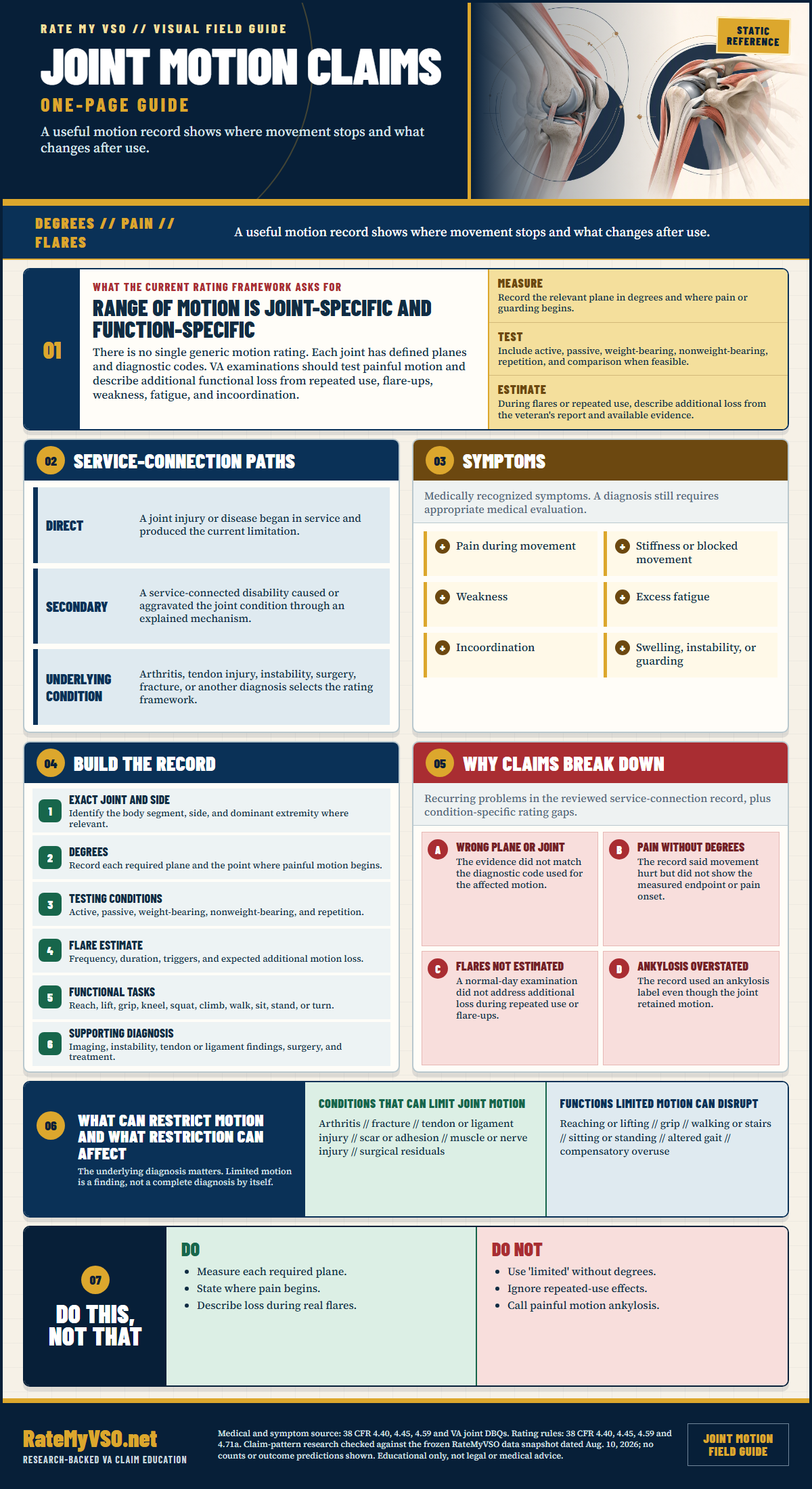 One-page guide: Joint Motion Claims in One Page
Joint-motion guide covering measurement in degrees, painful motion, repeated use, flare estimates, functional tasks, supporting diagnoses, and common examination gaps. Opens the full-size chart, free to save or print.
One-page guide: Joint Motion Claims in One Page
Joint-motion guide covering measurement in degrees, painful motion, repeated use, flare estimates, functional tasks, supporting diagnoses, and common examination gaps. Opens the full-size chart, free to save or print.
Start with the essentials
- 01Service Connection
The ways service connection can be established for this condition.
- 02Diagnosis and Evidence
Common symptoms and the evidence cited in published Board appeals.
- 03Your History
What you experienced, what others observed, and what treatment changed.
Understand the claim
ICD-10 Diagnosis Codes
The ICD-10 diagnosis codes most commonly used for DC 5262, Tibia and fibula, impairment of (the kind on your medical records, decision letter, or C&P exam report). VA rates the disability and its residuals, not the diagnosis itself, so coding can vary.
How Service Connection Works, At a High Level
Before getting into the rating tables and pathways below, it helps to understand the three things every joint or range-of-motion claim ultimately has to show. This is the same basic test that applies to any VA disability claim, just applied to these conditions (Shedden v. Principi, 381 F.3d 1163 (Fed. Cir. 2004)).
- A current diagnosis. Medical proof that you actually have the condition now, or during the claim. This is the cornerstone of the claim; a claim can fail on this element alone when the record contains no current diagnosis, which is a common denial pattern in shin splint claims specifically, discussed further below.
- An in-service event, injury, or the physical demands of your job. Something that happened or was documented during your service, such as a fall, an acute injury, or repetitive overuse from your duties, or a service-connected condition behind it for a secondary claim. The places, types, and circumstances of your service can help establish this (38 USC 1154(a)); physically demanding duties such as air assault or helicopter operations have supported findings of an in-service back or shin injury even without a treatment note in the file.
- A medical nexus. A doctor's opinion connecting your current joint condition to service, or to the service-connected condition behind it, and explaining the reasoning, not just stating a conclusion.
Getting These Joints Service Connected: Direct and Secondary Pathways
- Direct: an in-service injury (a fall, a parachute landing, a sports or training injury) or documented overuse, a current diagnosis, and a nexus. Continuity of symptoms since service helps.
- Secondary, altered gait or overcompensation: a service-connected knee or ankle that changes how you walk can cause or worsen the opposite knee, the hip, or the low back. A bad shoulder can overload the other shoulder. These are common, well-recognized secondary paths. See service connection.
- Secondary, plantar fasciitis from a foot or gait condition: flat feet (pes planus), a service-connected knee injury that alters stride, or leg-length discrepancy can be nexus sources for plantar fasciitis. A private nexus letter connecting the conditions is the typical evidentiary vehicle.
- Secondary, shin splints from overuse during service: high-mileage training, parachute operations, or combat marching documented in service records supports direct service connection. Shin splints can also flow from a gait-altering condition (pes planus, ankle, or knee) as a secondary claim.
- Aggravation: service made a pre-existing joint problem permanently worse.
Four documented pathways come up often enough in published Board decisions on joint and range-of-motion claims to lay out on their own, alongside the altered-gait and shin-splints-overuse pathways above.
Secondary via Altered Gait or Overcompensation
This is the same altered-gait pathway named above, spelled out in more detail because it is one of the more frequently granted secondary theories for these joints. When a service-connected knee, ankle, or foot condition changes how a veteran walks or bears weight, the opposite side, the hip, or the low back can absorb the extra stress over time. The nexus opinion needs to trace the specific mechanical chain: which joint is compromised, how that changes gait or weight-bearing, and how that change plausibly caused or worsened the joint now being claimed.
Secondary via Degenerative Arthritis From Joint Overuse
Degenerative arthritis (DC 5003) can develop in a joint that has been overloaded for years by a service-connected condition elsewhere in the same limb, for example a shin or ankle condition that changes how weight travels through the leg over time. Across the Board's published decisions, this is a real but harder-to-win pathway than the gait-based theories above; the grant rate is meaningfully lower, and the opinion needs to explain the specific mechanical link between the service-connected joint and the arthritis, not just note that both conditions exist in the same veteran.
Secondary via Radiating Nerve Pain From the Spine
Radiating leg pain (radiculopathy) is a recognized secondary condition when a veteran already has a service-connected back condition such as lumbosacral strain or scoliosis. This is a distinct claim from the joint or shin condition itself, filed as its own secondary issue, and the medical opinion needs to address whether the back condition is both causing and, separately, worsening the nerve symptoms in the leg. See our Secondary Service Connection Guide.
Gulf War Undiagnosed Illness Pathway
If you served in the Southwest Asia theater, certain chronic joint pain, muscle pain, or unexplained nerve symptoms that cannot be tied to a specific diagnosis can be presumed related to service under the Gulf War undiagnosed illness provisions (38 CFR 3.317, 38 USC 1117), without needing to prove an in-service injury or a medical nexus in the usual sense. This pathway applies specifically to symptoms that remain medically unexplained; once a specific diagnosis is made (for example, a documented meniscus tear or degenerative arthritis), the claim generally proceeds under direct or secondary service connection instead.
Secondary, Plantar Fasciitis From a Foot or Gait Condition
Formalizing the plantar-fasciitis pathway named above: flat feet (pes planus), a service-connected knee injury that alters stride, or a documented leg-length discrepancy are recognized nexus sources for plantar fasciitis. A private nexus letter connecting the specific gait mechanism to the heel or midfoot pain is the typical evidentiary vehicle, and it should identify which foot the fasciitis affects if the underlying gait condition is unilateral.
Direct or Secondary Service Connection for Shin Splints
Formalizing the shin-splints pathway named above: high-mileage training, parachute operations, ruck marching, or other documented physically demanding duties support direct service connection for shin splints. Shin splints can also be filed as secondary to a gait-altering condition already service-connected in the same leg, such as pes planus, an ankle condition, or a knee condition. Either pathway still has to satisfy the treatment-duration rating structure described in the Shin Splints section above once service connection is granted.
What VA Looks For: Tests, Records, and Diagnostic Codes
Records to gather for a direct or secondary claim:
- Range-of-motion measurements in degrees, taken with a goniometer at the C&P exam, in active, passive, weight-bearing, and non-weight-bearing motion, plus an estimate of any additional loss during flare-ups and after repetitive use. These degrees are what the rating tables in this guide translate into a percentage.
- Treatment history and duration. For treatment-response codes like plantar fasciitis (DC 5269) and shin splints (DC 5262), what matters is not degrees but how long you've been treated and whether non-surgical and surgical treatment relieved the symptoms.
- Imaging and clinical findings: X-ray or MRI evidence of arthritis, instability testing, meniscus findings, or confirmation of a flail joint or nonunion, which support ratings that don't turn on motion alone.
- The diagnostic codes involved: the specific joint code, for example DC 5260 and 5261 (knee flexion/extension), 5257 (knee instability), 5201 (shoulder), 5271 (ankle), 5252 and 5253 (hip), 5269 (plantar fasciitis), or 5262 (shin splints/tibia and fibula), plus whatever code applies to a condition you're connecting it to, for example a back condition (lumbosacral strain) or degenerative arthritis (DC 5003).
- The actual form the examiner fills out: a joint-specific Disability Benefits Questionnaire (DBQ), discussed in more detail later in this guide.
Symptoms and rating
Symptoms Recorded in Granted Arthritis Decisions
We analyzed 7,594 granted Board decisions involving arthritis for symptoms named in sentences about the condition (rating-criteria recitations excluded). Descriptive of the published record, what the Board wrote down, not a checklist of what to report.
Bar length shows decisions. Percentages remain context.
Symptoms Recorded in Granted Knee and lower-leg conditions Decisions
We analyzed 9,813 granted Board decisions involving knee and lower-leg conditions for symptoms named in sentences about the condition (rating-criteria recitations excluded). Descriptive of the published record, what the Board wrote down, not a checklist of what to report.
Bar length shows decisions. Percentages remain context.
Symptoms Recorded in Granted Shoulder and arm conditions Decisions
We analyzed 3,150 granted Board decisions involving shoulder and arm conditions for symptoms named in sentences about the condition (rating-criteria recitations excluded). Descriptive of the published record, what the Board wrote down, not a checklist of what to report.
Bar length shows decisions. Percentages remain context.
Symptoms Recorded in Granted Ankle conditions Decisions
We analyzed 2,565 granted Board decisions involving ankle conditions for symptoms named in sentences about the condition (rating-criteria recitations excluded). Descriptive of the published record, what the Board wrote down, not a checklist of what to report.
Bar length shows decisions. Percentages remain context.
Symptoms Recorded in Granted Hip and thigh conditions Decisions
We analyzed 1,849 granted Board decisions involving hip and thigh conditions for symptoms named in sentences about the condition (rating-criteria recitations excluded). Descriptive of the published record, what the Board wrote down, not a checklist of what to report.
Bar length shows decisions. Percentages remain context.
Symptoms Recorded in Granted Wrist and forearm conditions Decisions
We analyzed 848 granted Board decisions involving wrist and forearm conditions for symptoms named in sentences about the condition (rating-criteria recitations excluded). Descriptive of the published record, what the Board wrote down, not a checklist of what to report.
Bar length shows decisions. Percentages remain context.
Detected by phrase-reading the decision text with condition-specific vocabularies. Source: Board of Veterans' Appeals decisions, RateMyVSO analysis.
How the VA Rates Limited Motion (the Shared Rules)
Every joint is rated under 38 CFR 4.71a by measuring range of motion in degrees with a goniometer. But the degrees on the exam are only the starting point. Four rules can change the result, and they apply to the knee, shoulder, and ankle alike.
- Painful motion gets at least the minimum rating (38 CFR 4.59). If a joint is painful on motion, it is entitled to at least the minimum compensable rating for that joint (usually 10%), even if the measured range is technically "normal."
- Functional loss counts, not just degrees (38 CFR 4.40 and 4.45). Weakness, fatigue, incoordination, and lack of endurance that reduce how you actually use the joint must be factored in.
- Flare-ups matter (DeLuca v. Brown). The rating must account for additional loss of motion during flare-ups and after repeated use over time, not just your best single measurement in the exam room. (Pain alone, without extra functional loss, may not raise the rating, Mitchell v. Shinseki.)
- The exam must test motion both ways (Correia v. McDonald). A proper joint exam tests range of motion in active and passive motion, and in weight-bearing and non-weight-bearing. If the C&P exam skipped this, the exam may be inadequate.
Knee (Instability, Limited Motion, Meniscus)
The knee is the most-claimed joint, and one where a single knee can carry more than one rating at once, because instability (DC 5257), limitation of flexion (DC 5260), limitation of extension (DC 5261), and meniscus damage (5258 / 5259) are separate problems the VA rates on their own.
Shoulder / Arm (DC 5201, Limitation of Arm Motion)
The shoulder is rated by how far you can raise the arm (flexion and abduction), and the level depends on whether it is your dominant (major) or non-dominant (minor) arm.
Go deeper: open the full DC 5201 breakdown- What the VA measures at your C&P exam
- Evidence that has won at the Board
- Inside the rater's playbook: grant, denial, and remand rates
- Secondary condition map
Related shoulder codes cover other problems: DC 5200 (ankylosis, the joint fused), DC 5202 (humerus, including recurrent dislocation and flail/false joint), and DC 5203 (clavicle or scapula). The painful-motion and flare-up rules apply here too.
Ankle (DC 5271, Limited Motion)
The 38 CFR 4.71a definitions of "moderate" and "marked" for the ankle are spelled out in degrees, which is unusual and helpful.
Limitation of motion, DC 5271
Go deeper: open the full DC 5271 breakdown- What the VA measures at your C&P exam
- Evidence that has won at the Board
- Inside the rater's playbook: grant, denial, and remand rates
- Secondary condition map
Ankylosis, DC 5270
Go deeper: open the full DC 5270 breakdown- What the VA measures at your C&P exam
- Evidence that has won at the Board
- Inside the rater's playbook: grant, denial, and remand rates
- Secondary condition map
Total ankle replacement, DC 5056
Go deeper: open the full DC 5056 breakdown- What the VA measures at your C&P exam
- Evidence that has won at the Board
- Inside the rater's playbook: grant, denial, and remand rates
- Secondary condition map
Intermediate residuals after ankle replacement are rated by analogy to DC 5270 or 5271, whichever is more favorable.
Hip and Thigh (DCs 5250-5255, 5054)
The hip is a synovial joint with multiple planes of motion: flexion, extension, abduction (leg out), adduction (leg toward midline), and rotation. Each plane is a separate diagnostic code, and a veteran can receive ratings under more than one as long as they are not pyramiding the same symptom. All of these fall under 38 CFR 4.71a.
Hip ankylosis (joint fused), DC 5250
An ankylosed hip has no range of motion and therefore no painful-motion minimum (38 CFR 4.59 does not apply to a fused joint). The rating depends on the position the joint is frozen in and whether the foot reaches the ground.
Go deeper: open the full DC 5250 breakdown- What the VA measures at your C&P exam
- Evidence that has won at the Board
- Inside the rater's playbook: grant, denial, and remand rates
- Secondary condition map
Limitation of extension, DC 5251
Extension loss (inability to push the leg behind neutral) is difficult to measure and rarely rated above 0% unless there is painful motion, which may qualify for the minimum 10%.
Go deeper: open the full DC 5251 breakdown- What the VA measures at your C&P exam
- Evidence that has won at the Board
- Inside the rater's playbook: grant, denial, and remand rates
- Secondary condition map
Limitation of flexion, DC 5252
Flexion (raising the knee toward the chest) is the most commonly rated hip motion. Normal hip flexion is approximately 125 degrees; the rating table measures how severely it is restricted. Painful flexion with near-normal degrees still qualifies for the minimum 10% under 38 CFR 4.59.
Go deeper: open the full DC 5252 breakdown- What the VA measures at your C&P exam
- Evidence that has won at the Board
- Inside the rater's playbook: grant, denial, and remand rates
- Secondary condition map
Thigh impairment (adduction, abduction, rotation), DC 5253
DC 5253 covers the planes of motion frequently missed at rating: how far the leg swings outward (abduction), whether the legs can cross (adduction), and whether the foot can toe outward (rotation). Each criterion is separate. An examiner who skips the "can you cross your legs" question or the toe-out rotation test may miss a 10% rating.
Go deeper: open the full DC 5253 breakdown- What the VA measures at your C&P exam
- Evidence that has won at the Board
- Inside the rater's playbook: grant, denial, and remand rates
- Secondary condition map
Hip flail joint, DC 5254
Go deeper: open the full DC 5254 breakdown- What the VA measures at your C&P exam
- Evidence that has won at the Board
- Inside the rater's playbook: grant, denial, and remand rates
- Secondary condition map
A diagnosis of flail joint must be supported by X-ray or other imaging. Because the 80% rating already compensates for all planes of motion loss, a separate rating for limitation of flexion or extension in the same hip would be pyramiding under 38 CFR 4.14.
Femur impairment, DC 5255
Go deeper: open the full DC 5255 breakdown- What the VA measures at your C&P exam
- Evidence that has won at the Board
- Inside the rater's playbook: grant, denial, and remand rates
- Secondary condition map
Malunion of the femur is evaluated under DC 5256, 5257, 5260, or 5261 for the knee, or DCs 5250-5254 for the hip, whichever produces the highest evaluation. The location of the fracture along the femur determines whether the knee or hip DBQ applies.
Total hip replacement, DC 5054
"Prosthetic replacement" under DC 5054 means a total replacement of the head of the femur or the acetabulum. A partial replacement or resurfacing does not qualify for the prosthetic-replacement criteria. After resurfacing, the VA evaluates residuals under DCs 5250-5255 with no minimum rating floor.
Go deeper: open the full DC 5054 breakdown- What the VA measures at your C&P exam
- Evidence that has won at the Board
- Inside the rater's playbook: grant, denial, and remand rates
- Secondary condition map
Foot / Plantar Fasciitis (DC 5269) and Pes Planus (DC 5276)
Plantar fasciitis is rated under DC 5269 in 38 CFR 4.71a. Unlike most joint conditions, it is not rated by range of motion or by degrees. It is rated by whether the condition has responded to treatment and whether surgery has been performed. The foot DBQ is used for all plantar fasciitis claims regardless of whether the pain is closer to the heel or midfoot.
Plantar fasciitis, DC 5269
Go deeper: open the full DC 5269 breakdown- What the VA measures at your C&P exam
- Evidence that has won at the Board
- Inside the rater's playbook: grant, denial, and remand rates
- Secondary condition map
Relationship to pes planus (flat feet), DC 5276
When a veteran has both plantar fasciitis (DC 5269) and pes planus (DC 5276) that are related, the M21-1 manual requires rating them together under the higher of the two diagnostic codes, rather than separately. Because pes planus can rate as high as 50%, it is typically the primary code in combined cases. Separately, metatarsalgia (pain in the forefoot) can be evaluated alongside plantar fasciitis (heel pain) because the two symptoms involve different anatomical areas and do not generally overlap, unless the evidence shows the symptoms are the same disability under different labels.
Go deeper: open the full DC 5276 breakdown- What the VA measures at your C&P exam
- Evidence that has won at the Board
- Inside the rater's playbook: grant, denial, and remand rates
- Secondary condition map
Shin Splints / Medial Tibial Stress Syndrome (DC 5262)
Shin splints (medial tibial stress syndrome, MTSS) are rated under DC 5262 (tibia and fibula impairment) in 38 CFR 4.71a, regardless of whether the pain is closer to the knee or the ankle. Like plantar fasciitis, shin splints are rated by treatment duration and response, not by range of motion degrees.
The DBQ used at the C&P exam depends on where symptoms are located. Shin splints closer to the knee use the knee DBQ, and shin splints closer to the ankle use the ankle DBQ. The rating code remains DC 5262 either way.
Shin splints (MTSS), DC 5262
Go deeper: open the full DC 5262 breakdown- What the VA measures at your C&P exam
- Evidence that has won at the Board
- Inside the rater's playbook: grant, denial, and remand rates
- Secondary condition map
The Bilateral Factor (38 CFR 4.26)
If you are service-connected for the same joint on both sides (both knees, both ankles, both arms), the VA adds a bilateral factor: it takes the combined value of the paired disabilities and adds 10% of that value before combining with your other ratings. It is easy for the VA to miss, so it is worth checking your code sheet. The VA Math calculator applies the bilateral factor automatically so you can see whether your combined rating looks right.
Evidence and Board research
Evidence That Wins
Across the Board's published DC 5262 decisions, whether a private nexus opinion is in the file makes a real difference in outcome, shown below.
- A current diagnosis, clearly documented. This is the cornerstone of any joint claim. Shin splint claims in particular are denied outright when the record contains no current diagnosis at all, discussed further in Why Claims Get Denied below.
- Range-of-motion measurements in degrees, taken with a goniometer, including after repetitive use. The numbers drive the table for motion-rated joints.
- Documented flare-ups. Tell the examiner how often they happen, what triggers them, and how much more motion you lose during one. A dated symptom log makes this concrete, since the examiner is expected to estimate flare-up loss from your reports even without observing a flare firsthand.
- A Correia-compliant exam, testing active, passive, weight-bearing, and non-weight-bearing motion. If your C&P skipped weight-bearing testing, that can be grounds to challenge the exam.
- Imaging and clinical findings (X-ray, MRI, instability testing, meniscus findings) that support a separate rating.
- A private nexus opinion that explains its reasoning, reviews the file, and applies its conclusion to your specific facts rather than stating a bare conclusion. This kind of opinion has carried claims for the spine, shin splints, shoulder, hip, and back alike in the Board's published decisions. See our Nexus Letters Guide.
- Proof of the in-service duties or event, including the places, types, and circumstances of your service (38 USC 1154(a)). Physically demanding duties, such as air assault, helicopter operations, or documented ruck marching, have supported in-service back and shin injuries even without a same-day treatment note.
- Consistent lay statements about onset and continuity, along with statements from people who observed your symptoms (limping, favoring a leg, difficulty with stairs) during or shortly after service. See our Buddy & Lay Statements Guide.
- The right DBQ. The joint-specific Disability Benefits Questionnaire captures degrees, painful motion, flare-ups, and stability. See the DBQ guide and the C&P exam prep.
Evidence Cited in Published Arthritis Decisions
We analyzed 109,364 published Board decisions involving arthritis for condition-specific evidence, counting only case-specific mentions (boilerplate recitations excluded). "Favorable" is the share of decisions citing that evidence where every issue was granted or the outcome was mixed; the baseline across all these decisions is 49.1%, combining every diagnostic code below. Evidence appearing in a decision does not mean it decided the case. Descriptive of the published record, not a prediction.
Bar length shows decisions citing the evidence.
By diagnostic code
These codes are grouped together above. They do not perform the same, so find your own code here rather than reading the combined figure. A code retired in the schedule rewrites appears without a link, because its decisions were judged under criteria that no longer apply.
Bar length shows published decisions reviewed.
Evidence Cited in Published Knee and lower-leg conditions Decisions
We analyzed 191,367 published Board decisions involving knee and lower-leg conditions for condition-specific evidence, counting only case-specific mentions (boilerplate recitations excluded). "Favorable" is the share of decisions citing that evidence where every issue was granted or the outcome was mixed; the baseline across all these decisions is 45.6%, combining every diagnostic code below. Evidence appearing in a decision does not mean it decided the case. Descriptive of the published record, not a prediction.
Bar length shows decisions citing the evidence.
By diagnostic code
These codes are grouped together above. They do not perform the same, so find your own code here rather than reading the combined figure. A code retired in the schedule rewrites appears without a link, because its decisions were judged under criteria that no longer apply.
Bar length shows published decisions reviewed.
Evidence Cited in Published Shoulder and arm conditions Decisions
We analyzed 68,354 published Board decisions involving shoulder and arm conditions for condition-specific evidence, counting only case-specific mentions (boilerplate recitations excluded). "Favorable" is the share of decisions citing that evidence where every issue was granted or the outcome was mixed; the baseline across all these decisions is 47.7%, combining every diagnostic code below. Evidence appearing in a decision does not mean it decided the case. Descriptive of the published record, not a prediction.
Bar length shows decisions citing the evidence.
By diagnostic code
These codes are grouped together above. They do not perform the same, so find your own code here rather than reading the combined figure. A code retired in the schedule rewrites appears without a link, because its decisions were judged under criteria that no longer apply.
Bar length shows published decisions reviewed.
Evidence Cited in Published Ankle conditions Decisions
We analyzed 54,232 published Board decisions involving ankle conditions for condition-specific evidence, counting only case-specific mentions (boilerplate recitations excluded). "Favorable" is the share of decisions citing that evidence where every issue was granted or the outcome was mixed; the baseline across all these decisions is 49.7%. Evidence appearing in a decision does not mean it decided the case. Descriptive of the published record, not a prediction.
Bar length shows decisions citing the evidence.
Evidence Cited in Published Hip and thigh conditions Decisions
We analyzed 43,133 published Board decisions involving hip and thigh conditions for condition-specific evidence, counting only case-specific mentions (boilerplate recitations excluded). "Favorable" is the share of decisions citing that evidence where every issue was granted or the outcome was mixed; the baseline across all these decisions is 47.9%, combining every diagnostic code below. Evidence appearing in a decision does not mean it decided the case. Descriptive of the published record, not a prediction.
Bar length shows decisions citing the evidence.
By diagnostic code
These codes are grouped together above. They do not perform the same, so find your own code here rather than reading the combined figure. A code retired in the schedule rewrites appears without a link, because its decisions were judged under criteria that no longer apply.
Bar length shows published decisions reviewed.
Evidence Cited in Published Wrist and forearm conditions Decisions
We analyzed 25,523 published Board decisions involving wrist and forearm conditions for condition-specific evidence, counting only case-specific mentions (boilerplate recitations excluded). "Favorable" is the share of decisions citing that evidence where every issue was granted or the outcome was mixed; the baseline across all these decisions is 50.5%, combining every diagnostic code below. Evidence appearing in a decision does not mean it decided the case. Descriptive of the published record, not a prediction.
Bar length shows decisions citing the evidence.
By diagnostic code
These codes are grouped together above. They do not perform the same, so find your own code here rather than reading the combined figure. A code retired in the schedule rewrites appears without a link, because its decisions were judged under criteria that no longer apply.
Bar length shows published decisions reviewed.
Detected by phrase-reading the decision text with condition-specific vocabularies. Source: Board of Veterans' Appeals decisions, RateMyVSO analysis.
Board Grants, Dissected
Shin splints and related tibia and fibula impairment claims turn heavily on whether service records document leg pain in service and whether the Board finds a veteran's report of continuing symptoms credible. In the decisions below, the Board granted direct service connection for shin splints (a condition tied to Diagnostic Code 5262, tibia and fibula impairment) after finding VA examiner opinions inadequate because they leaned on a lack of post-service treatment records without addressing a veteran's credible lay statements. These are individual decisions. Board decisions are not binding precedent, and each case turned on its own record.
Shin splints granted after Board found VA opinion ignored consistent lay reports Citation A26017416 (February 26, 2026), Hearing docket
The record: Service treatment records showed treatment for a right tibia stress reaction in February 1996 and bilateral tibia pain in November 1996, with physical profiles issued. A November 2019 VA examiner diagnosed bilateral shin splints but opined they were less likely than not related to service because the injuries were "acute" and there was no chronicity of care. The Board found this opinion inadequate because the examiner did not address the veteran's participation in an Army air assault unit and discounted his lay statements about pain since service without explanation. A July 2024 private opinion from a nurse practitioner, W.H., reviewed the claims file, cited medical literature on shin splints in military personnel, and found the condition at least as likely as not related to service.
Why it won: The Board gave the November 2019 VA opinion no probative weight because it improperly discounted the veteran's credible lay statements and did not discuss his physically demanding duties. The Board found the private opinion competent, credible, and probative because it was based on a full record review and a reasoned medical explanation. With no opinion of record against the claim once the VA opinion was set aside, the evidence was at least in balance and the benefit of the doubt applied.
Bilateral shin splints granted based on treatment in service, family statements, and a supportive VA opinion Citation A26015317 (February 19, 2026), Hearing docket
The record: Service treatment records documented treatment for shin splints on multiple occasions in May 1990, with a physical profile issued in June 1990 for the condition. The veteran was diagnosed with bilateral shin splints at a March 2020 VA examination. Statements from the veteran's father and wife, submitted in September 2024, described his leg pain beginning after service and continuing since. In an August 2024 opinion, a VA physician stated that the veteran's shin splints were due to his in-service injuries.
Why it won: The Board found the veteran competently reported continuity of symptoms since service, and that his father's and wife's statements corroborated the onset and continuation of his leg pain. Combined with the August 2024 VA physician's opinion linking the current shin splints to the documented in-service treatment, the Board found the evidence supported the claim.
Left and right leg shin splints granted where VA examiner's opinion failed to address credible lay statements Citation A26015184 (February 19, 2026), Evidence Submission docket
The record: A January 2025 VA examiner diagnosed left and right leg shin splints but opined they were less likely than not related to service, citing no service treatment records documenting shin splints and no chronicity of care since separation. The veteran had reported shin pain beginning in service and continuing since, which the Board found internally consistent and consistent with the circumstances of his service.
Why it won: The Board found the VA opinion inadequate because it failed to consider the veteran's competent and credible lay statements about continuous shin symptoms, citing the rule that a lack of contemporaneous medical evidence should not be an absolute bar to proving a claim through competent lay evidence. With the lay evidence weighed appropriately, the Board found the evidence at least evenly balanced and granted the claim under the benefit of the doubt.
Right knee arthritis and shin splints granted based on private medical opinion citing military prevalence data Citation A26014434 (February 17, 2026), Hearing docket
The record: Service treatment records showed the veteran was seen in February 1974 for shin pain when running and walking and was diagnosed with shin splints. Private treatment records documented right knee arthritis. A May 2025 evaluation from a physician assistant, Mr. Udaze, opined that it was more likely than not that the veteran's right knee arthritis and right shin splints were directly associated with his service, citing medical literature showing a higher prevalence of knee pain and shin splints among service members due to physically demanding duties.
Why it won: The Board found the veteran's testimony about in-service running on coral and playing football credible and consistent with the circumstances of his service. Combined with the documented in-service shin splint diagnosis and the private opinion's supporting rationale and cited literature, the Board found the evidence at least in equipoise and granted service connection.
Why These Claims Get Denied
Beyond a missing nexus generally, a few specific denial patterns show up often enough in the Board's published decisions for these joints to call out on their own.
- No current diagnosis in the record. Shin splint claims in particular are denied when the medical evidence never documents an actual current diagnosis, and in that situation VA is not even required to schedule an exam. Without a current disability, there is no valid claim to connect to service.
- Pain that isn't shown to limit anything. Pain by itself can count as a disability, but only when it causes a functional impairment. Pain that examiners found did not affect a veteran's ability to work or perform daily activities has not been enough on its own; the file needs to explain how the pain actually limits function, not just that it exists.
- An account of the injury the records contradict. A described in-service injury or wound has been found not credible where the separation exam and other contemporaneous records showed no corresponding finding at all. When the account and the record conflict, both the claim and any opinion that relied on the veteran's account can lose their weight.
- A higher shin splints rating claimed without 12 months of treatment and failed surgery. A rating above the minimum under DC 5262 requires the full documented structure: at least 12 consecutive months of treatment, unresponsive to both conservative treatment and surgery. Higher ratings are consistently denied when that documentation isn't in the file, regardless of how the symptoms feel day to day.
- Trying to reopen a final effective date with a brand-new claim. Once an effective-date decision is final, a freestanding claim to move the effective date earlier does not work; only a clear and unmistakable error (CUE) motion can change a final decision on that point.
- Missing the appeal deadline. An appeal filed after the one-year window from the date VA mailed the decision is dismissed regardless of the underlying merits (38 CFR 20.302). Track your dates.
Common Mistakes
The same few errors quietly cost veterans range-of-motion ratings and, separately, a few procedural missteps quietly cost veterans an otherwise winnable case. Each one ties back to a rule already covered above.
- Treating the measured degrees as the whole story. Every joint is rated by goniometer degrees, but the degrees are only the starting point. Pain, flare-ups, and loss after repetitive use can change the result, and an exam that records only the best single measurement in the room often understates the disability.
- Not documenting flare-ups. Under DeLuca, the rating must account for additional loss of motion during flare-ups and after repeated use over time. When a veteran does not tell the examiner how often flares happen, what triggers them, and how much more motion is lost, the examiner has nothing to estimate from and the extra loss never reaches the rating.
- Letting the C&P skip weight-bearing testing. A Correia-compliant exam tests active, passive, weight-bearing, and non-weight-bearing motion. An exam that omits weight-bearing testing may be inadequate, which can be grounds to seek a new exam or appeal rather than accepting the result.
- Overlooking the painful-motion floor. Under 38 CFR 4.59, a joint that is painful on motion is entitled to at least the minimum compensable rating, usually 10%, even when measured motion is near-normal. The painful motion has to be documented on the exam to count, and it is the single most-missed point in these claims.
- No medical nexus tying the joint to service. A missing nexus opinion is one of the most common denial reasons across these claims. A useful opinion names the in-service injury or the service-connected condition and explains the link to the joint being claimed.
- Filing a freestanding claim to move a final effective date. A finalized effective-date decision cannot be reopened by simply filing a new claim asking for an earlier date; a CUE motion is the only route once the decision is final. Know this distinction before you file.
- Letting the one-year appeal window pass. Whatever the strength of your case, an appeal filed outside the one-year window from the decision notice is dismissed without regard to the merits.
- Not flagging a rating reduction that skipped notice. VA cannot cut a rating that lowers your monthly payment without first proposing the reduction and giving 60 days to respond (38 CFR 3.105(e)). A reduction that skipped this notice can be challenged and reversed.
Do's and Don'ts
A condensed version of everything above, in the order it actually matters when you sit down to build your file.
- Get a current diagnosis on record before you file, and confirm the report is actually in your claims file.
- Get a private nexus opinion that reviews your file, discusses your own reports, and explains its reasoning, not a bare conclusion.
- Document the in-service injury or the physical demands of your job (duty station, MOS, ruck marching, air assault or helicopter operations) even if there's no same-day treatment note.
- Tell every provider, consistently, when your symptoms started and that they never stopped.
- Identify every service-connected condition that could plausibly have caused or worsened the joint you're claiming (an altered-gait joint, a back condition for radiating leg pain, a documented overuse pattern).
- Describe flare-ups in detail: how bad, how often, how long, and what triggers them.
- Ask that your joint be rated on how it performs without pain medication, not with the medication's relief factored in.
- Confirm your C&P exam tested active, passive, weight-bearing, and non-weight-bearing motion.
- For shin splints or plantar fasciitis, keep records of every month of treatment and whether it failed, including any surgery.
- File any appeal within one year of your decision notice.
- If you were denied before, file a Supplemental Claim with new and relevant evidence rather than starting over.
- Don't assume claiming a condition proves you have it, a current diagnosis has to actually be in the record.
- Don't rely on pain alone without explaining how it limits your work or daily life.
- Don't describe an in-service injury the record contradicts, an account that conflicts with your own separation exam or treatment records can sink both the claim and any opinion built on it.
- Don't expect a shin splints rating above the minimum without 12 months of documented treatment and failed surgery.
- Don't try to reopen a final effective date with a brand-new claim, only a CUE motion can change a final decision.
- Don't miss the one-year deadline to appeal a decision, it's dismissed regardless of the merits.
- Don't let a rating reduction go unchallenged if VA skipped the required 60-day advance notice.
- Don't let your story about when symptoms began shift between statements and exams.
Secondary relationships
Secondary Conditions Linked to Shin Splints (DC 5262)
We found these are the conditions most often linked with tibia and fibula impairment (DC 5262) in the Board's published decisions. Each bar is the BVA grant rate, with the number of decisions below it. They describe what the Board's record shows across many veterans, not a prediction about any one claim.
Ways to connect via another condition (shin splints as the secondary)
Claims where a shin or tibia/fibula condition was argued as secondary to an already service-connected condition, for example a gait-altering knee, ankle, or foot condition:
Conditions secondary to shin splints (DC 5262 as the primary)
Conditions veterans have claimed as caused or aggravated by a service-connected tibia/fibula condition once it is already service-connected, including degenerative arthritis from years of altered mechanics and a lumbosacral or cervical strain from compensating for the leg:
Prepare and take the next step
Prepare: your own working pages
Optional. These are your own notes, in your own words. They are not a VA form, they are not sent to the VA, and nothing here is a medical finding or a prediction about your claim.
Three reminders while you prepare
- Describe the affected area and each side separately
Record the diagnosis, location, side, onset, and changes over time. Keep different joints, muscles, or body regions separate. Go to this part
- Document function during ordinary use and flares
Note pain, motion, weakness, endurance, stability, assistive devices, and what repeated use or a flare stops you doing. Go to this part
- Use measured findings and your own history together
Keep examination measurements and imaging distinct from your description of daily effects. Do not assign yourself a percentage. Go to this part
Sign in or create an account to save your answers and come back to them later. You can fill these in and print them without an account.
Condition and treatment timeline
Motion, flares, and daily function
Examination and objective findings
Records and unanswered questions
Decision-letter reading sheet
Quick Checklist Before You File
Bring these together before you submit anything.
- A current diagnosis of the joint or nerve condition from a doctor.
- Proof of the in-service injury, event, or the physical duties of your job.
- A private nexus opinion that reviews your file, discusses your own reports, and explains its reasoning.
- A written record of when symptoms started and that they have continued since service.
- Whether a secondary claim fits, because a service-connected condition caused or worsened the problem.
- For ratings: a description of flare-ups (severity, frequency, duration) and how the joint feels without medication.
- For shin splints or plantar fasciitis: a documented treatment timeline of at least 12 months, including whether surgery was tried.
- Any appeal filed within one year of the decision notice.
- If you were denied before: new and relevant evidence for a Supplemental Claim, not just a repeat of what was already considered.
For the mechanics of actually submitting the claim, see the Standard Claim Guide and the Fully Developed Claim Guide (filing with all your evidence up front can speed up the decision).
The Claims Process, Step by Step
Once you file, your claim moves through a series of hand-offs. Understanding who does what helps you know who to contact, and what to expect, at each stage.
- You file the claim. Directly with VA, through VA.gov, or with the help of an accredited representative.
- VA acknowledges the claim and assigns it for development. A Veteran Service Representative (VSR) is assigned to gather your service treatment records, VA and private medical records, and any other evidence needed.
- The VSR orders a Compensation & Pension (C&P) exam if one is needed. Most joint and range-of-motion claims require one, and secondary claims typically require a nexus opinion as part of it.
- The C&P exam is conducted. By a VA clinician or a contracted examiner, who completes the joint-specific Disability Benefits Questionnaire (DBQ), documenting range of motion, painful motion, flare-up estimates, and, where relevant, a nexus opinion.
- The file goes to a Rating Veteran Service Representative (RVSR), the "rater." The rater reviews the complete file, including the exam results, and decides whether service connection is warranted and at what percentage.
- A senior reviewer may review the decision before it's finalized, depending on the complexity of the claim.
- VA issues the decision letter. This states whether the claim is granted or denied, the rating percentage if granted, and the reasons behind the decision.
- If you disagree, you choose an appeal lane. Higher-Level Review, Supplemental Claim, or a Board appeal, covered later in this guide.
Who's who: VSO vs. VSR vs. Rater vs. C&P Examiner
Your VSO
An accredited representative from a veterans service organization, or an accredited attorney or claims agent. Not a VA employee. Helps you prepare, gather evidence, and file, and can represent you through an appeal. Has no authority to decide your claim.
VSR (Veteran Service Representative)
VA staff who "develops" your claim: requests records, schedules the C&P exam, and assembles the file. Does not decide the rating.
Rater (RVSR)
VA staff who reviews the completed file and makes the actual decision, service connection or denial, and the percentage. This is the person whose judgment the decision letter reflects.
C&P Examiner
A VA clinician or a contracted medical examiner who conducts the exam and completes the DBQ. Documents range of motion, functional loss, and, where asked, a nexus opinion. Does not decide the claim.
For the full walkthrough of every stage with more detail, see Inside Your Claim and Claim Stages.
DBQs and Your C&P Exam
A Disability Benefits Questionnaire (DBQ) is the standardized form an examiner completes for your condition. For joint conditions, it structures the exam into the specific data points the rating schedule requires: range of motion in degrees (active, passive, weight-bearing, and non-weight-bearing), whether motion is painful, an estimate of additional loss during flare-ups and after repetitive use, and, for treatment-response codes like shin splints and plantar fasciitis, the treatment history itself. See the DBQ Guide for how these forms work, including whether a private DBQ completed by your own doctor can be submitted instead of relying solely on a VA exam.
Before your C&P exam, bring a clear, specific account of your symptoms, focus on your worst days and how the condition affects daily function, not just how you feel on an average day. Tell the examiner how the joint performs without pain medication if you use it. Be consistent with what's already in your medical records and prior statements. For a full walkthrough of what to expect and how to prepare, see the C&P Exam Prep Guide.
Reading Your Decision Letter, and What to Do If Denied
Your decision letter has two parts: a narrative section explaining the reasoning (often called "reasons and bases"), and a codesheet showing the actual rating percentage, the effective date, and the diagnostic code used. See the Reading Your Decision Letter Guide for how to find and interpret each part, or use the Letter Interpreter tool to upload your own letter and get a plain-English breakdown.
If your claim is denied, or the rating is lower than you expected, you have three main lanes:
- Supplemental Claim: refile with new and relevant evidence, such as a new nexus opinion, updated imaging, or a longer documented treatment history. See Supplemental Claim Guide.
- Higher-Level Review (HLR): a senior reviewer looks at the same evidence again for a difference of opinion, no new evidence is added. See HLR Guide.
- Board Appeal: your case goes to a Veterans Law Judge at the Board of Veterans' Appeals, with options for a direct review, an evidence docket, or a hearing. See Board Appeal Guide.
Whichever lane you pick, file within one year of the decision notice; an appeal filed after that window is dismissed regardless of the merits. Not sure which lane fits your situation? See the Appeals decision guide for a side-by-side comparison of all three.
After You Win: Maintaining Your Rating
A grant is not always the end of the story. Keep your treatment consistent, continued follow-up documenting your range of motion, flare-ups, and any ongoing treatment protects you if VA schedules a future reexamination. Not every rating gets reexamined; understand when a rating becomes protected from future review (including Permanent and Total status) and what to do if VA proposes to reduce it. Remember that VA cannot cut a rating that lowers your compensation without first proposing the reduction and giving you 60 days to respond with additional evidence (38 CFR 3.105(e)); an improperly noticed reduction can be challenged and reversed. See Protect Your Rating and Future Reexaminations for the specifics.
If your joint condition worsens after the initial grant, for example motion narrows further or a joint that was rated for pain now shows instability or arthritis on imaging, you can file for an increased rating, or ask that a distinct, separately ratable problem in the same joint (a meniscus tear alongside limitation of motion, for example) be evaluated on its own. See the Rating Increase Guide.
References and related resources
Quick Reference Tables
Documented Secondary Connection Pathways
| Primary Condition or Mechanism | What Gets Connected | Evidence Needed |
|---|---|---|
| Altered gait or overcompensation from a service-connected knee, ankle, or foot condition | The opposite joint, the hip, or the low back | Nexus opinion tracing the specific mechanical chain |
| Overuse from a service-connected leg or shin condition | Degenerative arthritis (DC 5003) in the affected joint | Imaging confirming arthritis + nexus opinion explaining the mechanical link |
| Service-connected lumbosacral strain or scoliosis | Radiating leg pain (radiculopathy) | Nexus opinion addressing both causation and worsening (38 CFR 3.310) |
| Gulf War Southwest Asia service | Unexplained chronic joint, muscle, or nerve symptoms | Service in the presumptive theater + symptoms that remain medically unexplained (38 CFR 3.317) |
| Pes planus, altered stride, or leg-length discrepancy | Plantar fasciitis (DC 5269) | Private nexus letter connecting the gait mechanism to the heel/midfoot pain |
| High-mileage training, ruck marching, air assault or helicopter duties | Shin splints (DC 5262), direct | Service records/duty documentation + current diagnosis + nexus |
From Filing to Decision: Who Does What
| Role | Does | Decides your rating? |
|---|---|---|
| VSO / accredited representative | Helps prepare, gather evidence, and file; represents you on appeal | No |
| VSR | Develops the claim: orders records and the C&P exam | No |
| C&P Examiner | Conducts the exam, completes the DBQ, may give a nexus opinion | No / but has a strong impact |
| Rater (RVSR) | Reviews the full file and decides service connection and percentage | Yes |
Frequently Asked Questions
My knee moves fine but it hurts. Can I still get a rating?
Can I get two ratings for one knee?
Why does my dominant arm rate higher than the other?
What is the most I can get for ankle limitation of motion?
The examiner did not ask about flare-ups. Does that matter?
I have both knees rated. Is there an extra benefit?
Can I get separate ratings for different hip motions?
Why did my examiner not test whether I could cross my legs?
My plantar fasciitis has never had surgery. Can I get above 10%?
Do shin splints need a range-of-motion test?
I have shin splints in both legs. What is the maximum rating?
My shin splints claim was denied because there's "no current diagnosis." What does that mean?
Can I still win if my only proof of the in-service injury is my own statement?
Can I file a new claim to get an earlier effective date?
VA proposed to reduce my rating. What are my rights?
Related Tools and Guides
Sources
- 38 CFR 4.71a, Schedule of Ratings, Musculoskeletal System, including Diagnostic Codes 5054, 5056, 5200-5203, 5250-5262, 5269, 5276
- 38 CFR 4.59, painful motion
- 38 CFR 4.40 and 4.45, functional loss
- 38 CFR 4.14, avoidance of pyramiding
- 38 CFR 4.26, the bilateral factor
- 38 CFR 3.303, basic rules for service connection
- 38 CFR 3.310, Secondary Service Connection
- 38 CFR 3.306, aggravation of a pre-existing disability; 38 CFR 3.304(b) and 38 USC 1111, presumption of soundness
- 38 CFR 3.317 and 38 USC 1117, Gulf War undiagnosed illness
- 38 USC 1154(a), places, types, and circumstances of service as proof of an in-service event or injury
- 38 CFR 3.102 and 38 USC 5107(b), benefit of the doubt
- 38 CFR 3.105(e), notice required before a rating reduction
- 38 CFR 20.302, one-year time limit for filing a Notice of Disagreement
- 38 CFR 3.2501, new and relevant evidence for a Supplemental Claim; 38 USC 5110 and 38 CFR 3.400, effective dates
- Shedden v. Principi, 381 F.3d 1163 (Fed. Cir. 2004), the three-element test for service connection
- Saunders v. Wilkie, 886 F.3d 1356 (Fed. Cir. 2018), pain alone can constitute a disability where it causes functional impairment
- DeLuca v. Brown, 8 Vet. App. 202 (1995), functional loss during flare-ups and repetitive use
- Mitchell v. Shinseki, 25 Vet. App. 32 (2011), pain alone without additional functional loss may not raise a rating
- Correia v. McDonald, 28 Vet. App. 158 (2016), active/passive and weight-bearing/non-weight-bearing testing
- Sharp v. Shulkin, 29 Vet. App. 26 (2017), an examiner cannot decline to estimate flare-up loss solely because the exam did not occur during a flare
- Ingram v. Collins, 21 Vet. App. 232 (2007), rating the joint without the masking effect of pain medication where the rating criteria do not reference medication
- CCK Law, knee ratings
- CCK Law, shoulder/arm ratings