H.R. 9237 · 119TH CONGRESS
Sleep apnea & tinnitus.
Follow what changes.
Where the bill stands, what it would change, and which dates matter for VA disability benefits.
Following Section 108 of the Take Care of America’s Veterans Act.
Status may have changed. The last successful source check was November 15, 2026, more than 48 hours ago. Check the official action record.
New official information detected; update awaiting review. The explanations on this page were last updated November 12, 2026 and have not yet been reviewed against it. Source: House bill status, H.R. 9237
One page to come back to.
We’ll keep this page updated as official information changes: votes in Congress, changes to the bill, whether it becomes law, and the dates and claims affected. Each update will explain what changed and link to the source.
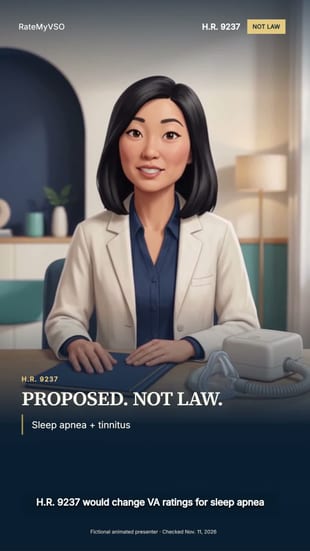
WATCH THE EXPLAINER · 2:59
The proposal in three minutes.
Our animated Short explains the proposed sleep apnea and tinnitus ratings, the existing-compensation protection, and why the dates matter.
Watch the YouTube Short ↗Status update · November 12: The House passed H.R. 9237 on November 11. The video’s opening refers to the earlier postponement. Use the current status and update record on this page for the latest developments.
01 / BILL PROGRESS
The House vote is one step.
A bill must clear the remaining legislative steps before it can change the law.
- COMPLETED
House passage
November 11, 2026
Passed by voice vote. - WATCHING
Senate passage
No Senate passage of H.R. 9237 recorded.
- PENDING
Becomes law
No enactment or public law number recorded.
- UNCONFIRMED
Dates & VA rollout
No enacted dates for these proposed changes.
Both chambers must agree to the same final text. If the Senate changes it, House agreement would still be needed. Any law’s applicability dates and VA’s implementation guidance will be tracked separately.
What about the Senate companion, S. 4744?
S. 4744 is a separate, related bill. Its latest recorded action is placement on the Senate calendar on June 11, 2026. Being on the calendar is not Senate passage.
Its published Section 108 applies to claims filed after enactment. The adopted House language uses October 1, 2026. We’ll identify the version Congress actually advances instead of treating the two bills as interchangeable.
Senate companion status · Senate calendar text02 / WHAT THE BILL WOULD CHANGE
Today’s rules. The proposal beside them.
House passage has not changed these rating criteria. Service connection must still be established; a diagnosis or a CPAP machine alone does not establish it.
CURRENT VA RULE
Required breathing assistance, such as CPAP
This is the current 50% criterion for service-connected sleep apnea. Other levels depend on the symptoms and findings in the record.
Read current DC 6847PROPOSED IN SECTION 108 · NOT IN EFFECT
Ratings based on treatment results
For the treatment-use exception, a qualified medical provider must find that another condition directly interferes with a recognized treatment normally shown to work.
Read the adopted House text, Section 108See every current sleep apnea rating level
There is no 10% level in current DC 6847. The House proposal has no 30% level.
Explore RateMyVSO’s sleep apnea referenceCURRENT VA RULE
One rating for recurrent tinnitus
Current DC 6260 provides one 10% rating for recurrent service-connected tinnitus, whether heard in one ear, both ears, or the head.
Objective tinnitus is evaluated with its underlying condition. The rule also limits separate ratings when tinnitus already supports another evaluation.
Read current DC 6260PROPOSED IN SECTION 108 · NOT IN EFFECT
A separate paid rating would be limited
The proposal generally bars a separate compensable tinnitus rating.
It would retain 10% when tinnitus is diagnosed as associated with service-connected hearing loss that is otherwise rated at a noncompensable level.
Simply having hearing loss would not satisfy all those conditions.
Read the adopted House text, Section 108Comparison based on the House text adopted July 16, 2026, and current eCFR criteria. The newly engrossed House text was not yet listed in the official feed when checked. We’ll reconcile it when posted.
03 / DATES & EXISTING RATINGS
The date in a bill is not a countdown.
No rating changes under H.R. 9237 are in effect. These are the dates and protections to watch in the final text.
October 1, 2026
The House language applies the revisions to claims filed on or after this date. It did not activate the changes on October 1.
If a later law keeps that wording, it could reach claims filed before enactment. That follows from the proposed wording; it is not a prediction of the final law.
No guaranteed filing safe harbor: Section 108 does not expressly resolve how an intent to file would be treated.
Section 108(c)(1)What the bill says about existing compensation
The proposed revisions could not be used to reduce, discontinue, or otherwise adversely affect compensation in effect the day before enactment.
That is protection from these revisions. It does not prevent every other lawful review or reduction.
Section 108(c)(2)A SEPARATE PROCESS
We’re also watching VA rulemaking.
VA proposed similar changes in 2022. That process is separate from Congress. No final rule replacing these sleep apnea or tinnitus criteria was found in the checks for this page; the current eCFR still shows the existing levels.
The 2024 supplemental proposal concerns constrictive bronchiolitis. A regulatory agenda target is not an effective date.
Read VA’s 2022 proposal04 / UPDATE RECORD
What changed, and when.
Newest first · Every entry has a source
House passage confirmed in the official record
The House passed H.R. 9237 by voice vote on November 11. This page now marks House passage complete. No Senate passage or enactment is recorded in the bill-status feed.
For veterans: This moves the bill forward. It does not put Section 108’s rating changes into effect.
Official House action recordHouse amendment adopted; proceedings postponed
The House adopted text using October 1, 2026 as the proposed claims applicability date. Final passage did not occur that day; proceedings were postponed.
Adopted text · Concluding House proceedingsOUR UPDATE PROMISE
Follow the record.
Explain the change.
We will keep this page current as official information changes, and make the checks visible so you can judge how fresh it is.
Congressional progress. House and Senate actions, amendments, the text both chambers approve, and whether the bill becomes law.
Dates that affect claims. Enactment, applicability, effective dates, existing-award protections, and VA implementation guidance.
A dated explanation. What changed, what it means for veterans, what remains unanswered, and the official source.
Visible checks and corrections. We’ll distinguish “checked, no change” from a substantive update. If we correct an earlier explanation, the correction will stay in the update record.
05 / VERIFY IT YOURSELF
The source is part of the update.
Primary records control the status and comparison above. A headline or a forecast is not an effective date.
House bill status
Official actions, text versions and enactment record
Adopted House text
Section 108 and the October 1 language
Current sleep apnea criteria
38 CFR 4.97 · Diagnostic Code 6847
Current tinnitus criteria
38 CFR 4.87 · Diagnostic Code 6260
Senate companion
S. 4744 · Separate bill, separately tracked
VA’s proposed rule
The separate 2022 regulatory proposal
Checked November 15, 2026. The eCFR API reports Title 38 current through November 12, 2026. The Federal Register search for RIN 2900-AQ72 returned no final rule. View the rulemaking search.
Keep this page handy.
We’ll put the next verified development here, with the date, the source, and a plain-English explanation.
Back to current status ↑This page explains legislation and rating criteria. For help applying the rules to your claim, find an accredited representative.