Build a Claim File that is Strong and Easy to Understand
The VA decides your claim from a file, a bunch of files really, and not from a conversation. A complete file has every element the VA evaluates, each one easy to find, with the theory you are claiming under stated plainly, so that the VA can do their job without hunting and possibly missing something. A complete and well organized claim can make the claims process smooth and reduce the chances of an error. Bigger is not always better, complete, clear, and easy to follow is always better for everyone involved. This guide walks through the elements a complete claim file generally contains, how to organize and label them, and it gives you a blank master-overview template you can print and use to help organize everything.

1. Everything is thereEvery element the VA looks for is present in the file.See the elements
2. Everything is easy to findName your files clearly and point to where each element lives.See examples
- Smart file naming
- Point to document and page numbers
- Call out the diagnosis and ICD codes
- Treating physician names
- Personal statement file names
- Buddy statement file names
- Group records by condition
- Date and sign every statement
3. The theory is clearThe reader can see which path to service connection you are claiming under.See the paths
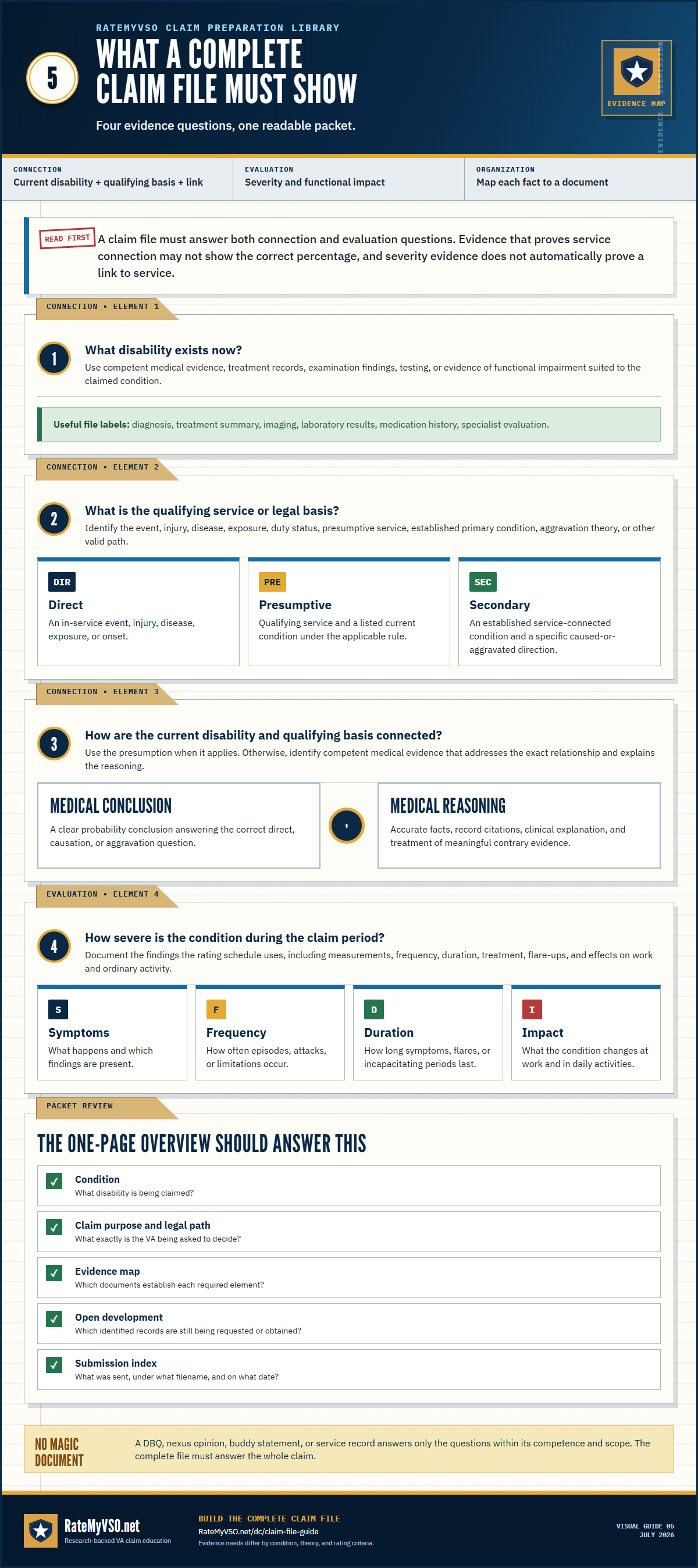
1 Critical elements that the VA looks for in your file
Almost every disability claim is evaluated on the same elements. Knowing them up front tells you what your file needs to contain.
- A current diagnosis from a medical professional. A symptom ("knee pain") is not a diagnosis; "M17.5 Other unilateral secondary osteoarthritis of knee" is a medical diagnosis.
- An in-service event, injury, exposure, or onset, or a presumptive or secondary basis that links the condition to service.
- A nexus, a medical opinion connecting the current diagnosis to service, usually phrased "at least as likely as not."
- Severity and functional impact, the documented symptoms and limitations the rating schedule uses to assign a percentage.
The first three are what decide service connection (yes or no). The fourth is what decides the rating percentage.
2 Gather the building blocks
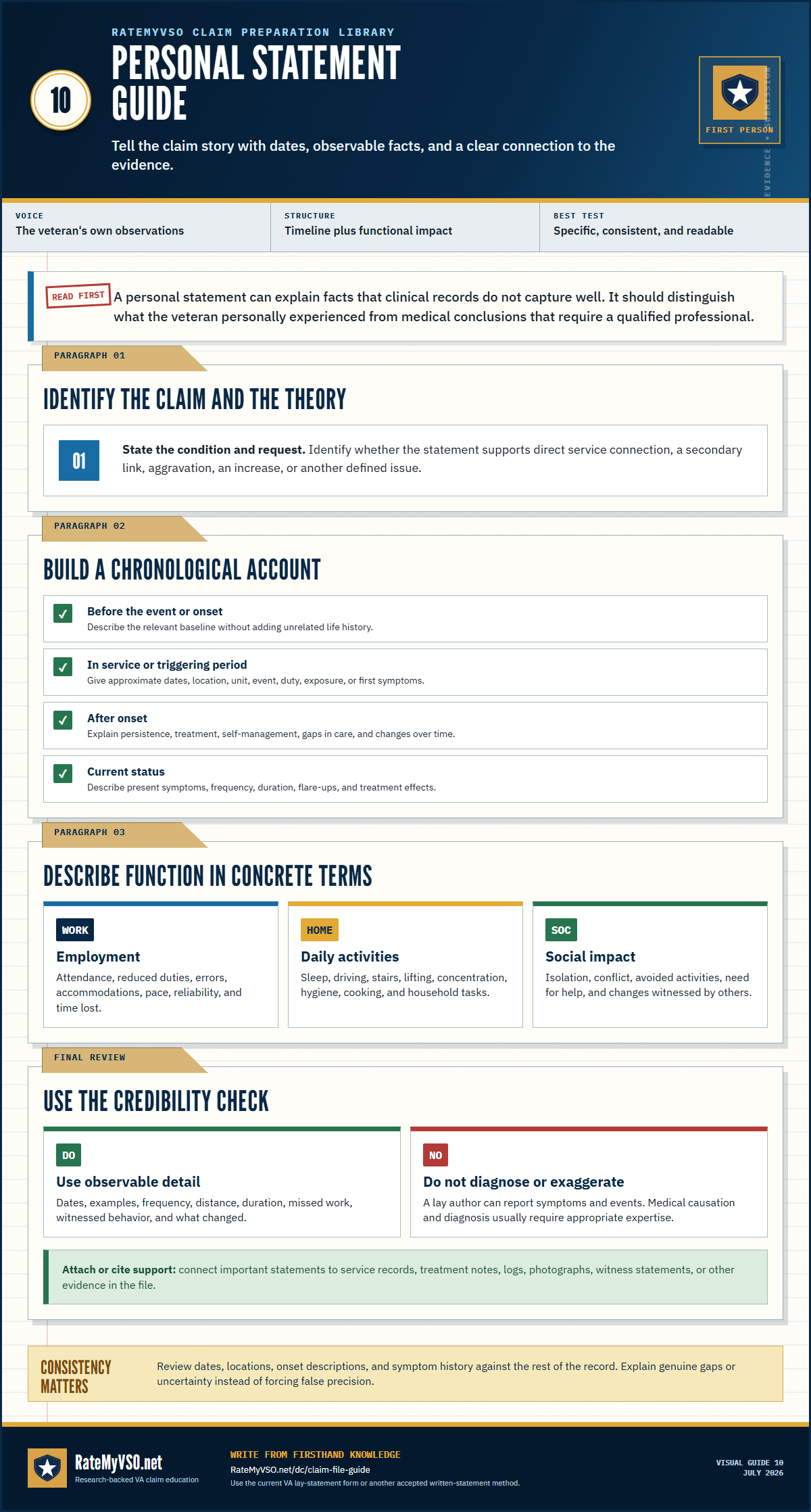
Gather your data before you file. Look for or determine these things first. These are the pieces a complete file should generally contain. Not every claim needs every one of these items; for example, PTSD would not have painful motion, and a knee injury would not need a stressor event. Each block links to the guide that goes deep.
Medical records
Service treatment records, VA records, and private records that show your diagnosis, treatment, and history.
Records Request Guide →Test and diagnostic results
Imaging, labs, sleep studies, audiograms. Some conditions require a specific test (for example, arthritis must be shown by x-ray).
What the examiner measures →Diagnosis and ICD codes
The named diagnosis from your records, and the ICD-10 codes that sit next to it. Confirm you have a current diagnosis on file.
ICD-10 to VA code lookup →Medications
What you take for the condition, the dose, and how often. Continuous medication is a rating factor for several conditions.
Look up your condition →The theory you are filing under
Direct, secondary, presumptive, aggravation, or 1151. The file should make clear which path you are claiming. Which one fits your facts is a determination for you and your representative, not something this page decides.
The 7 paths, explained →Functional impact
How the condition limits work and daily life. This is what moves a rating, not just the diagnosis name.
Functional Impact Library →Pain and painful motion
For musculoskeletal conditions, pain on movement, flare-ups, and functional loss (DeLuca, 38 CFR 4.40 and 4.45).
Painful Motion guide →Your personal statement
Your own account of symptoms, frequency, severity, and how they affect your day. Specific and dated beats general.
Lay and personal statements →Lay and buddy statements
Statements from a spouse, family member, or fellow service member who witnessed the event or your symptoms.
Buddy statement guide →Nexus / medical opinion
A medical professional's written opinion linking the condition to service. Often the piece that decides the claim.
Nexus Letter guide →Stressor verification (PTSD)
For PTSD, evidence corroborating the in-service stressor, or the relaxed standards that can apply.
Stressor verification →Mistakes to avoid
The avoidable errors that stall claims, from naming a symptom instead of a diagnosis to burying the key evidence.
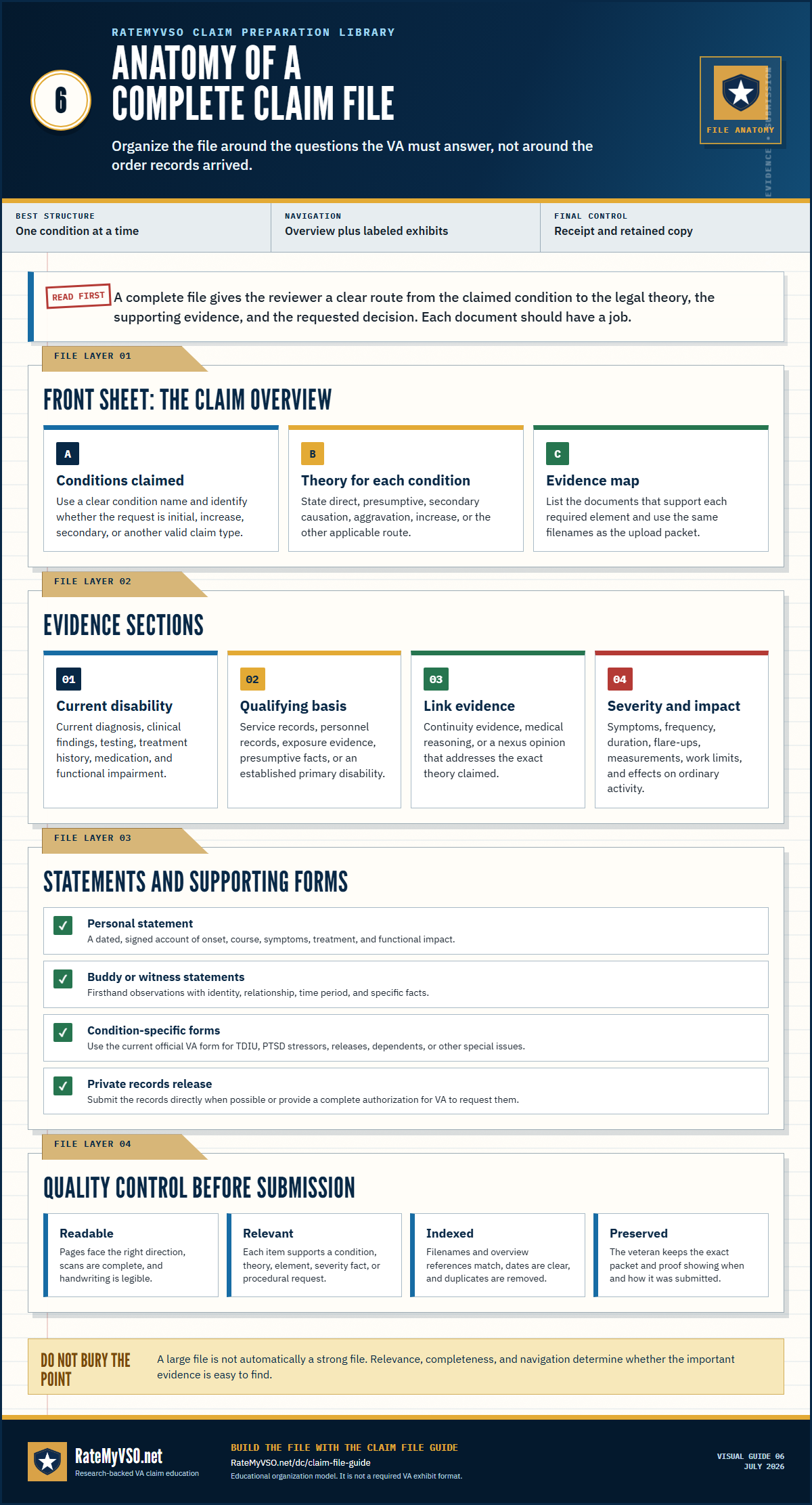
10 common mistakes →3 Organize and name your files in a way that makes it obvious what they are
A complete file can still make things difficult if the rating specialist cannot find each element quickly. A 200-page medical record that has a diagnosis in it can easily be missed if you do not call out the filename and page number. Organization is where you make their job easy.
- Name your uploaded files clearly. When you upload to VA.gov, a name like
Knee_Diagnosis_2019.pdforBuddyStatement_Smith.pdftells the reader what is inside before they open it. A name likescan0007.pdfdoes not. - Cite the document and page. For each element, note exactly where it lives: "Current diagnosis: VA records, exam dated 03/14/2019, page 4." This is the single most useful organizing habit.
- Keep one consistent structure. Group records by condition, and within a condition by element (diagnosis, event, nexus, severity), so nothing is buried.
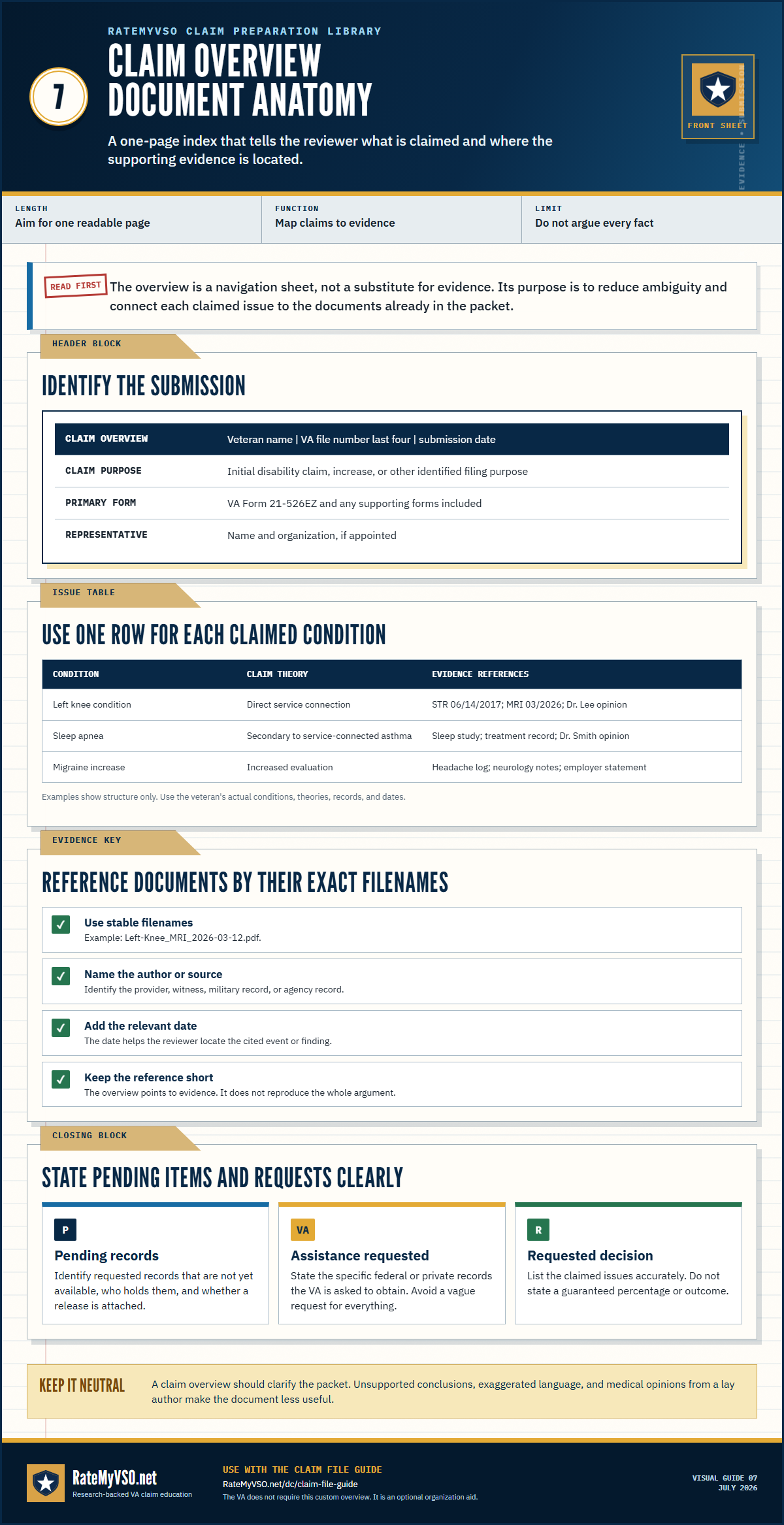
4 Include a Claim Overview document in your upload
A master Claim Overview is a short narrative document that indexes everything: for each condition, the theory you are claiming under and where each element lives in the file (file name, page number, theory). A VSR or rating specialist can read it in a minute and know exactly what you are claiming and where to look for the supporting materials.
It does not argue your claim. It is the map to your claim and all the important evidence. Below is a blank template you can print and fill in yourself.
5 Before you submit your file, make sure you do a completeness check
A plain check that the file is complete and findable:
Check your claim file's completeness against the elements below.
- Every condition has a current diagnosis on file.
- Every condition has an in-service event, onset, or a presumptive / secondary basis in the file.
- Every condition that needs one has a nexus / medical opinion.
- Severity and functional impact are documented, not just the diagnosis.
- The theory you are claiming under is stated plainly.
- Statements are signed and dated; uploads are clearly named.
- Your master overview points to the document and page for each element.
See a filled-in example
Here is what a completed Claim Overview can look like. It uses a made-up veteran and made-up records to show the format only. This example is for illustration; it is not printable, not legal advice, and not your data.
Show the filled-in example
Master Claim Overview (example)
A made-up veteran and made-up records, shown only to illustrate the format.
| Veteran name | Jordan Sample (fictional) | VA file number | xxx-xx-1234 |
| Date of birth | 01/02/1985 | Date of letter | 03/20/2026 |
| Branch of service | Army | Unit | 1st Battalion, 5th Infantry |
| Service dates | 2005 to 2011 | Theater | Iraq |
| Campaign | Operation Iraqi Freedom | Phone | (555) 010-1234 |
| Address | 100 Example St, Anytown, GA 30000 | [email protected] |
| Condition | Diagnostic code | Claim type | Legal basis | Where the evidence is |
|---|---|---|---|---|
| Right knee osteoarthritis | DC 5260 | Direct | 38 CFR 3.303 | STR p14; X-ray p2; nexus letter |
| Tinnitus | DC 6260 | Direct | 38 CFR 3.303 | 2019 audiogram; buddy statement |
| Sleep apnea | DC 6847 | Secondary to PTSD | 38 CFR 3.310 | 2021 sleep study; nexus letter |
| Date | Document (file + page) | Key finding | Element it supports |
|---|---|---|---|
| Jun 1989 | STR_1989_KneeInjury.pdf, p14 | Sick call for the right knee after a training fall | In-service event |
| Mar 2019 | Knee_Diagnosis_2019.pdf, p2 | X-ray: osteoarthritis, right knee (M17.11) | Diagnosis |
| Mar 2019 | NexusLetter_DrLee.pdf, p1 | "At least as likely as not related to service" | Nexus |
| Mar 2019 | VA_Exam_2019.pdf, p4 | Flexion 45 degrees, pain on motion, flare-ups | Severity / functional impact (knee) |
| 2019 | Audiology_2019.pdf, p1 | Tinnitus diagnosed (ICD H93.13) | Diagnosis (tinnitus) |
| 2021 | SleepStudy_2021.pdf, p2 | Obstructive sleep apnea, AHI 22, CPAP prescribed | Diagnosis and severity (sleep apnea) |
| 2021 | NexusLetter_DrPatel.pdf, p1 | Sleep apnea secondary to PTSD ("at least as likely as not") | Nexus (sleep apnea) |
I certify under penalty of law that all statements in this Comprehensive Personal Statement and in the individual attestation letters submitted as part of this claim package are true and accurate to the best of my knowledge and recollection. I understand that false statements made in connection with a VA claim are punishable under 18 U.S.C. § 1001 and 38 U.S.C. § 6103.
Signature: /s/ Jordan Sample (fictional)
Printed name: Jordan Sample (fictional)
Date: 03/20/2026
Fictional veteran and fictional records, shown only to illustrate the format. Not legal advice and not your data. For help with your own claim, work with a VA-accredited representative.
Blank master claim file overview
Download this blank template as a Word document and fill it in, or copy it into your own document. Nothing here is saved or sent anywhere, it is a blank form for your own use.
Master Claim File Overview
A one-page index for your VA claim file. Fill in your information and where each element lives so the reader can find it fast.
| Veteran name | VA file number | ||
| Date of birth | Date of letter | ||
| Branch of service | Unit | ||
| Service dates | Theater | ||
| Campaign | Phone | ||
| Address |
| Condition | Diagnostic code | Claim type | Legal basis | Where the evidence is |
|---|---|---|---|---|
Repeat this block for each additional condition you are claiming.
| Date | Document (file name + page) | Key finding | Element it supports |
|---|---|---|---|
I certify under penalty of law that all statements in this Comprehensive Personal Statement and in the individual attestation letters submitted as part of this claim package are true and accurate to the best of my knowledge and recollection. I understand that false statements made in connection with a VA claim are punishable under 18 U.S.C. § 1001 and 38 U.S.C. § 6103.
Signature:
Printed name:
Date:
Educational template only; not legal advice.
Claim Quest: Quick Check
Five questions based only on this guide.
This checks what you understood from this guide. It is not a claim-readiness score, a prediction, an official test, or a record on your account.
Frequently asked questions
Do I have to use this exact structure?
Will naming my files and citing pages really make a difference?
Which theory should I file under?
Is the master overview a legal document?
Is anything I type into the template saved?
Can you build or review my claim for me?
Related Tools and Guides
This page is educational and is not legal or medical advice. It helps you organize your own information; it does not prepare, present, or prosecute a claim. Based on 38 CFR Part 4 and VA adjudication procedures. For help with a specific claim, work with a VA-accredited representative. All RateMyVSO tools are free.