How a VA Secondary Claim Works
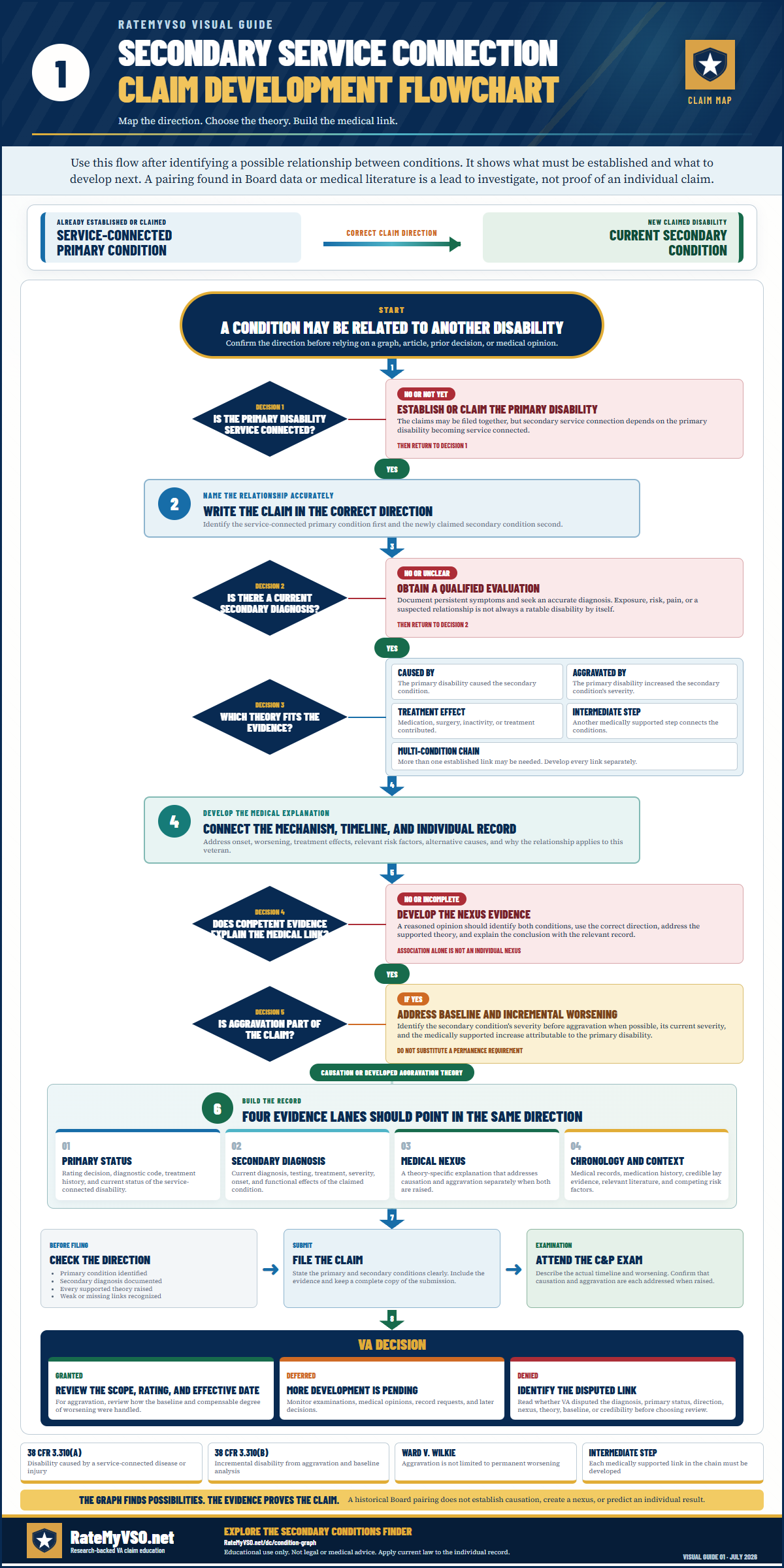
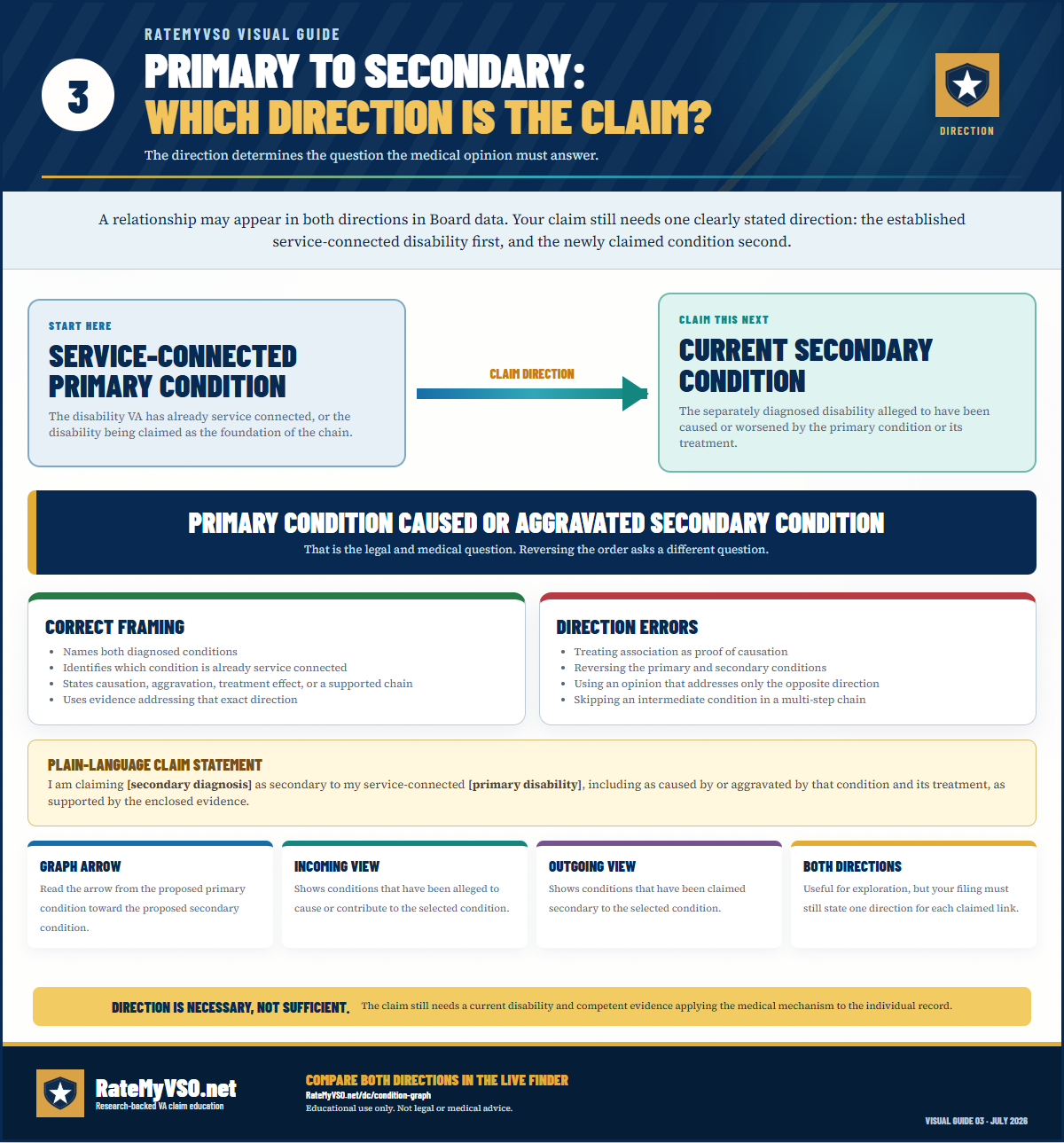
A secondary claim says a condition the VA already service-connected (the primary) caused or worsened a new condition (the secondary). This page explains the three elements secondary service connection needs under 38 CFR 3.310, the difference between caused and aggravated, and the medical nexus evidence these claims rely on.

What a Secondary Claim Is
A secondary claim asks for service connection for a condition that is not tied to military service on its own. The condition flows from a disability the VA already service-connected. The VA calls the already-connected disability the primary. It calls the new condition the secondary.
The rule sits in 38 CFR 3.310(a). It states that a "disability which is proximately due to or the result of a service-connected disease or injury shall be service connected." Put plainly, if a service-connected condition caused or worsened another condition, the VA can connect that second condition too.
Source: 38 CFR § 3.310. Read 38 CFR 3.310 on Cornell LII.
The Three Elements of Secondary Service Connection
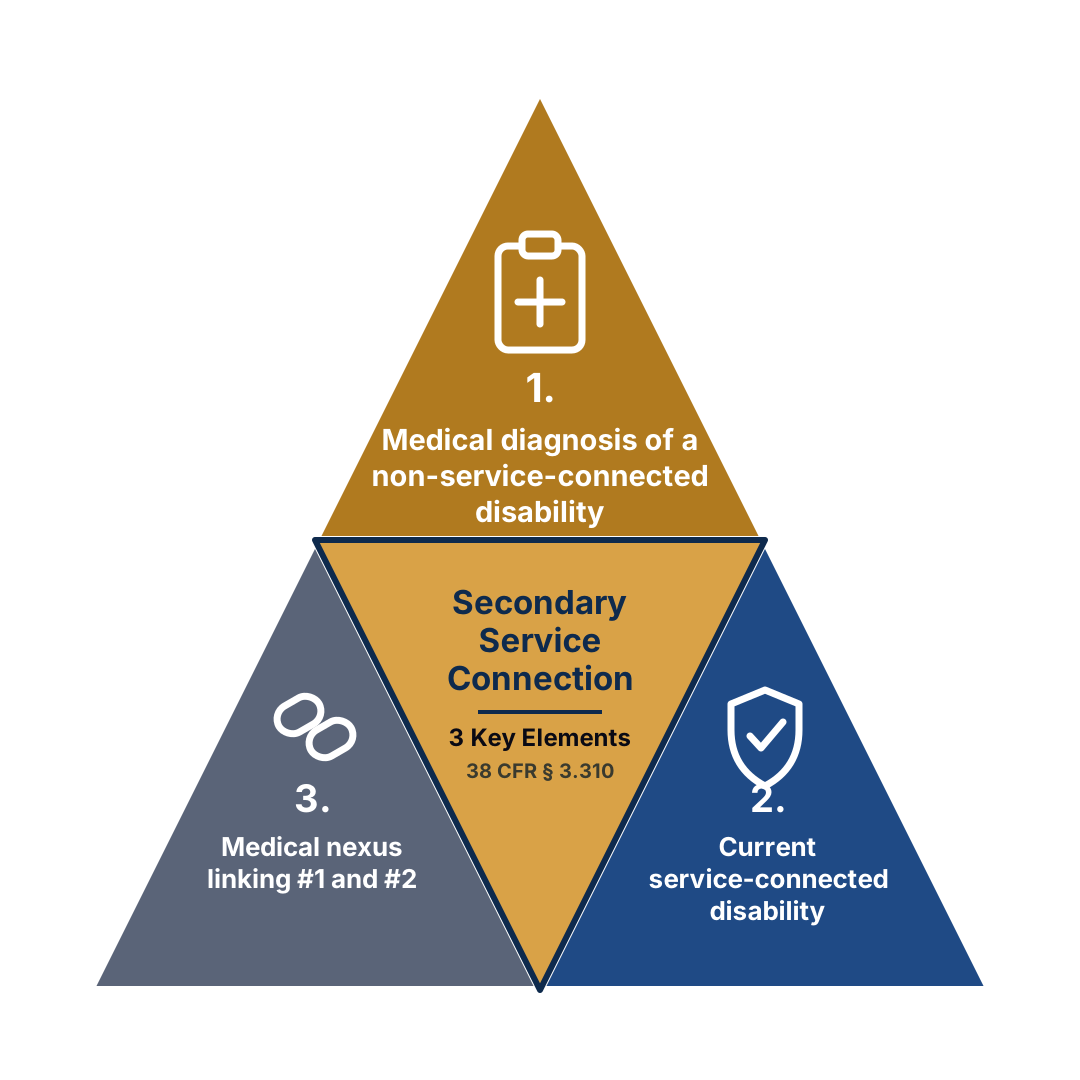
A secondary claim turns on three elements. The link holds only when all three are present. (see 38 CFR 3.310)
A current diagnosis
A medical diagnosis of the new non-service-connected condition you claim as the secondary.
A service-connected disability
A disability the VA already service-connected. It acts as the primary.
A medical nexus
A medical opinion linking element 1 to element 2, showing the primary caused or aggravated the secondary.
Caused vs Aggravated
Secondary service connection rests on two theories. The primary can cause the secondary condition. Or the primary can make worse a secondary condition that something else first brought on. Either theory can establish a secondary.
The aggravation theory comes from 38 CFR 3.310(b). It states that "any increase in severity of a nonservice-connected disease or injury that is proximately due to or the result of a service-connected disease or injury, and not due to the natural progress of the nonservice-connected disease, will be service connected."
For an aggravation theory, the rater first sets a baseline. The baseline is the level of the secondary condition before the service-connected disability began to worsen it. The rater then compares that baseline to the current severity. The VA pays the increase above the baseline. It takes out any worsening that came from the condition's own natural progression.
| Theory | Regulation | What it shows |
|---|---|---|
| Caused by | 38 CFR 3.310(a) | The primary disability brought the secondary condition into existence. |
| Aggravated by | 38 CFR 3.310(b) | The secondary condition existed already. The primary made it worse beyond its natural progress. The VA pays the increase above the baseline. |
Source: 38 CFR § 3.310(b). Read 38 CFR 3.310 on Cornell LII.
Common Examples
These examples show how the secondary theory gets used. They come from co-occurrence patterns documented in published Board decisions. They describe how the theory has been applied. They do not predict any one person's case.
- Sleep apnea secondary to PTSD: sleep apnea claimed as flowing from a service-connected mental health condition.
- Depression secondary to chronic pain: a depressive condition claimed as growing out of long-term pain from a service-connected disability.
- Radiculopathy secondary to a back disability: nerve-related leg or arm symptoms claimed as flowing from a service-connected spine condition.
- Erectile dysfunction secondary to medication: a condition claimed as a side effect of medication taken for a service-connected condition.
You can browse documented secondary relationships in the explorer tools. The Secondary Condition Suggester lists conditions commonly claimed as secondary to a given primary. The Secondary Condition Network Map shows how conditions connect as secondaries.
The Nexus Evidence
In a secondary claim, the third element, the medical nexus, almost always decides the case. The diagnosis and the service-connected disability are usually documented already. The record often lacks a clear medical opinion that connects the two.
A nexus is a medical opinion that explains how the primary caused or aggravated the secondary. The connection between two medical conditions is a medical question. So a lay statement from you alone is usually not enough to establish it. The opinion usually comes from a medical professional who reviews the records.
The Nexus Letter Guide explains what makes a medical nexus opinion strong enough to establish the link.
How the VA claim types compare
This chart shows what each VA claim type is for and how it differs from the others. It does not tell you which one to file. For help with your own claim, work with a free VA-accredited representative.
| Claim type | Use it when | Form | What makes it different |
|---|---|---|---|
| What you are claiming (the purpose) | |||
| Initial | You claim a condition the VA has not decided before. | VA Form 21-526EZ | You prove three elements: a current diagnosis, an in-service event, and a nexus that links them. |
| Increase | A condition the VA already granted has gotten worse. | VA Form 21-526EZ | You ask for a higher rating on a condition you already won. |
| Secondary You are here | A service-connected condition caused or worsened a new one. | VA Form 21-526EZ | You need a medical nexus that links the new condition to the service-connected one (38 CFR 3.310). |
| 1151 | VA medical care caused an added disability. | VA Form 21-526EZ | You show VA fault or an event that was not reasonably foreseeable. If granted, the VA pays it as if it were service-connected. |
| How the VA develops your claim (the path) | |||
| Standard | You want the VA to gather your records for you. | Same 526EZ claim, no separate form | The VA gathers evidence under its Duty to Assist. This is the default path and it takes longer. |
| Fully Developed | You already hold all of your evidence. | Same 526EZ claim, no separate form | You submit everything up front and certify there is no more. The VA still pulls federal records. It moves faster. |
The top group is what you claim. The bottom group is how the VA develops it. All four claim purposes use the same form, VA Form 21-526EZ. Every claim has one purpose and one development path. An initial claim, for example, is filed as either a Standard or a Fully Developed claim.
Claim Quest: Quick Check
Five questions based only on this guide.
This checks what you understood from this guide. It is not a claim-readiness score, a prediction, an official test, or a record on your account.
Frequently Asked Questions
Can a 0% primary support a secondary claim?
Yes. 38 CFR 3.310 looks at whether a service-connected disability caused or aggravated another condition, not at how severe the primary is. A disability the VA rates at 0% is still service-connected. So it can serve as the primary that supports a secondary.
What is the difference between caused and aggravated?
A condition is caused by the primary when the service-connected disability brought it into existence (38 CFR 3.310(a)). A condition is aggravated by the primary when it already existed but the service-connected disability made it worse beyond its natural progression (38 CFR 3.310(b)). For aggravation, the VA sets a baseline level before the worsening and pays the increase above that baseline.
Do I need a nexus letter for a secondary claim?
Almost always. The medical nexus, the opinion that links the primary to the secondary, is the element that most often decides a secondary claim. The link between two conditions is a medical question. So a lay statement alone is usually not enough, and a medical opinion is generally what establishes it.
RateMyVSO. Educational resource. Not affiliated with the U.S. Department of Veterans Affairs. Not legal advice. All RateMyVSO tools are free. Find a VSO representative for personalized guidance.
See: documented secondary-condition pairings with Board outcome data.