C&P Exam Prep Guide for Tenosynovitis, tendinitis, tendinosis or tendinopathy (DC 5024)
YOUR EXAM BLUEPRINT
Tenosynovitis, tendinitis, tendinosis or tendinopathy
A shoulder exam is a hands-on physical exam. The examiner measures how the shoulder moves, tests it, and reviews imaging, then rates under 38 CFR 4.71a.
DBQ used for this condition
- PPublic formDBQ MUSC Shoulder and ArmOpen the public DBQ
- PPublic formDBQ MUSC Elbow and ForearmOpen the public DBQ
- PPublic formDBQ MUSC WristOpen the public DBQ
- PPublic formDBQ MUSC Hand and FingerOpen the public DBQ
- PPublic formDBQ MUSC Hip and ThighOpen the public DBQ
- PPublic formDBQ MUSC Knee and Lower LegOpen the public DBQ
- PPublic formDBQ MUSC AnkleOpen the public DBQ
- PPublic formDBQ MUSC Foot Conditions Including Flatfoot (Pes Planus)Open the public DBQ
- PPublic formDBQ MUSC Neck (Cervical Spine)Open the public DBQ
- PPublic formDBQ MUSC Back (Thoracolumbar Spine)Open the public DBQ
What the examination is likely to focus on
Functional-impact topics to describe
- How far you can raise the arm (especially to shoulder level, about 90 degrees) and whether the dominant or non-dominant arm is affected, which set the rating.
- Findings map to the tiers in 38 CFR 4.71a (limitation of arm motion DC 5201; clavicle or scapula DC 5203).
Which form the examiner uses
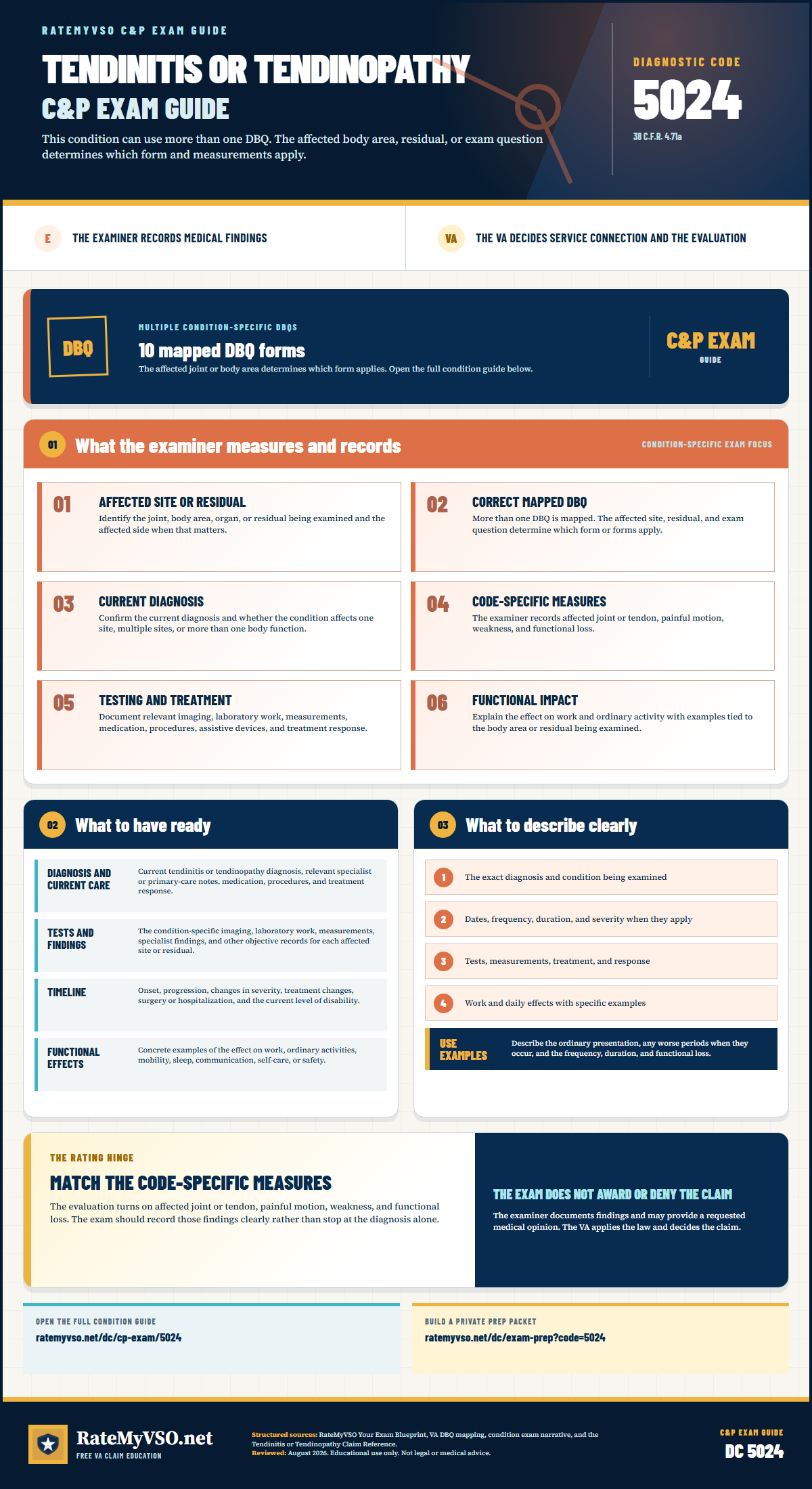
For tenosynovitis, tendinitis, tendinosis or tendinopathy (DC 5024), the C&P examiner uses the Disability Benefits Questionnaire (DBQ) that matches the condition, which can be more than one of these. The topics section below asks which ones apply.
- DBQ MUSC Shoulder and Arm (public PDF on VA.gov)
- DBQ MUSC Elbow and Forearm (public PDF on VA.gov)
- DBQ MUSC Wrist (public PDF on VA.gov)
- DBQ MUSC Hand and Finger (public PDF on VA.gov)
- DBQ MUSC Hip and Thigh (public PDF on VA.gov)
- DBQ MUSC Knee and Lower Leg (public PDF on VA.gov)
- DBQ MUSC Ankle (public PDF on VA.gov)
- DBQ MUSC Foot Conditions Including Flatfoot (Pes Planus) (public PDF on VA.gov)
- DBQ MUSC Neck (Cervical Spine) (public PDF on VA.gov)
- DBQ MUSC Back (Thoracolumbar Spine) (public PDF on VA.gov)
DBQs are Department of Veterans Affairs Form 21-0960 series documents. Public DBQs are hosted on benefits.va.gov. A handful are examiner-only and are not posted publicly.
The DBQ topics for this condition
These are the parts of the DBQ form that apply to tenosynovitis, tendinitis, tendinosis or tendinopathy (DC 5024). Sections the form uses for other conditions are left out. Topics marked Only if this applies depend on your own history, such as surgery, a device, or a complication; open one if it applies to you. Section and question numbers are the ones printed on the VA form.
Which form applies depends on your answer above. Depending on your answer, the examiner uses one or more of: Shoulder and/or Arm; Elbow & Forearm; Wrist; Hand and Finger; Hip and Thigh; Knee and Lower Leg; Ankle; Foot Conditions Including Flatfoot (Pes Planus); Neck (Cervical Spine); Back (Thoracolumbar Spine).
This is a preparation view built from the current public VA forms. It is not an official VA crosswalk, it does not decide which exam VA orders, and it does not tell the examiner to skip anything. Measurements, diagnoses and opinions on the form are the examiner's to record.
What to expect at your C&P exam
A shoulder exam is a hands-on physical exam. The examiner measures how the shoulder moves, tests it, and reviews imaging, then rates under 38 CFR 4.71a.
1Initial interview (history)
- When the shoulder problem started and its cause.
- Pain, weakness, popping, or dislocations, and which arm is your dominant one.
- Flare-ups and what triggers them.
- Surgeries and current treatment.
- Effect on reaching, lifting, and work.
2Physical examination
- Range of motion measured with a goniometer: raising the arm forward and out to the side, and rotation, in degrees.
- The point in the motion where pain begins.
- Repetitive-use testing (three repetitions) for added loss of motion or function.
- Strength and stability testing, and checking for dislocation.
3Diagnostic tests the examiner may rely on
Imaging is usually already in your records.
4Functional assessment
- How far you can raise the arm (especially to shoulder level, about 90 degrees) and whether the dominant or non-dominant arm is affected, which set the rating.
- Findings map to the tiers in 38 CFR 4.71a (limitation of arm motion DC 5201; clavicle or scapula DC 5203).
An elbow and forearm exam is a hands-on physical exam. The examiner measures how the elbow and forearm move and tests them, then rates under 38 CFR 4.71a.
1Initial interview (history)
- When the elbow or forearm problem started and its cause, and which arm is dominant.
- Pain, weakness, locking, or instability.
- Flare-ups, surgeries, and current treatment.
- Effect on lifting, carrying, and work.
2Physical examination
- Range of motion measured with a goniometer: bending and straightening the elbow, and turning the forearm palm-up and palm-down, in degrees.
- The point where pain begins, and repetitive-use testing.
- Strength and stability testing, and checking for ankylosis.
3Diagnostic tests the examiner may rely on
Imaging is usually already in your records.
4Functional assessment
- How much elbow and forearm motion is limited, and whether the dominant or non-dominant arm is affected, which set the rating.
- Findings map to the tiers in 38 CFR 4.71a (elbow and forearm DCs 5205-5213).
A wrist exam is a hands-on physical exam. The examiner measures how the wrist moves and tests it, then rates under 38 CFR 4.71a.
1Initial interview (history)
- When the wrist problem started and its cause, and which hand is dominant.
- Pain, weakness, stiffness, or instability.
- Flare-ups, surgeries, and current treatment.
- Effect on gripping, lifting, and work.
2Physical examination
- Range of motion measured with a goniometer: bending the wrist up and down, side to side, and turning the forearm, in degrees.
- The point where pain begins, and repetitive-use testing.
- Strength and stability testing, and checking for ankylosis.
3Diagnostic tests the examiner may rely on
Imaging is usually already in your records.
4Functional assessment
- How much wrist motion is limited and whether the joint is fused, which set the rating.
- Findings map to the tiers in 38 CFR 4.71a (wrist DCs 5213-5215).
A hand exam is a hands-on physical exam. The examiner measures how your fingers and thumb move and how well you grip, then rates under 38 CFR 4.71a.
1Initial interview (history)
- Which fingers or thumb are affected, and which hand is dominant.
- Pain, stiffness, or locking.
- Surgeries and current treatment.
- Effect on gripping, writing, buttoning, and work.
2Physical examination
- Range of motion of each affected finger and the thumb, including the gap between the fingertip and the palm.
- Grip and pinch strength.
- Checking for ankylosis (a frozen joint), and comparing to the other hand.
3Diagnostic tests the examiner may rely on
Imaging when a bone or joint problem is suspected.
4Functional assessment
- Limited motion or ankylosis of the fingers or thumb and the effect on grip, which set the rating.
- Findings map to the tiers in 38 CFR 4.71a (finger DCs 5216-5230).
A hip exam is a hands-on physical exam. The examiner measures how the hip moves, tests it, and reviews imaging, then rates under 38 CFR 4.71a.
1Initial interview (history)
- When the hip problem started and its cause.
- Pain in the hip, groin, or thigh, and what makes it worse.
- Flare-ups, giving way, surgeries or a hip replacement.
- Whether you use a cane, walker, or brace.
- Effect on walking, sitting, and work.
2Physical examination
- Range of motion measured with a goniometer: bending the hip, straightening it, moving the leg out to the side, and rotation, in degrees.
- The point in the motion where pain begins, and repetitive-use testing.
- Strength testing and checking for ankylosis (a frozen joint) or a flail joint.
- Watching you walk.
3Diagnostic tests the examiner may rely on
Imaging is usually already in your records.
4Functional assessment
- How much the hip motion is limited and whether you need an assistive device, which set the rating.
- Findings map to the tiers in 38 CFR 4.71a (hip and thigh DCs 5250-5255).
A knee exam is a hands-on physical exam. The examiner measures how the knee moves, tests it for stability, and reviews any imaging, then records the findings against the rating criteria in 38 CFR 4.71a.
1Initial interview (history)
- When the knee problem started and its cause (injury, surgery, or wear over time).
- Pain: where it is, how severe, and what makes it worse.
- Flare-ups: how often, how long they last, what triggers them, and how much more limited you are during one.
- Giving way or instability, locking, catching, or swelling.
- Surgeries or procedures, and current treatment (medication, injections, physical therapy).
- Whether you use a brace, cane, crutches, or other device.
- How the knee affects your work and daily activities.
2Physical examination
- Range of motion measured with a goniometer (a protractor-like tool): flexion (bending) and extension (straightening), in degrees.
- The point in the motion where pain begins.
- Repetitive-use testing: you bend and straighten the knee three times so the examiner can note any added loss of motion, pain, weakness, fatigue, or incoordination.
- Pain on weight-bearing, tenderness, and crepitus (a grinding feel).
- Muscle strength testing.
- Stability tests for the ligaments: front-to-back (Lachman and drawer tests) and side-to-side (varus and valgus).
- Tests for a meniscus (cartilage) tear and for ankylosis (a joint frozen in one position).
- The opposite knee is measured for comparison.
3Diagnostic tests the examiner may rely on
Imaging is usually already in your records. The examiner reviews it to confirm the diagnosis and severity.
4Functional assessment
- Whether the knee loses additional function during flare-ups or after repeated use (pain, weakness, fatigue, or incoordination).
- Whether you need a brace, cane, or other assistive device.
- How the knee limits standing, walking, climbing, squatting, and your ability to work.
- The examiner's range-of-motion and stability findings map to the tiers in 38 CFR 4.71a. Separate ratings can apply for limited motion and for instability.
An ankle exam is a hands-on physical exam. The examiner measures how the ankle moves and tests it, then rates under 38 CFR 4.71a.
1Initial interview (history)
- When the ankle problem started and its cause.
- Pain, swelling, giving way, and instability.
- Flare-ups, surgeries, braces, and current treatment.
- Effect on standing, walking, and work.
2Physical examination
- Range of motion measured with a goniometer: pointing the foot up and down, in degrees.
- The point where pain begins, and repetitive-use testing.
- Stability and strength testing.
- Watching you walk.
3Diagnostic tests the examiner may rely on
Imaging is usually already in your records.
4Functional assessment
- How much the ankle motion is limited (moderate versus marked) and whether it is unstable, which set the rating.
- Findings map to the tiers in 38 CFR 4.71a, DC 5271.
A foot exam is a hands-on physical exam. The examiner looks at the shape and alignment of your foot, how you walk, and where it hurts, then rates under 38 CFR 4.71a.
1Initial interview (history)
- When the foot problem started and its cause.
- Pain location and severity, and what makes it worse (standing, walking).
- Whether you use inserts (orthotics), special shoes, or a brace.
- Surgeries and current treatment.
- Effect on standing, walking, and work.
2Physical examination
- Inspecting the foot's shape and arch, and any deformity such as a bunion or claw toe.
- Watching you stand and walk (gait).
- Checking alignment, swelling, calluses, and tender areas.
- Whether symptoms improve with orthotics, and for flatfoot whether the arch corrects.
3Diagnostic tests the examiner may rely on
Used to confirm alignment or bone problems.
4Functional assessment
- Pain on use and whether orthotics relieve it, any deformity, and how the foot limits standing and walking, which set the rating.
- Findings map to the tiers in 38 CFR 4.71a (flatfoot DC 5276; plantar fasciitis DC 5269; hallux valgus or bunion DC 5280).
A spine exam (back or neck) is a hands-on physical exam. The examiner measures how the spine moves, checks for muscle spasm and nerve signs, and reviews imaging, then records the findings against the General Rating Formula in 38 CFR 4.71a.
1Initial interview (history)
- When the back or neck problem started and its cause.
- Pain: where it is, how severe, and whether it shoots into an arm or leg.
- Flare-ups: how often, how long they last, what triggers them, and how much more limited you are during one.
- Numbness, tingling, or weakness in the arms or legs (signs of nerve involvement).
- Any periods a doctor ordered bed rest, and roughly how many days over the past year.
- Surgeries, injections, physical therapy, and current treatment.
- Whether you use a back or neck brace, cane, or other device.
- How it affects your work and daily activities.
2Physical examination
- Range of motion measured with a goniometer: forward bending (flexion), backward (extension), side bending, and rotation, in degrees.
- The point in the motion where pain begins.
- Repetitive-use testing (three repetitions) for added loss of motion, pain, weakness, fatigue, or incoordination.
- Muscle spasm, guarding, and tenderness, and whether they change your posture or the way you walk.
- Whether the spine is fixed in one position (ankylosis).
- Reflexes, sensation, and strength in the arms or legs to check for a pinched nerve (radiculopathy).
- Straight-leg-raise and similar nerve-tension tests.
3Diagnostic tests the examiner may rely on
Imaging and nerve studies are usually already in your records. The examiner reviews them to confirm the diagnosis and severity.
4Functional assessment
- Whether the spine loses additional function during flare-ups or after repeated use.
- The number of days over the past 12 months a doctor ordered bed rest. For intervertebral disc syndrome this is the alternate basis for the rating.
- Whether you use a brace, cane, or other device.
- How it limits bending, lifting, sitting, standing, and your ability to work.
- Nerve symptoms (radiculopathy) are rated separately under the nerve codes; the examiner documents those findings too.
- Findings map to the General Rating Formula for the spine in 38 CFR 4.71a.
Test explainers open MedlinePlus (NIH National Library of Medicine), or Wikipedia where MedlinePlus has no matching page. This describes what happens and what is measured, not how to influence a result.
Rating Levels for DC 5024
The following tiers are reproduced from 38 CFR Part 4, the VA Schedule for Rating Disabilities. Toggle between the official VA criteria and a Plain English explanation.
Plain-English summaries are AI-generated to explain the official criteria. The official 38 CFR language is the binding legal standard. When in doubt, ask a VSO.
Related diagnostic codes
Evidence cited in published BVA decisions for DC 5024
Each row counts the issues for this diagnostic code that the Board granted or denied and whose decision text discussed that type of evidence. An issue is one condition the Board ruled on, and one decision can contain several. Remanded issues are not included. This is a count from the public record, not a prediction or a recommendation for any claim.
- Service treatment records: discussed in 2,010 granted or denied BVA issues (791 granted; 1,219 denied)
- Buddy / lay statements: discussed in 1,431 granted or denied BVA issues (593 granted; 838 denied)
- Medical literature: discussed in 95 granted or denied BVA issues (64 granted; 31 denied)
What the Board discussed in granted decisions for DC 5024
The themes below were extracted by clustering 500 grant-factor sentences from published Board of Veterans Appeals decisions for this diagnostic code. Frequencies indicate how often each theme appeared in the sample. This is a factual aggregate of the public record, not advice or strategy for any specific claim.
- 24% Benefit of the doubt doctrine statutory standard citedThe Board cited the statutory and regulatory standard requiring VA to resolve approximate balance of positive and negative evidence in the claimant's favor, often quoting 38 U.S.C. § 5107(b) or 38 C.F.R. § 3.102.118 of 500 sample sentences
- 20% Benefit of the doubt applied to grant higher ratingThe Board affirmatively applied the benefit of the doubt doctrine and resolved equipoise in the Veteran's favor, resulting in a grant of a specific disability rating or increased evaluation.98 of 500 sample sentences
- 19% Preponderance against claim, benefit of the doubt inapplicableThe Board found the preponderance of evidence was against the claim, rendering the benefit of the doubt doctrine inapplicable and resulting in denial.96 of 500 sample sentences
- 14% Evidence found in equipoise warranting grantThe Board found the competent lay and medical evidence was at least in relative equipoise on a material issue, directly supporting a grant of service connection or an increased rating.72 of 500 sample sentences
- 11% VA or private examiner nexus opinion noted as at least as likely as notA VA or private examiner opined that a current disability was at least as likely as not incurred in, caused by, or aggravated by active military service.55 of 500 sample sentences
- 5% Benefit of the doubt applied to specific symptom or functional findingThe Board applied the benefit of the doubt to resolve ambiguity regarding a specific clinical finding, symptom severity, or range-of-motion measurement in the Veteran's favor.24 of 500 sample sentences
- 5% Examiner nexus opinion request documentedThe record reflected a formal request or remand instruction for an examiner to opine whether a disability was at least as likely as not related to service or a service-connected condition.23 of 500 sample sentences
- 3% Negative nexus or unfavorable examiner opinion recordedAn examiner opined that a current disability was not at least as likely as not related to service or a service-connected condition, forming negative evidence against the claim.14 of 500 sample sentences
When the Board found the exam inadequate (DC 5024)
In 1,772 published Board of Veterans' Appeals decisions involving this condition, the Board found a C&P examination or medical opinion inadequate. Where the defect could be read from the decision, it was most often one of the following (counts are a floor from the decisions on file, not a total):
- 479 Failed to address a contention or part of the condition
- 391 Conclusion given without a supporting rationale
- 375 Veteran's lay statements not considered
- 147 Flare-ups or functional loss not addressed
- 139 Opinion relied on the absence of records instead of the evidence
- 83 Claims file or records not reviewed
- 69 Examiner said an opinion would require speculation
- 30 Exam too old to reflect current severity
- 17 Wrong legal standard or question applied
An inadequate exam is usually sent back for a new one rather than decided against the veteran. This is a factual report of published decisions, not advice about any exam or claim; whether an exam is adequate is decided case by case.
Disclaimer: This page reproduces public Department of Veterans Affairs forms (DBQs) and verbatim text from 38 CFR Part 4 (the VA Schedule for Rating Disabilities). It is informational only and is not legal or medical advice. For guidance on a specific claim, contact a VA-accredited representative.