C&P Exam Prep Guide for Hiatal hernia and paraesophageal hernia (DC 7346)
YOUR EXAM BLUEPRINT
Hiatal hernia and paraesophageal hernia
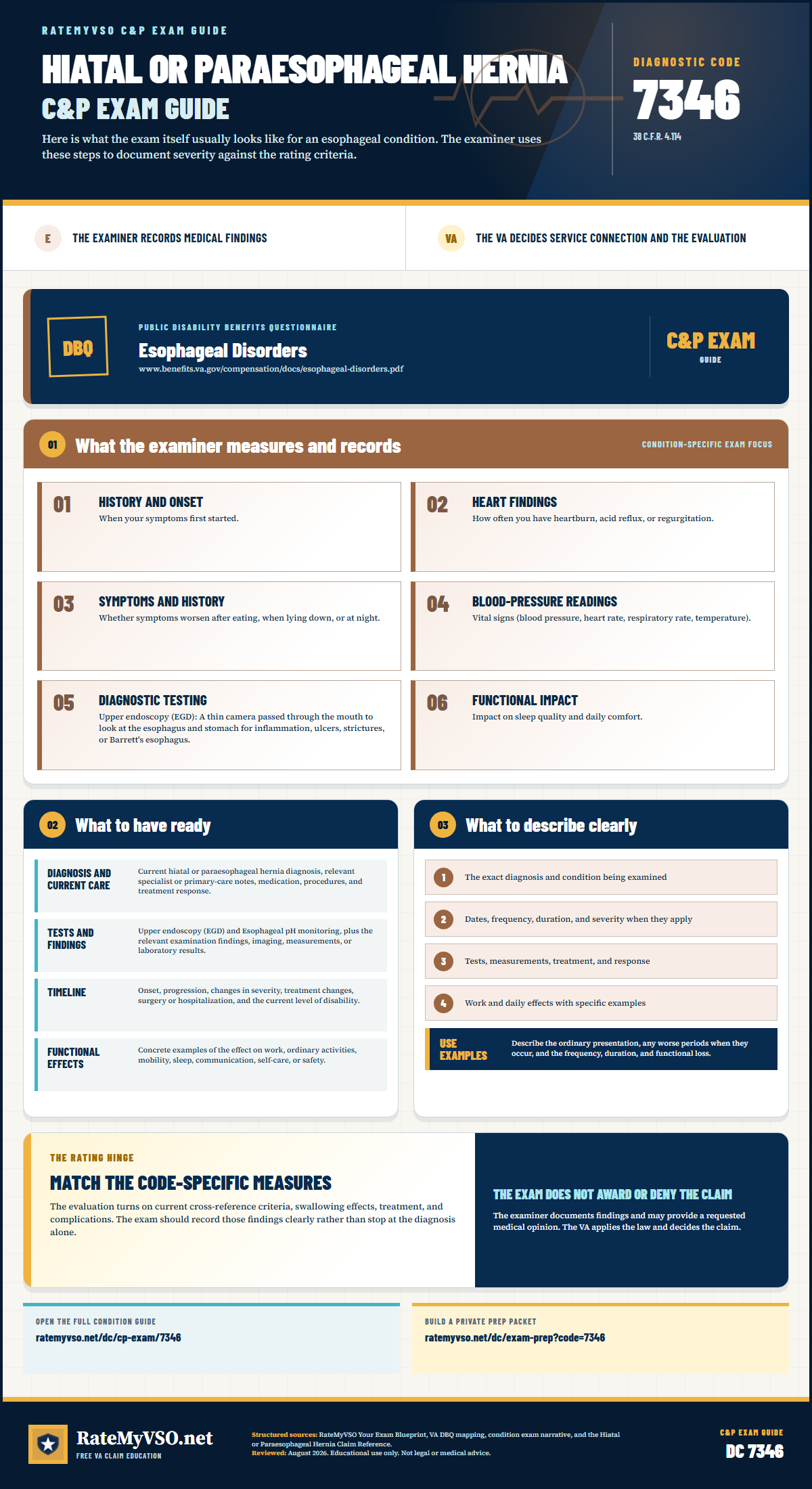
Here is what the exam itself usually looks like for an esophageal condition. The examiner uses these steps to document severity against the rating criteria.
DBQ used for this condition
- PPublic formDBQ GI Esophageal DisordersOpen the public DBQ
What the examination is likely to focus on
Functional-impact topics to describe
- Impact on sleep quality and daily comfort.
- Diet limitations and food restrictions.
- Need for ongoing medication or medical care.
- Frequency of flare-ups or incapacitating episodes.
- Effect on employment and physical activity.
Which form the examiner uses
For hiatal hernia and paraesophageal hernia (DC 7346), the C&P examiner completes the following Disability Benefits Questionnaire (DBQ):
- DBQ GI Esophageal Disorders (public PDF on VA.gov)
DBQs are Department of Veterans Affairs Form 21-0960 series documents. Public DBQs are hosted on benefits.va.gov. A handful are examiner-only and are not posted publicly.
What to expect at your C&P exam
Here is what the exam itself usually looks like for an esophageal condition. The examiner uses these steps to document severity against the rating criteria.
1Initial interview (history)
- When your symptoms first started.
- How often you have heartburn, acid reflux, or regurgitation.
- Whether symptoms worsen after eating, when lying down, or at night.
- Associated symptoms: chest pain, difficulty swallowing (dysphagia), chronic cough, sore throat, or a sour taste.
- How symptoms affect your daily activities, sleep, and ability to work.
- Treatments and medications tried (antacids, H2 blockers, proton pump inhibitors) and whether they helped.
- Any complications: esophagitis, strictures, Barrett's esophagus, or aspiration pneumonia.
- Smoking, alcohol, or dietary triggers, and family history.
2Physical examination
- Vital signs (blood pressure, heart rate, respiratory rate, temperature).
- Inspection of the chest and abdomen.
- Listening to lung and bowel sounds.
- Palpating the abdomen for tenderness, bloating, or discomfort.
3Diagnostic tests the examiner may rely on
These are usually already in your records rather than performed at the exam. The examiner reviews the results to gauge severity.
4Functional assessment
- Impact on sleep quality and daily comfort.
- Diet limitations and food restrictions.
- Need for ongoing medication or medical care.
- Frequency of flare-ups or incapacitating episodes.
- Effect on employment and physical activity.
Test explainers open MedlinePlus (NIH National Library of Medicine), or Wikipedia where MedlinePlus has no matching page. This describes what happens and what is measured, not how to influence a result.
What the examiner records (full DBQ form)
The fields below are reproduced from the DBQ form the examiner completes for this diagnostic code. This is the structural map of the form, showing what the examiner is asked to measure, observe, and record. It is a factual reproduction of the public DBQ, not advice on how to answer.
This DBQ evaluates esophageal conditions including gastroesophageal reflux disease (GERD), hiatal hernia, esophageal stricture, and other esophageal disorders.
How DC 7346 maps to this DBQ: for this diagnostic code specifically, the examiner typically completes sections I-III and V-VIII of this form. Section III is the condition-specific section for this code. Section IV covers an unrelated condition on this DBQ and is skipped.
DIAGNOSIS (Section I)
- 1A. List the claimed condition(s) that pertain to this questionnaire
- 1B. Select diagnoses associated with the claimed condition(s) (check all that apply): The Veteran does not have a current diagnosis associated with any claimed condition(s) listed above
- Hiatal hernia - ICD code / Date of diagnosis
- Gastroesophageal reflux disease (GERD) - ICD code / Date of diagnosis
- Paraesophageal hernia - ICD code / Date of diagnosis
- Esophagus, stricture of - ICD code / Date of diagnosis
- Esophagitis (specify type) - ICD code / Date of diagnosis
- Barrett's esophagus - ICD code / Date of diagnosis
- Mallory Weiss syndrome/tear - ICD code / Date of diagnosis
- Esophageal motility disorder (select one if known) - ICD code / Date of diagnosis
- Achalasia (cardiospasm) - ICD code / Date of diagnosis
- Diffuse esophageal spasm - ICD code / Date of diagnosis
- Corkscrew esophagus - ICD code / Date of diagnosis
- Nutcracker esophagus - ICD code / Date of diagnosis
- Other motor/motility disorders of the esophagus (specify type) - ICD code / Date of diagnosis
- Esophageal rings (including Schatzki rings) - ICD code / Date of diagnosis
- Disorder of esophageal mucosal webs - ICD code / Date of diagnosis
- Disorder of esophageal mucosal folds - ICD code / Date of diagnosis
- Esophagus impairment caused by systemic condition (specify condition) - ICD code / Date of diagnosis
- Esophagus, diverticulum of, acquired - ICD code / Date of diagnosis
- Pharyngoesophageal (Zenker's) diverticulum - ICD code / Date of diagnosis
- Mid-esophageal diverticulum - ICD code / Date of diagnosis
- Epiphrenic (distal esophagus) diverticulum - ICD code / Date of diagnosis
- Esophageal cancer - ICD code / Date of diagnosis
- Benign neoplasm of the esophagus (if checked specify) - ICD code / Date of diagnosis
- Other esophageal condition(s) (specify) - ICD code / Date of diagnosis
- 1C. If there are additional diagnoses that pertain to esophageal disorders, list using above format
MEDICAL HISTORY (Section II)
- 2A. Describe the history, including onset and course, of the Veteran's esophageal condition(s). Brief summary
- 2B. Does the Veteran's treatment plan include taking daily prescribed medication for the diagnosed condition(s)?
- If yes, list only those medications used for the diagnosed condition(s)
SIGNS AND SYMPTOMS (Section III)
- 3A. Does the Veteran have any of the following signs, symptoms, or treatment requirements due to any esophageal condition(s) (including GERD and hiatal hernia)?
- Without daily symptoms
- Without requirement for daily medication
- Dysphagia (difficulty swallowing)
- Requiring daily medication to control dysphagia
- Documented history of esophageal stricture(s) (If checked indicate if recurrent or refractory)
- Has the esophageal stricture(s) been recurrent or refractory?
- Requiring dilatation (if checked indicate frequency and list most recent dates): No more than 2 times a year / 3 or more times a year
- Was there dilatation utilizing steroids at least 1 time per year?
- Date of dilatation (x3)
- Requiring esophageal stent placement
- Aspiration
- Undernutrition
- Substantial weight loss
- Treatment with surgical correction
- Treatment with a percutaneous esophago-gastrointestinal tube (PEG tube)
- Other, symptom(s) specify
- 3B. Does the Veteran have Barrett's esophagus documented by pathologic diagnosis?
- Specify severity of dysplasia: High-grade dysplasia / Low-grade dysplasia / No dysplasia
- Did Barrett's esophagus cause esophageal stricture(s)?
- Has the condition been resolved via surgery, radiofrequency ablation, or other treatment?
- Surgery/procedure type and date (Barrett's esophagus)
- 3C. Did the Veteran have surgery or other procedure performed for an esophageal condition(s) (other than Barret's esophagus) or hiatal hernia?
- Surgery/procedure type and date (3C)
- 3D. Does the Veteran have chronic complications of esophageal or hiatal hernia surgery?
- Post-operative, asymptomatic
- Requiring continuous total parenteral nutrition (TPN) for a period longer than 30 consecutive days in the last six months - Start date of TPN / Completion date of TPN or anticipated date of completion
- Requiring continuous tube feeding for a period longer than 30 consecutive days in the last six months - Start date of tube feeding / Completion date of tube feeding or anticipated date of completion
- Vomiting (if checked indicate frequency and if managed by medical treatment, oral dietary modification, or medication): Frequency - Less than 2 times a week / 2 or more times a week / Daily
- Vomiting Treatment: No treatment / Managed by ongoing medical treatment / Vomiting despite medical treatment - Oral dietary modification / Medication / Other (specify)
- Watery bowel movements (if checked indicate frequency): Less than 3 per day every day / 3-5 per day every day / 6 or more per day every day
- Explosive bowel movements that are difficult to predict or control
- Nausea (if checked indicate if managed by medical treatment): Managed by ongoing medical treatment?
- Post-prandial (meal-induced) light-headedness (syncope) with sweating
- Requirement for medications to specifically treat complications of upper GI surgery including dumping syndrome or delayed gastric emptying
- Discomfort or pain within an hour of eating and requiring ongoing oral dietary modification
- Other, symptom(s) specify (3D)
TUMORS AND NEOPLASMS (Section IV)
- 4A. Does the Veteran currently have, or has had, a benign or malignant neoplasm or metastases related to any condition in the diagnosis section?
- 4B. Is the neoplasm: Benign / Malignant
- If malignant: Active / In remission
- If malignant: Primary / Secondary (metastatic) - if secondary, indicate the primary site, if known
- 4C. Has the Veteran completed treatment or is the Veteran currently undergoing treatment for a benign or malignant neoplasm or metastases?
- Treatment completed
- Surgery - If checked, describe / Date(s) of surgery
- Radiation therapy - Date of most recent treatment / Date of completion of treatment or anticipated date of completion
- Antineoplastic chemotherapy - Date of most recent treatment / Date of completion of treatment or anticipated date of completion
- Other therapeutic procedure - If checked, describe procedure / Date of most recent procedure
- Other therapeutic treatment - If checked, describe treatment / Date of completion of treatment or anticipated date of completion
- 4D. Does the Veteran currently have any residuals or complications due to the neoplasm (including metastases) or its treatment, other than those already documented in the report above?
- If yes, list residuals or complications (brief summary)
- 4E. If there are additional benign or malignant neoplasms or metastases related to any of the diagnoses in the diagnosis section, describe using the above format
OTHER PERTINENT PHYSICAL FINDINGS, COMPLICATIONS, CONDITIONS, SIGNS AND OR SYMPTOMS, AND SCARS (Section V)
- 5A. Does the Veteran have any other pertinent physical findings, complications, conditions, signs or symptoms related to any condition(s) listed in the diagnosis section above?
- If yes, describe (brief summary)
- 5B. Does the Veteran have any scars or other disfigurement (of the skin) related to any condition(s) or to the treatment of any condition(s) listed in the diagnosis section?
DIAGNOSTIC TESTING (Section VI)
- 6A. Have clinically relevant diagnostic imaging studies or other diagnostic procedures been performed or reviewed in conjunction with this examination?
- EGD - Date / Results
- Upper GI radiographic studies - Date / Results
- Barium swallow - Date / Results
- MRI - Date / Results
- CT - Date / Results
- Biopsy, specify site - Date / Results
- Other, specify - Date / Result
- 6B. Has clinically relevant laboratory testing been performed or reviewed in conjunction with this examination?
- CBC - Date of test / Hemoglobin / Hematocrit / White blood cell count / Platelets
- Other, specify - Date of test / Results
- 6C. Are there any other clinically relevant diagnostic test findings or results related to the claimed condition(s) and/or diagnosis(es), that were reviewed in conjunction with this examination? - If yes, provide type of test or procedure, date and results (brief summary)
- 6D. If any test result results are other than normal, indicate relationship of abnormal findings to diagnosed condition
FUNCTIONAL IMPACT (Section VII)
- 7A. Regardless of the Veteran's current employment status, do the conditions listed in the diagnosis section impact his/her ability to perform any type of occupational task (such as standing, walking, lifting, sitting, etc.)?
- If yes, describe the functional impact of each condition, providing one or more examples
REMARKS (Section VIII)
- 8A. Remarks (if any - please identify the section to which the remark pertains when appropriate)
Rating Levels for DC 7346
The following tiers are reproduced from 38 CFR Part 4, the VA Schedule for Rating Disabilities. Toggle between the official VA criteria and a Plain English explanation.
Plain-English summaries are AI-generated to explain the official criteria. The official 38 CFR language is the binding legal standard. When in doubt, ask a VSO.
Related diagnostic codes
Evidence cited in published BVA decisions for DC 7346
The counts below are aggregated from published Board of Veterans Appeals decisions for this diagnostic code, among issues the Board granted or denied (remanded issues are not included). Each row reports how often a given evidence type was discussed in the decision text, broken down by outcome. This is a factual aggregate of the public record, not a prediction or recommendation about any specific claim.
- Service treatment records: appeared in 502 granted decisions (1332 denied; 1834 decided total)
- Buddy / lay statements: appeared in 361 granted decisions (745 denied; 1106 decided total)
- Medical literature: appeared in 37 granted decisions (67 denied; 104 decided total)
What the Board discussed in granted decisions for DC 7346
The themes below were extracted by clustering 500 grant-factor sentences from published Board of Veterans Appeals decisions for this diagnostic code. Frequencies indicate how often each theme appeared in the sample. This is a factual aggregate of the public record, not advice or strategy for any specific claim.
- 27% Benefit of the doubt doctrine defined or cited as legal standardThe Board or decision cited the statutory and regulatory standard requiring VA to resolve approximate balance of positive and negative evidence in the claimant's favor, without applying it to a specific finding.134 of 500 sample sentences
- 18% Benefit of the doubt applied to grant service connection or ratingThe Board affirmatively applied the benefit of the doubt doctrine to resolve equipoise evidence in the Veteran's favor and granted service connection or an increased rating for a specific disability.89 of 500 sample sentences
- 16% Benefit of the doubt found inapplicable due to preponderance against claimThe Board found that the preponderance of the evidence was against the claim, making the benefit of the doubt doctrine inapplicable and resulting in denial.82 of 500 sample sentences
- 15% Medical nexus opinion recorded as at least as likely as notA VA or private examiner opined that a current disability was at least as likely as not incurred in, caused by, or aggravated by military service or a service-connected condition.76 of 500 sample sentences
- 10% Evidence found in relative equipoise supporting grantThe Board found the positive and negative evidence approximately balanced or in relative equipoise on a material question, with the Veteran prevailing as a result.52 of 500 sample sentences
- 5% GERD or hiatal hernia symptoms documented meeting rating criteriaThe Board recorded that the Veteran's GERD or hiatal hernia symptoms — such as persistently recurrent epigastric distress, dysphagia, pyrosis, regurgitation, or substernal pain — approximated criteria for a specific disability rating under DC 7346.26 of 500 sample sentences
- 4% Remand instructions requesting at least as likely as not nexus opinionThe Board or remand order directed an examiner to opine whether a current disability was at least as likely as not related to service or a service-connected condition, defining the evidentiary standard required.22 of 500 sample sentences
- 2% Definition of at least as likely as not standard notedThe decision recorded the definition that 'at least as likely as not' means the weight of medical evidence for and against a conclusion is so evenly divided that it is as medically sound to find in favor as against causation.12 of 500 sample sentences
- 1% Secondary service connection nexus documented via aggravationAn examiner or the Board noted that a current disability was at least as likely as not aggravated beyond its natural progression by an existing service-connected condition, supporting secondary service connection.7 of 500 sample sentences
When the Board found the exam inadequate (DC 7346)
In 1,019 published Board of Veterans' Appeals decisions involving this condition, the Board found a C&P examination or medical opinion inadequate. Where the defect could be read from the decision, it was most often one of the following (counts are a floor from the decisions on file, not a total):
- 286 Failed to address a contention or part of the condition
- 214 Conclusion given without a supporting rationale
- 171 Veteran's lay statements not considered
- 64 Opinion relied on the absence of records instead of the evidence
- 52 Claims file or records not reviewed
- 46 Flare-ups or functional loss not addressed
- 31 Examiner said an opinion would require speculation
- 26 Exam too old to reflect current severity
- 13 Wrong legal standard or question applied
An inadequate exam is usually sent back for a new one rather than decided against the veteran. This is a factual report of published decisions, not advice about any exam or claim; whether an exam is adequate is decided case by case.
Disclaimer: This page reproduces public Department of Veterans Affairs forms (DBQs) and verbatim text from 38 CFR Part 4 (the VA Schedule for Rating Disabilities). It is informational only and is not legal or medical advice. For guidance on a specific claim, contact a VA-accredited representative.