C&P Exam Prep Guide for Hepatitis C (DC 7354)
YOUR EXAM BLUEPRINT
Hepatitis C
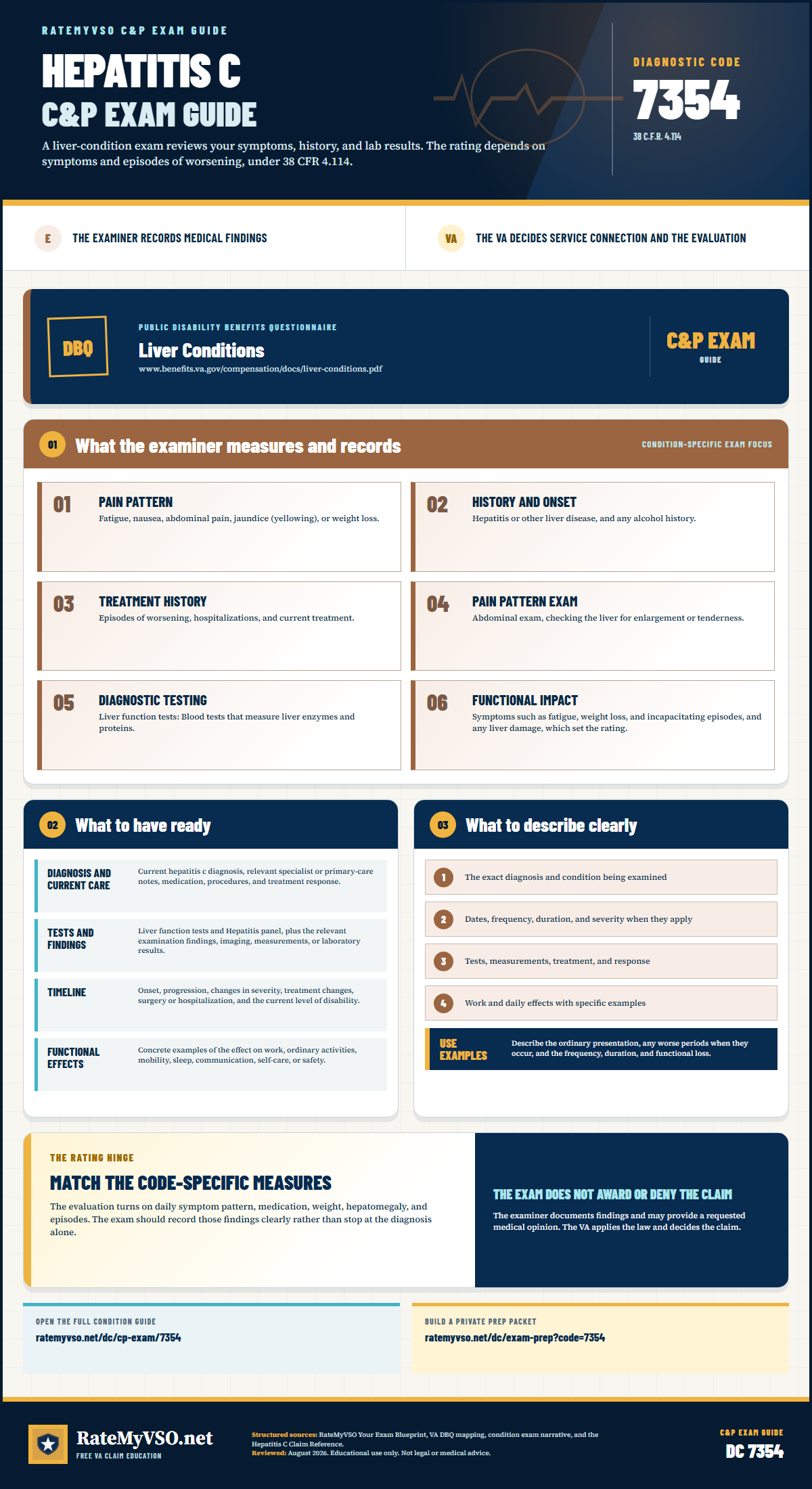
A liver-condition exam reviews your symptoms, history, and lab results. The rating depends on symptoms and episodes of worsening, under 38 CFR 4.114.
DBQ used for this condition
- PPublic formDBQ GI Liver ConditionsOpen the public DBQ
What the examination is likely to focus on
Functional-impact topics to describe
- Symptoms such as fatigue, weight loss, and incapacitating episodes, and any liver damage, which set the rating.
- Findings map to the tiers in 38 CFR 4.114 (hepatitis C DC 7354; chronic liver disease DC 7345).
Which form the examiner uses
For hepatitis c (DC 7354), the C&P examiner completes the following Disability Benefits Questionnaire (DBQ):
- DBQ GI Liver Conditions (public PDF on VA.gov)
DBQs are Department of Veterans Affairs Form 21-0960 series documents. Public DBQs are hosted on benefits.va.gov. A handful are examiner-only and are not posted publicly.
What to expect at your C&P exam
A liver-condition exam reviews your symptoms, history, and lab results. The rating depends on symptoms and episodes of worsening, under 38 CFR 4.114.
1Initial interview (history)
- Fatigue, nausea, abdominal pain, jaundice (yellowing), or weight loss.
- Hepatitis or other liver disease, and any alcohol history.
- Episodes of worsening, hospitalizations, and current treatment.
2Physical examination
- Abdominal exam, checking the liver for enlargement or tenderness.
- Looking for jaundice, swelling, or other signs of liver disease.
3Diagnostic tests the examiner may rely on
Lab tests and imaging the examiner reviews.
4Functional assessment
- Symptoms such as fatigue, weight loss, and incapacitating episodes, and any liver damage, which set the rating.
- Findings map to the tiers in 38 CFR 4.114 (hepatitis C DC 7354; chronic liver disease DC 7345).
Test explainers open MedlinePlus (NIH National Library of Medicine), or Wikipedia where MedlinePlus has no matching page. This describes what happens and what is measured, not how to influence a result.
What the examiner records (full DBQ form)
The fields below are reproduced from the DBQ form the examiner completes for this diagnostic code. This is the structural map of the form, showing what the examiner is asked to measure, observe, and record. It is a factual reproduction of the public DBQ, not advice on how to answer.
This DBQ evaluates hepatitis, cirrhosis, and other liver conditions including chronic liver disease, liver abscess, and liver transplant.
How DC 7354 maps to this DBQ: for this diagnostic code specifically, the examiner typically completes sections I-III, VII, and IX-XI of this form. Section III is the condition-specific section for this code. Sections IV-VI and VIII cover unrelated conditions on this DBQ and are skipped.
DIAGNOSIS (Section I)
- 1A. List the claimed condition(s) that pertain to this questionnaire:
- 1B. Does the Veteran have or has the Veteran ever had a liver condition?
- 1C. Select diagnoses associated with the claimed condition(s) (check all that apply): Hepatitis A - ICD Code / Date of diagnosis
- 1C. Hepatitis B - ICD Code / Date of diagnosis
- 1C. Hepatitis C - ICD Code / Date of diagnosis
- 1C. Autoimmune hepatitis - ICD Code / Date of diagnosis
- 1C. Drug induced hepatitis - ICD Code / Date of diagnosis
- 1C. Non-alcoholic steatohepatitis (NASH) - ICD Code / Date of diagnosis
- 1C. Cirrhosis of the liver - ICD Code / Date of diagnosis
- 1C. Primary sclerosing cholangitis - ICD Code / Date of diagnosis
- 1C. Primary biliary cirrhosis - ICD Code / Date of diagnosis
- 1C. Liver abscess - ICD Code / Date of diagnosis
- 1C. Liver transplant - ICD Code / Date of diagnosis
- 1C. Liver cancer - ICD Code / Date of diagnosis
- 1C. Hemochromatosis - ICD Code / Date of diagnosis
- 1C. Wilson's disease - ICD Code / Date of diagnosis
- 1C. Alpha-1 antitrypsin deficiency - ICD Code / Date of diagnosis
- 1C. Other diagnosis #1 - ICD Code / Date of diagnosis
- 1C. Other diagnosis #2 - ICD Code / Date of diagnosis
- 1C. Other diagnosis #3 - ICD Code / Date of diagnosis
- 1D. If there are additional diagnoses that pertain to liver conditions, list using above format:
- 1E. Remarks:
MEDICAL HISTORY (Section II)
- 2A. Describe the history (including onset and course) of the Veteran's liver condition(s) (brief summary):
CHRONIC LIVER DISEASE WITHOUT CIRRHOSIS (INCLUDING HEPATITIS) (Section III)
- 3A. Does the Veteran have or has the Veteran ever had signs or symptoms attributable to chronic or infectious liver disease?
- Previous history of liver disease
- Asymptomatic
- Fatigue - If checked, indicate frequency: Intermittent / Daily
- Malaise
- Anorexia
- Hepatomegaly
- Pruritus
- Arthralgia
- Causing weight loss - If checked, provide baseline weight and current weight
- Substantial weight loss (involuntary loss greater than 20 percent of an individual's baseline weight sustained for three months with diminished quality of self-care or work tasks)
- Minor weight loss (involuntary weight loss between 10 and 20 percent of an individual's baseline weight sustained for three months with gastrointestinal-related symptoms, involving diminished quality of self-care or work tasks, or decreased food intake)
- Requiring continuous medication (other than parenteral antiviral therapy or parenteral immunomodulatory therapy) - If checked, list medication / date treatment started / Date of completion of medication or anticipated date of completion
- Requiring parenteral antiviral therapy - If checked, indicate date treatment started / Date of completion of medication or anticipated date of completion
- Requiring parenteral immunomodulatory therapy - If checked, indicate date treatment started / Date of completion of medication or anticipated date of completion
- Other signs or symptoms, describe:
- 3B. Is treatment medically contraindicated for both parenteral antiviral therapy and parenteral immunomodulatory drugs? If yes, explain.
CIRRHOSIS OF THE LIVER (Section IV)
- 4A. Does the Veteran have cirrhosis of the liver?
- 4B. Is treatment medically contraindicated for both parenteral antiviral therapy and parenteral immunomodulatory drugs?
- Asymptomatic but with a history of liver disease
- Resolved following liver transplant
- Weakness
- Generalized weakness
- Malaise
- Daily fatigue
- Anorexia
- Abdominal pain
- Continuous daily debilitating symptoms (describe in comments section)
- Splenomegaly
- Ascites (fluid in the abdomen)
- Coagulopathy
- Portal hypertension
- Portal gastropathy (if checked, date(s) of episode(s) in past 24 months) Date(s):
- Hepatic encephalopathy (if checked, date(s) of episode(s) in past 24 months) Date(s):
- Hepatopulmonary syndrome
- Hepatorenal syndrome
- History of spontaneous bacterial peritonitis
- Variceal hemorrhage (if checked, date(s) of episode(s) in past 24 months) Date(s):
- Other signs or symptoms, describe:
- 4C. Is there a MELD score available? - MELD Score / Date / Source:
LIVER ABSCESS (Section V)
- 5A. Does the Veteran have or has the Veteran ever had, a liver abscess caused by bacterial, viral, amebic, fungal or other agents?
- If yes, what date was the abscess diagnosed?
- Comments:
LIVER TRANSPLANT (Section VI)
- 6A. Is the Veteran eligible for transplant surgery?
- Date medical evidence shows that a physician determined that the Veteran was eligible for transplant surgery:
- 6B. Is the Veteran awaiting transplant surgery?
- 6C. Has the Veteran undergone transplant surgery?
- Date(s) of transplant surgery:
- Date(s) of hospital admission:
- Date(s) of hospital discharge:
- Current signs and symptoms:
DIAGNOSTIC TESTING (Section VII)
- 7A. Have clinically relevant diagnostic imaging studies or other diagnostic procedures been performed or reviewed in conjunction with this examination?
- EUS (Endoscopic ultrasound) - Date / Results:
- ERCP (Endoscopic Retrograde Cholangiopancreatography) - Date / Results:
- Transhepatic cholangiogram - Date / Results:
- MRI or MRCP (Magnetic Resonance Cholangiopancreatography) - Date / Results:
- Computed Tomography (CT) - Date / Results:
- Ultrasound - Date / Results:
- Other, describe: - Date / Results:
- 7B. Have clinically relevant laboratory studies been performed or reviewed in conjunction with this examination?
- Recombinant immunoBlot assay (RIBA) - Date / Results:
- Hepatitis C genotype - Date / Results:
- Hepatitis C viral titers - Date / Results:
- AST - Date / Results:
- ALT - Date / Results:
- Alkaline phosphatase - Date / Results:
- Bilirubin - Date / Results:
- INR (PT) - Date / Results:
- Creatinine - Date / Results:
- Other, describe: - Date / Results:
- 7C. Has a liver biopsy been performed? - Date of test / Results:
- 7D. Are there any other clinically relevant diagnostic test findings and/or results related to the claimed condition(s) and/or diagnosis(es), that were reviewed in conjunction with this examination? - If yes, provide type of test or procedure, date and results (brief summary):
- 7E. If any test results are other than normal, indicate relationship of abnormal findings to diagnosed conditions:
TUMORS AND NEOPLASMS (Section VIII)
- 8A. Does the Veteran currently have, or has had, a benign or malignant neoplasm or metastases related to any condition in the diagnosis section?
- 8B. Is the neoplasm: Benign / Malignant
- If malignant: Active / In remission
- If malignant: Primary / Secondary (metastatic) (if secondary, indicate the primary site, if known):
- 8C. Has the Veteran completed treatment or is the Veteran currently undergoing treatment for a benign or malignant neoplasm or metastases?
- Treatment completed
- Surgery - If checked, describe / Date(s) of surgery:
- Radiation therapy - Date of most recent treatment / Date of completion of treatment or anticipated date of completion:
- Antineoplastic chemotherapy - Date of most recent treatment / Date of completion of treatment or anticipated date of completion:
- Other therapeutic procedure - If checked, describe procedure / Date of most recent procedure:
- Other therapeutic treatment - If checked, describe treatment / Date of completion of treatment or anticipated date of completion:
- 8D. Does the Veteran currently have any residuals or complications due to the neoplasm (including metastases) or its treatment, other than those already documented in the report above? - If yes, list residuals or complications (brief summary):
- 8E. If there are additional benign or malignant neoplasms or metastases related to any of the diagnoses in the diagnosis section, describe using the above format:
OTHER PERTINENT PHYSICAL FINDINGS, COMPLICATIONS, CONDITIONS, SIGNS, SYMPTOMS, AND SCARS (Section IX)
- 9A. Does the Veteran have any other pertinent physical findings, complications, conditions, signs or symptoms related to the conditions listed in the diagnosis section above? - If yes, describe (brief summary):
- 9B. Does the Veteran have any scars or other disfigurement of the skin related to any conditions or to the treatment of any conditions listed in the diagnosis section?
- 9C. Comments, if any:
FUNCTIONAL IMPACT (Section X)
- 10A. Regardless of the Veteran's current employment status, do the conditions listed in the diagnosis section impact his/her ability to perform any type of occupational task (such as standing, walking, lifting, sitting, etc.)?
- If yes, describe the functional impact of each condition, providing one or more examples:
REMARKS (Section XI)
- 11A. Remarks (if any - please identify the section to which the remark pertains when appropriate):
Rating Levels for DC 7354
The following tiers are reproduced from 38 CFR Part 4, the VA Schedule for Rating Disabilities. Toggle between the official VA criteria and a Plain English explanation.
Plain-English summaries are AI-generated to explain the official criteria. The official 38 CFR language is the binding legal standard. When in doubt, ask a VSO.
Related diagnostic codes
Evidence cited in published BVA decisions for DC 7354
The counts below are aggregated from published Board of Veterans Appeals decisions for this diagnostic code, among issues the Board granted or denied (remanded issues are not included). Each row reports how often a given evidence type was discussed in the decision text, broken down by outcome. This is a factual aggregate of the public record, not a prediction or recommendation about any specific claim.
- Service treatment records: appeared in 1204 granted decisions (3635 denied; 4839 decided total)
- Buddy / lay statements: appeared in 790 granted decisions (2146 denied; 2936 decided total)
- Medical literature: appeared in 148 granted decisions (328 denied; 476 decided total)
What the Board discussed in granted decisions for DC 7354
The themes below were extracted by clustering 500 grant-factor sentences from published Board of Veterans Appeals decisions for this diagnostic code. Frequencies indicate how often each theme appeared in the sample. This is a factual aggregate of the public record, not advice or strategy for any specific claim.
- 36% Benefit of the doubt doctrine explained or applied generallyThe Board cited the statutory benefit-of-the-doubt rule requiring resolution of approximate balance of positive and negative evidence in the claimant's favor, or noted its application or inapplicability to the claim at issue.181 of 500 sample sentences
- 20% Medical opinion found hepatitis C at least as likely as not service-relatedA VA examiner, private physician, or specialist opined that the veteran's hepatitis C was at least as likely as not incurred in or caused by active military service.98 of 500 sample sentences
- 15% Evidence in equipoise supporting hepatitis C service connectionThe Board found the evidence at least in relative equipoise on whether the veteran's hepatitis C was etiologically related to service, warranting a grant of service connection.74 of 500 sample sentences
- 11% In-service risk factors cited as nexus basis for hepatitis CThe Board or examiner noted specific in-service risk factors—such as air gun inoculations, shared razors, tattoos, blood transfusions, needle sticks, or healthcare exposure—as the basis for a nexus opinion linking hepatitis C to service.55 of 500 sample sentences
- 8% Preponderance of evidence against claim; benefit of the doubt inapplicableThe Board determined the preponderance of evidence weighed against the claim, making the benefit-of-the-doubt doctrine inapplicable and requiring denial.40 of 500 sample sentences
- 5% Examiner request for hepatitis C nexus opinion notedThe Board or remand order directed an examiner to opine whether it was at least as likely as not that the veteran's hepatitis C had its onset during or was related to active service, including identified in-service risk factors.25 of 500 sample sentences
- 3% Secondary conditions linked to service-connected hepatitis CMedical opinions or Board findings documented that conditions such as cirrhosis, liver cancer, kidney disease, fatigue, arthritis, or depression were at least as likely as not proximately due to or aggravated by service-connected hepatitis C.15 of 500 sample sentences
- 2% Rating level determined under diagnostic code 7354The Board resolved the benefit of the doubt or weighed the evidence to assign or deny a specific disability rating percentage for service-connected hepatitis C under Diagnostic Code 7354.8 of 500 sample sentences
- 1% Negative or inadequate medical opinion noted in recordThe Board recorded an examiner's opinion that it was not at least as likely as not that the veteran's hepatitis C was service-related, or found a prior opinion speculative or otherwise inadequate.4 of 500 sample sentences
When the Board found the exam inadequate (DC 7354)
In 862 published Board of Veterans' Appeals decisions involving this condition, the Board found a C&P examination or medical opinion inadequate. Where the defect could be read from the decision, it was most often one of the following (counts are a floor from the decisions on file, not a total):
- 200 Failed to address a contention or part of the condition
- 183 Conclusion given without a supporting rationale
- 84 Veteran's lay statements not considered
- 45 Claims file or records not reviewed
- 43 Examiner said an opinion would require speculation
- 36 Opinion relied on the absence of records instead of the evidence
- 10 Wrong legal standard or question applied
- 10 Flare-ups or functional loss not addressed
- 9 Exam too old to reflect current severity
An inadequate exam is usually sent back for a new one rather than decided against the veteran. This is a factual report of published decisions, not advice about any exam or claim; whether an exam is adequate is decided case by case.
Disclaimer: This page reproduces public Department of Veterans Affairs forms (DBQs) and verbatim text from 38 CFR Part 4 (the VA Schedule for Rating Disabilities). It is informational only and is not legal or medical advice. For guidance on a specific claim, contact a VA-accredited representative.