C&P Exam Prep Guide for Paralysis of median nerve (DC 8515)
YOUR EXAM BLUEPRINT
Paralysis of median nerve
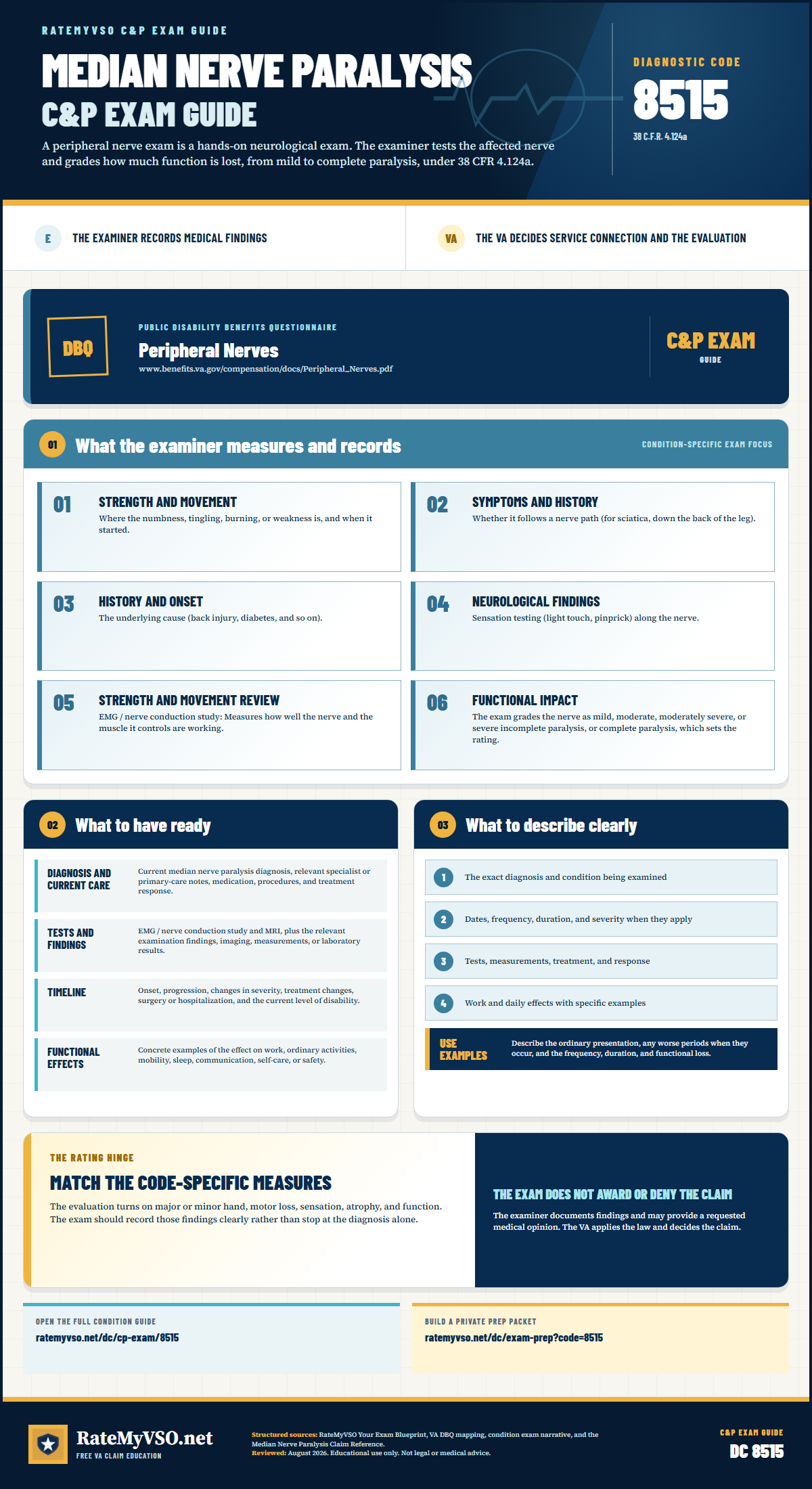
A peripheral nerve exam is a hands-on neurological exam. The examiner tests the affected nerve and grades how much function is lost, from mild to complete paralysis, under 38 CFR 4.124a.
DBQ used for this condition
- PPublic formDBQ NEURO Peripheral NervesOpen the public DBQ
What the examination is likely to focus on
Functional-impact topics to describe
- The exam grades the nerve as mild, moderate, moderately severe, or severe incomplete paralysis, or complete paralysis, which sets the rating.
- Whether you need a brace, cane, or other device, and the effect on walking and work.
- Findings map to the tiers in 38 CFR 4.124a (for the sciatic nerve, DC 8520).
Which form the examiner uses
For paralysis of median nerve (DC 8515), the C&P examiner completes the following Disability Benefits Questionnaire (DBQ):
- DBQ NEURO Peripheral Nerves (public PDF on VA.gov)
DBQs are Department of Veterans Affairs Form 21-0960 series documents. Public DBQs are hosted on benefits.va.gov. A handful are examiner-only and are not posted publicly.
What to expect at your C&P exam
A peripheral nerve exam is a hands-on neurological exam. The examiner tests the affected nerve and grades how much function is lost, from mild to complete paralysis, under 38 CFR 4.124a.
1Initial interview (history)
- Where the numbness, tingling, burning, or weakness is, and when it started.
- Whether it follows a nerve path (for sciatica, down the back of the leg).
- The underlying cause (back injury, diabetes, and so on).
- Pain severity, what makes it worse, and the effect on walking and work.
2Physical examination
- Sensation testing (light touch, pinprick) along the nerve.
- Muscle strength testing in the affected limb.
- Deep tendon reflexes.
- Checking for muscle wasting (atrophy) and changes in the way you walk.
- Nerve-tension tests such as the straight-leg raise (for sciatica).
3Diagnostic tests the examiner may rely on
Used to confirm which nerve is affected and how badly.
4Functional assessment
- The exam grades the nerve as mild, moderate, moderately severe, or severe incomplete paralysis, or complete paralysis, which sets the rating.
- Whether you need a brace, cane, or other device, and the effect on walking and work.
- Findings map to the tiers in 38 CFR 4.124a (for the sciatic nerve, DC 8520).
Test explainers open MedlinePlus (NIH National Library of Medicine), or Wikipedia where MedlinePlus has no matching page. This describes what happens and what is measured, not how to influence a result.
What the examiner records (full DBQ form)
The fields below are reproduced from the DBQ form the examiner completes for this diagnostic code. This is the structural map of the form, showing what the examiner is asked to measure, observe, and record. It is a factual reproduction of the public DBQ, not advice on how to answer.
This DBQ evaluates peripheral nerve conditions and peripheral neuropathy (excluding diabetic), documenting symptoms, motor/sensory exam, and severity per nerve.
How DC 8515 maps to this DBQ: for this diagnostic code specifically, the examiner typically completes sections I-X and XIV-XVII of this form. Sections IX-X are the condition-specific sections for this code. Sections XI-XIII cover unrelated conditions on this DBQ and are skipped.
DIAGNOSIS (Section I)
- DOES THE VETERAN HAVE A PERIPHERAL NERVE CONDITION OR PERIPHERAL NEUROPATHY?
- Diagnosis #1 / ICD Code / Date of diagnosis
- Diagnosis #2 / ICD Code / Date of diagnosis
- Diagnosis #3 / ICD Code / Date of diagnosis
- IF THERE ARE ADDITIONAL DIAGNOSES THAT PERTAIN TO A PERIPHERAL NERVE CONDITION AND/OR PERIPHERAL NEUROPATHY, LIST USING ABOVE FORMAT
MEDICAL HISTORY (Section II)
- DESCRIBE THE HISTORY (including onset and course) OF THE VETERAN'S PERIPHERAL NERVE CONDITION (brief summary)
- DOMINANT HAND: Right / Left / Ambidextrous
SYMPTOMS (Section III)
- Does the Veteran have any symptoms attributable to any peripheral nerve conditions?
- Constant pain (may be excruciating at times) - Right upper extremity: None / Mild / Moderate / Severe
- Constant pain (may be excruciating at times) - Left upper extremity: None / Mild / Moderate / Severe
- Constant pain (may be excruciating at times) - Right lower extremity: None / Mild / Moderate / Severe
- Constant pain (may be excruciating at times) - Left lower extremity: None / Mild / Moderate / Severe
- Intermittent pain (usually dull) - Right upper extremity: None / Mild / Moderate / Severe
- Intermittent pain (usually dull) - Left upper extremity: None / Mild / Moderate / Severe
- Intermittent pain (usually dull) - Right lower extremity: None / Mild / Moderate / Severe
- Intermittent pain (usually dull) - Left lower extremity: None / Mild / Moderate / Severe
- Paresthesias and/or dysesthesias - Right upper extremity: None / Mild / Moderate / Severe
- Paresthesias and/or dysesthesias - Left upper extremity: None / Mild / Moderate / Severe
- Paresthesias and/or dysesthesias - Right lower extremity: None / Mild / Moderate / Severe
- Paresthesias and/or dysesthesias - Left lower extremity: None / Mild / Moderate / Severe
- Numbness - Right upper extremity: None / Mild / Moderate / Severe
- Numbness - Left upper extremity: None / Mild / Moderate / Severe
- Numbness - Right Lower extremity: None / Mild / Moderate / Severe
- Numbness - Left lower extremity: None / Mild / Moderate / Severe
- Other symptoms (describe symptoms, location and severity)
MUSCLE STRENGTH TESTING (Section IV)
- All normal
- Elbow flexion: Right / Left (0/5–5/5)
- Elbow extension: Right / Left (0/5–5/5)
- Wrist flexion: Right / Left (0/5–5/5)
- Wrist extension: Right / Left (0/5–5/5)
- Grip: Right / Left (0/5–5/5)
- Pinch (thumb to index finger): Right / Left (0/5–5/5)
- Knee extension: Right / Left (0/5–5/5)
- Ankle plantar flexion: Right / Left (0/5–5/5)
- Ankle dorsiflexion: Right / Left (0/5–5/5)
- Does the Veteran have muscle atrophy?
- If muscle atrophy is present, indicate location
- Normal side (cm) / Atrophied side (cm) measured at maximum muscle bulk
REFLEX EXAM (Section V)
- All normal
- Biceps: Right / Left (0, 1+, 2+, 3+, 4+)
- Triceps: Right / Left (0, 1+, 2+, 3+, 4+)
- Brachioradialis: Right / Left (0, 1+, 2+, 3+, 4+)
- Knee: Right / Left (0, 1+, 2+, 3+, 4+)
- Ankle: Right / Left (0, 1+, 2+, 3+, 4+)
SENSORY EXAM (Section VI)
- All normal
- Shoulder area (C5): Right / Left - Normal / Decreased / Absent
- Inner/outer forearm (C6/T1): Right / Left - Normal / Decreased / Absent
- Hand/fingers (C6-8): Right / Left - Normal / Decreased / Absent
- Upper anterior thigh (L2): Right / Left - Normal / Decreased / Absent
- Thigh/knee (L3/4): Right / Left - Normal / Decreased / Absent
- Lower leg/ankle (L4/L5/S1): Right / Left - Normal / Decreased / Absent
- Foot/toes (L5): Right / Left - Normal / Decreased / Absent
- Other sensory findings, if any
TROPHIC CHANGES (Section VII)
- DOES THE VETERAN HAVE TROPHIC CHANGES (characterized by loss of extremity hair, smooth, shiny skin, etc.) ATTRIBUTABLE TO PERIPHERAL NEUROPATHY?
- If yes, describe
GAIT (Section VIII)
- IS THE VETERAN'S GAIT NORMAL?
- If no, describe abnormal gait
- Provide etiology of abnormal gait
SPECIAL TESTS FOR MEDIAN NERVE (Section IX)
- WERE SPECIAL TESTS INDICATED AND PERFORMED FOR MEDIAN NERVE EVALUATION?
- Phalen's sign: Right - Positive / Negative
- Phalen's sign: Left - Positive / Negative
- Tinel's sign: Right - Positive / Negative
- Tinel's sign: Left - Positive / Negative
NERVES AFFECTED: SEVERITY EVALUATION FOR UPPER EXTREMITY NERVES AND RADICULAR GROUPS (Section X)
- 10A. Radial nerve (musculospiral nerve) - Right: Normal / Incomplete paralysis (Mild/Moderate/Severe) / Complete paralysis
- 10A. Radial nerve (musculospiral nerve) - Left: Normal / Incomplete paralysis (Mild/Moderate/Severe) / Complete paralysis
- 10B. Median nerve - Right: Normal / Incomplete paralysis (Mild/Moderate/Severe) / Complete paralysis
- 10B. Median nerve - Left: Normal / Incomplete paralysis (Mild/Moderate/Severe) / Complete paralysis
- 10C. Ulnar nerve - Right: Normal / Incomplete paralysis (Mild/Moderate/Severe) / Complete paralysis
- 10C. Ulnar nerve - Left: Normal / Incomplete paralysis (Mild/Moderate/Severe) / Complete paralysis
- 10D. Musculocutaneous nerve - Right: Normal / Incomplete paralysis (Mild/Moderate/Severe) / Complete paralysis
- 10D. Musculocutaneous nerve - Left: Normal / Incomplete paralysis (Mild/Moderate/Severe) / Complete paralysis
- 10E. Circumflex nerve - Right: Normal / Incomplete paralysis (Mild/Moderate/Severe) / Complete paralysis
- 10E. Circumflex nerve - Left: Normal / Incomplete paralysis (Mild/Moderate/Severe) / Complete paralysis
- 10F. Long thoracic nerve - Right: Normal / Incomplete paralysis (Mild/Moderate/Severe) / Complete paralysis
- 10F. Long thoracic nerve - Left: Normal / Incomplete paralysis (Mild/Moderate/Severe) / Complete paralysis
- 10G. Upper radicular group (5th & 6th cervicals) - Right: Normal / Incomplete paralysis (Mild/Moderate/Severe) / Complete paralysis
- 10G. Upper radicular group (5th & 6th cervicals) - Left: Normal / Incomplete paralysis (Mild/Moderate/Severe) / Complete paralysis
- 10H. Middle radicular group - Right: Normal / Incomplete paralysis (Mild/Moderate/Severe) / Complete paralysis
- 10H. Middle radicular group - Left: Normal / Incomplete paralysis (Mild/Moderate/Severe) / Complete paralysis
- 10I. Lower radicular group - Right: Normal / Incomplete paralysis (Mild/Moderate/Severe) / Complete paralysis
- 10I. Lower radicular group - Left: Normal / Incomplete paralysis (Mild/Moderate/Severe) / Complete paralysis
NERVES AFFECTED: SEVERITY EVALUATION FOR LOWER EXTREMITY NERVES (Section XI)
- 11A. Sciatic nerve - Right: Normal / Incomplete paralysis (Mild/Moderate/Severe) / Complete paralysis
- 11A. Sciatic nerve - Left: Normal / Incomplete paralysis (Mild/Moderate/Severe) / Complete paralysis
- 11B. External popliteal (common peroneal) nerve - Right: Normal / Incomplete paralysis (Mild/Moderate/Severe) / Complete paralysis
- 11B. External popliteal (common peroneal) nerve - Left: Normal / Incomplete paralysis (Mild/Moderate/Severe) / Complete paralysis
- 11C. Musculocutaneous (superficial peroneal) nerve - Right: Normal / Incomplete paralysis (Mild/Moderate/Severe) / Complete paralysis
- 11C. Musculocutaneous (superficial peroneal) nerve - Left: Normal / Incomplete paralysis (Mild/Moderate/Severe) / Complete paralysis
- 11D. Anterior tibial (deep peroneal) nerve - Right: Normal / Incomplete paralysis (Mild/Moderate/Severe) / Complete paralysis
- 11D. Anterior tibial (deep peroneal) nerve - Left: Normal / Incomplete paralysis (Mild/Moderate/Severe) / Complete paralysis
- 11E. Internal popliteal (tibial) nerve - Right: Normal / Incomplete paralysis (Mild/Moderate/Severe) / Complete paralysis
- 11E. Internal popliteal (tibial) nerve - Left: Normal / Incomplete paralysis (Mild/Moderate/Severe) / Complete paralysis
- 11F. Posterior tibial nerve - Right: Normal / Incomplete paralysis (Mild/Moderate/Severe) / Complete paralysis
- 11F. Posterior tibial nerve - Left: Normal / Incomplete paralysis (Mild/Moderate/Severe) / Complete paralysis
- 11G. Anterior crural (femoral) nerve - Right: Normal / Incomplete paralysis (Mild/Moderate/Severe) / Complete paralysis
- 11G. Anterior crural (femoral) nerve - Left: Normal / Incomplete paralysis (Mild/Moderate/Severe) / Complete paralysis
- 11H. Internal saphenous nerve - Right: Normal / Incomplete paralysis (Mild/Moderate/Severe) / Complete paralysis
- 11H. Internal saphenous nerve - Left: Normal / Incomplete paralysis (Mild/Moderate/Severe) / Complete paralysis
- 11I. Obturator nerve - Right: Normal / Incomplete paralysis (Mild/Moderate/Severe) / Complete paralysis
- 11I. Obturator nerve - Left: Normal / Incomplete paralysis (Mild/Moderate/Severe) / Complete paralysis
- 11J. External cutaneous nerve of the thigh - Right: Normal / Incomplete paralysis (Mild/Moderate/Severe) / Complete paralysis
- 11J. External cutaneous nerve of the thigh - Left: Normal / Incomplete paralysis (Mild/Moderate/Severe) / Complete paralysis
- 11K. Illio-inguinal nerve - Right: Normal / Incomplete paralysis (Mild/Moderate/Severe) / Complete paralysis
- 11K. Illio-inguinal nerve - Left: Normal / Incomplete paralysis (Mild/Moderate/Severe) / Complete paralysis
ASSISTIVE DEVICES (Section XII)
- DOES THE VETERAN USE ANY ASSISTIVE DEVICES AS A NORMAL MODE OF LOCOMOTION ALTHOUGH OCCASIONAL LOCOMOTION BY OTHER METHODS MAY BE POSSIBLE?
- Wheelchair - Frequency of use: Occasional / Regular / Constant
- Brace(s) - Frequency of use: Occasional / Regular / Constant
- Crutch(es) - Frequency of use: Occasional / Regular / Constant
- Cane(s) - Frequency of use: Occasional / Regular / Constant
- Walker - Frequency of use: Occasional / Regular / Constant
- Other (specify) - Frequency of use: Occasional / Regular / Constant
- IF THE VETERAN USES ANY ASSISTIVE DEVICES, SPECIFY THE CONDITION AND IDENTIFY THE ASSISTIVE DEVICE USED FOR EACH CONDITION
REMAINING EFFECTIVE FUNCTION OF THE EXTREMITIES (Section XIII)
- Due to peripheral nerve conditions, is there functional impairment of an extremity such that no effective function remains other than that which would be equally well served by an amputation with prosthesis?
- If yes, indicate extremity(ies): Right upper / Left upper / Right lower / Left lower
- For each checked extremity, describe loss of effective function, identify the condition causing loss of function, and provide specific examples (brief summary)
OTHER PERTINENT PHYSICAL FINDINGS, COMPLICATIONS, CONDITIONS, SIGNS AND/OR SYMPTOMS (Section XIV)
- DOES THE VETERAN HAVE ANY OTHER PERTINENT PHYSICAL FINDINGS, COMPLICATIONS, CONDITIONS, SIGNS OR SYMPTOMS RELATED TO ANY CONDITIONS LISTED IN THE DIAGNOSIS SECTION ABOVE?
- IF YES, DESCRIBE (brief summary)
- DOES THE VETERAN HAVE ANY SCARS (surgical or otherwise) RELATED TO ANY CONDITIONS OR TO THE TREATMENT OF ANY CONDITIONS LISTED IN THE DIAGNOSIS SECTION ABOVE?
- IF YES, ARE ANY OF THESE SCARS PAINFUL OR UNSTABLE; HAVE A TOTAL AREA EQUAL TO OR GREATER THAN 39 SQUARE CM (6 square inches); OR ARE LOCATED ON THE HEAD, FACE OR NECK?
- IF NO, PROVIDE LOCATION AND MEASUREMENTS OF SCAR IN CENTIMETERS: LOCATION / MEASUREMENTS: length cm X width cm
- 14C. COMMENTS, IF ANY
DIAGNOSTIC TESTING (Section XV)
- HAVE EMG STUDIES BEEN PERFORMED?
- Right upper extremity - Results: Normal / Abnormal / Date
- Left upper extremity - Results: Normal / Abnormal / Date
- Right lower extremity - Results: Normal / Abnormal / Date
- Left lower extremity - Results: Normal / Abnormal / Date
- If abnormal, describe
- ARE THERE ANY OTHER SIGNIFICANT DIAGNOSTIC TEST FINDINGS AND/OR RESULTS?
- If yes, provide type of test or procedure, date and results (brief summary)
FUNCTIONAL IMPACT (Section XVI)
- DOES THE VETERAN'S PERIPHERAL NERVE CONDITION AND/OR PERIPHERAL NEUROPATHY IMPACT HIS OR HER ABILITY TO WORK?
- If yes, describe impact of each of the veteran's peripheral nerve and/or peripheral neuropathy condition(s), providing one or more examples
REMARKS (Section XVII)
- 17A. REMARKS (If any)
Rating Levels for DC 8515
The following tiers are reproduced from 38 CFR Part 4, the VA Schedule for Rating Disabilities. Toggle between the official VA criteria and a Plain English explanation.
Plain-English summaries are AI-generated to explain the official criteria. The official 38 CFR language is the binding legal standard. When in doubt, ask a VSO.
Evidence cited in published BVA decisions for DC 8515
The counts below are aggregated from published Board of Veterans Appeals decisions for this diagnostic code, among issues the Board granted or denied (remanded issues are not included). Each row reports how often a given evidence type was discussed in the decision text, broken down by outcome. This is a factual aggregate of the public record, not a prediction or recommendation about any specific claim.
- Service treatment records: appeared in 2593 granted decisions (5788 denied; 8381 decided total)
- Buddy / lay statements: appeared in 1936 granted decisions (3466 denied; 5402 decided total)
- Medical literature: appeared in 266 granted decisions (386 denied; 652 decided total)
What the Board discussed in granted decisions for DC 8515
The themes below were extracted by clustering 500 grant-factor sentences from published Board of Veterans Appeals decisions for this diagnostic code. Frequencies indicate how often each theme appeared in the sample. This is a factual aggregate of the public record, not advice or strategy for any specific claim.
- 24% Benefit of doubt doctrine applicability noted in decisionThe Board noted consideration or application of the benefit of the doubt doctrine, citing the statutory standard that approximate balance of positive and negative evidence entitles the claimant to a favorable resolution.118 of 500 sample sentences
- 17% Examiner opined disability at least as likely as not related to serviceA VA or private examiner provided a positive nexus opinion stating that a current disability was at least as likely as not incurred in, caused by, or related to active military service or a service-connected condition.83 of 500 sample sentences
- 14% Preponderance of evidence against claim, doctrine inapplicableThe Board found that the weight of evidence persuasively favored denial, making the benefit of the doubt doctrine inapplicable and resulting in denial of the claim.72 of 500 sample sentences
- 12% Evidence in equipoise, benefit of doubt resolved in veteran's favorThe Board found the evidence at least in relative equipoise and resolved the benefit of the doubt in favor of the veteran, granting service connection or an increased rating.62 of 500 sample sentences
- 4% Severity of paralysis or neuropathy finding recordedThe Board or examiner recorded a specific finding as to the degree of incomplete paralysis or neuropathy severity — mild, moderate, moderately severe, or severe — for rating purposes under the applicable diagnostic code.22 of 500 sample sentences
- 4% Secondary service connection nexus opinion documentedAn examiner opined that a current disability was at least as likely as not proximately due to, caused by, or aggravated by a service-connected condition, supporting secondary service connection.21 of 500 sample sentences
- 2% Examiner nexus opinion found negative or less likely than notA VA or private examiner provided a negative nexus opinion, finding the claimed condition was not at least as likely as not related to service or a service-connected disability.12 of 500 sample sentences
- 1% Evidence supported specific disability rating assignmentThe Board found that the medical and lay evidence of record supported assignment of a particular schedular disability rating percentage for the veteran's condition.7 of 500 sample sentences
- 0% Carpal tunnel syndrome service connection or rating grantedThe Board cited evidence in the record establishing service connection or an increased rating for bilateral or unilateral carpal tunnel syndrome, often applying the benefit of the doubt doctrine.1 of 500 sample sentences
When the Board found the exam inadequate (DC 8515)
In 2,229 published Board of Veterans' Appeals decisions involving this condition, the Board found a C&P examination or medical opinion inadequate. Where the defect could be read from the decision, it was most often one of the following (counts are a floor from the decisions on file, not a total):
- 613 Failed to address a contention or part of the condition
- 509 Conclusion given without a supporting rationale
- 379 Veteran's lay statements not considered
- 158 Opinion relied on the absence of records instead of the evidence
- 107 Flare-ups or functional loss not addressed
- 98 Claims file or records not reviewed
- 58 Examiner said an opinion would require speculation
- 31 Exam too old to reflect current severity
- 18 Wrong legal standard or question applied
An inadequate exam is usually sent back for a new one rather than decided against the veteran. This is a factual report of published decisions, not advice about any exam or claim; whether an exam is adequate is decided case by case.
Disclaimer: This page reproduces public Department of Veterans Affairs forms (DBQs) and verbatim text from 38 CFR Part 4 (the VA Schedule for Rating Disabilities). It is informational only and is not legal or medical advice. For guidance on a specific claim, contact a VA-accredited representative.