Migraines Secondary to PTSD
Among the conditions veterans most often claim as secondary to PTSD, migraines carry the highest win rate at the Board of Veterans' Appeals: 74 percent of decided issues are granted. This guide covers the stress mechanism that links PTSD to migraine, the legal standard under 38 CFR § 3.310, the causation-only flaw that keeps sinking VA examinations, five recent Board grants dissected case by case, and the evidence pattern the winning files share. It is built from the published decisions themselves.
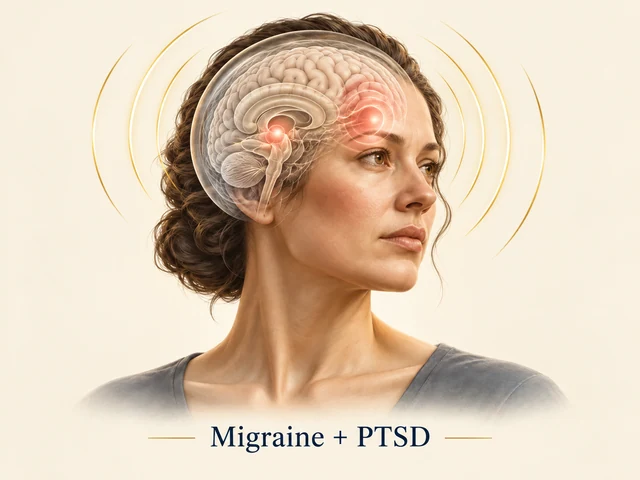
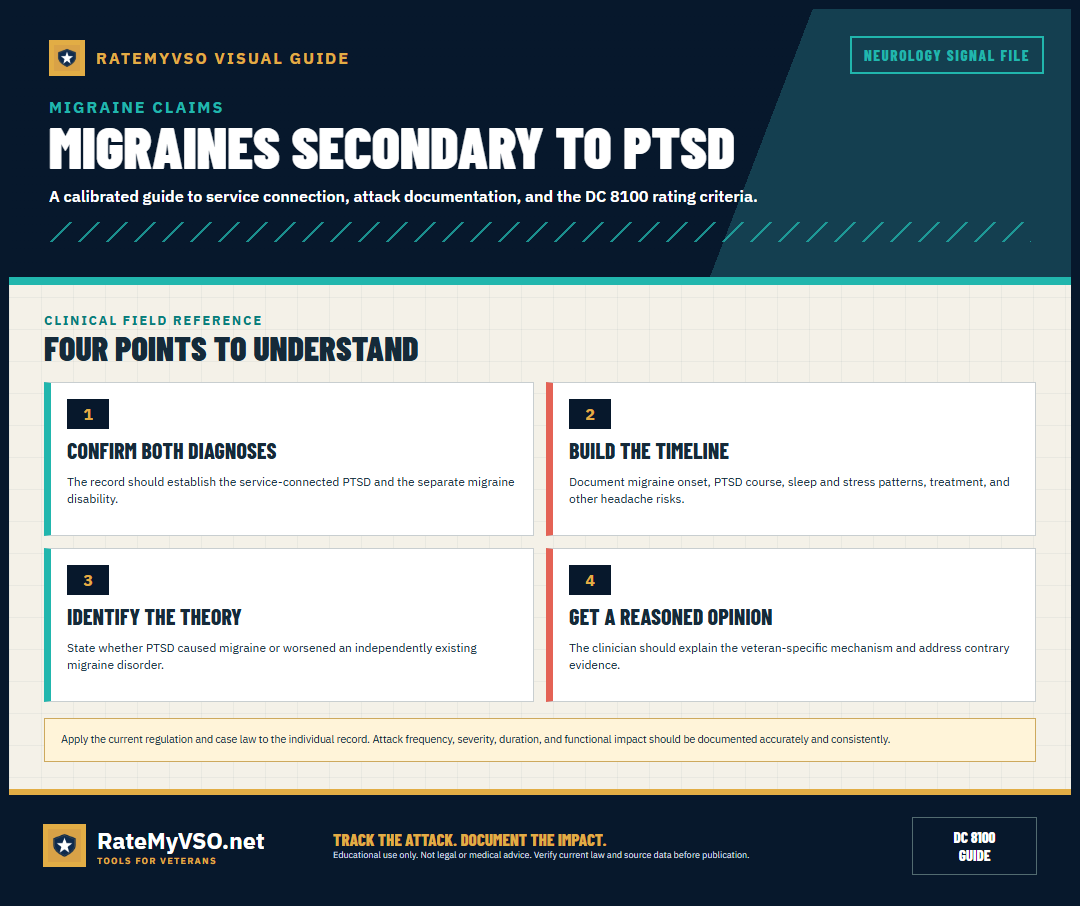 Visual guide: Migraines Secondary to PTSD
Board outcomes for this pairing, the three secondary service-connection elements, the medical theories, the evidence record, and the causation versus aggravation split. Opens the full-size chart, free to save or print.
Visual guide: Migraines Secondary to PTSD
Board outcomes for this pairing, the three secondary service-connection elements, the medical theories, the evidence record, and the causation versus aggravation split. Opens the full-size chart, free to save or print.
Start with the essentials
- 01Service Connection
The ways a secondary connection can be established for this pairing.
- 02Diagnosis and Evidence
Common symptoms and the evidence that supports this kind of claim.
- 03Your History
What you experienced, what others observed, and what treatment changed.
Understand the claim
ICD-10 Diagnosis Codes
The ICD-10 diagnosis codes most commonly used for DC 8100, Migraine (the kind on your medical records, decision letter, or C&P exam report). VA rates the disability and its residuals, not the diagnosis itself, so coding can vary.
The Legal Path: 38 CFR § 3.310 and the Aggravation Requirement
A secondary service connection claim needs three things (Wallin v. West, 11 Vet. App. 509 (1998)):
- A current disability: a diagnosed headache condition. A headache diary and treatment records matter here, one denial pattern below turns on VA calling the migraines "self-diagnosed."
- A service-connected primary: the PTSD rating.
- A nexus: medical evidence connecting the two, by causation or aggravation.
The sleep apnea version of this guide walks the shared doctrine in more depth (Spicer but-for causation, multi-step chains, the equipoise standard under Lynch, Alemany, and Wise): Sleep Apnea Secondary to PTSD. Two points are specific to the migraine pairing:
Symptoms and rating
If Granted: The Rating
Migraines are rated under 38 CFR § 4.124a, DC 8100, on attack frequency and severity. The word doing the work is "prostrating": an attack that forces you to stop what you are doing and lie down, typically in a dark, quiet room. The ladder: 50 percent for very frequent, completely prostrating attacks productive of severe economic inadaptability; 30 percent for prostrating attacks averaging about once a month; 10 percent for prostrating attacks averaging one every two months; 0 percent for less frequent attacks. The secondary rating combines with your PTSD rating under VA math rather than adding, run it in the VA Math Calculator. Full rating detail and the C&P exam are in the general Migraine Claims Guide.
Evidence and Board research
The Numbers, from 1.9M Appeals
In the Board's published decisions, migraine (DC 8100) claimed as secondary to PTSD (DC 9411) is a top-five pairing by volume, and first among them by win rate.
How those 1,163 issues came out
Same two readings as every secondary pairing: decided on the merits, this claim wins far more often than it loses, and the single biggest bucket is the remand, which usually means a gap in the medical-opinion record. The recurring gap in this pairing is specific and fixable: VA opinions that address causation but never aggravation, covered below.
Five Recent Board Grants, Dissected
All five decisions below granted service connection for migraines or headaches secondary to PTSD (one also via tinnitus), decided January through April 2026 before five different Veterans Law Judges. Published Board decisions are not precedent, but the patterns repeat.
Private DBQ + "major trigger" opinion survives a credible negative VA exam · Citation A26031478 (Apr. 7, 2026), Hearing docket
The record: the veteran filed with a completed private headaches DBQ and an opinion from a physician and physician assistant: migraines are triggered by a chemical reaction to stress, and the veteran's headaches tracked his PTSD severity, making PTSD the "major trigger." The VA examiner disagreed and attacked the submitted literature as non-peer-reviewed and about tension headaches.
Why it won: the Board gave BOTH opinions significant weight, called it equipoise, and the benefit of the doubt did the rest. A useful reminder: the private opinion does not have to demolish the VA exam. A well-reasoned tie wins.
The veteran's own VA treating clinician beats the C&P examiner · Citation A26027768 (Mar. 26, 2026), Hearing docket
The record: the C&P examiner wrote "to date, there is no study or documentation to relate PTSD as a causative etiology for headaches." Against that, a lengthy opinion from one of the veteran's own VA treatment providers: stress is linked to headaches in the medical evidence, PTSD drives high stress, the two conditions share brain chemistry, and the loop runs both ways.
Why it won: the examiner's opinion never addressed aggravation, so the Board gave it "limited probative value" (the Allen flaw). The treating clinician's opinion engaged the veteran's actual history and lay statements, so it carried. No private nexus letter was ever purchased; the winning opinion came from inside VA's own treatment system.
Lost service records, incomplete VA exam, private nurse practitioner fills the record · Citation A26017407 (Feb. 26, 2026)
The record: the veteran's service treatment records were lost (VA exhausted its search). The VA examiner said he had never been diagnosed with a headache condition and pinned the January 2020 treatment on sinus symptoms, missing the other headache treatment entries. A private nurse practitioner's opinion laid out the fight-or-flight mechanism, stress hormones triggering migraine onset, with literature.
Why it won: the VA opinion got low probative value for being "not based on a full review" of the treatment records. The reasoned opinion grounded in the actual file beat the one that misread it, missing records and all.
Dual-primary theory: headaches secondary to tinnitus AND PTSD together · Citation A26002176 (Jan. 8, 2026), Evidence docket, decided 13 months after the rating decision
The record: a 2015-2018 Army veteran. VA opinions said the migraines were "mostly inherited," then that they were "self-diagnosed... multifactorial... not Migraine per se," from a records-only review with no exam. A private physician held a telehealth appointment, diagnosed migraine against the diagnostic criteria, and opined the headaches were due to the service-connected tinnitus AND PTSD: the bidirectional psych-migraine relationship, norepinephrine/epinephrine elevation, sleep impairment, plus literature that tinnitus provokes and worsens migraines.
Why it won: the Board found the VA opinions conclusory and internally conflicting (inherited, yet no pre-service history). Notably the same private opinion's burn-pit paragraph was rejected as conclusory, and the direct theory failed, while its secondary reasoning was detailed enough to grant. Opinions are weighed theory by theory.
Eighteen inadequate VA opinions, one adequate private one · Citation A26000420 (Jan. 5, 2026), Direct Review docket
The record: a woman veteran with PTSD, headaches documented back to 2010, and a 2015 VA PTSD exam already noting headaches as physiological reactivity to stressor cues. Across years of development, "not one of the 18 VA medical opinions relevant to the instant claims is adequate": causation-only opinions, an exam that could not diagnose what the record repeatedly diagnosed, an addendum that ignored what it was asked to address. The private opinion: female sex plus PTSD predicts persistent posttraumatic headache at roughly threefold risk, on a large research body.
Why it won: with no adequate negative opinion left standing, and the no-remand-to-deny rule (Mariano) barring another round of exams, the reasoned private opinion controlled. This decision also granted four more secondaries (back, hip, both ankles) using the same reasoning: one adequate opinion beats none.
The pattern across all five
- Every grant had one reasoned medical opinion supporting the link, private physician, nurse practitioner, or the veteran's own VA treating clinician.
- The most repeated VA-exam failure is structural, not medical: answering causation and skipping aggravation (Allen/El-Amin). An opinion saying PTSD did not cause your migraines does not answer whether PTSD made them worse, so it cannot carry a denial on the aggravation question. It does not erase the rest of the report or by itself win the claim.
- The winning mechanism story is consistent: stress chemistry (fight-or-flight, norepinephrine/epinephrine), headaches worsening when PTSD worsens, and the bidirectional loop.
- Equipoise is enough. One grant issued with the VA's negative opinion still standing at full weight.
What the Board Said in Recent Grants
These are the Board's own words, quoted from the findings in 5 recent granted decisions on this pairing. Each sentence is the finding the grant rested on, not a summary of it. Click a citation to read the full decision.
“The Veteran's migraines are at least as likely as not caused by his service-connected tinnitus and posttraumatic stress disorder (PTSD).”
“The Veteran's claimed migraine headaches was proximately caused by his service connected tinnitus and PTSD.”
“The Veteran's migraine headaches are at least as likely as not related to her service-connected posttraumatic stress disorder (PTSD)”
“The evidence of record is at least approximately balanced regarding whether the Veteran's claimed migraine headaches disability was caused by his service-connected PTSD.”
“Resolving all doubt in the Veteran's favor, it is at least as likely as not that the Veteran's migraine headaches are proximately due to or aggravated by the Veteran's service connected post-traumatic stress disorder (PTSD), sleep apnea or tinnitus.”
Quoted from published Board decisions on this pairing, most recent first. Descriptive of the published record, not a prediction about any individual claim. Search the full decisions in BVA Decision Search.
The Evidence Checklist
What the winning files contained, item by item.
- A documented diagnosis: treatment records naming the headache condition. The "self-diagnosed" denial pattern exists because migraine has no lab test; a provider applying the diagnostic criteria on the record (as the telehealth physician did in A26002176) closes it.
- A headache log: dates, duration, severity, triggers, and what each attack forced you to stop doing. This documents both the nexus story (attacks tracking PTSD flares) and the "prostrating" element the DC 8100 rating turns on.
- The PTSD rating and its paper trail: PTSD C&P reports noting headaches, stress reactivity, or chronic sleep impairment are corroboration already sitting in your file. In A26000420, a 2015 PTSD exam had documented headaches as stressor reactivity a decade before the grant.
- A reasoned nexus opinion, addressing BOTH theories: here is what the winning opinions have in common:
- States the conclusion in the legal phrasing, and covers causation AND aggravation: "at least as likely as not caused by, or aggravated by," the service-connected PTSD.
- Explains the mechanism in plain terms: fight-or-flight activation, stress-hormone elevation (norepinephrine/epinephrine), sleep disruption, the bidirectional loop.
- Ties the mechanism to this veteran: headaches flaring with PTSD symptoms, after nightmares, during high-stress periods.
- Cites the literature: posttraumatic headache research, findings that PTSD and migraines occur together often, threefold-risk data for women veterans with PTSD.
- Applies the migraine diagnostic criteria if the diagnosis is thin in the records.
- Lay statements: your own account of onset and co-variation with PTSD symptoms is competent evidence (Layno, Jandreau), and the credited opinions in A26027768 and A26002176 leaned on it. Household members can describe what an attack looks like from outside.
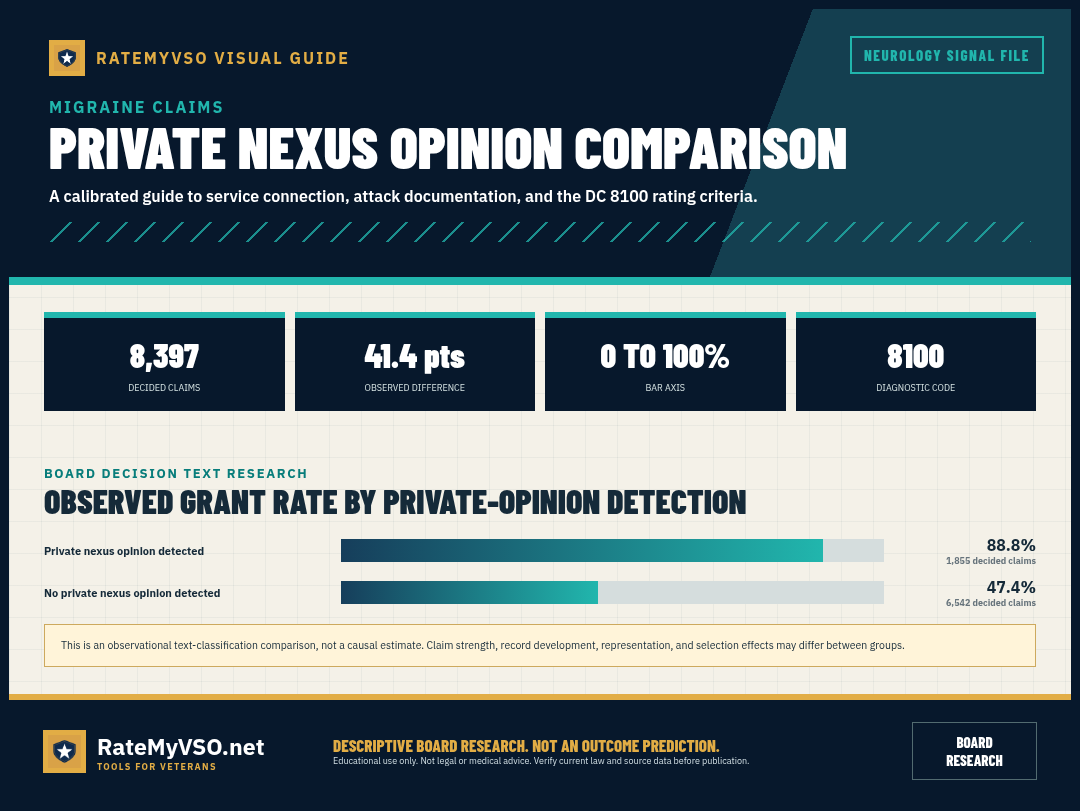
Across all published DC 8100 decisions, files with a private medical opinion track a much higher grant rate, shown live below.
Why VA Denies These Claims, and What the Board Said Back
Each rationale below is quoted or paraphrased from the actual VA examinations in the five cases, alongside how the Board answered it.
| VA examiner's rationale | How the Board answered it |
|---|---|
| "There is no study or documentation to relate PTSD as a causative etiology for headaches." | Discounted: the opinion also never addressed aggravation, making it inadequate under Allen regardless (A26027768). The claim granted over it. |
| Opinion addresses whether PTSD caused the migraines, says nothing about aggravation. | Does not resolve the aggravation question, so it cannot support a denial on that basis (Allen, El-Amin). This flaw appeared in three of the five cases, 18 times over in one of them (A26000420). |
| "Migraines are mostly inherited." | Conclusory, and inconsistent with a record showing no pre-service or in-service migraine history (A26002176). |
| "Self-diagnosed... multifactorial headaches, not Migraine per se," from a records-only review. | Outweighed by a private opinion that actually applied the diagnostic criteria to the veteran (A26002176). A records-only non-diagnosis does not erase documented treatment. |
| The submitted literature "is not peer reviewed" or "addresses tension headaches rather than migraines." | Treated as a fair critique of the literature's quality, but the private opinion still got significant weight, equipoise was reached, and the veteran won (A26031478). |
| No headache diagnosis exists; the January 2020 treatment was sinus-related. | Low probative value: the examiner missed the other headache treatment entries with no sinus symptoms. An opinion "not based on a full review" of the records loses to one that is (A26017407). |
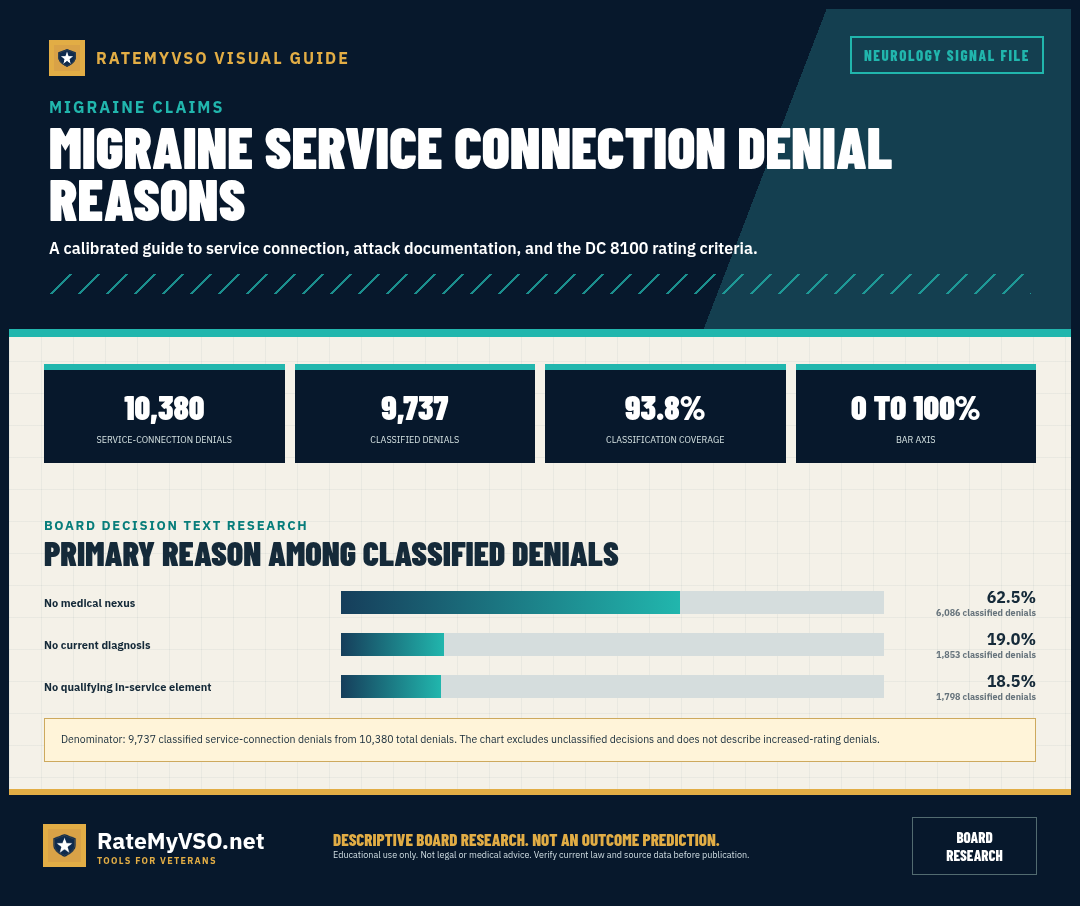
Across the Board's full record for migraine, the chart below shows which missing element service-connection denials turn on, from the current record.
Secondary relationships
The Mechanism: How PTSD Connects to Migraines
The winning medical opinions in recent grants describe the PTSD-to-migraine link through overlapping pathways, all running through the stress response.
The stress chemical reaction
The core mechanism credited by the Board: traumatic-stress activation of the fight-or-flight response elevates heart rate, respiratory rate, and stress hormones, including norepinephrine and epinephrine in the peripheral and central nervous systems, and that chemical cascade triggers migraine onset and increases severity (private opinions credited in Bd. Vet. App. A26017407 and A26002176). One credited opinion put it simply: medical research shows migraines are "triggered by a chemical reaction to stress," and the veteran's headaches worsened in step with his PTSD symptom severity, making the PTSD the "major trigger" (Bd. Vet. App. A26031478).
The bidirectional loop
A second credited framing: PTSD and migraine feed each other. Stress and mood changes trigger migraines; migraine pain and disability then raise stress and depress mood, which triggers more migraines. The two conditions "may be caused by similar brain chemicals" (VA treating clinician's opinion credited in Bd. Vet. App. A26027768). Sleep impairment and fatigue from PTSD sit inside the same loop, and one credited opinion tied the veteran's headache flares directly to nights of poor sleep and nightmares.
What the literature adds
- Posttraumatic headache risk: research identifies PTSD history, and female sex, as predictors of persistent posttraumatic headache syndromes. A credited 2024 opinion put a woman veteran with PTSD at roughly threefold risk of headache syndrome compared to non-PTSD counterparts, citing "a large body of research connecting PTSD with chronic headaches" (Bd. Vet. App. A26000420).
- Migraines and PTSD occurring together in combat veterans: peer-reviewed research has found that over 40 percent of combat veterans with migraines also met the criteria for PTSD.
- VA's own records often document the link first: in one grant, a VA psychologist's PTSD examination had noted years earlier that the veteran got headaches and nausea as "physiological reactivity to stressor cues" (A26000420). The mechanism was sitting in the veteran's own C&P file before the migraine claim was ever filed.
The Allen/El-Amin rule: a causation-only opinion is inadequate
A VA medical opinion on a secondary claim must address BOTH causation and aggravation to be adequate (Allen v. Brown, 7 Vet. App. 439, 448 (1995) (en banc); El-Amin v. Shinseki, 26 Vet. App. 136 (2013)). This is the single most common failure in the migraine cases: in three of the five recent grants below, VA opinions were discounted or thrown out because they answered "did PTSD cause the migraines" and never answered "does PTSD make them worse." In one case that flaw ran through 18 consecutive VA opinions (A26000420).
Migraines are a "chronic disease," which adds a second path
Migraine is treated as an "other organic disease of the nervous system," which is a chronic disease under 38 CFR § 3.309(a). Migraine is not named in the regulation's own list; VA's manual places it there (M21-1 V.iii.12.A.1.d). That classification is specific to migraine, not to headaches in general, so a headache diagnosis of another kind does not automatically come along.
Being a chronic disease opens two separate routes, and neither turns on onset alone:
- The one-year presumption (38 CFR § 3.307): it requires 90 days or more of qualifying service, and the migraines must have become manifest to a degree of 10 percent or more within one year of separation. Onset inside that year is not by itself enough; the manifestations have to reach that level.
- In-service onset (38 CFR § 3.303(b)): this is direct service connection with continuity of symptoms since service, not the presumption (Walker v. Shinseki, 708 F.3d 1331 (Fed. Cir. 2013)).
The recent grants were won on the secondary theory instead, but either route means in-service headache complaints in your service treatment records are worth gathering for this condition.
The Wider Data
Where migraine sits among the conditions veterans claim as secondary to PTSD. Live from the Board's published decisions, refreshed weekly:
Bars are BVA grant rates among decided issues for each condition claimed as secondary to PTSD, with issue counts. Descriptive of the published record, not a prediction about any one claim. Explore the underlying decisions in BVA Decision Search.
Prepare and take the next step
Prepare: your own working pages
Optional. These are your own notes, in your own words. They are not a VA form, they are not sent to the VA, and nothing here is a medical finding or a prediction about your claim.
Three reminders while you prepare
- Keep the two conditions separate
Record the history, diagnosis, symptoms, and treatment for PTSD and Migraines separately before describing the possible relationship. Go to this part
- Ask about causing and worsening separately
A clinician may need to address whether PTSD caused Migraines, whether it worsened it, and what other explanations the record shows. Go to this part
- Build the timeline from records you have
Mark missing or unverified records honestly. Research from published Board decisions describes the record reviewed; it does not predict an individual claim. Go to this part
Sign in or create an account to save your answers and come back to them later. You can fill these in and print them without an account.
Two-condition timeline
Migraines: symptoms and daily function
Provider questions about the relationship
Records and unanswered questions
Decision-letter reading sheet
Quick Checklist Before You File
- Documented headache/migraine diagnosis, ideally with the diagnostic criteria actually applied on the record.
- A running headache log, dates, duration, severity, triggers, and what each attack stopped you from doing.
- Your PTSD C&P exam records reviewed for any prior mention of headaches or stress reactivity.
- A nexus opinion written to address BOTH causation and aggravation, not causation alone.
- Your service treatment records checked for in-service or within-one-year headache history, for the chronic-disease presumptive route.
- Lay statements ready, from you and, where useful, a household member who has seen an attack happen.
For the mechanics of filing itself, see the Standard Claim Guide and the Fully Developed Claim Guide.
Do's and Don'ts
A condensed version of the pattern across the five grants and the denial rationales above.
- Get a documented headache diagnosis in your record, ideally with a provider applying the actual migraine diagnostic criteria, this closes off the "self-diagnosed" denial pattern.
- Keep a running headache log: dates, duration, severity, triggers, and what each attack forced you to stop doing. It works two ways: as nexus evidence and as the "prostrating" evidence your rating turns on.
- Push for a nexus opinion that addresses BOTH causation and aggravation. A causation-only opinion leaves the aggravation question unanswered, so VA needs adequate evidence on it before denying on that basis (Allen, El-Amin), and this was the flaw in three of the five recent grants.
- Pull your PTSD C&P exam records, they may already document headaches or stress reactivity years before you ever filed the migraine claim.
- Check your service treatment records for in-service migraine complaints. Migraine counts as a chronic disease under 38 CFR § 3.309(a), which opens a second path, though the one-year presumption also needs 90 days of qualifying service and migraines manifesting to at least 10 percent within that year.
- Don't assume you need an expensive purchased specialist letter, two of the five grants ran on a VA treating clinician's own notes or the veteran's existing PTSD exam record.
- Don't let a causation-only VA opinion stand unanswered, point out that it never addresses aggravation, that gap alone can void it.
- Don't accept "self-diagnosed," "mostly inherited," or "multifactorial" rationales at face value, the Board has called each conclusory where the record didn't actually support it.
- Don't assume a credible negative VA opinion means an automatic denial, more than one grant issued on equipoise with the VA's opinion still standing at full weight.
- Don't skip your own lay statement or one from a household member describing what an attack looks like, that is competent evidence and helped carry more than one of the grants above.
The Claims Process, Step by Step
A secondary claim moves through the same pipeline as any other. Understanding who does what helps you know who to contact and what to expect.
- You file the claim, naming PTSD as the service-connected primary and migraines as secondary. Directly with VA, through VA.gov, or with an accredited representative's help.
- VA assigns a Veteran Service Representative (VSR) to develop the claim: gather your service treatment records, VA and private medical records, and order a C&P exam if needed.
- The C&P exam is conducted, usually with the examiner asked to address the specific secondary theory (causation and aggravation both, not causation alone).
- The file goes to a Rating Veteran Service Representative (RVSR), the "rater," who weighs the medical evidence and decides service connection and, if granted, the rating percentage.
- VA issues the decision letter stating the outcome and the reasoning.
- If denied or under-rated, you choose an appeal lane, Supplemental Claim, Higher-Level Review, or a Board appeal, covered below.
Who's who: VSO vs. VSR vs. Rater vs. C&P Examiner
Your VSO
An accredited representative, agent, or attorney. Not a VA employee. Helps prepare and file, and can represent you on appeal. Has no authority to decide your claim.
VSR
VA staff who develops the claim: gathers records and schedules the exam. Does not decide the rating.
Rater (RVSR)
VA staff who reviews the complete file and makes the actual decision on service connection and percentage.
C&P Examiner
Conducts the exam and, where asked, gives a nexus opinion. Does not decide the claim, but as the case dissections above show, whether that opinion addresses both causation and aggravation carries real weight.
For the full walkthrough, see Inside Your Claim and Claim Stages.
DBQs and Your C&P Exam
A Disability Benefits Questionnaire (DBQ) is the standardized form the examiner completes for your condition. See the DBQ Guide for how these forms work and whether a private DBQ from your own doctor can be submitted instead of relying solely on a VA exam, one of the grants above ran on exactly a private headaches DBQ. For what to expect and how to prepare, see the C&P Exam Prep Guide, and bring your headache log; several of the grants above turned on the specific detail of how attacks track PTSD symptoms or flare after nightmares and poor sleep.
Reading Your Decision Letter, and What to Do If Denied
Your decision letter has a narrative "reasons and bases" section and a codesheet with the rating and effective date. See the Reading Your Decision Letter Guide or use the Letter Interpreter tool to decode your own letter. If denied, or if the reasoning only addresses causation and never aggravation (see the Allen/El-Amin discussion above), you have three main lanes:
- Supplemental Claim: refile with new and relevant evidence, such as a nexus opinion addressing aggravation, the theory VA's opinion never reached. See Supplemental Claim Guide.
- Higher-Level Review (HLR): a senior reviewer looks at the same evidence again, useful if the denial rested on a legal error like a causation-only opinion. See HLR Guide.
- Board Appeal: your case goes to a Veterans Law Judge, with a direct review, evidence, or hearing docket. See Board Appeal Guide.
Not sure which lane fits? See the Appeals decision guide for a side-by-side comparison.
After You Win: Maintaining Your Rating
Keep documenting your attacks, the same headache log that helped win the claim also protects your rating if VA schedules a future reexamination. See Protect Your Rating for when a rating becomes protected and Future Reexaminations for what triggers one. If your headaches become more frequent or severe, you can file for an increased rating, see the Rating Increase Guide.
References and related resources
Frequently Asked Questions
My migraines started years after service. Does that sink the claim?
Not on the secondary theory. The claim connects the migraines to your service-connected PTSD, not to service directly, so post-service onset is normal in these files. Separately, because migraine is treated as a chronic disease under 38 CFR § 3.309(a), there is an additional route if your records support it, but onset alone does not carry it: the one-year presumption needs 90 days of qualifying service plus migraines manifesting to at least 10 percent within that year (38 CFR § 3.307), and in-service onset is direct service connection with continuity of symptoms (38 CFR § 3.303(b)).
What is the single most common flaw in VA exams on this claim?
Answering only causation. A secondary opinion that never addresses whether the PTSD aggravates the migraines is inadequate as a matter of law (Allen v. Brown; El-Amin v. Shinseki), and the Board discounted opinions on exactly that ground in three of the five recent grants on this page. If your denial rests on an opinion that never mentions aggravation, that gap is the reviewable issue.
Do I need to pay for a private nexus letter?
The published record says a reasoned opinion is what matters, not who signs it. Two of the five recent grants ran on non-private opinions: one on the veteran's own VA treating clinician's letter, one partly on VA's own PTSD exam notes documenting headaches as stressor reactivity. Across all published DC 8100 decisions, a private opinion does track a much higher grant rate, but the mechanism is the reasoning, not the invoice.
The VA examiner said migraines are hereditary and multifactorial. Is that the end?
The Board rejected exactly that rationale where the record showed no family or pre-service migraine history, calling it conclusory (A26002176). "Multifactorial" describes symptoms. It does not explain the cause. The legal question stays whether PTSD is at least as likely as not one cause, or an aggravator. Equipoise goes to the veteran.
What does "prostrating" mean for my rating, and how do I document it?
An attack severe enough to force you to stop activity and rest, typically lying down in a dark, quiet room. The DC 8100 tiers turn on how often that happens, so a running headache log with dates, duration, and what each attack stopped you from doing is the single most useful rating document. Provider notes that use the word "prostrating" carry weight at the C&P exam.
Can my migraines be secondary to more than one service-connected condition?
Yes. One of the recent grants connected headaches to tinnitus and PTSD together (A26002176), on literature that each independently contributes. A nexus opinion can name every service-connected contributor; the claim needs only one adequate link to succeed.
Sources
- Bd. Vet. App. A26031478 (Apr. 7, 2026); A26027768 (Mar. 26, 2026); A26017407 (Feb. 26, 2026); A26002176 (Jan. 8, 2026); A26000420 (Jan. 5, 2026) (published, non-precedential).
- 38 U.S.C. §§ 1110, 5107; 38 CFR §§ 3.102, 3.303, 3.309(a), 3.310, 4.124a (DC 8100), 4.130 (DC 9411).
- Wallin v. West, 11 Vet. App. 509 (1998); Allen v. Brown, 7 Vet. App. 439 (1995) (en banc); El-Amin v. Shinseki, 26 Vet. App. 136 (2013); Spicer v. McDonough, 61 F.4th 1360 (Fed. Cir. 2023); Lynch v. McDonough, 21 F.4th 776 (Fed. Cir. 2021) (en banc); Walker v. Shinseki, 708 F.3d 1331 (Fed. Cir. 2013); Mariano v. Principi, 17 Vet. App. 305 (2003); Layno v. Brown, 6 Vet. App. 465 (1994); Jandreau v. Nicholson, 492 F.3d 1372 (Fed. Cir. 2007); Nieves-Rodriguez v. Peake, 22 Vet. App. 295 (2008).
- Medical literature as cited within the decisions above, including research on persistent posttraumatic headache predictors and how often PTSD and migraines occur together in combat veterans.
- Aggregate outcome counts: RateMyVSO index of published BVA decisions (as of July 2026 for the static chart; live widgets refresh weekly).