Sleep Apnea Secondary to PTSD
Obstructive sleep apnea claimed as secondary to PTSD is the single most-filed secondary pairing in the Board of Veterans' Appeals record. This guide covers the medical mechanism that links the two conditions, the legal standard under 38 CFR § 3.310, five recent Board grants dissected case by case, the reasons VA examiners give for denying, and the evidence pattern that shows up in the decisions that win. It is built from the published decisions themselves, not from theory.
Start with the essentials
- 01Service Connection
The ways a secondary connection can be established for this pairing.
- 02Diagnosis and Evidence
Common symptoms and the evidence cited in published Board appeals.
- 03Your History
What you experienced, what others observed, and what treatment changed.
Understand the claim
ICD-10 Diagnosis Codes
The ICD-10 diagnosis codes most commonly used for DC 6847, Sleep Apnea Syndromes (Obstructive, Central, Mixed) (the kind on your medical records, decision letter, or C&P exam report). VA rates the disability and its residuals, not the diagnosis itself, so coding can vary.
What This Claim Has to Prove
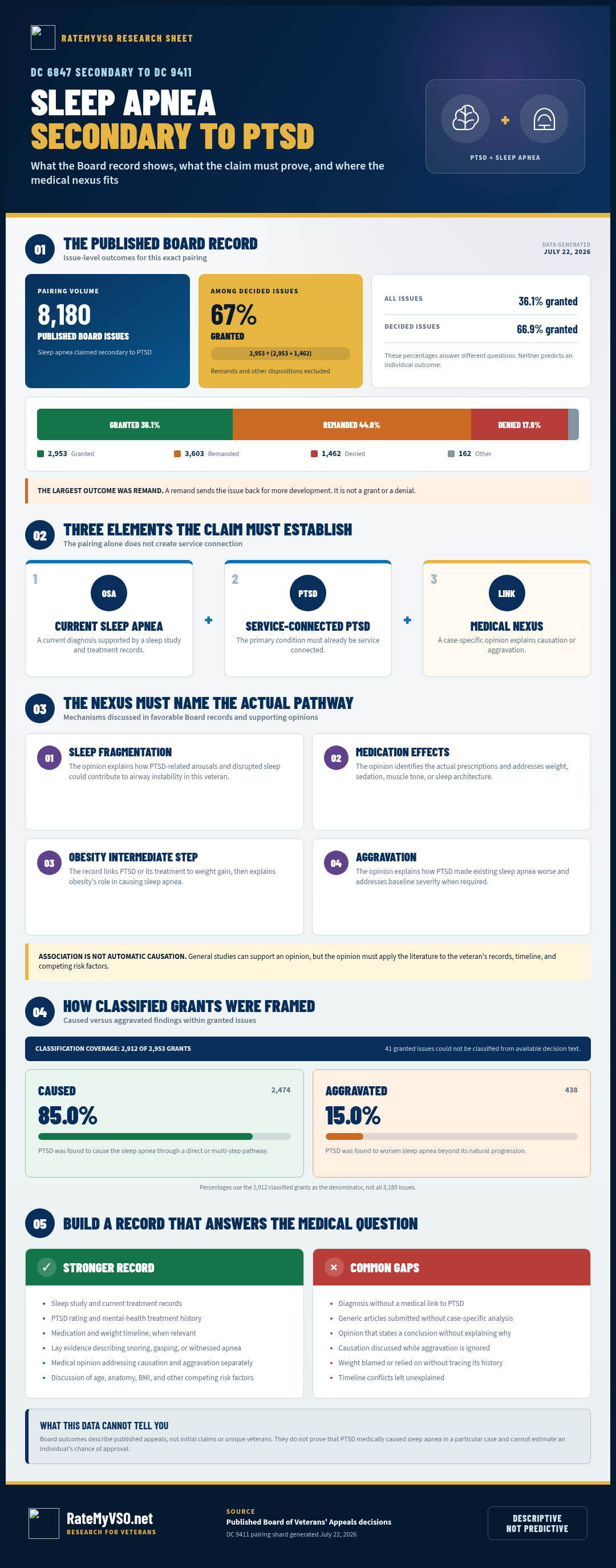
A secondary service connection claim needs three things (Wallin v. West, 11 Vet. App. 509 (1998)):
- A current disability: a diagnosed sleep apnea, which for DC 6847 means a sleep study (polysomnography or a validated home test).
- A service-connected primary: the PTSD rating itself.
- A nexus: medical evidence connecting the two.
Nothing in that test requires the sleep apnea to have started in service. That is what makes the secondary path different from a direct claim: the service-to-diagnosis gap that sinks direct claims is legally irrelevant here.
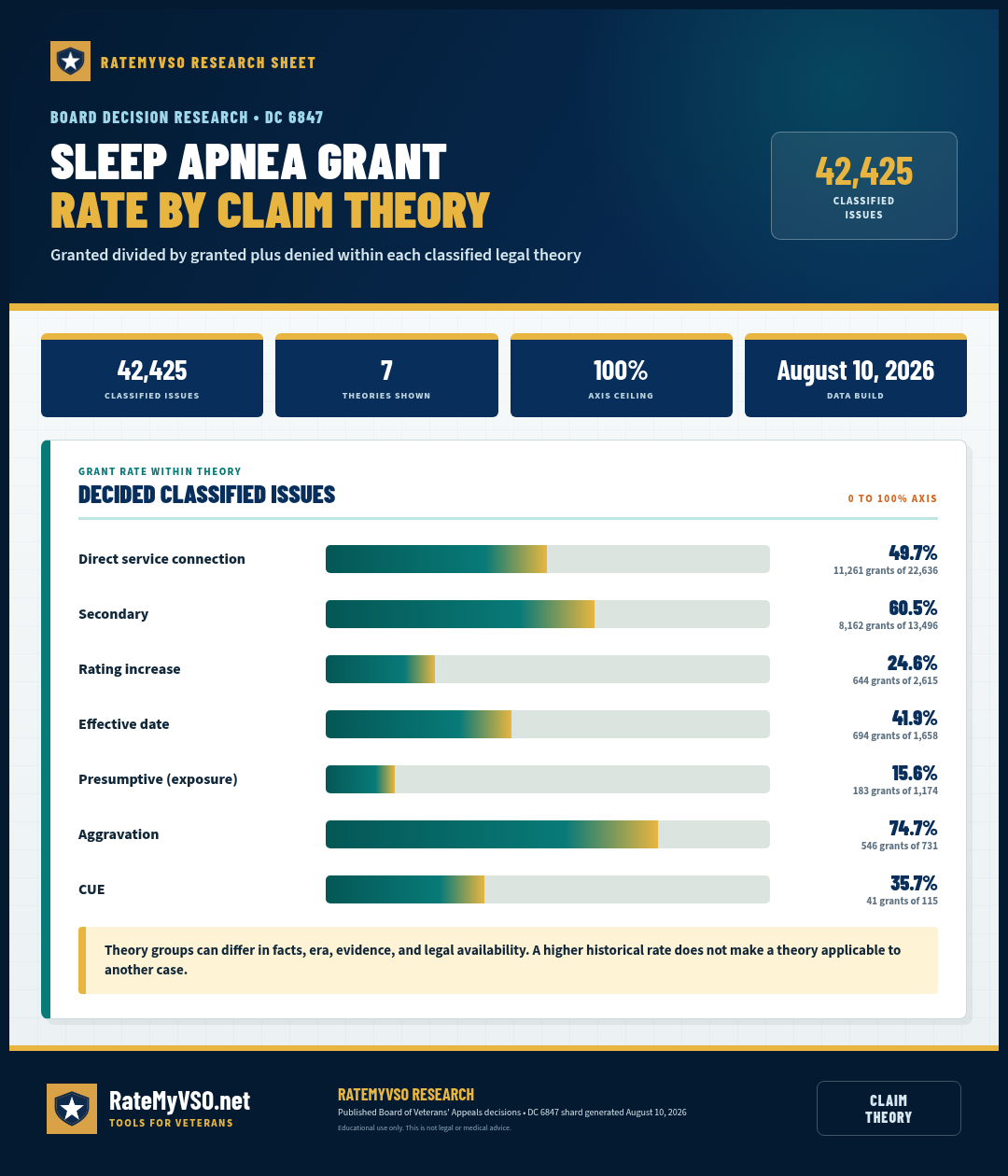 One-page guide: Sleep Apnea Grant Rate by Claim Theory
Board grant rates by claim theory across 43,635 decided classified sleep apnea issues. Opens the full-size chart, free to save or print.
One-page guide: Sleep Apnea Grant Rate by Claim Theory
Board grant rates by claim theory across 43,635 decided classified sleep apnea issues. Opens the full-size chart, free to save or print.
Causation and aggravation can both apply
38 CFR § 3.310 covers a primary condition that causes the secondary one, and separately a primary that aggravates a secondary condition that would exist anyway (subsection (b), Allen v. Brown, 7 Vet. App. 439 (1995)). Causation can also run through multiple steps in a chain (Spicer v. McDonough, 61 F.4th 1360 (Fed. Cir. 2023)), which is the doctrinal hook for the PTSD-to-weight-gain-to-OSA and PTSD-to-alcohol-to-OSA chains above. One of the April 2026 grants was decided explicitly on an aggravation theory alongside in-service onset (Bd. Vet. App. A26032315).
The "but for" standard and the baseline trap
Effective May 1, 2026, VA's adjudication manual adopted Spicer's "but for" causation language for secondary claims: the question becomes whether the OSA would have developed anyway, even without the PTSD. In practice this has cut against claimants. Sleep apnea is multifactorial (weight, age, sex, airway anatomy, family history all contribute), and when the other contributors are not addressed in the record, examiners increasingly find the link "too speculative" to support, effectively demanding a certainty the law does not require. On paper the evidentiary standard is still "at least as likely as not" with the benefit of the doubt at equipoise; the winning opinions in the cases above met the but-for framing head on by conceding the other risk factors and explaining why PTSD remained at least as likely a cause anyway (A26034183), or by tracing the risk factor itself back to the PTSD (A26033919).
Aggravation claims carry a second trap: 38 CFR § 3.310(b) requires establishing the baseline severity of the OSA before the aggravation, and a common denial pattern concedes the aggravation while denying because "a baseline cannot be established without resorting to mere speculation." That pattern, and how veterans have responded to it, has its own page: When VA Says a Baseline "Cannot Be Established". The May 2026 manual change and the Spicer line of cases are covered in more depth in the general Sleep Apnea Claims Guide.
The standard of proof is lower than examiners often apply
This is the most underused point in the whole area. The Board's recent grants repeatedly corrected VA examiners for demanding proof medicine cannot give:
- Exact etiology is not required. "An accurate determination of etiology is not a condition precedent to granting service connection; nor is definite etiology or obvious etiology" (Alemany v. Brown, 9 Vet. App. 518 (1996)).
- Scientific consensus is not required. "Congress has not mandated that a medical principle have reached the level of scientific consensus to support a claim for VA benefits" (Wise v. Shinseki, 26 Vet. App. 517 (2014)).
- A tie goes to the veteran. When the evidence for and against is in approximate balance, the benefit of the doubt applies; exact equipoise is not required (Lynch v. McDonough, 21 F.4th 776 (Fed. Cir. 2021) (en banc); 38 U.S.C. § 5107(b)).
Symptoms and rating
If Granted: The Rating
Sleep apnea is rated under 38 CFR § 4.97, DC 6847. The tier that matters most in practice: 50 percent where a breathing-assistance device such as a CPAP is required. Persistent daytime hypersomnolence without a device is 30 percent; documented sleep-disordered breathing without symptoms is 0 percent; chronic respiratory failure, cor pulmonale, or tracheostomy is 100 percent. The secondary rating combines with your PTSD rating under VA math rather than adding, run it in the VA Math Calculator. Full rating detail, the C&P exam, and the pending criteria changes are in the general Sleep Apnea Claims Guide.
Symptoms Recorded in Granted Sleep apnea Decisions
We analyzed 12,114 granted Board decisions involving sleep apnea for symptoms named in sentences about the condition (rating-criteria recitations excluded). Descriptive of the published record, what the Board wrote down, not a checklist of what to report.
Bar length shows decisions. Percentages remain context.
Detected by phrase-reading the decision text with condition-specific vocabularies. Source: Board of Veterans' Appeals decisions, RateMyVSO analysis.
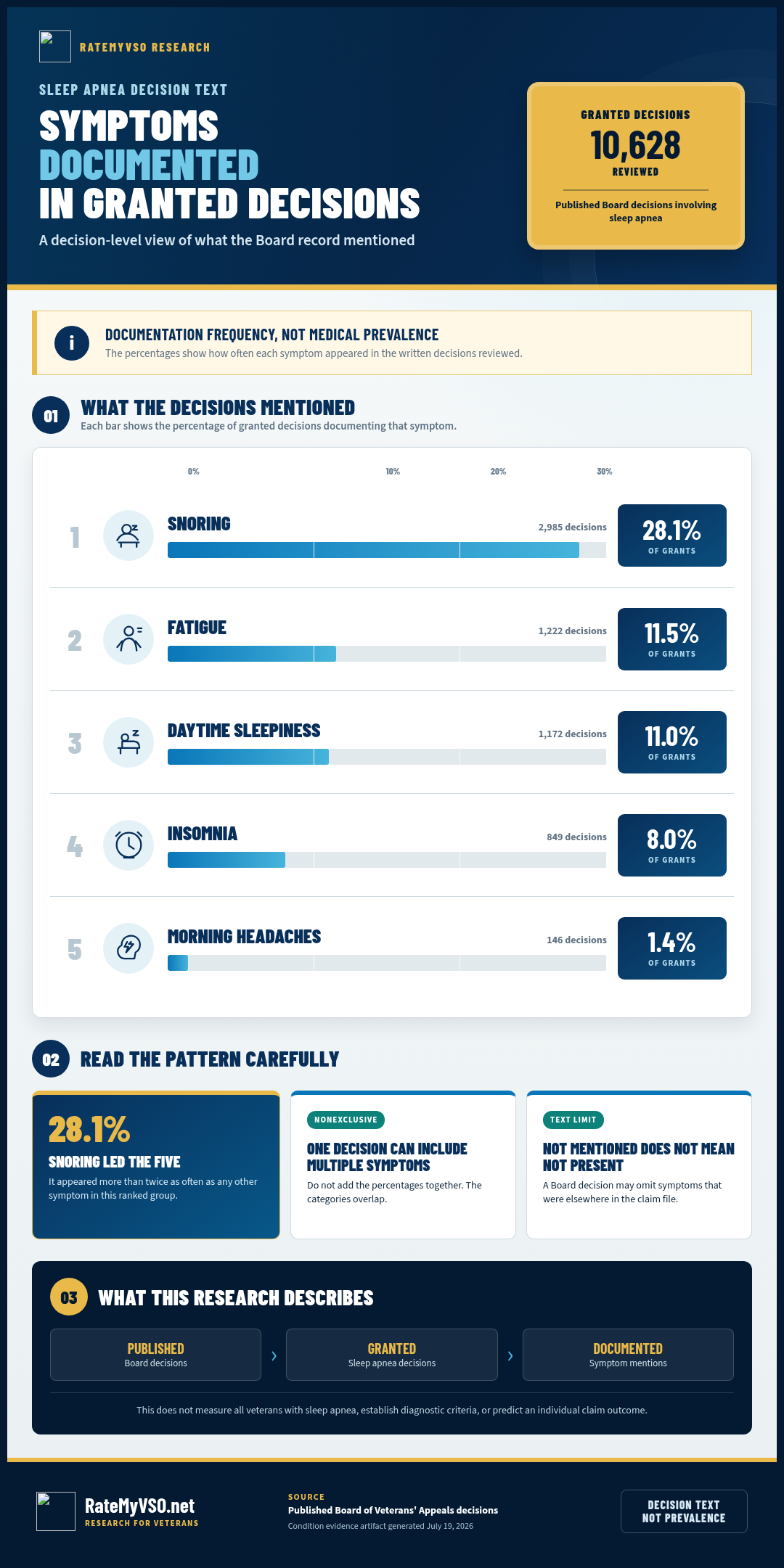 One-page guide: Symptoms Documented in Granted Decisions
Research summary of the symptoms documented across 12,114 granted sleep apnea Board decisions. Opens the full-size chart, free to save or print.
One-page guide: Symptoms Documented in Granted Decisions
Research summary of the symptoms documented across 12,114 granted sleep apnea Board decisions. Opens the full-size chart, free to save or print.
Evidence and Board research
The Numbers, from 1.9M Appeals
In the Board's published decisions, sleep apnea (DC 6847) is the number one condition veterans claim as secondary to PTSD (DC 9411). Nearly 8,000 published Board issues argue exactly this pairing.
How those 7,999 issues came out
Two readings of that chart matter. First, when the Board decides this issue on the merits, veterans win it twice as often as they lose it. Second, the single biggest outcome is a remand, which usually means the record was incomplete, most often the medical nexus opinion. The evidence sections below are about staying out of that remand bucket.
Five Recent Board Grants, Dissected
All five decisions below granted service connection for OSA secondary to (or partly alongside) PTSD, all in April 2026, before five different Veterans Law Judges. Together they map what the winning record looked like and what the losing VA opinions got wrong. Published Board decisions are not precedent, but the patterns repeat.
Private sleep specialist with 23 studies beats four VA exams · Citation A26034183 (Apr. 14, 2026), Direct Review docket
The record: four VA opinions against, including one that flatly said "there is no recognized pathophysiological pathway by which PTSD directly causes OSA." Against them, one private opinion from a physician double board-certified in otolaryngology and sleep medicine, laying out the low-arousal-threshold mechanism and citing 23 studies, and specifically rebutting each VA opinion, including conceding the veteran's obesity played a role while explaining why PTSD remained at least as likely a cause.
Why it won: the Board gave the private opinion "great probative weight" for its care and detail, and cut the final VA opinion down to moderate weight because it was "largely conclusory" and never engaged the 23 studies. Equipoise plus benefit of the doubt ended it.
Treating psychologist plus the twin study, and VA never traced the weight gain · Citation A26033919 (Apr. 13, 2026), Direct Review docket
The record: a Vietnam veteran whose treating VA psychologist documented, in ordinary treatment notes and a letter, that his PTSD caused severe sleep problems affecting his sleep apnea. The veteran himself submitted the JAMA twin study. Three separate VA opinions said no.
Why it won: the Board credited the treating psychologist, and dismantled the VA opinions one by one: the examiner who called weight gain the biggest risk factor never asked whether the PTSD caused the weight gain or the nightly drinking the veteran testified to; the examiner who dismissed the twin study as "association, not causation" was applying the wrong standard under Alemany and Wise. Notably, the veteran had no private nexus letter. His treating clinician's notes plus published literature carried it.
VA examiner says "cannot determine without speculating," private psychologist fills the gap · Citation A26033830 (Apr. 13, 2026), Hearing docket
The record: the VA examiner declined to give any opinion, writing they were "unable to determine that sleep apnea is caused by PTSD without speculating," with no explanation. A private licensed psychologist supplied the opinion instead, grounding the link in the DSM-5 PTSD criteria themselves (marked alterations in arousal and reactivity) and citing studies, then filed a second letter rebutting the VA exam.
Why it won: a non-opinion is not evidence against the claim. With the only reasoned opinion in the file pointing toward the PTSD link, approximate balance was reached. Note the timeline: 2021 filing, hearing in 2024, decision in 2026. The Hearing docket is slow.
The VA examiner's own positive opinion, in-service insomnia documented · Citation A26033198 (Apr. 9, 2026), Hearing docket
The record: sleep complaints documented in-theater in Afghanistan (2009 clinic visit, post-deployment health assessments), years of PTSD exams noting chronic sleep impairment, then a 2019 OSA diagnosis. Here the December 2019 VA examiner supported the claim, citing a Journal of Clinical Sleep Medicine study showing OEF/OIF/OND veterans with PTSD screen high-risk for OSA without classic predictors.
Why it won: a documented symptom trail from service forward, plus a reasoned positive opinion. A reminder that VA exams are not automatically adverse, and that in-service sleep complaints strengthen even a secondary theory.
Buddy statement plus private sleep specialist, on both onset and aggravation · Citation A26032315 (Apr. 8, 2026), Hearing docket
The record: service records showing poor-sleep complaints in 1994-95, a lay statement from a service contact describing the sleep problems in service and ever since, and a private sleep-studies physician opining the OSA began in service and was aggravated by the PTSD.
Why it won: the VA examiner's negative opinion never addressed the veteran's or the buddy's statements, so the Board gave it "minimal probative value." An opinion that ignores the lay evidence in the file is vulnerable, and the Board said so directly.
The pattern across all five
- Every grant had a reasoned medical opinion in the file supporting the link, whether from a private specialist, a private psychologist, a treating VA psychologist, or in one case the VA examiner.
- Every losing VA opinion failed the same way: conclusory, ignored the submitted literature, ignored the lay statements, or demanded causation-level proof the law does not require.
- Published literature did real work. The twin study and the prevalence studies were quoted by the Board itself, not just by the doctors.
What the Board Said in Recent Grants
These are the Board's own words, quoted from the findings in 5 recent granted decisions on this pairing. Each sentence is the finding the grant rested on, not a summary of it. Click a citation to read the full decision.
“The evidence is approximately balanced on whether the Veteran's OSA is proximately due to his service-connected PTSD.”
“Resolving doubt in favor of the Veteran, the most probative evidence supports a finding that the Veteran's current sleep apnea is related to the Veteran's current service-connected PTSD.”
“It is reasonably shown that the Veteran's obstructive sleep apnea is due to obesity, which is caused in part by his service-connected PTSD symptoms.”
“The Veteran's OSA is due to his service-connected posttraumatic stress disorder (PTSD).”
“Resolving reasonable doubt in the Veteran's favor, the Veteran's OSA is shown to be causally linked to his service-connected PTSD, with alcohol use disorder, MDD, and insomnia.”
Quoted from published Board decisions on this pairing, most recent first. Descriptive of the published record, not a prediction about any individual claim. Search the full decisions in BVA Decision Search.
The Evidence That Wins
What the winning files contained, item by item.
- Sleep study: polysomnography or a validated home sleep test with the diagnosis and AHI. Without it there is no current disability and no rating. Self-reported snoring is not a diagnosis.
- The PTSD rating: the service-connected primary. Records showing "chronic sleep impairment" among the rated PTSD symptoms (it appears on most PTSD exam reports) quietly document the mechanism years before the OSA diagnosis.
- A reasoned nexus opinion: the single item most correlated with the outcome. From the winning opinions, the working anatomy of one:
- States the conclusion in the legal phrasing: "at least as likely as not" caused or aggravated by the service-connected PTSD.
- Explains the mechanism in plain terms (sleep fragmentation, low arousal threshold, airway instability), not just the conclusion.
- Cites published literature by name. The JAMA twin study and the prevalence studies have been quoted by the Board itself.
- Addresses the obvious counter-explanation head on: if there is weight gain, says why PTSD remains at least as likely a cause, or traces the weight to the PTSD.
- Rebuts the specific VA opinion in the file, if one exists, rather than talking past it.
- Spouse or roommate statement: a lay witness is competent to describe witnessed apneas, gasping, and snoring (VA Form 21-10210). In A26032315 the buddy statement was part of why the VA opinion fell.
- Your own statement: the sleep timeline in your words, and, where true, the coping behaviors. The veteran's hearing testimony about drinking to sleep became load-bearing evidence in A26033919.
- Medication list: psychiatric medications with documented weight-gain side effects, if the weight-gain chain applies.
Across all published DC 6847 decisions, files with a private medical opinion track a much higher grant rate, shown live below.
Evidence Cited in Published Sleep apnea Decisions
We analyzed 89,710 published Board decisions involving sleep apnea for condition-specific evidence, counting only case-specific mentions (boilerplate recitations excluded). "Favorable" is the share of decisions citing that evidence where every issue was granted or the outcome was mixed; the baseline across all these decisions is 53.8%. Evidence appearing in a decision does not mean it decided the case. Descriptive of the published record, not a prediction.
Bar length shows decisions citing the evidence.
Detected by phrase-reading the decision text with condition-specific vocabularies. Source: Board of Veterans' Appeals decisions, RateMyVSO analysis.
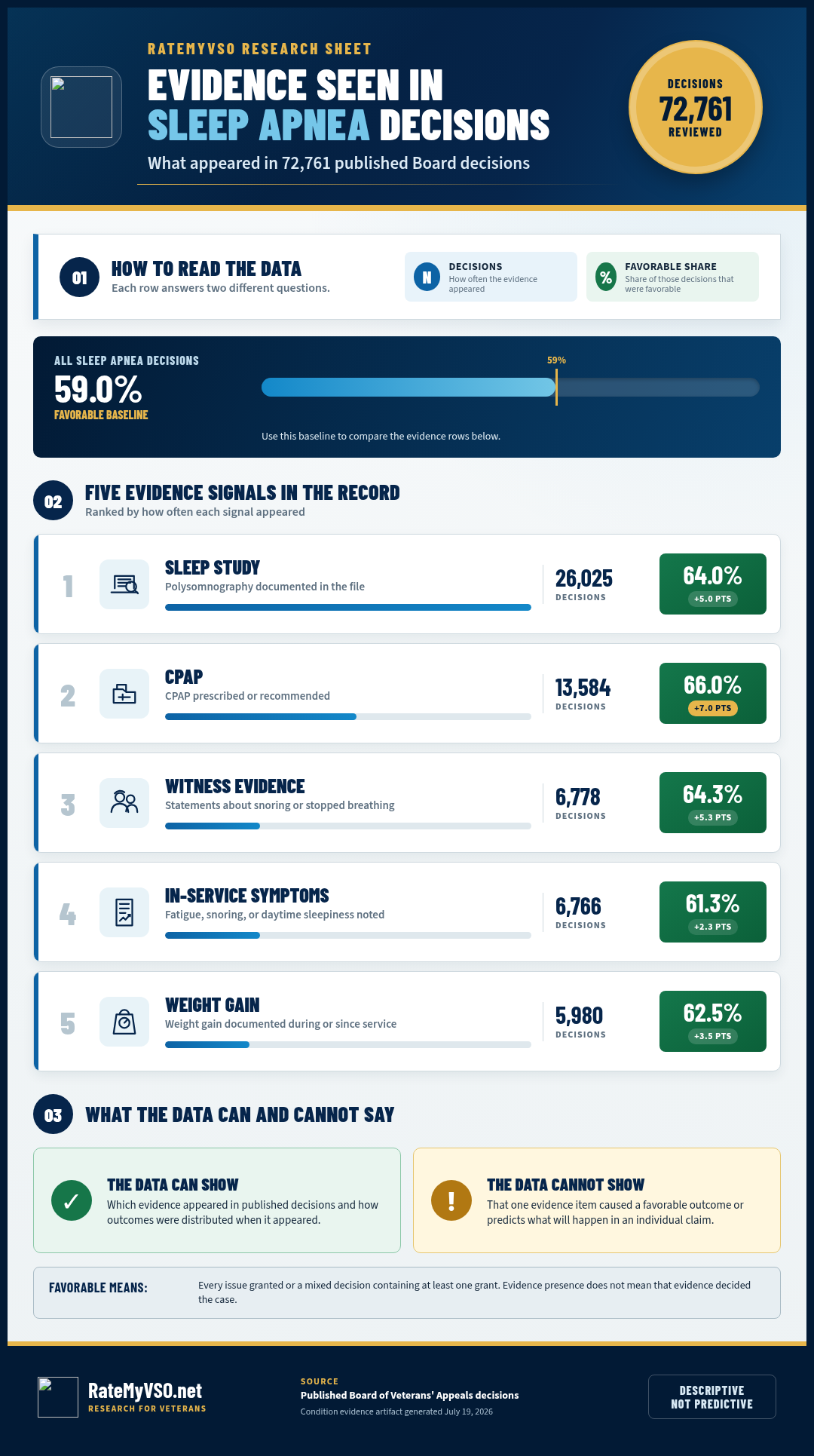 One-page guide: Evidence Seen in Board Decisions
Research summary of the evidence documented across 89,710 scanned sleep apnea Board decisions. Opens the full-size chart, free to save or print.
One-page guide: Evidence Seen in Board Decisions
Research summary of the evidence documented across 89,710 scanned sleep apnea Board decisions. Opens the full-size chart, free to save or print.
Why VA Denies These Claims, and What the Board Said Back
Every denial rationale below is quoted or paraphrased from the actual VA examinations in the five cases above, alongside how the Board answered it.
| VA examiner's rationale | How the Board answered it |
|---|---|
| "There is no recognized pathophysiological pathway by which PTSD directly causes OSA." | Called "largely conclusory" where the opinion cited one study and never engaged the 23 studies on the other side (A26034183). |
| "Weight gain is the most significant risk factor for sleep apnea." | Incomplete unless the examiner also asks whether the service-connected condition drove the weight gain or the drinking. Obesity can be an intermediate step in the causal chain (VAOPGCPREC 1-2017; A26033919). |
| "The study shows an association, not a causal relationship." | Wrong standard. Exact etiology and scientific consensus are not prerequisites; approximate balance plus benefit of the doubt is the test (Alemany, Wise, Lynch; A26033919). |
| "There is an 8 to 11 year gap between separation and the OSA diagnosis." | Relevant to a direct theory, not the secondary theory. Three of the negative opinions in A26034183 were discounted because they never addressed the secondary question at all. |
| "Unable to determine without speculating." | An unexplained non-opinion is not evidence against the claim, and leaves the reasoned private opinion unrebutted (A26033830). |
| A negative opinion that never mentions the veteran's or spouse's statements. | "Minimal probative value" for failing to address the lay evidence of onset and continuity (A26032315). |
Across the Board's full record for sleep apnea, the chart below shows which missing element service-connection denials turn on, from the current record.
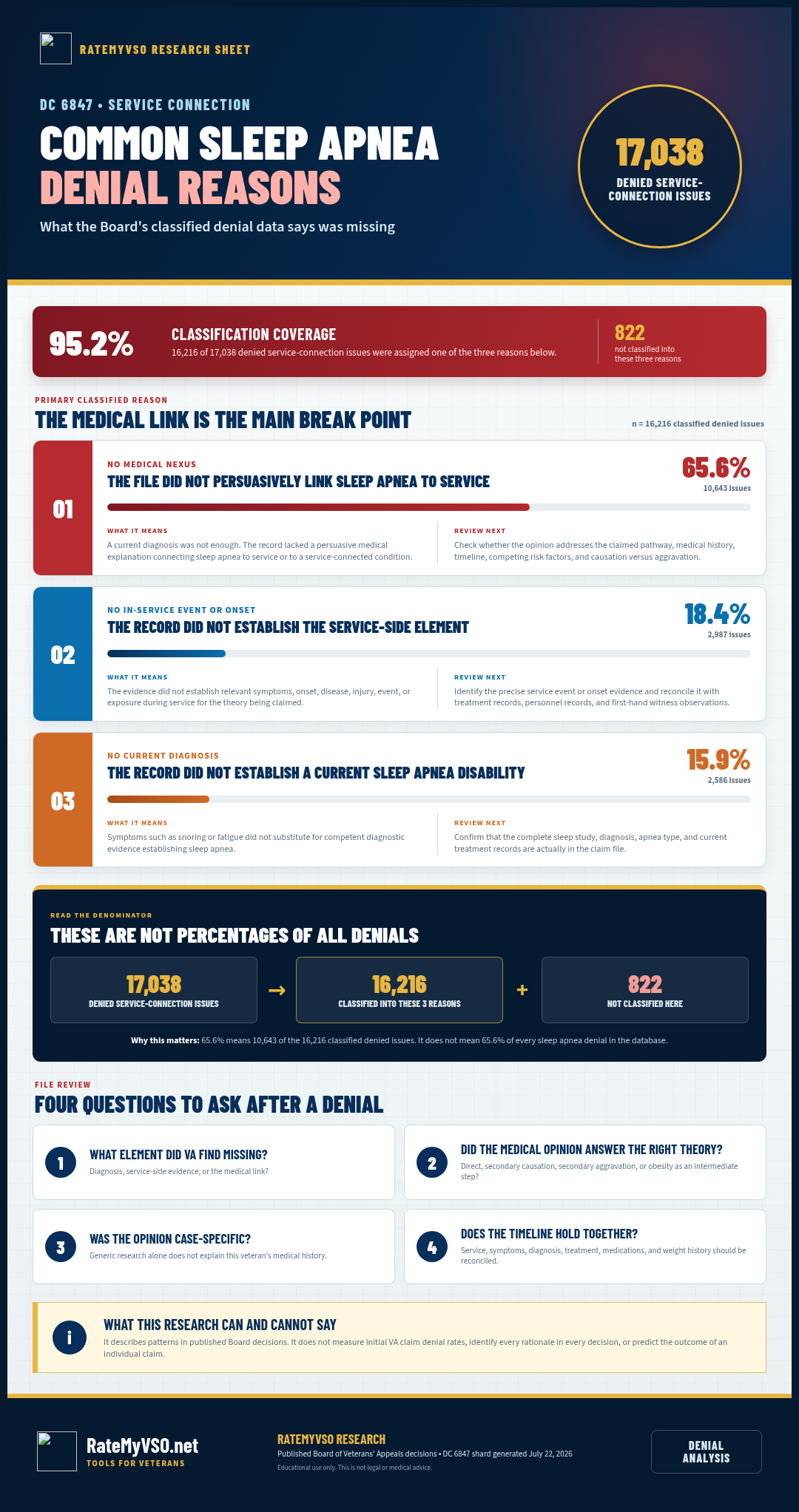 One-page guide: Common Sleep Apnea Denial Reasons
Research summary of the common denial reasons found across 16,545 classified sleep apnea denials, out of 17,485 denied in total. Opens the full-size chart, free to save or print.
One-page guide: Common Sleep Apnea Denial Reasons
Research summary of the common denial reasons found across 16,545 classified sleep apnea denials, out of 17,485 denied in total. Opens the full-size chart, free to save or print.
Secondary relationships
The Mechanism: How PTSD Causes Sleep Apnea
The most common VA denial rationale is some version of "PTSD is a mental health condition and OSA is a physical airway disorder, so one cannot cause the other." Medical literature accepted in favorable Board opinions answers that claim directly. It shows several documented pathways connecting the two conditions.
Sleep fragmentation and the low arousal threshold
PTSD causes fragmented sleep: sufferers wake too easily and spend more time in light sleep. That matters for the airway. During normal sleep, respiratory stimuli accumulate and activate the upper airway dilator muscles that hold the throat open. Constant arousals cut that process short, so the throat muscles never get the signal, the airway becomes unstable, and the collapse events that define OSA follow. A private sleep-medicine opinion credited by the Board in April 2026 described the chain as "complex neuroplastic alterations of the brain cause sleep fragmentation and recurrent arousals characteristic of PTSD, triggering upper airway instability and promoting the sleep-disordered breathing events that define OSA" (Bd. Vet. App. A26034183, quoting the private opinion). One study cited there showed airway collapsibility measurably increased after sleep fragmentation in healthy volunteers.
The twin study: effect size on par with obesity
The strongest single piece of literature appearing in recent grants is a JAMA Network Open cross-sectional study of Vietnam-era veteran twin pairs. Comparing brothers discordant for PTSD, higher PTSD symptom load went with a statistically and clinically higher apnea-hypopnea index, in a dose-response pattern, with familial confounders controlled by the twin design. The standardized effect size for PTSD symptoms was similar to that of body mass index, which is the most established OSA risk factor there is (cited in Bd. Vet. App. A26033919).
Prevalence far above the general population
A private opinion credited by the Board put OSA prevalence at roughly 34 percent of adult men generally, but far higher in veterans with PTSD, with studies reporting ranges from 69 to 91 percent (Bd. Vet. App. A26034183). A separate Journal of Clinical Sleep Medicine study of OEF/OIF/OND veterans found those with PTSD screened high-risk for OSA at much higher rates than community populations, and often without the classic predictors, meaning younger veterans without elevated BMI (cited in Bd. Vet. App. A26033198).
The indirect chains: weight gain, medications, and self-medication
Several more pathways show up in the decisions and the literature, most running through an intermediate step:
- Medication and stress-driven weight gain: common psychiatric medications and PTSD itself are associated with weight gain, and obesity narrows the airway. VA's own General Counsel has held that obesity can serve as an "intermediate step" between a service-connected condition and a secondary disability (VAOPGCPREC 1-2017). In one April 2026 grant, the Board faulted a VA examiner for blaming the veteran's weight without ever asking whether the PTSD drove the weight (Bd. Vet. App. A26033919).
- Direct medication effects on the airway: beyond weight gain, sedatives and muscle relaxants prescribed for PTSD symptoms reduce upper-airway muscle tone during sleep, and the literature describes antidepressants (SSRIs/SNRIs) altering respiratory drive and sleep architecture. A nexus opinion that names the specific prescriptions and their documented airway effects ties this chain to the individual record.
- Chronic stress physiology: sustained stress-hormone activation and inflammation are described in the literature as affecting airway muscle tone and respiratory control, part of the same sympathetic-activation picture as the arousal mechanism above.
- Alcohol as self-medication: alcohol relaxes the throat muscles. In A26033919, the veteran's testimony that he drank nightly to cope with his PTSD symptoms became part of the causal chain the Board credited, and the VA examiners' failure to address it undercut their opinions.
Caused By vs Aggravated By: What the Board Found
Under 38 CFR § 3.310 this claim can be won two ways: the PTSD caused the sleep apnea (subsection (a)), or it aggravated sleep apnea you already had (subsection (b)). Every grant rests on one or the other, so the split below divides up the granted claims only. It matters for the nexus opinion, because one that argues causation alone leaves the aggravation theory, a separate legal basis, on the table.
Conditions That Commonly Follow
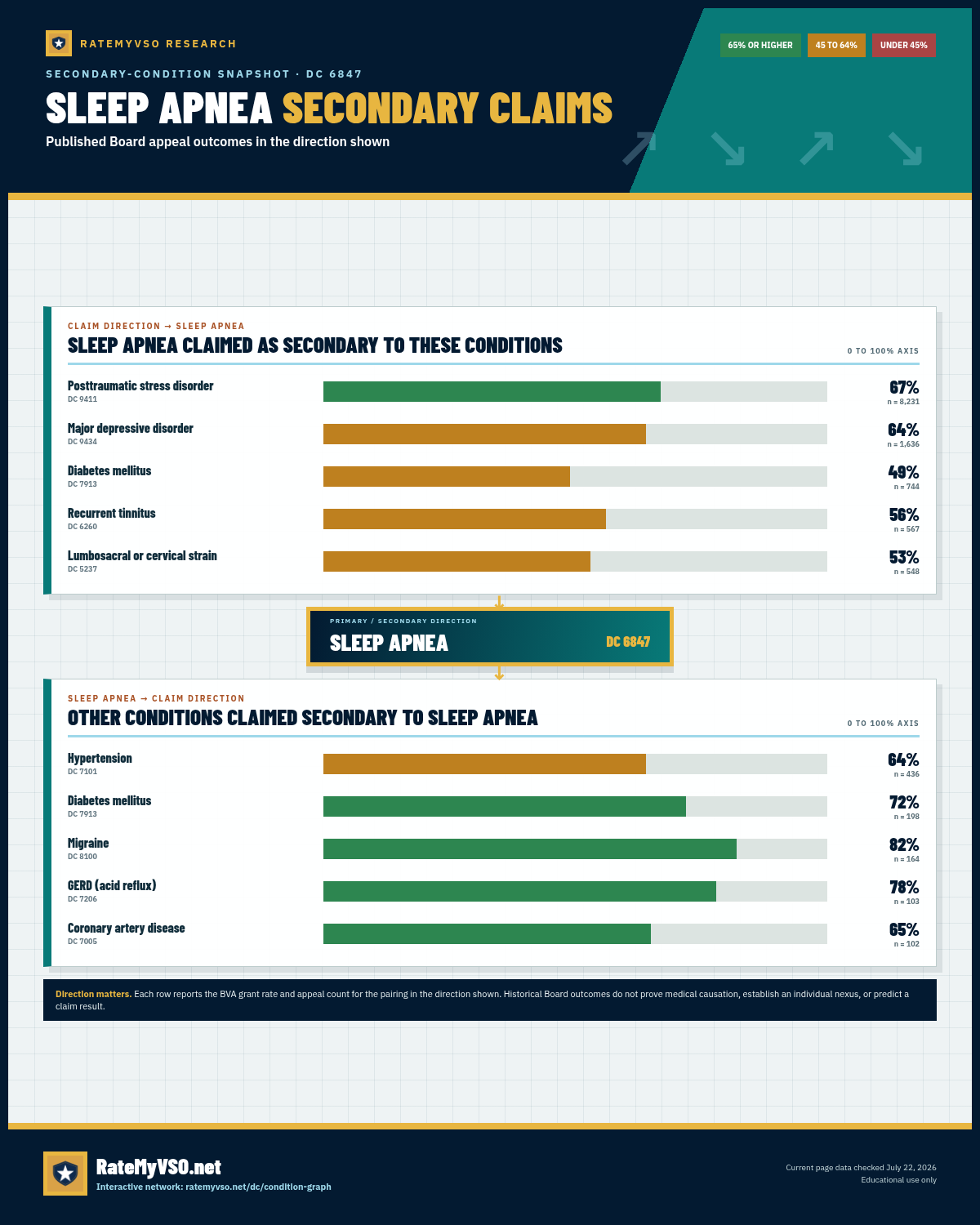
OSA leads the list of conditions veterans claim as secondary to PTSD. Live from the Board's published decisions, refreshed weekly:
Bars are BVA grant rates among decided issues for each condition claimed as secondary to PTSD, with issue counts. Descriptive of the published record, not a prediction about any one claim. Explore the underlying decisions in BVA Decision Search.
What else the Board has seen cause sleep apnea
PTSD is not the only primary condition veterans claim sleep apnea under. These are the other primaries in the published record, with how often each was granted:
Prepare and take the next step
Prepare: your own working pages
Optional. These are your own notes, in your own words. They are not a VA form, they are not sent to the VA, and nothing here is a medical finding or a prediction about your claim.
Three reminders while you prepare
- Keep the two conditions separate
Record the history, diagnosis, symptoms, and treatment for PTSD and Sleep Apnea separately before describing the possible relationship. Go to this part
- Ask about causing and worsening separately
A clinician may need to address whether PTSD caused Sleep Apnea, whether it worsened it, and what other explanations the record shows. Go to this part
- Build the timeline from records you have
Mark missing or unverified records honestly. Research from published Board decisions describes the record reviewed; it does not predict an individual claim. Go to this part
Sign in or create an account to save your answers and come back to them later. You can fill these in and print them without an account.
Two-condition timeline
Sleep Apnea: symptoms and daily function
Provider questions about the relationship
Records and unanswered questions
Decision-letter reading sheet
Quick Checklist Before You File
- Sleep study on file: polysomnography or a validated home test, with the diagnosis and AHI documented.
- PTSD rating already in place, ideally with "chronic sleep impairment" or similar documented among the rated symptoms.
- A nexus opinion naming the mechanism, sleep fragmentation, low arousal threshold, medication effects, chronic stress physiology, or self-medication, and citing published literature.
- If weight gain is part of your history, the opinion addresses whether PTSD or its medications drove it, not just that the weight exists.
- A spouse, roommate, or buddy statement describing witnessed apnea events, gasping, or snoring.
- Your own statement on the sleep timeline and, where true, coping behaviors like drinking to fall asleep.
- If a VA opinion already exists in the file, your opinion or statement rebuts its specific reasoning.
For the mechanics of filing itself, see the Standard Claim Guide and the Fully Developed Claim Guide.
Do's and Don'ts
A condensed version of the pattern across the five grants and the denial rationales above.
- Get a documented sleep study (polysomnography or a validated home test) with the diagnosis and AHI in your file before you file the secondary claim.
- Get a nexus opinion that names the specific mechanism, sleep fragmentation and low arousal threshold, medication effects, or self-medication, and cites the published literature, not just a conclusion.
- If weight gain is part of your record, get the opinion to address whether the PTSD or its medications drove the weight, rather than letting weight stand as an unexplained dead end.
- Get a spouse, roommate, or buddy statement describing witnessed apneas, gasping, or snoring, lay evidence the Board has credited directly.
- If a VA opinion already exists in your file, have your own opinion rebut it point by point rather than simply asserting the opposite conclusion.
- Don't accept "the study shows an association, not causation" as the final word, exact etiology and scientific consensus are not the legal standard (Alemany, Wise).
- Don't treat a VA examiner's "unable to determine without speculating" as evidence against you, an unexplained non-opinion is not evidence at all.
- Don't let a service-to-diagnosis time gap sink your secondary claim, that gap matters for a direct claim, not this one.
- Don't assume you need an expensive specialist, treating VA psychologist notes plus published literature carried at least one grant outright.
- Don't leave a negative opinion unchallenged if it never engaged your submitted literature or lay statements, the Board has downgraded exactly that kind of opinion to minimal weight.
The Claims Process, Step by Step
A secondary claim moves through the same pipeline as any other. Understanding who does what helps you know who to contact and what to expect.
- You file the claim, naming PTSD as the service-connected primary and sleep apnea as secondary. Directly with VA, through VA.gov, or with an accredited representative's help.
- VA assigns a Veteran Service Representative (VSR) to develop the claim: gather your service treatment records, VA and private medical records, and order a C&P exam if needed.
- The C&P exam is conducted, usually with the examiner asked to address the specific secondary theory (causation and aggravation both).
- The file goes to a Rating Veteran Service Representative (RVSR), the "rater," who weighs the medical evidence and decides service connection and, if granted, the rating percentage.
- VA issues the decision letter stating the outcome and the reasoning.
- If denied or under-rated, you choose an appeal lane, Supplemental Claim, Higher-Level Review, or a Board appeal, covered below.
Who's who: VSO vs. VSR vs. Rater vs. C&P Examiner
Your VSO
An accredited representative, agent, or attorney. Not a VA employee. Helps prepare and file, and can represent you on appeal. Has no authority to decide your claim.
VSR
VA staff who develops the claim: gathers records and schedules the exam. Does not decide the rating.
Rater (RVSR)
VA staff who reviews the complete file and makes the actual decision on service connection and percentage.
C&P Examiner
Conducts the exam and, where asked, gives a nexus opinion. Does not decide the claim, but as the case dissections above show, the opinion's reasoning and legal framing carry real weight.
For the full walkthrough, see Inside Your Claim and Claim Stages.
DBQs and Your C&P Exam
A Disability Benefits Questionnaire (DBQ) is the standardized form the examiner completes for your condition. See the DBQ Guide for how these forms work and whether a private DBQ from your own doctor can be submitted instead of relying solely on a VA exam. For what to expect and how to prepare, see the C&P Exam Prep Guide, and be specific about how your sleep symptoms track your PTSD symptoms, medication timeline, or coping behaviors; several of the grants above turned on exactly that kind of detail being in the record.
Reading Your Decision Letter, and What to Do If Denied
Your decision letter has a narrative "reasons and bases" section and a codesheet with the rating and effective date. See the Reading Your Decision Letter Guide or use the Letter Interpreter tool to decode your own letter. If denied, or if the reasoning demands proof beyond what the law requires (see the standard-of-proof discussion above), you have three main lanes:
- Supplemental Claim: refile with new and relevant evidence, such as a nexus opinion that addresses the mechanism, the literature, and the specific VA rationale you're rebutting. See Supplemental Claim Guide.
- Higher-Level Review (HLR): a senior reviewer looks at the same evidence again, useful if the denial rested on a legal error like demanding scientific consensus or exact etiology. See HLR Guide.
- Board Appeal: your case goes to a Veterans Law Judge, with a direct review, evidence, or hearing docket. See Board Appeal Guide.
Not sure which lane fits? See the Appeals decision guide for a side-by-side comparison.
After You Win: Maintaining Your Rating
Keep your CPAP compliance data, ongoing sleep clinic follow-ups, and any updated sleep studies on file, this protects you if VA schedules a future reexamination. See Protect Your Rating for when a rating becomes protected and Future Reexaminations for what triggers one. If your sleep apnea worsens, see the Rating Increase Guide.
References and related resources
Frequently Asked Questions
Does my sleep apnea need to have started during service?
No. That is the point of the secondary path. The claim connects the OSA to your service-connected PTSD, not to service directly, so a diagnosis years after separation is normal in these files. The service-to-diagnosis gap arguments VA examiners raise belong to direct claims, and the Board has discounted opinions that leaned on them without addressing the secondary theory.
VA already denied me because my weight causes my apnea. Is that the end?
The published decisions treat obesity as a complication to address, not an automatic dead end. VA's General Counsel has held obesity can be an intermediate step between a service-connected condition and the secondary disability (VAOPGCPREC 1-2017), and the Board has faulted examiners who blamed weight without asking whether the PTSD, its medications, or coping behaviors drove the weight. Winning opinions concede the weight's role and explain why PTSD remains at least as likely a cause.
Do I need a private nexus letter, or can VA evidence carry it?
Most of the recent grants ran on a private opinion, and across all published DC 6847 decisions a private opinion tracks a much higher grant rate. But not always: in one April 2026 grant the treating VA psychologist's notes plus a published twin study carried the claim, and in another the VA examiner's own opinion supported it. What every grant had was a reasoned medical opinion somewhere in the file.
What single study gets cited the most?
The JAMA Network Open twin study of Vietnam-era veteran twin pairs. Because it compared brothers discordant for PTSD, it controlled the family and genetic confounders that weaken ordinary studies, found a dose-response relationship between PTSD symptom severity and apnea severity, and measured an effect size on par with BMI. Boards have quoted it directly.
What does "aggravation" add if I cannot show PTSD caused the apnea?
38 CFR § 3.310(b) separately covers a service-connected condition making a non-service-connected one worse. If the OSA would exist anyway but the PTSD worsens it, that is a compensable theory of its own, and one of the April 2026 grants ran partly on it. Aggravation ratings offset the pre-existing baseline severity, so the paperwork differs; see Secondary vs Aggravation.
My remand came back. What was VA actually asking for?
Remand is the most common single outcome for this pairing (45 percent of the published issues). The typical remand instructs the regional office to obtain a medical opinion that actually addresses the secondary question, explains the mechanism, and engages the submitted literature, which is a description of the gap in the file. The evidence checklist above is essentially the list of what remands go looking for.
Sources
- Bd. Vet. App. A26034183 (Apr. 14, 2026); A26033919 (Apr. 13, 2026); A26033830 (Apr. 13, 2026); A26033198 (Apr. 9, 2026); A26032315 (Apr. 8, 2026) (published, non-precedential).
- 38 U.S.C. §§ 1110, 5107; 38 CFR §§ 3.102, 3.303, 3.310, 4.97 (DC 6847), 4.130 (DC 9411).
- Wallin v. West, 11 Vet. App. 509 (1998); Allen v. Brown, 7 Vet. App. 439 (1995) (en banc); Spicer v. McDonough, 61 F.4th 1360 (Fed. Cir. 2023); Alemany v. Brown, 9 Vet. App. 518 (1996); Wise v. Shinseki, 26 Vet. App. 517 (2014); Lynch v. McDonough, 21 F.4th 776 (Fed. Cir. 2021) (en banc); Jandreau v. Nicholson, 492 F.3d 1372 (Fed. Cir. 2007).
- VAOPGCPREC 1-2017 (obesity as an intermediate step); Marcelino v. Shulkin, 29 Vet. App. 155 (2018).
- Medical literature as cited within the decisions above, including the JAMA Network Open twin study of PTSD and OSA in Vietnam-era veteran twins and a Journal of Clinical Sleep Medicine study of OEF/OIF/OND veterans.
- Aggregate outcome counts: RateMyVSO index of published BVA decisions (as of July 2026 for the static chart; live widgets refresh weekly).