How to Read Your VA Rating Decision
A "VA rating decision" is actually two documents: the narrative the VA mails to you, and the codesheet that lives in your file and drives your actual payment. The narrative explains the reasoning in English. The codesheet is the machine-readable master record. Mismatches between the two are one of the most common sources of underpayment.

The two documents that together are "the rating decision"
Most veterans only ever see one of the two documents that make up the rating decision. The narrative comes in the mail (and posts on VA.gov). The codesheet stays inside the claim file and is only visible when the claim file is pulled, usually via a FOIA or Privacy Act request.
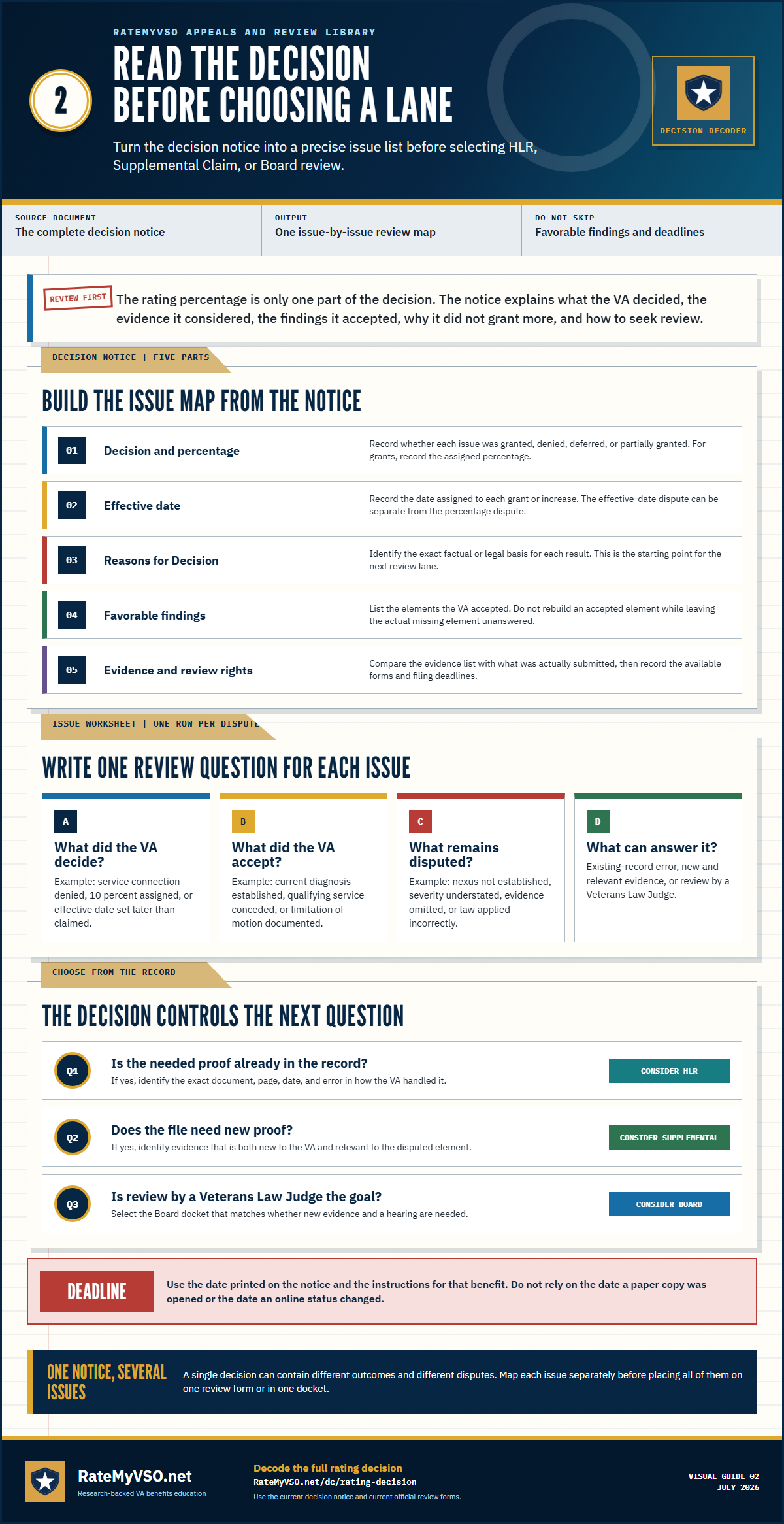
- Rating Decision Narrative. The mailed document. Five sections: basic info, introduction, decision summaries, evidence list, and reasons and basis. Written in something close to plain English.
- Rating Decision Codesheet. The internal master record. Diagnostic codes, evaluation percentages, effective dates, bilateral factor designations, ancillary benefit codes, SMC pay codes. Pure data. This is what the VA's payment system reads.
Rating Decision Narrative, five sections
1 Basic Information
Veteran's name, file number, branch of service, dates of service, and the date the narrative was generated. A quick visual check: confirm the dates of service match your DD-214. Discrepancies here can propagate into the rest of the decision.
2 Introduction
Identifies the claim type (original, increase, secondary, supplemental, etc.), the conditions claimed, and the period of consideration. Sometimes notes whether the claim was filed as a Fully Developed Claim (FDC) or Standard Claim.
3 Decision Summaries
The fast-read section. One line per condition with the outcome (granted / denied / deferred / continued), the percentage if granted, and the effective date. This is what most veterans flip to first.
4 Evidence List
Lists the evidence the rater identified as considered. Service treatment records, C&P exam reports, lay statements, private medical records by provider name, and any DBQs.
5 Reasons and Basis
The substance of the decision. One block per condition explaining the rater's reasoning. Grants, denials, and deferrals each follow a different format. See the next section.
Reasons and Basis: how grants, denials, and deferrals are written
G Grant blocks Granted condition
Three required components:
- Basis of grant. Direct, Secondary, Presumptive, 1151 (VA-caused), or Chapter 17 (vocational rehab program). "Direct" is the default if not stated otherwise.
- Effective date. Usually omitted in the narrative when it matches the claim receipt date or the day after separation. When the effective date is anything unusual, the rater should explain it.
- Evaluation. Describes the symptoms documented in the record and lists the criteria that would qualify for the next-higher tier in the rating schedule.
D Denial blocks Denied condition
Three required components:
- Theories considered. Direct, Secondary, Presumptive, Aggravation, 1151. The rater is supposed to address each theory that the evidence reasonably raises.
- Explanation. Which element of service connection is missing (current diagnosis, in-service event, nexus) and why the evidence in the file does not meet it.
- Favorable findings. Any element the rater did find in your favor. Even on a denial, favorable findings are binding on future raters and are valuable for a Supplemental Claim.
DF Deferral blocks Decision postponed
Identifies the missing development that prevents a decision: federal records still pending, private records the veteran identified but the VA has not yet received, a missed or insufficient C&P exam, an examiner clarification request, or a rater consultation on a complex issue. Deferred is not a signal about likely outcome. See the claim types catalog.
Codesheet anatomy: the master record that drives payment
The codesheet is the source of truth for the VA's payment systems. If the narrative says "70% PTSD, granted, effective 2024-03-15" but the codesheet says "50%, effective 2024-06-01," the payment will follow the codesheet. The narrative is for humans. The codesheet is for the machine.
Data Tables
Identifies the veteran, the rater, the date of decision, and any prior decisions being amended. Service periods are listed here, including each separate enlistment, with branch and character of discharge for each. Errors in service period data can affect presumptive eligibility downstream.
Jurisdiction and Associated Claim(s)
Two related but distinct entries:
- Jurisdiction. Identifies which Regional Office or center is responsible for the decision, and the legal authority for that responsibility.
- Associated Claim(s). Lists each "End Product" (EP) code being addressed in this decision. EP codes are how the VA tracks claim types internally (e.g. EP 010 for original disability, EP 020 for increase). Administrative significance: which EPs close out determines what tracker statuses change.
Coded Conclusion
The most consequential section. For each condition:
- Diagnostic Code (DC). The 4-digit Schedule for Rating Disabilities code (e.g. 5237 for lumbosacral strain, 6260 for tinnitus).
- Decision. Service-connected or not service-connected, with the basis (Direct, Secondary, Presumptive, 1151, Chapter 17). A "-COMBAT" suffix marks combat-incurred conditions.
- Special issue brackets. Bracketed flags like [PACT], [GULF WAR], [MST], or [TBI] that tag the condition for special handling.
- Static vs. reevaluation. Static conditions are protected from routine future exams. Reevaluation conditions schedule a future C&P at a specified interval.
- Evaluation with effective date. The actual percentage and the date it begins. Multiple dates appear when the rating stepped up or down over time.
- Previous diagnostic codes. If the condition was previously rated under a different DC, both codes appear.
- Combined evaluation. The final combined disability rating using the 38 CFR 4.25 combined-ratings table. Verify with the Combined Rating Estimator.
- Bilateral factor. Applied when both sides of the body are affected for certain musculoskeletal DCs. Adds 10% to the combined rating of the two paired ratings before adding to the total.
- Ancillary decisions. Adaptive Auto, Specially Adapted Housing (SAH/SHA), Chapter 35 DEA benefits eligibility, and similar add-ons.
- SMC pay code. Special Monthly Compensation level if any. See the SMC guide.
Combat codes (1 through 4)
A separate codesheet field flags combat status across all rated conditions in the decision. The scale runs 1 to 4:
| Code | Meaning |
|---|---|
| 1 | No combat-incurred conditions in this decision. |
| 2 | All combat-incurred conditions are rated at 10% or higher. |
| 3 | All combat-incurred conditions are rated at 0%. |
| 4 | Mixed: some combat-incurred conditions are 10%+ and some are 0%. |
Special notation templates raters drop in
Codesheets contain several standardized templates the rater uses to flag special situations. The four most common:
Clear and Unmistakable Error (CUE) Template
Used when the current rater identifies an error in a prior decision that meets the strict CUE standard (the error was undebatable and would have manifestly changed the outcome). The template summarizes the proposed correction. Veterans can also raise CUE themselves. See the CUE guide.
Special Notation Box
Free-text instructions from the rater to downstream staff: the post-rating VSR (POST-VSR), future raters, or quality reviewers. Common contents: instructions for ADT/IADT period conversions, justifications for unusual effective-date choices, or notes on Guard/Reserve service period determinations.
Amputation Rule Template
Identifies conditions affected by the "amputation rule" under 38 CFR 4.68, which caps the combined evaluation for an extremity at the level that would be assigned if the extremity were amputated. Prevents stacking ratings beyond the amputation equivalent.
Accrued Grant Template
Used when a veteran's claim is granted after their death, with benefits accruing to an eligible survivor. Specifies the accrued benefit amount and the recipient.
The SMC pay code is the actual payment driver
Special Monthly Compensation is paid at higher rates than the standard schedular ratings, and a wrong SMC code on the codesheet quietly underpays a veteran for years. The narrative can describe SMC entitlement correctly in English, but if the codesheet's SMC pay code is missing or wrong, the payment will not reflect the narrative.
- SMC-K: Loss or loss of use of a creative organ, or limbs/hands/feet. Paid in addition to other ratings.
- SMC-L through SMC-N: Anatomical losses and aid-and-attendance levels.
- SMC-O and SMC-P: Combined-level entitlements involving multiple losses or impairments.
- SMC-R1 and SMC-R2: Higher-level aid-and-attendance, the highest standard SMC tiers.
- SMC-S: Housebound status (statutory or factual).
- SMC-T: TBI-specific aid-and-attendance level.
Full SMC guide. If the codesheet shows no SMC code and your ratings combine in a way that should trigger SMC-S (one 100% plus an independent 60%+, or housebound by fact), that is a checkable miscoding.
Common decoding pitfalls
- "Denied" with an evaluation percentage. Occasionally appears on combined Pension/compensation claims to show what a hypothetical grant rate would have been. Does not entitle the veteran to that rate. Sometimes also a rater error where the grant was reversed without removing the evaluation from the codesheet. If you see this and were not filing for pension, raise it.
- Effective date silently set to the wrong year. Compare the effective date on each condition to your ITF date or claim receipt date. The Letter Interpreter tool flags effective-date discrepancies automatically.
- Bilateral factor not applied to paired extremities. If you have bilateral knee ratings or bilateral hearing loss with appropriate DCs and the codesheet shows no bilateral factor, the combined math is likely off.
- SMC-S missing despite one 100% + 60%+. Statutory housebound under 38 CFR 3.350(i) is mandatory when the math triggers it. Missing SMC-S is a frequent and recoverable codesheet error.
- Static condition incorrectly marked for reevaluation. A static condition is protected. Marking a condition for routine reexam when it should be static can lead to unwarranted future reduction proposals.
- Ancillary benefits not adjudicated. When the rated combination would entitle the veteran to Adaptive Auto, SAH, or Chapter 35 DEA benefits and the codesheet does not address it, the rater may have failed to consider an inferred ancillary claim.
Claim Quest: Quick Check
Five questions based only on this guide.
This checks what you understood from this guide. It is not a claim-readiness score, a prediction, an official test, or a record on your account.
Primary authorities
- M21-1, Part V, Subpart iv, Chapter 1, Section A (Rating Decision Narrative).
- M21-1, Part V, Subpart iv, Chapter 1, Section B (Codesheet structure).
- M21-1, Part V, Subpart iv, Chapter 1, Section C (Coded Conclusion fields).
- M21-1, Part VIII, Subpart iv, Chapter 4, Section A (Special Monthly Compensation coding).
- 38 CFR 4.25 (combined ratings table). law.cornell.edu/cfr/text/38/4.25
- 38 CFR 4.26 (bilateral factor). law.cornell.edu/cfr/text/38/4.26
- 38 CFR 4.68 (amputation rule). law.cornell.edu/cfr/text/38/4.68
- 38 CFR 3.350 (Special Monthly Compensation). law.cornell.edu/cfr/text/38/3.350
Frequently Asked Questions
How do I get a copy of the codesheet? Mine wasn't in the mail.
The codesheet stays internal. To see it, request your claim file (often called the "C-file") through a FOIA / Privacy Act request. See the records request guide. Processing typically takes 60 to 120 days. Your VSO representative can usually access it faster on your behalf.
The narrative says 70% but my deposit reflects 50%. What happened?
Most likely a codesheet/narrative mismatch, an effective-date error, or a withholding (recoupment of severance pay, military retirement offset, or court-ordered apportionment). The fastest diagnostic is to pull the codesheet and confirm the actual percentage on file. Call 1-800-827-1000 first. If unresolved, file a Higher-Level Review for the codesheet error.
What's a "favorable finding" on a denial and why does it matter?
A favorable finding is any element of service connection the rater concluded in your favor, even if the overall claim was denied. Favorable findings are binding on future raters under 38 CFR 3.104(c). On a Supplemental Claim, you only need to supply what is missing. You do not need to re-prove the favorable elements.
How do I know if my condition was marked static or reevaluation?
The codesheet's Coded Conclusion shows it explicitly. The narrative usually does not. If the narrative says nothing about a future exam but you receive a routine reexam notice years later, that means the codesheet flagged it for reevaluation. Conditions that have stabilized for 5+ years generally should not be re-examined. See 38 CFR 3.344.
What does a bracketed flag like [PACT] or [MST] mean on the codesheet?
These are "special issue" flags that route the condition through additional handling. [PACT] tags conditions adjudicated under the PACT Act presumptions. [MST] indicates Military Sexual Trauma claims, which receive additional procedural protections. [GULF WAR] tags Gulf War undiagnosed illness presumptions. The flag does not by itself change the rating. It changes the procedural path.
My rater signed for a trainee. Is that a problem?
No. The VA routinely has multiple signatures on rating decisions, especially when a junior rater (RVSR-in-training) drafted the decision under a senior rater's supervision. The supervisory signature certifies the decision. Multiple signatures do not by themselves indicate quality issues or appellate vulnerability.
I think the rater missed a piece of evidence. What's my recourse?
Two options. If you have new evidence the VA has not yet considered, file a Supplemental Claim (VA Form 20-0995). If the rater simply did not consider evidence already in the file, file a Higher-Level Review (VA Form 20-0996) within one year and request a senior rater re-examine the same record. See the appeals guide for the difference.
Related Tools and Guides
RateMyVSO. Educational resource. Not affiliated with the U.S. Department of Veterans Affairs. Not legal advice. All RateMyVSO tools are free. Find a VSO representative for personalized guidance.