Diabetic Retinopathy Secondary to Diabetes
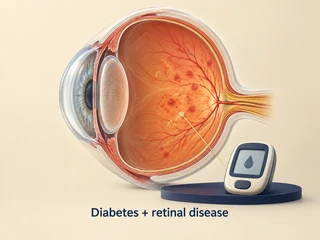
Diabetic retinopathy claimed as secondary to diabetes is granted in 45 percent of decided Board issues. Unlike claims that hinge on a hard-fought nexus letter, the published grants below show something different: once a clinician writes a compound diagnosis like "diabetes mellitus with diabetic retinopathy," the Board tends to treat causation as close to self-evident. This guide covers the mechanism, why blood-sugar control matters more than how long you've had diabetes, five recent Board decisions dissected, and the evidence that wins.
Start with the essentials
- 01Service Connection
The ways a secondary connection can be established for this pairing.
- 02Diagnosis and Evidence
Common symptoms and the evidence that supports this kind of claim.
- 03Your History
What you experienced, what others observed, and what treatment changed.
Understand the claim
ICD-10 Diagnosis Codes
The ICD-10 diagnosis codes most commonly used for DC 6040, Diabetic retinopathy (the kind on your medical records, decision letter, or C&P exam report). VA rates the disability and its residuals, not the diagnosis itself, so coding can vary.
The Legal Path: Why the Diagnosis Label Often Does the Work
A secondary service connection claim needs three things (Allen v. Brown, 7 Vet. App. 439 (1995) (en banc)):
- A current disability: a diagnosed diabetic retinopathy, which for DC 6040 means a dilated eye exam or ophthalmology evaluation documenting the retinal changes.
- A service-connected primary: the diabetes rating itself.
- A nexus: medical evidence connecting the two.
This pairing shows a distinctive pattern: the nexus element is frequently satisfied by the diagnosis language itself.
Symptoms and rating
If Granted: The Rating
DC 6040 is rated under 38 CFR § 4.79 on either visual impairment (acuity or visual field loss under the eye rating tables) or, where active retinopathy causes incapacitating episodes, a frequency-based scale. Which applies depends on the specific findings in your eye exam. The secondary rating combines with your diabetes rating under VA math rather than adding, run it in the VA Math Calculator. Full detail on eye rating criteria is in the Eye Conditions Claims Guide, and diabetes complication coverage is in the Diabetes Claims Guide.
Evidence and Board research
The Numbers, from 1.9M Appeals
In the Board's published decisions, diabetic retinopathy (DC 6040) claimed as secondary to diabetes (DC 7913) is a mid-sized, consistently filed pairing.
How those 796 issues came out
Denied outnumbers granted here, unusual among this site's diabetes-secondary pairings. Every published grant reviewed for this guide won cleanly, none turned on a contested medical fight. That suggests the denials are the harder-fought cases, the ones without a clean diagnosis label or a corroborating VA exam to lean on.
Five Recent Board Decisions Dissected
All five decisions below granted service connection for diabetic retinopathy secondary to diabetes, decided February 2024 through November 2025 before five different Veterans Law Judges. Published Board decisions are not precedent, but the patterns repeat.
The diagnosis label alone carries the grant · Citation 25014069 (Nov. 18, 2025), legacy docket, twice remanded
The record: after two prior Board remands and five VA addendum opinions over two years, the operative evidence was thin: an April 2025 VA screening note and an encounter diagnosis of "type II DM with unspecified diabetic retinopathy without macular edema."
Why it won: no separate medical nexus opinion was even required. "As diabetic retinopathy is a symptom of the Veteran's service-connected type II diabetes mellitus, service connection for diabetic retinopathy secondary to service-connected type II diabetes mellitus is granted." The diagnosis label did the work.
A cancelled eye exam, and a treatment note that filled the gap · Citation A25066934 (Aug. 7, 2025), Evidence Submission docket
The record: a private record documented "type 1 DM with moderate NPDR (non-proliferative diabetic retinopathy) without macular edema." A VA diabetes exam didn't include an eye exam and was negative; a follow-up VA eye exam was cancelled, but a VA treatment note from the same month independently confirmed moderate NPDR. The RO had denied for failure to report to the cancelled exam, despite conceding both the diabetes service connection and the retinopathy diagnosis.
Why it won: again, the compound diagnosis phrasing, "type 1 DM with moderate NPDR", was read as indicating the retinopathy is caused by the service-connected diabetes on its own.
A decades-old appeal with several linked secondary conditions · Citation 25004992 (Apr. 11, 2025), legacy docket pending since 1996
The record: a multi-issue chain: PTSD to chronic sleep impairment to heart disability and hypertension to diabetes to both an eye disability (retinopathy and cataracts) and a prostate condition. A VA examiner's opinion, citing medical treatise material, reasoned diabetics commonly develop ophthalmic complications, "most common being diabetic retinopathy," with no contrary opinion on file.
Why it won: "the Board finds the... opinions probative... there are no contrary opinions of record regarding these secondary relationships." An unopposed opinion, even one leaning on general treatise language, carried the claim.
A bare-minimum nexus opinion, still enough · Citation A24056203 (Sep. 13, 2024), Direct Review docket
The record: a two-condition chain, sleep apnea to diabetes (secondary), diabetes to retinopathy (secondary). A June 2021 RO medical opinion stated retinopathy is "by definition caused by or a result of diabetes mellitus," about as minimal a nexus statement as this pool contains.
Why it won: "the Veteran has a present diagnosis of diabetic retinopathy and a positive nexus opinion... affording all benefit of the doubt... the claim is granted." Even a bare, close-to-definitional nexus statement was enough where nothing contradicted it.
Five remands, and VA opinions the Board couldn't credit at all · Citation 24006394 (Feb. 6, 2024), legacy docket, five prior remands, hearing held 2019
The record: private ophthalmology records documented retinopathy as early as October 2008, repeated in 2009 and 2011, with the veteran testifying he sought regular private eye care "because he was afraid of losing his eyesight due to his diabetes." A 2013 letter from a physician treating him for diabetes since 1997 described the retinopathy developing during that roughly 11-year span. A November 2023 VA opinion was internally inconsistent, arguing both that the retinopathy was unlikely service-related because it was diagnosed decades post-discharge, and that the veteran didn't actually have retinopathy during the appeal period at all.
Why it won: after finding multiple VA opinions across the appeal's history inadequate, the Board adjudicated on the record as it stood, given the judicial-efficiency concern of yet another remand, and resolved reasonable doubt in the veteran's favor on the strength of the long, corroborated private ophthalmology history.
The pattern across all five
- A compound diagnosis label frequently does the nexus work on its own, three of five grants turned on phrasing like "diabetes with diabetic retinopathy" rather than a discrete, separately reasoned opinion.
- None of the five decisions reach a rating discussion, all are service-connection-only opinions; the rating mechanics live in the regulation itself, not in these cases.
- Multiple remands are the norm, not the exception, this pool's grants averaged several prior remands each, mostly for inadequate VA opinions.
- A1C and glycemic control specifics were missing from all five decisions, a real gap between the strongest medical literature and what VA examiners actually discuss.
What the Board Said in Recent Grants
These are the Board's own words, quoted from the findings in 5 recent granted decisions on this pairing. Each sentence is the finding the grant rested on, not a summary of it. Click a citation to read the full decision.
“Diabetic retinopathy is secondary to the service-connected diabetes mellitus type II”
“The persuasive evidence of record indicates the Veteran's diabetic retinopathy, peripheral neuropathies of the bilateral upper extremities, kidney condition, and eye condition are etiologically related to his service-connected type II diabetes”
“The Veteran's bilateral eye diabetic retinopathy was caused by his now service-connected diabetes mellitus type II”
“The Veteran's diabetic retinopathy is proximately due to his service-connected diabetes”
“The Veteran's bilateral non-proliferative diabetic retinopathy is due to his service-connected diabetes mellitus, type II”
Quoted from published Board decisions on this pairing, most recent first. Descriptive of the published record, not a prediction about any individual claim. Search the full decisions in BVA Decision Search.
The Evidence Checklist
What the winning files contained, item by item.
- A compound diagnosis, if your treatment records already have one: a clinician's note reading "diabetes with diabetic retinopathy" carries real weight on its own; check your own VA and private treatment records for this phrasing before assuming you need a separate nexus letter.
- A1C and glycemic-control history: the medical literature identifies this, not duration since diagnosis, as the dominant risk factor. None of the sampled grants used it, which may mean it's under-raised, not that it doesn't matter.
- Continuous private ophthalmology records: a long, corroborated treatment history from a private eye doctor, even decades old, can outweigh internally inconsistent or poorly reasoned VA opinions.
- Patience through the remand cycle: several grants here took multiple remands and years to resolve; a remand is not a loss.
- Check for internal inconsistency in VA's own opinion: an opinion that argues both "too long after service" and "no current diagnosis" at once is the kind of self-contradiction the Board has rejected outright.
Secondary relationships
The Mechanism: How Diabetes Connects to Retinopathy
Diabetic retinopathy develops as chronic high blood sugar damages the small blood vessels of the retina. Law-firm marketing content commonly frames how long you've had diabetes as the key risk driver. The actual epidemiology says otherwise.
A1C Control Matters More Than Years Since Diagnosis
A long-term diabetic-retinopathy cohort study found that a 1-point drop in A1C from baseline to four-year follow-up corresponded to an 18 percent decrease in 21-year progression to proliferative retinopathy and a 15 percent higher odds of improvement. Duration functioned as a statistical time variable, not an independent risk factor on its own, A1C dominated. Male sex, higher BMI, and higher diastolic blood pressure also predicted progression. See the Wisconsin Epidemiologic Study of Diabetic Retinopathy, PMC2761813.
None of the five published grants below actually litigated A1C history or glycemic control specifically, a gap between what the strongest medical literature emphasizes and what VA examiners and the Board's opinions in this sample actually discussed. If your file includes a documented A1C history, especially one showing a period of poor control before your retinopathy diagnosis, that may be under-used evidence worth raising directly.
A compound diagnosis can carry the nexus on its own
When a clinician writes a diagnosis like "type 2 diabetes mellitus with diabetic retinopathy," the Board has repeatedly treated that phrasing as effectively establishing the causal link, without demanding a separate, discrete nexus opinion. In one grant, the Board reasoned simply: "as diabetic retinopathy is a symptom of the Veteran's service-connected type II diabetes mellitus, service connection... is granted" (Bd. Vet. App. 25014069).
Medical evidence can support a nexus, but a patient's opinion outweighs it
General medical literature can show "plausible causality based upon objective facts" and support a grant (Sacks v. West, 11 Vet. App. 314 (1998)), but an opinion addressing the veteran's specific facts carries more weight than a treatise alone (Herlehy v. Brown, 4 Vet. App. 122 (1993)).
The Wider Data
Where diabetic retinopathy sits among the conditions veterans claim as secondary to diabetes. Live from the Board's published decisions, refreshed weekly:
Bars are BVA grant rates among decided issues for each condition claimed as secondary to diabetes, with issue counts. Descriptive of the published record, not a prediction about any one claim. Explore the underlying decisions in BVA Decision Search.
Prepare and take the next step
Prepare: your own working pages
Optional. These are your own notes, in your own words. They are not a VA form, they are not sent to the VA, and nothing here is a medical finding or a prediction about your claim.
Three reminders while you prepare
- Keep the two conditions separate
Record the history, diagnosis, symptoms, and treatment for Diabetes and Diabetic Retinopathy separately before describing the possible relationship. Go to this part
- Ask about causing and worsening separately
A clinician may need to address whether Diabetes caused Diabetic Retinopathy, whether it worsened it, and what other explanations the record shows. Go to this part
- Build the timeline from records you have
Mark missing or unverified records honestly. Research from published Board decisions describes the record reviewed; it does not predict an individual claim. Go to this part
Sign in or create an account to save your answers and come back to them later. You can fill these in and print them without an account.
Two-condition timeline
Diabetic Retinopathy: symptoms and daily function
Provider questions about the relationship
Records and unanswered questions
Decision-letter reading sheet
Quick Checklist Before You File
- Documented diabetic retinopathy diagnosis, ideally already phrased in your records as a compound diagnosis with diabetes ("diabetes with diabetic retinopathy" or similar).
- A1C and glycemic-control history pulled, not just the number of years since your diabetes diagnosis.
- Continuous private or VA ophthalmology treatment records gathered and ready to submit.
- A realistic expectation that a remand is common in this pairing, and not a sign your claim is weak.
- Any internally inconsistent VA opinion identified and flagged, rather than left unchallenged.
For the mechanics of filing itself, see the Standard Claim Guide and the Fully Developed Claim Guide.
Do's and Don'ts
A condensed version of the pattern across the five decisions above.
- Check your own VA and private treatment records for a compound diagnosis reading "diabetes with diabetic retinopathy" or similar before assuming you need a separate, discrete nexus letter, three of the five grants turned on that phrasing alone.
- Pull your A1C and glycemic-control history. The medical literature identifies blood-sugar control, not years since diagnosis, as the dominant risk factor, and none of the sampled grants actually raised it.
- Gather continuous private ophthalmology records, even decades old; a long corroborated treatment history outweighed internally inconsistent VA opinions in more than one grant.
- Expect patience through the remand cycle: this pool's grants averaged several prior remands each, some pending over a decade.
- Look for a VA treatment note from around the same time as a cancelled or incomplete eye exam, one grant used exactly that note to fill the gap.
- Don't assume you need a hard-fought nexus letter if your own diagnosis label already reads "diabetes with diabetic retinopathy," the Board has treated that phrasing as effectively establishing the causal link on its own.
- Don't treat a remand as a loss, multiple remands are the norm in this pairing, not the exception.
- Don't lean on duration-since-diagnosis as the deciding fact, the strongest literature says A1C control matters more, and none of the five decisions actually argued duration.
- Don't let an internally inconsistent VA opinion stand unchallenged, an opinion arguing both "too remote from service" and "no current diagnosis" at once is the kind of self-contradiction the Board has rejected outright.
- Don't assume a general treatise citation is the strongest evidence available, an opinion addressing your specific facts carries more weight than a treatise alone (Herlehy v. Brown).
The Claims Process, Step by Step
A secondary claim moves through the same pipeline as any other. Understanding who does what helps you know who to contact and what to expect.
- You file the claim, naming diabetes as the service-connected primary and diabetic retinopathy as secondary. Directly with VA, through VA.gov, or with an accredited representative's help.
- VA assigns a Veteran Service Representative (VSR) to develop the claim: gather your service treatment records, VA and private medical records, including any private ophthalmology history, and order a C&P exam if needed.
- The eye exam is conducted, typically as part of a diabetes exam or a separate eye exam; several grants above turned on whether this exam happened, was cancelled, or was filled in by a treatment note instead.
- The file goes to a Rating Veteran Service Representative (RVSR), the "rater," who weighs the medical evidence, including any compound diagnosis already in your records, and decides service connection and, if granted, the rating percentage.
- VA issues the decision letter stating the outcome and the reasoning.
- If denied or under-rated, you choose an appeal lane, Supplemental Claim, Higher-Level Review, or a Board appeal, covered below.
Who's who: VSO vs. VSR vs. Rater vs. C&P Examiner
Your VSO
An accredited representative, agent, or attorney. Not a VA employee. Helps prepare and file, and can represent you on appeal. Has no authority to decide your claim.
VSR
VA staff who develops the claim: gathers records and schedules the exam. Does not decide the rating.
Rater (RVSR)
VA staff who reviews the complete file and makes the actual decision on service connection and percentage.
C&P Examiner
Conducts the eye exam and, where asked, gives a nexus opinion. Does not decide the claim, but as the case dissections above show, whether the exam happens at all, and how the diagnosis gets written, carries real weight.
For the full walkthrough, see Inside Your Claim and Claim Stages.
DBQs and Your C&P Exam
A Disability Benefits Questionnaire (DBQ) is the standardized form the examiner completes for your condition. See the DBQ Guide for how these forms work and whether a private DBQ from your own eye doctor can be submitted instead of relying solely on a VA exam. For what to expect and how to prepare, see the C&P Exam Prep Guide. Bring your A1C and glycemic-control history and any prior ophthalmology records with you; several of the grants above turned on exactly this kind of detail, or its absence, being in the record.
Reading Your Decision Letter, and What to Do If Denied
Your decision letter has a narrative "reasons and bases" section and a codesheet with the rating and effective date. See the Reading Your Decision Letter Guide or use the Letter Interpreter tool to decode your own letter. If denied, or if the reasoning rests on an internally inconsistent VA opinion (see the discussion above), you have three main lanes:
- Supplemental Claim: refile with new and relevant evidence, such as a compound-diagnosis treatment note VA overlooked or A1C and glycemic-control records. See Supplemental Claim Guide.
- Higher-Level Review (HLR): a senior reviewer looks at the same evidence again, useful if the denial rested on an internally inconsistent or poorly reasoned VA opinion. See HLR Guide.
- Board Appeal: your case goes to a Veterans Law Judge, with a direct review, evidence, or hearing docket. See Board Appeal Guide.
Not sure which lane fits? See the Appeals decision guide for a side-by-side comparison.
After You Win: Maintaining Your Rating
Keep your eye care consistent, ongoing ophthalmology visits, treatment records, and any A1C or glycemic-control results, protects you if VA schedules a future reexamination. See Protect Your Rating for when a rating becomes protected and Future Reexaminations for what triggers one. If your retinopathy worsens, you can file for an increased rating, see the Rating Increase Guide.
References and related resources
Frequently Asked Questions
Do I need a separate nexus letter, or does my diagnosis already say enough?
Check your records first. In three of the five grants dissected here, a clinician's compound diagnosis, phrasing like "diabetes with diabetic retinopathy", was itself treated as establishing the causal link, with no separate nexus opinion litigated.
Does it matter how long I've had diabetes before my retinopathy developed?
Less than you'd think. The strongest medical literature on this pairing identifies blood-sugar control (A1C), not duration, as the dominant risk factor for progression. None of the five sampled Board decisions actually argued duration as the deciding fact.
My claim has already been remanded once or twice. Is that a bad sign?
No. The grants dissected here averaged several prior remands each, some pending over a decade, almost always because earlier VA opinions were found inadequate. A remand means more development, not a denial.
Why does this pairing deny more often (39%) than other diabetes-secondary claims on this site?
Denied outnumbers granted in this specific pool. Every grant reviewed for this guide won cleanly, on an unopposed or near-tautological nexus, suggesting the denials in this pool are the genuinely contested files, without a clean diagnosis label or a corroborating exam to lean on.
My VA opinion seems to contradict itself. What do I do?
Flag it directly. In one grant, a VA opinion argued both that retinopathy was too remote from service to be related and that the veteran didn't actually have retinopathy during the appeal period, a self-contradiction the Board rejected outright before ruling in the veteran's favor.
Sources
- Bd. Vet. App. 25014069 (Nov. 18, 2025); A25066934 (Aug. 7, 2025); 25004992 (Apr. 11, 2025); A24056203 (Sep. 13, 2024); 24006394 (Feb. 6, 2024) (published, non-precedential).
- 38 U.S.C. §§ 1110, 1131, 5107; 38 CFR §§ 3.102, 3.303, 3.310, 4.79 (DC 6040), 4.119 (DC 7913).
- Allen v. Brown, 7 Vet. App. 439 (1995) (en banc); Shedden v. Principi, 381 F.3d 1163 (Fed. Cir. 2004); Sacks v. West, 11 Vet. App. 314 (1998); Herlehy v. Brown, 4 Vet. App. 122 (1993); Lynch v. McDonough, 21 F.4th 776 (Fed. Cir. 2021); Gilbert v. Derwinski, 1 Vet. App. 49 (1990); Wise v. Shinseki, 26 Vet. App. 517 (2014); Stegall v. West, 11 Vet. App. 268 (1998).
- Wisconsin Epidemiologic Study of Diabetic Retinopathy long-term cohort findings on glycemic control and progression, PMC2761813.
- Aggregate outcome counts: RateMyVSO index of published BVA decisions (as of July 2026 for the static chart; live widgets refresh weekly).