VA Diabetes Claims Guide
Diabetes mellitus is one of the highest-volume VA disability claims, and for many veterans it is also one of the most straightforward to get service connected. Type 2 diabetes is a long-standing Agent Orange presumptive, so a veteran with qualifying herbicide-exposure service does not have to prove a medical link to service at all. The rating under diagnostic code 7913 turns on how the disease is treated (restricted diet, oral medication, insulin, and medically-prescribed "regulation of activities"), not on blood sugar numbers alone. Diabetes is also a powerful primary condition: its complications (peripheral neuropathy, kidney disease, eye disease, erectile dysfunction, and heart disease) are frequently rated separately and combined. This guide walks the whole path: how service connection works, the presumptive and secondary pathways, DC 7913 rating criteria, the evidence that wins, why claims get denied, a checklist before you file, the claims process step by step, how to read your decision letter, and what to do whether you win or you're denied.
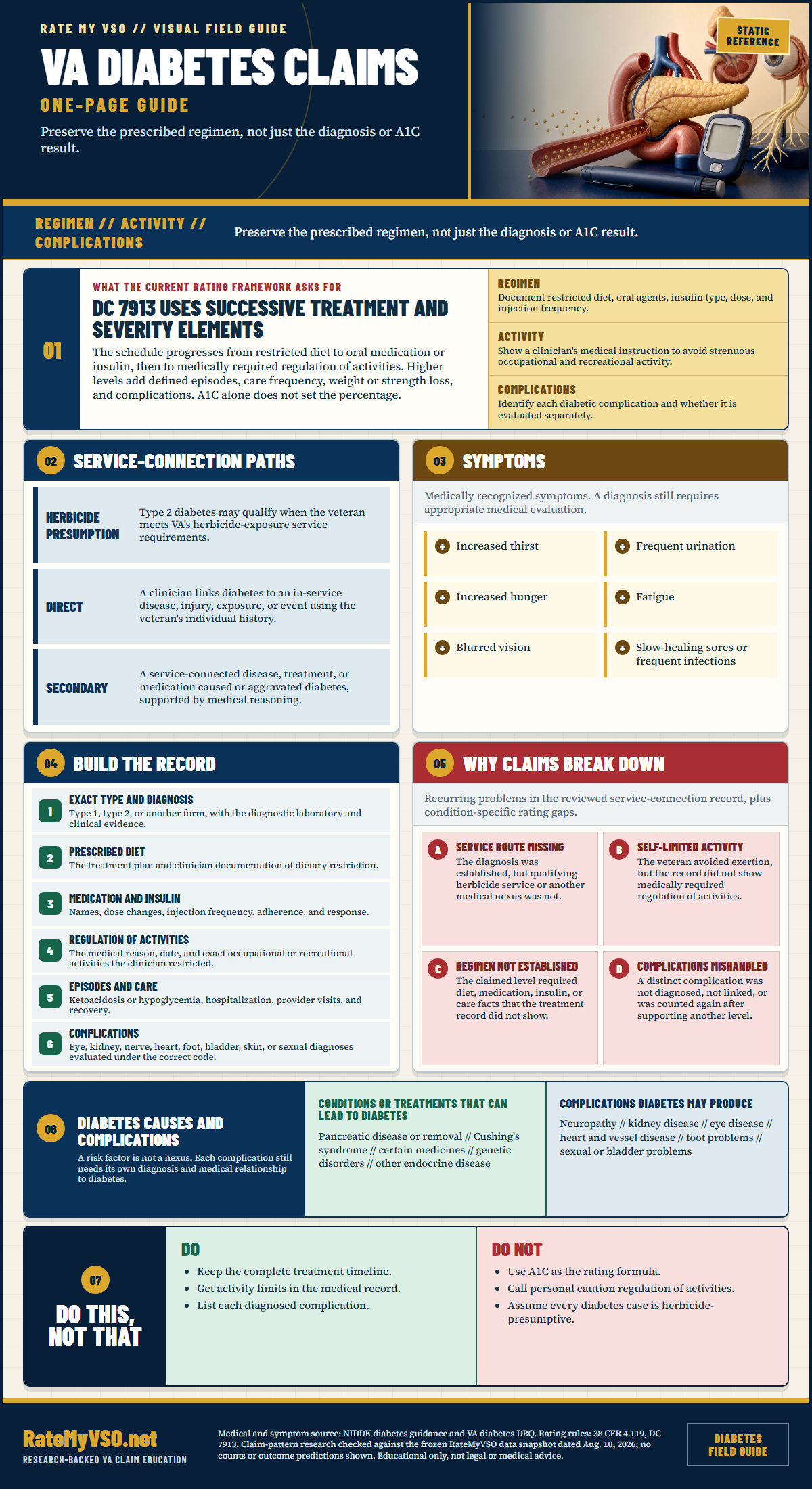 One-page guide: VA Diabetes Claims in One Page
Diabetes guide covering DC 7913, the prescribed treatment regimen, medically required regulation of activities, herbicide and other service paths, symptoms, complications, evidence, and common claim gaps. Opens the full-size chart, free to save or print.
One-page guide: VA Diabetes Claims in One Page
Diabetes guide covering DC 7913, the prescribed treatment regimen, medically required regulation of activities, herbicide and other service paths, symptoms, complications, evidence, and common claim gaps. Opens the full-size chart, free to save or print.
Start with the essentials
- Start with the confirmed diagnosis and monitoring
Record the diagnosis, laboratory or clinical monitoring, treatment, and dates from the records you have. Go to this part
- Separate the main condition from complications
List symptoms and functional effects, then identify separately diagnosed complications or residuals without assuming they are automatically connected. Go to this part
- Keep the timeline complete
Organize service history, exposures, onset, treatment, and changes over time, and mark missing or unverified records honestly. Go to this part
A short take-away plus blank working pages. The full explanations, research, charts and sources are all still on this page, below.
Prepare: your own working pages
Optional. These are your own notes, in your own words. They are not a VA form, they are not sent to the VA, and nothing here is a medical finding or a prediction about your claim.
Sign in or create an account to save your answers and come back to them later. You can fill these in and print them without an account.
Diagnosis, monitoring, and treatment
Symptoms, function, and complications
Connection and examination questions
Records and unanswered questions
Decision-letter reading sheet
Understand the claim
Overview
Diabetes mellitus is rated under DC 7913 within 38 CFR § 4.119 (Schedule of Ratings, Endocrine System). Both type 1 and type 2 diabetes are evaluated under the same diagnostic code and the same rating criteria; what changes the rating is the treatment the disease requires, not the type label. Type 2 diabetes carries an added advantage most VA conditions do not have: it is a longstanding Agent Orange presumptive, so a veteran with qualifying herbicide-exposure service can win without ever proving a medical nexus.
What the VA Counts as Diabetes mellitus
For VA purposes, diabetes mellitus is rated under 38 CFR 4.119, the endocrine section, at diagnostic code 7913. Diabetes is a condition in which the body cannot properly control blood sugar (glucose), either because it does not make enough insulin or because the body resists the insulin it does make. The VA rates the disease the same way under one table whether it is type 1 (usually requiring insulin from the start) or type 2 (often managed first by diet and oral medication). What matters for the rating is the treatment your condition requires, not the type label.
Type 2 diabetes
The most common form, where the body resists or does not make enough insulin. It is the form covered by the Agent Orange presumptive list, which is why most VA diabetes claims involve type 2. It is often controlled at first by restricted diet and oral medication, then insulin as it progresses.
Type 1 diabetes
Where the body makes little or no insulin and daily insulin is required from diagnosis. It is rated under the same DC 7913 table as type 2. Type 1 is not on the Agent Orange presumptive list, so it generally relies on direct or secondary service connection.
ICD-10 Diagnosis Codes
The ICD-10 diagnosis codes most commonly used for DC 7913, Diabetes mellitus (the kind on your medical records, decision letter, or C&P exam report). VA rates the disability and its residuals, not the diagnosis itself, so coding can vary.
How Service Connection Works, At a High Level
Before getting into the specific pathways below, it helps to understand the three things a direct diabetes claim generally has to show. This is the same basic test that applies to any VA disability claim, just applied to this condition.
- A current diagnosis. You must have diabetes now, or during the time your claim is being decided. Claims have failed on nothing more than a missing current diagnosis inside the claim window, including a case where the veteran had repeatedly denied having diabetes to his own doctors.
- An in-service event or cause. Something in service, a documented high blood sugar reading, a confirmed toxic exposure such as Agent Orange, or a service-connected disability that led to the diabetes, must connect the disease to your service.
- A medical nexus. A doctor generally needs to tie the diabetes to service, and the opinion must explain its reasoning rather than just stating a conclusion. The Board gives the most weight to opinions that spell out the why.
Service Connection Pathways
Diabetes has more available pathways to service connection than most VA disabilities, because it is both a listed Agent Orange presumptive and a listed chronic disease. In the published Board record, the presumptive routes below account for most of the direct grants; the weaker "diabetes as secondary" direction is covered separately after them.
Agent Orange / herbicide presumption (38 CFR § 3.309(e))
This is by far the most common winning route for diabetes. Type 2 diabetes (the regulation calls it "Diabetes mellitus type 2") is on the VA's Agent Orange presumptive list. A veteran who has type 2 diabetes and qualifying herbicide-exposure service does not have to prove a medical nexus to service; exposure and the diagnosis are presumed connected. Veterans have won this way on Korean DMZ service supported by unit records and credible testimony, and on later-surfaced service records showing Thailand base perimeter spraying. See the Agent Orange presumptive page for the qualifying locations and the full condition list.
Qualifying service includes the Republic of Vietnam, its inland waterways, and ships operating within 12 nautical miles of the Vietnam and Cambodia demarcation line (January 9, 1962 to May 7, 1975), and the Korean demilitarized zone (September 1, 1967 to August 31, 1971). The PACT Act expanded the qualifying herbicide locations to also include:
- Thailand: any U.S. or Royal Thai military base (January 9, 1962 to June 30, 1976).
- Laos: December 1, 1965 to September 30, 1969.
- Cambodia: at Mimot or Krek, Kampong Cham Province (April 16 to April 30, 1969).
- Guam or American Samoa and their territorial waters (January 9, 1962 to July 31, 1980).
- Johnston Atoll or a ship that called there (January 1, 1972 to September 30, 1977).
One-year chronic disease presumption (38 CFR § 3.309(a))
Diabetes mellitus is listed as a chronic disease. If diabetes is shown to a compensable degree (10% or more) within one year of separation from active duty, service connection can be presumed without proof of a specific in-service event. Veterans have won on this alone with a private record showing diagnosis and medication within the year of separation. See the presumptive check tool.
Continuity of symptoms from an in-service sign
Even without a formal diagnosis in service, repeated high glucose readings or documented prediabetes in service, followed by ongoing progression to a full diagnosis, can support service connection as an early manifestation of a chronic disease. This route is only available because diabetes is on the list of chronic diseases recognized under 38 CFR § 3.309(a); the U.S. Court of Appeals for the Federal Circuit limited this "continuity of symptomatology" theory in Walker v. Shinseki, 708 F.3d 1331 (Fed. Cir. 2013), to conditions on that chronic-disease list, and diabetes is on it. Pulling service treatment records and flagging any elevated glucose, impaired fasting glucose, or prediabetes notes is the concrete step here. See also Combee v. Brown, 34 F.3d 1039 (Fed. Cir. 1994) (a veteran may still prove direct actual causation outside a presumption).
Direct service connection
Where a presumption does not apply (for example, type 1 diabetes, or service that does not fall within a qualifying herbicide location and date), direct service connection requires three things: a current diabetes diagnosis, an in-service event, exposure, or onset, and a medical nexus linking the two (Shedden v. Principi, 381 F.3d 1163 (Fed. Cir. 2004); 38 CFR 3.303). In the published BVA diabetes record, lack of a nexus was the dominant dispositive denial reason, which is covered in the evidence section below. The nexus opinion carries the most weight when it explains its reasoning rather than stating a bare conclusion (Nieves-Rodriguez v. Peake, 22 Vet. App. 295 (2008)).
Secondary to another service-connected condition (38 CFR § 3.310)
Diabetes can be granted if a disability VA already covers caused it. Diabetes has been granted as caused by service-connected hypertension when a physician explained the medical link and no contrary opinion existed. If VA already covers a related condition, a doctor's opinion on whether it caused or worsened the diabetes is the operative evidence.
Secondary via obesity as an intermediate step
If a service-connected disability (for example, a back or knee condition) kept a veteran from exercising and led to weight gain, and that weight gain caused or aggravated the diabetes, this is recognized as "obesity as an intermediate step" (Walsh v. Wilkie, 32 Vet. App. 300 (2020); VA General Counsel Precedent Opinion 1-2017). A private doctor walking through all three links, the service-connected condition, the resultant weight gain, and the causal role of obesity in the diabetes diagnosis, has won claims on this theory.
Diabetes as a secondary condition (the weaker direction)
Veterans sometimes argue that diabetes itself was caused or aggravated by another service-connected condition, the reverse of the pathway cards above. The published Board record shows this is a weaker direction overall: diabetes claimed as secondary to sleep apnea appears at a 73% grant rate but on a small sample (n = 120), while diabetes secondary to PTSD (about 45%) or to hypertension (about 31%) is weaker. The high-value direction is the opposite one, diabetes as the primary that feeds downstream secondary claims, covered in the next section.
What VA Looks For: Tests, Records, and Diagnostic Codes
Whether you are filing on a presumptive, direct, or secondary basis, the record VA actually reviews centers on a small set of documents and data points.
- Lab-confirmed diagnosis: fasting plasma glucose and HbA1c (a blood test reflecting average blood sugar over about three months) confirm the diagnosis and ongoing glycemic control. Per Note (2) to DC 7913, once diabetes is conclusively diagnosed a glucose tolerance test is not requested solely for rating purposes.
- Treatment records: documentation of restricted diet, oral hypoglycemic agents, insulin (and the number of daily injections), and, critically, any record that a provider actually prescribed "regulation of activities."
- Service treatment records: any note of elevated glucose, impaired fasting glucose, or documented prediabetes during service, which can support both a direct claim and the continuity-of-symptoms pathway.
- Exposure records: unit records, deployment orders, or a records-research response confirming service in a qualifying herbicide location, needed to support the Agent Orange presumption when it is not otherwise conceded.
- The diagnostic codes involved: DC 7913 for the diabetes itself, plus whatever code applies to a complication or connected condition, for example DC 7541 (diabetic nephropathy), the DC 8520 family (peripheral neuropathy), DC 7522 (erectile dysfunction), or DC 7101 (hypertension).
- The actual form the examiner fills out: the Endocrine Disability Benefits Questionnaire (DBQ) for diabetes, discussed in the rating mechanics section below and again later in this guide.
Symptoms and rating
DC 7913 Rating Levels
The full schedule entry is "diabetes mellitus" under 38 CFR 4.119. The criteria below are reproduced verbatim from the regulation. Each level builds on the one below it, so the higher levels require everything in the lower level plus more.
Go deeper: open the full diabetes breakdown- What the VA measures at your C&P exam
- Evidence that has won at the Board
- Inside the rater's playbook: grant, denial, and remand rates
- Secondary condition map
The two thresholds that decide most diabetes ratings are the jump from 20% to 40% (which requires documented "regulation of activities"), and the jump from 40% to 60% or 100% (which requires documented episodes of ketoacidosis or hypoglycemia counted by hospitalizations or provider visits). The table below summarizes the treatment elements at each level.
| Rating | Core treatment elements required |
|---|---|
| 100% | More than one daily insulin injection, restricted diet, regulation of activities, severe episodes (3+ hospitalizations/yr or weekly provider visits), plus weight and strength loss or compensable complications |
| 60% | One or more daily insulin injections, restricted diet, regulation of activities, episodes needing 1 or 2 hospitalizations/yr or twice-monthly provider visits, plus noncompensable complications |
| 40% | One or more daily insulin injections, restricted diet, and regulation of activities |
| 20% | Insulin plus restricted diet, or an oral hypoglycemic agent plus restricted diet |
| 10% | Manageable by restricted diet only |
Notes from the regulation:
- Note (1): Evaluate compensable complications of diabetes separately unless they are part of the criteria used to support a 100-percent evaluation. Noncompensable complications are considered part of the diabetic process under DC 7913.
- Note (2): When diabetes mellitus has been conclusively diagnosed, do not request a glucose tolerance test solely for rating purposes.
Pyramiding and Rating Separately
The VA's pyramiding rule prevents paying twice for the same symptoms. For diabetes, the key interaction is built right into 38 CFR 4.119, Note (1), and it works in the veteran's favor: compensable complications of diabetes are rated separately from the base DC 7913 rating and then combined under 38 CFR 4.25 (the combined-ratings table), not simply added.
So a veteran can hold a DC 7913 rating for the diabetes itself plus separate ratings for, for example, peripheral neuropathy of each affected limb (DC 8520 or the 8305 family), diabetic nephropathy (DC 7541), diabetic retinopathy, ischemic heart disease, and erectile dysfunction (DC 7522). These are distinct disabilities affecting distinct body functions, so rating them separately is not pyramiding. Effective dates for these complications generally run from when the complication itself arose or was claimed, which can differ from the effective date of the diabetes rating.
How the Diabetes Rating Works: Insulin, Diet, and "Regulation of Activities"
The DC 7913 ladder is built from a short list of treatment elements. Understanding each one explains why a claim stops at one level instead of advancing to the next.
- Restricted diet: a medically directed diet to control blood sugar. Diet alone, with no medication, is the 10% level.
- Oral hypoglycemic agent: a pill (such as metformin) taken to lower blood sugar. An oral agent plus restricted diet is one of the two ways to reach 20%.
- Insulin: injected insulin. One or more daily injections plus restricted diet is the other way to reach 20%.
- Regulation of activities: the regulation defines this as "avoidance of strenuous occupational and recreational activities." This is the element that separates 20% from 40%, and it is the single most important phrase in the whole rating.
- Episodes, hospitalizations, and provider visits: documented episodes of ketoacidosis (a dangerous buildup of acids in the blood, also called DKA) or hypoglycemic reactions (blood sugar dropping too low), counted by how many hospitalizations per year or how often you see a diabetic care provider. These drive the 60% and 100% levels.
- Progressive loss of weight and strength, or compensable complications: additional criteria that, combined with the above, reach 100%.
This is also where the Endocrine DBQ matters (covered in the rating mechanics here so you do not need a separate page). The controlling exam form is the Endocrine DBQ, Diabetes Mellitus (VA Form 21-0960E-1). It asks the examiner to record the treatment regimen (diet, oral agents, number of daily insulin injections), whether activities are regulated, the frequency of ketoacidosis and hypoglycemic episodes, hospitalizations and provider-visit frequency, weight and strength changes, and the presence of complications. A form that confirms insulin but is silent on "regulation of activities" leaves the 40% threshold unmet on its face.
Common Symptoms of Diabetes
These are the warning signs the American Diabetes Association lists for diabetes. They are general medical information, not rating criteria. The VA rates diabetes on insulin, diet, and regulation of activities, so a symptom on this list does not by itself set a percentage.
- Urinating often
- Feeling very thirsty
- Feeling very hungry, even though you are eating
- Extreme fatigue
- Blurry vision
- Cuts and bruises that are slow to heal
- Weight loss, even though you are eating more (type 1)
- Tingling, pain, or numbness in the hands or feet (type 2)
Source: American Diabetes Association, Warning Signs and Symptoms. If you have these symptoms and have not been diagnosed, see a doctor. This page explains how VA rates a diagnosed condition; it is not medical advice.
Evidence and Board research
Evidence That Wins These Claims
We analyzed the Board's published decisions and found a private medical opinion is the highest-yield evidence for these claims. The bars below show the grant rate when the file held a private opinion versus when it did not. They describe what the Board's record shows, not a prediction about any individual claim.
- A nexus opinion that explains its reasoning: across the published decisions, the single strongest move was a private doctor's opinion that reviewed the whole record and gave a clear rationale. A detailed private opinion has outweighed several VA opinions pointing the other way, because the private doctor explained the underlying medical reasoning and directly addressed the VA examiners' contrary findings. The value of an opinion comes from its reasoning, not its conclusion (Nieves-Rodriguez v. Peake, 22 Vet. App. 295 (2008)).
- Proof of the treatment regimen: documentation of insulin (and the number of daily injections), oral hypoglycemic agents, and restricted diet sets which rating level is even reachable.
- Documentation of "regulation of activities": medical evidence that a provider prescribed avoidance of strenuous activity (the Camacho standard) is what allows a 20% rating to reach 40% or higher.
- Records of episodes, hospitalizations, and visits: counts of ketoacidosis and hypoglycemic episodes, hospitalizations per year, and diabetic-care-provider visit frequency drive the 60% and 100% levels, along with weight and strength history.
- Exposure documentation: unit records, credible testimony, or a records-research response supporting service in a qualifying herbicide location. Veterans have won the Agent Orange presumption on Korean DMZ unit records and on later-surfaced records showing Thailand base perimeter spraying.
- Complication work-ups: a dilated eye exam (retinopathy), urinalysis with microalbumin and eGFR (nephropathy, DC 7541), a peripheral-neuropathy exam or EMG/NCS nerve study (DCs 8520-8730), and cardiac evaluation each support separate ratings under Note (1).
Evidence Cited in Published Diabetes (type 2) Decisions
We analyzed 49,872 published Board decisions involving diabetes (type 2) for condition-specific evidence, counting only case-specific mentions (boilerplate recitations excluded). "Favorable" is the share of decisions citing that evidence where every issue was granted or the outcome was mixed; the baseline across all these decisions is 54.8%. Evidence appearing in a decision does not mean it decided the case. Descriptive of the published record, not a prediction.
Bar length shows decisions citing the evidence.
Detected by phrase-reading the decision text with condition-specific vocabularies. Source: Board of Veterans' Appeals decisions, RateMyVSO analysis.
Board Grants, Dissected
The eight granted decisions in this set show that direct service connection for diabetes mellitus is most often won through proof of herbicide agent exposure, either presumed by law or shown on a facts-found basis. Several grants also rest on a chain of secondary connections, where a service-connected disability caused obesity, and obesity in turn caused diabetes. Note that Board decisions like these are not binding precedent on other veterans' claims. Below are five representative grants.
Washing C-123 "Agent Orange" aircraft won presumptive service connection Citation A26039235 (April 28, 2026), hearing docket
The record: The veteran testified that while stationed at Kingsville Naval Air Station, he and other sailors washed C-123 aircraft with no protective equipment and got "drenched" in a sticky residue. His military personnel records confirmed aircraft maintenance duties but did not specifically mention C-123 contact. A VA treatment note from April 2017 recorded a VA physician's comment that the veteran's "[d]iabetes and neuropathy that can be related to exposure to agent orange."
Why it won: The Board found the veteran's account of washing C-123s credible because it matched his documented maintenance duties, even without direct personnel-record confirmation. Resolving reasonable doubt in his favor, the Board conceded Agent Orange exposure on a facts-found basis and granted diabetes, bilateral lower extremity neuropathy, and Meniere's disease.
Perimeter duty at Thai air bases established exposure without the PACT Act Citation A26038368 (April 23, 2026), direct review docket
The record: The surviving spouse of the veteran, substituted as claimant after his death, pointed to his service as a munitions specialist at U-Tapao and Nakhon Phanom Royal Thai Air Force Bases. He had stated in an August 2020 declaration that his duties took him daily between the base perimeter and the flight line, and that his living quarters were as close as 100 yards from the perimeter. Because he died before the PACT Act's effective date, that law could not apply.
Why it won: The Board found the statements credible and consistent with the places, types, and circumstances of his service, citing his personnel records. It resolved reasonable doubt in the veteran's favor to find as likely as not exposure to herbicides, then applied the presumption for diabetes, hypertension, ischemic heart disease, and prostate cancer.
Fort McClellan claim succeeded on facts-found herbicide exposure Citation A26038330 (April 23, 2026), direct review docket
The record: The veteran said he was exposed to herbicide agents while training at Fort McClellan, Alabama, describing "a chemical smell" from grounds crews spraying nearby. His representative submitted a declassified Environmental Baseline Survey documenting herbicide use and storage at the base, along with a report from Dr. H.M., described as an environmental scientist, who concluded it was "more likely than not, in fact...to a reasonable degree of certainty" that those stationed at Fort McClellan during the relevant years were exposed to the same herbicide agents used in Vietnam. The AOJ had not developed this theory and only produced records finding no conceded toxic exposure.
Why it won: The Board found the research and Dr. H.M.'s report put the evidence at least in approximate balance on exposure, and resolved that doubt in the veteran's favor. With exposure conceded, diabetes and coronary artery disease followed under the presumptive regulation, and several secondary conditions (neuropathy, amputations, nephropathy, gastroparesis, peripheral vascular disease) were separately connected to the now-service-connected diabetes based on unrebutted VA examiner opinions.
Chronic weight gain from a service-connected back disability supported an obesity pathway Citation A26037559 (April 22, 2026), hearing docket
The record: The veteran said his service-connected lumbosacral strain and related conditions limited his ability to exercise, causing weight gain that led to diabetes. An August 2020 VA examiner found against a connection, reasoning generally about obesity and its causes but not addressing the veteran's specific claim about lack of exercise from chronic pain. A private provider, Dr. J.W.C., reviewed the claims file, discussed medical literature, and opined it was more likely than less likely that the veteran's lumbar spine disability and radiculopathy contributed significantly to his diabetes through reduced physical activity.
Why it won: The Board found the VA opinion inadequate because it did not consider the veteran's specific argument, and found the private opinion adequate because it reviewed the file, discussed literature, and gave reasoned analysis. With no contrary adequate opinion left standing, the Board applied the obesity as an "intermediate step" doctrine and granted the claim.
Medication records dated the onset of diabetes to within a year of separation Citation A26037253 (April 21, 2026), hearing docket
The record: The veteran and his wife testified that, in the last years of his 20-year active duty career, he developed constant thirst, fatigue, and weight gain, and that a military doctor mentioned "pre-diabetes symptoms" without prescribing medication. The veteran separated in September 2000. He submitted a medication profile showing that in August 2001, less than a year after separation, he was prescribed Metformin along with blood glucose test strips and lancets.
Why it won: The Board found the medication profile showed diabetes had become disabling enough to require an oral hypoglycemic agent and glucose monitoring within one year of separation, satisfying the compensable-degree requirement for the chronic disease presumption. Diabetes was granted, and the already-conceded secondary neuropathy claims followed from that grant.
Why These Claims Get Denied
Beyond the general "no nexus" reason covered above, a few specific denial patterns show up often enough in the published record to call out on their own.
- A confirmed diagnosis with no connection to service. Having diabetes, even a clearly documented case, is not enough by itself. Claims have been denied where the disability plainly exists but the veteran could not point to any in-service link and testified he did not know how his diabetes related to service.
- An exposure claim that is not backed by records. Saying a herbicide exposure occurred is not enough when service records do not support it. Claims have failed where a records search could not verify herbicide spraying at the claimed bases and the only evidence was the veteran's own belief, with no unit records or research response behind it.
- A weak obesity theory missing a link in the chain. The obesity-as-intermediate-step theory requires proof that the service-connected condition caused the obesity, that the obesity substantially caused the diabetes, and that the veteran would not have diabetes but for it. A claim has failed where a VA examiner found the diabetes was multifactorial (diet, inactivity, family history), so the but-for step was not met.
- Reopening an old denial with only repeat evidence. If a diabetes claim was already finally denied, VA will not reopen it without new and relevant evidence. A reopening request has been refused where the new records only re-proved the veteran had diabetes and repeated an old exposure argument without adding any new facts.
- A current diagnosis that lapses during the claim window. Claims have been denied because the record did not show an active diabetes diagnosis at the time the claim was being decided, in one instance because the veteran had repeatedly told his own doctors he did not have diabetes. Keeping treatment ongoing and an active diagnosis documented through the whole claim matters.
- A higher-rating claim missing "regulation of activities." Claims for 40% or higher have been denied where the medical records confirmed insulin and diet but did not document that a doctor had actually restricted the veteran's activities.
Common Mistakes
- Treating the rating as automatic once on insulin: the 40%, 60%, and 100% levels all require medically-documented "regulation of activities." Under Camacho v. Nicholson this element cannot be inferred from a restricted diet or insulin alone, and its absence is the most common reason a 20% rating does not advance to 40%.
- Leaving complications unclaimed: under Note (1), diabetic peripheral neuropathy (DCs 8520-8730), nephropathy (DC 7541), retinopathy, and ischemic heart disease are rated separately and combined, often worth far more than the diabetes code itself. Many veterans never claim them.
- Assuming presumptive exposure is automatic: a veteran whose service does not fall within the listed Vietnam, Thailand, Laos, Cambodia, Guam, American Samoa, Johnston Atoll, or Korean DMZ windows still has to prove direct service connection, including a nexus, and an exposure claim without supporting unit or service records generally does not carry a presumptive claim by itself.
- Omitting a private nexus opinion on a direct claim: the Board record shows "no nexus" is the number-one dispositive denial reason for diabetes claims, and a private nexus opinion roughly doubled the measured grant rate when the presumptive did not apply.
- Misreading the value of erectile dysfunction: ED secondary to diabetes is rated 0% schedular under the current DC 7522, so a veteran expecting a percentage is often surprised. The actual compensation is the flat-rate SMC-K add-on, which is screened for separately (see the FAQ).
- Relying on a glucose tolerance test for rating: contrary to Note (2), a tolerance test is not ordered solely for rating once diabetes is diagnosed. The rating turns on treatment, episodes, hospitalizations and visits, weight and strength, and complications.
Do's and Don'ts
A condensed version of everything above, in the order it actually matters when you sit down to build your file.
- Confirm you have a current, documented diabetes diagnosis and keep treatment ongoing through the whole claim.
- Pull your service treatment records and flag any high blood sugar, prediabetes, or impaired fasting glucose notes.
- If you served in Vietnam, near the Korean DMZ, or on covered Thailand, Laos, Cambodia, Guam, American Samoa, or Johnston Atoll locations, claim the Agent Orange presumption and gather records supporting exposure.
- If diabetes appeared within a year of separation, get records proving diagnosis and treatment in that window.
- If a service-connected condition caused it (directly, or by making you obese), ask a doctor for a written opinion that explains each link in the chain.
- Make sure any nexus opinion reviews your records and gives a clear, reasoned rationale, not just a conclusion.
- For a higher rating, get medical records that specifically document insulin, restricted diet, and doctor-ordered regulation of activities.
- Claim every complication separately: peripheral neuropathy, nephropathy, retinopathy, heart disease, and erectile dysfunction.
- If you were denied before, file with genuinely new and relevant evidence rather than repeating what was already considered.
- Don't assume a diagnosis alone wins the claim, you still need the connection to service or a presumption that covers it.
- Don't lean on a claimed herbicide exposure that isn't backed by unit records or a records-research response.
- Don't file a secondary obesity theory without proof of every link: the service-connected cause, the weight gain, and the diabetes.
- Don't let your current diagnosis lapse during the claim window, or tell providers something that contradicts your own claim.
- Don't assume insulin alone gets you to 40%, the rating also requires documented regulation of activities.
- Don't leave diabetes complications unclaimed, they are rated separately from the base diabetes rating.
- Don't reopen an old denial with only records that repeat what VA already considered.
- Don't expect a glucose tolerance test to matter for rating once diabetes is diagnosed.
Secondary relationships
Common Secondary Conditions
Secondary connection runs in two directions, and for diabetes the two directions look very different in the published Board record.
What diabetes causes (diabetes as the primary)
This is the strong direction. Long-term high blood sugar damages nerves, kidneys, eyes, and blood vessels, so a long list of conditions are commonly claimed as caused or aggravated by service-connected diabetes. The bars below show the conditions claimed most often secondary to diabetes, each with its published BVA grant rate and the number of decisions:
Diabetic retinopathy (eye disease) is another recognized complication that is rated under the eye section when present. These complications are what make Note (1) so important: when they are compensable, they are rated separately and combined, often adding far more than the diabetes code by itself.
What can cause diabetes (diabetes as the secondary)
The reverse direction is weaker, as noted in the service-connection section: the published record shows diabetes argued as secondary to sleep apnea (about 73%, n = 120), PTSD (about 45%), or hypertension (about 31%). Most of these are small samples or low grant rates compared with the presumptive route, which is why most diabetes service connection runs through Agent Orange rather than through a secondary theory. The bar below shows this reverse direction from the same corpus:
Prepare and take the next step
Quick Checklist Before You File
Bring these together before you submit anything.
- Confirm you have a current, documented diabetes diagnosis and keep treatment ongoing through the whole claim.
- Pull your service treatment records and flag any high blood sugar, prediabetes, or impaired fasting glucose notes.
- If you served in Vietnam, near the Korean DMZ, or on covered Thailand, Laos, Cambodia, Guam, American Samoa, or Johnston Atoll locations, claim the Agent Orange presumption and gather anything that supports exposure.
- If diabetes appeared within a year of separation, get records proving diagnosis and treatment in that window.
- If a service-connected condition caused it (directly, or by making you obese), ask a doctor for a written opinion that explains each link.
- Make sure any nexus opinion reviews your records and gives a clear, reasoned rationale, not just a conclusion.
- For a higher rating, get medical records showing insulin, restricted diet, and doctor-ordered regulation of activities.
- List every complication you may have (neuropathy, kidney, eye, heart, erectile dysfunction) so each can be claimed and rated separately.
For the mechanics of actually submitting the claim, see the Standard Claim Guide and the Fully Developed Claim Guide (filing with all your evidence up front can speed up the decision).
The Claims Process, Step by Step
Once you file, your claim moves through a series of hand-offs. Understanding who does what helps you know who to contact, and what to expect, at each stage.
- You file the claim. Directly with VA, through VA.gov, or with the help of an accredited representative.
- VA acknowledges the claim and assigns it for development. A Veteran Service Representative (VSR) is assigned to gather your service treatment records, VA and private medical records, and any other evidence needed.
- The VSR orders a Compensation & Pension (C&P) exam if one is needed. Not every claim requires one, especially where the Agent Orange presumption already applies, but most direct and secondary diabetes claims do.
- The C&P exam is conducted. By a VA clinician or a contracted examiner, who completes an Endocrine Disability Benefits Questionnaire (DBQ) documenting the diagnosis, treatment regimen, and, where relevant, a nexus opinion.
- The file goes to a Rating Veteran Service Representative (RVSR), the "rater." The rater reviews the complete file, including the exam results, and decides whether service connection is warranted and at what percentage.
- A senior reviewer may review the decision before it's finalized, depending on the complexity of the claim.
- VA issues the decision letter. This states whether the claim is granted or denied, the rating percentage if granted, and the reasons behind the decision.
- If you disagree, you choose an appeal lane. Higher-Level Review, Supplemental Claim, or a Board appeal, covered later in this guide.
Who's who: VSO vs. VSR vs. Rater vs. C&P Examiner
Your VSO
An accredited representative from a veterans service organization, or an accredited attorney or claims agent. Not a VA employee. Helps you prepare, gather evidence, and file, and can represent you through an appeal. Has no authority to decide your claim.
VSR (Veteran Service Representative)
VA staff who "develops" your claim: requests records, schedules the C&P exam, and assembles the file. Does not decide the rating.
Rater (RVSR)
VA staff who reviews the completed file and makes the actual decision, service connection or denial, and the percentage. This is the person whose judgment the decision letter reflects.
C&P Examiner
A VA clinician or a contracted medical examiner who conducts the exam and completes the DBQ. Documents findings and, where asked, a nexus opinion. Does not decide the claim.
For the full walkthrough of every stage with more detail, see Inside Your Claim and Claim Stages.
DBQs and Your C&P Exam
A Disability Benefits Questionnaire (DBQ) is the standardized form an examiner completes for your condition, it structures the exam findings into the specific data points VA's rating schedule requires. For diabetes, that's the Endocrine DBQ (VA Form 21-0960E-1) covered in the rating mechanics section above, which records the treatment regimen, whether activities are regulated, episode frequency, and complications. See the DBQ Guide for how these forms work generally, including whether a private DBQ completed by your own doctor can be submitted instead of relying solely on a VA exam.
Before your C&P exam, bring a clear, specific account of your treatment history, including whether a doctor has actually restricted your activities and how often you've needed hospital or provider care for episodes. Be consistent with what's already in your medical records and prior statements. For a full walkthrough of what to expect and how to prepare, see the C&P Exam Prep Guide.
Reading Your Decision Letter, and What to Do If Denied
Your decision letter has two parts: a narrative section explaining the reasoning (often called "reasons and bases"), and a codesheet showing the actual rating percentage, the effective date, and the diagnostic code used. See the Reading Your Decision Letter Guide for how to find and interpret each part, or use the Letter Interpreter tool to upload your own letter and get a plain-English breakdown.
If your claim is denied, or the rating is lower than you expected, you have three main lanes:
- Supplemental Claim: refile with new and relevant evidence, such as a new nexus opinion, updated exposure records, or evidence of regulation of activities. See Supplemental Claim Guide.
- Higher-Level Review (HLR): a senior reviewer looks at the same evidence again for a difference of opinion, no new evidence is added. See HLR Guide.
- Board Appeal: your case goes to a Veterans Law Judge at the Board of Veterans' Appeals, with options for a direct review, an evidence docket, or a hearing. See Board Appeal Guide.
Not sure which lane fits your situation? See the Appeals decision guide for a side-by-side comparison of all three.
After You Win: Maintaining Your Rating
A grant is not always the end of the story. Keeping treatment consistent, continued follow-up with your diabetic-care provider, and records documenting your regimen and any regulation of activities, protects you if VA schedules a future reexamination. Not every rating gets reexamined; understand when a rating becomes protected from future review (including Permanent and Total status) and what to do if VA proposes to reduce it. See Protect Your Rating and Future Reexaminations for the specifics.
If your diabetes worsens after the initial grant, for example progressing to require insulin, a documented regulation of activities, or more frequent hospitalizations, you can file for an increased rating. See the Rating Increase Guide.
References and related resources
Quick Reference Tables
Service Connection Pathways
| Pathway | What It Requires | Evidence Needed |
|---|---|---|
| Agent Orange presumptive (type 2 only) | Qualifying herbicide-location service; no nexus needed | Service records showing dates/location; unit records if location is disputed |
| One-year chronic disease presumptive | Diabetes at 10%+ within 1 year of separation | Post-separation medical records showing diagnosis and treatment in that window |
| Continuity of in-service symptoms | Documented elevated glucose or prediabetes in service, continuing after | Service treatment records + post-service progression records |
| Direct service connection | Current diagnosis + in-service event + nexus | Diagnosis, STRs showing the event, reasoned nexus opinion |
| Secondary to hypertension (DC 7101) | Hypertension already service connected; medical link to diabetes | Nexus opinion explaining the causal mechanism |
| Secondary via obesity (intermediate step) | Service-connected condition caused obesity, which caused diabetes | Three-link documentation: injury/condition, weight gain, diabetes |
From Filing to Decision: Who Does What
| Role | Does | Decides your rating? |
|---|---|---|
| VSO / accredited representative | Helps prepare, gather evidence, and file; represents you on appeal | No |
| VSR | Develops the claim: orders records and the C&P exam | No |
| C&P Examiner | Conducts the exam, completes the DBQ, may give a nexus opinion | No / but has a strong impact |
| Rater (RVSR) | Reviews the full file and decides service connection and percentage | Yes |
Frequently Asked Questions
Is type 2 diabetes an Agent Orange presumptive condition?
What does "regulation of activities" mean, and why does my rating stop at 20%?
Can my diabetes complications be rated separately from the diabetes itself?
I have erectile dysfunction from my diabetes. How is that compensated?
Is there a 100% rating for diabetes alone?
Will the VA make me take a glucose tolerance test to get rated?
Can I reopen a diabetes claim that was already denied?
Related Tools and Guides
Sources
- 38 CFR § 4.119, DC 7913, diabetes mellitus (Schedule of Ratings, Endocrine System)
- 38 CFR § 3.303, direct service connection, including 3.303(b) continuity of symptomatology and 3.303(d) disease diagnosed after service
- 38 CFR § 3.309(a), chronic disease presumption within one year of separation, and 3.309(e), herbicide/Agent Orange presumption
- 38 USC 1116, 1116B, herbicide exposure presumption including the PACT Act location expansions
- 38 CFR § 3.310, secondary service connection
- 38 USC 5107(b) and 38 CFR 3.102, benefit of the doubt
- 38 CFR 3.156 and 3.2501, new and relevant evidence to reopen a claim; 3.156(c), service department records and effective dates
- 38 CFR 3.400, effective dates, including 3.400(o)(1) after severance
- VA.gov, Agent Orange related diseases (type 2 diabetes presumptive)
- VA.gov, the PACT Act and your VA benefits (expanded herbicide locations)
- American Diabetes Association, Warning Signs and Symptoms of Diabetes
- Camacho v. Nicholson, 21 Vet. App. 360 (2007), "regulation of activities" must be medically prescribed, not inferred from insulin or diet alone
- Shedden v. Principi, 381 F.3d 1163 (Fed. Cir. 2004), the three-element test for direct service connection
- Nieves-Rodriguez v. Peake, 22 Vet. App. 295 (2008), the probative value of a medical opinion comes from its reasoning
- Walker v. Shinseki, 708 F.3d 1331 (Fed. Cir. 2013), continuity-of-symptomatology theory limited to conditions listed as chronic diseases under 38 CFR 3.309(a), which includes diabetes
- Combee v. Brown, 34 F.3d 1039 (Fed. Cir. 1994), a veteran may still prove direct actual causation outside a regulatory presumption
- Walsh v. Wilkie, 32 Vet. App. 300 (2020), obesity as an intermediate step in secondary service connection, whether caused or aggravated by the service-connected disability
- VA General Counsel Precedent Opinion 1-2017, obesity as an intermediate step