The Hidden Fight Over Your TDIU Start Date
What 13,405 denied TDIU issues show about the years that can remain disputed after the VA grants unemployability.

Abstract
One Veteran won TDIU, but nearly nine earlier years were still denied. His case highlights a second battle that can continue after the VA agrees that service-connected disabilities prevent steady, paid work: when did he lose the ability to keep working? We reviewed 13,405 denied TDIU issues in Board of Veterans' Appeals decisions from 2021 through 2025. About one in five involved an earlier period left denied by a later TDIU award. Those earlier years most often failed for two reasons: the medical record did not show that service-connected disabilities prevented the Veteran from working, or the Veteran was still maintaining regular, paid employment. The fight was not simply over a date on a form. It was over when the work history and medical evidence showed that the Veteran could no longer work.
Highlights
- Winning TDIU does not always settle the whole timeline. Roughly one in five denials involved an earlier period left behind by a later award.
- The original claim date can keep earlier years open for review, but it does not automatically become the TDIU start date. The record still has to show when service-connected disabilities actually prevented regular, adequately paid work.
- Being unemployed and being unemployable because of service-connected disabilities are not the same thing. The reason the Veteran was out of work mattered.
- Working did not always defeat TDIU. Earnings, hours, missed work, reduced duties, unusual employer concessions, and whether the job was protected or marginal could change the answer.
- A consistent work timeline carried real weight. VA Form 21-8940 was strongest when its dates matched treatment notes, examinations, earnings records, and the Veteran's account.
- The turning point was often visible in the evidence. A job loss, a new medical finding, newly service-connected disabilities, or the last day of regular full-time work could become the dividing line.
He won TDIU, but nearly nine years stayed denied
In our first case study the Veteran's TDIU issue dates back to June 4, 2010. This was when he first claimed a psychiatric disability. By the time the Board reviewed his appeal in April 2025, the VA had assigned TDIU as of February 18, 2023.
However, this didn’t resolve the entire case. There was a gap of almost thirteen years between the original claim and the VA's chosen date.
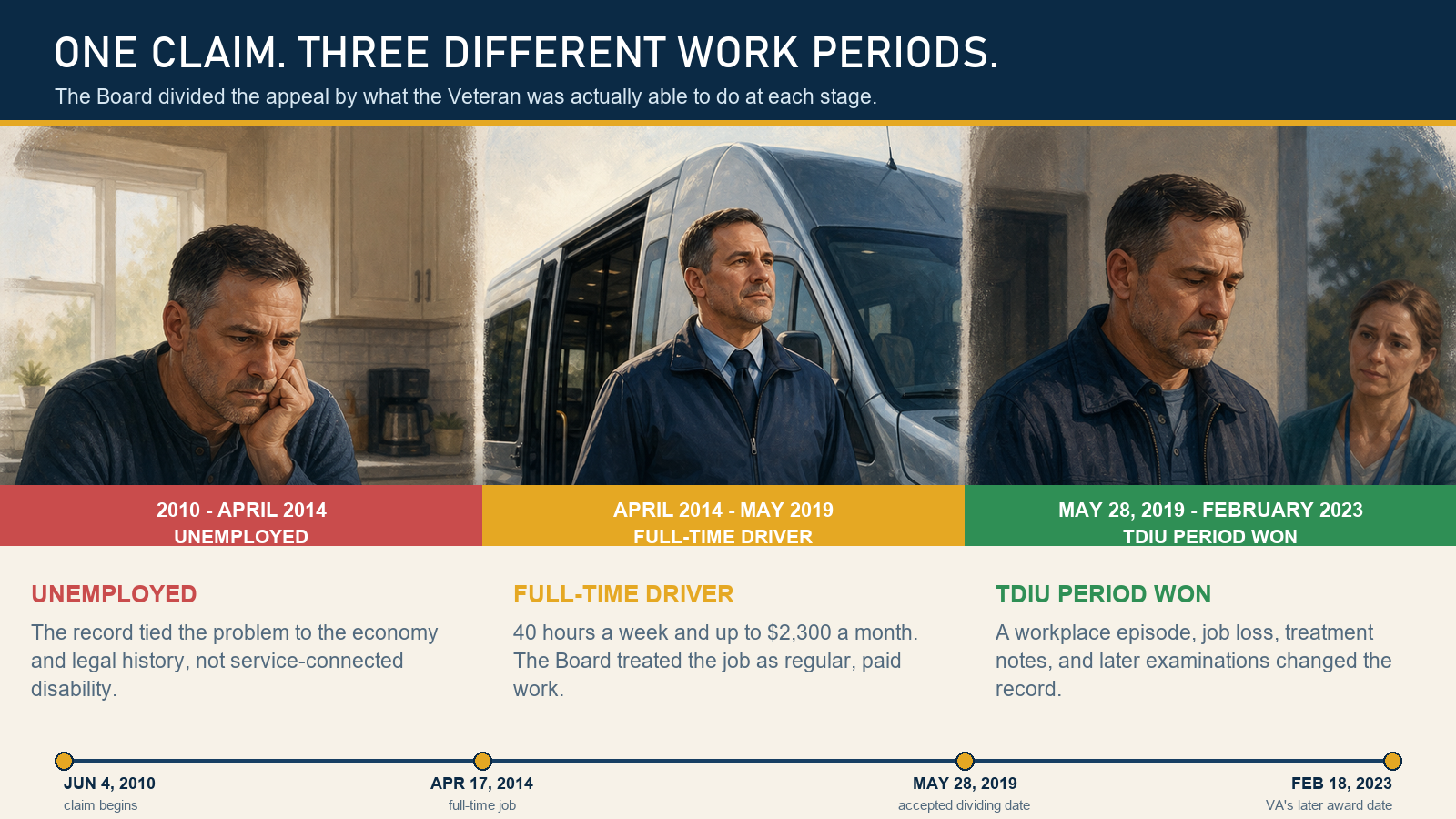
The Board addressed this gap in two parts. It denied TDIU from June 4, 2010, to May 28, 2019. Then, it granted TDIU from May 28, 2019, to February 18, 2023. In this case, the outcome turned on what the records showed during three different stages of the Veteran's working life. Citation 25004447.
Chapter 1: Unemployed, but not shown to be unemployable because of service-connected disabilities
From 2010 to April 2014, the Veteran was not working. But unemployment alone did not show that his service-connected disabilities prevented him from working.
The records showed he struggled to find work due to the economy and past legal issues. A December 2010 exam noted his psychiatric symptoms were mild at that time and did not stop him from job searching. So, the Board concluded that his unemployment was not due to his service-connected disabilities.
This distinction is important. TDIU isn't granted just because a Veteran is jobless. The key question is whether service-connected disabilities stop a veteran from regular work that pays more than a minimal income. The regulation refers to this as "substantially gainful employment."
Chapter 2: Five years of full-time work
The Veteran started as a driver for Wynne Transportation on April 17, 2014. He worked 40 hours a week and earned up to $2,300 a month.
His duties matched his previous transportation experience. There was no evidence that the employer or a family business protected his job through unusual accommodations. The pay was not low enough to classify the work as marginal. Therefore, the Board considered his employment from April 2014 to May 2019 as regular and adequately paid, despite his serious psychiatric condition and increasing rating.
Chapter 3: The event that changed the record
In April 2019, the Veteran had a flashback or dissociative episode at work and lost his driving job. Treatment records noted the episode, the job loss, and worsening work issues. Later exams revealed active psychotic episodes, trouble concentrating, intrusive thoughts, and flashbacks that severely impacted his work.
On his February 2023 VA Form 21-8940, he marked May 28, 2019, as the date he became too disabled to work. However, the same form showed employment through November 20, 2019, which created a conflict. The Board addressed this issue. It compared the form with treatment records that indicated he was unemployed by July 2019 and accepted May 28 as the more consistent date.
The conflict on the form did not harm the case, and the date on the form alone wasn't decisive. The Board evaluated it against the Veteran's work history, treatment records, and medical exams. May 28 stood out because those records aligned well enough to clarify when his job ended and his disability began preventing him from working.
The award did not automatically reach back to the claim
A long-running rating appeal can keep an earlier TDIU period active, even if the VA grants TDIU from a later date. That’s what happened here. The original claim set up the review period, but it didn’t show that the Veteran met TDIU requirements every day since 2010.
The Board looked at when the service-connected disabilities stopped the Veteran from keeping regular, adequately paid work. In the first period, unemployment was due to other reasons. Full-time work marked the second period. A documented workplace incident, job loss, and later medical findings changed the outcome for the third period.
The start date was not just a clerical note. It marked the point where the evidence shifted.
The hidden split appeared in roughly one in five denials
Out of 13,405 denied TDIU issues, 2,522 involved Veterans who had TDIU from one date but were denied for an earlier period. That's about one in five.
This is the hidden split. A decision may state "TDIU granted," yet years of the same appeal can still be denied. For the Veteran, the key question isn't just academic. It's whether the evidence supports moving the start date back by months or years.
A later TDIU award still left an earlier period denied in 2,522 of 13,405 denied TDIU issues.
Why the earlier years were denied
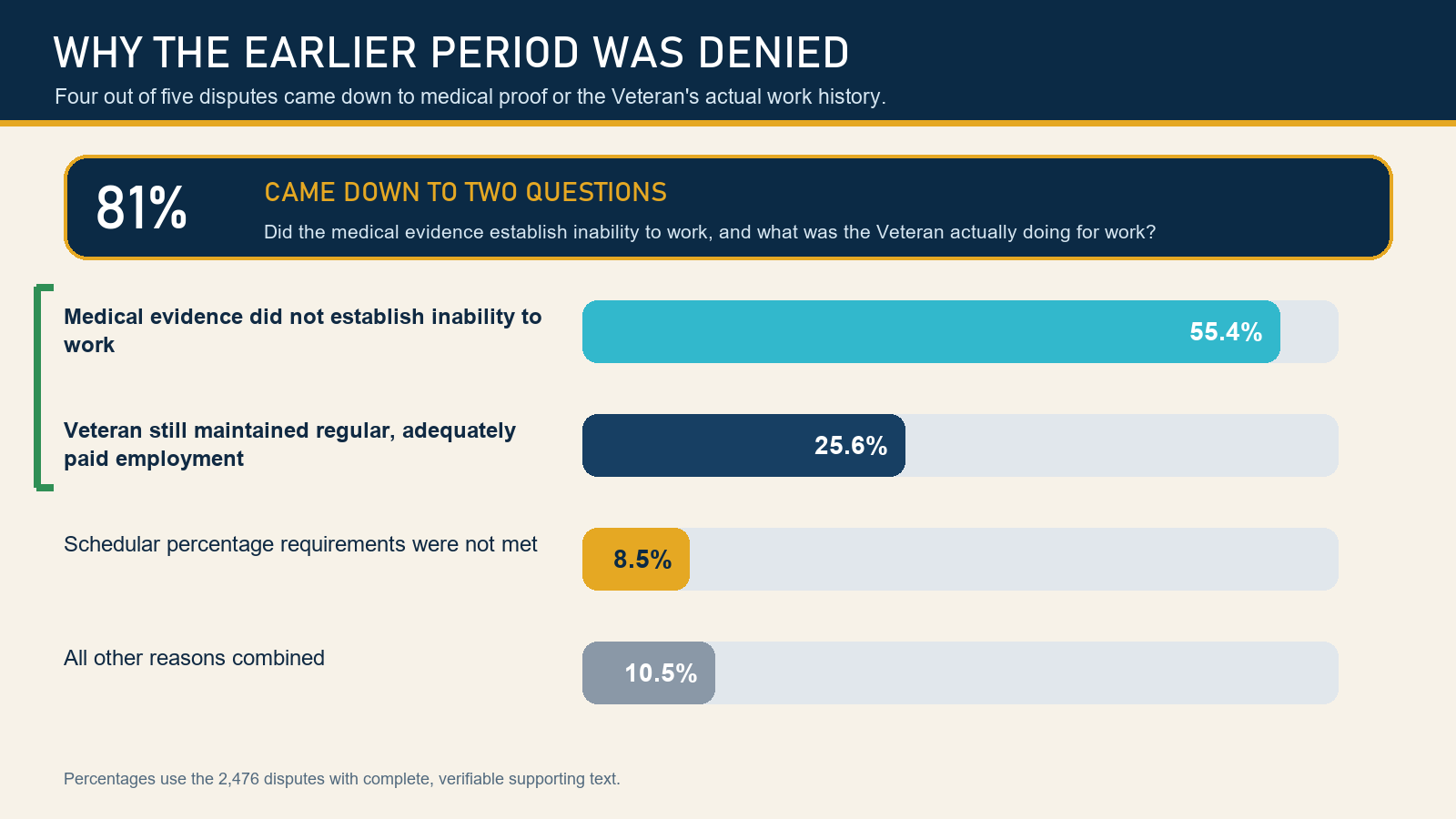
Four out of five earlier denials fell into two main groups.
The first group lacked medical proof. They didn’t show how service-connected disabilities stopped the Veteran from keeping a regular, adequately paid job. A diagnosis or high rating alone wasn’t enough. The records had to clarify what the disabilities limited and why those limitations made continued regular work no longer realistically sustainable.
The second group included Veterans still employed during the disputed time. The Board assessed whether their jobs were regular and adequately paid. They also considered if the jobs were marginal, protected, or only held through special concessions.
A smaller group failed because they hadn’t met the schedular percentage requirements. The key takeaway is clear: the start-date issue usually hinged on medical evidence and actual work history, not just the oldest date in the file.
Being out of work for years was still not enough
Another 2025 decision shows how severe the start-date fight can become. That Veteran had not worked since 2002. The Board still denied TDIU from August 2, 2002 through December 3, 2024 and granted it only from December 3, 2024. Citation 25009587.
The Board found that the earlier service-connected disability did not stop the Veteran from doing sedentary work based on their education and experience. This changed in December 2024, when new service-connected lower-extremity radiculopathies and recent exams updated the overall record.
The key point is not that twenty-two years outside the workforce meant nothing. Instead, the Board focused on a narrower question: did the service-connected conditions during that earlier time stop regular, adequately paid work? Time alone did not replace the need for a medical and vocational link.
On the other hand, a 2023 decision used a clear employment boundary. The Veteran worked full-time for the VA until August 31, 2012. TDIU began on September 1, 2012, the day after full-time work ended. The Board denied the earlier period because the record did not show the job was marginal. Citation 23065486.
Together, these cases show why there is no universal start-date shortcut. Sometimes the dividing line is the last day of full-time work. Sometimes it is a new examination, a newly service-connected disability, or another documented change in functional ability.
What most often set the awarded date
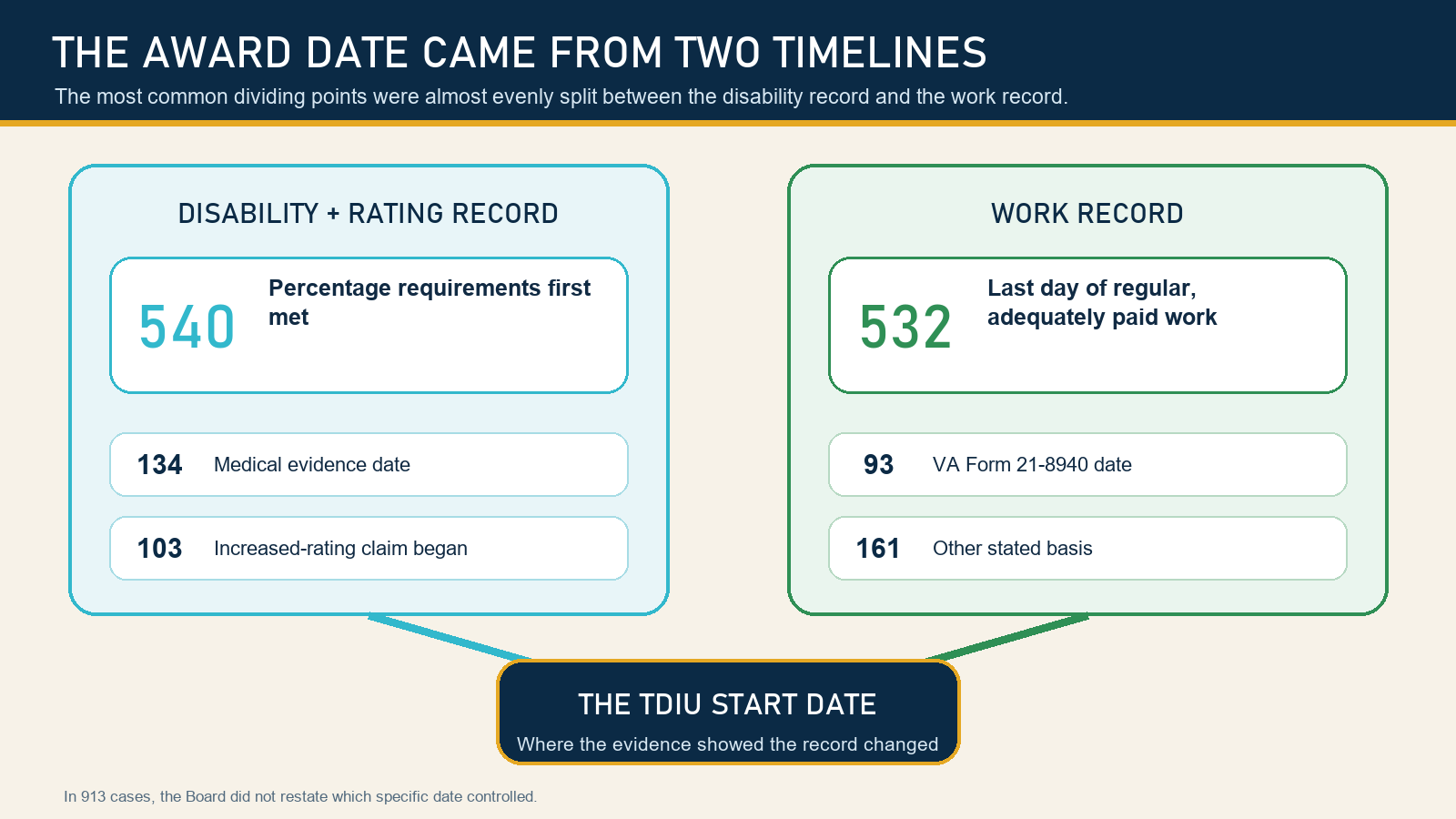
When the Board discussed the dividing point, two dates stood out: when the Veteran first met the schedular percentage requirements and the last day of regular work above a marginal level. These dates were nearly equal.
Other cases focused on a medical exam, the start of an increased-rating claim, or the date on VA Form 21-8940. This pattern highlights the human aspect of these cases. A TDIU start date often falls where two timelines intersect: the disability and rating record on one side, and the Veteran's work history on the other.
The Veteran's own work-history form mattered
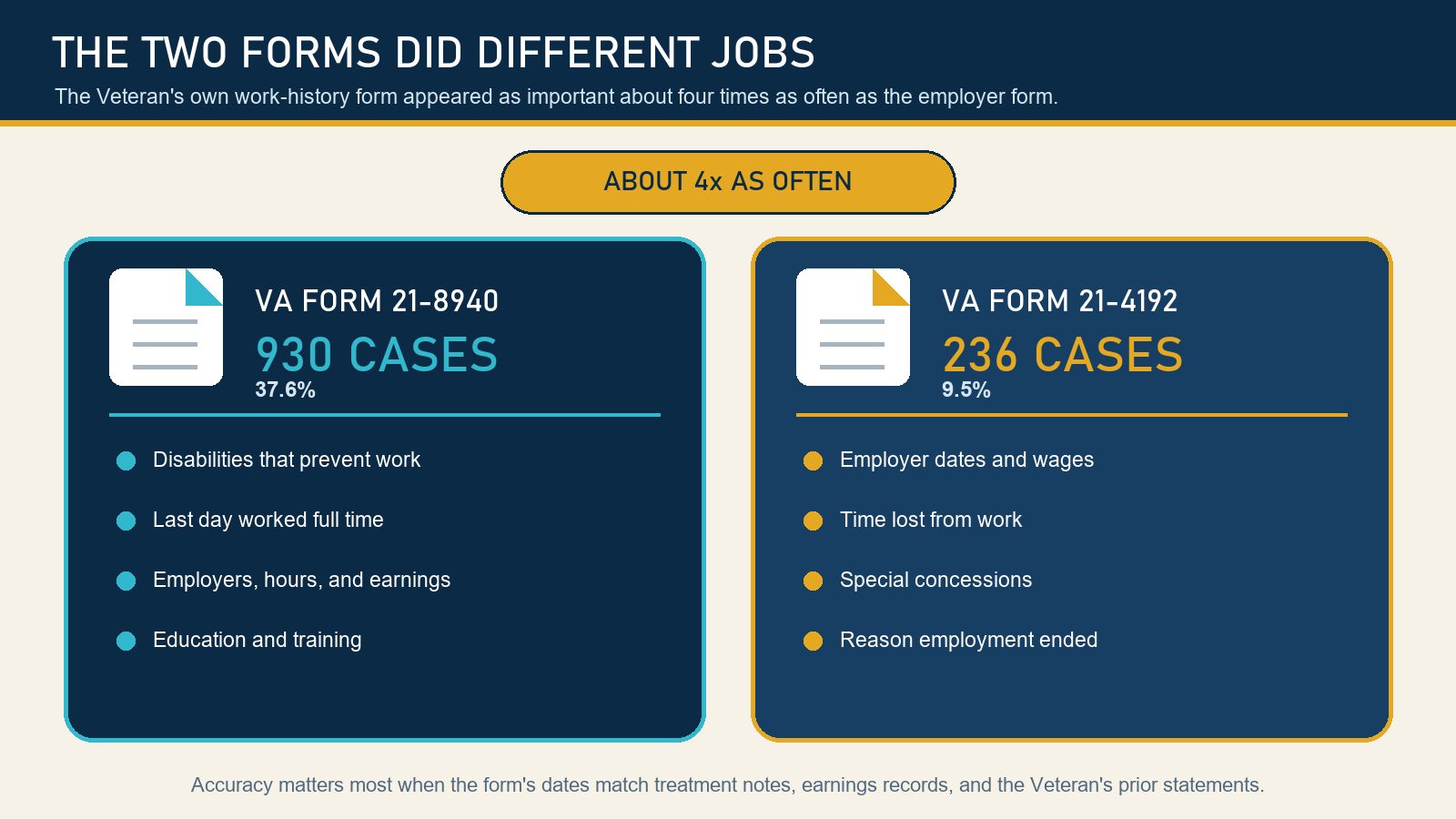
VA Form 21-8940 asks Veterans to list disabilities that prevent them from working. It also requires the date the disability impacted full-time work, the last day worked full time, employment history, earnings, education, and training. This form lets Veterans consolidate their work timeline into one record. The current form is available from the official VA Form 21-8940 page.
The Veteran's own form was marked as important about four times as often as the employer's VA Form 21-4192. The employer form is still useful. It can record dates worked, time lost, earnings, concessions, and reasons for job termination. The current form is available from the official VA Form 21-4192 page.
The difference makes accuracy crucial. A work date that clashes with treatment notes, tax records, or other statements can create a credibility issue. A date backed by records made at the time can form the backbone of the timeline, as seen in Citation 25004447.
Working did not always end the question
The research does not support a simple rule that any work defeats TDIU. Federal regulation says marginal employment is not substantially gainful employment. It also allows consideration of the nature of the job and why it ended. 38 CFR 4.16.
That is why the record often goes beyond a yes-or-no employment question. Details can decide the issue. How much did the Veteran earn? How many hours were worked? Was the job kept only because a family business or employer made special concessions? Did the Veteran miss work often, leave early, receive reduced duties, or lose the job due to service-connected symptoms?
These facts help separate regular, adequately paid work from jobs that may be marginal or done in a protected environment. The job title alone does not provide a clear answer.
What a strong start-date record makes visible
The decisions point to a practical timeline, not a magic sentence. A clear record should make five things easy to find:
- The service-connected disabilities involved. Identify which conditions prevented the Veteran from maintaining regular, adequately paid work during the disputed period.
- The actual work history. List employers, dates, hours, earnings, duties, absences, concessions, and why each job ended.
- The functional change. Show what the conditions prevented the veteran from doing before and after the proposed dividing date.
- The medical support. Connect symptoms and limitations to the ability to secure or follow work, using the Veteran's actual history rather than a general statement about the diagnosis.
- A consistent date. Reconcile VA Form 21-8940, employer information, treatment records, Social Security records when relevant, and prior statements.
The goal is not to manufacture a date. It is to show when service-connected disabilities made regular, adequately paid work no longer realistically sustainable. That is the factual question behind the legal phrase "substantially gainful employment."
What we searched
We searched the production RateMyVSO Board research corpus for denied TDIU issues decided during complete calendar years 2021 through 2025. That produced 13,405 issues across 13,203 decisions.
We counted a start-date dispute when the same decision both awarded TDIU from one date and denied it for an earlier period. That produced 2,522 confirmed disputes. Partial-year 2026 data was not included.
How we counted
The unit of analysis was one TDIU issue, not one Veteran. A single Board decision can contain more than one issue, so decision counts and issue counts are not interchangeable.
The detailed findings use 2,476 disputes with complete, verifiable supporting text. We also hand-checked a sample of the classifications before using the results. The full extraction, validation, and quality-control details remain available in the research files for anyone who wants to audit the work.
What this research means
The hidden TDIU fight often begins after the words “TDIU granted.” The next question is whether the VA selected the right date.
Citation 25004447 shows the stakes clearly. The Veteran's claim reached back to 2010. His TDIU did not. The Board found one period of unemployment tied to nonservice factors, followed by five years of regular full-time work. Only after a documented workplace episode, job loss, and supporting medical evidence did the record establish the dividing point the Board accepted.
The broader data shows that this was not unusual. Roughly one in five denied TDIU issues involved an earlier period left behind by a later award. Most of those earlier periods turned on the same two questions.
- Did the medical record show that service-connected disabilities prevented work?
- What was the Veteran actually doing for work at the time?
The original claim date may open the door to review. The evidence still has to show when service-connected disabilities made regular, adequately paid work no longer possible. That date can control years of benefits.
Questions veterans commonly ask
If the VA grants TDIU, does it automatically go back to the original claim date?
No. The earlier period can remain disputed. The record must show that service-connected disabilities prevented regular, adequately paid work during that earlier period.
Is being unemployed enough to establish TDIU?
No. The reason for unemployment matters. The evidence must connect the inability to obtain or keep regular, adequately paid work to service-connected disabilities.
Does working automatically defeat TDIU?
Not always. Marginal employment is not considered substantially gainful under 38 CFR 4.16. Earnings, hours, job duties, concessions, and the nature of the work can matter.
Why is VA Form 21-8940 important?
It puts the Veteran's disability and work timeline in one place. Its dates and employment details should match treatment records, earnings information, employer records, and the Veteran's prior statements.
What if an employer will not complete VA Form 21-4192?
The employer form is useful, but it is not the only evidence of employment history. Pay records, tax records, leave records, personnel documents, treatment notes, statements, and the Veteran's own form may help document the timeline. The VA's current instructions should be checked for the claim at issue.
Illustrative Board decisions
These decisions show three recurring ways the Board drew the line between the denied period and the awarded period.
| Citation | Year | TDIU outcome relevant to this article | Official source |
|---|---|---|---|
| 25004447 | 2025 | Denied from June 4, 2010 to May 28, 2019; granted from May 28, 2019 to February 18, 2023 | VA decision |
| 25009587 | 2025 | Denied from August 2, 2002 to December 3, 2024; granted from December 3, 2024 | VA decision |
| 23065486 | 2023 | Earlier period denied through the last day of full-time work; TDIU effective September 1, 2012 | VA decision |
Primary sources and research files
- 38 CFR 4.16, Total disability ratings for compensation based on unemployability of the individual
- VA Form 21-8940, Veteran's Application for Increased Compensation Based on Unemployability
- VA Form 21-4192, Request for Employment Information in Connection with Claim for Disability Benefits
- Internal research summary:
docs/research/TDIU-START-DATE-RESEARCH-SUMMARY-2026-08-17.md - Detailed reason findings:
docs/research/TDIU-START-DATE-REASONS-FINDINGS-2026-08-16.md - Issue-level accepted results:
docs/research/TDIU-START-DATE-REASONS-ISSUE-LEVEL-2026-08-16.csv - Lead-story verification:
docs/research/TDIU-START-DATE-LEAD-HUMAN-STORY-VERIFICATION-2026-08-17.md
Research completed: August 16, 2026 Lead decision independently verified: August 17, 2026