How to File a Board (BVA) Appeal
This guide walks you through appealing a VA decision to the Board of Veterans' Appeals (BVA), where a Veterans Law Judge reviews your case. You will learn what the appeal form is, the three Board dockets and how to pick one, the 1-year deadline, exactly where and how to submit, what happens after you file, and how to tell whether the Board is the right lane for your situation or whether a Higher-Level Review or Supplemental Claim is the better move.

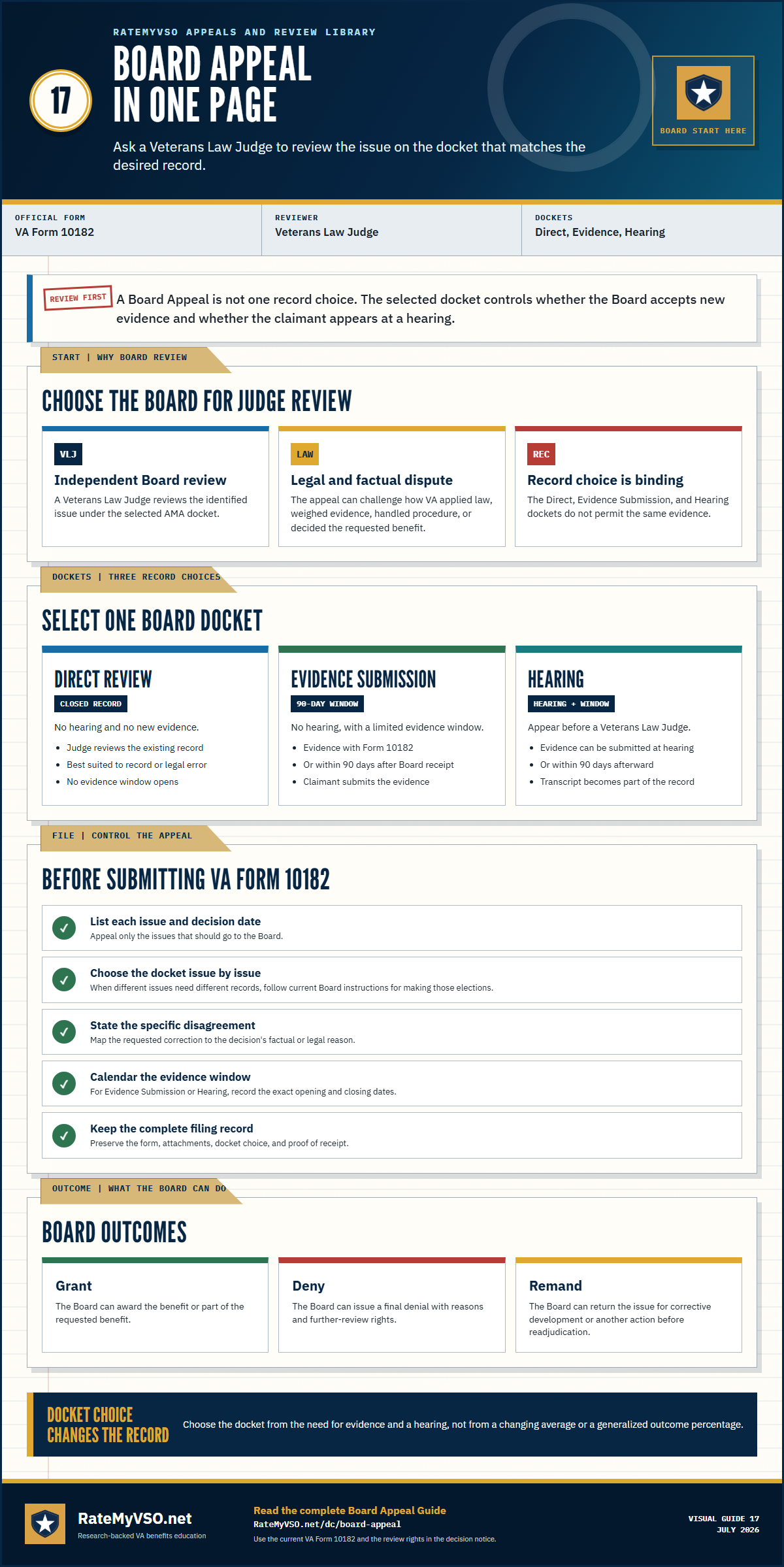 One-page guide: Board Appeal in One Page
Board Appeal in one page explaining judge review, the three Board dockets, Form 10182 filing controls, and grant, denial, and remand outcomes. Opens the full-size chart, free to save or print.
One-page guide: Board Appeal in One Page
Board Appeal in one page explaining judge review, the three Board dockets, Form 10182 filing controls, and grant, denial, and remand outcomes. Opens the full-size chart, free to save or print.
First: Is the Board the Right Lane?
For any VA decision dated February 19, 2019 or later, you have three ways to challenge it. The Board is one of them. Picking the right lane is the most important decision you will make, because the lanes accept different things and move at very different speeds.
Supplemental Claim
You give the VA new and relevant evidence it has not seen: a nexus letter, new records, buddy statements. Filed on Form 20-0995. Often the fastest fix. Supplemental Claim guide →
Higher-Level Review
A senior reviewer re-reads the same evidence and looks for a mistake. No new evidence. Filed on Form 20-0996, with an optional informal phone conference. HLR guide →
Board Appeal (this guide)
A Veterans Law Judge at the Board reviews your case. You can choose to add evidence or testify at a hearing. Filed on Form 10182. The most thorough review, and the slowest.
Want all five AMA lanes compared side by side, including the two Veterans Benefits Administration lanes and the three Board dockets? See the Which VA Appeal to File overview.
What a Board Appeal Is
A Board appeal asks the Board of Veterans' Appeals, a part of VA that is separate from the regional office that decided your claim, to review your decision. Your case is decided by a Veterans Law Judge (VLJ), an attorney-judge who reviews VA decisions full time. Because the judge is independent of the office that issued the denial, the Board is the lane veterans choose when they want a fresh, senior set of eyes on a decision they believe is wrong.
You start a Board appeal by filing VA Form 10182, "Decision Review Request: Board Appeal (Notice of Disagreement)." That single form replaces the old two-step legacy process (see Legacy Appeals below). On the form you also choose one of three dockets, which decide whether you can add evidence and whether you get a hearing.
- Who can file: the veteran, or a surviving spouse, child, or parent pursuing the claim, or an accredited representative acting for them.
- What it reviews: a decision you disagree with. A Board appeal does not start a brand-new claim for a condition you never filed for.
- Possible results: the Board can grant the benefit, deny it, or remand it (send it back to the regional office to fix a problem, such as a missing exam, before deciding again).
The Three Board Dockets
When you file Form 10182 you must pick one of three dockets. They differ on one thing above all: whether you can add new evidence, and whether you get a hearing. That choice also drives how long the appeal takes.
| Board docket | Direct Review | Evidence Submission | Hearing |
|---|---|---|---|
| Can you add new evidence? | No | Yes, with the appeal or within 90 days of filing | Yes, at the hearing or within 90 days after it |
| Is there a hearing? | No | No | Yes, with a Veterans Law Judge |
| Who decides? | A Veterans Law Judge | A Veterans Law Judge | A Veterans Law Judge |
| VA decision goal | 365 days | 550 days | 730 days |
| Best when | The record is already complete and you are arguing the VA got it wrong on what is on file. | You have new evidence to add but do not need to testify. | You want to explain your case to the judge in person, by video, or by phone. |
Swipe the table sideways to see all three dockets.
The "VA decision goal" is the Board's target, not a guarantee. Actual waits run longer and shift over time; the Hearing docket is consistently the slowest. See live figures on Board appeal wait times and the monthly Appeals Pulse. Source: VA.gov Board Appeals; the per-docket evidence rules are set in 38 CFR 20.301 to 20.303.
When the Board Is the Right Choice
A Board appeal fits when one or more of these is true:
- You want a judge to decide. A Veterans Law Judge is more senior than a regional-office rater and is independent of the office that denied you.
- You believe the VA made a legal or factual error on evidence that is already in the file, and you want to argue it (the Direct Review docket is built for this).
- You want to testify about your symptoms, your service, or your history (the Hearing docket).
- You have new evidence and also want a judge (the Evidence Submission or Hearing docket lets you add it).
- A Higher-Level Review or Supplemental Claim already failed and you want the next level of review.
- You are within one year of the decision you are challenging.
When NOT to File a Board Appeal
- You have new evidence and just want it considered. A Supplemental Claim (Form 20-0995) is typically faster, can be filed at any time, and is designed for new and relevant evidence.
- You think the reviewer made a clear mistake, you have no new evidence, and you do not need a judge. A Higher-Level Review (Form 20-0996) is faster, keeps the same evidence, and includes an optional informal conference.
- You want the fastest possible result. Every Board docket is slower than the regional-office lanes, and the Hearing docket is the slowest option of all.
- More than one year has passed since the decision. The Board and Higher-Level Review deadlines have closed. A Supplemental Claim can still be filed, though the effective date may change. See Effective Dates →
- It is a brand-new condition you never claimed. That is an original claim, not an appeal. File the claim first.
How to File: Step by Step
Check your deadline
You have 1 year from the date on your decision letter to file a Board appeal (38 CFR 3.2500). Contested claims are the exception: those must be filed within 60 days. Miss the window and the Board lane closes, so file early if you are unsure.
Get VA Form 10182
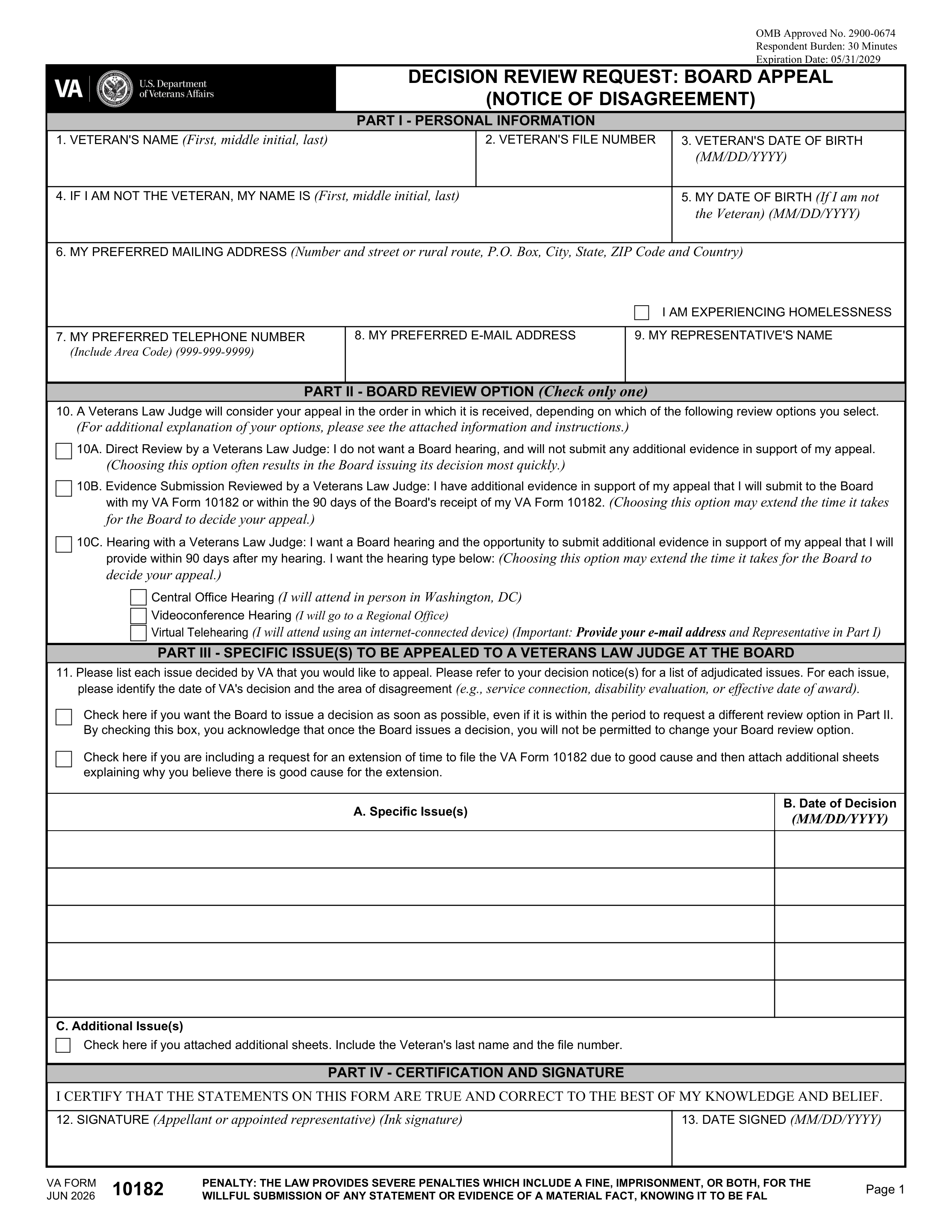
Download "Decision Review Request: Board Appeal (Notice of Disagreement)" at va.gov/forms/10182, or start it online (see step 5). A VSO representative can complete it with you at no charge. Find a VSO rep →
List the issues you are appealing
On the form, identify each issue from the decision you disagree with and the date of that decision. You can appeal one issue or several. Anything you leave off is not part of the appeal.
Choose one docket
Pick Direct Review (no new evidence, no hearing), Evidence Submission (add evidence within 90 days, no hearing), or Hearing (testify before a judge). See the docket table above. You can choose only one.
Submit it
File online, by mail, by fax, or in person at a VA regional office. The exact addresses and numbers are in the next section.
Keep proof and track it
Save a copy of the completed form and your submission confirmation. If you mailed it, the postmark date is what counts. You can check status later by phone or through your VA.gov account.
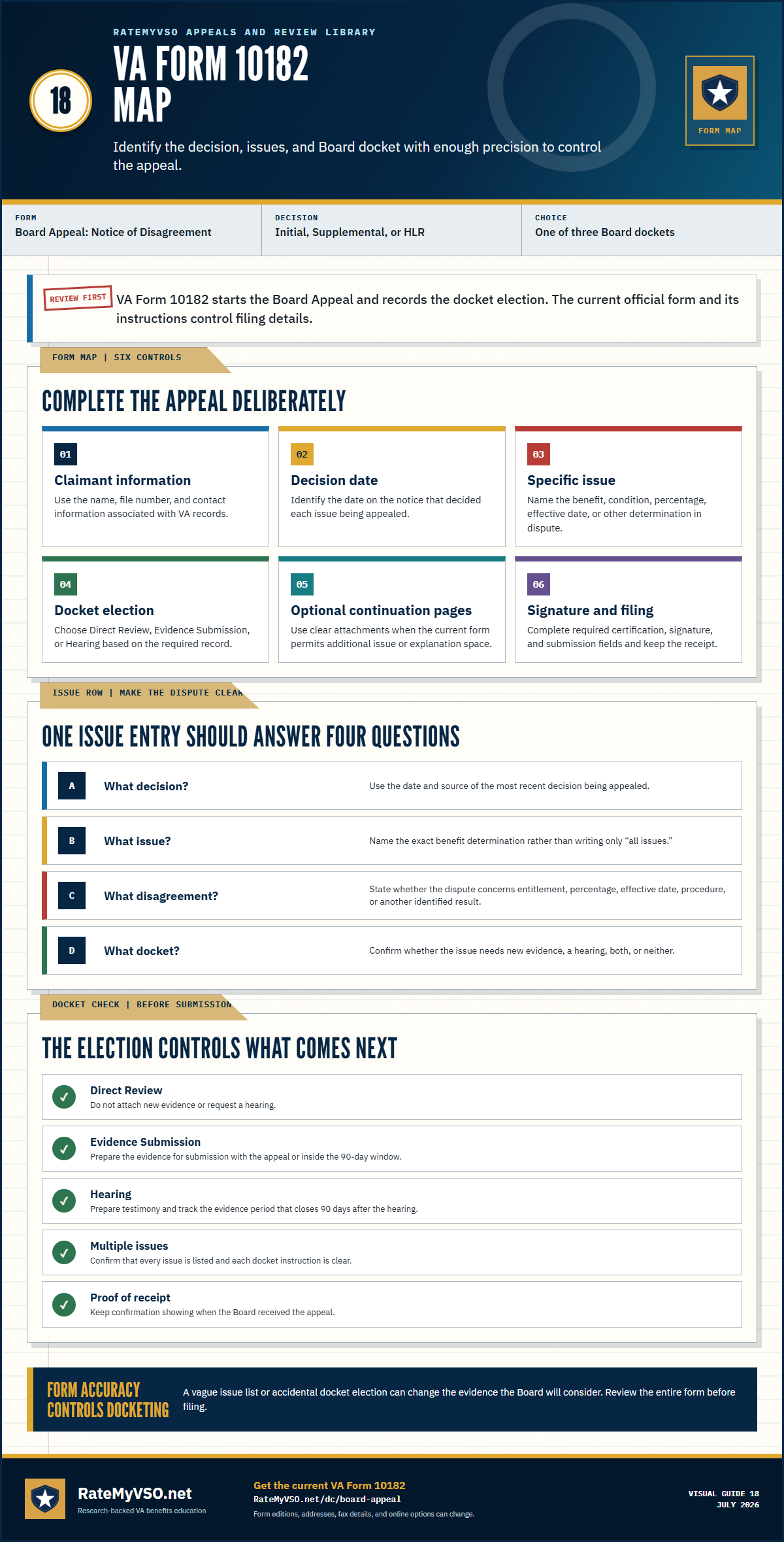
Where and How to Submit Form 10182
VA accepts the Board appeal four ways. Online is the most reliable and gives you an instant confirmation.
Official submission methods
- Online
- Request a Board Appeal on VA.gov → (sign in, complete, and submit; preferred)
- By mail
- Board of Veterans' Appeals
PO Box 27063
Washington, DC 20038 - By fax
- 844-678-8979 (confirm the current fax number printed on the form you download before sending)
- In person
- Bring the completed form to any VA regional office. Find a VA location →
- Phone (help & status)
- 800-827-1000 (TTY: 711), Monday to Friday, 8:00 a.m. to 9:00 p.m. ET
Do not email your appeal. VA does not accept Form 10182 by email; the Board's email line is for status questions only, not for filing.
What Happens After You File
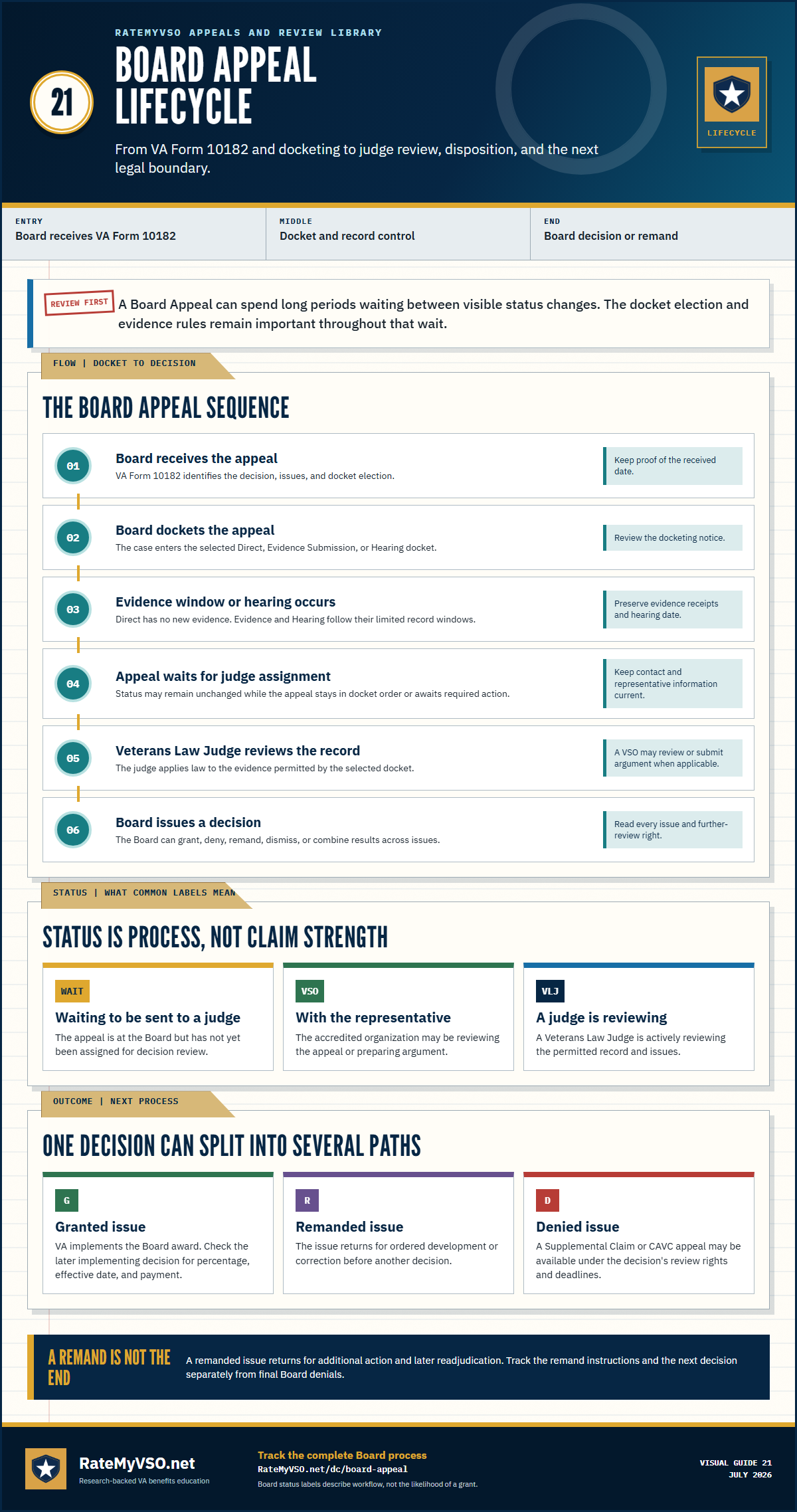
- Docketing. The Board logs your appeal and places it in line on the docket you chose. Cases are generally decided in the order received within each docket.
- The wait. This is the long part, and the docket matters. VA's monthly all-inventory report, which includes non-veteran matters such as VHA contract appeals, currently shows average days pending of 471 days for Direct Review, 688 days for Evidence Submission, and 833 days for Hearing. These figures measure the age of appeals that are still open. They do not predict when a decision will arrive, and they are not comparable to the Board's separate goals for completing decided appeals. See Choosing a Board docket for the veterans-and-dependents-only breakout, and Board appeal wait times for decided-case history.
- Evidence window. If you chose Evidence Submission, get your new evidence in within 90 days of filing. If you chose Hearing, you can add evidence at the hearing or within 90 days after it. On Direct Review, the record is closed to new evidence.
- Hearing scheduling. If you chose the Hearing docket, the Board notifies you of the date and format (video, virtual, or in person). See the Board Hearing guide to prepare.
- The decision. A Veterans Law Judge issues a written decision that grants, denies, or remands each issue. A remand sends the issue back to the regional office to fix something (often a new exam) and then return it to the Board.
Common Mistakes Filing Form 10182
- Not picking a docket: The form requires choosing one of the three dockets (Direct Review, Evidence Submission, Hearing). Leaving it blank causes processing delays while the Board follows up.
- Choosing Hearing without wanting one: The Hearing docket has the longest wait. Pick it only if you actually want to testify, not as a default.
- Sending new evidence on the Direct Review docket: Direct Review closes the record to new evidence. Evidence sent anyway is not considered under that docket.
- Missing the 1-year deadline (60 days for contested claims): Filed even one day late can close the Board lane for that decision.
- Leaving an issue off the form: Only the issues explicitly listed on Form 10182 are part of the appeal. An issue you meant to include but did not list is not appealed.
- Emailing the form: VA does not accept Form 10182 by email. Use online, mail, fax, or in person.
Legacy Appeals (Decisions Before February 19, 2019)
Everything above is the modern AMA process, which covers VA decisions dated February 19, 2019 or later. If your decision is older and you did not opt into the modern system, you are in the legacy appeal process, which works differently:
- You file a Notice of Disagreement first.
- VA then issues a Statement of the Case.
- You complete the appeal with a Substantive Appeal on VA Form 9 ("Appeal to Board of Veterans' Appeals").
That two-step path is replaced under AMA by the single Form 10182. If you are unsure which system your decision falls under, the VA legacy appeals page explains the difference, and a VSO representative can confirm it for you.
Related Tools and Guides
Sources: VA.gov Board Appeals · VA Form 10182 · Board of Veterans' Appeals contact · 38 CFR 3.2500 · 38 CFR Part 20 · VA legacy appeals. Contact details verified against VA.gov on 2026-06-25. This guide is for educational purposes only and is not legal advice. Find a VSO representative for help with your specific appeal.