Three Doors at the Board
Veterans appealing to the Board pick one of three dockets. We measured how 13,157 unemployability issues ended in each, and what each one costs in waiting.
Abstract
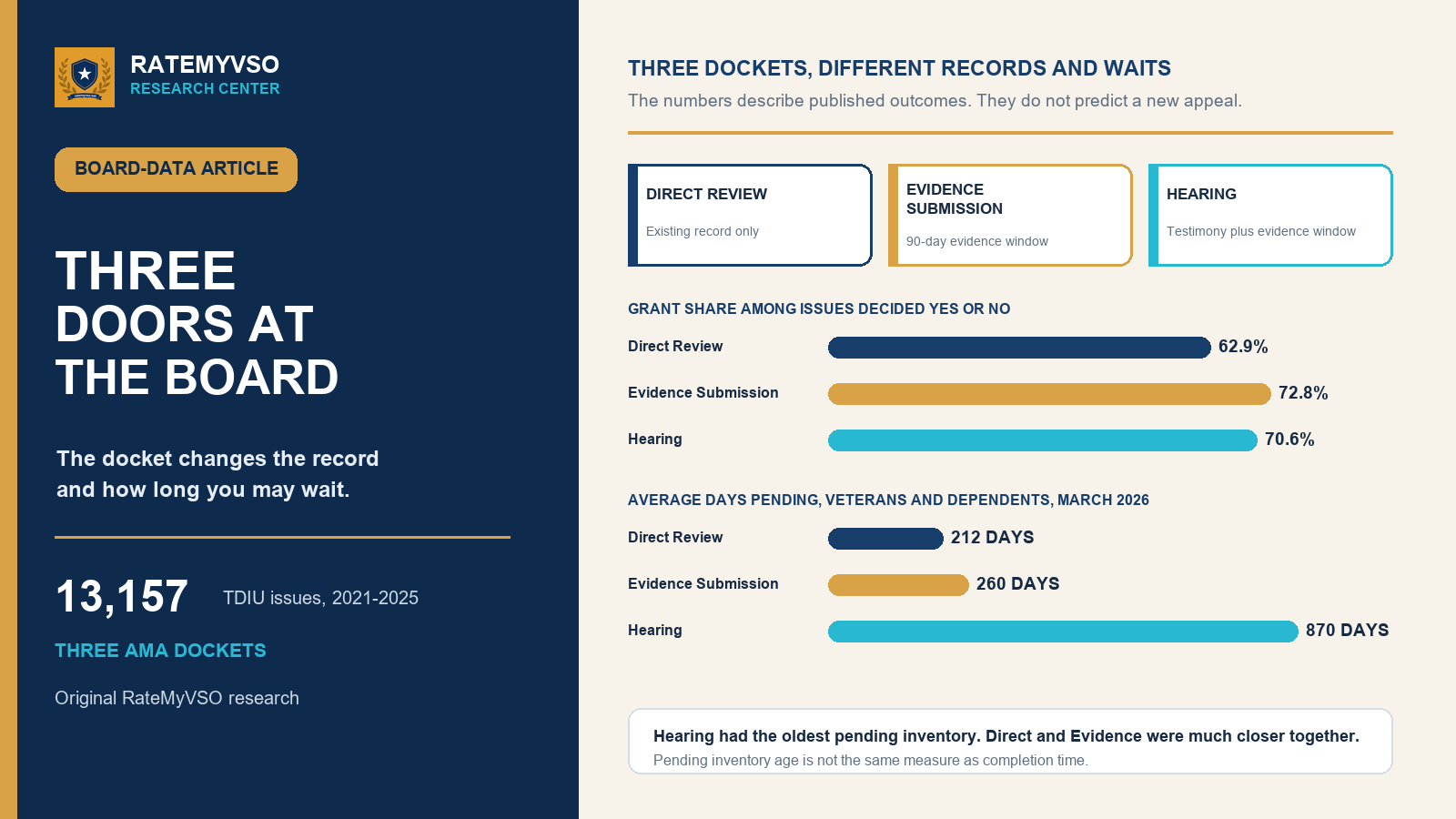
Veterans using the modernized Board appeal system choose one of three dockets on VA Form 10182: Direct Review, Evidence Submission, or Hearing. We examined 13,157 TDIU issues extracted from published Board decisions from 2021 through 2025 whose decisions carried one of those docket labels, drawn from a corpus of 1.9 million decisions. Among issues that ended in either a grant or a denial, the grant share was 62.9 percent in Direct Review, 72.8 percent in Evidence Submission, and 70.6 percent in Hearing. Remand shares were closer together, 35.3 to 38.9 percent. These are descriptions of how issues ended, not predictions: veterans choose their own docket, so the groups differ before the Board ever rules, and one decision can contribute more than one TDIU issue. The Board separately publishes how long appeals have been waiting in each docket, and those figures differ sharply, but they measure the age of pending inventory rather than how long a new appeal will take.
Highlights
- A difference in merits outcomes. Among TDIU issues that ended in a grant or a denial, the grant share was 62.9 percent in Direct Review, 72.8 percent in Evidence Submission, and 70.6 percent in Hearing.
- Most issues do not end in either box. Remands ran 35.3 to 38.9 percent, and dismissals or other outcomes another 8.7 to 13.4 percent.
- The difference shows up in every year from 2022 through 2025. Its size varies year to year.
- Denials and dismissals both differ. Direct Review has the highest denial share at 19.4 percent; Hearing has the highest dismissal share at 13.4 percent.
- Direct Review's remand share rose from 28.5 percent of its TDIU issues in 2021 to 42.0 percent in 2025.
- Waiting differs by docket, but not the way the raw inventory number suggests. For veterans and dependents specifically, the Board reported 212 average days pending in Direct Review, 260 in Evidence Submission, and 870 in Hearing at the end of March 2026.
- Selection, not causation. Veterans pick their own docket. This data cannot show that the docket caused the difference, and it does not predict any individual appeal.
Every veteran who appeals to the Board of Veterans' Appeals picks a docket on VA Form 10182. There are three. Direct Review means the Board decides on the record the agency already has. Evidence Submission gives you 90 days to send new evidence. Hearing means you testify before a Veterans Law Judge, and evidence may follow.
The form does not tell you how issues in the three dockets have ended. We looked at 13,157 individual unemployability issues decided between 2021 and 2025 to find out.
They did not end the same way.
The merits gap
Here is every TDIU issue decided in one of the three dockets from 2021 through 2025.
| Docket | TDIU issues | Granted | Denied | Remanded | Dismissed or other | Grant share among grant-or-deny outcomes |
|---|---|---|---|---|---|---|
| Direct Review | 5,921 | 32.9% | 19.4% | 38.9% | 8.7% | 62.9% |
| Evidence Submission | 3,636 | 38.8% | 14.5% | 37.8% | 9.0% | 72.8% |
| Hearing | 3,600 | 36.3% | 15.1% | 35.3% | 13.4% | 70.6% |
The last column narrows the comparison to issues the Board answered yes or no. It leaves out remands, dismissals, and a handful of other outcomes. That makes it a merits comparison, not a share of everything the Board did.
Read that way, Direct Review granted 63 of every 100 TDIU issues it decided on the merits. Evidence Submission granted 73. Hearing granted 71.
The gap appears in every year from 2022 through 2025, though its size moves around from year to year. The 2021 figures rest on 119 to 221 issues per docket and are directional only.
Remand shares are similar; denials and dismissals are not
It would be reasonable to guess that the two evidence-bearing dockets simply push more cases into remand, moving them out of the denial column without winning anything. The counts do not support that. Remand shares sit in a fairly narrow band, 35.3 to 38.9 percent, with Hearing the lowest of the three.
The dockets separate on the other two outcomes. Direct Review has the highest denial share, 19.4 percent against 14.5 and 15.1. Hearing has the highest dismissal share, 13.4 percent against 8.7 and 9.0. Both facts matter, and the second is easy to miss: a dismissal removes an issue from the merits denominator, so part of the Hearing docket's strong merits number reflects issues that never reached a merits answer at all.
What this looks like in three decisions
Aggregates hide the mechanism. Here are three 2025 decisions, one from each docket. All are published, and all are linked in the table below.
Evidence Submission, granted. In A25041973, the veteran elected the Evidence Submission docket on his September 2021 Form 10182. That same month, two things arrived: a statement from his wife describing his PTSD symptoms and what his working life had been like, and a private examination finding total occupational and social impairment. The Board granted TDIU based on PTSD. The decision is also explicit about the docket's limits, telling the veteran that evidence the Board could not consider could still support a Supplemental Claim.
Hearing, granted. In A25007881, the veteran testified at a September 2024 Board hearing, describing mood instability, losing his temper, and isolating himself from people including his family. The Board granted TDIU based on PTSD. The grant rested on the combined record, testimony together with treatment records and medical opinions including material received in the post-hearing window, not on testimony by itself.
Direct Review, single-disability TDIU denied. In A25003258, the veteran already had TDIU based on the combined effects of his service-connected disabilities. The narrower question was whether major depressive disorder alone supported TDIU, which matters for special monthly compensation. On the closed Direct Review record, the Board said no. This is not an example of a veteran losing all TDIU entitlement, and it is worth knowing that this kind of narrower question is common in TDIU appeals.
Three decisions prove nothing on their own, and they are not offered as proof. They show what the underlying paperwork looks like.
One shift inside Direct Review
Direct Review is the docket chosen for speed. Its remand share has climbed.
| Year | Remand share |
|---|---|
| 2021 | 28.5% |
| 2022 | 34.9% |
| 2023 | 30.6% |
| 2024 | 39.4% |
| 2025 | 42.0% |
In 2025, more than four in ten Direct Review TDIU issues ended in a remand. A remand is neither a grant nor a denial. The Board sends the issue back for correction and readjudication. Under the modernized system it does not automatically come back to the Board; if the veteran disagrees with the new agency decision, another review request is generally required.
Waiting: what the published numbers do and do not say
Waiting differs by docket. Getting this right matters, because the obvious number is the misleading one.
The monthly performance report shows average days pending of 471 for Direct Review, 688 for Evidence Submission, and 833 for Hearing as of May 31, 2026. Those figures cover everything on the Board's docket. The Board explains why that is the wrong number for a veteran: a large batch of VHA third-party contract provider appeals was moved onto its docket, which "primarily impacted the AMA Direct and Evidence dockets," and it is separating those from "Veteran, dependent, and beneficiary-related appeals."
For veterans and dependents specifically, the Board reported these figures at the end of March 2026.
| Docket | Average days pending |
|---|---|
| Direct Review | 212 days |
| Evidence Submission | 260 days |
| Hearing | 870 days |
That changes the picture in both directions. The distance between Direct Review and Evidence Submission is far smaller than the raw report implies, and the distance to the Hearing docket is far larger.
Two cautions belong with these numbers. They describe how long appeals still waiting have been waiting, at one moment in time. They are not the average time to a decision, and they are not a forecast for an appeal filed today. They also cover all appeal types, not TDIU specifically.
Days pending is not the same as the Board's published goals
The Board carries a timeliness goal for each docket, and those goals are easy to line up against the wrong number. They are average days to complete (ADC) goals, which measure a finished appeal from Notice of Disagreement to decision: 365 days for Direct Review, 550 for Evidence Submission, 730 for Hearing. Average days pending measures something else entirely, the age of appeals that have not been decided yet. The Board's FY 2024 Annual Report devotes a section to the two being confused, noting the goals "continue to be misunderstood by many." A pending figure should never be scored against a completion goal.
On the matching measure, the Board reported average days to complete of 937 for Direct Review, 1,028 for Evidence Submission, and 1,091 for Hearing in FY 2024, well above every goal. It has since reported that completion times for the Direct and Evidence dockets have crested and settled back within their published goals.
So the safe statement is a narrow one. The Hearing docket currently carries a much older pending inventory than the other two, while Direct Review and Evidence Submission sit far closer together than the headline inventory number suggests.
What this does not say
This describes how issues ended. It does not show that choosing a docket caused an outcome, and it is not a recommendation.
Dockets are not assigned at random. A veteran who elects Evidence Submission generally has something to submit. A veteran who requests a hearing generally has something specific to say. The two groups may also differ in ways nobody can see in a published decision, including how strong the record already was before the appeal was filed.
The docket label also proves less than it might appear to. It shows which docket the decision identifies. It does not prove that new evidence was in fact submitted in an Evidence Submission case, that a hearing was actually held in every Hearing-docket case, or that anything admitted through a docket changed the result.
Nothing here predicts an individual claim.
What we searched
- The corpus: roughly 1.9 million published Board decisions, decision years 1992 through 2026, holding roughly 4.2 million extracted issues. This is our own copy of the published record, and it is rebuilt weekly, so the totals move.
- Narrowed to the question: 182,634 extracted issues carry the individual-unemployability claim type. 74,848 of those were decided from 2021 through 2025, inside 549,535 decisions from those years.
- Analyzed here: the 13,157 of those TDIU issues whose parent decision carries one of the three docket labels. The rest are legacy-era appeals or decisions whose docket could not be identified, and they are excluded rather than folded in.
How we counted
- The unit is an extracted issue, not a veteran, an appeal, or a decision. One decision can contribute more than one TDIU issue, including a denial for one period and a grant for another. The percentages are descriptive and make no statistical adjustment for several issues arriving from the same decision.
- Two denominators, kept apart. Grant, deny, remand and dismissal percentages use all outcomes as the denominator. The merits column divides grants by grants plus denials.
- Docket labels come from the docket type recorded on each decision. As a check, 86 percent of decisions in the Hearing docket also carry a separate hearing-held flag, against 7 percent in Direct Review.
- 2026 is excluded. Our corpus runs into early August 2026 and docket labeling for that year is incomplete.
- Wait figures are the Board's, not ours, and cover all appeal types rather than TDIU alone.
- Cited decisions were verified against the published VA text, and each file's size matches the character count stored in our corpus, so the decision analyzed and the decision linked are the same document.
Decisions cited
| Decision | Docket | Outcome |
|---|---|---|
| A25041973 | Evidence Submission | TDIU granted |
| A25007881 | Hearing | TDIU granted |
| A25003258 | Direct Review | Single-disability TDIU denied |
Waiting figures for veterans and dependents come from the Board of Veterans' Appeals page on how appeal type influences wait times, with data through March 2026. The all-inventory figures come from the monthly AMA performance report, file date May 31, 2026. The timeliness goals and the average-days-to-complete figures come from the Board of Veterans' Appeals FY 2024 Annual Report.