One Opinion, Decided
What 20 recent Board outcomes show about sleep apnea secondary to PTSD.
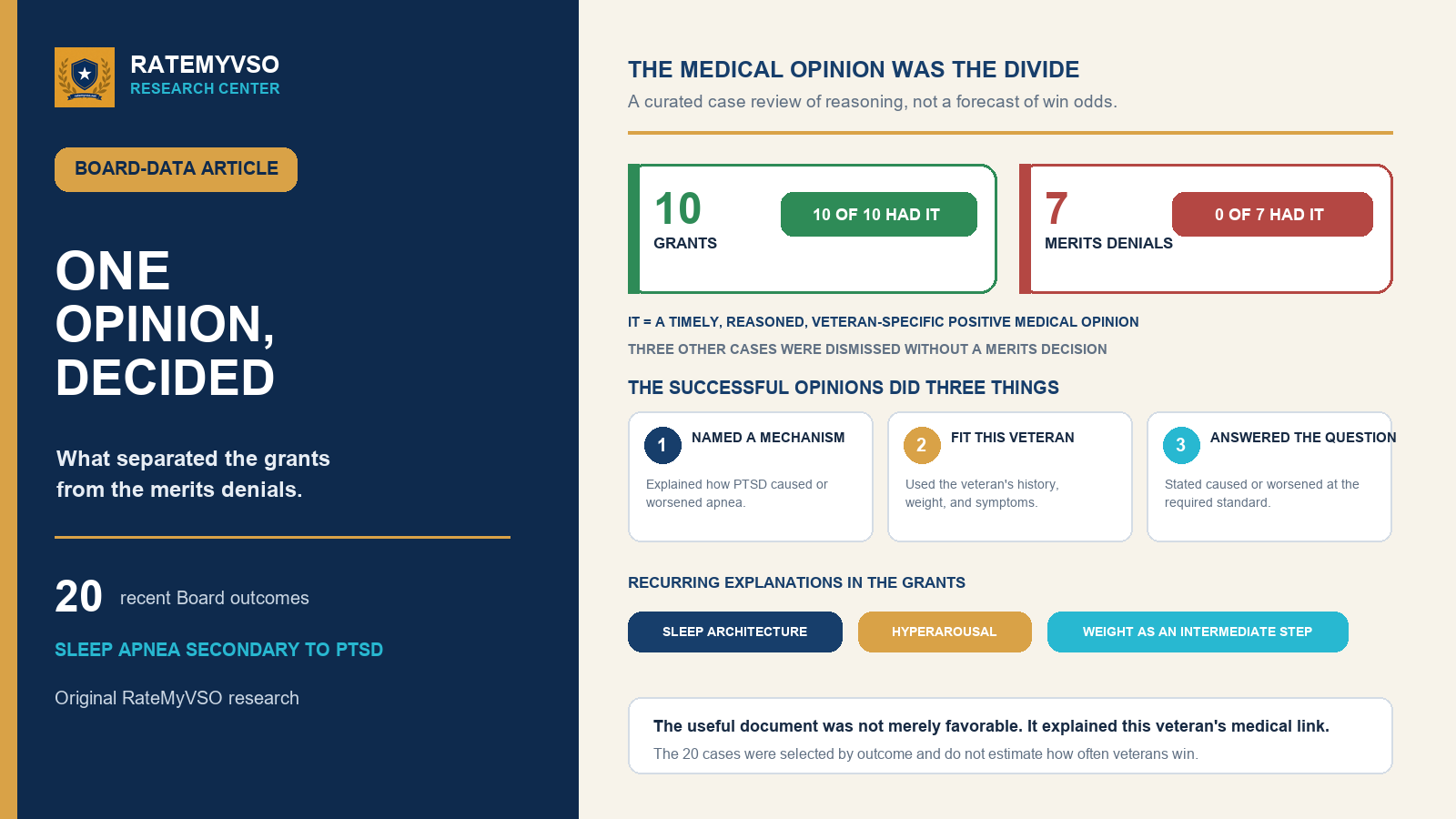
In these 20 recent cases, one thing usually separated the veterans who won from those who lost: a medical opinion that clearly explained why that veteran’s PTSD caused or made the sleep apnea worse.
Sleep apnea claimed as secondary to service-connected PTSD is one of the most common secondary claims veterans bring, and one of the most contested. We reviewed 20 recent cases: 10 grants, seven actual denials, and three cases the Board dismissed without deciding whether the evidence was strong enough. The striking thing is how little the outcomes turned on the veteran’s symptoms or even the strength of the science, and how much they turned on whether the record held a competent, well-reasoned, positive medical opinion, filed in time to be counted. Every veteran who won had one. The veterans who lost either did not have one, submitted it too late, or had an opinion that did not explain the connection well enough.
What the claim must show
To win service connection on a secondary basis, a veteran must show a current disability (here, a sleep apnea diagnosis), an existing service-connected condition (here, PTSD), and medical evidence showing that PTSD caused the sleep apnea or made it worse. See 38 C.F.R. section 3.310. The first two are usually settled by the time the claim reaches this point. The whole fight is almost always over the third link in the chain, which the law calls a "nexus." A veteran can describe snoring, gasping, broken sleep, nightmares, weight changes, and when the symptoms began. That evidence matters. But in these cases, and in general, the veteran’s own belief that PTSD caused or worsened the sleep apnea is not enough by itself to establish a medical connection. The Board required that connection to come from a qualified medical professional. That single rule is why the medical opinion is not just important but decisive.
The one variable that decides the case
Across all ten grants, the record contained a private or treating opinion that did three things.
- It gave an actual reason, meaning it explained a biological mechanism rather than just asserting a conclusion.
- It tied that reasoning to the specific veteran, his history, his weight trajectory, his documented symptoms.
- It framed the conclusion in the legal standard, that the apnea was "at least as likely as not" caused or worsened by the PTSD.
None of the merits denials had one. Put simply, where that type of nexus opinion existed the claim was granted, and where it did not the claim was denied. Why it carries so much weight is a matter of settled law: the probative value of a medical opinion comes mostly from its reasoning (Nieves-Rodriguez v. Peake). A treating cardiologist of fifteen years who discussed the specific veteran was preferred over a conclusory government examiner (Hwa, A26040643, Apr. 30, 2026). An opinion the Board itself called "somewhat speculative" was still enough to grant, because it out-reasoned the negative opinion across the table (Seesel, A26039415, Apr. 28, 2026).
The mechanisms that keep winning
The successful opinions tended to rely on one of three explanations, and the same three kept showing up.
- The first was a sleep-architecture pathway. The medical opinion explained that PTSD fragmented REM sleep and disrupted the muscle control that helps keep the airway open, allowing the airway to collapse (Hager, A26040879, Apr. 30, 2026; Marcus, A26039038, Apr. 27, 2026).
- The second was hyperarousal. The opinion explained that the heightened nervous-system activity caused by PTSD changed airway muscle tone and lowered the threshold for these breathing events (Hager).
- The third, and one of the most effective, was the "obesity intermediate step." In those cases, the opinion built a chain the law recognizes when the evidence supports it: PTSD symptoms or treatment caused or worsened the veteran’s weight gain, and that weight gain caused or worsened the sleep apnea (Hachey, A26040946, Apr. 30, 2026; Wight, A26039177, Apr. 27, 2026, applying VAOPGCPREC 1-2017 and Walsh v. Wilkie).
When an opinion built one of these explanations around the veteran’s actual medical history, and the government’s examiner ignored it, the veteran tended to win.
Why the denials lose, in buckets
The losses are not random. Set aside three of the ten "denials" that were not losses on the evidence at all: two appeals were dismissed because the veteran died (Sim, A26034477, Apr. 14, 2026; Crawford, A26032173, Apr. 8, 2026) and one was withdrawn by the veteran’s attorney (Donnelly, A26034619, Apr. 14, 2026). The remaining merits denials fall into four clean categories, each of which is really just a different way the decisive opinion was missing.
No current diagnosis. The claim fails before nexus is even reached, because there is no confirmed apnea to connect to anything. In one case the veteran declined the sleep study that would have established it (Zadora, A26040936, Apr. 30, 2026).
No positive opinion at all. Three denials had the same basic problem: no doctor supported the veteran’s claim.
In two cases, the only medical opinion was the VA examiner’s negative one (Knope, A26036334, Apr. 20, 2026; Hwa, A26033226, Apr. 9, 2026).
In the third, the veteran did not argue that PTSD caused his sleep apnea until his Board hearing. His representative mentioned medical studies but never submitted them, and no doctor supported the connection. The VA had no earlier duty to order an examination based on an argument the veteran had not yet raised (Jones, A26034393, Apr. 14, 2026). With no supporting medical opinion in any of the three cases, the Board denied the claims.
A good opinion that arrived too late. This is the quieter driver. In the modern appeals system, evidence submitted outside a defined window cannot be considered, no matter how strong it is. One veteran had a positive opinion and a supporting study that fell outside the ninety-day window, so the Board was barred from looking at them and denied the claim (Donohue, A26033282, Apr. 9, 2026).
An opinion that was there and timely but not persuasive. Either it gave no reasoning, or it was unclear the examiner had reviewed the file, or it hedged. One decision rejected an opinion that offered only a "recommendation that these are related" (Mackenzie, A26032650, Apr. 8, 2026). Another rejected a long, citation-heavy opinion because it leaned on "may" and "could," admitted the mechanism "is not clear," rested on correlation rather than causation, and cited twenty-three studies that were never placed in the record and so could not be considered (Simpson, A26031731, Apr. 7, 2026).
The quiet advantage veterans have
One more pattern runs underneath all of this. The government’s own examiners often hurt the government’s position. Their opinions tend to be boilerplate: the medical literature shows association, not causation, with no discussion of the particular veteran and, tellingly, no engagement with the obesity pathway. Because reasoning is what gives an opinion weight, those conclusory opinions get little of it, and a detailed private opinion beats them. In one grant the Board worked through six negative opinions and set them all aside for failing to address obesity as an intermediate step (Wight, A26039177).
Two legal doctrines make that tilt possible. The benefit-of-the-doubt rule means the veteran prevails whenever the evidence is in "approximate balance," not only when it clearly favors him (Lynch v. McDonough). So one solid private opinion against one negative government opinion is often enough to win. PTSD also does not have to be the only cause of sleep apnea. But it must have made a real difference: without the PTSD, the sleep apnea would not have developed or would not have become as severe (Spicer v. McDonough). Together they set a low bar that a single well-built opinion can clear.
The takeaway
If there is one sentence to carry away, it is this: these cases are won or lost on a single, timely, well-reasoned medical opinion that connects PTSD to this veteran’s apnea through a named mechanism, judged against a deliberately low bar. PTSD does not have to be the only cause, but it must have made a real difference. Everything else, the symptoms, the sincerity, the volume of paperwork, matters far less than whether that one document is present, on time, and reasoned.
The twenty decisions
| Decision | Date | Outcome | What drove it |
|---|---|---|---|
| Seesel, A26040982 | 04/30/26 | Granted | Reasoned private opinion rebutted the VA weight theory; equipoise. |
| Hachey, A26040946 | 04/30/26 | Granted | Obesity intermediate step plus REM mechanism; VA opinions ignored obesity. |
| Hager, A26040879 | 04/30/26 | Granted | Positive opinion on hyperarousal mechanism; no contrary opinion. |
| Slabbekorn, A26040792 | 04/30/26 | Granted | Opinion tracked the veteran’s BMI trajectory; no contrary opinion. |
| Hwa, A26040643 | 04/30/26 | Granted | 15-year treating cardiologist, veteran-specific, over conclusory VA opinion. |
| Seesel, A26039415 | 04/28/26 | Granted | Opinion called "somewhat speculative" but still enough at equipoise. |
| Bruce, A26039408 | 04/28/26 | Granted | Treating-physician opinion vs a conclusory "no literature" VA opinion. |
| Wight, A26039177 | 04/27/26 | Granted | Six negative opinions set aside for ignoring the obesity pathway. |
| Marcus, A26039038 | 04/27/26 | Granted | Detailed mechanism opinion; the only secondary opinion of record. |
| Graham, A26038790 | 04/27/26 | Granted | After court remand; positive opinion, VA opinion deemed inadequate. |
| Zadora, A26040936 | 04/30/26 | Denied | No current diagnosis; veteran declined the sleep study. |
| Knope, A26036334 | 04/20/26 | Denied | No positive opinion; only lay statements vs a negative VA opinion. |
| Jones, A26034393 | 04/14/26 | Denied | PTSD theory first raised at the Board hearing; no supporting medical opinion or submitted studies. |
| Donohue, A26033282 | 04/09/26 | Denied | Positive opinion and article filed outside the evidence window. |
| Hwa, A26033226 | 04/09/26 | Denied | No medical nexus evidence; only lay assertions. |
| Mackenzie, A26032650 | 04/08/26 | Denied | Two positive opinions, both conclusory and without rationale. |
| Simpson, A26031731 | 04/07/26 | Denied | Long opinion found non-probative; speculative, correlation, cited studies not in record. |
| Donnelly, A26034619 | 04/14/26 | Dismissed | Claim withdrawn by the veteran’s attorney. |
| Sim, A26034477 | 04/14/26 | Dismissed | Veteran died during the appeal. |
| Crawford, A26032173 | 04/08/26 | Dismissed | Veteran died during the appeal. |
A note on method and confidence
This piece draws on the ten latest grants and ten latest denials in this category, all non-precedential Board decisions from early 2026. Because the set is curated by outcome rather than randomly sampled, it shows how these cases are reasoned, not how often veterans win. Three of the ten "denials" were dismissals (two deaths, one withdrawal), so the merits comparison is roughly ten grants to seven denials, and with numbers that small the bucket counts are illustrative rather than statistical. The observation that a timely, reasoned, veteran-specific positive opinion is close to both necessary and sufficient is a strong pattern within these twenty decisions, stated as such rather than as a general rule. Regulatory and case-law standards are described as the decisions themselves state them.