VA Sleep Apnea Claims Guide
This guide explains how to file a sleep apnea claim and how the VA evaluates it: how service connection works, how sleep apnea gets connected to your service (directly, or secondary to another condition), what evidence you need, why these claims get denied, a checklist before you file, what the claims process looks like step by step, how to read your decision letter, and what to do whether you win or you're denied. You will also learn how sleep apnea is rated under 38 CFR § 4.97, Diagnostic Code 6847, including the criteria for the 0, 30, 50, and 100 percent levels based on symptoms, sleep-study results, and whether you need a CPAP or BiPAP machine.
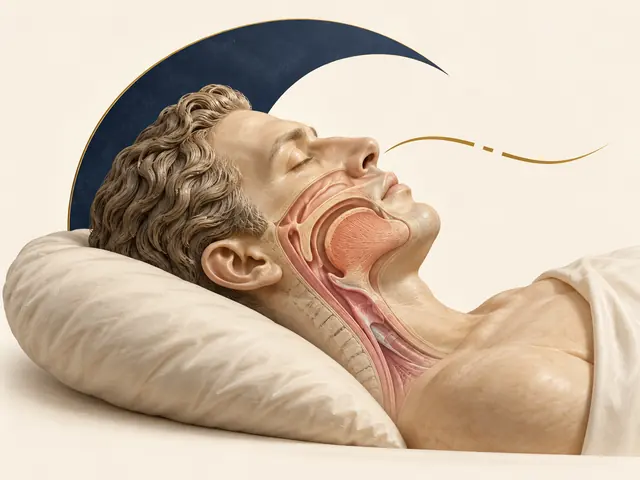
Start with the essentials
- 01Service Connection
The ways service connection can be established for this condition.
- 02Diagnosis and Evidence
Common symptoms and the evidence cited in published Board appeals.
- 03Your History
What you experienced, what others observed, and what treatment changed.
Understand the claim
Overview
Sleep apnea is among the most commonly claimed VA disabilities, with over 650,000 veterans receiving compensation for the condition. It is rated under DC 6847 within 38 CFR § 4.97 (Schedule of Ratings, Respiratory System). All three clinical types, obstructive sleep apnea (OSA), central sleep apnea (CSA), and mixed sleep apnea, are evaluated under the same diagnostic code and the same rating criteria.
Types of Sleep Apnea
Obstructive Sleep Apnea (OSA) is the most common type. The upper airway physically collapses or becomes blocked during sleep, causing repeated breathing interruptions. Risk factors include obesity, upper airway anatomy, nasal obstruction, and neurological influences from conditions such as PTSD and TBI.
Central Sleep Apnea (CSA) occurs when the brain fails to send proper breathing signals to the respiratory muscles. It is associated with neurological conditions, opioid use, and traumatic brain injury. CSA is less common and can be more difficult to service-connect without a documented link to a service-related cause.
Mixed Sleep Apnea combines features of both types and is evaluated identically under DC 6847.
Diagnosis requires a polysomnography (overnight sleep study) conducted in a qualified facility, or in some cases a validated home sleep apnea test (HSAT). A diagnosis of sleep apnea is required before VA will assign any rating. A veteran's report of symptoms alone is not sufficient.
Symptoms Recorded in Granted Sleep apnea Decisions
We analyzed 11,178 granted Board decisions involving sleep apnea for symptoms named in sentences about the condition (rating-criteria recitations excluded). Descriptive of the published record, what the Board wrote down, not a checklist of what to report.
Bar length shows decisions. Percentages remain context.
Detected by phrase-reading the decision text with condition-specific vocabularies. Source: Board of Veterans' Appeals decisions, RateMyVSO analysis.
ICD-10 Diagnosis Codes
The ICD-10 diagnosis codes most commonly used for DC 6847, Sleep Apnea Syndromes (Obstructive, Central, Mixed) (the kind on your medical records, decision letter, or C&P exam report). VA rates the disability and its residuals, not the diagnosis itself, so coding can vary.
How Service Connection Works, At a High Level
Before getting into the specific pathways below, it helps to understand the three things every sleep apnea claim ultimately has to show. This is the same basic test that applies to any VA disability claim, just applied to this condition.
- A current diagnosis. A sleep study (polysomnography or a validated home sleep apnea test) showing you have sleep apnea. This part is often the easiest, VA frequently accepts the diagnosis once a study is in the file.
- An in-service event, or a service-connected condition behind it. Either something that happened or was documented during your service, or a disability VA has already service-connected that caused or worsened the sleep apnea.
- A medical nexus. A doctor's opinion connecting your sleep apnea to service, or to the service-connected condition, and explaining the reasoning, not just stating a conclusion.
Service Connection Pathways: Direct and Secondary
Sleep apnea is not a VA presumptive condition for any exposure category as of this writing. Service connection must be established through one of the following pathways.
Veterans do argue exposure theories for sleep apnea at the Board (1,174 decided cases), but none has ever been granted as a presumptive condition; the wins in that group came through direct or secondary service connection.
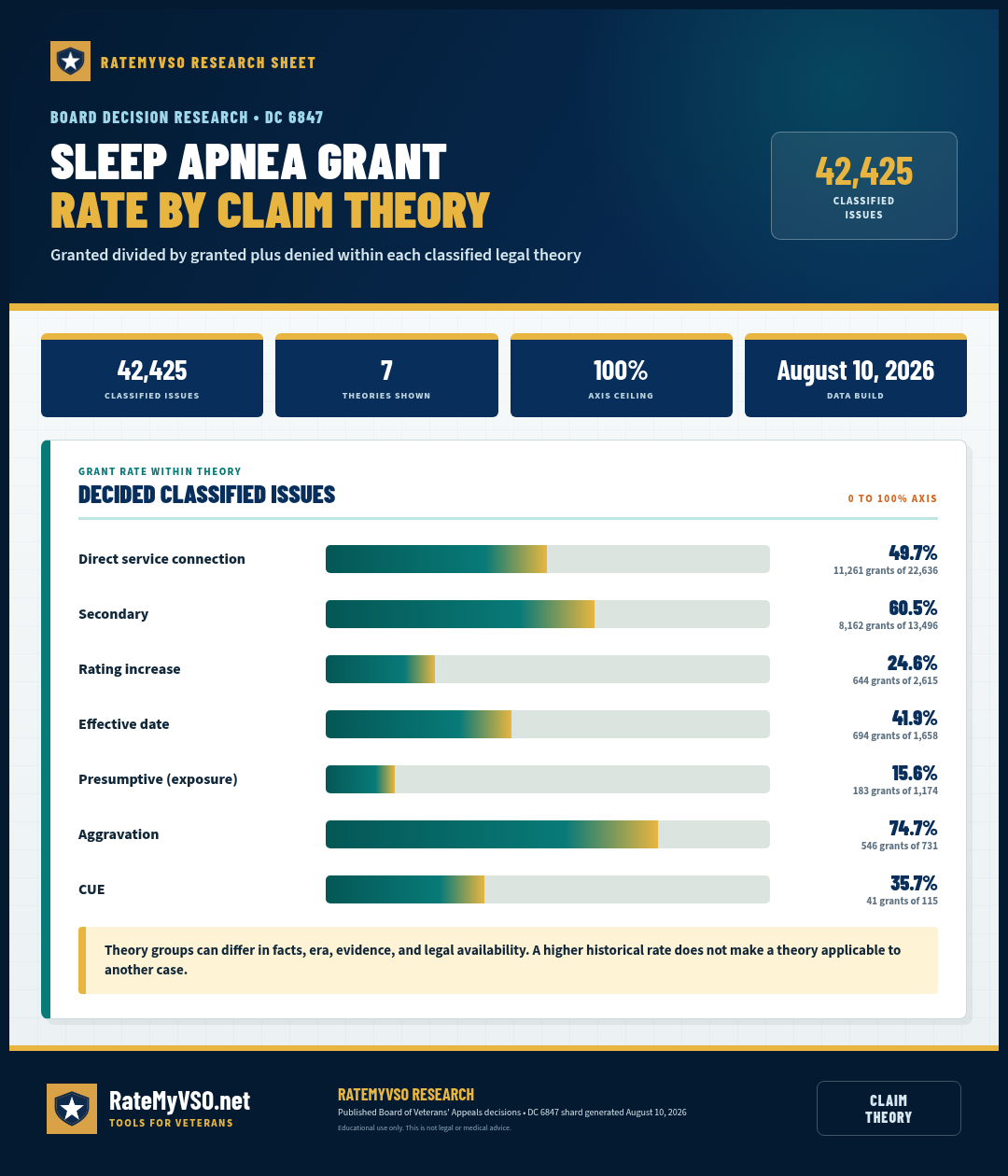 One-page guide: Sleep Apnea Grant Rate by Claim Theory
Board grant rates by claim theory across 43,101 decided classified sleep apnea issues. Opens the full-size chart, free to save or print.
One-page guide: Sleep Apnea Grant Rate by Claim Theory
Board grant rates by claim theory across 43,101 decided classified sleep apnea issues. Opens the full-size chart, free to save or print.
Direct Service Connection
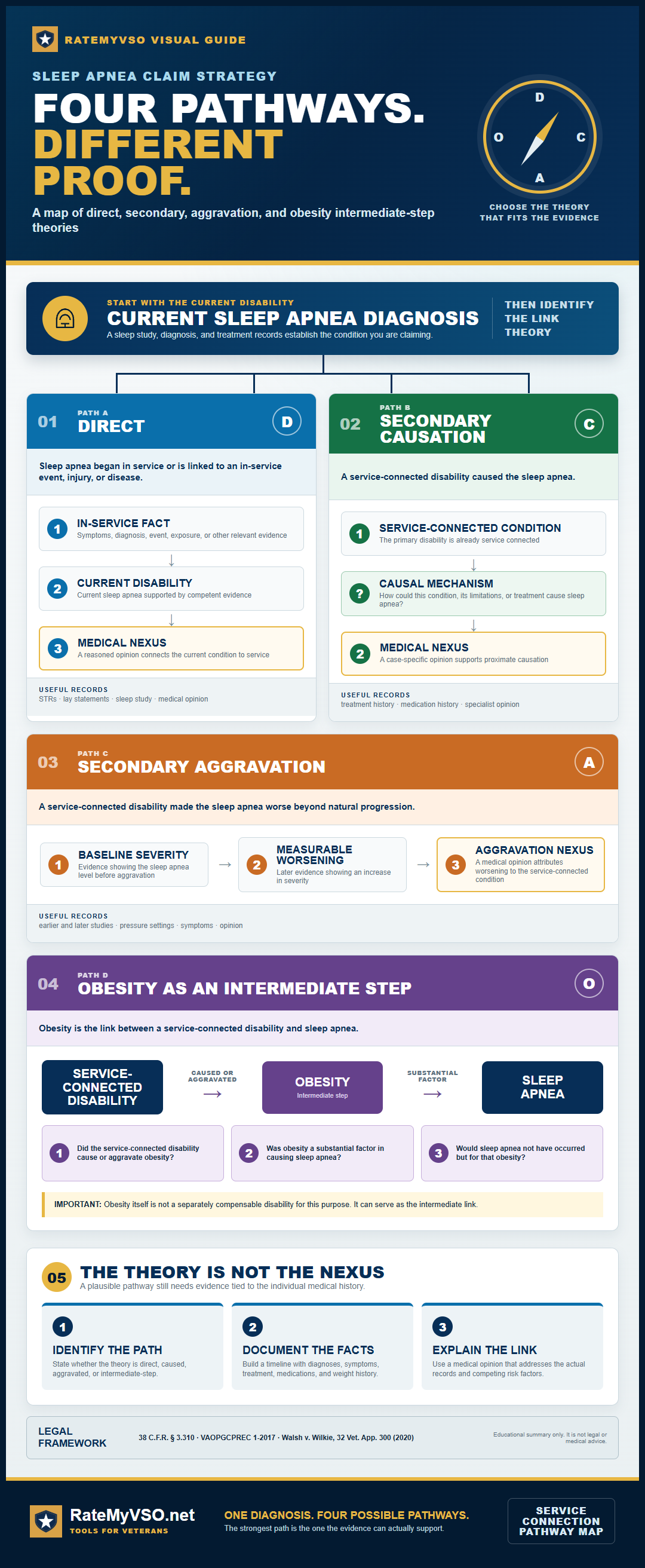
A veteran demonstrates that sleep apnea began during or was caused by active military service. Supporting evidence includes sleep study results, records from military treatment facilities documenting sleep complaints, and a medical nexus opinion linking the diagnosis to in-service events or exposures. Direct service connection is the most common pathway when symptoms began during a deployment or were documented in service treatment records. See our Service Connection Guide.
Secondary Service Connection (38 CFR § 3.310)
A veteran demonstrates that sleep apnea was caused or chronically aggravated by an already service-connected condition. This is a frequently used and well-supported pathway, and in practice it is often the easier of the two routes: many veterans win not by proving sleep apnea started in service, but by showing that a condition VA has already service-connected caused or worsened it. See our Secondary Service Connection Guide.
2026 update, the "but for" causation standard: Effective May 1, 2026, VA revised its adjudication manual (M21-1, Part V, Subpart ii, Chapter 2, Section D) so that secondary service connection under 38 CFR § 3.310(a) and (b) covers disabilities that are "the result of, or would not have occurred but for," a service-connected disability. This language tracks the causation standard the Federal Circuit applied in Spicer v. McDonough, 61 F.4th 1360 (Fed. Cir. 2023), which held that "but for" causation under 38 U.S.C. § 1110 can be satisfied even where a service-connected condition only impeded or prevented treatment of the secondary condition, not just where it directly caused or aggravated it, reversing a narrower lower-court reading of the statute. You can read how the Board has applied Spicer in our CAVC research tool.
What "but for" means: the question becomes whether the secondary condition would have developed anyway, even without the service-connected condition. Sleep apnea is a multifactorial condition, meaning it can have several contributing causes such as weight, age, sex, airway anatomy, and family history. When those other possible causes are not addressed in the record, an examiner can find the link too speculative to grant.
Why this matters for the medical opinion: a private nexus opinion is stronger when it does more than assert a link. It helps when the provider addresses the other recognized causes of sleep apnea and explains why they do not account for the diagnosis in this veteran, for example noting that age, documented weight history, or family history is not the likely driver. It is reasonable to ask the treating provider to address each plausible alternative cause and to document the timeline, because under 38 CFR § 3.310(a) the service-connected condition must come before the sleep apnea for a causation theory, while § 3.310(b) covers later aggravation measured against a baseline.
Manual sections carrying the revised language: Secondary SC and Aggravation, Determining the Issues, Reviewing Diagnoses.
Established secondary pathways include:
Secondary to PTSD (DC 9411)
Research supports a medically recognized bidirectional relationship between PTSD and OSA. PTSD disrupts sleep architecture through hypervigilance and chronic stress activation of the hypothalamic-pituitary-adrenal axis. PTSD medications, particularly antipsychotics and antidepressants in the tricyclic and SSRI categories, contribute to weight gain that is itself a primary risk factor for OSA. A 2015 study cited in clinical literature found approximately 69% of Iraq and Afghanistan veterans with PTSD were at high risk for sleep apnea. Sleep apnea has also been repeatedly connected to service-connected depression, a mood disorder, or tinnitus on the same theory. See our PTSD Claims Guide.
Secondary to TBI (DC 8045)
Traumatic brain injury affects brainstem respiratory control centers. Central sleep apnea and disrupted breathing patterns during sleep are recognized neurological sequelae of TBI.
Secondary via obesity as an intermediary
When a service-connected condition (for example, a bilateral knee disability that prevents exercise, or PTSD) has caused or significantly worsened obesity, and that obesity has caused or aggravated sleep apnea, VA may recognize the full causal chain as secondary service connection. This requires documentation at each link in the chain: the service-connected condition, the resultant weight gain, and the causal role of obesity in the sleep apnea diagnosis. The controlling authority is Walsh v. Wilkie, 32 Vet. App. 300, 306-07 (2020), which held that obesity may serve as an intermediate step whether the service-connected disability caused the weight gain or merely aggravated it, applying VA General Counsel Precedent Opinion 1-2017. See also Garner v. Tran, 33 Vet. App. 241, 247 (2021).
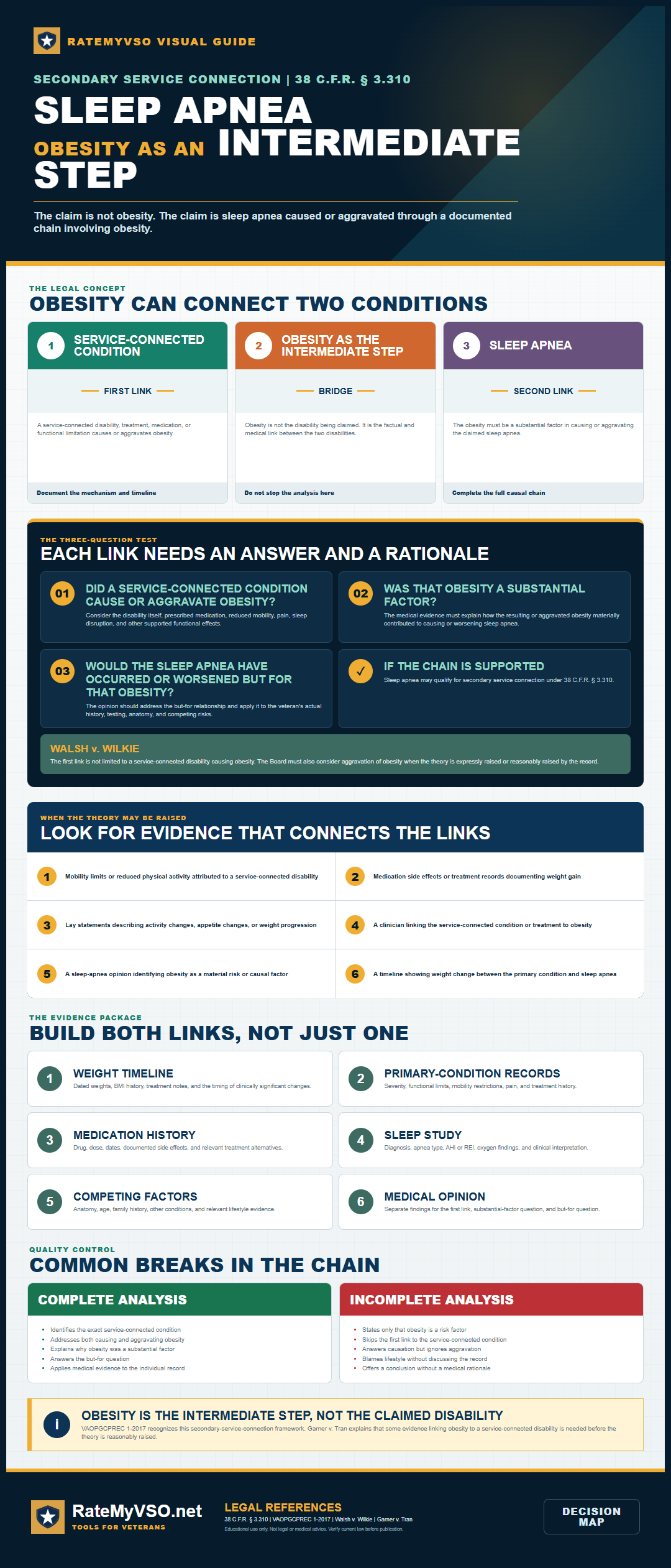 One-page guide: Obesity as an Intermediate Step
Legal decision map for sleep apnea secondary service connection using obesity as an intermediate step. Opens the full-size chart, free to save or print.
One-page guide: Obesity as an Intermediate Step
Legal decision map for sleep apnea secondary service connection using obesity as an intermediate step. Opens the full-size chart, free to save or print.
Secondary to rhinitis, sinusitis, or nasal deformity
Chronic nasal obstruction reduces airflow and promotes mouth breathing, both recognized contributors to OSA. Veterans with service-connected rhinitis (DC 6522), sinusitis (DC 6510 through 6513), or nasal trauma are recognized candidates for secondary connection.
Secondary to Medications
Medications prescribed for a service-connected condition can cause or worsen sleep apnea. Under 38 CFR § 3.310 this is an intermediate-step chain: a service-connected condition leads to a prescribed medication, and that medication causes or aggravates the apnea. See our Secondary Service Connection Guide.
Opioids and CNS depressants: Opioids and other central-nervous-system depressants, often prescribed for chronic pain from service-connected musculoskeletal conditions, blunt the brain's breathing drive and are linked to central sleep apnea.
Benzodiazepines, muscle relaxants, and sedative-hypnotics: These medications, often prescribed for anxiety, PTSD, or back pain, relax upper-airway muscles and can worsen obstructive sleep apnea.
Weight gain from psychiatric medications: Some psychiatric medications cause weight gain that can independently worsen obstructive sleep apnea, creating a separate intermediate-step chain alongside the direct pharmacological effects.
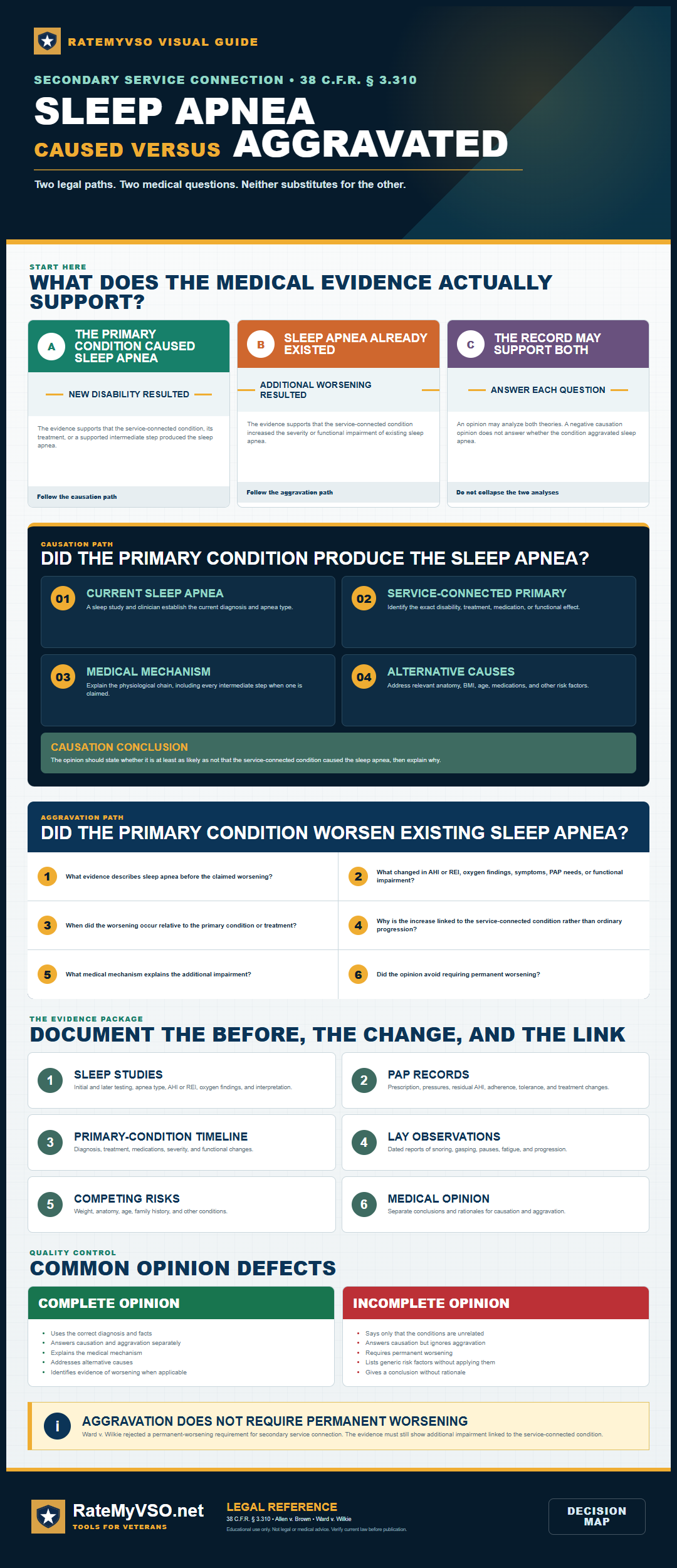
Aggravation under 38 CFR § 3.310(b): If the apnea already existed before the medication was prescribed, 38 CFR § 3.310(b) still allows service connection for the increase in severity caused by the medication, measured against the documented baseline before the worsening.
Evidence: A nexus opinion should name the specific medication and the mechanism, state it is at least as likely as not that the medication caused or aggravated the apnea, and rest on a sleep study that identifies the apnea type, because the distinction between central and obstructive apnea is relevant to which medication mechanism applies.
Service Connection by Aggravation
When a veteran had documented pre-service sleep apnea or sleep-disordered breathing that was significantly worsened beyond its natural progression by military service, aggravation-based service connection under 38 CFR § 3.306 is available.
Symptoms, treatment, and rating
Current Rating Criteria Under DC 6847
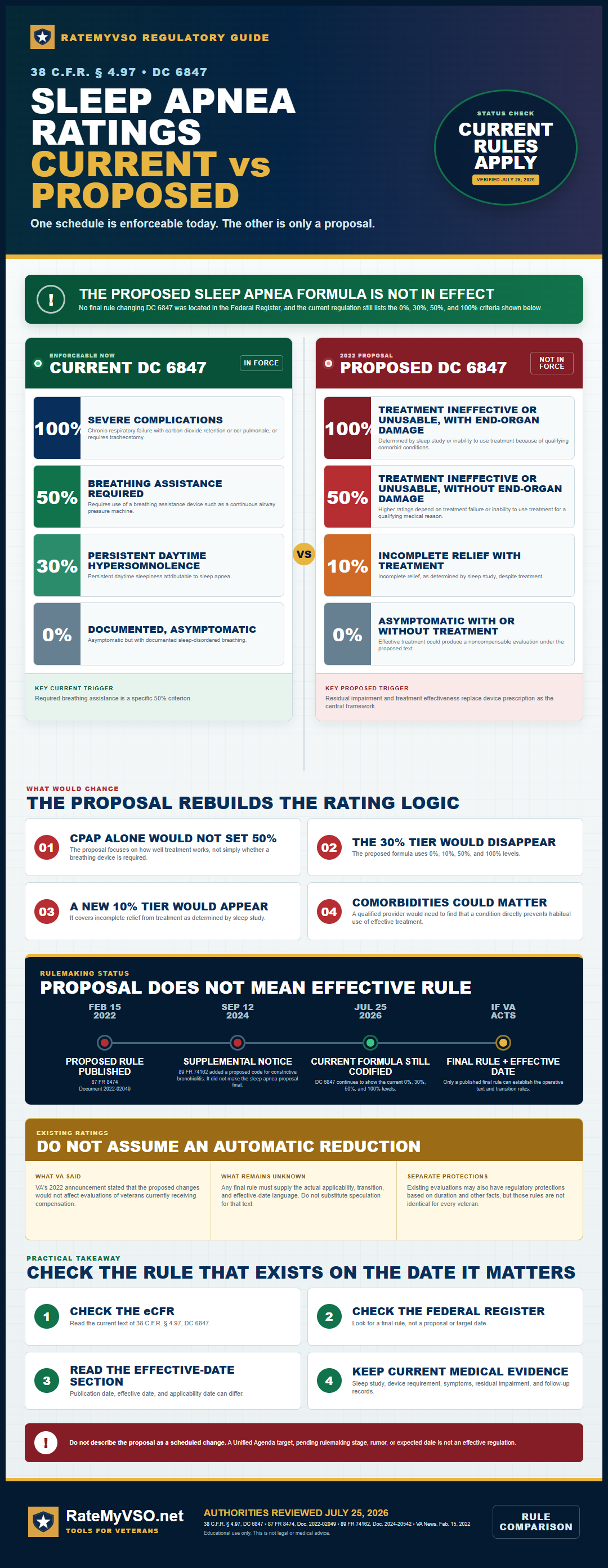
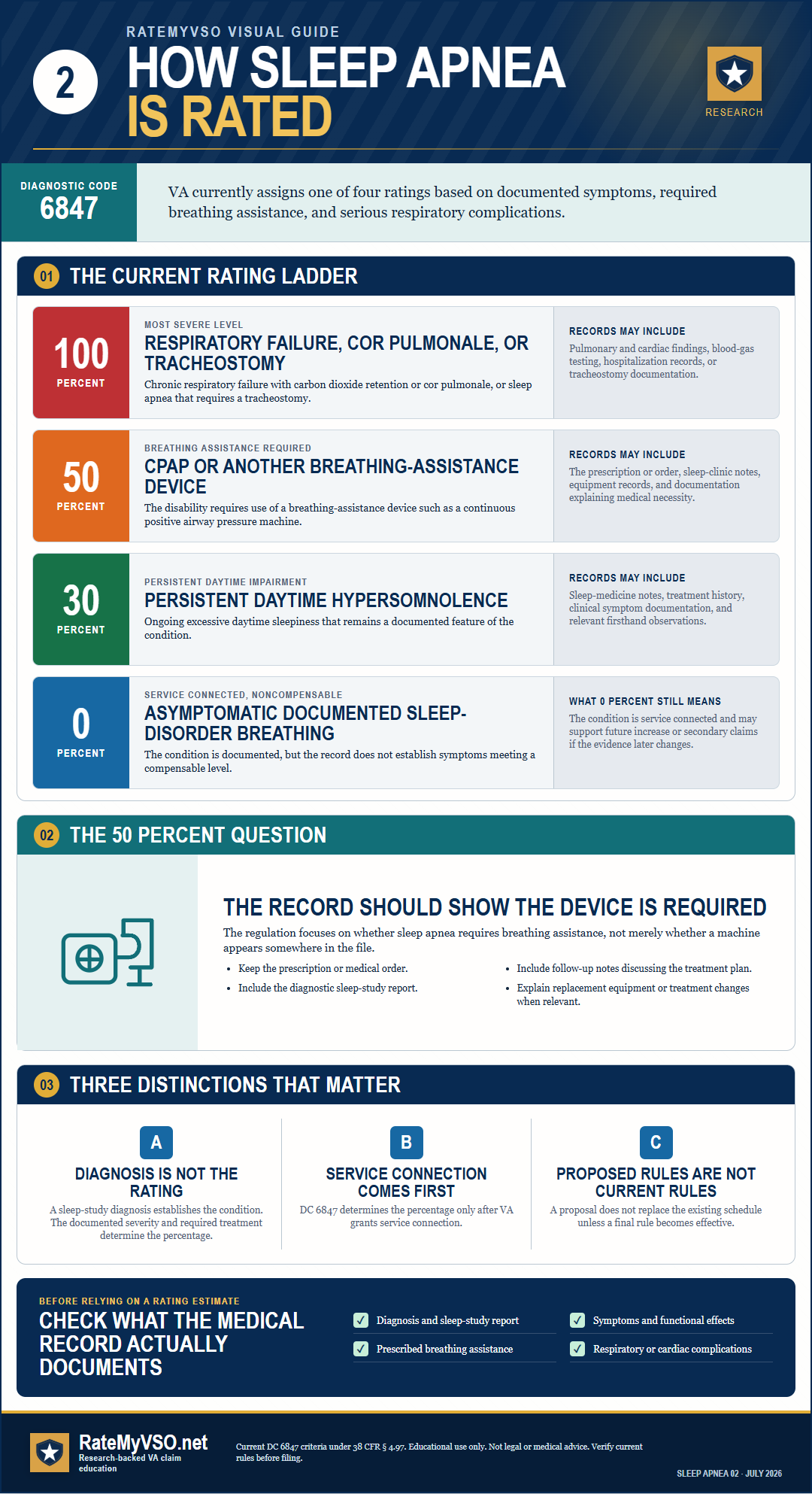
Sleep apnea is rated under DC 6847, 38 CFR § 4.97. The current rating structure produces four levels.
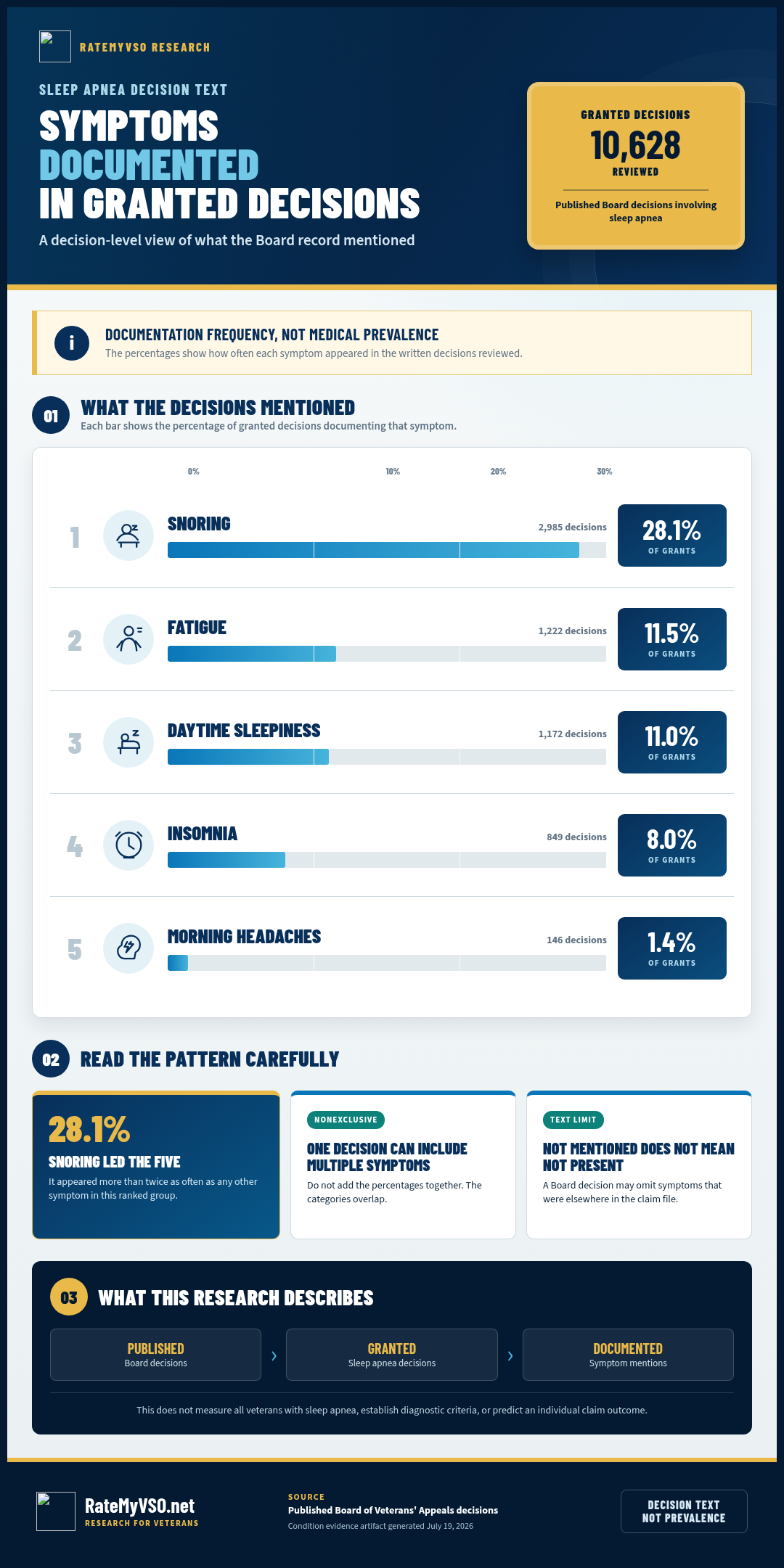 One-page guide: Symptoms Documented in Granted Decisions
Research summary of the symptoms documented across 11,178 granted sleep apnea Board decisions. Opens the full-size chart, free to save or print.
One-page guide: Symptoms Documented in Granted Decisions
Research summary of the symptoms documented across 11,178 granted sleep apnea Board decisions. Opens the full-size chart, free to save or print.
Evidence and Board research
What VA Looks For: Tests, Records, and Diagnostic Codes
Records to gather for a direct or secondary claim:
- The sleep study itself: a polysomnography or HSAT report identifying the Apnea-Hypopnea Index (AHI), the apnea type (obstructive, central, or mixed), the oxygen desaturation nadir, and whether CPAP or BiPAP therapy is indicated and at what pressure.
- Treatment records: any prescription or documented recommendation for a breathing assistance device, and ongoing follow-up showing the condition is being managed.
- The diagnostic codes involved: DC 6847 for the sleep apnea itself, plus whatever code applies to the condition you're connecting it to, for example DC 9411 (PTSD), DC 8045 (TBI), DC 6522 (rhinitis), or DC 6510 through 6513 (sinusitis).
- The actual form the examiner fills out: a Disability Benefits Questionnaire (DBQ) specific to sleep apnea, discussed in more detail later in this guide.
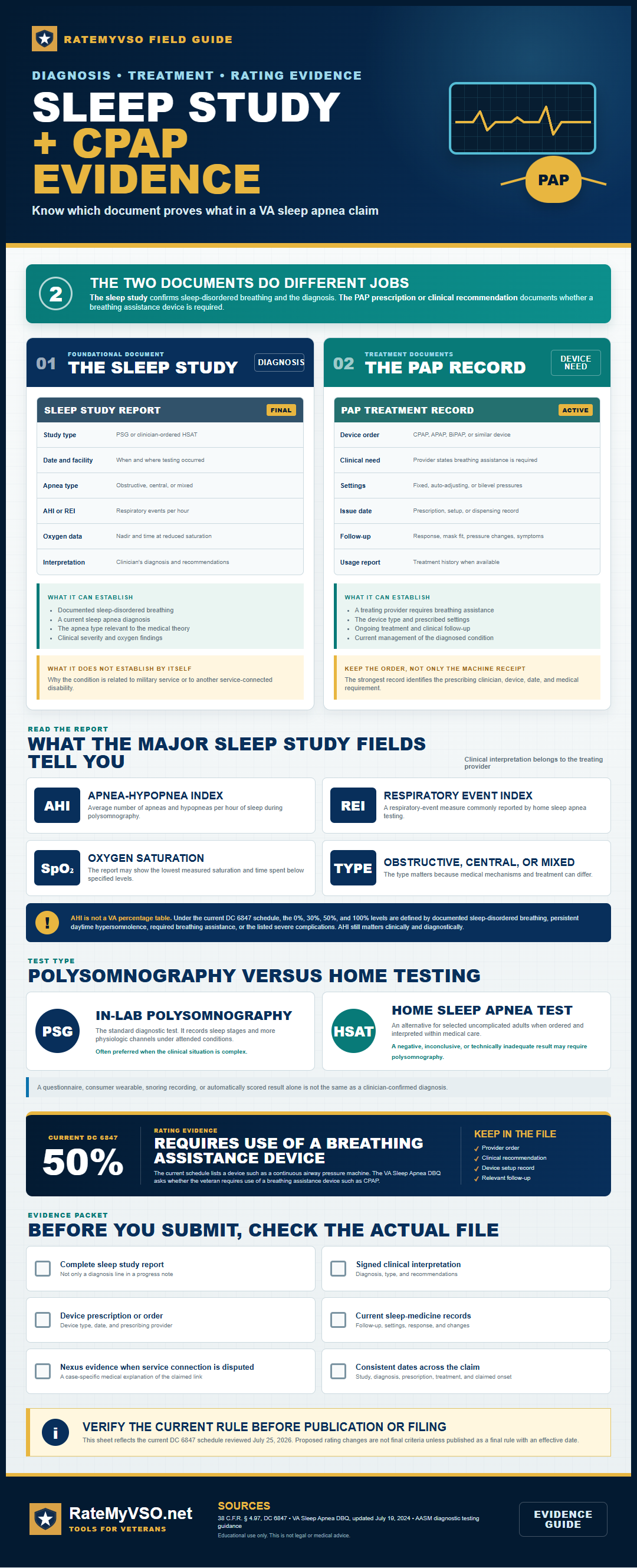 One-page guide: Sleep Study and CPAP Evidence Guide
Guide to sleep studies, PAP prescriptions, and related sleep apnea claim evidence. Opens the full-size chart, free to save or print.
One-page guide: Sleep Study and CPAP Evidence Guide
Guide to sleep studies, PAP prescriptions, and related sleep apnea claim evidence. Opens the full-size chart, free to save or print.
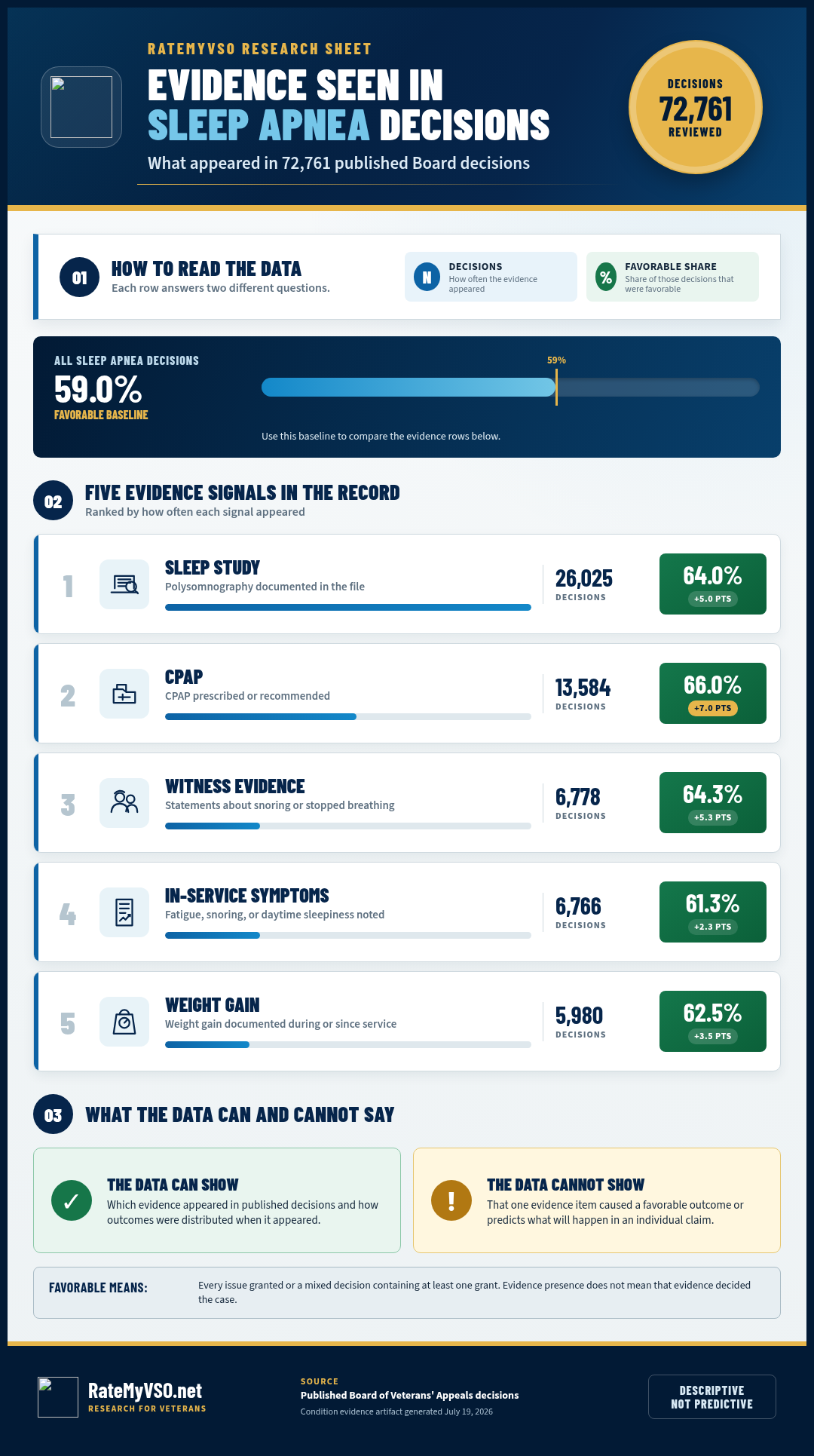 One-page guide: Evidence Seen in Board Decisions
Research summary of the evidence documented across 78,321 scanned sleep apnea Board decisions. Opens the full-size chart, free to save or print.
One-page guide: Evidence Seen in Board Decisions
Research summary of the evidence documented across 78,321 scanned sleep apnea Board decisions. Opens the full-size chart, free to save or print.
Evidence Cited in Published Sleep apnea Decisions
We analyzed 78,321 published Board decisions involving sleep apnea for condition-specific evidence, counting only case-specific mentions (boilerplate recitations excluded). "Favorable" is the share of decisions citing that evidence where every issue was granted or the outcome was mixed; the baseline across all these decisions is 58%. Evidence appearing in a decision does not mean it decided the case. Descriptive of the published record, not a prediction.
Bar length shows decisions citing the evidence.
Detected by phrase-reading the decision text with condition-specific vocabularies. Source: Board of Veterans' Appeals decisions, RateMyVSO analysis.
Why These Claims Get Denied
Beyond the general "no nexus" and "no sleep study" reasons covered above, a few specific denial patterns show up often enough to call out on their own.
- A confirmed diagnosis with no connection to service. Having sleep apnea, even a clearly documented case, is not enough by itself. Claims are denied where the disability plainly exists but nothing in the record ties it to service or to a service-connected condition.
- The veteran's own belief about the cause, without a doctor's opinion behind it. VA treats the cause of sleep apnea as a medical question a non-doctor cannot answer on their own. A veteran's personal opinion that service caused the condition, without a supporting medical nexus, does not carry the claim (Jandreau v. Nicholson).
- An onset story that shifts. When a veteran's account of when symptoms began changes between statements, and the record repeatedly contradicts an in-service onset, that inconsistency itself becomes a reason for denial.
- A representative's legal brief standing in for a medical opinion. Citing general medical literature in an appeal brief, without a treating or examining doctor applying that literature to the veteran's specific facts, is not medical evidence (Wallin v. West, 11 Vet. App. 509 (1998)).
- Toxic or burn-pit exposure argued alone. Sleep apnea is not on the PACT Act presumptive list. A claim that rests only on general toxic-exposure argument, with no medical opinion explaining a specific mechanism, is a weak claim on its own; it can still work when a private opinion explains a concrete mechanism (for example, how airborne particles narrow the airway), but the exposure argument by itself does not substitute for that opinion.
- Obesity that predates service, used to argue the intermediate-step theory. If the record shows the veteran was already obese before or during service, the obesity-as-intermediate-step chain breaks at its first link, since service cannot be said to have caused weight that was already present.
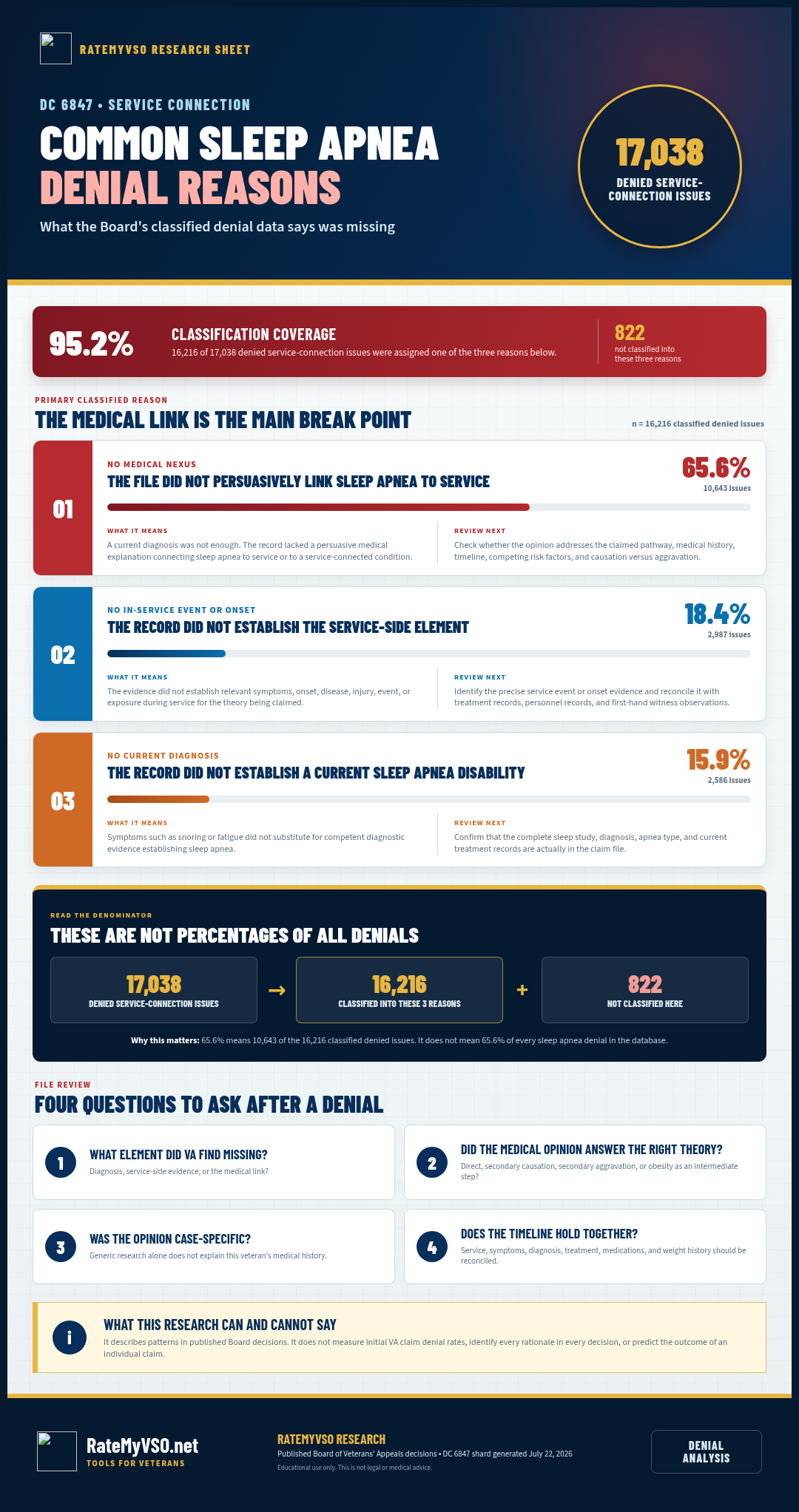 One-page guide: Common Sleep Apnea Denial Reasons
Research summary of the common denial reasons found across 16,545 classified sleep apnea denials, out of 17,327 denied in total. Opens the full-size chart, free to save or print.
One-page guide: Common Sleep Apnea Denial Reasons
Research summary of the common denial reasons found across 16,545 classified sleep apnea denials, out of 17,327 denied in total. Opens the full-size chart, free to save or print.
Pitfalls and Common Mistakes
Patterns the published DC 6847 decisions flag most often. Among the Board's classified service-connection denials for sleep apnea, here is what claims most often fell short on.
- No nexus opinion in the file. A useful opinion names the in-service event or the service-connected primary and explains the link.
- No confirming sleep study. The VA requires a polysomnography or a validated home sleep apnea test before it will assign any rating, and a veteran's report of symptoms alone is not enough.
- No in-service onset or event documented. Service treatment records that note sleep complaints, or a nexus tying the apnea to a documented in-service exposure, anchor a direct claim.
- Leaving the apnea type out of the record. Central and obstructive apnea connect to service through different mechanisms, so a sleep study that identifies the type lets the nexus opinion match the correct pathway.
- A medical opinion that addresses causation but skips aggravation, or the reverse. On a secondary claim, an opinion must speak to both whether the service-connected condition caused the apnea and whether it made it worse; an opinion that skips the worsening question can be found inadequate.
- A VA exam that leans only on silence in old records or ignores your lay statements. An exam that dismisses a claim solely because service records are quiet on the issue, without engaging the veteran's own statements or later evidence, can be challenged as inadequate (Buchanan v. Nicholson, 451 F.3d 1331 (Fed. Cir. 2006)).
- Filing insomnia as a separate claim. Insomnia caused by sleep apnea is folded into the DC 6847 rating, not rated separately, unless it is a standalone DSM-5 insomnia disorder unrelated to the apnea.
Do's and Don'ts
A condensed version of everything above, in the order it actually matters when you sit down to build your file.
- Get a sleep study before you file, and make sure the report is actually in your file.
- Get a private nexus opinion that explains its reasoning and cites your specific medical history, not a bare conclusion.
- Identify every service-connected condition that could plausibly have caused or worsened your sleep apnea (PTSD, depression, tinnitus, a knee or back condition, a medication).
- If a service-connected condition caused or worsened your weight, raise obesity as the connecting link.
- Ask your doctor's opinion to address both whether the condition caused the apnea and whether it made it worse.
- Gather buddy statements describing snoring, choking, or gasping for air that others witnessed, especially during service.
- Keep your account of when symptoms started consistent across every form, exam, and statement.
- If a VA exam ignored your lay statements or leaned only on silence in old records, say so directly in your response or appeal.
- If you were denied before, file a Supplemental Claim with new and relevant evidence rather than starting over.
- Don't assume a diagnosis alone wins the claim, you still need the connection to service.
- Don't rely only on your own opinion about what caused it, causation for sleep apnea is treated as a medical question.
- Don't let your story about when symptoms began shift between statements and exams.
- Don't rely on your representative's brief alone to make the medical argument, a doctor has to apply the literature to your facts.
- Don't expect toxic or burn-pit exposure by itself to connect the claim, sleep apnea isn't on the PACT Act presumptive list.
- Don't ignore that obesity present before or during service can break the obesity-intermediate-step theory.
- Don't file insomnia as a separate claim when it's part of the same sleep-disordered-breathing picture.
Evidence for a Sleep Apnea Claim
We analyzed the Board's published DC 6847 decisions: a private nexus opinion in the file goes with a much higher grant rate, shown below.
Polysomnography report: The sleep study is the foundational diagnostic document. The report identifies the Apnea-Hypopnea Index (AHI), the type of sleep apnea, the oxygen desaturation nadir, and whether CPAP therapy is indicated and at what pressure.
CPAP prescription or recommendation: For a 50% rating under current criteria, documentation that a treating provider prescribed or recommended a breathing assistance device is the key evidence item.
Symptom documentation: Medical records noting daytime sleepiness, cognitive effects, morning headaches, and their impact on function are relevant to both service connection and rating.
Nexus opinion: For secondary claims, a medical opinion from a treating provider or qualified clinician explaining the causal or aggravating relationship between the primary service-connected condition and sleep apnea. The clearest path to a grant is an opinion that spells out how the connection works and cites supporting medical literature applied to your own facts, rather than a bare conclusion with no rationale; an opinion with no explanation is given little weight. The opinion should reference the veteran's specific medical history. See our Nexus Letters Guide.
Lay statements: First-person descriptions of sleep disturbance, daytime impairment, and functional limitations, along with statements from spouses, household members, or people who served alongside you who directly observed snoring, choking, or gasping for air, contribute to the evidence record and can help establish that symptoms began in service. See our Buddy & Lay Statements Guide. (Jandreau v. Nicholson, 492 F.3d 1372 (Fed. Cir. 2007); Layno v. Brown, 6 Vet. App. 465 (1994).)
Secondary relationships
Common Secondary Conditions
We found these are the conditions most often linked with sleep apnea in the Board's published decisions. Each bar is the BVA grant rate for DC 6847, with the number of decisions below it. They describe what the Board's record shows across many veterans, not a prediction about any one claim.
Conditions that can cause sleep apnea (sleep apnea as the secondary)
Claims where sleep apnea was argued as secondary to an already service-connected condition. This is the "ways to connect via another condition" list, and it's usually the easier route into a grant:
Conditions sleep apnea can cause (sleep apnea as the primary)
Conditions veterans have claimed as caused or aggravated by a service-connected sleep apnea, in other words, conditions secondary to OSA once OSA itself is already service-connected:
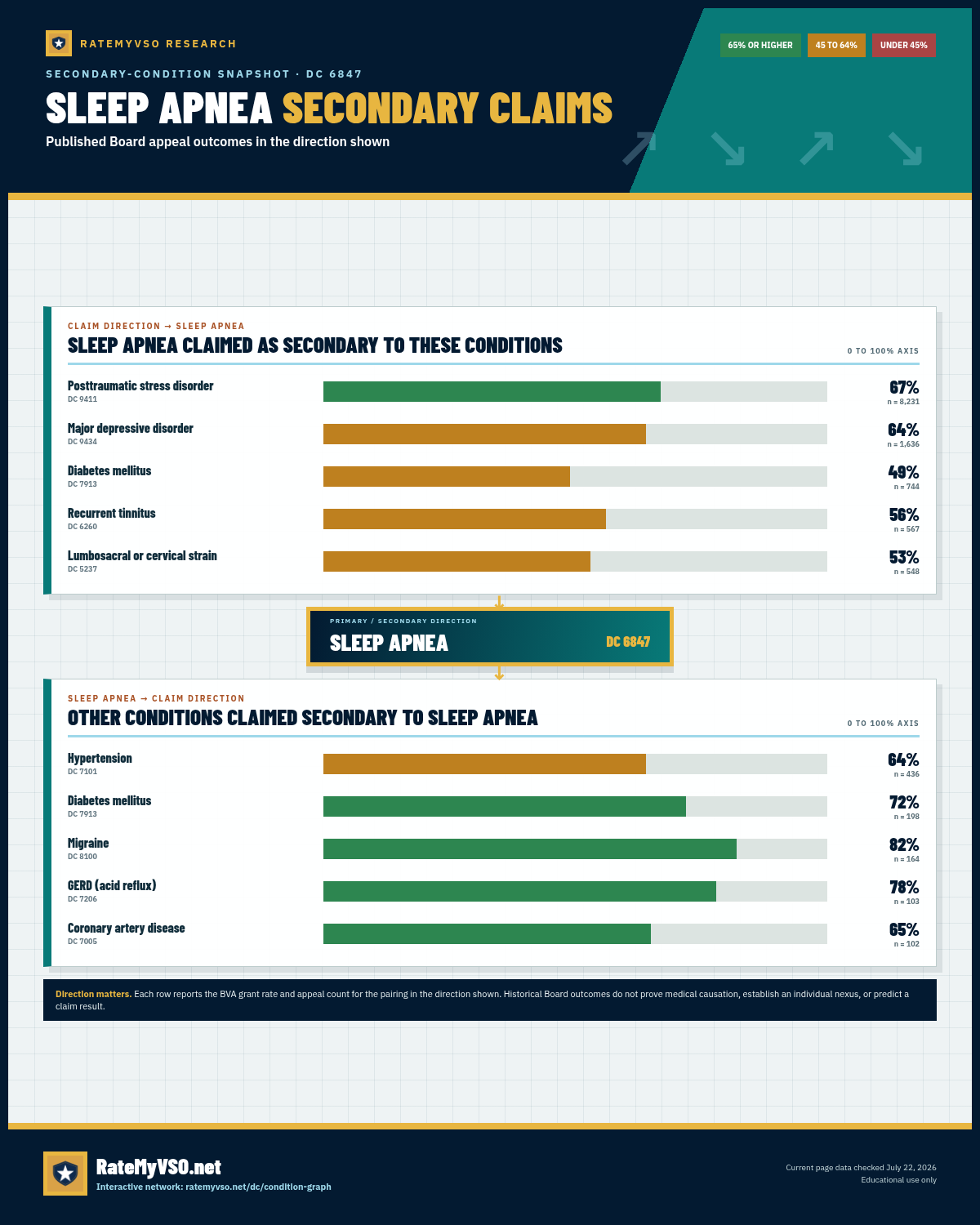 One-page guide: Sleep Apnea Secondary-Claim Snapshot
Two-direction secondary-claim snapshot for SLEEP APNEA, showing BVA grant rates and appeal counts for conditions claimed toward and away from SLEEP APNEA. Opens the full-size chart, free to save or print.
One-page guide: Sleep Apnea Secondary-Claim Snapshot
Two-direction secondary-claim snapshot for SLEEP APNEA, showing BVA grant rates and appeal counts for conditions claimed toward and away from SLEEP APNEA. Opens the full-size chart, free to save or print.
Prepare and take the next step
Prepare: your own working pages
Optional. These are your own notes, in your own words. They are not a VA form, they are not sent to the VA, and nothing here is a medical finding or a prediction about your claim.
Three reminders while you prepare
- Start with the sleep-study record
Record the diagnosis and apnea type as written in the report, along with the study date and prescribed treatment. Leave unknown results blank. Go to this part
- Keep diagnosis and service connection separate
A sleep-study result identifies the condition. The guide separately explains the possible connection to service, or to another service-connected condition. Go to this part
- Describe the history and daily effects
Organize what you experienced, what someone else actually observed, and what changed with treatment. Do not treat research percentages as your own odds. Go to this part
Sign in or create an account to save your answers and come back to them later. You can fill these in and print them without an account.
Sleep study and treatment record
Onset and daily-life timeline
Exam and provider conversation
Records and unanswered questions
Decision-letter reading sheet
Quick Checklist Before You File
Bring these together before you submit anything.
- A sleep study confirming your sleep apnea diagnosis, with the apnea type and AHI documented.
- A nexus opinion that explains its reasoning and is tied to service or to a specific service-connected condition.
- A list of every service-connected condition that could plausibly connect (PTSD, depression, tinnitus, a knee or back condition, a medication).
- Your weight and treatment history if you're raising obesity as an intermediate step.
- Buddy statements about snoring, choking, or gasping for air, ideally describing when it was first noticed.
- A personal statement describing your symptoms and their onset, consistent with everything else in your file.
- If you were denied before: new and relevant evidence for a Supplemental Claim, not just a repeat of what was already considered.
For the mechanics of actually submitting the claim, see the Standard Claim Guide and the Fully Developed Claim Guide (filing with all your evidence up front can speed up the decision).
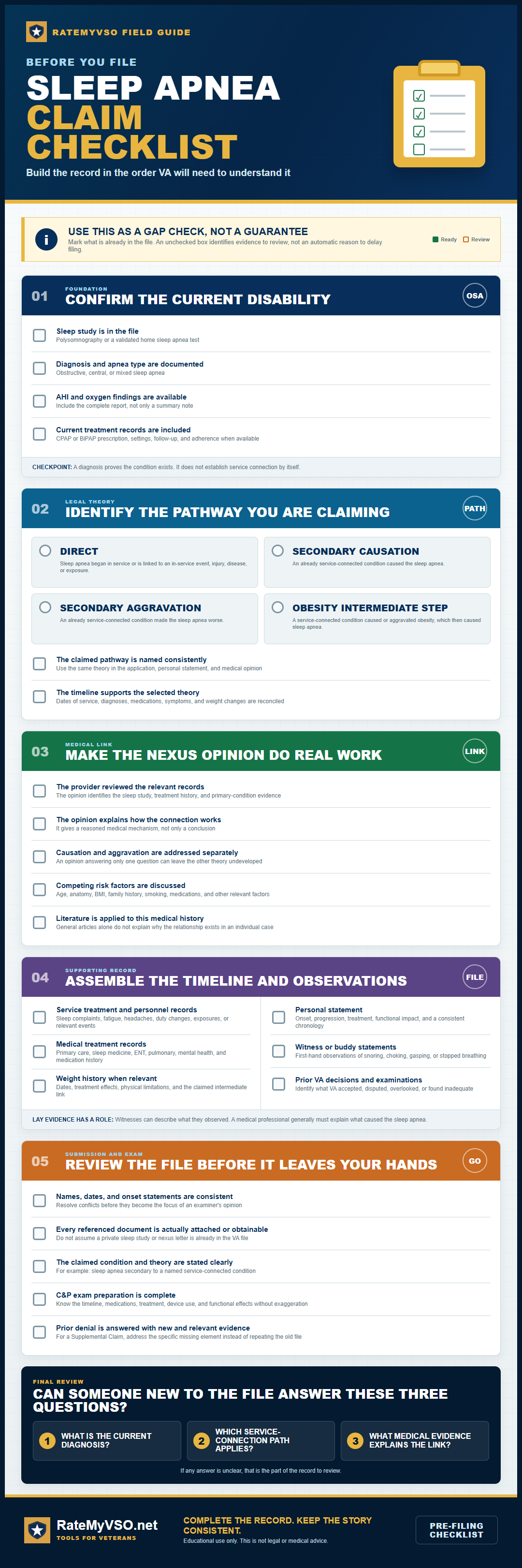 One-page guide: Sleep Apnea Claim Checklist
Pre-filing checklist for direct and secondary VA sleep apnea claims. Opens the full-size chart, free to save or print.
One-page guide: Sleep Apnea Claim Checklist
Pre-filing checklist for direct and secondary VA sleep apnea claims. Opens the full-size chart, free to save or print.
The Claims Process, Step by Step
Once you file, your claim moves through a series of hand-offs. Understanding who does what helps you know who to contact, and what to expect, at each stage.
- You file the claim. Directly with VA, through VA.gov, or with the help of an accredited representative.
- VA acknowledges the claim and assigns it for development. A Veteran Service Representative (VSR) is assigned to gather your service treatment records, VA and private medical records, and any other evidence needed.
- The VSR orders a Compensation & Pension (C&P) exam if one is needed. Not every claim requires one, but most sleep apnea claims do, especially secondary claims where a nexus opinion is required.
- The C&P exam is conducted. By a VA clinician or a contracted examiner, who completes a Disability Benefits Questionnaire (DBQ) documenting the diagnosis, severity, and, where relevant, a nexus opinion.
- The file goes to a Rating Veteran Service Representative (RVSR), the "rater." The rater reviews the complete file, including the exam results, and decides whether service connection is warranted and at what percentage.
- A senior reviewer may review the decision before it's finalized, depending on the complexity of the claim.
- VA issues the decision letter. This states whether the claim is granted or denied, the rating percentage if granted, and the reasons behind the decision.
- If you disagree, you choose an appeal lane. Higher-Level Review, Supplemental Claim, or a Board appeal, covered later in this guide.
Who's who: VSO vs. VSR vs. Rater vs. C&P Examiner
Your VSO
An accredited representative from a veterans service organization, or an accredited attorney or claims agent. Not a VA employee. Helps you prepare, gather evidence, and file, and can represent you through an appeal. Has no authority to decide your claim.
VSR (Veteran Service Representative)
VA staff who "develops" your claim: requests records, schedules the C&P exam, and assembles the file. Does not decide the rating.
Rater (RVSR)
VA staff who reviews the completed file and makes the actual decision, service connection or denial, and the percentage. This is the person whose judgment the decision letter reflects.
C&P Examiner
A VA clinician or a contracted medical examiner who conducts the exam and completes the DBQ. Documents findings and, where asked, a nexus opinion. Does not decide the claim.
For the full walkthrough of every stage with more detail, see Inside Your Claim and Claim Stages.
DBQs and Your C&P Exam
A Disability Benefits Questionnaire (DBQ) is the standardized form an examiner completes for your condition, it structures the exam findings into the specific data points VA's rating schedule requires (for sleep apnea, that includes the sleep-study results, AHI, and whether a breathing device is prescribed). See the DBQ Guide for how these forms work, including whether a private DBQ completed by your own doctor can be submitted instead of relying solely on a VA exam.
Before your C&P exam, bring a clear, specific account of your symptoms, focus on your worst days and how the condition affects daily function, not just how you feel on an average day. Be consistent with what's already in your medical records and prior statements. For a full walkthrough of what to expect and how to prepare, see the C&P Exam Prep Guide.
Reading Your Decision Letter, and What to Do If Denied
Your decision letter has two parts: a narrative section explaining the reasoning (often called "reasons and bases"), and a codesheet showing the actual rating percentage, the effective date, and the diagnostic code used. See the Reading Your Decision Letter Guide for how to find and interpret each part, or use the Letter Interpreter tool to upload your own letter and get a plain-English breakdown.
If your claim is denied, or the rating is lower than you expected, you have three main lanes:
- Supplemental Claim: refile with new and relevant evidence, such as a new nexus opinion or updated sleep study. See Supplemental Claim Guide.
- Higher-Level Review (HLR): a senior reviewer looks at the same evidence again for a difference of opinion, no new evidence is added. See HLR Guide.
- Board Appeal: your case goes to a Veterans Law Judge at the Board of Veterans' Appeals, with options for a direct review, an evidence docket, or a hearing. See Board Appeal Guide.
Not sure which lane fits your situation? See the Appeals decision guide for a side-by-side comparison of all three.
After You Win: Maintaining Your Rating
A grant is not always the end of the story. Keep your treatment consistent, continued follow-up with a sleep-medicine provider, and records showing ongoing CPAP or BiPAP use if one is prescribed, protects you if VA schedules a future reexamination. Not every rating gets reexamined; understand when a rating becomes protected from future review (including Permanent and Total status) and what to do if VA proposes to reduce it. See Protect Your Rating and Future Reexaminations for the specifics.
If your sleep apnea worsens after the initial grant, for example progressing to require a higher level of care, you can file for an increased rating. See the Rating Increase Guide.
References and related resources
Quick Reference Tables
Secondary Connection Pathways
| Primary Condition | Mechanism | Evidence Needed |
|---|---|---|
| PTSD (DC 9411) | Sleep disruption, hypervigilance, medication weight gain | Sleep study + nexus opinion linking PTSD to OSA |
| TBI (DC 8045) | Brainstem respiratory control dysfunction | Sleep study + neurological nexus opinion |
| Knee/back disability | Immobility causing obesity causing OSA | Three-link documentation: injury, weight gain, OSA |
| Rhinitis/sinusitis (DC 6522, 6513) | Nasal obstruction reducing airflow | Sleep study + ENT or pulmonary nexus |
| Prescribed medications (opioids, benzodiazepines, CNS depressants, psychiatric medications) | Blunted breathing drive (central apnea) or relaxed upper-airway muscles (obstructive apnea); weight gain as intermediate step | Sleep study identifying apnea type + nexus opinion naming the specific medication and mechanism |
From Filing to Decision: Who Does What
| Role | Does | Decides your rating? |
|---|---|---|
| VSO / accredited representative | Helps prepare, gather evidence, and file; represents you on appeal | No |
| VSR | Develops the claim: orders records and the C&P exam | No |
| C&P Examiner | Conducts the exam, completes the DBQ, may give a nexus opinion | No / but has a strong impact |
| Rater (RVSR) | Reviews the full file and decides service connection and percentage | Yes |
Related Tools and Guides
Sources
- 38 CFR § 4.97, DC 6847, Schedule of Ratings, Respiratory System (Sleep Apnea Syndromes)
- 38 CFR § 3.303, basic rules for service connection
- 38 CFR § 3.310, Secondary Service Connection
- 38 CFR § 3.306, Aggravation of Pre-Service Disability
- 38 CFR § 3.951(b), Protection of Ratings
- 38 CFR § 3.2501, new and relevant evidence to reopen a claim; 38 CFR § 3.400, effective dates
- 87 FR 8474 (Feb. 15, 2022), NPRM Proposed Sleep Apnea Rating Changes
- 89 FR 74162 (Sept. 12, 2024), Supplemental NPRM on Sleep Apnea
- Walsh v. Wilkie, 32 Vet. App. 300 (2020), obesity as an intermediate step in secondary service connection, whether caused or aggravated by the service-connected disability
- Garner v. Tran, 33 Vet. App. 241 (2021), applying the obesity intermediate-step theory
- VA General Counsel Precedent Opinion 1-2017, obesity as an intermediate step
- Linville v. Shulkin, 26 Vet. App. 180 (2013), Obesity as intermediate step in secondary service connection
- Spicer v. McDonough, 61 F.4th 1360 (Fed. Cir. 2023), but-for causation standard for secondary service connection, including impeded treatment
- Jandreau v. Nicholson, 492 F.3d 1372 (Fed. Cir. 2007), competency of lay testimony regarding observable symptoms
- Layno v. Brown, 6 Vet. App. 465 (1994), competency of lay evidence describing personally observed symptoms
- Wallin v. West, 11 Vet. App. 509 (1998), a medical nexus requires a competent medical opinion, not just an advocate's argument
- Buchanan v. Nicholson, 451 F.3d 1331 (Fed. Cir. 2006), VA cannot rely solely on the absence of records to deny a claim
- VA Claims Insider, "Sleep Apnea Secondary to PTSD" (2025)
- After Service, "VA Sleep Apnea CPAP 50% Rating Explained" (2025)
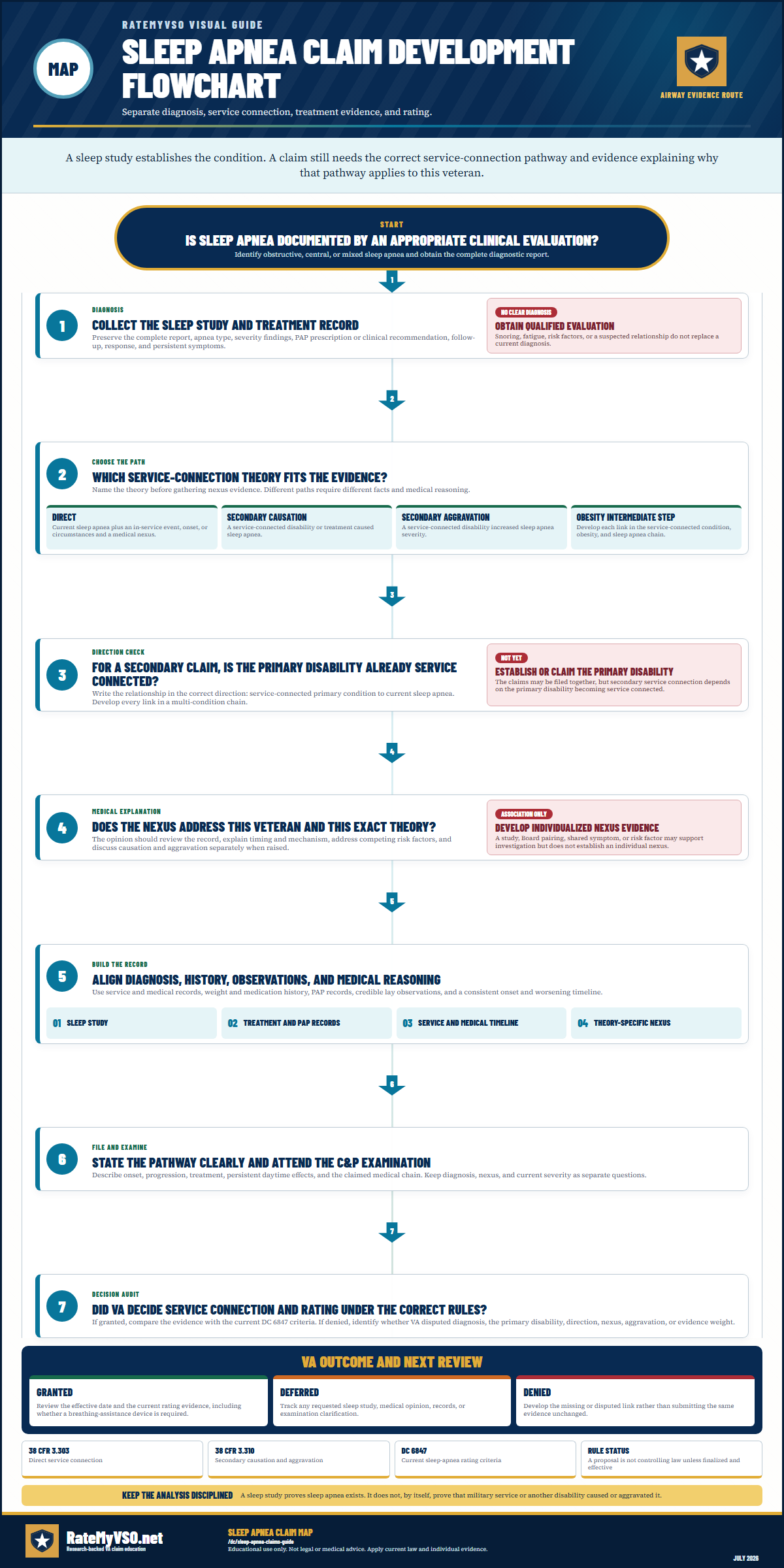
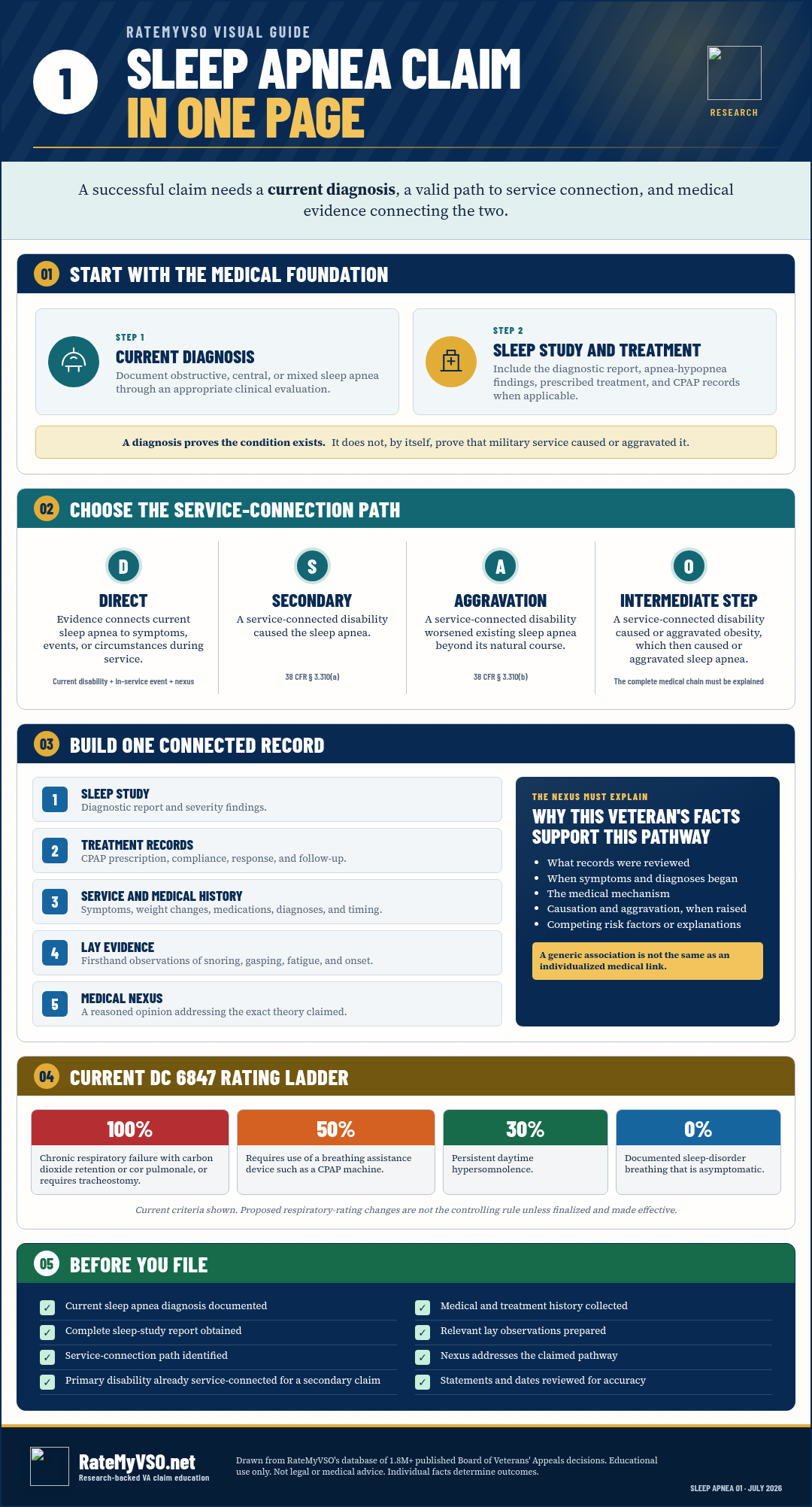 One-page guide: Sleep Apnea Claim in One Page
One-page overview of the evidence and legal paths for a VA sleep apnea claim. Opens the full-size chart, free to save or print.
One-page guide: Sleep Apnea Claim in One Page
One-page overview of the evidence and legal paths for a VA sleep apnea claim. Opens the full-size chart, free to save or print.