The Fight Over When VA Benefits Begin
Two veterans show the early impact and limits of Hoffman v. Collins

AI-generated editorial illustration of a fictional veteran, not a photograph or a depiction of either claimant in the cited decisions.
Summary
A migraine veteran kept asking VA to correct his benefit date. A National Guard veteran won earlier dates for three awards. Their cases show how Hoffman v. Collins began influencing Board appeals within days, and why a new ruling could not resolve every dispute.
Highlights
- The Board questioned the 0% rating. The migraine examiner had said a headaches examination was unnecessary.
- Hoffman helped preserve an earlier date. The Guard veteran received a one-year change for three awards.
- An error motion remained undecided. The migraine veteran still needed the VA office to address it.
Severe migraines and an unanswered request
Long before he filed his claim, the veteran had suffered severe, prolonged migraine attacks. Witness statements and medical records documented that history. Yet when VA first recognized his headaches as connected to his service, it assigned a 0% rating.
VA later awarded 50%, but from a later starting date. The veteran kept asking it to correct what he believed was an error in the earlier decision.
By August 2026, the Board of Veterans' Appeals was questioning the original rating, too. VA had obtained a medical opinion about the connection to service, but the examiner had submitted a "Waiver Option Form" indicating that a headaches examination was unnecessary. No headaches examination was conducted for the initial claim. Given the medical and witness evidence documenting severe attacks, the Board said the basis for the initial 0% evaluation was unclear.
It also acknowledged the veteran's frustration. He had repeatedly raised a specific challenge to the old decision, and VA had repeatedly failed to decide it. The Board said it was "baffled" by the VA office's disregard of the properly raised motion and repeated requests for an answer. Read the migraine decision.
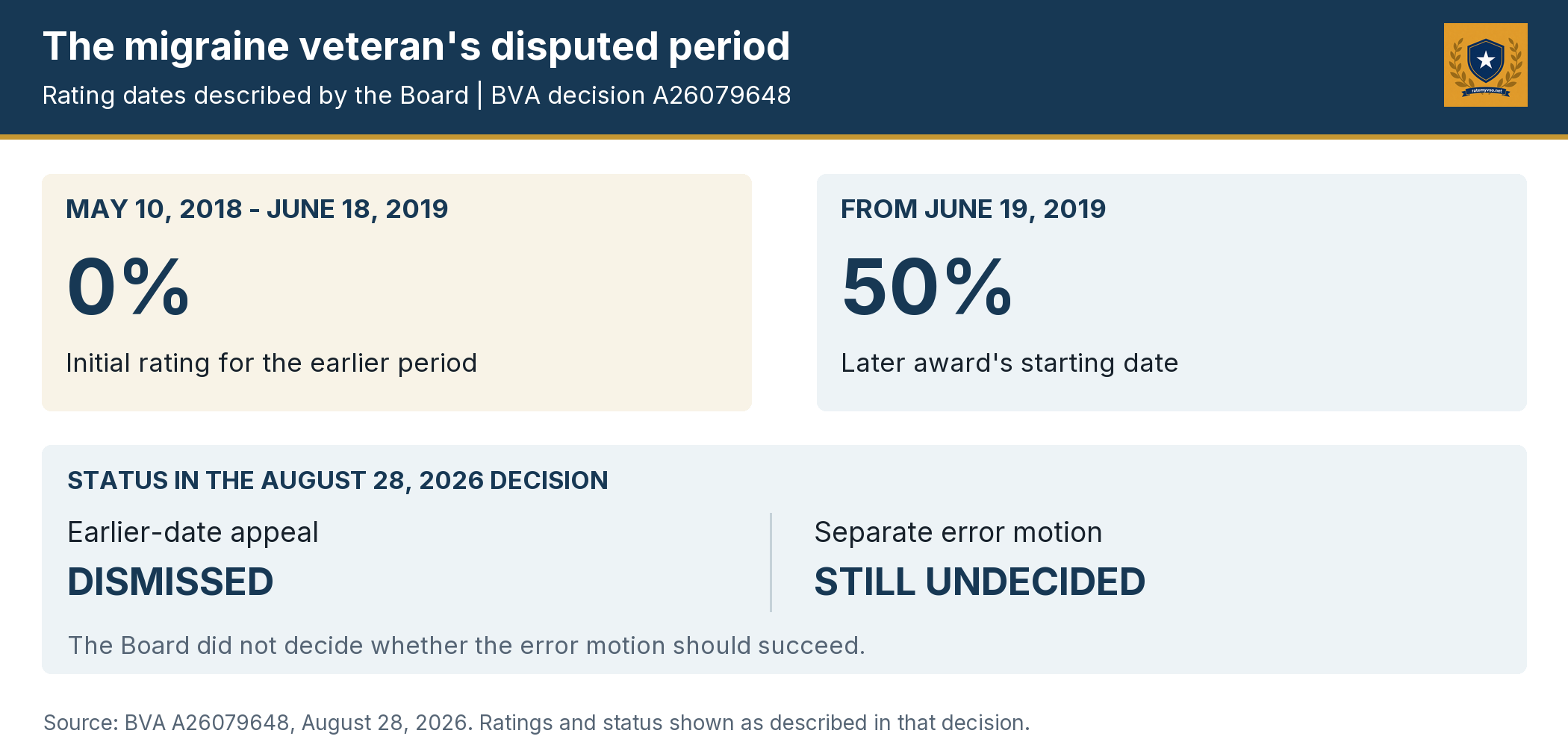
The veteran had served on active duty from November 1990 to November 1994. His dispute concerned the period between May 2018, when his original claim was considered filed, and June 2019, when the 50% rating began. He believed the higher rating should have covered that earlier period as well.
The issue had already reached the Board before. Its August 2026 decision recalled a September 2024 ruling that had recognized his allegation of error. Nearly two years later, the VA office still had not decided that allegation.
Why an Intent to File matters
Four days before this latest Board decision, the Court of Appeals for Veterans Claims had issued Hoffman v. Collins. The new precedent addressed a filing-date problem that could cost veterans an earlier start to their benefits. The Board saw a possible Hoffman problem in this veteran's case. Even so, it could not grant the appeal before it.
An Intent to File tells VA that a claim is coming. Completing the appropriate claim within a year can preserve that earlier date. But some veterans also have older claims they are keeping alive through timely requests for review.
In Hoffman, VA had used up an Intent to File on one of those continuously pursued claims, even though that claim gained no earlier date from it. VA then refused to apply the Intent to File to a later claim that could benefit. On August 24, 2026, the Court held that VA could not do that. The ruling protected the filing date from being consumed without helping the veteran. Read the court's decision.
An earlier date for a National Guard veteran
Three days later, the Board cited Hoffman in the case of a Missouri Army National Guard veteran who had served on active duty in 2004-2005 and again from April 2008 to May 2009.
He first filed for tinnitus on April 28, 2009, while still on active duty. VA denied that claim the following month. It eventually granted service connection in May 2025. By the time his appeal reached the Board in August 2026, the dispute was over how far back that award should reach.
He was pursuing a sleep-apnea claim while preparing separate claims for carpal tunnel syndrome in both arms and tinnitus. He filed an Intent to File on February 28, 2023, then submitted the completed carpal-tunnel and tinnitus claims on February 28, 2024. His representative specifically asked VA to connect them to the earlier filing date.
VA instead treated the Intent to File as already used by the sleep-apnea claim. That claim had remained alive through timely review requests and already had an earlier protected date. Using the Intent to File there added nothing, while leaving the other claims with later dates.
The Board agreed that the Intent to File should have remained available. In its August 27 decision, it cited Hoffman and awarded February 28, 2023, effective dates for both carpal-tunnel awards and tinnitus, a year earlier than the dates under review. Read the National Guard veteran's decision.
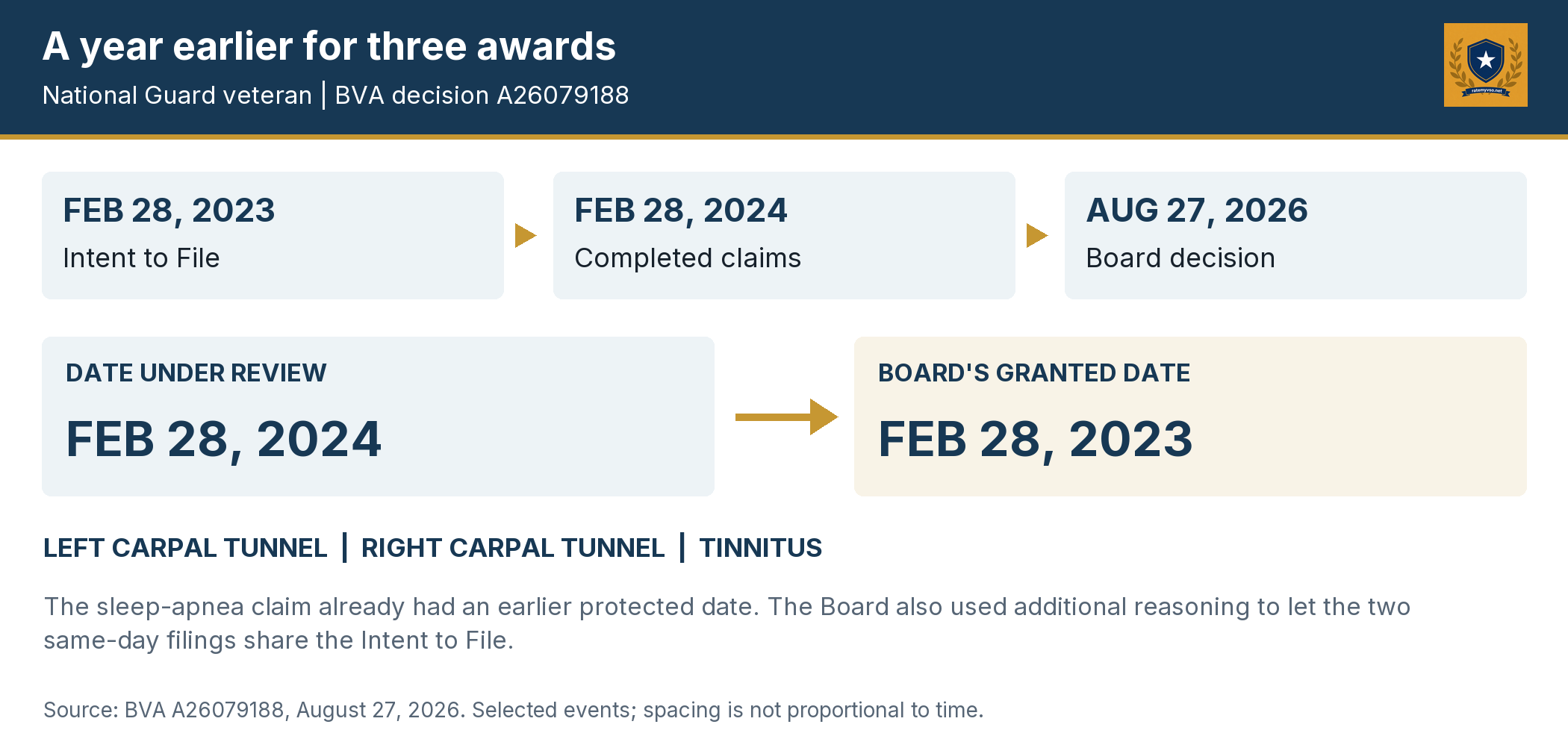
Tinnitus required an additional step. The veteran's representative had used separate forms for the claims to comply with VA's filing practices. The Board considered those good-faith efforts and allowed both filings to share the Intent to File. That part of the result involved reasoning beyond Hoffman itself.
The decision does not state how much additional money the veteran received. What it establishes is that, within three days of the Court's ruling, the Board was using Hoffman to support earlier benefit dates in another veteran's case.
Why the migraine appeal was dismissed
The migraine veteran encountered a different obstacle. His November 2019 rating decision had become final because he had not selected a review option within the following year. His later request for an earlier date could not, by itself, reopen that final decision.
He had also raised clear and unmistakable error, a specific legal challenge to a final decision. The VA office had to decide that challenge before the Board could review it. The Board said the office had repeatedly addressed the earlier-date issue instead of adjudicating the error motion the veteran had actually raised.
Hoffman did not remove that obstacle. Although the Board questioned VA's handling of the date, it dismissed the appeal. The separate error motion remained pending, and the Board did not decide whether it should succeed. Its decision urged the veteran and his representative to press the VA office to decide it. The Board's explanation.
How this affects you
These cases are among four late-August Board decisions citing Hoffman that RateMyVSO found in its decision database. Three granted earlier dates. The migraine appeal was the fourth. The database searched reached August 31, 2026, so these are early examples, not a measure of implementation throughout VA or an account of later developments.
For veterans reviewing a decision, the cases show why the reason for an assigned date matters. An Intent to File used on the wrong claim presents a different problem from an old decision that became final, or an error motion that VA has not addressed. A representative reviewing the record needs to know which problem remains unresolved.
For the National Guard veteran, the August 27 decision moved three benefit dates back a year. For the migraine veteran, the next day's decision acknowledged his symptoms, his repeated requests and his frustration. As of that decision, VA still owed him an answer to the error motion he had already raised.
References
1. Board of Veterans' Appeals. Decision A26079648. August 28, 2026. Migraine appeal.
2. Board of Veterans' Appeals. Decision A26079188. August 27, 2026. National Guard appeal.
3. Hoffman v. Collins, No. 24-7834. U.S. Court of Appeals for Veterans Claims, August 24, 2026.