Understanding the PACT Act and TERA for VA Claims
What presumptions establish and where exposure evidence still matters

Editorial illustration. The veteran and service photograph shown are fictional.
Summary
The PACT Act expanded VA benefits for toxic exposures, including conditions VA presumes are connected to qualifying service. It also created a requirement for certain toxic exposure risk activity, or TERA, examinations and medical opinions. If a presumption applies, you generally do not need a separate opinion proving the exposure caused your condition. If it does not, your exposure history and medical evidence may still support service connection. The key is knowing what your claim has established and what still needs evidence.
Highlights
- Check the condition and the service requirements together. A qualifying presumption generally supplies the medical connection.
- Describe the actual exposure. Your duties and supporting records can matter even when ILER is incomplete.
- Read what VA decided. Accepting exposure, linking a disability and awarding benefits are separate steps.
A mechanic whose exposure record did not tell the whole story
A veteran who repaired military vehicles had a negative exposure report in his claim file. He also had prostate-cancer residuals and believed his military service was responsible.
He had served from July 1968 to July 1971, including time in Korea. His duties included work as a wheel vehicle mechanic and a fuel and electrical systems repairman. Although his Individual Longitudinal Exposure Record, known as ILER, was negative, VA accepted exposure to fuel and fumes based on his military work.
His claim also involved an allegation of Agent Orange exposure near the Korean demilitarized zone. The record did not establish that exposure. The accepted fuel exposure was a separate finding supported by his duties.
A VA medical opinion supplied the connection between those duties and his prostate-cancer residuals. In January 2025, the Board of Veterans' Appeals granted service connection.
But the Board denied three other conditions in the same decision: AL amyloidosis, type 2 diabetes and hypertension. Accepting the fuel exposure did not settle whether it caused each disability.
Read the mechanic's decision on RateMyVSO, A25004600.
The exposure finding and the medical connection answer different questions. A presumption can supply the connection in a qualifying claim. In another claim, a medical opinion may be needed to establish it.
Where the PACT Act and TERA fit together
The PACT Act is the law Congress enacted in 2022 to expand benefits and health care for veterans with toxic exposures. Among its changes, it added presumptive conditions and qualifying exposure locations. It also established the TERA examination and opinion requirement in 38 USC 1168.
TERA stands for toxic exposure risk activity. In a compensation claim, it concerns an activity or service circumstance involving toxic exposure that may be relevant to the disability being claimed.
You do not have to choose between two separate benefit programs. You claim the disability. VA then considers the service history, the applicable presumptions and the other evidence connecting that disability to service.
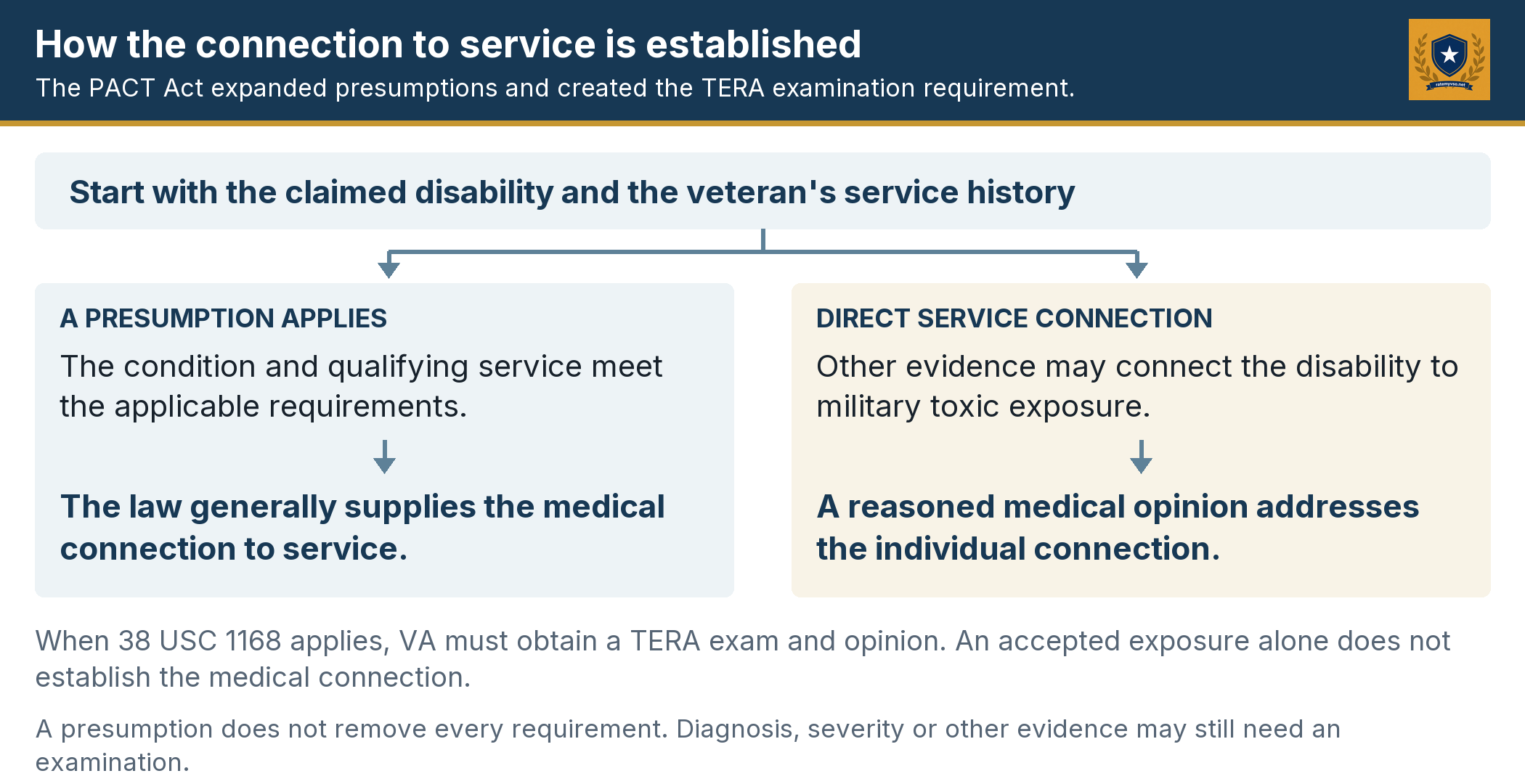
Some presumptions predate the PACT Act; others were added or expanded by it. Check your condition and service against the applicable rules. VA's PACT Act guidance explains the current lists.
What a presumption does and what it leaves to prove
A presumption can remove the need to prove that a particular exposure caused your illness. You still need evidence that the claimed disability exists and that the qualifying service requirements are satisfied. The name of the condition matters.
An Army veteran's March 2025 Board decision shows why. The veteran had qualifying service in Kuwait, Bahrain and Afghanistan and claimed both rhinitis and sinusitis. An examination contained conflicting statements about rhinitis, but treatment records supported that diagnosis. The Board granted rhinitis on a presumptive basis.
It denied sinusitis because the record did not establish a current sinusitis diagnosis. The problem was not that sinusitis could never qualify as presumptive. The necessary diagnosis was missing from this veteran's evidence.
Read the rhinitis and sinusitis decision on RateMyVSO, A25021432.
For someone preparing a claim, that is a reason to review the actual medical records rather than rely on a broad description such as sinus problems. Make sure the condition you identify matches what your clinician has found. Separate rules can apply to Gulf War undiagnosed illnesses; those should not be confused with a claim for a specific diagnosed condition.
What counts as a toxic exposure risk activity
Toxic exposure can come from the work you performed as well as the place you served. Relevant activities may involve:
- Handling fuels or working around exhaust.
- Working near burn pits, oil-well fires or other airborne hazards.
- Using solvents, cleaning agents, pesticides or industrial chemicals.
- Working with materials containing asbestos.
- Training or working with firefighting foam containing PFAS.
- Other documented occupational or environmental hazards.
The statutory definition of TERA includes activities requiring entries in exposure tracking records and other activities VA determines qualify for the protection of veterans' health. An overseas combat deployment is not a universal requirement. Military maintenance, firefighting and other duties can matter even when they occurred at a domestic installation.
A job title helps establish context, but your actual duties provide the detail. Explain what you handled, where you worked and how the contact occurred. For Guard and Reserve service, identify the duty status and dates as well; compensation eligibility depends on the type of service involved.
Ionizing radiation has additional presumptive and dose-development procedures. A generic TERA explanation should not replace those specific rules.
How VA decides whether you participated in a TERA
VA reviews the exposure history alongside the available records. Those can include assignments, personnel records, service treatment records, deployment information, occupational duties, exposure databases and credible statements from you or people who served with you. 38 USC 1119 allows VA to consider exposure tracking records and the circumstances of service.
VA's TERA memorandum records its exposure determination for the claim. It helps tell the medical examiner which exposures need consideration.
If you can review that memorandum with your representative, compare it with your actual history. Are the dates and assignments correct? Does it address the fuel, solvents or other hazards you described? Does the medical opinion discuss the exposures VA accepted?
Be specific about gaps. A statement explaining that you cleaned engine components with a particular solvent several times a week is more informative than simply saying you worked around chemicals. Identify the substance if you know it, describe the task and explain the basis for your recollection. Do not guess at a chemical name or an exposure level you never measured.
RateMyVSO's MOS exposure guide can help you research the hazards associated with military work. Use that information to organize your account and locate supporting records. A general occupational list does not prove every exposure in an individual claim.
What ILER can tell you
The Individual Longitudinal Exposure Record is a DoD and VA system that links information about military exposures and related service history. It can bring together information from deployments, duty locations, occupational records and other sources. DoD's ILER explanation describes its purpose and limitations.
ILER depends on the information available in those source systems. It cannot be assumed to contain every exposure from every veteran's service, particularly when historical records are incomplete. A negative entry is therefore something to examine alongside the other evidence, rather than treat as the entire answer.
Ask your representative about the exposure records used in your claim and discuss relevant exposure history with your clinician. If records are missing or inaccurate, provide the assignments, duties and supporting evidence needed to explain the discrepancy. RateMyVSO's claim file guide explains how the documents behind a decision fit together.
When VA must obtain an examination and opinion
Section 1168 requires an examination and medical opinion when a compensation claim includes evidence of a disability and participation in a TERA during qualifying active service, the evidence is insufficient to establish service connection, and the statutory exception does not apply.
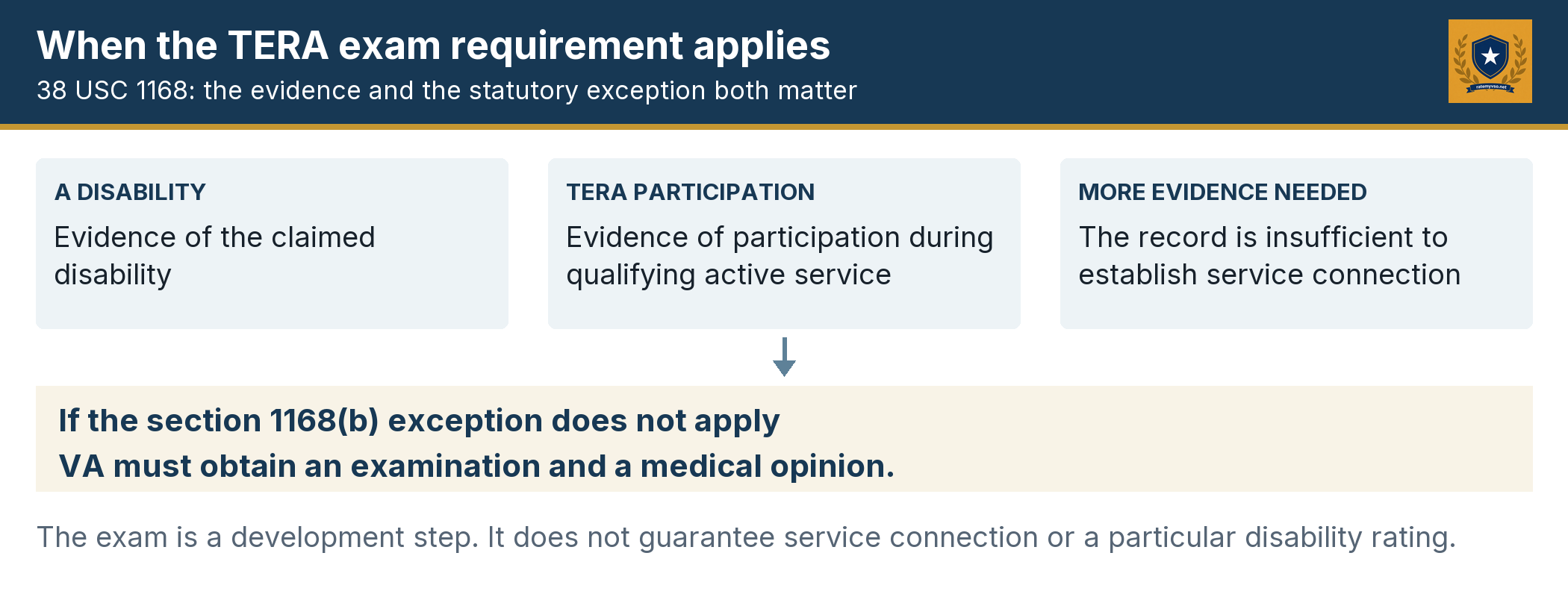
The opinion must address whether the disability is at least as likely as not related to the TERA. It must consider total potential exposure through applicable deployments and the combined effect of the veteran's TERAs. Read the examination requirements.
The statute includes an exception when VA determines there is no indication of an association between the claimed disability and the TERA. That makes the condition and the evidence important. An exception to this particular examination requirement does not automatically eliminate other grounds for service connection.
A medical opinion should explain how its conclusion fits your history. An opinion that merely says your condition is not on a presumptive list does not answer whether your exposure caused it directly. VA's direct service-connection regulation permits service connection for a disease diagnosed after discharge when the evidence establishes that it was incurred in service.
You also do not automatically need to buy a private nexus letter. The favorable opinion in the mechanic's case came from VA. A private opinion can help when it addresses a gap or conflicting evidence, but its reasoning and relevance matter more than a generic conclusion. VA's definition of competent medical evidence turns on appropriate education, training or experience, rather than a universal physician-only requirement.
Two firefighting cases with different outcomes
A veteran who served from September to December 1989 worked as a firefighter apprentice. VA accepted exposure to firefighting foam containing PFAS. Years later, the veteran had chronic lymphocytic leukemia.
In a January 2025 opinion, a private physician considered the veteran's history and medical literature. The Board weighed that opinion against an unfavorable VA opinion and found the evidence at least approximately balanced. In December 2025, it granted service connection on a direct basis.
Read the firefighter apprentice's decision on RateMyVSO, A25108050.
A different case involved an Air Force veteran who served from 1983 to 1994. Service records documented fire-brigade duties, and VA accepted PFAS exposure. The claims involved kidney cancer and hypertension, with a theory that hypertension was secondary to kidney cancer also raised.
The veteran submitted information about PFAS. The Board found the negative medical opinions did not adequately address the particular exposure history and relevant evidence. In November 2025, it remanded both issues for more development.
Read the Air Force firefighter's decision on RateMyVSO, A25095918.
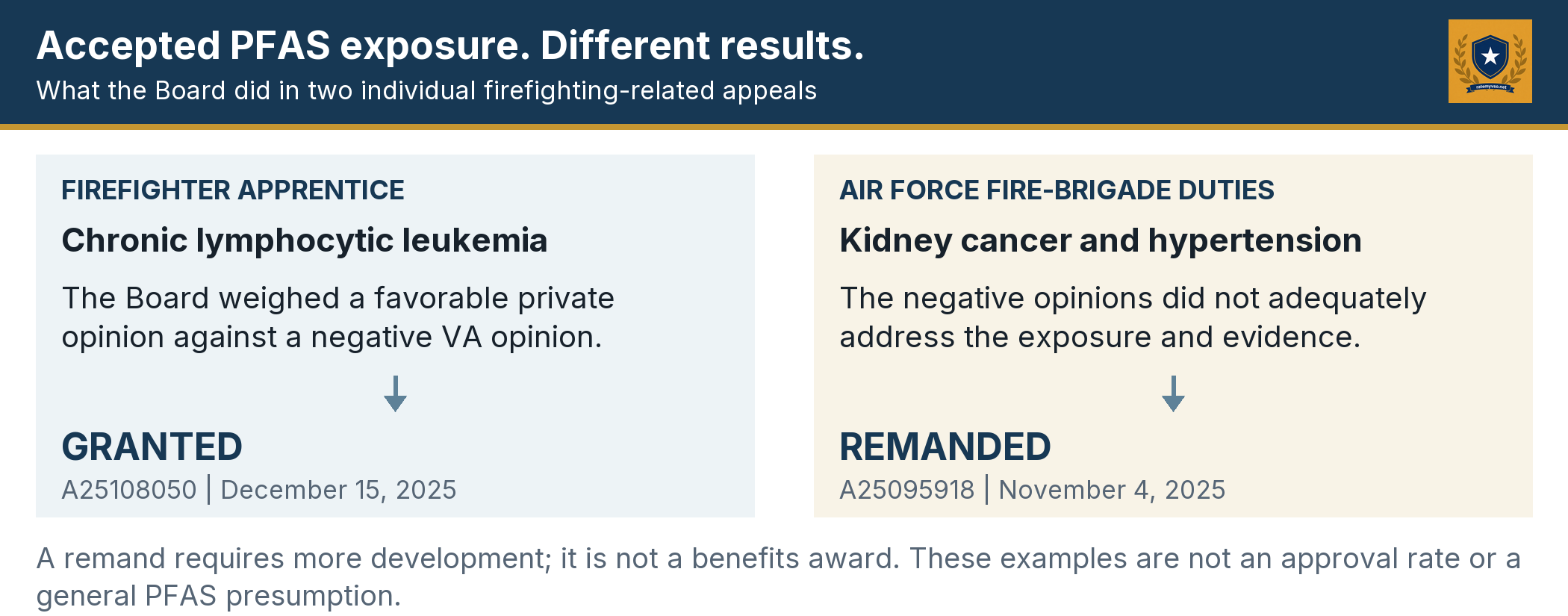
The first veteran received a grant. The second received another opportunity for VA to properly develop and decide the claims. A remand can correct a serious problem, but it is not an award of benefits.
Neither decision created a general PFAS presumption. VA currently states that military PFAS exposure has no presumptive conditions and that it considers disability claims individually. These cases show how evidence was evaluated in particular appeals; they do not establish that every firefighter develops the same illnesses or that every similar claim should have the same result.
What to put in your claim
Identify the disability you are claiming and the service exposure you believe is relevant. TERA itself has no disability percentage, and exposure alone is not the disability being rated.
Build a short, organized account of your service and medical history:
- The condition: Include relevant diagnoses, testing, treatment and continuing residuals.
- The service: Identify the unit, assignment, installation or deployment, dates and relevant duty status.
- The activity: Describe the tasks, substances if known, frequency, duration, protective equipment and how contact occurred.
- The supporting records: Identify personnel records, medical records, duty descriptions, incident reports or witnesses that support your account.
- The unresolved question: Explain any missing exposure, incorrect fact or medical issue that VA still needs to address.
For a new disability claim, VA provides Form 21-526EZ and online filing. A personal or buddy statement can be submitted using Form 21-10210. Describe what you experienced or observed, and leave medical conclusions requiring expertise to qualified clinicians.
If VA previously denied a condition that is now presumptive, its PACT guidance directs veterans to file a Supplemental Claim using Form 20-0995. Other denied claims may call for a different review choice depending on the decision, timing and whether you have new evidence. Read the decision letter before choosing the next step.
A toxic-exposure screening or registry evaluation does not file this claim for you. Those health-care activities serve different purposes from the compensation process, as VA explains in its comparison of examinations, screenings and registries.
Which approach should you pursue
Check for an applicable presumption early. It can remove the need to prove medical causation individually. RateMyVSO's Presumptive Checker can help you examine the condition and service requirements.
If you do not qualify, consider the other grounds supported by your evidence. Direct service connection can address a relationship between a disability and a military exposure. Secondary service connection addresses a disability caused or aggravated by a service-connected disability. These are different medical questions, and more than one theory can be relevant.
Claim history can affect the start date
Even after a presumptive grant, the claim history can matter. In a January 2025 decision, the Board awarded a veteran an effective date of June 29, 2020 for hypertension on a direct basis, earlier than the August 10, 2022 PACT date previously assigned. The result depended on that veteran's evidence and claim history. Read the effective-date decision on RateMyVSO, A25005304.
That is a reason to examine a supported direct theory, not a promise that TERA will move every award back to an earlier claim.
How this affects you
Start with your condition and your actual service history. Match them against the relevant presumptive rules. If they match, make sure VA has the medical and service records needed to apply the presumption. If they do not, identify the exposure evidence and the medical connection that remain to be considered.
When reading a decision, separate the findings. VA may accept that you encountered a hazard while finding that a particular disability has not been linked to it. It may recognize qualifying service while finding no evidence of the diagnosis you claimed. Those problems require different responses.
Before your next appointment or discussion with a representative, write down:
- The exact disability or residuals you are claiming.
- The service facts or exposures VA has already accepted.
- Any important error or omission in the exposure history.
- Whether the medical opinion addressed your actual condition and relevant exposures.
- What evidence would answer the reason VA gave for denying the claim.
The Board stories in this article are individual decisions, not binding precedents or predictions for your case. Their value is in showing where the evidence mattered and what VA still needed to address.
Go into your next appointment or conversation with a representative knowing which part of the claim needs attention. A missing diagnosis, an incomplete exposure history and an inadequate medical opinion each call for different evidence. Understanding that difference helps you make the next step specific to your claim.