The Presumption Trap
Two Digestive Claims, Two Different Doors
What 25,372 recent Board issues show about Gulf War presumptions, secondary service connection, and the evidence that moved real cases
Abstract
Two veterans file digestive claims. One has IBS, the other has GERD. On paper the conditions look like neighbors. At the Board of Veterans' Appeals, they walk through different doors, and the door determines what the veteran must prove.
We examined 25,372 Board issues from 2020 through 2025 that explicitly named GERD or IBS in the issue line, drawn from a corpus of 1.9 million published decisions. The pattern was clear. In 2023-2025, when the Board reached a final yes-or-no decision, it granted 79.4% of IBS issues claimed under the Gulf War presumption (177 of 223) and 70.3% of GERD issues claimed secondary to another service-connected condition (626 of 891). A focused follow-up found 242 actual GERD issues in which veterans raised a presumption or exposure theory. Only six ended in a presumptive grant for diagnosed GERD, and those six nonprecedential Board decisions conflict with the Veterans Court's controlling decision in Atencio. Twelve grants instead relied on an individualized medical opinion connecting that veteran's toxic exposure to GERD. Another 143 issues were remanded, most often for a missing or inadequate medical opinion.
The finding is not a contest between percentages. It is that the diagnosis changes the route, and the route changes the evidence the claim needs. These figures describe issues extracted from published, nonprecedential Board decisions and do not predict what will happen in a new claim.
Highlights
- The diagnosis picks the door. IBS can use the Gulf War presumption. GERD cannot, and the Veterans Court has said so directly.
- The IBS presumptive path was the strongest recent route in the data. When the Board decided yes or no, it granted 177 issues and denied 46. Another 102 were remanded.
- Secondary service connection was GERD's strongest path. The Board granted 626 issues and denied 265. But 811 more were remanded, which is more than granted and denied combined.
- The presumption was rarely the real winning path for GERD. After four non-GERD issues were removed, the focused cohort contained 242 issues. Sixty were denied, 143 were remanded, and only six ended in a presumptive grant for diagnosed GERD. Twelve grants instead relied on an individualized toxic-exposure medical opinion.
- The popular GERD/PTSD number is smaller than it looks. The tempting 82.8% merits figure for the 309-issue GERD/PTSD subset falls to 40.5% when remands and dismissals stay in the denominator.
- Both conditions are surging at the Board. GERD issues grew 66.1% and IBS issues grew 85.9% between 2020-2022 and 2023-2025, against 18.1% growth for all Board issues. Most of the growth was fights over service connection itself.
- None of this is a forecast. 2026 is excluded as a partial year, and no figure here is a medical conclusion or proof that one legal theory caused an outcome.
Two files, two doors
One veteran had IBS and service in Afghanistan. Before the PACT Act, that geography did not fit the older Persian Gulf definition used for this presumption. After Congress expanded the map, the Board found qualifying service, a diagnosis, chronic symptoms, and a compensable level of disability. It granted the claim under the expanded presumption.
A different veteran had GERD and service-connected PTSD. Geography did not open the same door. His record instead traced an individual chain: PTSD and depression were linked in his treatment records to alcohol use and dietary coping; a VA examiner identified alcohol use as a GERD risk factor; the Board resolved the evidence in his favor and granted GERD as secondary to PTSD.
Both are digestive claims. They are not the same claim. One turned on the Gulf War presumption and qualifying service. The other turned on a medical bridge built around that veteran's history. The Board data shows the difference at scale. The two decisions are illustrations, not proof by themselves.
IBS often starts with where you served. GERD usually starts with what caused it.
IBS sits inside the Gulf War rule. The regulation expressly includes irritable bowel syndrome among functional gastrointestinal disorders. For a qualifying Persian Gulf veteran, that can remove the ordinary need to prove a direct medical link between service and the condition, if the other requirements are met. (see 38 CFR 3.317).
MUCMI is short for medically unexplained chronic multisymptom illness. Under the Gulf War rule, it is a legal category that includes IBS and certain other chronic conditions when the remaining requirements are met.
GERD does not qualify for that same Gulf War presumption. The Veterans Court held that the regulation excludes GERD from consideration as a medically unexplained chronic multisymptom illness because GERD is a structural gastrointestinal disease. The ruling did not say GERD can never be service connected. It said this particular MUCMI door is closed to GERD. (Atencio v. O'Rourke).
That distinction changes the question the evidence must answer. An IBS presumptive file asks whether the veteran, service, diagnosis, chronicity, and level of disability fit the Gulf War rule. A GERD secondary file asks whether a service-connected condition caused GERD or made it worse, and whether the medical reasoning is tied to the individual record.
For this analysis, we grouped each issue by how the veteran claimed the condition was connected to service:
- Direct: The condition began during service or resulted from something that happened during service.
- Secondary: Another service-connected condition caused or aggravated it. Aggravation is included here, not counted as a separate fourth category.
- Presumptive or exposure argument: The veteran invoked a legal presumption or argued that an exposure caused the condition. For GERD, this label records the argument raised; it does not mean GERD is itself presumptive.
What happened to the recent issues
A remand is not a grant or a denial. It means the Board sent the issue back for more evidence, a better examination, or correction of another problem before a final decision could be made.
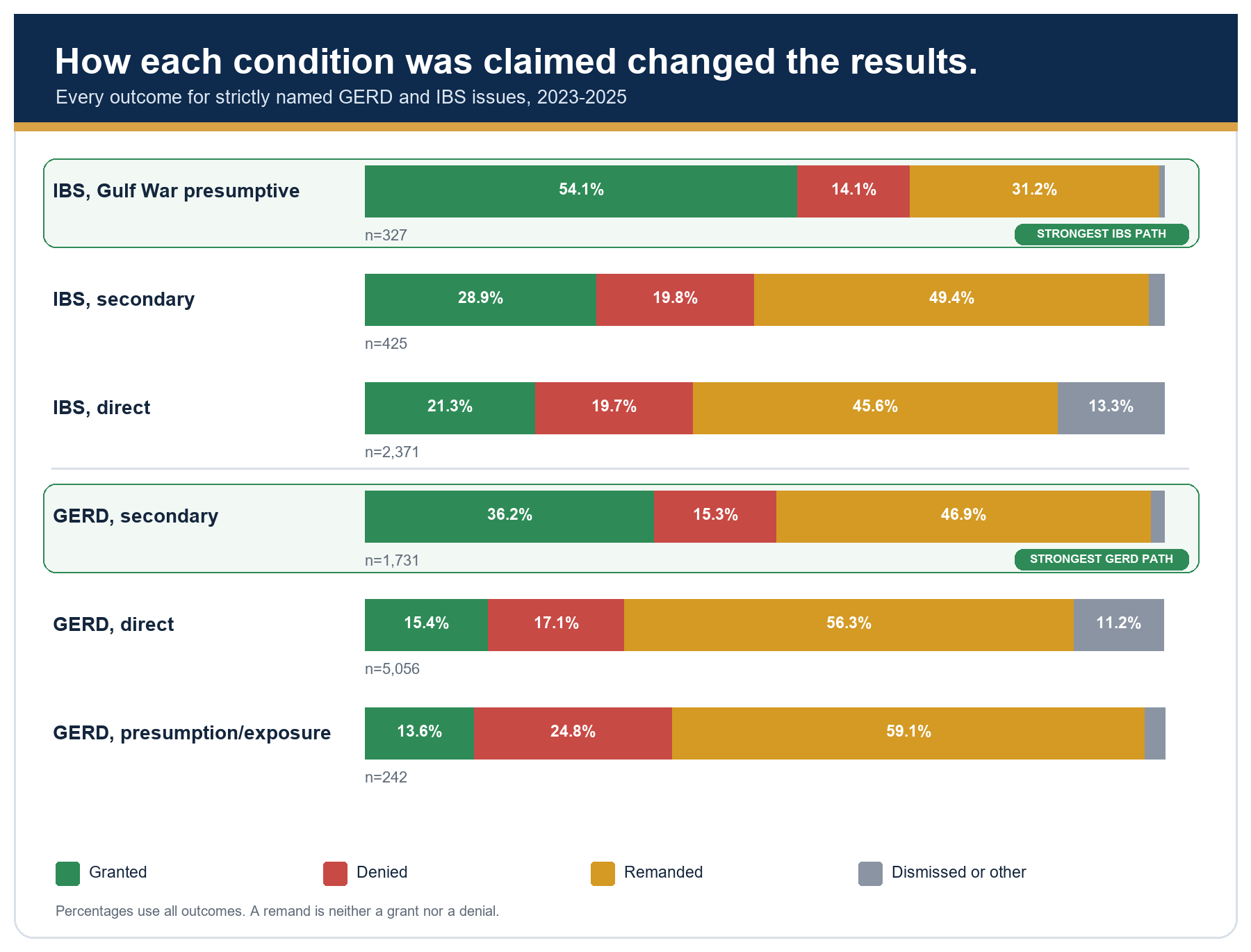
Presumptive IBS is the only claim category in the chart where grants make up more than half of every outcome, not just grants and denials. Secondary GERD is the next strongest, but its 626 grants sit beside 811 remands. The GERD exposure group shows the opposite pattern: more denials than grants, and almost six of every ten issues remanded.
The remand column is not background noise. It is the Board saying the issue could not yet be finally granted or denied. It may reflect an inadequate examination, a missed theory, missing records, or another development error. Leaving remands out can answer a useful narrow question, what happened when the Board reached yes or no, but it cannot describe the whole set.
Veterans tried the presumptive door for GERD anyway
GERD is not presumptive under the Gulf War MUCMI rule, the PACT Act burn-pit list, Agent Orange rules, or the Camp Lejeune contaminated-water list. Veterans nevertheless raised a presumption or exposure theory in 242 actual GERD issues. The arguments referenced Gulf War illness, herbicides, Camp Lejeune water, burn pits, radiation, and other toxic exposures. Four parser matches involving a different primary condition were removed before these focused counts were calculated.
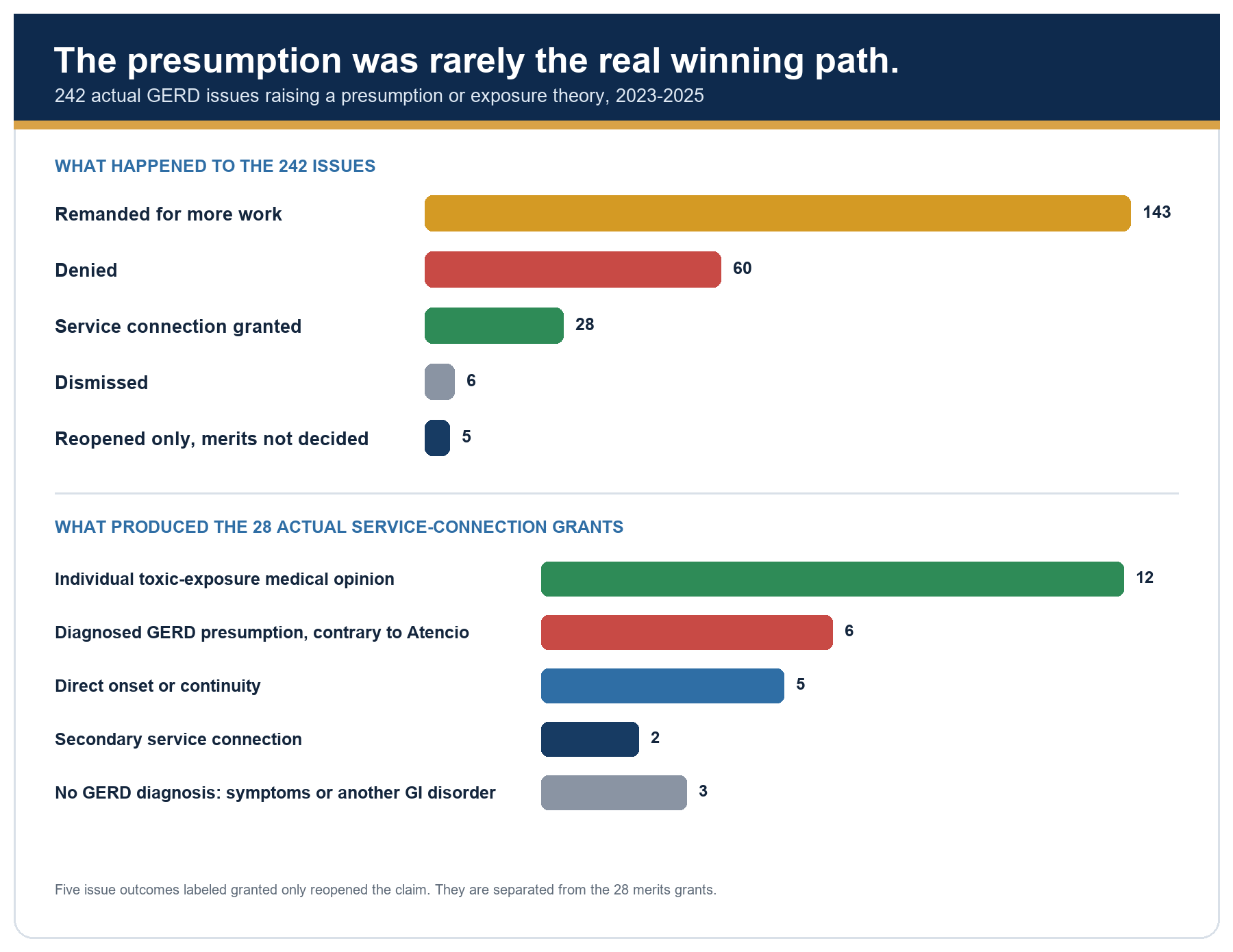
The outcome label alone hides what happened. Thirty-three issues were labeled granted, but five merely reopened the claim and sent service connection back for more work. That leaves 28 actual service-connection grants. Twelve relied on an individualized medical opinion connecting that veteran's toxic exposure to GERD. Five won through evidence of onset or continuity, and two were secondary grants. Three did not establish presumptive service connection for diagnosed GERD at all: the Board granted reflux symptoms or another functional gastrointestinal disorder after finding that GERD was not diagnosed.
Six decisions did grant diagnosed GERD under the Gulf War presumption. Those unusual, nonprecedential Board decisions conflict with Atencio, the controlling Veterans Court decision holding that GERD is excluded from consideration as a MUCMI. They show inconsistency in individual Board decisions, not a second dependable legal rule.
The larger pattern points elsewhere. The Board denied 60 issues and remanded 143. It most often remanded for a missing or inadequate medical opinion, including 102 orders for a direct-service-connection opinion and 67 orders for a toxic-exposure examination or opinion. In six of the twelve individualized toxic-exposure grants, the Board first rejected the named presumption and then granted direct service connection based on the veteran's own exposure evidence and medical opinion.
That makes the failed argument useful. Exposure may still support GERD when the evidence directly connects the exposure to the disease. But simply pointing to Gulf War service, Agent Orange, Camp Lejeune, burn pits, or the PACT Act did not finish the job.
The PACT Act expanded Gulf War eligibility. It did not make GERD presumptive.
IBS was already named in the Gulf War regulation before the PACT Act. Congress did not add IBS to the burn-pit disease list. Section 405 did two different things that matter here. It changed the statute so a qualifying disability could become manifest to any degree at any time, and it expanded who counts as a Persian Gulf veteran for this rule, including veterans who served in Afghanistan.
That is exactly what happened in one 2025 decision. The Board wrote that the veteran's Afghanistan service had not qualified before the PACT Act. The new definition supplied the missing geography. With a current IBS diagnosis, chronic symptoms, and a compensable level of disability, the Board granted under the expanded presumption. (A25013304).
The established Gulf War presumption still works. A 2024 case involved confirmed service in Saudi Arabia during the Gulf War and a diagnosis of IBS. The Board treated IBS as the qualifying chronic multisymptom illness and granted. (A24001473).
The presumption does not manufacture a diagnosis. In a 2025 denial, the veteran described occasional loose stools but had never discussed them with a treating provider. The examiner found no pathology supporting IBS, and the Board denied because there was no current IBS diagnosis. Qualifying service and a presumption could not replace the missing disability. (A25008669).
Primary law: 38 USC 1117 and Public Law 117-168, section 405.
GERD needs a bridge, not a shortcut
The recent GERD numbers point away from the Gulf War presumption and toward secondary service connection. But that claim path is not a broad medical rule that PTSD causes GERD. The Board decisions turn on the reasoning in the individual record.
Two imperfect opinions, one balanced record. A private clinician cited medical literature linking psychiatric stress and GERD. A VA examiner focused more closely on the veteran but said there was no documented causal relationship. The Board found strengths and weaknesses on both sides, called the evidence approximately balanced, and granted GERD secondary to PTSD. (A24067178).
An indirect chain built from the treatment record. Another examiner rejected a simple PTSD-to-GERD causal claim but identified alcohol use as a GERD risk factor. The veteran's treatment records tied alcohol use and unhealthy eating to PTSD and depression. The Board used that individualized chain and granted. (A25092998).
General articles could not replace the missing diagnosis. In one 2024 denial, the veteran did not come empty-handed. He submitted a medical treatise discussing PTSD, stress hormones, and digestive symptoms, along with an article about the connection between post-traumatic stress and digestion. The Board did not say those materials were worthless. It found them too general when standing alone. The veteran reported weekly burning and regurgitation, but the VA examiner and treatment records did not establish that he had GERD. No article downloaded from the internet could diagnose him, and no medical professional had applied that research to his specific condition. General studies can support a reasoned medical opinion. They cannot replace the diagnosis or the case-specific medical explanation the claim still needs. (A24016171).
The focused 242-issue review found the same problem at scale. In 47 actual GERD issues, the Board expressly discussed internet articles, general studies, or generic exposure evidence that did not establish the connection for that veteran. The rule cuts both ways. The Board also rejected VA opinions that relied on general literature or a boilerplate statement without applying it to the veteran's facts. Research can support medical reasoning. It cannot substitute for medical reasoning tied to the individual record.
Across those illustrations, the winning file did not merely name PTSD and GERD in the same sentence. It contained a current diagnosis and a medical explanation that the Board could weigh against the contrary evidence. The losing file never reached that contest because the current diagnosis was missing.
The most tempting number is the easiest to misuse
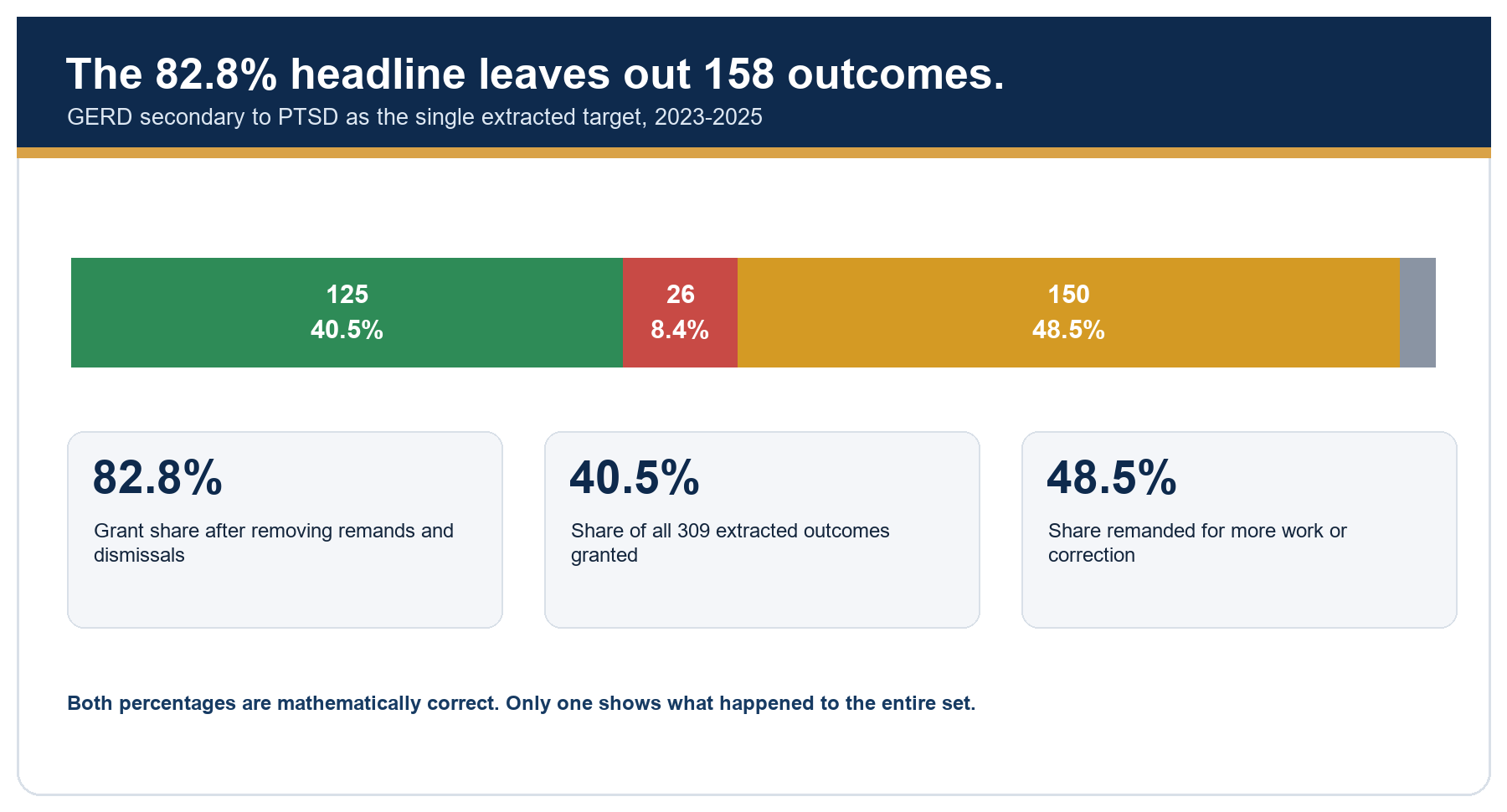
If the question is limited to grants and denials, 125 of 151 merits outcomes were grants, or 82.8%. That is mathematically correct. It is also incomplete when presented as the result for the whole set. Of all 309 issues, 125 were granted outright, 40.5%, while 150 were remanded.
The honest sentence is not 'GERD secondary to PTSD wins 83% of the time.' The honest sentence is that grants greatly outnumbered denials when the Board reached a final yes-or-no answer, while nearly half of the full set was sent back for more work.
How the conditions were claimed changed the results
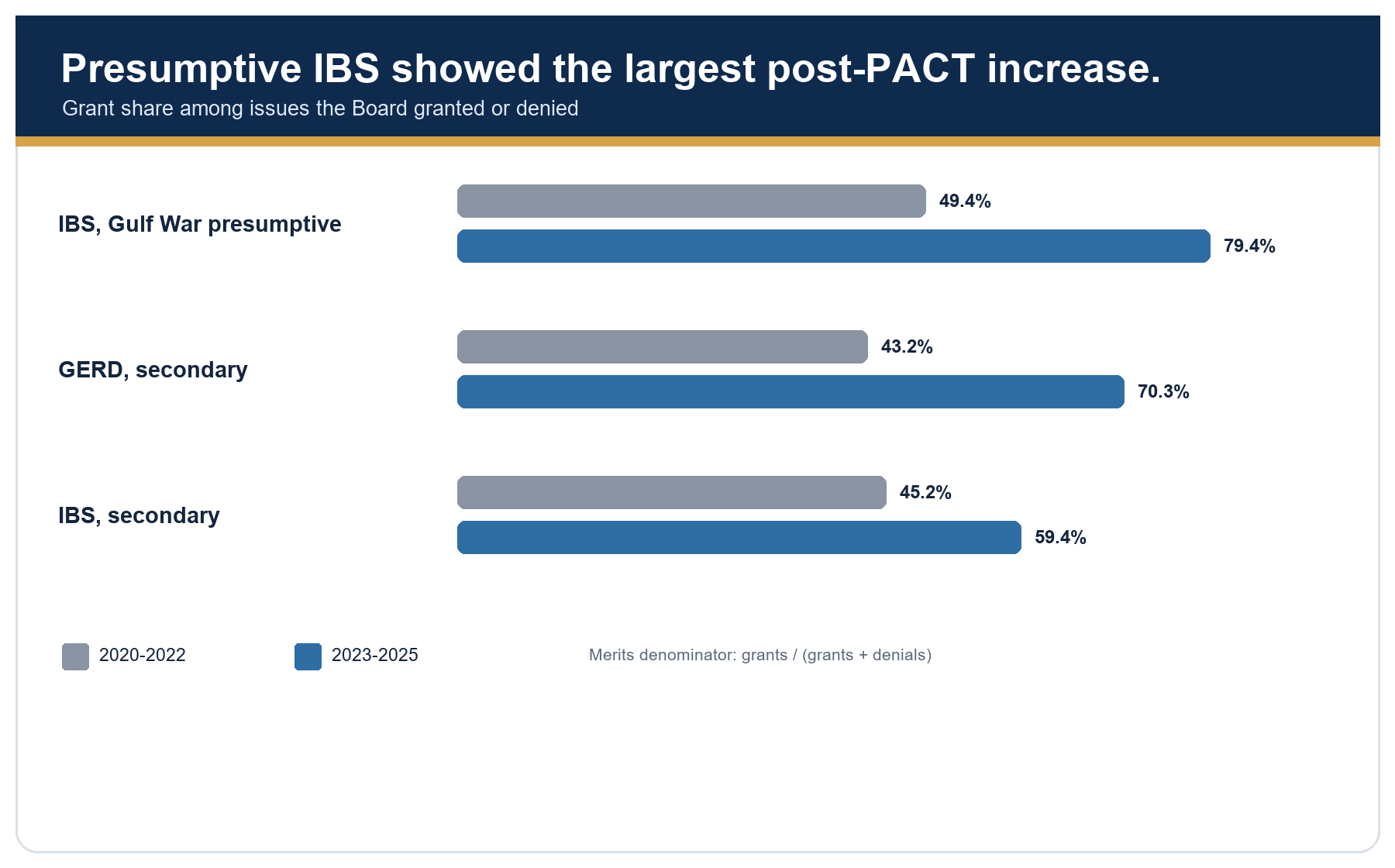
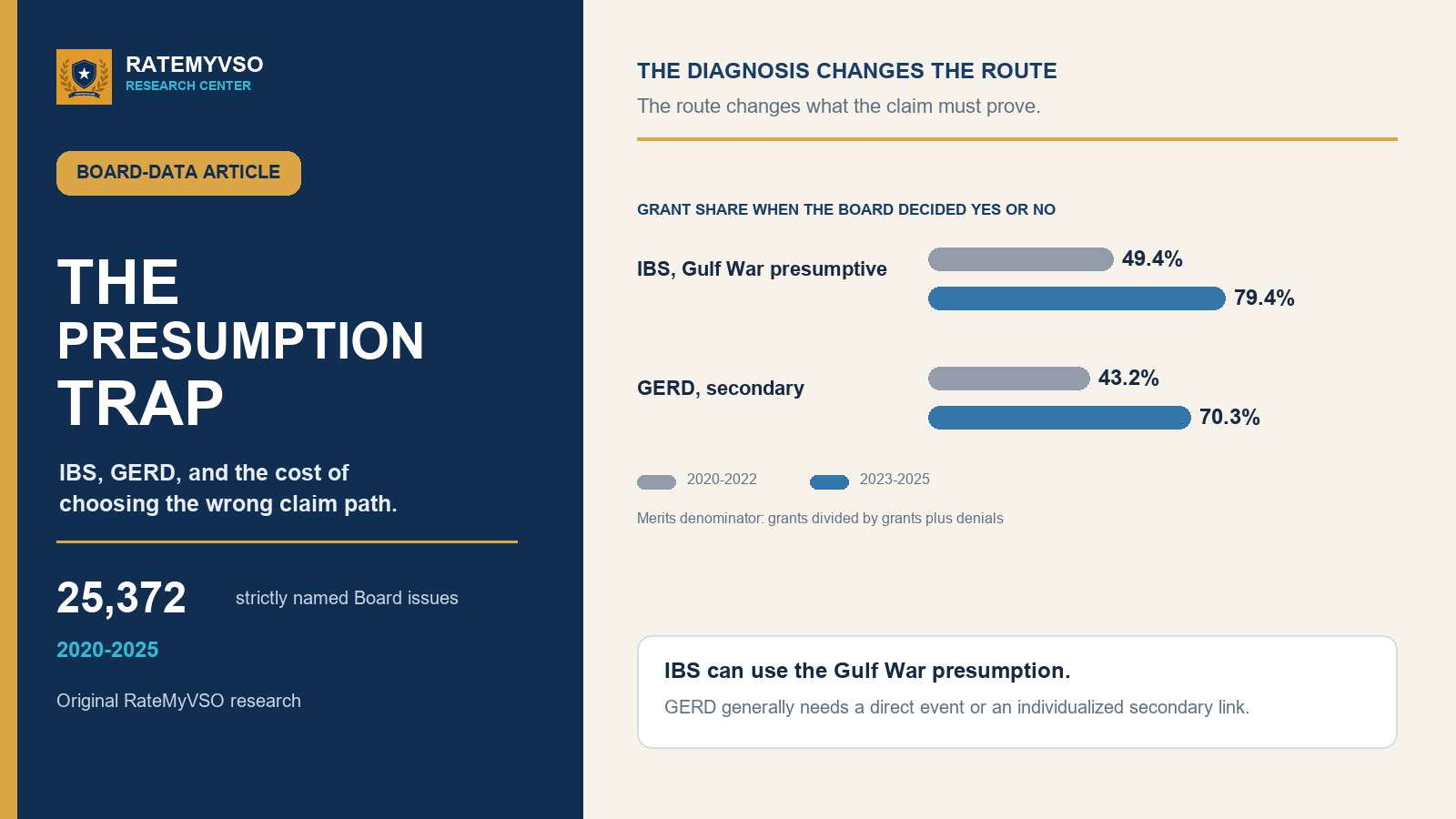
Presumptive IBS grants rose from 49.4% to 79.4% among cases decided on the merits. That shift is consistent with the PACT Act expansion, and A25013304 shows the law changing the answer. Keep in mind that there is no way to prove with 100 percent certainty that the PACT Act caused the entire increase. Case mix, docket mix, evidence quality, and Board timing can affect the number as well.
Secondary GERD rose from 43.2% to 70.3%. The PACT Act does not explain that increase. The Board data shows that the results changed sharply, but it cannot isolate the reason.
A rating-schedule change also sits inside the later window. Effective May 19, 2024, the VA revised the digestive schedule, added a dedicated GERD diagnostic code, and changed the IBS criteria. Board decisions lag the claims that produced them, and older GERD issues in the corpus are mapped to the modern code. The change is a coding and timing caveat, not a proven explanation for the pattern. (89 FR 19735).
The volume grew too
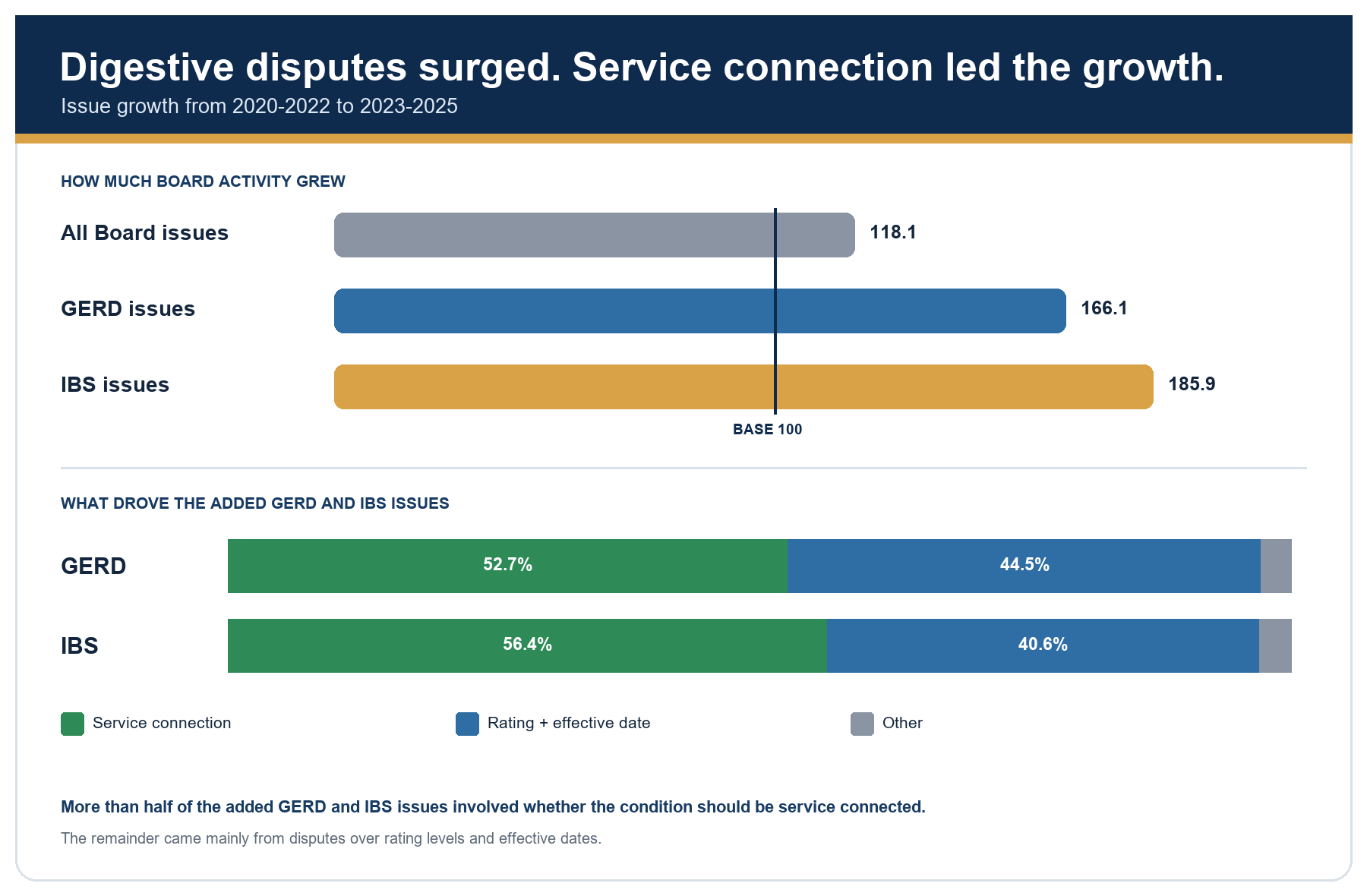
Strictly named GERD issues increased from 6,821 in 2020-2022 to 11,330 in 2023-2025, up 66.1%. IBS increased from 2,526 to 4,695, up 85.9%. All Board issues increased 18.1% over the same windows.
The increase was driven first by fights over service connection. Those issues accounted for 52.7% of GERD's growth and 56.4% of IBS's growth. Increased-rating and effective-date disputes accounted for another 44.5% and 40.6%, respectively. In plain English, veterans were not merely returning for higher ratings or earlier effective dates. Most of the added GERD and IBS cases involved the more fundamental question: Should the condition be connected to military service at all?
The data show where the growth occurred. They do not tell us why more of those disputes reached the Board.
Conclusion: The diagnosis changes the claim
IBS and GERD are both digestive conditions, but the VA does not treat them the same under the Gulf War presumption. In this analysis, veterans raised a presumption or exposure theory in 242 actual GERD issues, including Gulf War arguments. IBS is specifically included as a functional gastrointestinal disorder under the MUCMI rule. GERD is a structural disease and is not presumptive under that rule. This Board data shows why applying the IBS claim path to GERD can be a costly mistake by the Veteran.
These issues are reaching the Board much faster than the Board's overall issue volume. From 2020-2022 to 2023-2025, GERD issues grew 66.1% and IBS issues grew 85.9%, compared with 18.1% growth across all Board issues. More than half of the added issues for each condition were fights over the most basic question: Should this condition be connected to military service at all?
The PACT Act likely helped reshape the IBS side of that growth. It expanded who qualifies as a Persian Gulf veteran, including certain veterans who served in Afghanistan, and one cited decision shows that change turning previously disqualifying geography into a grant. The IBS presumptive merits grant share rose from 49.4% to 79.4%. But the PACT Act did not make GERD presumptive, and it does not explain GERD's stronger secondary-service-connection results.
The focused review makes the difference concrete. Of 242 actual GERD issues raising a presumption or exposure theory, 143 were remanded and 60 were denied. Only six ended in a presumptive grant for diagnosed GERD, and those six nonprecedential decisions conflict with Atencio. Twelve grants instead relied on an individualized medical opinion connecting the veteran's toxic exposure to GERD. GERD generally needs a different route: direct evidence connecting it to service, or a case-specific medical explanation showing that another service-connected condition caused or worsened it.
Start with the diagnosis. Then use the claim route that fits that diagnosis and build the evidence that route requires. Do not file a generic digestive claim. File the right claim for the condition you actually have.
What we searched
- Roughly 1.9 million published decisions in the RateMyVSO production Board corpus, containing roughly 4.2 million extracted issues when rechecked on August 12, 2026.
- 28,085 candidate issues from complete years 2020-2025 carried GERD code 7206 or IBS code 7319 at an extraction confidence of at least 0.4.
- 25,372 issues survived the stricter issue-line check: 18,151 explicitly named GERD, gastroesophageal reflux, or acid reflux; 7,221 explicitly named IBS or irritable bowel.
- 10,156 recent claim-path issues from 2023-2025 carried one of the three compared service-connection labels: direct, secondary, or presumptive.
- 242 actual GERD issues remained in the focused presumption-or-exposure cohort after four parser matches involving a different primary condition were removed. All 33 granted issue outcomes were hand-verified; 20 denials and 20 remands were also checked against the full decision text with no overturned classification.
- 309 GERD/PTSD issues formed the narrow single-target subset used to test the popular 82.8% merits figure.
- Nine full decisions were selected as illustrations, three from the original IBS/GERD comparison and six addressing the focused GERD questions. Every cited VA source URL was verified during the August 12-13, 2026 research work.
How we counted
- One issue is the unit. A single Board decision can decide several issues and therefore can appear more than once in an issue-level analysis.
- Every outcome stays visible. Granted, denied, remanded, dismissed, and other outcomes are counted separately in the full-outcome charts.
- Merits grant share has a narrower denominator. It is grants divided by grants plus denials. It excludes remands and dismissals and is always labeled as such.
- All-outcome grant share uses the full denominator. It is grants divided by every extracted outcome in the group.
- Complete years only. The comparison uses 2020-2022 and 2023-2025. Partial 2026 data is excluded.
- Text validation follows code screening. A condition-code match alone was not enough; the issue line also had to name the condition.
What the data cannot say
Board decisions are public but nonprecedential. The outcome shares describe issues that reached the Board, not all VA claims and not all veterans with GERD or IBS. Veterans choose different appeal and review options; files arrive with different evidence; the Board chooses whether to grant, deny, remand, or dismiss. None of those groups is randomly assigned.
The broad claim-path labels, target-condition labels, and outcomes come from RateMyVSO's extraction layer and can be imperfect. The focused GERD review used production data on August 13, 2026. It classified 246 candidates, removed four involving another primary condition, hand-verified all 33 granted issue outcomes, and checked 20 denials and 20 remands without overturning a classification. Denial and remand aggregates remain AI-extracted with sampled verification.
The cited decisions make the mechanisms concrete. They do not prove the aggregate pattern by themselves. The aggregate pattern does not prove that the PACT Act, PTSD, a diagnostic code, or any other single factor caused an outcome. Nothing here predicts an individual claim.
Verified decisions cited
All cited VA source URLs were verified during the August 12-13, 2026 research work. Board decisions are illustrations, not precedent.
| Citation | Year | Outcome | Why it appears | Source |
|---|---|---|---|---|
| A25013304 | 2025 | Granted | PACT Act expanded qualifying geography for IBS | Open |
| A24001473 | 2024 | Granted | IBS grant under the established Gulf War presumption | Open |
| A25008669 | 2025 | Denied | No current IBS diagnosis | Open |
| A24067178 | 2024 | Granted | Competing GERD/PTSD opinions in approximate balance | Open |
| A25092998 | 2025 | Granted | Individualized PTSD, alcohol-use, diet, and GERD chain | Open |
| A24016171 | 2024 | Denied | No current GERD diagnosis | Open |
| 23009250 | 2023 | Granted | Board granted diagnosed GERD presumptively despite Atencio | Open |
| A24004452 | 2024 | Granted | Presumption rejected; individualized toxic-exposure nexus won | Open |
| A24085074 | 2024 | Remanded | The agency considered only the presumption and failed to obtain an opinion | Open |
References
- RateMyVSO BVA Decision Search and production corpus snapshot, rechecked August 12, 2026
- 38 CFR 3.317, Compensation for certain disabilities occurring in Persian Gulf veterans
- 38 USC 1117, Compensation for disabilities occurring in Persian Gulf War veterans
- Public Law 117-168, section 405, Improving compensation for disabilities occurring in Persian Gulf War veterans
- Atencio v. O'Rourke, 30 Vet. App. 74 (2018)
- Schedule for Rating Disabilities: The Digestive System, 89 FR 19735, effective May 19, 2024