Choosing the Right Board Docket for Your Case: What the Data and Case Law Show
This is a guide to help you make an educated choice with your representative on which docket lane is right for you and your appeal. It uses facts, data, and case law to lay out clearly the implications of each docket choice. Once you understand the implications of each one, you can have a more meaningful conversation with your legal representative and make an informed choice. When you take a VA decision to the Board of Veterans' Appeals, you pick one of three dockets: Direct Review, Evidence Submission, or a Hearing. A hearing has always been your right and your choice, and it always will be. But the appeals system underneath that choice changed in 2019, and the published outcome and wait-time data, along with recent court decisions, are worth understanding before you decide. This page lays out what the numbers show, what the Appeals Modernization Act (AMA) changed about the hearing, and a live debate among practitioners about when a hearing is still worth requesting. It reports that debate. It does not tell you what to do with your own appeal.

The Hearing Was Built for One System; the AMA Built Another
Under the old (Legacy) appeals system, requesting a hearing usually made sense, for reasons built into how that system worked:
- The judge who heard your case decided your case. The Veterans Law Judge (VLJ) who conducted your hearing was required by law to participate in the decision. The personal encounter carried weight no written page could match.
- The hearing came with extra protections. In Bryant v. Shinseki (2010), the court held that the presiding judge had to fully explain the issues on appeal and to point out when the record was missing evidence on a material point. For a veteran without a trained representative, that was a real safety net.
- The record stayed open. You could add evidence or argument at almost any time before the Board ruled, so the hearing was the one structured choice: request it or waive it.
The AMA, fully in effect for decisions dated February 19, 2019 or later, kept the statutory right to a hearing but changed the structure around it. Three of those changes matter most.
What the AMA Changed
1. One appeal became three dockets
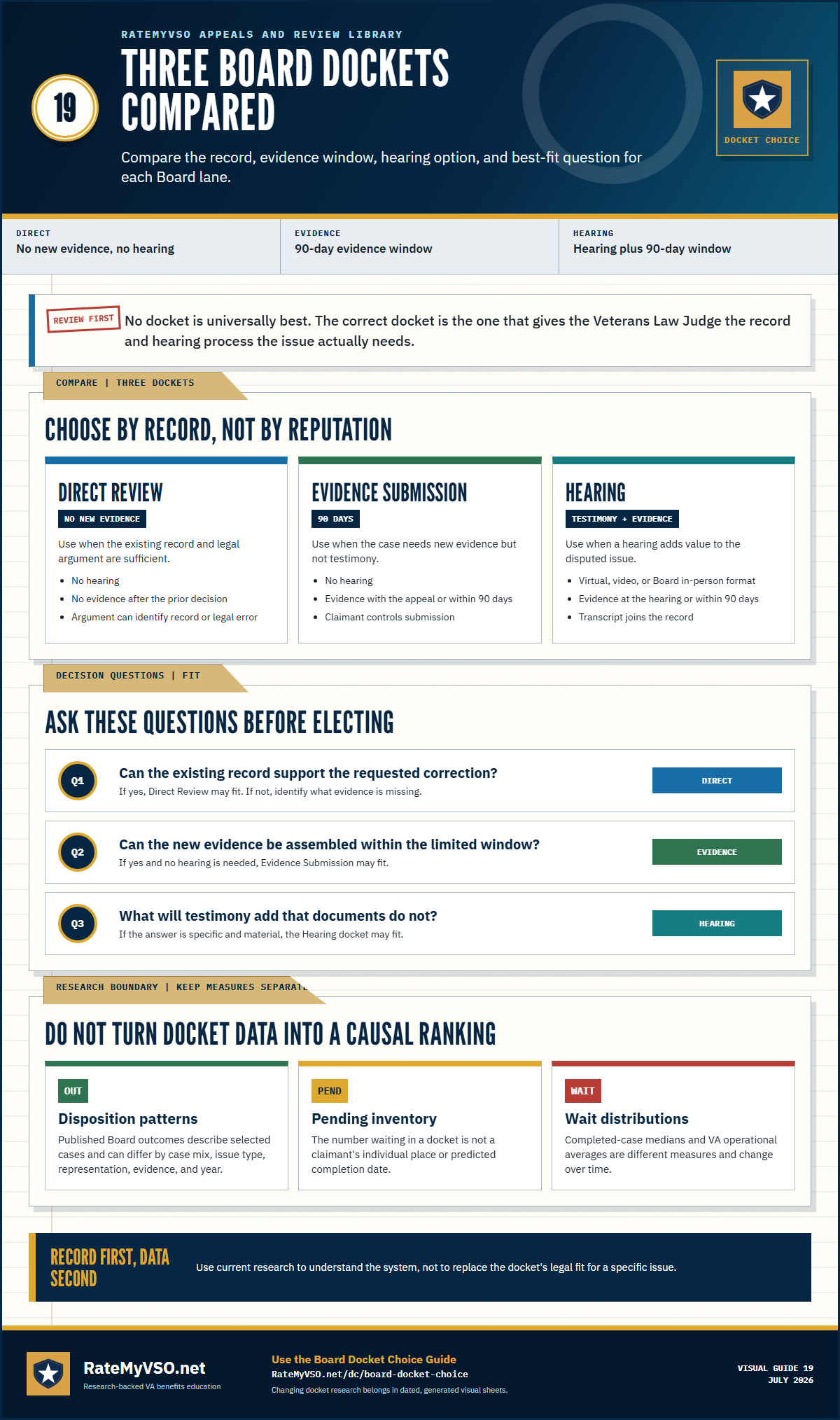
Instead of "request a hearing or not," you now elect one of three lanes at the Notice of Disagreement, each with its own evidence window and its own timing. The choice has consequences for evidence, posture, and how long you wait. See the side-by-side in the filing guide.
2. The hearing judge no longer decides the case
Under the AMA, the VLJ who holds your hearing is not necessarily the one who issues the decision. A different judge can decide months later from the written transcript. The court upheld this in Frantzis v. McDonough (2022), affirmed by the Federal Circuit in 2024.
3. Argument belongs in a brief, testimony belongs at a hearing
The Board's own rule (38 CFR 20.700(b)) says a hearing "will not normally be scheduled solely for the purpose of receiving argument," because argument "may be submitted in the form of a written brief." A hearing earns its place when it adds testimony the written record cannot carry.
Do the Three Dockets Produce Different Outcomes?
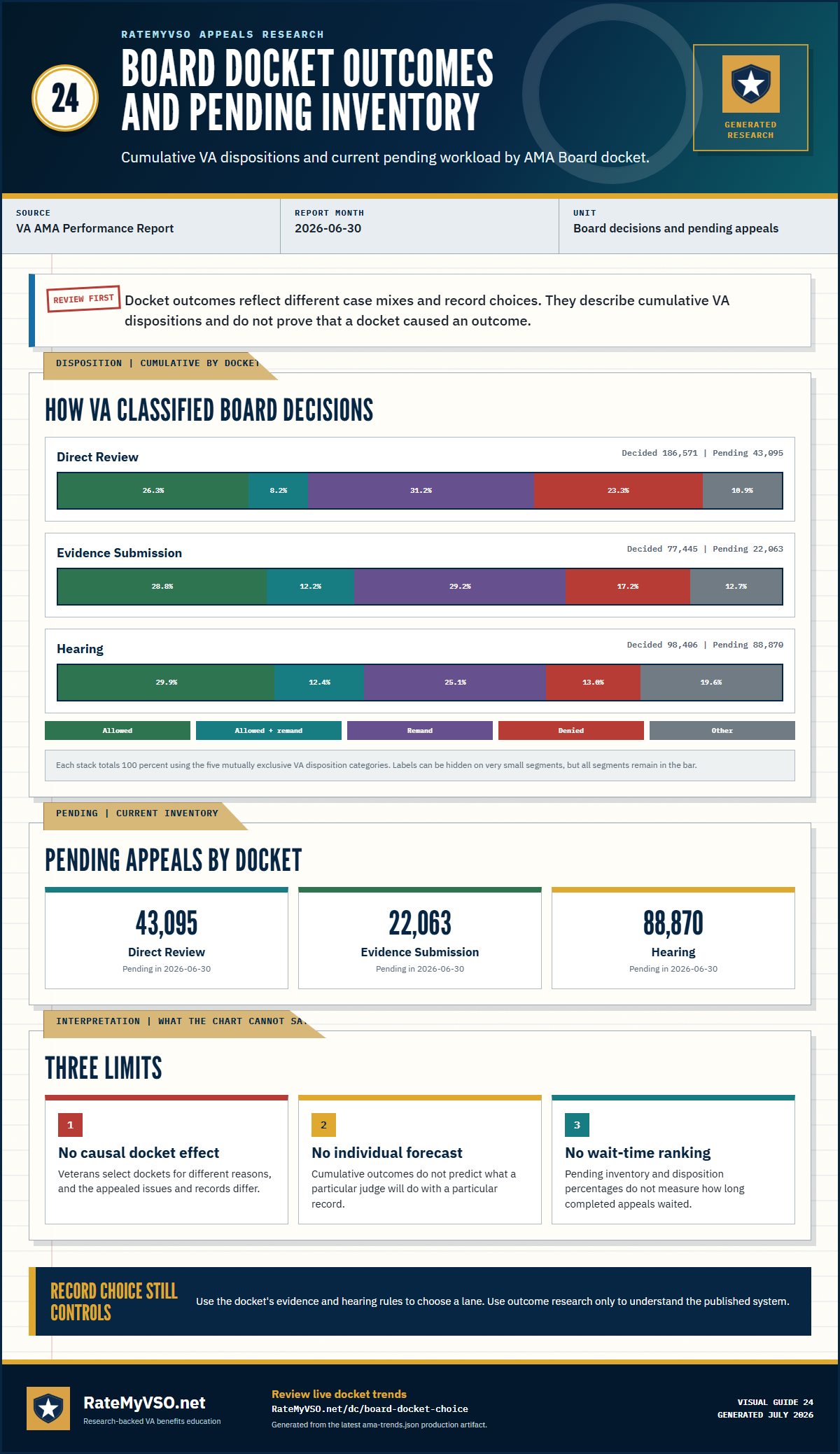
VA reports how Board appeals turn out, broken down by docket, in its AMA Performance Reports. The figures below come straight from that report and cover every AMA Board decision through May 31, 2026, about 352,000 in all. First, what the five outcomes mean, because two of them are both wins:
- Allowed = the Board granted at least one issue you appealed and did not have to send anything back. A straight grant.
- Allowed with remand = the Board granted at least one issue and sent another back to the regional office for more work (often a new exam) before it can be decided. Part win now, part still in progress. Both "Allowed" and "Allowed with remand" count as coming away with a grant.
- Remand = not a grant and not a denial. A "not yet": the issue goes back for more development, then returns to the Board.
- Denied = the Board ruled against you on the issue.
- Other = the case ended without a ruling on the merits at all (withdrawn, dismissed, or administratively closed).
Add the two grant rows together and you get the share that walked away with at least one issue granted: about 34% on Direct Review, 41% on Evidence Submission, and 42% on the Hearing docket. Close to each other.
| Outcome | Direct Review | Evidence Submission | Hearing | All dockets |
|---|---|---|---|---|
| Allowed | 26% | 29% | 30% | 28% |
| Allowed with remand | 8% | 12% | 12% | 10% |
| Granted (Allowed + Allowed with remand) | 34% | 41% | 42% | 38% |
| Remand | 31% | 29% | 25% | 29% |
| Denied | 23% | 17% | 13% | 19% |
| Reached a decision | 161,834 | 66,478 | 75,244 | 302,981 |
| Other (never reached merits) | 11% | 13% | 20% | 14% |
| Never reached merits | 20,002 | 9,934 | 18,811 | 49,322 |
| Total cases | 181,836 | 76,412 | 94,055 | 352,303 |
Swipe the table sideways to see all columns.
Look closer before you compare these numbers. At first glance the Hearing docket looks best: the lowest denial rate (13%) and a grant in more than 4 of every 10 cases (42%). But two things hide inside the table. First, look at the "Other" row. On the Hearing docket, 20% of cases landed there, nearly double the Direct Review share, meaning they were withdrawn, dismissed, or closed without the Board ever ruling, often after a years-long wait. So fewer hearing cases even reach a decision. Second, and this matters most, the three dockets run on different evidence rules. Direct Review is a closed record: the Board decides on the same evidence the regional office already had, with nothing new allowed. Evidence Submission gives you 90 days to add new evidence. The Hearing docket lets you submit evidence at the hearing and for 90 days after, and because that lane runs far longer, close to two extra years for veterans and dependents, you effectively have that whole stretch to build up your file. The data reflects exactly that: a private medical opinion appears in about 27 to 31% of Evidence and Hearing cases, against 20% on Direct Review, because two of the three lanes actually let you submit one. So the better-looking hearing and evidence numbers largely reflect the chance to fix a thin record, not the hearing itself improving the outcome. That is why we treat all of these as a record of what the Board has done before, not a prediction of what will happen in any one veteran's appeal.
What About Timing?
This is where the dockets diverge sharply. Start with the figure that describes a veteran's own appeal. At the end of March 2026 the Board reported the average time appeals from veterans and dependents had been waiting in each docket:
- Direct Review: 212 days
- Evidence Submission: 260 days
- Hearing: 870 days
Read that carefully, because it is not the number most often quoted. The two faster dockets sit close together, roughly seven weeks apart, while the Hearing docket sits about a year and a half beyond them.
The Board's monthly report shows much larger figures for the same three dockets, because that count covers everything on its docket rather than veterans alone:
- Direct Review: 471 days pending on average
- Evidence Submission: 688 days pending on average
- Hearing: 833 days pending on average
The Board explains the gap: a large batch of VHA third-party contract provider appeals was moved onto its docket, which it says "primarily impacted the AMA Direct and Evidence dockets," and it is separating those from veteran, dependent and beneficiary appeals. Those contract cases are not veterans' claims, so the veterans-and-dependents figures above are the ones that describe a veteran's wait.
One more number is easy to line up against the wrong thing. The Board publishes a timeliness goal for each docket, 365 days for Direct Review, 550 for Evidence Submission and 730 for Hearing. Those are average days to complete goals, measuring a finished appeal from the day it is filed to the day it is decided. Days pending measures the age of appeals that have not been decided yet. The two are not comparable, and the Board's own annual report says the goals "continue to be misunderstood by many." On the matching measure, the Board reported average days to complete of 937, 1,028 and 1,091 days in FY 2024, and has since reported that the Direct and Evidence dockets have come back within their goals.
A case without priority (Advance-on-Docket status, granted for terminal illness, severe hardship, or age over 75) can wait considerably longer than any of these averages. Track current figures, by docket and condition, on Board appeal wait times.
How AMA Outcomes Have Shifted Since 2019
The AMA went live in February 2019. Because VA publishes a fresh workload report every month, and each one counts every Board decision since launch, we can watch how the system settled in. Each point below comes straight from a monthly VA AMA Performance Report (Section J). The series updates on its own as new reports post.
Loading VA trend data…
The Case Law Is Moving One Direction
Two recent decisions, both in our CAVC decision database, describe a hearing under tighter procedural rules than the system that created it. Click either case to open the full opinion:
- Frantzis v. McDonough (2022, aff'd Fed. Cir. 2024). Confirmed that the judge who holds your hearing need not be the judge who decides. The live encounter that once justified the hearing no longer reaches the decision-maker directly; the transcript does.
- Cook v. McDonough (2023). Hardened the closed-record rule. Evidence outside a docket's narrow windows does not enter the record, and the Board will not fix a missed window on appeal. The Hearing docket's 90-day evidence window is firm, not flexible.
Set against the older Bryant protections: in 2010 most veterans at the Board were unrepresented or helped by a service officer without legal training, and the judge's duties to explain the issues and flag missing evidence filled a real gap. Where a veteran is now represented by an accredited attorney or claims agent, the courts have separately recognized (in cases like Massie and Mason) that agency and review obligations are calibrated down, because counsel is expected to do that work. Bryant still protects the unrepresented. Its rationale simply does less when a trained representative is already identifying the missing evidence in writing.
When a Hearing Still Earns Its Place
Reading these changes together, some practitioners argue the default should shift. Former Veterans Law Judge Bradley Hennings, now at the firm Chisholm Chisholm & Kilpatrick, has written that for veterans with accredited representation, hearings should be rare and the default should be Evidence Submission or Direct Review, reserving the hearing for cases where testimony genuinely cannot be replaced by a written submission. That is one practitioner's argument, presented here as part of the professional debate, not as guidance for your appeal. Here is the shape of both sides.
Where a hearing adds what a brief cannot
- Credibility is the whole case. The dispositive question is whether your account is believed, and the written record cannot settle it.
- Functional impact the file has not captured. The rating turns on how the disability affects daily life, and that has never been documented.
- You are the only witness. Testimony is the only way to develop a specific factual point.
Risks the argument points to
- Testimony cuts both ways. A stray concession or an inconsistency with an earlier statement becomes part of the record the Board can rely on to deny.
- Credibility findings are hard to undo. The Board's factfinding gets deferential review on appeal.
- The transcript is read cold. Under Frantzis, the deciding judge often was not in the room. A focused brief controls the narrative in a way a transcript does not.
The counterweight is just as real: a hearing is your statutory right, the only stage where you speak directly to the Board, and for many veterans that voice matters in its own right. The point of the debate is not that hearings are bad. It is that the choice deserves a deliberate look at your specific case rather than a reflex.
Related Tools and Guides
Sources: VA AMA Performance Reports (docket outcomes and days-pending, data through May 31, 2026) · VA BVA FY 2024 Annual Report · 38 CFR 20.700 · VA.gov Board Appeals · Frantzis v. McDonough, 35 Vet. App. 354 (2022), aff'd 104 F.4th 262 (Fed. Cir. 2024) · Cook v. McDonough, 36 Vet. App. 175 (2023) · Bryant v. Shinseki, 23 Vet. App. 488 (2010) · B. Hennings, "The Board Hearing Under the AMA" (Chisholm Chisholm & Kilpatrick) for the practitioner argument on docket selection. Outcome and timing figures are VA-published aggregates and shift over time. This guide is for educational purposes only and is not legal advice.