The VA Can Accept the Account but Reject the Conclusion
What Buddy and Lay Statements Can Actually Prove in a VA Claim
Abstract
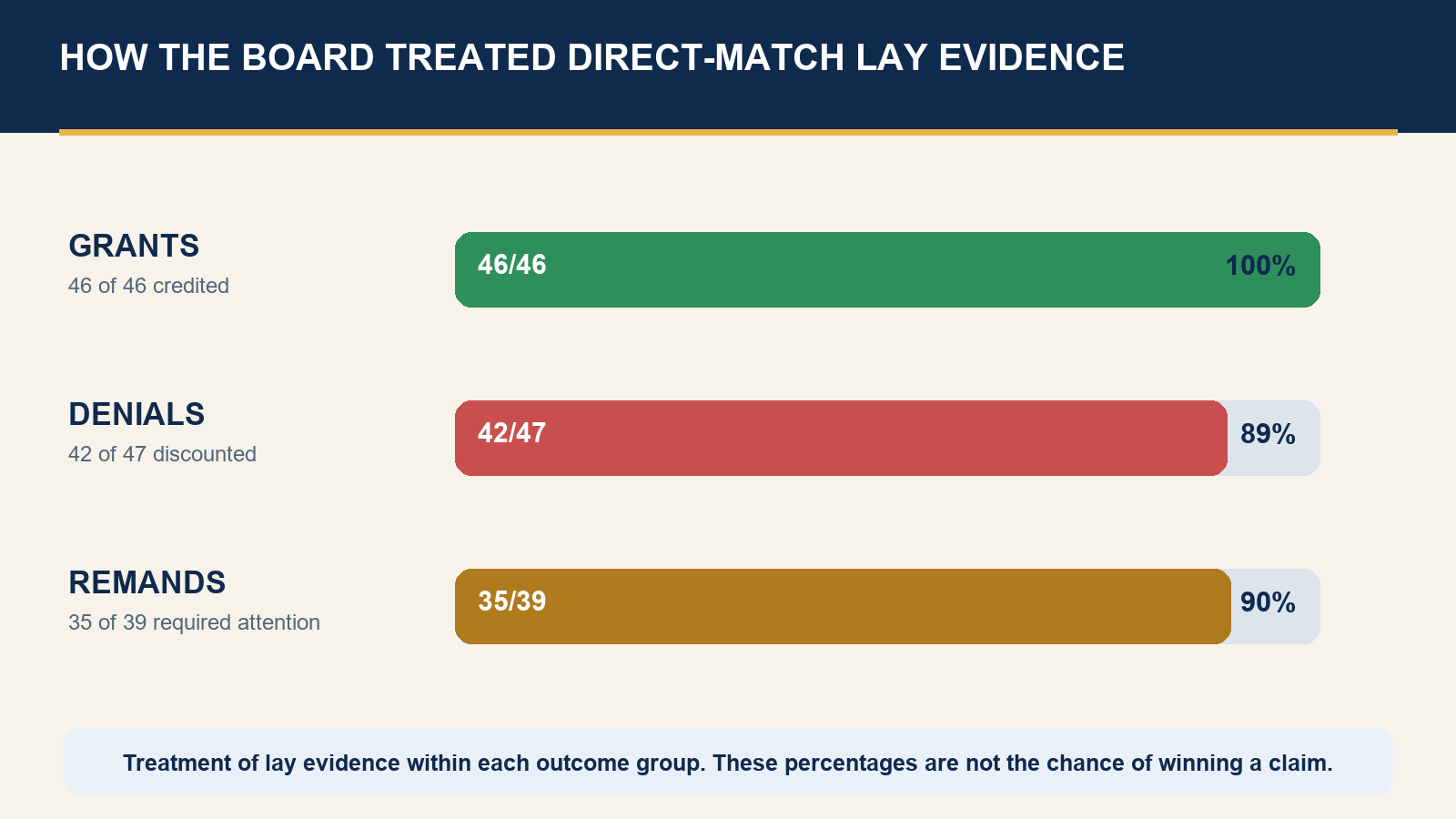
What makes a buddy or lay statement useful in a VA disability claim? We reviewed 168 Board of Veterans' Appeals decisions involving seven conditions and three outcomes, then checked whether the lay evidence actually concerned the disability being reviewed and how the Board used it. In 132 cases, the lay evidence directly addressed that disability. The Board credited it in all 46 grants, discounted it in 42 of 47 denials, and required it to be addressed in 35 of 39 remands. Across all three outcomes, the same distinction kept appearing: a witness was most useful when describing a fact personally observed and least useful when trying to answer a medical question beyond that witness's knowledge. The sample was deliberately balanced to show how the Board handled different types of lay evidence, not to calculate a grant rate for all VA claims.
Highlights
- Firsthand beats secondhand: A witness is strongest when describing something that person actually saw, heard, or noticed.
- The witness must match the facts: A fellow servicemember may know what happened during service, while a spouse or caregiver may know what happened in the years afterward.
- Observation is not a medical nexus: The same statement can provide strong evidence of symptoms and no useful evidence about what medically caused them.
- Missing records do not automatically end the issue: A credible witness may describe what happened and explain why no medical entry was made at the time.
- Ignored statements can expose an incomplete examination: If an examiner leaves out relevant firsthand observations, the Board may require another opinion.
- Consistency matters: Honest uncertainty is safer than a precise date or detail that later conflicts with the record.
The same witness gave the Board two different kinds of evidence
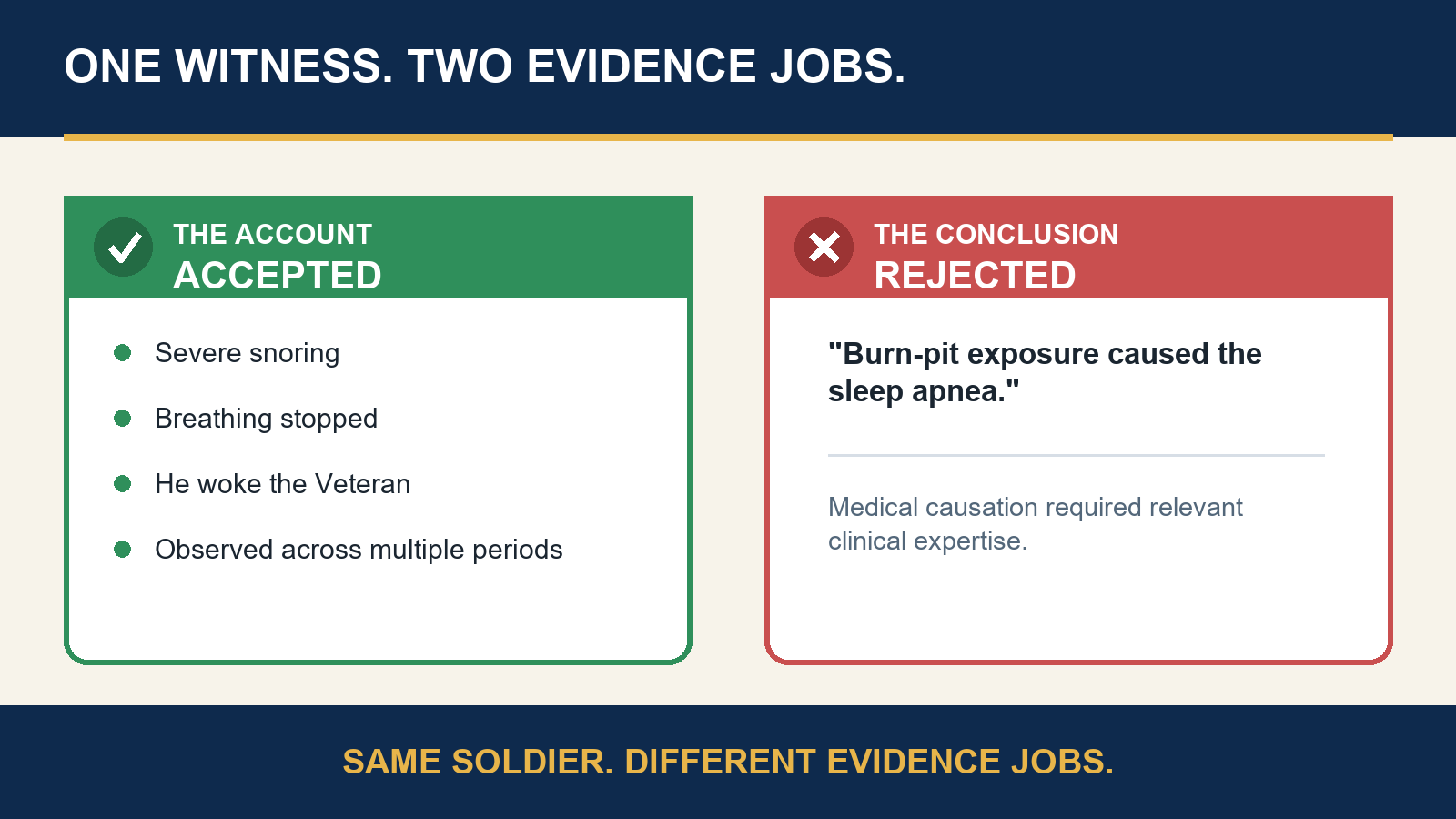
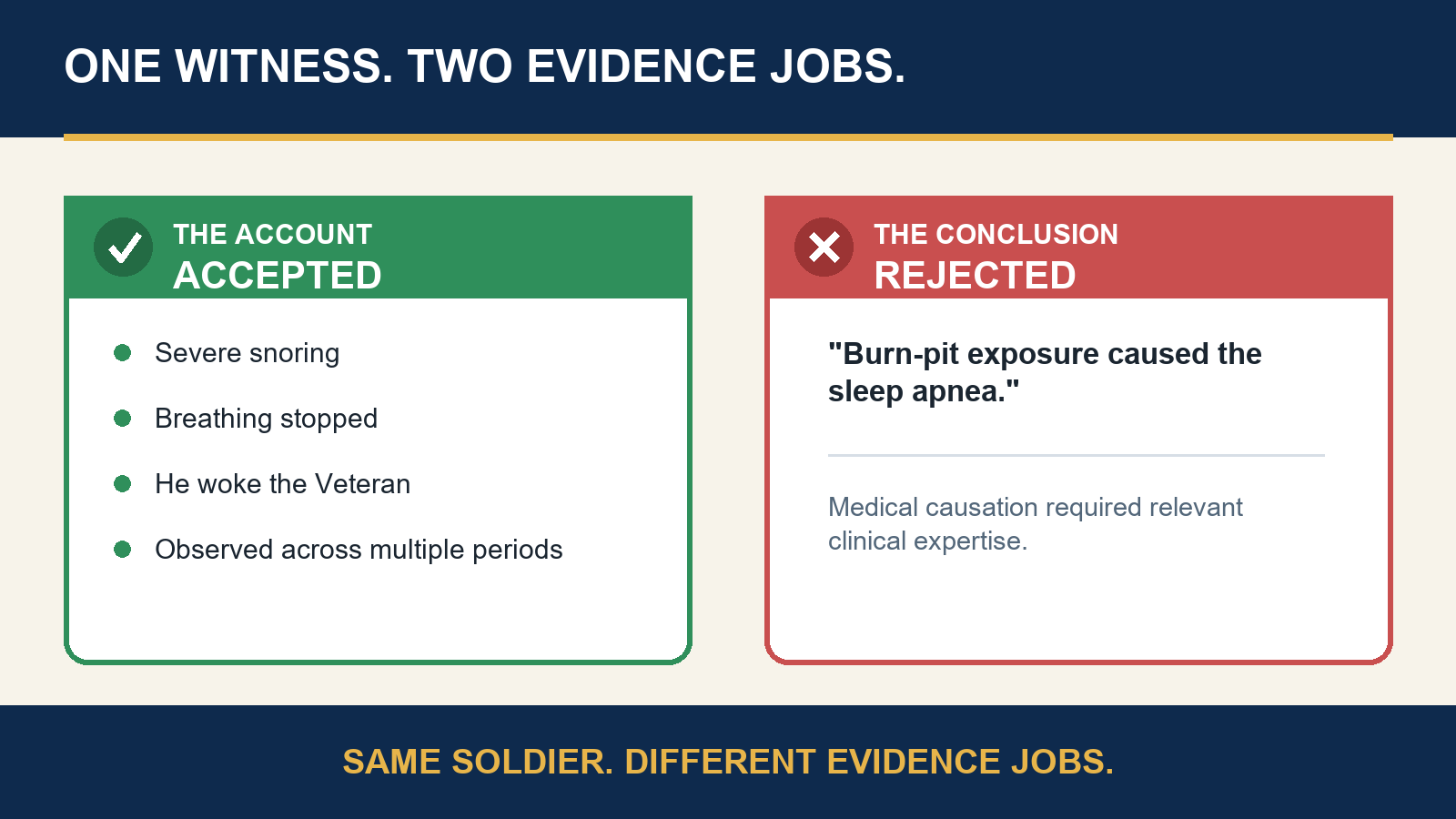
He served beside the Veteran for nearly 15 years and deployed with him to Iraq. He heard the severe snoring, saw the Veteran stop breathing, and woke him during the night. The Board believed those observations. But the same Soldier also said he believed the Veteran's obstructive sleep apnea was related to burn-pit exposure during their deployment. The Board gave that medical conclusion no weight.
The Soldier did not suddenly become unreliable. He had crossed the line between describing what he personally witnessed and giving an opinion about what medically caused the diagnosis. One part of his statement answered, "What happened while you were there?" The other tried to answer, "What caused the sleep apnea?"
He was in an unusually strong position to answer the first question. He had shared rooms with the Veteran on missions before the Iraq deployment, during it, and after demobilization. He could describe a change over time: the snoring became loud enough to require earplugs, and the breathing pauses later required him to wake the Veteran.
The Board found him competent and credible to report those observable symptoms. It did not give his burn-pit conclusion weight because the record did not show that he had medical training related to sleep or respiratory conditions. A physician separately gave the Board the medical opinion it needed on what caused the Veteran's sleep apnea. Citation A25060510.
That case captures the central rule: a witness can provide powerful evidence for one part of a claim and have no useful expertise for another.
Lay evidence is part of the claim record
A buddy statement is not an informal character reference. Federal law requires the VA to consider pertinent lay evidence along with medical evidence and the circumstances of service. The VA's regulation defines competent lay evidence as information that does not require specialized education, training, or experience and comes from someone who knows facts that can be observed and described. (see 38 U.S.C. § 1154(a) and 38 CFR § 3.159(a)(2))
Personal knowledge is the dividing line. A witness can report what that person saw, heard, felt, or noticed. A diagnosis or medical cause is a separate question. Some medical conditions are simple enough for a person without medical training to identify, while others require clinical knowledge. The answer depends on the fact being established, not on a blanket rule that laypeople can never address medical matters. (Jandreau v. Nicholson)
The practical question comes before writing a statement: What exact fact is missing from the claim record? Only then can the right witness be identified.
Start with the missing fact, then identify who was there
For an event during deployment, a fellow servicemember who was present can describe things a spouse or friend at home could not have seen. That witness may be able to explain the assignment, location, conditions, injury, exposure, or symptoms as they occurred.
For symptoms after service, a spouse, family member, roommate, friend, coworker, or caregiver may have years of direct observations that a former unit member could not provide. That person may be able to describe disturbed sleep, changes in behavior, visible pain, missed work, loss of function, or the timing of a decline.
The Veteran may be the only person who can describe what pain, ringing in the ears, dizziness, or another subjective symptom actually felt like. A spouse or caregiver can add what the symptom did to the Veteran's daily life and what the family witnessed or had to take on because of it. A clinician is normally better positioned to distinguish among competing diagnoses or explain a medically complex nexus.
This is not a ranking of relationships. It is a simple question of who personally knew the important fact within the claim:
| Missing fact | Witness with direct knowledge | What that witness can describe |
|---|---|---|
| Event, duty, injury, exposure, or symptom during service | Fellow servicemember, supervisor, commander, or medic who was present | Where and when it happened, what the witness saw, and what changed |
| Symptoms or function after service | Spouse, relative, friend, roommate, coworker, or caregiver | Observable behavior, sleep, pain, limitations, frequency, and change over time |
| Subjective experience | The Veteran | What the symptom felt like, when it began, how often it occurred, and how it affected function |
| Complex diagnosis or medical cause | Qualified medical professional | Clinical diagnosis, competing causes, and the medical link between facts and condition |
The point is to put the person who actually witnessed an important fact within the claim on the record.
Service records can be silent while witnesses still remember
One 2025 headache decision involved a former submariner whose service treatment records contained no headache complaints. The fact that no headache treatment appeared in those records did not end the Board's review.
His first-line supervisor remembered reducing his workload when headaches struck. Shipmates remembered frequent complaints, requests for pain medication, and head impacts in the confined submarine environment. The onboard medic remembered the headaches and explained why they were rarely documented: one medic was responsible for more than 160 sailors, headaches were generally handled with medication and rest, and formal documentation could affect submarine qualification.
The Board found those service-era statements credible and gave them weight. They did more than repeat that the Veteran had headaches. They explained who observed them, when they happened, how they affected his duties, and why the expected medical entries were missing. Citation A25011890.
A separate sleep-apnea case showed why several witnesses can matter. Each knew the Veteran during a different part of his life. A fellow servicemember described loud snoring and apparent breathing pauses during service. The Veteran's wife described the same problems during and after service. His brother described loud snoring and breathing pauses six months after discharge. The Board treated all three accounts as competent and credible evidence that the symptoms existed during service and continued afterward. Citation 20034588.
Each witness contributed observations from the period that person actually knew.
Ignoring the statement can leave the examination incomplete
A lay statement can matter even when it does not lead immediately to a grant. If an examiner leaves out relevant firsthand observations, the medical opinion may rest on an incomplete history.
In a 2025 sleep-apnea appeal, treatment records contained years of reported sleep problems. The Veteran's girlfriend also told a social worker that he had breathing problems while sleeping. A VA examiner later addressed whether toxic exposure caused the sleep apnea but did not discuss the broader symptom history, a provider's concern that a sleep study was warranted, or the girlfriend's observation. The Board remanded for another opinion. Citation A25056777.
The same problem appeared in a cervical-spine appeal. The Veteran said his classified duties and combat circumstances explained why the reported injury was not documented in service records. The earlier decision did not address that explanation, and the medical opinion relied on the missing documentation without addressing his reports. The decision was vacated and the issue returned for further consideration. Citation 21016115.
A diabetes case followed a similar path. An earlier Board decision dismissed the Veteran's account of duties near the perimeter of a Thai air base without first establishing why the absence of supporting service records should count against him. After a Court-ordered remand, the Board reconsidered the account and granted the claim. Citation 22003829.
An overlooked statement does not automatically produce a grant. It may lead to a new examination, a vacated decision, or another Board review. When an examiner fails to address relevant lay reports and the Board has not found those reports unbelievable, a new examination may be required. (Miller v. Wilkie)
Inconsistency is the most common credibility killer
Specific details make a statement useful, but conflicting details can make it collapse. In a 2018 knee case, the Veteran and a fellow servicemember agreed that an injury occurred during service. Their accounts changed, however, on whether treatment happened immediately or the next day, whether the Veteran received crutches, whether he returned to physical training, and how the fall occurred. The fellow servicemember also claimed continuing symptoms even though he later acknowledged having no contact with the Veteran for more than two decades.
The tinnitus claim in the same decision had a separate set of contradictions. In one account, the Veteran said he worked in a noisy environment for two years before a supervisor told him that hearing protection was required. At his hearing, he said he was never issued hearing protection. He also reported that tinnitus began when he threw a live grenade in 1986, but the Board considered that account against the broader pattern of conflicting testimony and did not find it credible.
The Board assigned no weight to the knee statements and rejected the tinnitus account. Citation 1812778.
Uncertainty is not the same as dishonesty. People forget exact dates, especially when describing events from years earlier. A witness can say "during the summer of 2009" or "within several months after he came home" and explain what anchors that memory. An honest range is more useful than invented precision that later conflicts with medical records, service records, or another statement.
Conclusion: Build the statement around five questions
The lesson is not that every claim needs more statements. It is that every statement should have a clear job. A Lay or Buddy statement should be tested against five questions before it is submitted:
- What exact missing fact is this statement meant to establish? An event, symptom, timeline, functional limitation, behavioral change, or explanation for a record gap?
- Was this witness personally present for that fact? If not, the statement may only repeat what someone else said.
- When and where did the observation occur? Honest time ranges are better than unsupported exact dates.
- What did the witness actually see, hear, or notice? Concrete observations say more than conclusions such as "he became disabled" or "service caused it."
- Does the statement stay inside the witness's knowledge? Observation and medical causation are different jobs.
A fellow servicemember can preserve an event or service-era observation that may exist nowhere else. A spouse, relative, friend, or caregiver can describe years of symptoms, functional change, and effects on the family. The Veteran can describe personal experiences no one else could feel. A qualified medical professional can address the diagnosis or causation question when clinical expertise is required.
The strongest statement identifies the missing fact, puts the person who actually witnessed it on the record, and stops before observation turns into an unsupported medical conclusion.
What we searched
The local RateMyVSO research corpus contained roughly 1.9 million published Board decisions from 1992 through partial-year 2026 when this review was completed on August 25, 2026. A decision-level research flag identified 424,224 decisions containing buddy- or lay-evidence language.
For the focused review, we limited the pool to service-connection issues from 2019 forward with a medium- or high-confidence primary diagnostic code, a granted, denied, or remanded outcome, and the decision-level lay-evidence flag. Across the seven selected diagnostic-code groups, 102,189 issue rows met those filters. Full decision text was available for every sampled case.
The seven groups covered degenerative arthritis, back or neck strain, hearing loss, tinnitus, sleep apnea, generalized anxiety disorder, and PTSD. Article 2 separately addresses the specialized Combat and PTSD corroboration rules.
How we counted
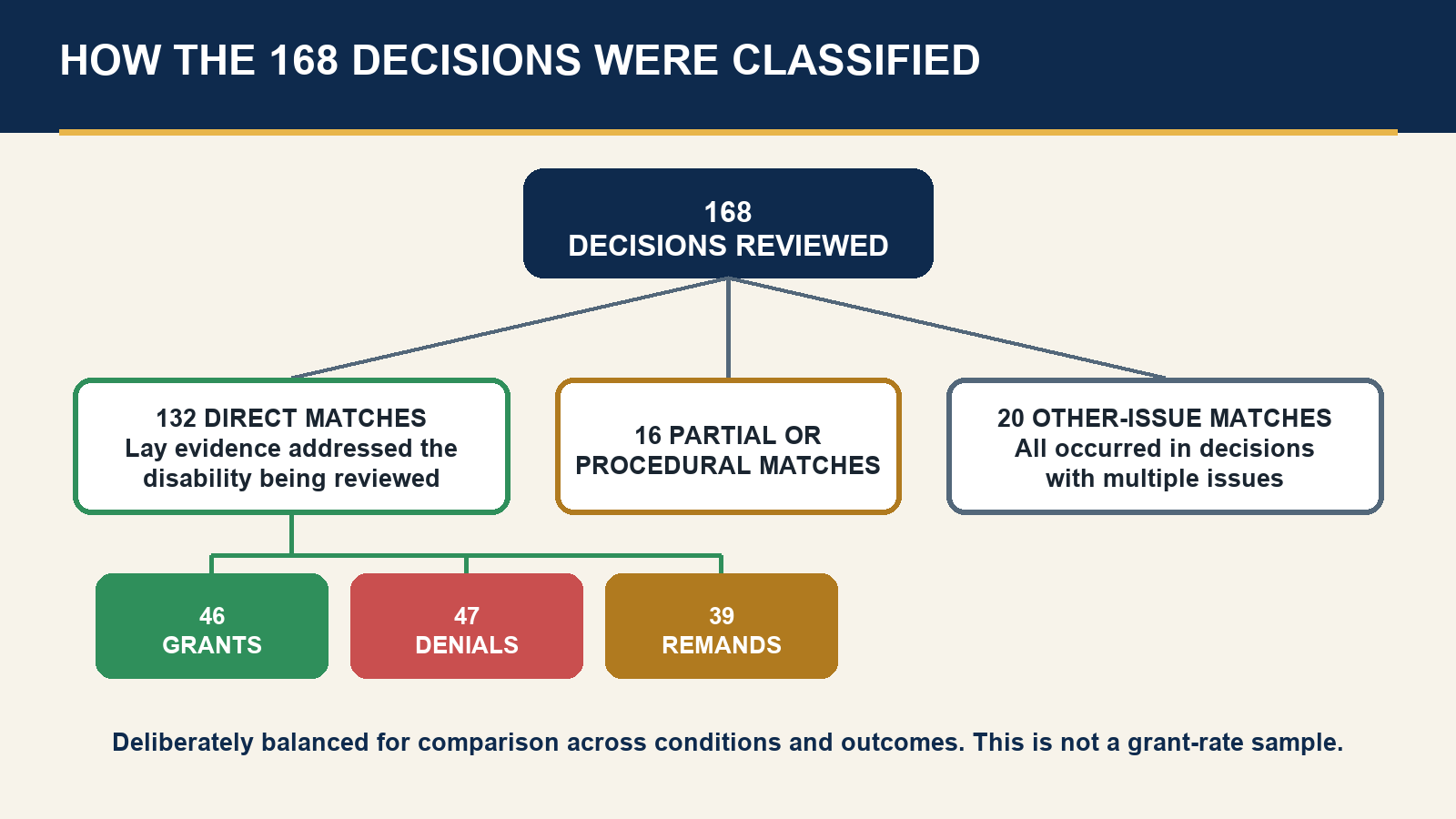
We built a deliberately balanced review sample instead of assuming that every broad lay-evidence flag concerned the disability being studied. The sample contained seven conditions, three outcomes, two decision structures (single issue and multiple issues), and four decisions per group. That produced 168 decisions across 42 groups.
Each decision was reviewed for the named disability, the person speaking, what fact the statement addressed, how the Board treated it, and whether the Board discussed competence or credibility. In 132 decisions, the lay evidence directly concerned the named disability. Sixteen were partial or procedural matches, and 20 concerned another issue in the same decision. All 20 mismatches occurred in decisions containing multiple issues.
The outcome numbers in this Article come from the 132 decisions where the lay evidence actually addressed the disability being reviewed. Because the sample was deliberately balanced, those numbers describe the reviewed cases rather than the overall odds for VA claims. Board decisions also apply only to the cases decided and do not create binding rules for another Veteran's claim. (see 38 CFR § 20.1303)
Decisions discussed in this Article
| Citation | Year | Outcome | What the decision illustrates |
|---|---|---|---|
| A25060510 | 2025 | Granted | Same witness's sleep observations carried weight; his burn-pit causation conclusion did not |
| A25011890 | 2025 | Granted | Fellow servicemembers and the onboard medic described service-era headaches and explained missing records |
| 20034588 | 2020 | Granted | The wife, brother, and fellow servicemember described symptoms from different periods |
| A25056777 | 2025 | Remanded | The examiner did not address the Veteran's history or his girlfriend's observation |
| 21016115 | 2021 | Remanded | The earlier review and examination did not address lay explanations and the reported injury history |
| 22003829 | 2022 | Granted after Court remand | The prior Board rejected lay evidence without establishing a proper basis or deciding credibility |
| 1812778 | 2018 | Denied | Specific contradictions damaged both the knee and tinnitus accounts |
The VA provides Form 21-10210, Lay/Witness Statement, for statements supporting a Veteran's claim. RateMyVSO's Buddy and Lay Statements Guide explains competency, credibility, forms, and common statement problems in more detail.