Pain, Weight Gain, and Sleep Apnea: The Missing Middle in a VA Claim
What 6,591 unique published Board decisions show about pain, psychiatric symptoms, medication, obesity, medical opinions, and the chain that connects them to obstructive sleep apnea.

Abstract
A veteran can have diagnosed obstructive sleep apnea, documented obesity, and a service-connected condition that limits movement or changes eating behavior, yet still lose the claim. The missing piece is often the medical story between those facts. We examined 3,471 published Board decisions that accepted or rejected weight gain as the middle link to sleep apnea, plus 3,123 confirmed remands involving that theory. Favorable private medical opinions appeared in 90.9% of accepted chains but only 37.6% of rejected chains. Among remands, 94.7% were missing at least one medical link. The data shows what separated the records, not what will happen in a new claim. Board decisions are nonprecedential, the 2026 data is partial, and the detailed mechanism labels were produced by a validated extraction process with known limits.
Highlights
- 2,489 chains were accepted and 896 were rejected in the final decided-case comparison. Another 86 had a mixed, different, or unclear basis and were kept out of the binary evidence comparison.
- 90.9% of accepted chains contained a favorable private nexus opinion, compared with 37.6% of rejected chains. A private opinion did not guarantee a grant, but the records that won looked materially different.
- 72.7% of accepted chains still contained a negative VA medical opinion. A negative government examination did not always end the claim when the Board found other medical evidence more persuasive.
- 2,957 of 3,123 confirmed remands, or 94.7%, were missing at least one medical link. In 2,651 of those 2,957, both links were missing.
- Aggravation was an express reason for remand in 1,465 cases, or 46.9%. Nearly half were sent back because the medical analysis did not answer whether a service-connected condition made the weight problem or sleep apnea worse.
- The grant rate rose from 42.6% before Walsh to 86.1% after Spicer. The published decisions also used express but-for reasoning far more often after Spicer.
- These figures describe published Board decisions through August 2026, not every VA claim. The legal decisions, changing docket mix, better-developed records, and the large recent caseload all moved during the same period.
Two veterans, the same theory, opposite results
One veteran told the Board that he entered service at 190 pounds, left at 230, and later reached 305. His service-connected pain made physical activity difficult. His psychiatric symptoms drained his motivation and led him toward high-calorie food for comfort. His records also documented years of sleep problems.
That alone did not win the claim.
What changed the case was the way two private clinicians assembled the record. They used the veteran's statements, service records, post-service treatment, weight history, and medical literature to explain a sequence: chronic pain reduced activity, psychiatric symptoms affected eating and motivation, the resulting weight gain contributed to obstructive sleep apnea, and the VA examinations had never answered that entire chain. The Board granted the claim in 2025. (Citation A25015492)
Another veteran presented a similar theory. He had chronic pain, plantar fasciitis, a psychiatric condition, obesity, OSA, and several favorable private opinions. But the dates worked against the explanation. His OSA was diagnosed in 2015. The psychiatric condition was diagnosed three years later, and the plantar fasciitis was recorded as asymptomatic until four years after the OSA diagnosis. The record also showed that he later lost more than 60 pounds.
The private opinions said pain, inactivity, and poor food choices caused the weight gain. They did not convincingly explain the timeline, the later weight loss, or why the proposed causes appeared after the OSA. The Board denied the claim in 2024. (Citation A24079460)
The difference was not whether obesity can contribute to sleep apnea. Both records contained that general idea. The difference was whether the evidence explained this veteran's sequence of events.
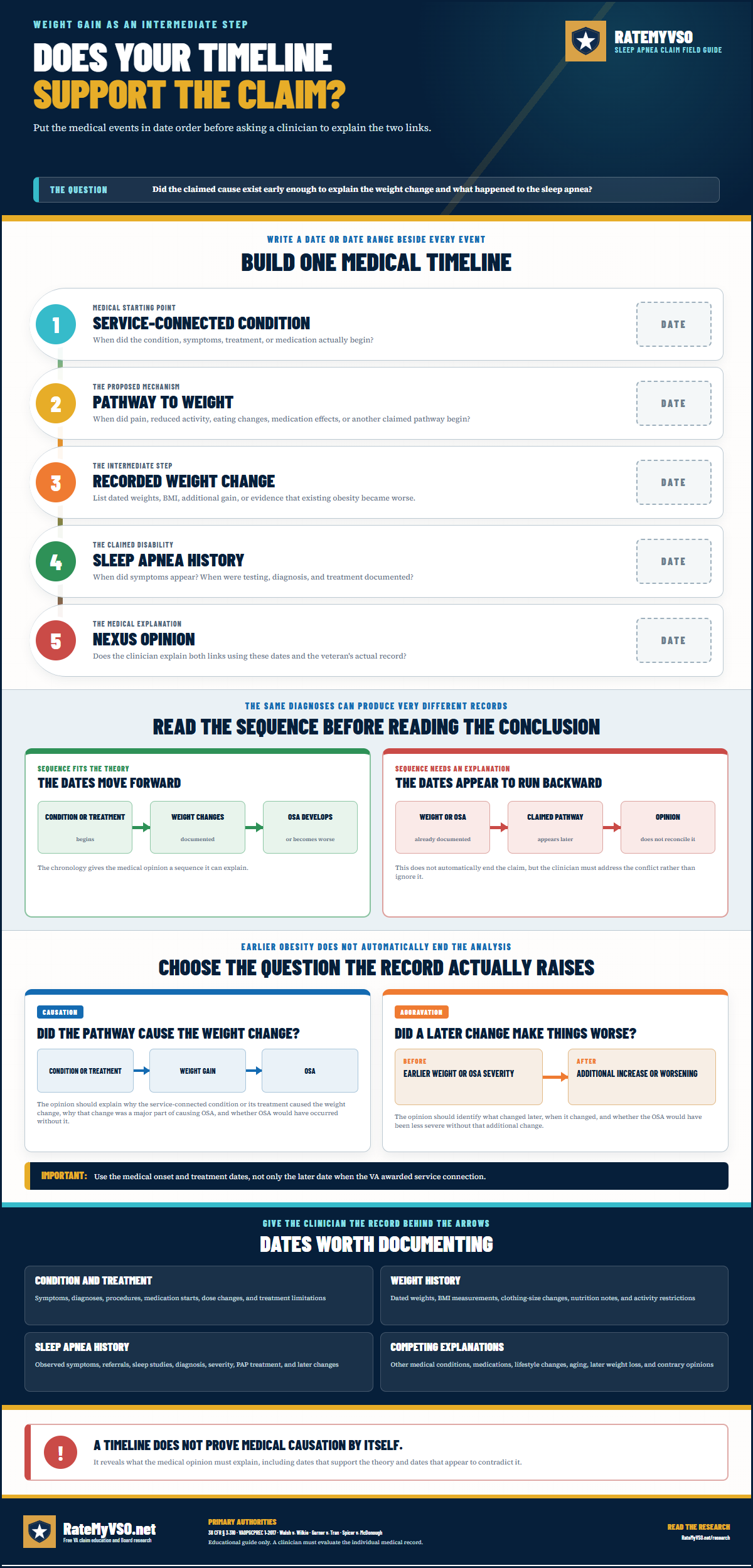 One-page guide: Does Your Timeline Support the Claim?
Put the service-connected condition, why the weight changed, weight gain or worsened obesity, sleep-apnea history, and the medical opinion explaining both links in date order.
One-page guide: Does Your Timeline Support the Claim?
Put the service-connected condition, why the weight changed, weight gain or worsened obesity, sleep-apnea history, and the medical opinion explaining both links in date order.
What the intermediate step actually means
Weight gain is not a shortcut around the need for a medical connection. It adds another link that must be proven.
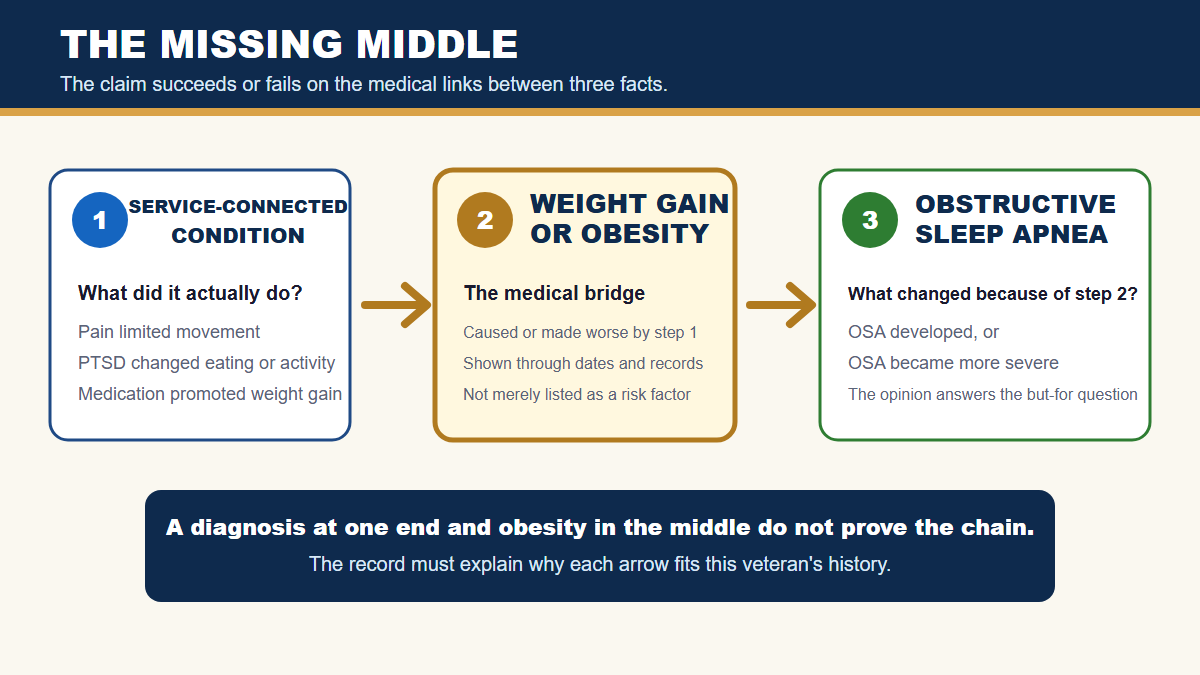
The record must answer three practical questions:
- What did the service-connected condition or its treatment do to the veteran's weight? It may have caused the original weight gain, caused additional weight gain, or made existing obesity worse.
- What did the resulting weight change do to the sleep apnea? The medical evidence must explain why the obesity was a substantial factor in causing or worsening OSA.
- What would have happened without that chain? The opinion must address whether the OSA would not have developed, or would have been less severe, without the service-connected condition's effect on weight.
The first condition does not have to be the original reason the veteran became obese. A veteran who was already overweight can still have a valid theory if a service-connected condition later caused additional weight gain or aggravated the obesity. The question is what changed after the service-connected condition entered the story.
When the claim involves aggravation, baseline evidence still matters because the VA compares the earlier and current severity to determine the additional disability attributable to the service-connected chain.
What caused the weight gain in these records
The published decisions did not describe one standard route. They described lives that had become smaller, harder, and less predictable.
Pain and restricted movement
Back, knee, foot, and other musculoskeletal conditions appeared repeatedly. Veterans described pain that limited walking, standing, exercise, and sometimes ordinary movement. In one 2018 grant, lumbar-spine pain reduced the veteran's ability to exercise. His spouse also described depression disrupting his diet. A private physician connected the back condition, reduced activity, obesity, and OSA, and the Board found the evidence evenly balanced. (Citation 18128375)
The stronger records did more than say, "pain prevented exercise." They described what the veteran could no longer do, when the limitations began, how the weight changed afterward, and why that change mattered medically.
Psychiatric symptoms and comfort eating
Mental-health records described several routes to weight gain: loss of motivation, social isolation, disrupted sleep, reduced activity, alcohol used as a coping mechanism, and eating for emotional comfort. These are not interchangeable explanations. A clinician still had to identify which route fit the veteran and show when it appeared.
The 2025 grant described above did that. The veteran reported choosing high-calorie food for temporary comfort and losing motivation to exercise. The private opinions connected those facts to his psychiatric history, pain, weight timeline, and OSA. The Board treated the explanation as veteran-specific rather than a general claim that depression and obesity are associated.
Medication effects
Medication was another recurring route, but a listed side effect was not enough. The record had to show that the veteran took the medication, that the timing fit the weight change, and that the weight change fit the development or worsening of OSA.
A 2021 grant shows why the timing matters. A private physician identified trazodone as a possible source of weight gain, but the veteran was already obese and suspected of having sleep apnea before that prescription. The medication theory alone did not fit. The record became persuasive only when another examiner connected the broader history: severe back pain, a more sedentary life, PTSD symptoms, alcohol used to cope, weight gain, and worsening OSA. The Board granted after weighing several conflicting opinions. (Citation 21066051)
Several causes at once
Real weight gain rarely arrived through one clean doorway. Pain could reduce activity while depression changed eating. Medication could add weight while poor sleep made activity harder. A respiratory condition could restrict exertion while steroid treatment affected metabolism.
The Board did not require a tidy life. It required a medical explanation that separated the plausible from the merely possible and tied the chosen explanation to the record.
The evidence difference was hard to miss
The clearest statistical divide was not between back pain and PTSD, or between medication and inactivity. It was between records with and without a favorable private medical explanation.
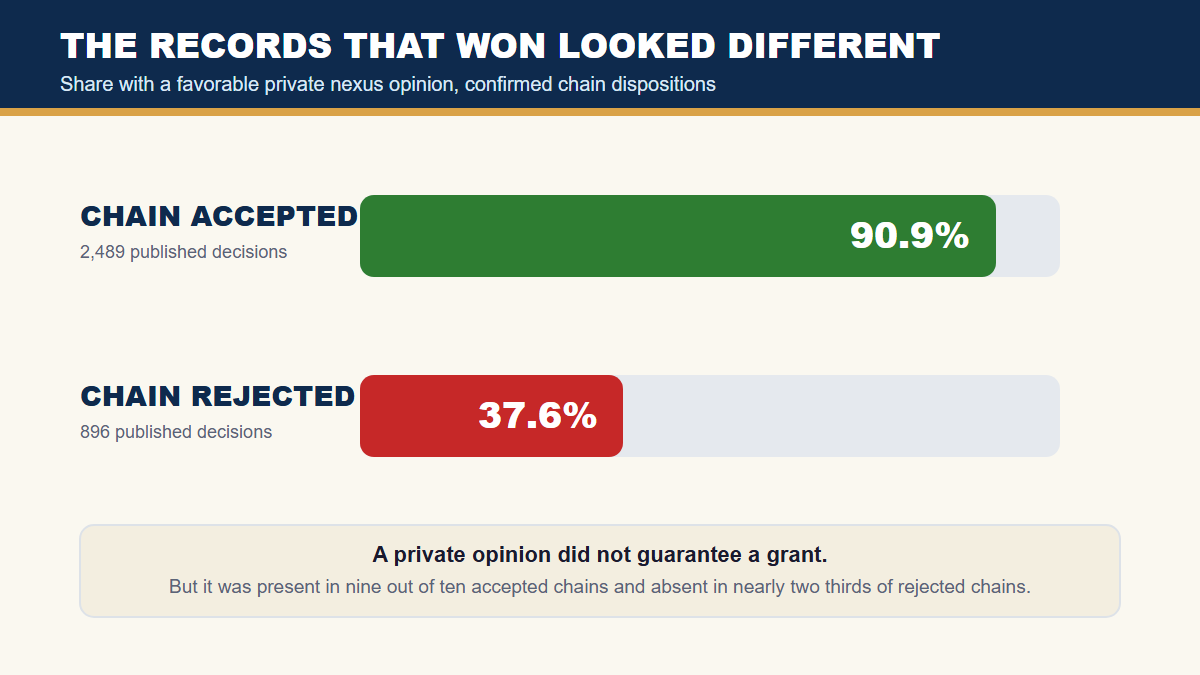
A favorable private nexus opinion appeared in 2,262 of 2,489 accepted chains, or 90.9%. It appeared in 337 of 896 rejected chains, or 37.6%. Conversely, no private nexus was identified in 61.9% of rejected chains.
That does not mean the words "at least as likely as not" won the case. Some favorable opinions were rejected. The opinions that mattered tended to do four things:
- identify the service-connected condition, treatment, or medication at the start of the chain
- use a weight timeline that matched the claimed cause
- explain why the weight change caused or worsened this veteran's OSA
- address other obvious explanations instead of pretending they did not exist
The government evidence was often unfavorable. A negative VA opinion appeared in 72.7% of accepted chains and 92.7% of rejected chains. The important point is not that one side's doctor always defeated the other. It is that a negative VA examination was not automatically the last word when a better-supported opinion made the full chain visible.
Why favorable opinions still failed
The 2024 denial is important because it prevents a lazy conclusion from the 90.9% figure. That veteran submitted multiple favorable opinions. The Board still rejected them.
The problem was not the absence of medical language. The problem was that the language did not survive contact with the record:
- OSA appeared before the psychiatric diagnosis offered as a cause.
- The foot condition was recorded as asymptomatic when OSA was diagnosed.
- The veteran later lost more than 60 pounds, which the opinions did not reconcile with the claimed inability to control weight.
- The clinicians cited general studies but did not fully apply them to the dates, competing risks, and actual physical limits in the file.
The Board data showed the same failure pattern at scale. Rejected chains frequently credited anatomy or demographic risk factors, diet or lifestyle explanations, another nonservice-connected condition, or alcohol and tobacco history. A strong opinion did not have to erase every competing cause. It had to explain why the service-connected chain still made a material difference.
General articles could show that pain, psychiatric symptoms, medication, obesity, and OSA can be connected. They could not establish that the connection occurred in a particular veteran. The missing work was the medical explanation tied to the veteran's dates, symptoms, treatment, weight history, and other risk factors.
Why so many claims came back on remand
A remand is not a grant or a denial. It means the Board could not properly decide the issue because more work was required. In this research, the missing work was overwhelmingly medical.
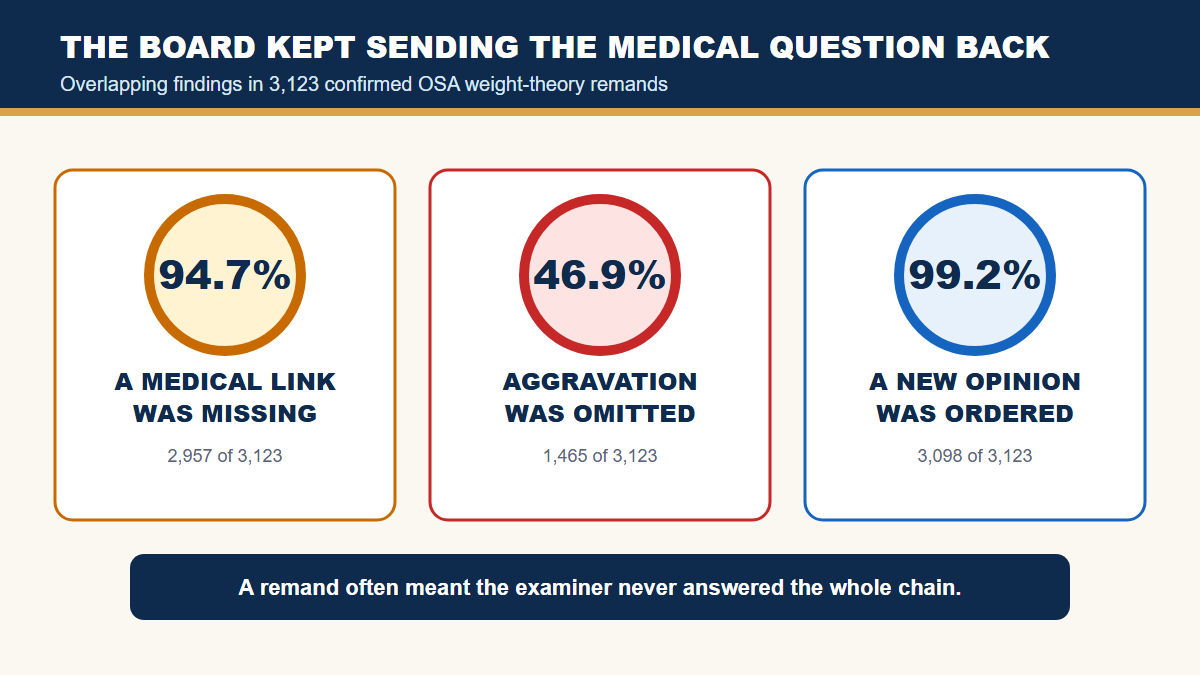
Among 3,123 confirmed weight-theory remands:
- 2,957, or 94.7%, were missing at least one named medical link
- 2,651 of those 2,957 were missing both links
- 1,465, or 46.9%, expressly identified an unanswered aggravation question
- 3,098, or 99.2%, ordered a new medical opinion
- 441, or 14.1%, found that an earlier remand had already failed to produce the required development
One case shows how a claim can become trapped in incomplete answers. A 2020 VA examiner said the veteran's weight gain was the likely cause of his sleep apnea but did not answer whether a service-connected condition or its medication caused or aggravated the weight gain. The Board sent the case back.
The next examiner discussed whether depression and obesity were associated in women and concluded that the study did not establish causation. That did not answer the veteran's question. The Board sent the case back again in 2022. The claim had not failed because the theory was impossible. It remained unresolved because the examinations kept answering only pieces of it. (Citation 22048018)
Another 2024 remand found that an examiner had discussed risk factors for hypertension while failing to explain the veteran's OSA risk factors. The record described a man who became short of breath after walking five or six minutes, used a cane constantly, and struggled with stairs, bending, kneeling, and squatting. The Board ordered a new opinion addressing how those specific mobility limits affected obesity and how obesity affected OSA. (Citation 24019888)
These cases explain the 94.7% figure. The file may contain every noun in the chain, yet still lack the sentences that connect them.
How the key court decisions changed the question
The legal history matters because each decision widened or clarified a different part of the medical question.
The intermediate step became a recognized route
In 2017, the VA's General Counsel recognized that obesity could sit between a service-connected condition and another disability. The original framework asked whether the service-connected condition caused obesity, whether obesity substantially caused the claimed disability, and whether the claimed disability would have occurred without that obesity. (VAOPGCPREC 1-2017)
Existing obesity stopped being an automatic dead end
In 2020, the Veterans Court held that the first link also includes aggravation. A service-connected condition can make existing obesity worse. The veteran does not have to prove that the service-connected condition was the original reason the weight problem began. The medical opinion must address aggravation when the record raises it. (Walsh v. Wilkie)
The record still has to raise the theory
In 2021, the Veterans Court explained that isolated weight entries do not automatically raise an intermediate-step theory. The record needs some connection, such as mobility limits, medication-related weight gain, psychiatric effects on eating or activity, medical literature, lay evidence, or a clinician's statement. Those facts raise the question. They do not prove the answer. (Garner v. Tran)
The final question became broader
In 2023, the Federal Circuit rejected a narrow view of secondary causation. The service-connected disability may be one link in a longer chain, and the claimed condition may qualify when it would have been less severe without that chain. Spicer was not an obesity case, but its but-for rule fits the exact structure of weight-as-an-intermediate-step claims. (Spicer v. McDonough)
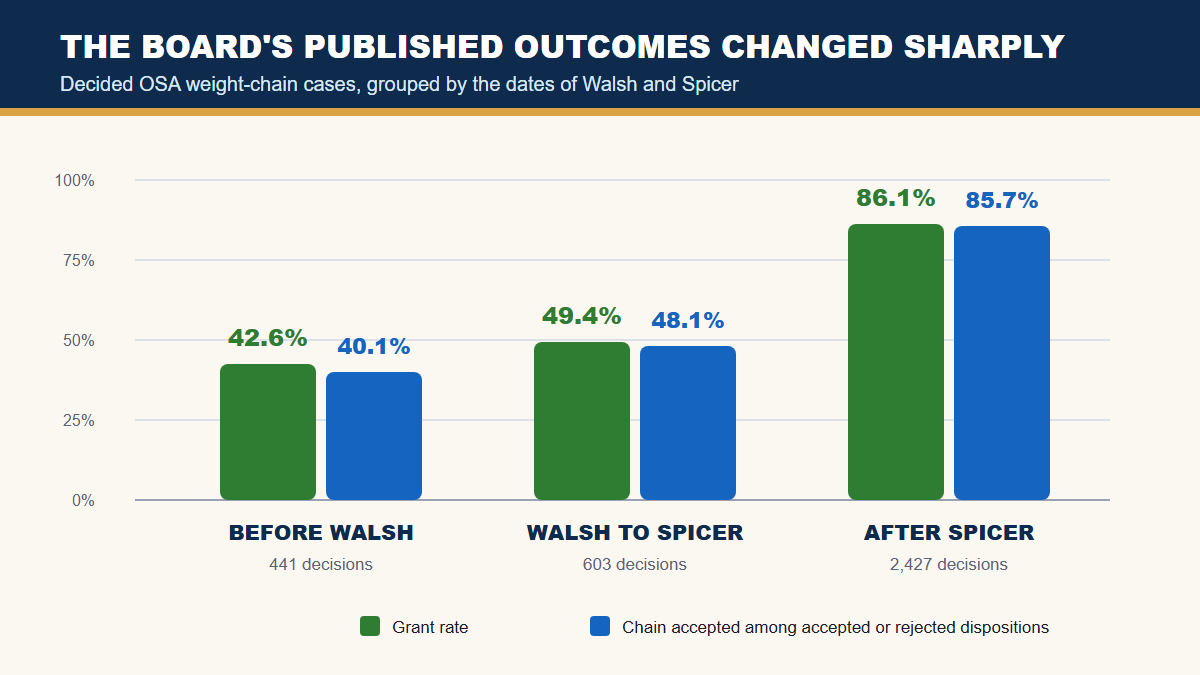
The published Board decisions changed sharply across those eras. The grant rate was 42.6% before Walsh, 49.4% between Walsh and Spicer, and 86.1% after Spicer. Chain acceptance among the accepted-or-rejected dispositions rose from 40.1% to 48.1% to 85.7%.
The Board was not merely granting more often. The model also detected express but-for reasoning in 14.5% of pre-Walsh decisions, 37.3% between Walsh and Spicer, and 66.5% after Spicer. That secondary field is better read as a trend than a precision count, but its direction matches the much stronger outcome data. Spicer alone cannot explain every percentage point, but the timing and the language both changed.
One later correction about obesity itself
The Veterans Court added another boundary in 2025. Obesity is still not directly service connected as an in-service disease or injury. But it also cannot be categorically excluded as a secondary disability when the obesity itself causes functional impairment of earning capacity and the service-connected condition is a but-for cause. That Adams ruling is important, but it does not replace the intermediate-step theory examined here. (Adams v. Collins)
What a complete medical explanation looked like
Across the grants, the strongest opinions did not merely repeat that obesity is a risk factor for OSA. They built a timeline, explained both medical links, and answered the exact question presented by the record.
Five features appeared repeatedly in the better-developed files:
- Identify the service-connected condition clearly. If medication, pain, restricted movement, PTSD symptoms, or another part of its treatment started the chain, name that too.
- Name the secondary diagnosis and explain its current impact. For this article, that means diagnosed OSA, its current symptoms, and its functional severity.
- Explain the medical mechanism connecting them. Trace the timeline and the biological or treatment pathway from the service-connected condition to weight gain or aggravated obesity, and then from that weight change to OSA.
- State the exact medical question being answered. Did the chain cause OSA, make it worse, or leave it more severe than it otherwise would have been? If the theory is aggravation, answer what would have happened without the service-connected chain.
- Apply the explanation to this veteran. Use the actual history, weight timeline, records, findings, medications, treatment limits, and competing causes in the file rather than discussing only the general population.
Spicer matters most to the fourth point. It clarified that the service-connected condition need not be the only cause. The medical question is whether the claimed disability would have been less severe without the service-connected condition and the chain it set in motion. In these OSA cases, there are two arrows, so the medical explanation may need to answer causation or aggravation at both links.
These five features are not a court-created checklist and do not guarantee a result. They describe what the Board repeatedly accepted, rejected, or sent back unanswered in these records.
What we searched and how we counted
What we searched
The starting database contained approximately 1.89 million published Board decisions. The first filter found 25,988 coded OSA secondary or aggravation issues. A full-text proximity search then found 23,749 decisions containing 10,305 OSA issues where weight gain or obesity appeared near sleep apnea or OSA.
The full-text cases were read in stages:
- 6,329 granted or denied decisions were screened to determine whether the Board actually ruled on the weight chain.
- 3,471 decisions survived as the final decided mechanism cohort.
- 3,873 remand candidates were separately extracted.
- 3,123 of those remands were confirmed to contain an actual OSA weight-gain or obesity theory and became the final remand cohort.
Three citations appear in both final cohorts, leaving 6,591 unique decisions across the decided and remand analysis.
The analyzed decisions span 1992 through August 2026, with most of the volume concentrated in recent years. The 2026 period is partial.
How we counted
Each percentage uses the denominator named beside it. Accepted-versus-rejected evidence comparisons use 2,489 confirmed accepted chains and 896 confirmed rejected chains. Mixed, different-basis, and unclear decisions are not forced into either group.
Remand percentages use 3,123 confirmed weight-theory remands, not all 3,873 proximity-search candidates. The 750 candidates in which the model found no actual weight theory were excluded.
The AI extraction was tested before the full batches and followed by a 20-case owner review. The decided extraction measured 96.0% pooled accuracy across scalar fields, while detailed pathway entries measured 75.7% and tended to overcount mechanisms. That is why this article uses exact evidence and remand figures but explains the types of weight-gain mechanisms through verified cases rather than publishing a precise mechanism leaderboard. The remand theory-present filter produced one error in the 47-case validation; the express aggravation-remand field measured 95% precision.
What this research means
The important lesson is not that weight gain makes an OSA claim easier. It often makes the medical question harder because the file must prove two links instead of one.
The 2025 grant and the 2024 denial began with similar ingredients: pain, psychiatric symptoms, obesity, OSA, and favorable medical opinions. One record tied those facts to a coherent timeline. The other asked the Board to overlook dates that contradicted the theory.
That is the missing middle. A veteran's life may explain why the weight changed: chronic pain narrowed movement, PTSD changed eating, medication added another pressure, or several forces arrived together. The claim record still has to turn that lived experience into a medical chain that accounts for time, severity, and competing causes.
When the full chain was visible, the Board often accepted it even over a negative VA opinion. When the chain was generic, contradicted, or incomplete, the Board denied it or sent it back for yet another examination.
Questions veterans commonly ask
Can an OSA claim use weight gain if the veteran was already obese?
Yes, the theory is not automatically barred by earlier obesity. The relevant medical question may be whether a service-connected condition later caused additional weight gain or aggravated the existing obesity, and whether that worsening caused or increased the severity of OSA.
Is a medical article linking obesity and sleep apnea enough?
No. General research may show that a connection is medically possible, but it does not establish what happened in one veteran. The Board decisions repeatedly focused on whether a clinician applied the research to the veteran's dates, conditions, treatment, weight history, and other risk factors.
Does a negative VA examination end the claim?
Not necessarily. A negative VA opinion appeared in 72.7% of the accepted chains in this research. The Board sometimes found a private or treating opinion more persuasive because it explained the complete veteran-specific chain. That statistic describes past Board records and does not predict a new outcome.
Does a remand mean the Board agreed with the theory?
No. A remand means more development was required before the Board could decide. In this cohort, the usual problem was an incomplete medical opinion. Nearly 95% of confirmed remands were missing at least one medical link, and 99.2% ordered a new opinion.
Illustrative Board decisions
These decisions make the mechanisms concrete. They are illustrations, not precedent and not proof of what another claim will do.
| Citation | Year | Outcome | Why it appears here | Verified source |
|---|---|---|---|---|
| 18128375 | 2018 | Granted | Back pain, reduced exercise, obesity, and OSA; spouse also described depression disrupting diet | VA decision |
| 21066051 | 2021 | Granted | Combined back pain, sedentary activity, PTSD symptoms, alcohol coping, medication, weight gain, and severe OSA | VA decision |
| A25015492 | 2025 | Granted | Pain-limited activity and psychiatric comfort eating supported by a weight timeline and two private opinions | VA decision |
| A24079460 | 2024 | Denied | Favorable opinions did not reconcile the OSA date, later diagnoses, competing causes, and substantial weight loss | VA decision |
| 22048018 | 2022 | Remanded | Examiners repeatedly answered only part of the two-link chain | VA decision |
| 24019888 | 2024 | Remanded | The examiner failed to apply OSA risk factors to the veteran's severe mobility limits | VA decision |
Primary legal sources
- VAOPGCPREC 1-2017
- Walsh v. Wilkie
- Garner v. Tran
- Spicer v. McDonough
- Adams v. Collins
- Current 38 CFR § 3.310
Research files and limitations
The figures were rebuilt from the production-derived citation cohorts and independently audited before drafting. The denominator and accuracy memo is docs/research/OSA-WEIGHT-GAIN-DENOMINATOR-AND-ACCURACY-AUDIT-2026-08-15.md. The legal verification memo is docs/research/OSA-WEIGHT-GAIN-LEGAL-VERIFICATION-2026-08-15.md. The 20-case owner review is docs/research/OSA-WEIGHT-GAIN-HUMAN-REVIEW-SAMPLE-20-2026-08-15.md.
Published Board decisions are nonprecedential and do not represent every initial claim filed with the VA. The dataset measures what appears in published decision text. It can show recurring evidence patterns, remand failures, and changes in written reasoning. It cannot predict an individual outcome or prove that a single court decision caused the entire historical shift.