The Medical Study Trap
Why generic research usually does not prove that a Veteran's sleep apnea was caused or worsened by another service-connected condition.
Abstract
Veterans regularly submit medical articles showing that sleep apnea is associated with PTSD, TBI, obesity, medication use, or another condition. The research may be legitimate. The connection described in the article may also be real. But that does not automatically prove what caused or worsened one Veteran's sleep apnea.
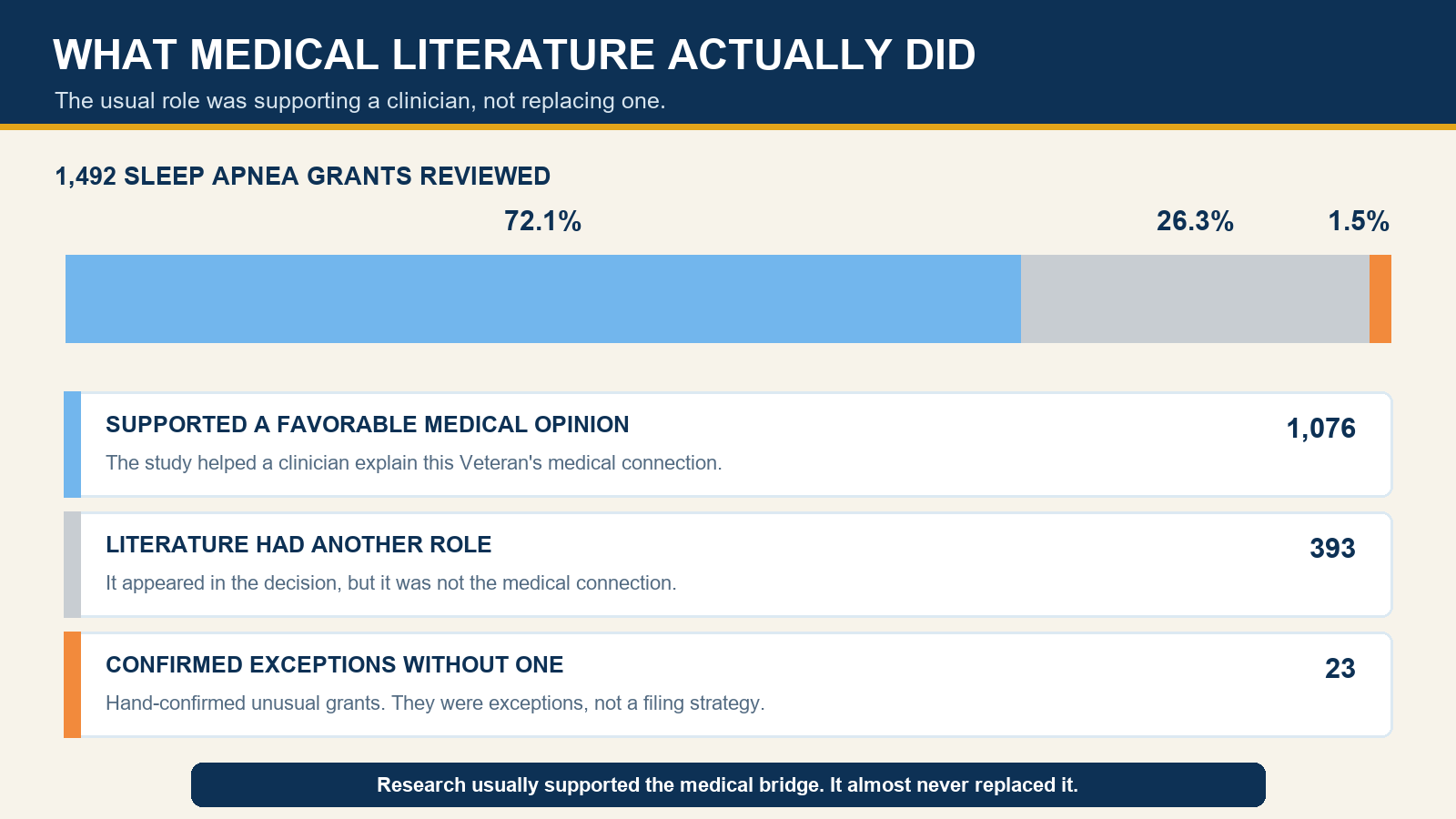
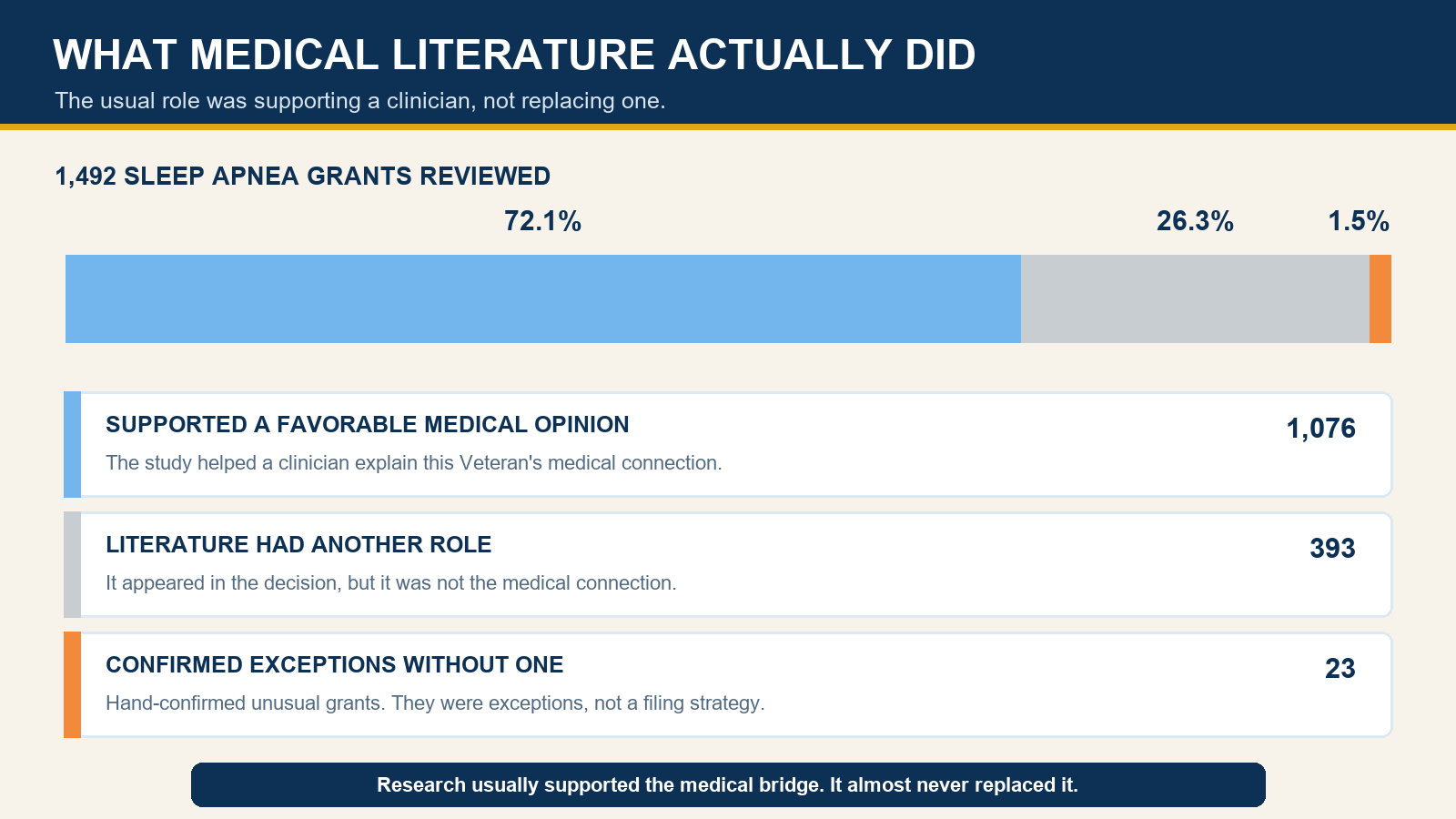
We reviewed 1,492 published Board of Veterans' Appeals decisions that granted a sleep apnea issue and discussed medical literature. In nearly three quarters, the literature supported a favorable medical opinion. It did not replace one. We found only 23 unusual grants in which literature carried substantial weight without a favorable nexus opinion.
Those rare cases are useful because they show what the ordinary “I found a study” submission is missing. The research was tied to the Veteran's actual history, and the opposing medical evidence was usually missing, defective, or contained concessions that helped complete the connection.
Highlights
- A medical study can support a claim without proving the claim. Research about a group of patients does not automatically explain what caused or worsened one Veteran's sleep apnea.
- In nearly three quarters of the sampled grants, literature supported a favorable medical opinion. The clinician applied the research to the Veteran instead of leaving the Board or the rater to make the medical connection.
- The 23 grants without a favorable nexus opinion were exceptions, not a strategy. They usually involved repeated inadequate VA opinions, damaging concessions inside a negative opinion, strong evidence of onset, or no adequate medical evidence against the theory.
- The safest use of medical literature is to strengthen a Veteran-specific medical explanation. The study should support the mechanism. A qualified clinician should explain why that mechanism fits the Veteran's diagnoses, timeline, treatment, risk factors, and competing causes.
Three remands, and the medical question was still unanswered
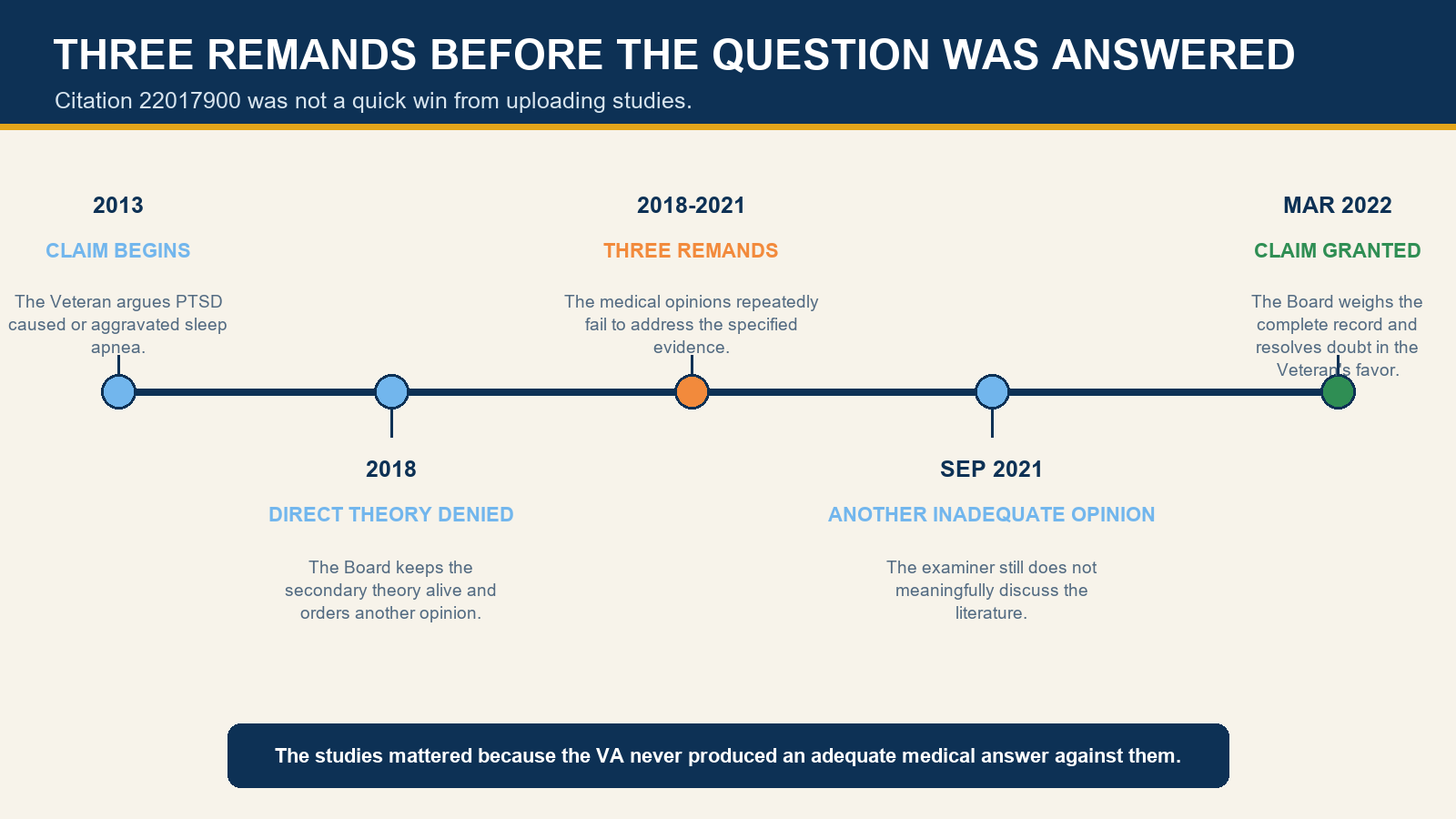
One Veteran had been pursuing service connection for sleep apnea since 2013. His theory was that PTSD caused or aggravated the condition.
The Board denied direct service connection in 2018 but kept the secondary theory alive. It sent the case back for another medical opinion. Then it sent the case back again. Then it did it a third time.
The problem was not simply that the VA examiners reached a negative conclusion. The examiners repeatedly failed to answer the evidence the Board told them to address. The record included medical articles, treatment notes, reported symptoms, and other material supporting a relationship between PTSD and sleep apnea. The September 2021 examiner still did not meaningfully discuss the specified literature.
By March 2022, the Board had three rounds of failed development in front of it. It found the VA opinions inadequate and gave them no meaningful weight. The Board then considered the submitted research together with the Veteran's treatment history, the evidence about when his symptoms began, and the absence of an adequate medical opinion against the theory. It resolved the remaining doubt in the Veteran's favor and granted the claim. Citation 22017900.
This was not a Veteran dropping a stack of studies into a new claim and winning. It was a long appeal in which the VA repeatedly failed to obtain an adequate answer to the medical question. The literature mattered because it was part of a much larger record and because the opinions that should have addressed it did not do the job.
That distinction is the center of this story.
Authoritative medical literature can be evidence, but it is not automatically a nexus
38 CFR 3.159(a)(1) recognizes sound medical principles in medical treatises and statements in authoritative medical or scientific writings as competent medical evidence. The M21-1 uses the same definition.
That sounds powerful, and it can be. But competent evidence and sufficient evidence are not the same thing.
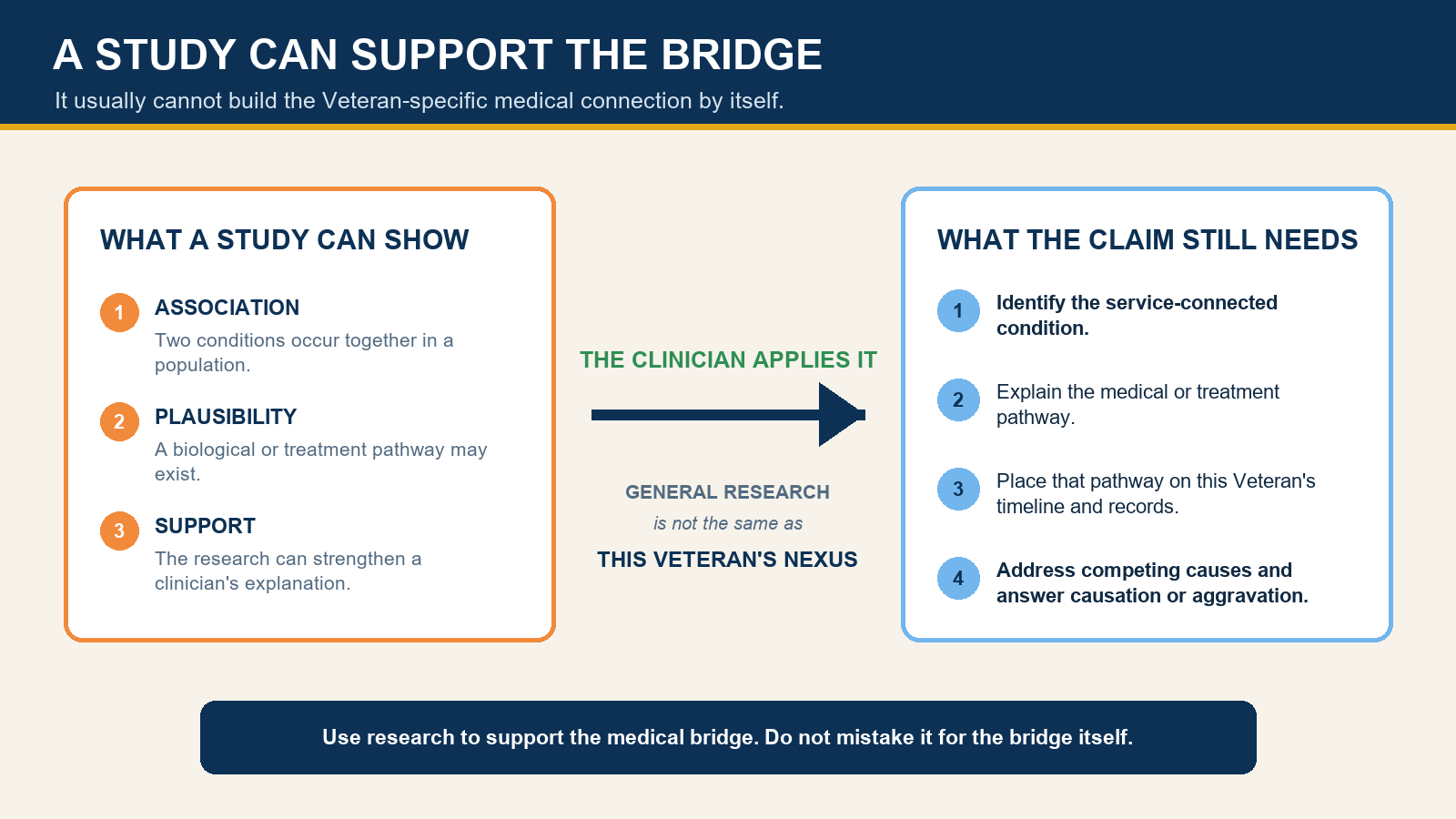
A study may establish that two conditions are associated across a population. A nexus opinion has a harder job. It must explain why the medical relationship applies to this Veteran. It should address the Veteran's history, the order in which the conditions developed, treatment, weight changes, medications, symptoms, other risk factors, and the specific theory being claimed.
The M21-1 itself illustrates the difference. It says a medical treatise establishing a known relationship can help give credibility to a secondary claim and support ordering an examination. In other words, the literature may be enough to require a medical question to be asked. That does not mean the literature has already answered the question.
What happened in most of the grants
We reviewed a sample of 1,492 published Board decisions that granted a sleep apnea issue and discussed medical literature.
In 1,076 decisions, or 72.1%, the literature supported a favorable medical opinion. A clinician did not simply cite a study and stop. The opinion used the research as part of the explanation connecting the Veteran's actual record to the conclusion.
That is the normal, stronger path.
The study explains what is medically possible. The clinician explains why it happened, or why it made the condition worse, in this Veteran.
Only 23 decisions were hand-confirmed grants in which literature carried substantial nexus weight without a favorable medical nexus opinion. They reveal what made the unusual cases different. They are not evidence that a Veteran should skip the medical opinion and submit articles instead.
What the unusual grants had that a generic article does not
Across the 23 decisions, the literature rarely stood alone in any meaningful sense. Four recurring features made the records different.
1. The research addressed the actual theory
A study about obesity and obstructive sleep apnea does not automatically support a claim that PTSD directly caused sleep apnea. A paper discussing PTSD and sleep quality may not address obstructive sleep apnea at all. The useful literature dealt with the medical pathway actually being claimed.
2. The record supplied the Veteran-specific facts
The Board could compare the research with evidence showing when symptoms began, when weight changed, what medication was prescribed, what treatment was blocked, or what risk factors were and were not present.
The article supplied a general medical principle. The record supplied the individual facts needed to use it.
3. The negative opinion was defective or helped the Veteran
Several grants did not involve a clean contest between a strong negative opinion and an internet article. The VA opinion was factually wrong, used the wrong standard, ignored the submitted research, answered a different theory, or contained concessions that supported the claim.
In some cases, the examiner's own discussion supplied pieces of the medical chain. Once those concessions were combined with the Veteran's history and the research, the negative opinion no longer worked entirely against the claim.
4. There was no adequate medical answer against the theory
The cleanest example was Citation A23025111. The Veteran submitted articles supporting a relationship between PTSD and obstructive sleep apnea. The VA opinion addressed a different theory involving weight gain and foot disabilities. It did not answer whether PTSD caused or aggravated the sleep apnea. The Board noted that the record contained no contrary opinion on the PTSD theory and granted.
That is very different from a file containing a reasoned negative opinion that directly addresses the Veteran's history, the submitted study, other risk factors, and the claimed medical pathway.
When the VA examiner demanded too much certainty
Another decision involved a Veteran who reported that sleep apnea symptoms began after a December 1985 wisdom tooth extraction. The service records confirmed the procedure, and later records documented treatment for sleep apnea.
The VA examiner acknowledged an association between the procedure and the claimed condition but relied on the absence of a medical consensus. The Veteran's attorney submitted literature supporting the relationship.
The Board did not treat the article as automatic proof. It compared the article, the confirmed in-service procedure, the symptom history, and the examiner's own concession that some causal relationship existed. It then rejected the demand for medical certainty because the governing standard was whether the evidence was in approximate balance. The claim was granted. Citation 24006635.
The important lesson is not that a study about tooth extraction will win another Veteran's sleep apnea claim. The lesson is that an examiner cannot acknowledge supporting medical evidence and then deny solely because medicine has not reached absolute consensus.
When the negative opinions supplied the missing links
In Citation A26003318, the theory involved PTSD, weight gain, and obstructive sleep apnea.
The negative examiners made several useful concessions. They identified obesity as a major sleep apnea risk factor, acknowledged psychosocial causes of obesity, and noted that alcohol could worsen the sleep apnea. The Veteran's record described PTSD-related inactivity and overeating followed by obesity and sleep apnea.
The Board used those concessions with the Veteran's actual history to assemble the intermediate-step chain. The medical literature mattered, but the grant did not rest on a generic statement that PTSD and sleep apnea sometimes occur together. The record showed the proposed pathway and contained medical concessions supporting its individual links.
Why dumping studies into the file usually fails
The weak version of this strategy looks familiar:
- A Veteran searches the internet for “PTSD causes sleep apnea.”
- The Veteran downloads several studies involving other patients.
- The articles are submitted with a statement that the research proves secondary service connection.
- No clinician explains why the research fits the Veteran's history or addresses the Veteran's other risk factors.
The submission may show that the theory is medically possible. It usually does not show that it is at least as likely as not what happened in that Veteran's case.
Generic studies commonly leave the decisive questions unanswered:
- Did the service-connected condition exist before the sleep apnea developed or worsened?
- What biological, behavioral, or treatment pathway connects them?
- Does the study concern obstructive sleep apnea, central sleep apnea, sleep quality, or a different sleep problem?
- Does the Veteran resemble the population studied?
- What other risk factors are present?
- Is the claim based on causation, aggravation, or an intermediate step such as obesity?
- If aggravation is claimed, what evidence shows the sleep apnea became more severe because of the service-connected condition?
A pile of articles does not answer those questions merely by being large.
What a useful literature-supported medical opinion should do
The strongest use of research is not to ask a rater to practice medicine. It is to give a qualified medical professional reliable support for a Veteran-specific explanation.
A useful opinion should make five things clear:
- Identify the service-connected condition. Name the condition, medication, treatment, or functional limitation that begins the claimed chain.
- Identify the current secondary disability. Name the sleep apnea diagnosis and describe its current medical impact.
- Explain the medical mechanism. Show the biological, behavioral, medication, treatment, or weight-related pathway and place it on the Veteran's actual timeline.
- Answer the correct question. State whether the sleep apnea was caused, made worse, or left more severe because treatment was blocked, and explain why.
- Apply the research to this Veteran. Address the records, symptoms, findings, medications, weight history, and competing causes in the file. Do not stop at what may occur in the general population.
The article should support that reasoning. It should not be asked to replace it.
What this research means
Medical literature has a legitimate place in a VA claim. It can show that a proposed connection is medically plausible, expose a false statement that no research supports the theory, help identify a flaw in an examination, and strengthen a clinician's explanation.
It can also help trigger a medical examination. The M21-1 recognizes a medical treatise establishing a known relationship as one type of evidence that can give credibility to a secondary claim when the VA decides whether an examination or opinion is necessary.
But the strongest finding in these decisions is what the literature usually did not do. It usually did not replace the favorable opinion. In nearly three quarters of the sampled grants, the study and the clinician worked together.
The unusual grants reinforce that pattern. Those records succeeded because the literature was connected to the Veteran's facts and because the opposing medical evidence was missing, defective, or contained concessions that helped complete the chain.
The practical lesson is simple: use research to support the medical bridge. Do not mistake the research for the bridge itself.
Questions Veterans commonly ask
Can a medical study prove nexus by itself?
It is possible for authoritative medical literature to carry significant evidentiary weight, but it is almost impossible for a generic study to establish the entire nexus by itself. Most studies describe a relationship across a population. A VA claim asks what caused or worsened one Veteran's disability. A qualified medical opinion that applies the research to the Veteran's actual history is usually much stronger.
If a study says PTSD is associated with sleep apnea, does that prove secondary service connection?
No. An association means the conditions occur together more often than expected. It does not automatically prove that PTSD caused or aggravated this Veteran's sleep apnea. The record still needs a reasoned explanation of the pathway and why it fits the Veteran.
Can medical literature help the VA order an examination?
Yes. The M21-1 lists a medical treatise establishing a known relationship as evidence that may give credibility to a secondary claim when the VA decides whether an examination or opinion is necessary. That is not the same as establishing service connection. It means the evidence may justify asking a medical professional to address the theory.
Do these Board decisions require a VSR or rater to grant a similar claim?
No. A Board decision applies only to the case decided. The Board is also not bound by the M21-1 manual used during initial claim development and rating. The decisions are useful for understanding what happened in those records, but they do not control a different claim.
What if a VA examiner says there is no medical literature supporting the claim?
If reliable research does exist, submitting it can expose a factual weakness in the opinion. The more useful response is not simply attaching the article. Identify the examiner's statement, provide the relevant research, and obtain a qualified medical explanation of how that research applies to the Veteran's actual record.
What we searched and counted
We searched the RateMyVSO Board research corpus for published sleep apnea decisions discussing medical literature, treatises, scientific research, or peer-reviewed studies. We reviewed 1,492 grants and then read every candidate that appeared to rely on literature without a favorable nexus opinion.
That full-text review reduced 44 possible cases to 23 confirmed decisions. The others included claims that were reopened and remanded rather than granted, claims granted because sleep apnea began in service, and decisions that actually contained a favorable medical opinion.
We have not completed the same human verification on the denial side, so this article does not present a grant-versus-denial ratio. The 23 confirmed decisions are used only to identify what made the unusual grants different.
Illustrative decisions
| Citation | What made the literature matter |
|---|---|
| 22017900 | Three remands failed to produce an adequate opinion addressing the literature; the Board considered the studies with treatment and onset evidence. |
| 23020901 | TBI and sleep apnea research mattered after the VA opinion relied on an inaccurate account of the Veteran's TBI history. |
| A23025111 | The VA opinion addressed a different theory, and no contrary opinion answered the PTSD theory supported by the submitted articles. |
| 24006635 | The examiner acknowledged an association but demanded medical consensus; the Board applied the approximate-balance standard to the complete record. |
| A26003318 | Negative examiners supplied concessions about obesity, psychosocial causes, and alcohol that helped complete the Veteran-specific chain. |
Primary legal and procedural sources
- 38 CFR 3.159, Department of Veterans Affairs assistance in developing claims
- 38 CFR 20.105, criteria governing disposition of appeals
- 38 CFR 20.1303, nonprecedential nature of Board decisions
- M21-1, Part I, Subpart i, Chapter 1, Section A, definition of competent medical evidence
- M21-1, Part IV, Subpart i, Chapter 1, Section B, evidence that may support ordering an examination or opinion for a secondary claim
- Sacks v. West, 11 Vet. App. 314 (1998)
- Wallin v. West, 11 Vet. App. 509 (1998)
- Mattern v. West, 12 Vet. App. 222 (1999)
- Hensley v. West, 212 F.3d 1255 (Fed. Cir. 2000)
- Euzebio v. McDonough, 989 F.3d 1305 (Fed. Cir. 2021)
- Bailey v. O'Rourke, 30 Vet. App. 54 (2018)
Research files
docs/research/APNEA-MEDICAL-LITERATURE-EVIDENCE-2026-08-13.mddocs/research/APNEA-MEDICAL-LITERATURE-HAND-VERIFICATION-2026-08-17.mddocs/research/APNEA-MEDICAL-LITERATURE-GRANT-RESULTS-2026-08-17.jsondocs/research/APNEA-MEDICAL-LITERATURE-DENIAL-RESULTS-2026-08-17.json