RateMyVSO / Secondary service connection
Secondary Conditions
A secondary condition is one the VA did not connect to your service directly, but connects to a condition it already service-connected, because that first condition caused it or made it worse. The rule comes from 38 CFR 3.310. This hub catalogues the Board record on how secondary conditions get service-connected: the interactive Explorer for browsing pairings, the programmatic pair pages built from Board decisions, the difference between "caused by" and "made worse by" and why that difference changes what evidence is needed, and the separate Gulf War undiagnosed illness pathway.
One hub. Different questions.
Find a guide.
Explore a connection.
Understand the evidence.
What would help you right now?
Choose your next step.
Three different resources. Start with the question you are trying to answer.
I know the pairing.
Read a focused claim guide.Browse secondary condition claim guides organized by body system. The guides include: Grant and Denial statistics, Common ICD Codes, Caused vs Aggravated, Common Evidence, Rating Criteria and more.Secondary Claim GuidesI know my primary condition.
Explore related conditions.Interactive tool: pick a service-connected condition and see what the Board record shows it commonly leads to.Secondary Conditions ExplorerI want the detailed research.
Examine the Board record.Pick one of 100 conditions and see its Board data as charts: grant rates, denial reasons, symptoms in winning decisions, and a deep dive on every secondary connection with the Board's own words quoted.Condition Data ExplorerFrom research to preparation
Understand the rule.
Prepare the evidence.
The pairing guide and the claim process answer different questions. Keep both close at hand.
Caused By vs. Made Worse
The two paths under 38 CFR 3.310, and how the evidence the Board looks for differs between them.Nexus Letters
The medical opinion that links a secondary condition back to the service-connected one.How a Secondary Claim Works
The filing steps for a secondary claim, from VA Form 21-526EZ through the evidence VA reviews.Take a copy with you
Printable charts
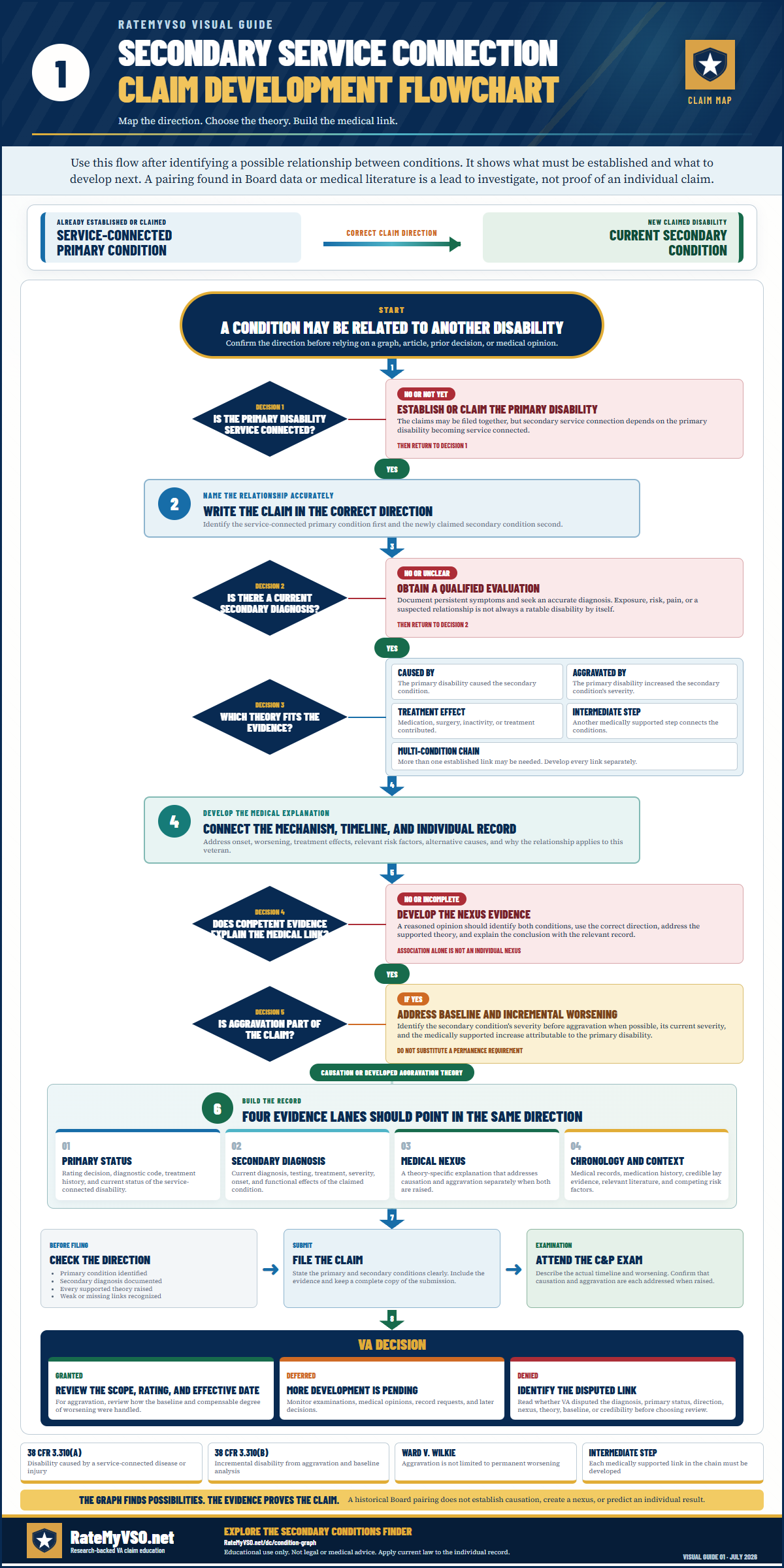 Secondary Claim Development Flowchart
Every checkpoint from a service-connected primary condition through causation, aggravation, nexus, and the VA decision. Opens the full-size chart, free to save or print.
Secondary Claim Development Flowchart
Every checkpoint from a service-connected primary condition through causation, aggravation, nexus, and the VA decision. Opens the full-size chart, free to save or print.
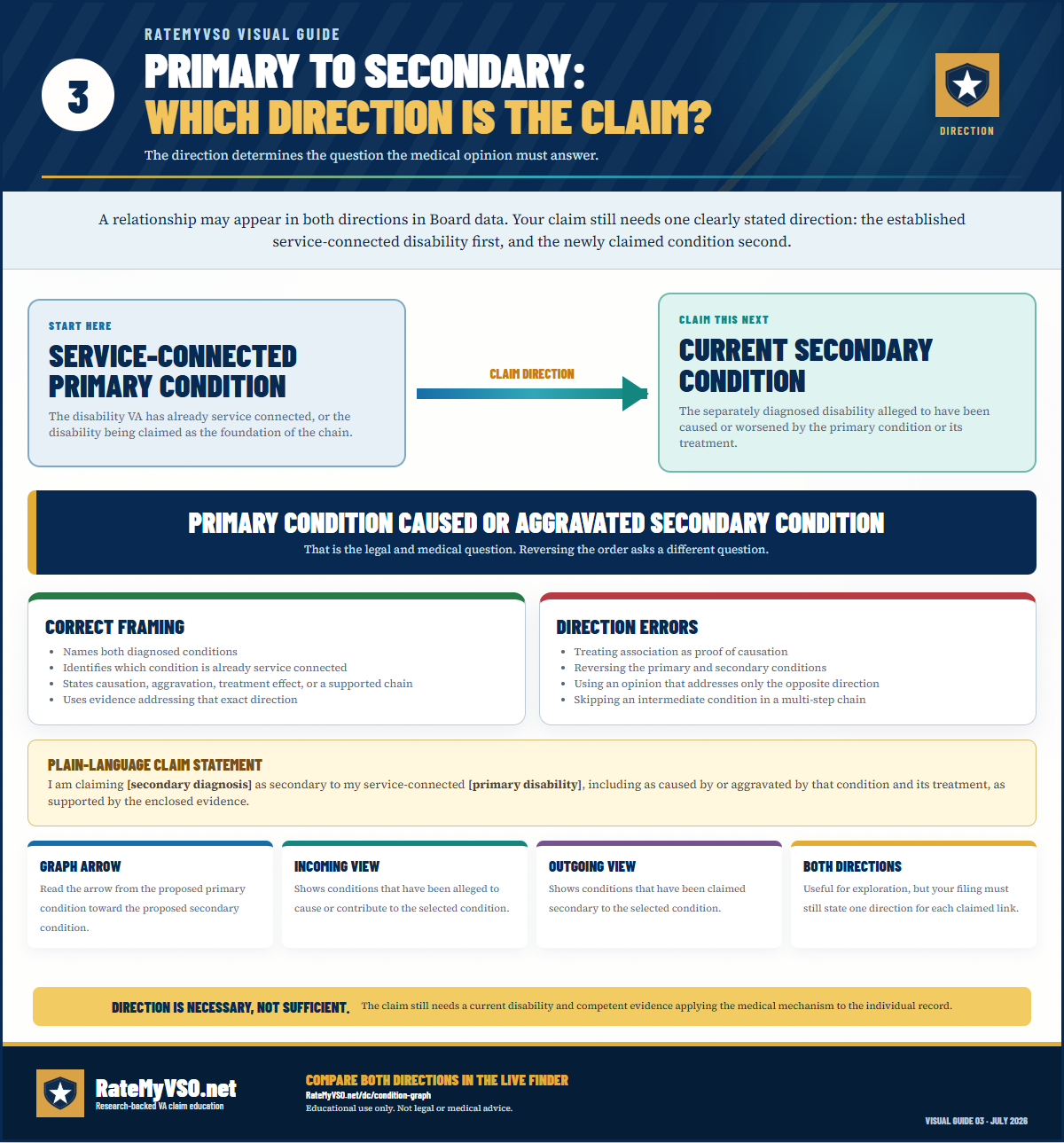 Which Direction Is the Claim?
Which condition is the primary and which is the secondary, and why naming them backwards points at the wrong medical opinion. Opens the full-size chart, free to save or print.
Which Direction Is the Claim?
Which condition is the primary and which is the secondary, and why naming them backwards points at the wrong medical opinion. Opens the full-size chart, free to save or print.
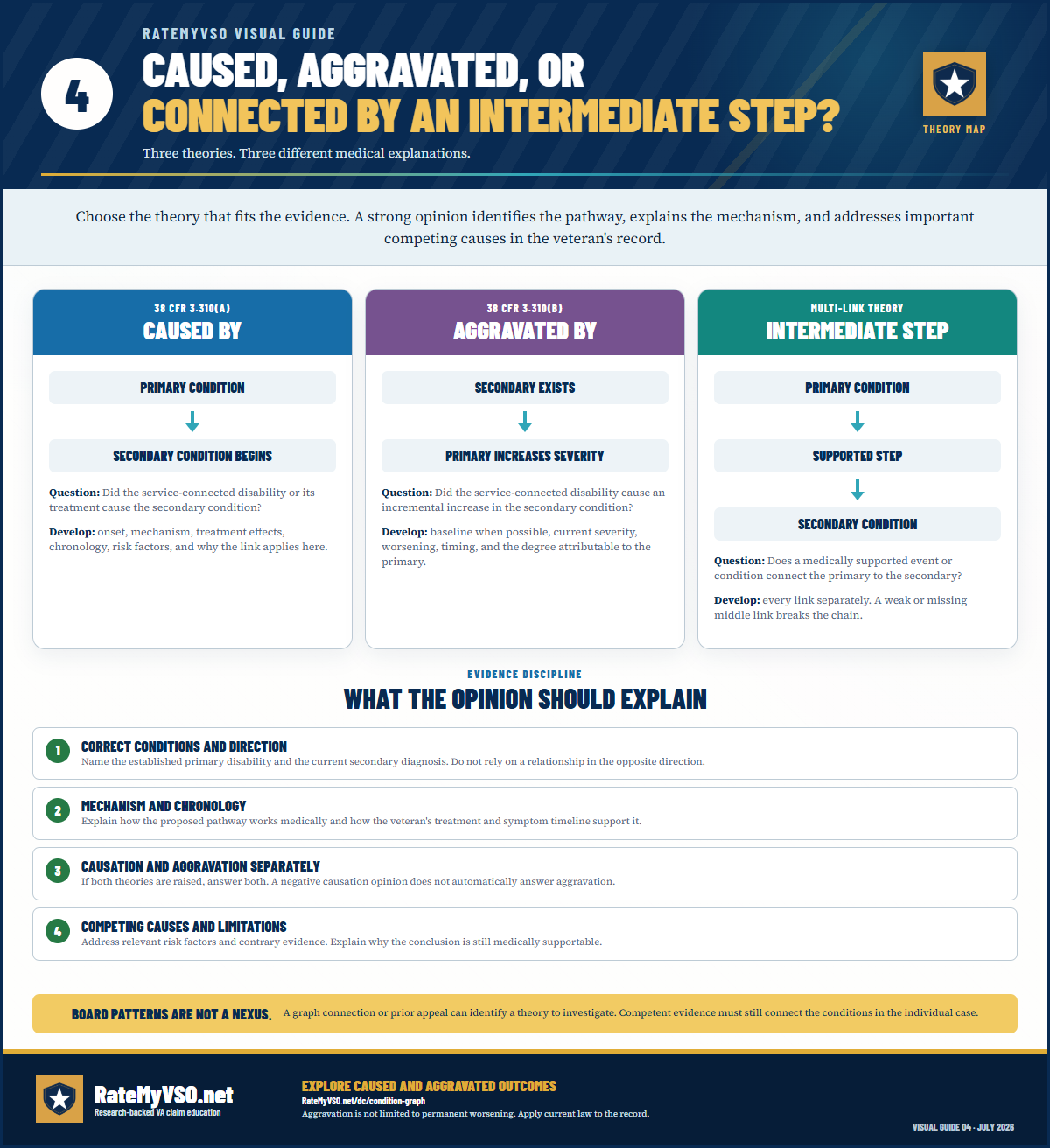 Caused, Aggravated, or Connected by an Intermediate Step?
The three shapes a secondary claim takes under 38 CFR 3.310, and what each one has to show. Opens the full-size chart, free to save or print.
Caused, Aggravated, or Connected by an Intermediate Step?
The three shapes a secondary claim takes under 38 CFR 3.310, and what each one has to show. Opens the full-size chart, free to save or print.
What Counts as a Secondary Condition
The Board record surfaced through these pages shows two ways a condition qualifies as secondary to one already service-connected:
- Caused by: the service-connected condition is the direct cause of the new condition. Example: nerve damage caused by a service-connected back condition.
- Aggravated by: the new condition already existed but the service-connected condition made it measurably worse. VA rates only the amount of the worsening, not the full severity of the condition.
Both paths require the same three pieces of evidence: the secondary condition itself must be diagnosed, the primary condition must already be service-connected, and a medical opinion (a nexus letter) has to connect the two. The Caused By vs. Made Worse page shows how the required documentation differs between the two paths.
What the Pair Pages Show
The Secondary Pairs Index and the Secondary Conditions Explorer are both built from the same underlying Board of Veterans' Appeals decision data. Each pairing page reports how often a specific secondary condition was claimed against a specific primary condition in published Board decisions, and how the Board ruled. They catalogue what the record shows; they do not estimate an individual veteran's odds on any specific claim.
This hub is for educational purposes only and is not medical or legal advice. The secondary-connection rule comes from 38 CFR 3.310. For help with your claim, find a VSO representative near you.