Board Hearing: What to Expect
You have chosen, or are considering, a hearing before a Veterans Law Judge at the Board of Veterans' Appeals. This is a plain-language walk-through of what actually happens, so nothing about the day surprises you. You will learn the three ways a hearing can happen, who is in the room, how to prepare, what the day itself is like, and how and when the decision finally arrives. At the end, you can follow one fictional veteran through an entire hearing from preparation to decision.

The Big Picture First
A Board hearing is your chance to talk to a Veterans Law Judge about your appeal and tell your story in your own words. It is a conversation, not a trial. There is no VA lawyer on the other side arguing against you, and the judge is there to understand your case, not to work against you. That is what people mean when they call a Board hearing non-adversarial.
Two things surprise most veterans, so it is worth saying up front:
You are never required to have a hearing. It is always optional. If you chose it, you did so because you want the judge to hear from you directly. The rest of this page explains exactly how that goes. For how the hearing lane compares to the other two Board options, see the Appeals Overview.
The Three Ways a Hearing Can Happen
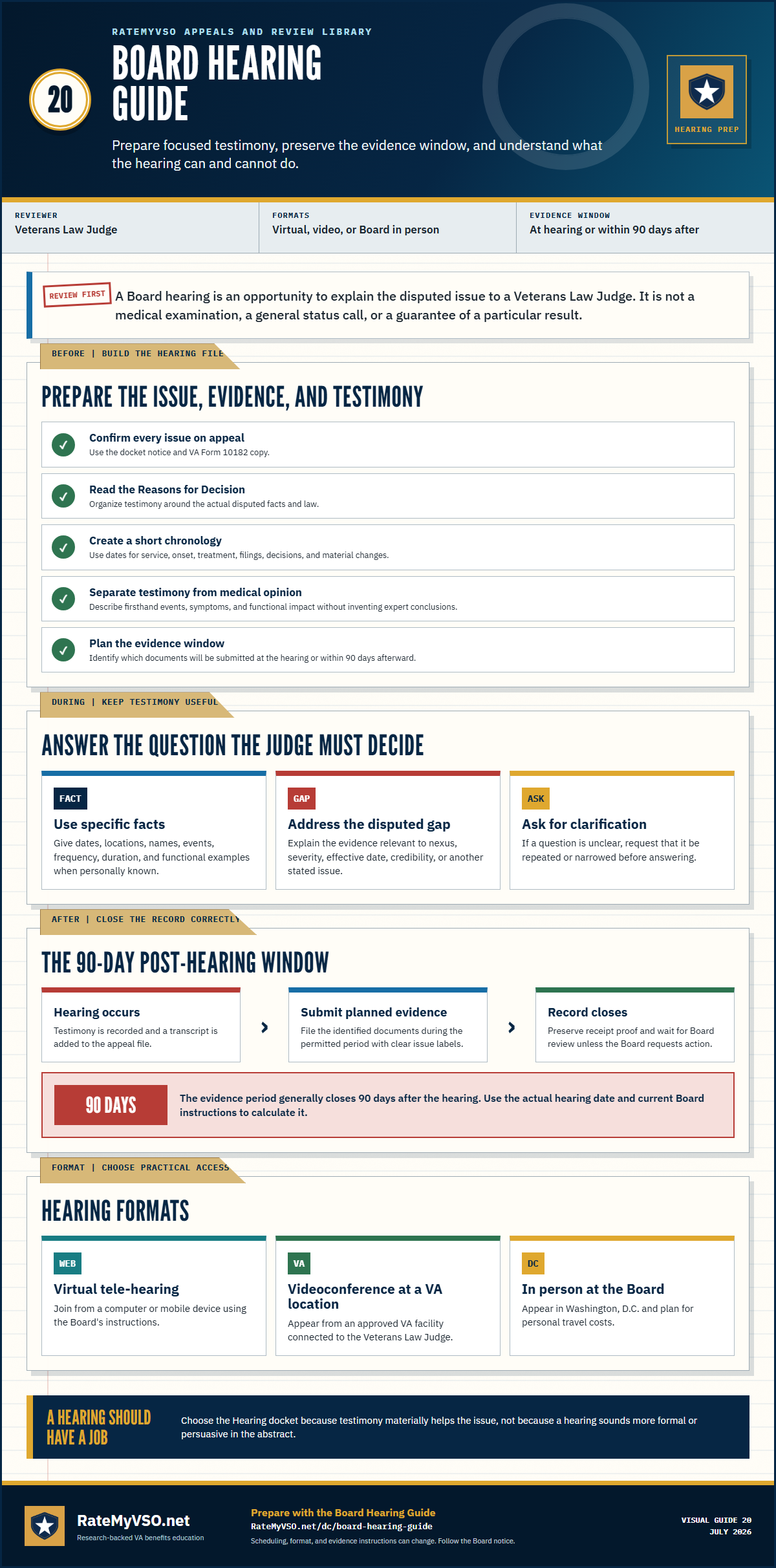
Under the current (AMA) appeals system, all three formats put you in front of the same kind of judge and carry the same weight. They differ only in where you sit and how long you may wait. The judge is always located in Washington, D.C. What changes is where you are.
1. Virtual tele-hearing (from home)
You join from your own home, or anywhere you choose, using a phone, tablet, or computer with a camera, microphone, and reliable internet. You get a date, time, and a secure link by email, and you click in at the scheduled time to see and talk to the judge on screen. This is the easiest to schedule and the option the Board itself encourages, because there is no travel and no facility to book. If your signal is shaky on the day, a hearing coordinator can help you sort it out.
2. Video hearing at a VA office
You travel to your local VA regional office (or another nearby VA facility) and sit in a conference room there. The judge appears on a large monitor by video from Washington. A VA staff member is usually on hand to help with the screen and the connection. This suits veterans who would rather not run the video from home but still want to avoid a long trip. Plan for the drive, parking, and time off, and arrive early to check in.
3. In-person hearing in Washington, D.C.
You travel to the Board's offices in Washington, D.C., and sit in the same room as the judge. Bring a photo ID to get into the building, and arrive early, because the judge schedules several veterans across the day. Be honest with yourself about this one: it carries no extra advantage over the other two formats, it usually takes the longest to schedule, and the VA does not reimburse your travel. It is generally only worth considering if you happen to live very close to D.C.
Who Is in the Room
A Board hearing is small and low-key. Depending on your format, the people involved are:
- You. You are the center of the hearing. This is your chance to speak.
- The Veterans Law Judge. One judge, who has already read your file before you arrive. They run the hearing and ask questions to understand your appeal.
- Your representative, if you have one. This may be an accredited attorney, an accredited claims agent, or a representative from a Veterans Service Organization. They can help you through the conversation. You are allowed to have a hearing without one. Find an accredited representative.
- A hearing coordinator or VA staff member, who handles the technical side and the recording. For a video hearing at a VA office, someone is usually present to help with the equipment.
- A witness, if you bring one. Common witnesses are a spouse, other family member, friend, fellow service member, or doctor, someone who can speak to what they have seen.
There is no opposing attorney. No one is in the room to argue against your claim.
A witness is there to speak to what they have seen, not to represent you. A lawyer, another accredited representative besides the one you have chosen, or a member of the media cannot attend a hearing in the role of witness.
Before the Hearing Starts
You will get a notice in the mail telling you the date, time, and location of your hearing. By law the Board sends this at least 30 days ahead, and hearings are scheduled in the order requests came in. A few practical things to know going in:
- Dress is business casual. Clean and comfortable is fine. You do not need a suit.
- Bring any new evidence to the hearing rather than mailing it ahead of time. You also have a 90-day window after the hearing to submit more.
- Some judges hold a short pre-hearing conversation to summarize the issues you are appealing and confirm what will be discussed, before the formal part begins.
- For a virtual hearing, test your device early. Check that your camera, microphone, and internet work well before the day, and join a few minutes ahead of your slot.
- For an in-person or VA-office hearing, bring a photo ID and arrive early to allow time to check in.
What Happens During the Hearing
Hearings usually last about 30 minutes. Here is the typical flow.
The judge swears you in. You will be asked to raise your right hand, if you are able, and take an oath or affirmation that you will tell the truth.
The judge frames the issues. They confirm which parts of your case you are appealing, so everyone is on the same page.
You tell your story. You explain, in your own words, why you believe you qualify for the benefits in your appeal. This is the heart of the hearing, and you should feel comfortable taking your time.
The judge asks questions. They may ask a few things to better understand your appeal. This is to fill in gaps, not to challenge you like a cross-examination.
Your representative may speak. If you have one, they can help present your information and add points on your behalf.
You can share new evidence. Anything new and relevant you brought can be handed to the judge for the file.
Everything said is recorded and transcribed, and that transcript becomes part of your appeal file. You can ask for a copy of the transcript for your own records. If you do not understand a question, it is perfectly fine to say so and ask the judge to put it another way.
What Happens After
When the hearing ends, the case does not close right away.
- The 90-day evidence window opens. You have 90 days after the hearing to send the judge any additional new evidence. If you have nothing more to add, you may choose to waive this period so the case can move forward sooner. If your representative wants time to file extra arguments, talk to them before waiving it.
- The case goes on the docket for a decision. Once that 90-day window closes, your case is placed in line for the judge to decide.
- The judge reviews everything. They consider your testimony along with all the evidence in your file, then issue a written decision.
- You receive the decision by mail later. It may grant your appeal, deny it, or remand it, meaning it sends the case back for more development such as a new exam. A remand is not a loss, but it does add more time.
Because so many veterans are waiting in the hearing line, the stretch between your hearing and your decision can run from many months to a few years. Knowing that in advance helps keep the wait from feeling like something has gone wrong. To understand what a written decision looks like when it arrives, see How to Read Your Rating Decision.
If You Need to Reschedule or Cancel
Life happens, and the Board has a process for it.
- To reschedule, send the Board a written request with good cause at least two weeks before your hearing. Good cause includes things like illness or trouble getting records. Include your name, your VA file number, and the reason. If your hearing is less than two weeks away, you will need to file a motion explaining why.
- You keep your place in line. Rescheduling does not send you to the back. You keep the same docket date and get the earliest new date possible.
- To withdraw (cancel) the hearing, you or your representative can send a written request at least two weeks ahead. Canceling does not automatically speed up your appeal unless you also switch to a no-hearing lane.
- Do not simply skip it. Missing a hearing without notice wastes the slot and can delay both your case and other veterans waiting behind you. If you cannot make it, tell the Board as soon as possible.
A Veteran's Hearing, Start to Finish
To make the timeline concrete, here is one fictional veteran's hearing from the day the notice arrives to the day the decision lands. He chose a virtual tele-hearing, the most common format. The notes in brackets point out where another format would differ.
How Marcus prepared
Marcus, an Army veteran appealing a denied lower-back claim, opened his mail one afternoon to a Board notice: a virtual tele-hearing, six weeks out, with a date, a time, and a secure video link. His first feeling was relief that the wait for a date was finally over, followed quickly by nerves about being on camera with a judge.
He called the VSO representative who had been helping him and told him the date. Over the next few weeks, Marcus gathered the one new thing he had not submitted yet, a short letter from his current doctor, and set it aside to bring to the hearing rather than mailing it. He did not write a script. He just thought through, in plain terms, what his back stops him from doing day to day: the mornings he cannot tie his boots, the warehouse job he had to leave.
Two days before, he tested the video link the Board had emailed. His laptop camera worked, but the microphone was faint, so he dug out a cheap headset and tried again until the picture and sound were clear. He picked a quiet room, told his family he would need it for an hour, and laid out his doctor's letter and a glass of water.
The day of
Marcus clicked the link ten minutes early in a clean shirt, no suit. A hearing coordinator joined first, checked that he could be seen and heard, and explained how the next half hour would go. Then the Veterans Law Judge appeared on screen, friendly and matter-of-fact, and Marcus realized the judge had clearly already read his file.
The judge asked him to raise his right hand and swear to tell the truth, then said plainly which issue they were there about: the denied back condition. The judge invited Marcus to explain, in his own words, what he was dealing with. Marcus talked for a few minutes about the pain, the lost job, the things he can no longer do. The judge asked a couple of follow-up questions to fill in gaps, not to argue, and when one question confused him, Marcus said so and the judge rephrased it. His representative added a few points at the end. Marcus mentioned the new doctor's letter, and the judge noted it for the file. About thirty minutes after it began, the hearing was over. No ruling, just a thank-you and a reminder that a decision would come later by mail.
The result and decision
After the hearing, Marcus had a 90-day window to send anything more. He submitted the doctor's letter through his representative and, with nothing else to add, did not drag the window out. Once it closed, his case went into line for the judge to write the decision.
The wait was long, well over a year, and there were stretches where it felt like nothing was happening. Marcus reminded himself that the hearing lane is simply the slow lane, and that quiet did not mean something had gone wrong. Eventually a thick envelope arrived. The judge had granted service connection for his back. (In another veteran's case the same envelope might instead deny the appeal, or remand it, sending it back for a new exam before a final answer. A remand is not a loss, but it adds more time.) Marcus read the decision twice, then called his representative to understand what the grant meant for his rating and his effective date.
The Numbers, in Context
These figures describe the Board's hearing docket as a whole. They are not a prediction about any individual appeal.
The hearing docket is the slowest of the Board's three lanes for two reasons the Board itself points to: the large number of veterans who choose the hearing lane, and the large number of scheduled hearings that become "no shows" or are withdrawn too late to give the slot to another waiting veteran. The Board schedules roughly a thousand hearings a week and has been expanding capacity, so wait times that peaked recently have begun to come down. The virtual tele-hearing is consistently the quickest format to get scheduled.
Frequently Asked Questions
Do I have to have a hearing?
Will the judge decide my case at the hearing?
Which format is best?
Can I bring new evidence?
What does a remand mean?
What if I need to reschedule?
Do I need a lawyer or representative?
Related Tools and Guides
Sources & official references: VA.gov, Board hearings with a Veterans Law Judge · VA News, What to Expect at a Board Hearing · VA News, hearing types and reschedule options · VA.gov, Hearing Coordinators · VA.gov, Request a Board Appeal (VA Form 10182) · Board of Veterans' Appeals, Decision Wait Times · Board of Veterans' Appeals FY 2024 Annual Report. This guide is for educational purposes only and is not legal advice. Procedures can change; confirm current details on the official VA pages above. For decisions about your own appeal, talk with a VA-accredited representative, claims agent, or attorney. Find a VSO representative.