C&P Exam Prep Guide for Bursitis (DC 5019)
YOUR EXAM BLUEPRINT
Bursitis
A knee exam is a hands-on physical exam. The examiner measures how the knee moves, tests it for stability, and reviews any imaging, then records the findings against the rating criteria in 38 CFR 4.71a.
DBQ used for this condition
- PPublic formDBQ MUSC Knee and Lower LegOpen the public DBQ
- PPublic formDBQ MUSC AnkleOpen the public DBQ
- PPublic formDBQ MUSC Hip and ThighOpen the public DBQ
- PPublic formDBQ MUSC Shoulder and ArmOpen the public DBQ
- PPublic formDBQ MUSC Hand and FingerOpen the public DBQ
- PPublic formDBQ MUSC WristOpen the public DBQ
- PPublic formDBQ MUSC Back (Thoracolumbar Spine)Open the public DBQ
- PPublic formDBQ MUSC Neck (Cervical Spine)Open the public DBQ
- PPublic formDBQ MUSC Foot Conditions Including Flatfoot (Pes Planus)Open the public DBQ
- PPublic formDBQ RHEUM ArthritisOpen the public DBQ
What the examination is likely to focus on
Functional-impact topics to describe
- Whether the knee loses additional function during flare-ups or after repeated use (pain, weakness, fatigue, or incoordination).
- Whether you need a brace, cane, or other assistive device.
- How the knee limits standing, walking, climbing, squatting, and your ability to work.
- The examiner's range-of-motion and stability findings map to the tiers in 38 CFR 4.71a. Separate ratings can apply for limited motion and for instability.
Which form the examiner uses
For bursitis (DC 5019), the C&P examiner completes the following Disability Benefits Questionnaire (DBQ):
- DBQ MUSC Knee and Lower Leg (public PDF on VA.gov)
- DBQ MUSC Ankle (public PDF on VA.gov)
- DBQ MUSC Hip and Thigh (public PDF on VA.gov)
- DBQ MUSC Shoulder and Arm (public PDF on VA.gov)
- DBQ MUSC Hand and Finger (public PDF on VA.gov)
- DBQ MUSC Wrist (public PDF on VA.gov)
- DBQ MUSC Back (Thoracolumbar Spine) (public PDF on VA.gov)
- DBQ MUSC Neck (Cervical Spine) (public PDF on VA.gov)
- DBQ MUSC Foot Conditions Including Flatfoot (Pes Planus) (public PDF on VA.gov)
- DBQ RHEUM Arthritis (public PDF on VA.gov)
DBQs are Department of Veterans Affairs Form 21-0960 series documents. Public DBQs are hosted on benefits.va.gov. A handful are examiner-only and are not posted publicly.
What to expect at your C&P exam
A knee exam is a hands-on physical exam. The examiner measures how the knee moves, tests it for stability, and reviews any imaging, then records the findings against the rating criteria in 38 CFR 4.71a.
1Initial interview (history)
- When the knee problem started and its cause (injury, surgery, or wear over time).
- Pain: where it is, how severe, and what makes it worse.
- Flare-ups: how often, how long they last, what triggers them, and how much more limited you are during one.
- Giving way or instability, locking, catching, or swelling.
- Surgeries or procedures, and current treatment (medication, injections, physical therapy).
- Whether you use a brace, cane, crutches, or other device.
- How the knee affects your work and daily activities.
2Physical examination
- Range of motion measured with a goniometer (a protractor-like tool): flexion (bending) and extension (straightening), in degrees.
- The point in the motion where pain begins.
- Repetitive-use testing: you bend and straighten the knee three times so the examiner can note any added loss of motion, pain, weakness, fatigue, or incoordination.
- Pain on weight-bearing, tenderness, and crepitus (a grinding feel).
- Muscle strength testing.
- Stability tests for the ligaments: front-to-back (Lachman and drawer tests) and side-to-side (varus and valgus).
- Tests for a meniscus (cartilage) tear and for ankylosis (a joint frozen in one position).
- The opposite knee is measured for comparison.
3Diagnostic tests the examiner may rely on
Imaging is usually already in your records. The examiner reviews it to confirm the diagnosis and severity.
4Functional assessment
- Whether the knee loses additional function during flare-ups or after repeated use (pain, weakness, fatigue, or incoordination).
- Whether you need a brace, cane, or other assistive device.
- How the knee limits standing, walking, climbing, squatting, and your ability to work.
- The examiner's range-of-motion and stability findings map to the tiers in 38 CFR 4.71a. Separate ratings can apply for limited motion and for instability.
An ankle exam is a hands-on physical exam. The examiner measures how the ankle moves and tests it, then rates under 38 CFR 4.71a.
1Initial interview (history)
- When the ankle problem started and its cause.
- Pain, swelling, giving way, and instability.
- Flare-ups, surgeries, braces, and current treatment.
- Effect on standing, walking, and work.
2Physical examination
- Range of motion measured with a goniometer: pointing the foot up and down, in degrees.
- The point where pain begins, and repetitive-use testing.
- Stability and strength testing.
- Watching you walk.
3Diagnostic tests the examiner may rely on
Imaging is usually already in your records.
4Functional assessment
- How much the ankle motion is limited (moderate versus marked) and whether it is unstable, which set the rating.
- Findings map to the tiers in 38 CFR 4.71a, DC 5271.
A hip exam is a hands-on physical exam. The examiner measures how the hip moves, tests it, and reviews imaging, then rates under 38 CFR 4.71a.
1Initial interview (history)
- When the hip problem started and its cause.
- Pain in the hip, groin, or thigh, and what makes it worse.
- Flare-ups, giving way, surgeries or a hip replacement.
- Whether you use a cane, walker, or brace.
- Effect on walking, sitting, and work.
2Physical examination
- Range of motion measured with a goniometer: bending the hip, straightening it, moving the leg out to the side, and rotation, in degrees.
- The point in the motion where pain begins, and repetitive-use testing.
- Strength testing and checking for ankylosis (a frozen joint) or a flail joint.
- Watching you walk.
3Diagnostic tests the examiner may rely on
Imaging is usually already in your records.
4Functional assessment
- How much the hip motion is limited and whether you need an assistive device, which set the rating.
- Findings map to the tiers in 38 CFR 4.71a (hip and thigh DCs 5250-5255).
A shoulder exam is a hands-on physical exam. The examiner measures how the shoulder moves, tests it, and reviews imaging, then rates under 38 CFR 4.71a.
1Initial interview (history)
- When the shoulder problem started and its cause.
- Pain, weakness, popping, or dislocations, and which arm is your dominant one.
- Flare-ups and what triggers them.
- Surgeries and current treatment.
- Effect on reaching, lifting, and work.
2Physical examination
- Range of motion measured with a goniometer: raising the arm forward and out to the side, and rotation, in degrees.
- The point in the motion where pain begins.
- Repetitive-use testing (three repetitions) for added loss of motion or function.
- Strength and stability testing, and checking for dislocation.
3Diagnostic tests the examiner may rely on
Imaging is usually already in your records.
4Functional assessment
- How far you can raise the arm (especially to shoulder level, about 90 degrees) and whether the dominant or non-dominant arm is affected, which set the rating.
- Findings map to the tiers in 38 CFR 4.71a (limitation of arm motion DC 5201; clavicle or scapula DC 5203).
A hand exam is a hands-on physical exam. The examiner measures how your fingers and thumb move and how well you grip, then rates under 38 CFR 4.71a.
1Initial interview (history)
- Which fingers or thumb are affected, and which hand is dominant.
- Pain, stiffness, or locking.
- Surgeries and current treatment.
- Effect on gripping, writing, buttoning, and work.
2Physical examination
- Range of motion of each affected finger and the thumb, including the gap between the fingertip and the palm.
- Grip and pinch strength.
- Checking for ankylosis (a frozen joint), and comparing to the other hand.
3Diagnostic tests the examiner may rely on
Imaging when a bone or joint problem is suspected.
4Functional assessment
- Limited motion or ankylosis of the fingers or thumb and the effect on grip, which set the rating.
- Findings map to the tiers in 38 CFR 4.71a (finger DCs 5216-5230).
A wrist exam is a hands-on physical exam. The examiner measures how the wrist moves and tests it, then rates under 38 CFR 4.71a.
1Initial interview (history)
- When the wrist problem started and its cause, and which hand is dominant.
- Pain, weakness, stiffness, or instability.
- Flare-ups, surgeries, and current treatment.
- Effect on gripping, lifting, and work.
2Physical examination
- Range of motion measured with a goniometer: bending the wrist up and down, side to side, and turning the forearm, in degrees.
- The point where pain begins, and repetitive-use testing.
- Strength and stability testing, and checking for ankylosis.
3Diagnostic tests the examiner may rely on
Imaging is usually already in your records.
4Functional assessment
- How much wrist motion is limited and whether the joint is fused, which set the rating.
- Findings map to the tiers in 38 CFR 4.71a (wrist DCs 5213-5215).
A spine exam (back or neck) is a hands-on physical exam. The examiner measures how the spine moves, checks for muscle spasm and nerve signs, and reviews imaging, then records the findings against the General Rating Formula in 38 CFR 4.71a.
1Initial interview (history)
- When the back or neck problem started and its cause.
- Pain: where it is, how severe, and whether it shoots into an arm or leg.
- Flare-ups: how often, how long they last, what triggers them, and how much more limited you are during one.
- Numbness, tingling, or weakness in the arms or legs (signs of nerve involvement).
- Any periods a doctor ordered bed rest, and roughly how many days over the past year.
- Surgeries, injections, physical therapy, and current treatment.
- Whether you use a back or neck brace, cane, or other device.
- How it affects your work and daily activities.
2Physical examination
- Range of motion measured with a goniometer: forward bending (flexion), backward (extension), side bending, and rotation, in degrees.
- The point in the motion where pain begins.
- Repetitive-use testing (three repetitions) for added loss of motion, pain, weakness, fatigue, or incoordination.
- Muscle spasm, guarding, and tenderness, and whether they change your posture or the way you walk.
- Whether the spine is fixed in one position (ankylosis).
- Reflexes, sensation, and strength in the arms or legs to check for a pinched nerve (radiculopathy).
- Straight-leg-raise and similar nerve-tension tests.
3Diagnostic tests the examiner may rely on
Imaging and nerve studies are usually already in your records. The examiner reviews them to confirm the diagnosis and severity.
4Functional assessment
- Whether the spine loses additional function during flare-ups or after repeated use.
- The number of days over the past 12 months a doctor ordered bed rest. For intervertebral disc syndrome this is the alternate basis for the rating.
- Whether you use a brace, cane, or other device.
- How it limits bending, lifting, sitting, standing, and your ability to work.
- Nerve symptoms (radiculopathy) are rated separately under the nerve codes; the examiner documents those findings too.
- Findings map to the General Rating Formula for the spine in 38 CFR 4.71a.
A foot exam is a hands-on physical exam. The examiner looks at the shape and alignment of your foot, how you walk, and where it hurts, then rates under 38 CFR 4.71a.
1Initial interview (history)
- When the foot problem started and its cause.
- Pain location and severity, and what makes it worse (standing, walking).
- Whether you use inserts (orthotics), special shoes, or a brace.
- Surgeries and current treatment.
- Effect on standing, walking, and work.
2Physical examination
- Inspecting the foot's shape and arch, and any deformity such as a bunion or claw toe.
- Watching you stand and walk (gait).
- Checking alignment, swelling, calluses, and tender areas.
- Whether symptoms improve with orthotics, and for flatfoot whether the arch corrects.
3Diagnostic tests the examiner may rely on
Used to confirm alignment or bone problems.
4Functional assessment
- Pain on use and whether orthotics relieve it, any deformity, and how the foot limits standing and walking, which set the rating.
- Findings map to the tiers in 38 CFR 4.71a (flatfoot DC 5276; plantar fasciitis DC 5269; hallux valgus or bunion DC 5280).
An arthritis exam checks the affected joints and reviews imaging. The rating depends on how many joints are involved and the limitation they cause, under 38 CFR 4.71a.
1Initial interview (history)
- Which joints are affected, and pain, swelling, or morning stiffness.
- Flare-ups: how often and how long.
- Treatment and the effect on daily activities and work.
2Physical examination
- Examining the affected joints for swelling and tenderness.
- Measuring range of motion and watching how you move.
3Diagnostic tests the examiner may rely on
Used to confirm arthritis and its type.
4Functional assessment
- The number of joints involved, incapacitating flare-ups, and limited motion, which set the rating.
- Findings map to the tiers in 38 CFR 4.71a (multi-joint arthritis DC 5002).
Test explainers open MedlinePlus (NIH National Library of Medicine), or Wikipedia where MedlinePlus has no matching page. This describes what happens and what is measured, not how to influence a result.
What the examiner records (full DBQ form)
The fields below are reproduced from the DBQ form the examiner completes for this diagnostic code. This is the structural map of the form, showing what the examiner is asked to measure, observe, and record. It is a factual reproduction of the public DBQ, not advice on how to answer.
DBQ MUSC Knee and Lower Leg
This DBQ evaluates knee and lower leg conditions including range of motion, ankylosis, joint stability, tibial/fibular impairment, meniscal conditions, and surgical procedures.
How DC 5019 maps to this DBQ: This diagnostic code applies to many joints. The C&P examiner uses whichever DBQ matches the affected joint and completes the standard exam sections (Diagnosis, Medical History, Range of Motion, etc.). Sections covering other joints on this form do not apply.
DIAGNOSIS (Section I)
- 1A. List the claimed condition(s) that pertain to this questionnaire
- 1B. Select diagnoses associated with the claimed condition(s) (check all that apply)
- The Veteran does not have a current diagnosis associated with any claimed condition(s) listed above.
- Knee strain - Side affected / ICD Code / Date of diagnosis
- Knee meniscal tear - Side affected / ICD Code / Date of diagnosis
- Knee anterior cruciate ligament tear - Side affected / ICD Code / Date of diagnosis
- Knee posterior cruciate ligament tear - Side affected / ICD Code / Date of diagnosis
- Patellar or quadriceps tendon rupture - Side affected / ICD Code / Date of diagnosis
- Knee joint osteoarthritis - Side affected / ICD Code / Date of diagnosis
- Knee joint ankylosis - Side affected / ICD Code / Date of diagnosis
- Knee fracture (including patellar fracture) - Side affected / ICD Code / Date of diagnosis
- Stress fracture of tibia - Side affected / ICD Code / Date of diagnosis
- Tibia and/or fibula fracture - Side affected / ICD Code / Date of diagnosis
- Recurrent patellar dislocation - Side affected / ICD Code / Date of diagnosis
- Recurrent subluxation - Side affected / ICD Code / Date of diagnosis
- Knee instability - Side affected / ICD Code / Date of diagnosis
- Patellar instability - Side affected / ICD Code / Date of diagnosis
- Knee cartilage restoration surgery - Side affected / ICD Code / Date of diagnosis
- Shin splints/medial tibial stress syndrome - MTSS (including post-surgery or treatment) - Side affected / ICD Code / Date of diagnosis
- Patellofemoral pain syndrome - Side affected / ICD Code / Date of diagnosis
- Degenerative arthritis, other than post traumatic - Side affected / ICD Code / Date of diagnosis
- Arthritis, gonorrheal - Side affected / ICD Code / Date of diagnosis
- Arthritis, pneumococcic - Side affected / ICD Code / Date of diagnosis
- Arthritis, streptococcic - Side affected / ICD Code / Date of diagnosis
- Arthritis, syphilitic - Side affected / ICD Code / Date of diagnosis
- Arthritis, rheumatoid (multi-joints) - Side affected / ICD Code / Date of diagnosis
- Post-traumatic arthritis - Side affected / ICD Code / Date of diagnosis
- Arthritis, typhoid - Side affected / ICD Code / Date of diagnosis
- Other specified forms of arthropathy (excluding gout) - Side affected / ICD Code / Date of diagnosis / Specify
- Osteoporosis, residuals of - Side affected / ICD Code / Date of diagnosis
- Osteomalacia, residuals of - Side affected / ICD Code / Date of diagnosis
- Bones, neoplasm, benign - Side affected / ICD Code / Date of diagnosis
- Osteitis deformans - Side affected / ICD Code / Date of diagnosis
- Gout - Side affected / ICD Code / Date of diagnosis
- Bursitis - Side affected / ICD Code / Date of diagnosis
- Myositis - Side affected / ICD Code / Date of diagnosis
- Heterotopic ossification - Side affected / ICD Code / Date of diagnosis
- Tendinopathy (select one if known) - Tendinitis / Tendinosis / Tenosynovitis - Side affected / ICD Code / Date of diagnosis
- Inflammatory other types - Side affected / ICD Code / Date of diagnosis / Specify
- Other (specify) - Other diagnosis #1 / #2 / #3 - Side affected / ICD Code / Date of diagnosis
- 1C. If there are additional diagnoses that pertain to knee conditions, list using above format
MEDICAL HISTORY (Section II)
- 2A. Describe the history, including onset and course, of the Veteran's knee and/or lower leg condition(s). Brief summary
- 2B. Does the Veteran report flare-ups of the knee and/or lower leg?
- If yes, document the Veteran's description of the flare-ups he/she experiences, including the frequency, duration, characteristics, precipitating and alleviating factors, severity and/or extent of functional impairment he or she experiences during a flare-up of symptoms.
- 2C. Does the Veteran report having any functional loss or functional impairment of the joint or extremity being evaluated on this questionnaire, including but not limited to after repeated use over time?
- If yes, document the Veteran's description of functional loss or functional impairment in his/her own words.
- 2D. Does the Veteran report or have a history of instability or recurrent subluxation of the knee?
- If yes, document the Veteran's description of instability/recurrent subluxation in his/her own words.
- 2E. Does the Veteran report or have a history of frequent effusion of the knee?
- If yes, is the frequent effusion a result of a diagnosis in Section 1? Describe below
RANGE OF MOTION (ROM) AND FUNCTIONAL LIMITATION (Section III)
- 3A. Initial ROM measurements - All normal / Abnormal or outside of normal range / Unable to test / Not indicated
- If 'Unable to test' or 'Not indicated' please explain
- If ROM is outside of 'normal' range, but is normal for the Veteran (for reason other than a knee/lower leg condition, such as age, body habitus, neurologic disease), please describe
- If abnormal, does the range of motion itself contribute to a functional loss? Yes / No - If yes, please explain
- Can testing be performed? Yes / No - If no, provide an explanation
- If this is the unclaimed joint, is it: Damaged / Undamaged
- Active Range of Motion (ROM) - Flexion endpoint (140 degrees): degrees
- Active Range of Motion (ROM) - Extension endpoint (0 degrees): degrees
- If noted on examination, which ROM exhibited pain (select all that apply): Flexion / Extension
- If any limitation of motion is specifically attributable to pain, weakness, fatigability, incoordination, or other; please note the degree(s) in which limitation of motion is specifically attributable to the factors identified and describe. Flexion degree endpoint (if different than above) / Extension degree endpoint (if different than above)
- Passive Range of Motion - Flexion endpoint (140 degrees): degrees / Same as active ROM
- Passive Range of Motion - Extension endpoint (0 degrees): degrees / Same as active ROM
- If noted on examination, which passive ROM exhibited pain (select all that apply): Flexion / Extension
- If any limitation of motion is specifically attributable to pain, weakness, fatigability, incoordination, or other; please note the degree(s) in which limitation of motion is specifically attributable to the factors identified and describe. Flexion degree endpoint (if different than above) / Extension degree endpoint (if different than above)
- Is there evidence of pain? Yes / No - If yes, check all that apply: weight-bearing / nonweight-bearing / active motion / passive motion / on rest/non-movement / does not result in/cause functional loss / causes functional loss
- Comments
- Is there objective evidence of crepitus? Yes / No
- Is there objective evidence of localized tenderness or pain on palpation of the joint or associated soft tissue? Yes / No - If yes, please explain. Include location, severity, and relationship to condition(s).
- 3B. Observed repetitive use ROM - Is the Veteran able to perform repetitive-use testing with at least three repetitions? Yes / No - If no, please explain
- Is there additional loss of function or range of motion after three repetitions? Yes / No
- If yes - Flexion endpoint (140 degrees): degrees
- If yes - Extension endpoint (0 degrees): degrees
- Select factors that cause this functional loss. Check all that apply: Pain / Fatigability / Weakness / Lack of endurance / Incoordination / Other / N/A
- 3C. Repeated use over time - Is the Veteran being examined immediately after repeated use over time? Yes / No
- Does procured evidence (statements from the Veteran) suggest pain, fatigability, weakness, lack of endurance, or incoordination which significantly limits functional ability with repeated use over time? Yes / No
- Select factors that cause this functional loss. Check all that apply: Pain / Fatigability / Weakness / Lack of endurance / Incoordination / Other / N/A
- Estimate range of motion in degrees for this joint immediately after repeated use over time - Flexion endpoint (140 degrees): degrees
- Estimate range of motion in degrees for this joint immediately after repeated use over time - Extension endpoint (0 degrees): degrees
- Please cite and discuss evidence. (Must be specific to the case and based on all procurable evidence.)
- 3D. Flare-ups - Is the examination being conducted during a flare-up? Yes / No
- Does procured evidence (statements from the Veteran) suggest pain, fatigability, weakness, lack of endurance, or incoordination which significantly limits functional ability with flare-ups? Yes / No
- Select factors that cause this functional loss. Check all that apply: Pain / Fatigability / Weakness / Lack of endurance / Incoordination / Other / N/A
- Estimate range of motion in degrees for this joint during flare-ups - Flexion endpoint (140 degrees): degrees
- Estimate range of motion in degrees for this joint during flare-ups - Extension endpoint (0 degrees): degrees
- Please cite and discuss evidence. (Must be specific to the case and based on all procurable evidence.)
- 3E. Additional factors contributing to disability - None / Interference with sitting / Interference with standing / Swelling / Disturbance of locomotion / Deformity / Less movement than normal / More movement than normal / nonunion of fracture / Weakened movement / Atrophy of disuse / Instability of station / Other, describe
- Please describe additional contributing factors of disability
MUSCLE ATROPHY (Section IV)
- 4A. Does the Veteran have muscle atrophy? Yes / No
- 4B. If yes, is the muscle atrophy due to the claimed condition in the diagnosis section? Yes / No - If no, provide rationale
- 4C. For any muscle atrophy due to a diagnosis listed in Section I, indicate specific location of atrophy - Right lower extremity (specify location of measurement such as '10cm above or below knee')
- Circumference of more normal side: cm
- Circumference of atrophied side: cm
- 4C. For any muscle atrophy due to a diagnosis listed in Section I, indicate specific location of atrophy - Left lower extremity (specify location of measurement such as '10cm above or below knee')
- Circumference of more normal side: cm
- Circumference of atrophied side: cm
ANKYLOSIS (Section V)
- 5A. Is there ankylosis of the knee and/or lower leg? Yes / No
- If yes, indicate the severity of ankylosis: Favorable angle in full extension or in slight flexion between 0 and 10 degrees / In flexion between 10 and 20 degrees / In flexion between 20 and 45 degrees / Extremely unfavorable, in flexion at an angle of 45 degrees or more
- 5B. Indicate angle of ankylosis in degrees. degrees / N/A no ankylosis of knee joint
- 5C. If ankylosed, is there involvement of Muscle Group XIII (posterior thigh group, hamstring complex of 2-joint muscles: (1) biceps femoris; (2) semimembranosus; (3) semitendinosus)? Yes / No
JOINT STABILITY (Section VI)
- 6A. Is there recurrent subluxation or persistent instability? Yes / No
- 6B. Is there or has there been a ligament tear (sprain)? Yes / No - If yes, select one of the following: Complete ligament tear / Incomplete/partial ligament tear
- 6C. Was the ligament tear repaired? Yes / No - If yes, select one of the following: Complete tear repair- successful / Complete tear repair- failed
- 6D. Does the Veteran require a prescription (by a medical provider) of any of the following for ambulation? Yes / No - If yes, check all that apply: Cane(s) / Walker / Crutches / Brace(s)
- 6E. Is there recurrent patellar instability? Yes / No
- 6F. Has the Veteran had surgical repair of the knee for patellar instability? Yes / No - If yes, please describe
- 6G. Does the Veteran require a prescription (by a medical provider) of any of the following for ambulation with patellar instability? Yes / No - If yes, check all that apply: Cane(s) / Walker / Crutches / Brace(s)
TIBIAL OR FIBULAR IMPAIRMENT (Section VII)
- 7A. Does the Veteran currently have or has the Veteran been diagnosed with a recurrent patellar dislocation, shin splints (medial tibial stress syndrome), stress fractures, or any other tibial or fibular impairment? Yes / No
- If yes, indicate condition: Stress fracture of the lower leg / Describe current symptoms
- Acquired and/or traumatic genu recurvatum with objectively demonstrated weakness and insecurity in weight-bearing.
- Recurrent patellar dislocation
- 'Shin Splints' (medial tibial stress syndrome - MTSS) - Indicate length of treatment: no treatment received / treatment for less than 12 consecutive months / requiring treatment for 12 consecutive months or more
- If Veteran underwent treatment, indicate response to treatment: responsive to surgery and/or treatment / unresponsive to either shoe orthotics or other conservative treatment / unresponsive to surgery and either shoe orthotics or other conservative treatment
- Leg length discrepancy (shortening of any bones of the lower extremity) - Measurements: Right leg cm / inch; Left leg cm / inch
- For any leg length discrepancy, please describe the relationship to the conditions listed in the diagnosis section above
MENISCAL CONDITIONS (Section VIII)
- 8A. Does the Veteran currently have or has the Veteran been diagnosed with a meniscus (semilunar cartilage) condition? Yes / No
- If yes, indicate severity and frequency of symptoms: No current symptoms / Meniscal dislocation / Meniscal tear / Frequent episodes of joint 'locking' / Frequent episodes of joint pain / Frequent episodes of joint effusion
- For all checked boxes above, describe
SURGICAL PROCEDURES (Section IX)
- 9A. Indicate any surgical procedures that the Veteran has had performed (check all that apply): No surgery
- Knee joint resurfacing - Date of surgery
- Total knee joint replacement - Date of surgery
- Total knee joint replacement residuals: None / Intermediate degrees of residual weakness, pain, or limitation of motion / Chronic residuals consisting of severe painful motion or weakness / Other residuals, describe
- Meniscectomy - Date of surgery
- Arthroscopic ligament repair - Date of surgery
- Other surgery not described (specify below) - Date of surgery / Type of surgery
- Residual signs of symptoms due to meniscectomy, arthroscopic ligament repair or other knee surgery not described above - Describe residuals
OTHER PERTINENT PHYSICAL FINDINGS, COMPLICATIONS, CONDITIONS, SIGNS, SYMPTOMS, AND SCARS (Section X)
- 10A. Does the Veteran have any other pertinent physical findings, complications, conditions, signs or symptoms related to any conditions listed in the diagnosis section above? Yes / No - If yes, describe (brief summary)
- 10B. Does the Veteran have any scars or other disfigurement (of the skin) related to any conditions or to the treatment of any conditions listed in the diagnosis section? Yes / No
ASSISTIVE DEVICES (Section XI)
- 11A. Does the Veteran use any assistive devices (other than those noted in Section VI) as a normal mode of locomotion, although occasional locomotion by other methods may be possible? Yes / No
- Wheelchair - Frequency of use: Occasional / Regular / Constant
- Brace - Frequency of use: Occasional / Regular / Constant
- Crutches - Frequency of use: Occasional / Regular / Constant
- Cane(s) - Frequency of use: Occasional / Regular / Constant
- Walker - Frequency of use: Occasional / Regular / Constant
- Other, describe - Frequency of use: Occasional / Regular / Constant
- 11B. If the Veteran uses any assistive devices, specify the condition, indicate the side, and identify the assistive device used for each condition.
REMAINING EFFECTIVE FUNCTION OF THE EXTREMITIES (Section XII)
- 12A. Due to the Veterans knee or lower leg condition(s), is there functional impairment of an extremity such that no effective function remains other than that which would be equally well served by an amputation with prosthesis (functions of the lower extremity include balance and propulsion, etc.)? Yes, functioning is so diminished that amputation with prosthesis would equally serve the Veteran. / No
- If yes, indicate extremities for which this applies: Right lower / Left lower
- 12B. For each checked extremity, identify the condition causing loss of function, describe loss of effective function and provide specific examples (brief summary)
DIAGNOSTIC TESTING (Section XIII)
- 13A. Have clinically relevant diagnostic imaging studies or other diagnostic procedures been performed or reviewed in conjunction with this examination? Yes / No
- 13B. If yes, is degenerative or post-traumatic arthritis documented? Yes / No - If yes, indicate side: Right / Left / Both
- 13C. If yes, provide type of test or procedure, date, and results (brief summary)
- 13D. Are there any other clinically relevant diagnostic test findings or results related to the claimed condition(s) and/or diagnosis(es), that were reviewed in conjunction with this examination? Yes / No - If yes, provide type of test or procedure, date, and results (brief summary)
- 13E. If any test results are other than normal, indicate relationship of abnormal findings to diagnosed conditions
FUNCTIONAL IMPACT (Section XIV)
- 14A. Regardless of the Veteran's current employment status, do the conditions listed in the diagnosis section impact his/her ability to perform any type of occupational task (such as standing, walking, lifting, sitting, etc.)? Yes / No
- If yes, describe the functional impact of each condition, providing one or more examples
REMARKS (Section XV)
- 15A. Remarks (if any - please identify the section to which the remark pertains when appropriate).
DBQ MUSC Ankle
This DBQ evaluates ankle conditions including range of motion, ankylosis, joint stability, surgical procedures, and functional impact.
How DC 5019 maps to this DBQ: This diagnostic code applies to many joints. The C&P examiner uses whichever DBQ matches the affected joint and completes the standard exam sections (Diagnosis, Medical History, Range of Motion, etc.). Sections covering other joints on this form do not apply.
DIAGNOSIS (Section I)
- 1A. List the claimed condition(s) that pertain to this questionnaire
- 1B. Select diagnoses associated with the claimed condition(s) (check all that apply)
- The Veteran does not have a current diagnosis associated with any claimed condition(s) listed above.
- Lateral collateral ligament sprain (chronic/recurrent) - Side affected / ICD code / Date of diagnosis
- Deltoid ligament sprain (chronic/recurrent) - Side affected / ICD code / Date of diagnosis
- Osteochondritis dissecans to include osteochondral fracture - Side affected / ICD code / Date of diagnosis
- Impingement (anterior/posterior (or trigonum syndrome)/anterolateral) - Side affected / ICD code / Date of diagnosis
- Tendonitis (Achilles/peroneal/posterior tibial) - Side affected / ICD code / Date of diagnosis
- Retrocalcaneal bursitis - Side affected / ICD code / Date of diagnosis
- Achilles' tendon rupture - Side affected / ICD code / Date of diagnosis
- Avascular necrosis, talus - Side affected / ICD code / Date of diagnosis
- Ankle joint replacement - Side affected / ICD code / Date of diagnosis
- Ankylosis of ankle, subtalar or tarsal joint - Side affected / ICD code / Date of diagnosis
- Shin splints/medial tibial stress syndrome - MTSS (including post-surgery or treatment) - Side affected / ICD code / Date of diagnosis
- Degenerative arthritis, other than post-traumatic - Side affected / ICD code / Date of diagnosis
- Arthritis, gonorrheal - Side affected / ICD code / Date of diagnosis
- Arthritis, pneumococcic - Side affected / ICD code / Date of diagnosis
- Arthritis, streptococcic - Side affected / ICD code / Date of diagnosis
- Arthritis, syphilitic - Side affected / ICD code / Date of diagnosis
- Arthritis, rheumatoid (multi-joints) - Side affected / ICD code / Date of diagnosis
- Arthritis, post-traumatic - Side affected / ICD code / Date of diagnosis
- Arthritis, typhoid - Side affected / ICD code / Date of diagnosis
- Other specified forms of arthropathy (excluding gout) - Side affected / ICD code / Date of diagnosis
- Osteoporosis, residuals of - Side affected / ICD code / Date of diagnosis
- Osteomalacia, residuals of - Side affected / ICD code / Date of diagnosis
- Bones, neoplasm, benign - Side affected / ICD code / Date of diagnosis
- Bones, neoplasm, malignant, primary or secondary - Side affected / ICD code / Date of diagnosis
- Osteitis deformans - Side affected / ICD code / Date of diagnosis
- Gout - Side affected / ICD code / Date of diagnosis
- Bursitis - Side affected / ICD code / Date of diagnosis
- Myositis - Side affected / ICD code / Date of diagnosis
- Heterotopic ossification - Side affected / ICD code / Date of diagnosis
- Tendinopathy (select one if known): Tendinitis / Tendinosis / Tenosynovitis - Side affected / ICD code / Date of diagnosis
- Other diagnosis #1 - Side affected / ICD code / Date of diagnosis
- Other diagnosis #2 - Side affected / ICD code / Date of diagnosis
- Other diagnosis #3 - Side affected / ICD code / Date of diagnosis
- 1C. If there are additional diagnoses that pertain to ankle conditions, list using above format
MEDICAL HISTORY (Section II)
- 2A. Describe the history, including onset and course, of the Veteran's ankle condition(s). Brief summary
- 2B. Does the Veteran report flare-ups of the ankle?
- If yes, document the Veteran's description of the flare-ups he/she experiences, including the frequency, duration, characteristics, precipitating and alleviating factors, severity, and/or extent of functional impairment he/she experiences during a flare-up of symptoms
- 2C. Does the Veteran report having any functional loss or functional impairment of the joint or extremity being evaluated on this questionnaire, including but not limited to after repeated use over time?
- If yes, document the Veteran's description of functional loss or functional impairment in his/her own words
- 2D. Does the Veteran report or have a history of instability of the ankle?
- If yes, document the Veteran's description of instability in his/her own words
RANGE OF MOTION (ROM) AND FUNCTIONAL LIMITATION (Section III)
- 3A. Initial ROM measurements: All Normal / Abnormal or outside of normal range / Unable to test / Not indicated
- If 'Unable to test' or 'Not indicated', please explain
- If ROM is outside of 'normal' range, but is normal for the Veteran (for reasons other than an ankle condition, such as age, body habitus, neurologic disease), please describe
- If abnormal, does the range of motion itself contribute to a functional loss?
- Can testing be performed?
- If this is the unclaimed joint, is it: Damaged / Undamaged
- Active Range of Motion (ROM) - Plantar flexion endpoint (45 degrees): degrees
- Active Range of Motion (ROM) - Dorsiflexion endpoint (20 degrees): degrees
- If noted on examination, which ROM exhibited pain (select all that apply): Plantar flexion / Dorsiflexion
- If any limitation of motion is specifically attributable to pain, weakness, fatigability, incoordination, or other; please note the degree(s) in which limitation of motion is specifically attributable to the factors identified and describe
- Plantar flexion degree endpoint (if different than above)
- Dorsiflexion degree endpoint (if different than above)
- Passive Range of Motion - Plantar flexion endpoint (45 degrees): degrees / Same as active ROM
- Passive Range of Motion - Dorsiflexion endpoint (20 degrees): degrees / Same as active ROM
- If noted on examination, which passive ROM exhibited pain (select all that apply): Plantar flexion / Dorsiflexion
- Is there evidence of pain? Weight-bearing / Nonweight-bearing / Active motion / Passive motion / On rest/nonmovement / Causes functional loss / Does not result in/cause functional loss
- Comments
- Is there objective evidence of crepitus?
- Is there objective evidence of localized tenderness or pain on palpation of the joint or associated soft tissue? If yes, please explain. Include location, severity, and relationship to condition(s).
- 3B. Observed repetitive use ROM - Is the Veteran able to perform repetitive-use testing with at least three repetitions?
- Is there additional loss of function or range of motion after three repetitions?
- After three repetitions - Plantar flexion endpoint (45 degrees): degrees
- After three repetitions - Dorsiflexion endpoint (20 degrees): degrees
- Select factors that cause this functional loss. Check all that apply: Pain / Fatigability / Weakness / Lack of endurance / Incoordination / Other
- 3C. Repeated use over time - Is the Veteran being examined immediately after repeated use over time?
- Does procured evidence (statements from the Veteran) suggest pain, fatigability, weakness, lack of endurance, or incoordination which significantly limits functional ability with repeated use over time?
- Select factors that cause this functional loss (repeated use over time): Pain / Fatigability / Weakness / Lack of endurance / Incoordination / Other
- Estimate range of motion in degrees for this joint immediately after repeated use over time - Plantar flexion endpoint (45 degrees): degrees
- Estimate range of motion in degrees for this joint immediately after repeated use over time - Dorsiflexion endpoint (20 degrees): degrees
- Please cite and discuss evidence. (Must be specific to the case and based on all procurable evidence.)
- 3D. Flare-ups - Is the examination being conducted during a flare-up?
- Does procured evidence (statements from the Veteran) suggest pain, fatigability, weakness, lack of endurance, or incoordination which significantly limits functional ability with flare-ups?
- Select factors that cause this functional loss (flare-ups): Pain / Fatigability / Weakness / Lack of endurance / Incoordination / Other
- Estimate range of motion in degrees for this joint during flare-ups - Plantar flexion endpoint (45 degrees): degrees
- Estimate range of motion in degrees for this joint during flare-ups - Dorsiflexion endpoint (20 degrees): degrees
- 3E. Additional factors contributing to disability: None / Interference with sitting / Interference with standing / Swelling / Disturbance of locomotion / Deformity / Less movement than normal / More movement than normal / Weakened movement / Atrophy of disuse / Instability of station / Other
- Please describe additional contributing factors of disability
MUSCLE ATROPHY (Section IV)
- 4A. Does the Veteran have muscle atrophy?
- 4B. If yes, is the muscle atrophy due to the claimed condition in the diagnosis section? If no, provide rationale
- 4C. Right lower extremity - specify location of measurement such as '1cm above or below ankle'
- Circumference of more normal side: cm
- Circumference of atrophied side: cm
- 4C. Left lower extremity - specify location of measurement such as '1cm above or below ankle'
- Circumference of more normal side: cm (left)
- Circumference of atrophied side: cm (left)
ANKYLOSIS (Section V)
- 5A. Is there ankylosis of the ankle?
- If yes, indicate the severity of ankle ankylosis: In plantar flexion, less than 30 degrees / In plantar flexion, between 30 degrees and 40 degrees / In plantar flexion at more than 40 degrees / In dorsiflexion, between 0 degrees and 10 degree / In dorsiflexion at more than 10 degrees / With an abduction deformity / With an adduction deformity / With an inversion deformity / With an eversion deformity
- 5B. Indicate angle of ankle ankylosis in degrees: N/A no ankle ankylosis of joint / Plantar flexion / Dorsiflexion
- 5C. Is there ankylosis of the subastragalar or tarsal joint? If yes, indicate severity: In good weight-bearing position / In poor weight-bearing position
JOINT STABILITY (Section VI)
- 6A. Anterior Drawer Test: Is there absence of firm end point with asymmetric or excessive motion?
- Talar Tilt Test: Is there asymmetric or excessive motion?
- If unable to test, please explain why
- 6B. If unable to test, is ankle instability suspected? If yes, please describe
ADDITIONAL COMMENTS (Section VII)
- 7A. Does the Veteran now have or has he or she ever had shin splints (medial tibial stress syndrome), stress fractures, Achilles tendonitis, Achilles tendon rupture, malunion of calcaneus (os calcis) or talus (astragalus), or has the Veteran had a talectomy (astragalectomy)?
- Stress fracture of the lower leg - Describe current symptoms
- Achilles tendonitis or Achilles tendon rupture - Describe current symptoms
- Malunion of calcaneus (os calcis) or talus (astragalus) - Indicate severity: Moderate deformity / Marked deformity
- 'Shin Splints' (medial tibial stress syndrome - MTSS) - Indicate length of treatment: no treatment received / treatment for less than 12 consecutive months / requiring treatment for 12 consecutive months or more
- If Veteran underwent treatment, indicate response to treatment: responsive to surgery and/or treatment / unresponsive to either shoe orthotics or other conservative treatment / unresponsive to surgery and either shoe orthotics or other conservative treatment
- Does this condition affect ROM of knee?
- Talectomy - Describe current symptoms
SURGICAL PROCEDURES (Section VIII)
- 8A. Indicate any surgical procedures that the Veteran has had performed: No surgery / Total ankle joint replacement / Arthroscopic or other ankle surgery
- Total ankle joint replacement - Date of surgery
- Total ankle joint replacement - Residuals: None / Intermediate degrees of residual weakness, pain or limitation of motion / Chronic residuals consisting of severe painful motion or weakness / Other, describe
- Arthroscopic or other ankle surgery - Type of surgery
- Arthroscopic or other ankle surgery - Date of surgery
- Residuals of arthroscopic or other ankle surgery - Describe residuals
OTHER PERTINENT PHYSICAL FINDINGS, COMPLICATIONS, CONDITIONS, SIGNS, SYMPTOMS, AND SCARS (Section IX)
- 9A. Does the Veteran have any other pertinent physical findings, complications, conditions, signs or symptoms related to any conditions listed in the diagnosis section above? If yes, describe (brief summary)
- 9B. Does the Veteran have any scars or other disfigurement (of the skin) related to any conditions or to the treatment of any conditions listed in the diagnosis section?
ASSISTIVE DEVICES (Section X)
- 10A. Does the Veteran use any assistive devices as a normal mode of locomotion, although occasional locomotion by other methods may be possible?
- Wheelchair - Frequency of use: Occasional / Regular / Constant
- Brace(s) - Frequency of use: Occasional / Regular / Constant
- Crutch(es) - Frequency of use: Occasional / Regular / Constant
- Cane(s) - Frequency of use: Occasional / Regular / Constant
- Walker - Frequency of use: Occasional / Regular / Constant
- Other - Frequency of use: Occasional / Regular / Constant
- 10B. If the Veteran uses any assistive devices, specify the condition, indicate the side, and identify the assistive device used for each condition.
REMAINING EFFECTIVE FUNCTION OF THE EXTREMITIES (Section XI)
- 11A. Due to the Veterans ankle condition(s), is there functional impairment of an extremity such that no effective function remains other than that which would be equally well served by an amputation with prosthesis?
- If yes, indicate extremities for which this applies: Right lower / Left lower
- 11B. For each checked extremity, identify the condition causing loss of function, describe loss of effective function and provide specific examples (brief summary)
DIAGNOSTIC TESTING (Section XII)
- 12A. Have clinically relevant diagnostic imaging studies or other diagnostic procedures been performed or reviewed in conjunction with this examination?
- 12B. If yes, is degenerative or post-traumatic arthritis documented? If yes, indicate side: Right / Left / Both
- 12C. If yes, provide type of test or procedure, date and results (brief summary)
- 12D. Are there any other clinically relevant diagnostic test findings or results related to the claimed condition(s) and/or diagnosis(es), that were reviewed in conjunction with this examination? If yes, provide type of test or procedure, date and results (brief summary)
- 12E. If any test results are other than normal, indicate relationship of abnormal findings to diagnosed conditions
FUNCTIONAL IMPACT (Section XIII)
- 13A. Regardless of the Veteran's current employment status, do the conditions listed in the diagnosis section impact his/her ability to perform any type of occupational task (such as standing, walking, lifting, sitting, etc.)?
- If yes, describe the functional impact of each condition, providing one or more examples
REMARKS (Section XIV)
- 14A. Remarks (if any - please identify the section to which the remark pertains when appropriate)
DBQ MUSC Hip and Thigh
This DBQ evaluates hip and thigh conditions including range of motion, ankylosis, femur impairment, and surgical procedures.
How DC 5019 maps to this DBQ: This diagnostic code applies to many joints. The C&P examiner uses whichever DBQ matches the affected joint and completes the standard exam sections (Diagnosis, Medical History, Range of Motion, etc.). Sections covering other joints on this form do not apply.
DIAGNOSIS (Section I)
- List the claimed conditions that pertain to this questionnaire:
- The Veteran does not have a current diagnosis associated with any claimed conditions listed above.
- Osteoarthritis, hip - Side affected: Right / Left / Both; ICD Code; Date of diagnosis
- Hip joint replacement - Side affected: Right / Left / Both; ICD Code; Date of diagnosis
- Hip joint resurfacing - Side affected: Right / Left / Both; ICD Code; Date of diagnosis
- Trochanteric pain syndrome (includes trochanteric bursitis) - Side affected: Right / Left / Both; ICD Code; Date of diagnosis
- Femoral acetabular impingement syndrome (includes labral tears) - Side affected: Right / Left / Both; ICD Code; Date of diagnosis
- Iliopsoas tendinitis - Side affected: Right / Left / Both; ICD Code; Date of diagnosis
- Femoral neck stress fracture - Side affected: Right / Left / Both; ICD Code; Date of diagnosis
- Avascular necrosis, hip - Side affected: Right / Left / Both; ICD Code; Date of diagnosis
- Ankylosis of hip joint - Side affected: Right / Left / Both; ICD Code; Date of diagnosis
- Degenerative arthritis, other than posttraumatic - Side affected: Right / Left / Both; ICD Code; Date of diagnosis
- Arthritis, gonorrheal - Side affected: Right / Left / Both; ICD Code; Date of diagnosis
- Arthritis, pneumococcic - Side affected: Right / Left / Both; ICD Code; Date of diagnosis
- Arthritis, streptococcic - Side affected: Right / Left / Both; ICD Code; Date of diagnosis
- Arthritis, syphilitic - Side affected: Right / Left / Both; ICD Code; Date of diagnosis
- Arthritis, rheumatoid (multi-joints) - Side affected: Right / Left / Both; ICD Code; Date of diagnosis
- Post-traumatic arthritis - Side affected: Right / Left / Both; ICD Code; Date of diagnosis
- Arthritis, typhoid - Side affected: Right / Left / Both; ICD Code; Date of diagnosis
- Other specified forms of arthropathy (excluding gout) (specify) - Side affected: Right / Left / Both; ICD Code; Date of diagnosis
- Osteoporosis, residuals of - Side affected: Right / Left / Both; ICD Code; Date of diagnosis
- Osteomalacia, residuals of - Side affected: Right / Left / Both; ICD Code; Date of diagnosis
- Bones, neoplasm, benign - Side affected: Right / Left / Both; ICD Code; Date of diagnosis
- Osteitis deformans - Side affected: Right / Left / Both; ICD Code; Date of diagnosis
- Gout - Side affected: Right / Left / Both; ICD Code; Date of diagnosis
- Bursitis - Side affected: Right / Left / Both; ICD Code; Date of diagnosis
- Myositis - Side affected: Right / Left / Both; ICD Code; Date of diagnosis
- Heterotopic ossification - Side affected: Right / Left / Both; ICD Code; Date of diagnosis
- Tendinopathy (select one if known): Tendinitis / Tendinosis / Tenosynovitis - Side affected: Right / Left / Both; ICD Code; Date of diagnosis
- Inflammatory other types (specify) - Side affected: Right / Left / Both; ICD Code; Date of diagnosis
- Other (specify) - Other diagnosis #1: Side affected, ICD Code, Date of diagnosis
- Other diagnosis #2: Side affected, ICD Code, Date of diagnosis
- Other diagnosis #3: Side affected, ICD Code, Date of diagnosis
MEDICAL HISTORY (Section II)
- 2A. Describe the history (including onset and course) of the Veteran's hip or thigh condition (brief summary):
- 2B. Does the Veteran report flare-ups of the hip or thigh? Yes / No
- If yes, document the Veteran's description of the flare-ups he/she experiences, including the frequency, duration, characteristics, precipitating and alleviating factors, severity and/or extent of functional impairment he or she experiences during a flare-up of symptoms.
- 2C. Does the Veteran report having any functional loss or functional impairment of the joint or extremity being evaluated on this questionnaire, including but not limited to after repeated use over time? Yes / No
- If yes, document the Veteran's description of functional loss or functional impairment in his/her own words.
RANGE OF MOTION (ROM) AND FUNCTIONAL LIMITATION (Section III)
- 3A. Initial ROM measurements - All normal / Abnormal or outside of normal range / Unable to test / Not indicated
- If ROM is outside of 'normal' range, but is normal for the Veteran (for reason other than a hip/thigh condition, such as age, body habitus, neurologic disease), please describe:
- If abnormal, does the range of motion itself contribute to a functional loss? Yes / No
- Can testing be performed? Yes / No
- If this is the unclaimed joint, is it: Damaged / Undamaged
- Active ROM - Flexion endpoint (125 degrees): degrees
- Active ROM - Extension endpoint (30 degrees): degrees
- Active ROM - Abduction endpoint (45 degrees): degrees
- Active ROM - Adduction endpoint (25 degrees): degrees
- Active ROM - External rotation endpoint (60 degrees): degrees
- Active ROM - Internal rotation endpoint (40 degrees): degrees
- If noted on examination, which ROM exhibited pain (select all that apply): Flexion / Extension / Abduction / Adduction / External Rotation / Internal Rotation
- If any limitation of motion is specifically attributable to pain, weakness, fatigability, incoordination, or other; please note the degree(s) in which limitation of motion is specifically attributable to the factors identified and describe.
- Flexion degree endpoint (if different than above)
- Extension degree endpoint (if different than above)
- Abduction degree endpoint (if different than above)
- Adduction degree endpoint (if different than above)
- External Rotation degree endpoint (if different than above)
- Internal Rotation degree endpoint (if different than above)
- Does a limitation in adduction prevent the Veteran from crossing his/her legs? Yes / No
- Passive ROM - Flexion endpoint (125 degrees): degree / Same as active ROM
- Passive ROM - Extension endpoint (30 degrees): degree / Same as active ROM
- Passive ROM - Abduction endpoint (45 degrees): degree / Same as active ROM
- Passive ROM - Adduction endpoint (25 degrees): degree / Same as active ROM
- Passive ROM - External rotation endpoint (60 degrees): degree / Same as active ROM
- Passive ROM - Internal rotation endpoint (40 degrees): degree / Same as active ROM
- If noted on examination, which ROM exhibited pain (passive) (select all that apply): Flexion / Extension / Abduction / Adduction / External Rotation / Internal Rotation
- Does a limitation in passive adduction prevent the Veteran from crossing his/her legs? Yes / No
- Is there evidence of pain? Yes / No - weight-bearing / nonweight-bearing / active motion / passive motion / on rest/non-movement / causes functional loss / does not result in/cause functional loss
- Is there objective evidence of crepitus? Yes / No
- Is there objective evidence of localized tenderness or pain on palpation of the joint or associated soft tissue? Yes / No
- 3B. Is the Veteran able to perform repetitive-use testing with at least three repetitions? Yes / No
- Is there additional loss of function or range of motion after three repetitions? Yes / No
- Flexion endpoint after three repetitions (125 degrees): degrees
- Extension endpoint after three repetitions (30 degrees): degrees
- Abduction endpoint after three repetitions (45 degrees): degrees
- Adduction endpoint after three repetitions (25 degrees): degrees
- External rotation endpoint after three repetitions (60 degrees): degrees
- Internal rotation endpoint after three repetitions (40 degrees): degrees
- Does limitation in adduction after observed repetitive use prevent the Veteran from crossing his/her legs? Yes / No
- Select factors that cause this functional loss: Pain / Fatigability / Weakness / Lack of endurance / Incoordination / Other / N/A
- 3C. Is the Veteran being examined immediately after repeated use over time? Yes / No
- Does procured evidence (statements from the Veteran) suggest pain, fatigability, weakness, lack of endurance, or incoordination which significantly limits functional ability with repeated use over time? Yes / No
- Select factors that cause this functional loss (repeated use over time): Pain / Fatigability / Weakness / Lack of endurance / Incoordination / Other / N/A
- Estimate range of motion - Flexion endpoint after repeated use over time (125 degrees): degrees
- Estimate range of motion - Extension endpoint after repeated use over time (30 degrees): degrees
- Estimate range of motion - Abduction endpoint after repeated use over time (45 degrees): degrees
- Estimate range of motion - Adduction endpoint after repeated use over time (25 degrees): degrees
- Estimate range of motion - External rotation endpoint after repeated use over time (60 degrees): degrees
- Estimate range of motion - Internal rotation endpoint after repeated use over time (40 degrees): degrees
- Please cite and discuss evidence. (Must be specific to the case and based on all procurable evidence.)
- Does limitation in adduction after repeated use over time prevent the Veteran from crossing his/her legs? Yes / No
- 3D. Is the examination being conducted during a flare-up? Yes / No
- Does procured evidence (statements from the Veteran) suggest pain, fatigability, weakness, lack of endurance, or incoordination which significantly limits functional ability with flare-ups? Yes / No
- Select factors that cause this functional loss (flare-ups): Pain / Fatigability / Weakness / Lack of endurance / Incoordination / Other / N/A
- Estimate range of motion during flare-ups - Flexion endpoint (125 degrees): degrees
- Estimate range of motion during flare-ups - Extension endpoint (30 degrees): degrees
- Estimate range of motion during flare-ups - Abduction endpoint (45 degrees): degrees
- Estimate range of motion during flare-ups - Adduction endpoint (25 degrees): degrees
- Estimate range of motion during flare-ups - External rotation endpoint (60 degrees): degrees
- Estimate range of motion during flare-ups - Internal rotation endpoint (40 degrees): degrees
- Please cite and discuss evidence. (Must be specific to the case and based on all procurable evidence.)
- Does limitation in adduction during flare-ups prevent the Veteran from crossing his/her legs? Yes / No
- 3E. In addition to those addressed above, are there additional contributing factors of disability? Please select all that apply and describe: None / Interference with standing / Disturbance of locomotion / Less movement than normal / Weakened movement / Instability of station / Interference with sitting / Swelling / Deformity / More movement than normal / Atrophy of disuse / Other, describe
- Please describe additional contributing factors of disability:
MUSCLE ATROPHY (Section IV)
- 4A. Does the Veteran have muscle atrophy? Yes / No
- 4B. If yes, is the muscle atrophy due to the claimed condition in the diagnosis section? Yes / No - If no, provide rationale:
- 4C. Specify location of atrophy (e.g. '10cm above or below the hip'):
- Circumference of more normal side: cm
- Circumference of atrophied side: cm
ANKYLOSIS (Section V)
- 5A. Is there ankylosis of the hip and/or thigh? Yes / No
- If yes, indicate the severity of ankylosis: Unfavorable, extremely unfavorable ankylosis, foot not reaching ground, crutches needed / Intermediate, between favorable and unfavorable / Favorable, in flexion at an angle between 20 and 40 degrees, and slight abduction or adduction
FEMUR OR FLAIL HIP JOINT IMPAIRMENT (Section VI)
- 6A. Does the Veteran have malunion or non union of femur, flail hip joint or leg length discrepancy? Yes / No
- Fracture of shaft or neck (anatomical), with nonunion with loose motion (spiral or oblique fracture)
- Fracture of shaft or neck (anatomical), resulting in nonunion without loose motion; weight-bearing preserved with aid of brace
- Fracture of surgical neck with false joint
- Malunion of the femur
- Flail hip joint
- Leg length discrepancy (shortening of any bones of the lower extremity)
- Measurements: Right leg: cm / inch
- Measurements: Left leg: cm / inch
- For any leg length discrepancy, please describe the relationship to the conditions listed in the diagnosis section above:
SURGICAL PROCEDURES (Section VII)
- 7A. Indicate any surgical procedures that the Veteran has had performed (check all that apply): No surgery
- Hip joint resurfacing - Date of surgery:
- Total hip joint replacement - Date of surgery:
- Total hip joint replacement residuals: None / Moderately severe residuals of weakness, pain or limitation of motion / Markedly severe residuals of weakness, pain or limitation of motion following implantation of prosthesis / Following implantation of prosthesis with painful motion or weakness such as to require the use of crutches / Other, describe:
- Arthroscopic ligament repair - Date of surgery:
- Other surgery not described (specify below): Date of surgery / Type of surgery:
- Residuals of arthroscopic or other hip surgery - Describe residuals:
OTHER PERTINENT PHYSICAL FINDINGS, COMPLICATIONS, CONDITIONS, SIGNS, SYMPTOMS, AND SCARS (Section VIII)
- 8A. Does the Veteran have any other pertinent physical findings, complications, conditions, signs or symptoms related to any conditions listed in the diagnosis section above? Yes / No - If yes, describe (brief summary)
- 8B. Does the Veteran have any scars or other disfigurement (of the skin) related to any conditions or to the treatment of any conditions listed in the diagnosis section above? Yes / No
ASSISTIVE DEVICES (Section IX)
- 9A. Does the Veteran use any assistive devices as a normal mode of locomotion, although occasional locomotion by other methods may be possible? Yes / No
- Wheelchair - Frequency of use: Occasional / Regular / Constant
- Brace for ambulation - Frequency of use: Occasional / Regular / Constant
- Crutches - Frequency of use: Occasional / Regular / Constant
- Cane(s) - Frequency of use: Occasional / Regular / Constant
- Walker - Frequency of use: Occasional / Regular / Constant
- Other, describe: - Frequency of use: Occasional / Regular / Constant
- 9B. If the Veteran uses any assistive devices, specify the condition, indicate the side, and identify the assistive device used for each condition.
REMAINING EFFECTIVE FUNCTION OF THE EXTREMITIES (Section X)
- 10A. Due to the Veterans hip or thigh condition(s), is there functional impairment of an extremity such that no effective functions remain other than that which would be equally well served by an amputation with prosthesis (functions of the lower extremity include balance and propulsion, etc.)? Yes, functioning is so diminished that amputation with prosthesis would equally serve the Veteran / No
- If yes, indicate extremities for which this applies: Right lower / Left lower
- 10B. For each checked extremity, identify the condition causing loss of function, describe loss of effective function and provide specific examples (brief summary):
DIAGNOSTIC TESTING (Section XI)
- 11A. Have imaging studies been performed in conjunction with this examination? Yes / No
- 11B. If yes, is degenerative or post-traumatic arthritis documented? Yes / No - Indicate side: Right / Left / Both
- 11C. If yes provide type of test or procedure, date and results (brief summary):
- 11D. Are there any other significant diagnostic test findings or results related to the claimed condition(s) and/or diagnosis(es), that were reviewed in conjunction with this examination? Yes / No - If yes, provide type of test or procedure, date and results (brief summary):
- 11E. If any test results are other than normal, indicate relationship of abnormal findings to diagnosed conditions:
FUNCTIONAL IMPACT (Section XII)
- 12A. Regardless of the Veteran's current employment status, do the conditions listed in the diagnosis section impact his/her ability to perform any type of occupational task (such as standing, walking, lifting, sitting, etc.)? Yes / No
- If yes, describe the functional impact of each condition, providing one or more examples:
REMARKS (Section XIII)
- 13A. Remarks (if any - please identify the section to which the remark pertains when appropriate).
DBQ MUSC Shoulder and Arm
This DBQ evaluates shoulder and arm conditions including range of motion, ankylosis, rotator cuff, instability, clavicle/scapula and humerus impairment, and surgical procedures.
How DC 5019 maps to this DBQ: This diagnostic code applies to many joints. The C&P examiner uses whichever DBQ matches the affected joint and completes the standard exam sections (Diagnosis, Medical History, Range of Motion, etc.). Sections covering other joints on this form do not apply.
DIAGNOSIS (Section I)
- List the claimed conditions that pertain to this questionnaire
- The Veteran does not have a current diagnosis associated with any claimed conditions listed above.
- Shoulder strain – Side affected (Right/Left/Both), ICD Code, Date of diagnosis
- Shoulder impingement syndrome – Side affected (Right/Left/Both), ICD Code, Date of diagnosis
- Bicipital tendonitis – Side affected (Right/Left/Both), ICD Code, Date of diagnosis
- Bicipital tendon tear – Side affected (Right/Left/Both), ICD Code, Date of diagnosis
- Rotator cuff tendonitis – Side affected (Right/Left/Both), ICD Code, Date of diagnosis
- Rotator cuff tear – Side affected (Right/Left/Both), ICD Code, Date of diagnosis
- Labral tear, including SLAP (superior labral anterior-posterior lesion) – Side affected (Right/Left/Both), ICD Code, Date of diagnosis
- Subacromial/subdeltoid bursitis – Side affected (Right/Left/Both), ICD Code, Date of diagnosis
- Glenohumeral joint osteoarthritis – Side affected (Right/Left/Both), ICD Code, Date of diagnosis
- Acromioclavicular joint osteoarthritis – Side affected (Right/Left/Both), ICD Code, Date of diagnosis
- Ankylosis of glenohumeral articulations (shoulder joint) – Side affected (Right/Left/Both), ICD Code, Date of diagnosis
- Glenohumeral joint instability – Side affected (Right/Left/Both), ICD Code, Date of diagnosis
- Glenohumeral joint dislocation/recurrent dislocation – Side affected (Right/Left/Both), ICD Code, Date of diagnosis
- Shoulder joint replacement (total shoulder arthroplasty/hemiarthroplasty) – Side affected (Right/Left/Both), ICD Code, Date of diagnosis
- Acromioclavicular joint separation – Side affected (Right/Left/Both), ICD Code, Date of diagnosis
- Degenerative arthritis, other than posttraumatic – Side affected (Right/Left/Both), ICD Code, Date of diagnosis
- Arthritis, gonorrheal – Side affected (Right/Left/Both), ICD Code, Date of diagnosis
- Arthritis, pneumococcic – Side affected (Right/Left/Both), ICD Code, Date of diagnosis
- Arthritis, streptococcic – Side affected (Right/Left/Both), ICD Code, Date of diagnosis
- Arthritis, syphilitic – Side affected (Right/Left/Both), ICD Code, Date of diagnosis
- Arthritis, rheumatoid (multi-joints) – Side affected (Right/Left/Both), ICD Code, Date of diagnosis
- Post-traumatic arthritis – Side affected (Right/Left/Both), ICD Code, Date of diagnosis
- Arthritis, typhoid – Side affected (Right/Left/Both), ICD Code, Date of diagnosis
- Other specified forms of arthropathy (excluding gout) (specify) – Side affected (Right/Left/Both), ICD Code, Date of diagnosis
- Osteoporosis, residuals of – Side affected (Right/Left/Both), ICD Code, Date of diagnosis
- Osteomalacia, residuals of – Side affected (Right/Left/Both), ICD Code, Date of diagnosis
- Bones, neoplasm, benign – Side affected (Right/Left/Both), ICD Code, Date of diagnosis
- Osteitis deformans – Side affected (Right/Left/Both), ICD Code, Date of diagnosis
- Gout – Side affected (Right/Left/Both), ICD Code, Date of diagnosis
- Bursitis – Side affected (Right/Left/Both), ICD Code, Date of diagnosis
- Myositis – Side affected (Right/Left/Both), ICD Code, Date of diagnosis
- Heterotopic ossification – Side affected (Right/Left/Both), ICD Code, Date of diagnosis
- Tendinopathy (select one if known): Tendinitis / Tendinosis / Tenosynovitis – Side affected (Right/Left/Both), ICD Code, Date of diagnosis
- Inflammatory other types (specify) – Side affected (Right/Left/Both), ICD Code, Date of diagnosis
- Other (specify) – Other diagnosis #1: Side affected (Right/Left/Both), ICD Code, Date of diagnosis
- Other (specify) – Other diagnosis #2: Side affected (Right/Left/Both), ICD Code, Date of diagnosis
- If there are additional diagnoses that pertain to shoulder and/or arm conditions, list using above format
MEDICAL HISTORY (Section II)
- 2A. Describe the history (including onset and course) of the Veteran's shoulder and/or arm condition (brief summary)
- 2B. Does the Veteran report flare-ups of the shoulder and/or arm? Yes / No
- If yes, document the Veteran's description of the flare-ups he or she experiences, including the frequency, duration, characteristics, precipitating and alleviating factors, severity and/or extent of functional impairment he or she experiences during a flare-up of symptoms
- 2C. Does the Veteran report having any functional loss or functional impairment of the joint or extremity being evaluated on this questionnaire, including but not limited to after repeated use over time? Yes / No
- If yes, document the Veteran's description of functional loss or functional impairment in his/her own words
RANGE OF MOTION (ROM) AND FUNCTIONAL LIMITATION (Section III)
- 3A. Initial ROM measurements: All normal / Abnormal or outside of normal range / Unable to test / Not indicated
- If 'Unable to test' or 'Not indicated' please explain
- If ROM is outside of 'normal' range, but is normal for the Veteran (for reason other than a shoulder/arm condition, such as age, body habitus, neurologic disease), please describe
- If abnormal, does the range of motion itself contribute to a functional loss? Yes / No (if yes, please explain)
- Can testing be performed? Yes / No; If no, provide an explanation
- If this is the unclaimed joint, is it: Damaged / Undamaged
- Active Range of Motion – Flexion endpoint (180 degrees)
- Active Range of Motion – Abduction endpoint (180 degrees)
- Active Range of Motion – Internal rotation endpoint (90 degrees)
- Active Range of Motion – External rotation endpoint (90 degrees)
- If noted on examination, which ROM exhibited pain (select all that apply): Flexion / Abduction / Internal Rotation / External Rotation
- If any limitation of motion is specifically attributable to pain, weakness, fatigability, incoordination, or other; please note the degree(s) in which limitation of motion is specifically attributable to the factors identified and describe – Flexion degree endpoint (if different than above)
- If any limitation of motion is specifically attributable to pain, weakness, fatigability, incoordination, or other – Abduction degree endpoint (if different than above)
- If any limitation of motion is specifically attributable to pain, weakness, fatigability, incoordination, or other – Internal rotation degree endpoint (if different than above)
- If any limitation of motion is specifically attributable to pain, weakness, fatigability, incoordination, or other – External rotation degree endpoint (if different than above)
- Passive Range of Motion – Flexion endpoint (180 degrees) / Same as active ROM
- Passive Range of Motion – Abduction endpoint (180 degrees) / Same as active ROM
- Passive Range of Motion – Internal rotation endpoint (90 degrees) / Same as active ROM
- Passive Range of Motion – External rotation endpoint (90 degrees) / Same as active ROM
- If noted on examination, which ROM exhibited pain? (select all that apply): Flexion / Abduction / Internal Rotation / External Rotation
- Passive ROM limitation attributable to pain, weakness, fatigability, incoordination, or other – Flexion degree endpoint (if different than above)
- Passive ROM limitation attributable to pain, weakness, fatigability, incoordination, or other – Abduction degree endpoint (if different than above)
- Passive ROM limitation attributable to pain, weakness, fatigability, incoordination, or other – Internal Rotation degree endpoint (if different than above)
- Passive ROM limitation attributable to pain, weakness, fatigability, incoordination, or other – External rotation degree endpoint (if different than above)
- Is there evidence of pain? Yes / No; If yes check all that apply: weight-bearing / nonweight-bearing / active motion / passive motion / on rest/non-movement / causes functional loss / does not result in/cause functional loss
- Comments
- Is there objective evidence of crepitus? Yes / No
- Is there objective evidence of localized tenderness or pain on palpation of the joint or associated soft tissue, to include the glenohumeral joint, humerus, clavicle, scapula, acromioclavicular joint, or sternoclavicular joint? Yes / No; If yes, please explain. Include location, severity, and relationship to condition(s).
- 3B. Is the Veteran able to perform repetitive-use testing with at least three repetitions? Yes / No; If no, please explain
- Is there additional loss of function or range of motion after three repetitions? Yes / No
- After three repetitions – Flexion endpoint (180 degrees)
- After three repetitions – Abduction endpoint (180 degrees)
- After three repetitions – Internal rotation endpoint (90 degrees)
- After three repetitions – External rotation endpoint (90 degrees)
- Select factors that cause this functional loss: Pain / Fatigability / Weakness / Lack of endurance / Incoordination / Other / N/A
- 3C. Is the Veteran being examined immediately after repeated use over time? Yes / No
- Does procured evidence (statements from the Veteran) suggest pain, fatigability, weakness, lack of endurance, or incoordination which significantly limits functional ability with repeated use over time? Yes / No
- Select factors that cause this functional loss (repeated use over time): Pain / Fatigability / Weakness / Lack of endurance / Incoordination / Other / N/A
- Estimate range of motion immediately after repeated use over time – Flexion endpoint (180 degrees)
- Estimate range of motion immediately after repeated use over time – Abduction endpoint (180 degrees)
- Estimate range of motion immediately after repeated use over time – Internal rotation endpoint (90 degrees)
- Estimate range of motion immediately after repeated use over time – External rotation endpoint (90 degrees)
- Please cite and discuss evidence. (Must be specific to the case and based on all procurable evidence.)
- 3D. Is the examination being conducted during a flare-up? Yes / No
- Does procured evidence (statements from the Veteran) suggest pain, fatigability, weakness, lack of endurance, or incoordination which significantly limits functional ability with flare-ups? Yes / No
- Select factors that cause this functional loss (flare-ups): Pain / Fatigability / Weakness / Lack of endurance / Incoordination / Other / N/A
- Estimate range of motion during flare-ups – Flexion endpoint (180 degrees)
- Estimate range of motion during flare-ups – Abduction endpoint (180 degrees)
- Estimate range of motion during flare-ups – Internal rotation endpoint (90 degrees)
- Estimate range of motion during flare-ups – External rotation endpoint (90 degrees)
- Please cite and discuss evidence. (Must be specific to the case and based on all procurable evidence.)
- 3E. In addition to those addressed above, are there additional contributing factors of disability? Please select all that apply and describe: None / Interference with standing / Disturbance of locomotion / Less movement than normal / Weakened movement / Instability of station / Interference with sitting / Swelling / Deformity / More movement than normal / Atrophy of disuse / Other, describe
- Please describe additional contributing factors of disability
MUSCLE ATROPHY (Section IV)
- 4A. Does the Veteran have muscle atrophy? Yes / No
- 4B. If yes, is the muscle atrophy due to the claimed condition in the diagnosis section? Yes / No; If no, provide rationale
- 4C. Right upper extremity – specify location of measurement
- Circumference of more normal side (cm)
- Circumference of atrophied side (cm)
- 4C. Left upper extremity – specify location of measurement
- Circumference of more normal side (cm)
- Circumference of atrophied side (cm)
ANKYLOSIS (Section V)
- 5A. Is there ankylosis of the scapulohumeral (glenohumeral) articulation (shoulder joint) - (i.e., the scapula and humerus move as one piece)? Yes / No
- If yes, indicate the severity of ankylosis: Ankylosis in abduction up to 60 degrees; can reach mouth and head (favorable ankylosis)
- Ankylosis in abduction between favorable and unfavorable (intermediate ankylosis)
- Ankylosis in abduction at 25 degrees or less from side (unfavorable ankylosis)
- 5B. Indicate angle of ankylosis in degrees of abduction
- 5C. If ankylosed, is there involvement of Muscle Group I (trapezius, levator scapulae, serratus magnus) and II (pectoralis major II (costosternal), latissimus dorsi and teres major, pectoralis minor; rhomboid)? Yes / No; If yes, complete the Muscle Injuries questionnaire.
ROTATOR CUFF CONDITIONS (Section VI)
- Hawkins' Impingement Test: Positive / Negative / Unable to test / N/A
- Empty Can Test: Positive / Negative / Unable to test / N/A
- External rotation/infraspinatus strength test: Positive / Negative / Unable to test / N/A
- Lift-off subscapularis test: Positive / Negative / Unable to test / N/A
- 6B. If unable to test, is a rotator cuff condition suspected? Yes / No; If yes, please describe
SHOULDER INSTABILITY, DISLOCATION OR LABRAL PATHOLOGY (Section VII)
- 7A. Crank Apprehension and Relocation Test: Positive / Negative / Unable to test / N/A
- 7B. If unable to test, is shoulder instability, dislocation or labral pathology suspected? Yes / No; If yes, please describe
- 7C. Is there shoulder instability, dislocation or labral pathology? Yes / No
- 7D. Does the Veteran have mechanical symptoms (clicking, catching, etc.)? Yes / No
- 7E. Are there current residuals of recurrent dislocation (subluxation) of the glenohumeral (scapulohumeral) joint? Yes / No; If yes, check all that apply: Infrequent episodes and guarding of movement only at shoulder level (flexion and/or abduction at 90°) / Frequent episodes and guarding of all arm movements
- Affects range of motion? Yes / No
CLAVICLE, SCAPULA, ACROMIOCLAVICULAR (AC) JOINT AND STERNOCLAVICULAR JOINT CONDITIONS (Section VIII)
- 8A. Cross-body adduction test: Positive / Negative / Unable to test / N/A
- 8B. If unable to test, is a clavicle, scapula, acromioclavicular (AC) joint or sternoclavicular joint condition suspected? Yes / No; If yes, please describe
- 8C. Is there a clavicle, scapula, acromioclavicular (AC) joint, sternoclavicular joint condition or other impairment? Yes / No; If yes, indicate severity: Malunion of clavicle or scapula / Nonunion of clavicle or scapula without loose movement / Nonunion of clavicle or scapula with loose movement / Dislocation (acromioclavicular separation or sternoclavicular dislocation) / Other (describe)
- 8D. Does the clavicle or scapula condition affect range of motion of the shoulder (glenohumeral joint)? Yes / No
CONDITIONS OR IMPAIRMENTS OF THE HUMERUS (Section IX)
- 9A. Does the Veteran have loss of head (flail shoulder), nonunion (false flail shoulder), or fibrous union of the humerus? Yes / No; If yes, check all that apply: Loss of head (flail shoulder) / Nonunion (false flail shoulder) / Fibrous union
- 9B. Does the Veteran have malunion of the humerus with moderate or marked deformity? Yes / No; If yes, indicate severity: Moderate deformity / Marked deformity
- 9C. Does the humerus condition affect range of motion of the shoulder (glenohumeral joint)? Yes / No
SURGICAL PROCEDURES (Section X)
- 10A. No surgery
- Total shoulder joint replacement – Date of surgery
- Residuals: None / Intermediate degrees of residual weakness, pain, or limitation of motion / Chronic residuals consisting of severe painful motion or weakness / Other residuals, describe
- Arthroscopic or other shoulder surgery – Date of Surgery / Type of Surgery
- Describe residuals
OTHER PERTINENT PHYSICAL FINDINGS, COMPLICATIONS, CONDITIONS, SIGNS, SYMPTOMS, AND SCARS (Section XI)
- 11A. Does the Veteran have any other pertinent physical findings, complications, signs, or symptoms related to any conditions listed in the diagnosis section above? Yes / No; If yes, describe (brief summary)
- 11B. Does the Veteran have any scars or other disfigurement (of the skin) related to any conditions or to the treatment of any conditions listed in the diagnosis section? Yes / No; If yes, also complete the appropriate dermatological questionnaire.
- 11C. Comments, if any
ASSISTIVE DEVICES (Section XII)
- 12A. Does the Veteran use any assistive devices? Yes / No
- Brace – Frequency of use: Occasional / Regular / Constant
- Other, describe – Frequency of use: Occasional / Regular / Constant
- 12B. If the Veteran uses any assistive devices, specify the condition, indicate the side, and identify the assistive device used for each condition
REMAINING EFFECTIVE FUNCTION OF THE EXTREMITIES (Section XIII)
- 13A. Due to the Veteran's shoulder or arm condition(s), is there functional impairment of an extremity such that no effective functions remain other than that which would be equally well-served by an amputation with prosthesis (functions of the upper extremity include grasping, manipulation, etc.)? Yes, functioning is so diminished that amputation with prosthesis would equally serve the Veteran / No
- If yes, indicate extremities for which this applies: Right upper / Left upper
- 13B. For each checked extremity, identify the condition causing loss of function, describe loss of effective function, and provide specific examples (brief summary)
DIAGNOSTIC TESTING (Section XIV)
- 14A. Have imaging studies been performed in conjunction with this examination? Yes / No
- 14B. If yes, is degenerative or post-traumatic arthritis documented? Yes / No; If yes, indicate side: Right / Left / Both
- 14C. If yes, provide type of test or procedure, date and results (brief summary)
- 14D. Are there any other significant diagnostic test findings or results related to the claimed condition(s) and/or diagnosis(es), that were reviewed in conjunction with this examination? Yes / No; If yes, provide type of test or procedure, date and results (brief summary)
- 14E. If any test results are other than normal, indicate relationship of abnormal findings to diagnosed condition(s)
FUNCTIONAL IMPACT (Section XV)
- 15A. Regardless of the Veteran's current employment status, do the conditions listed in the diagnosis section impact his/her ability to perform any type of occupational task (such as standing, walking, lifting, sitting, etc.)? Yes / No
- If yes, describe the functional impact of each condition, providing one or more examples
REMARKS (Section XVI)
- 16A. Remarks (if any - please identify the section to which the remark pertains when appropriate)
DBQ MUSC Hand and Finger
This DBQ evaluates hand and finger conditions including range of motion, ankylosis, muscle strength, and functional impact.
How DC 5019 maps to this DBQ: This diagnostic code applies to many joints. The C&P examiner uses whichever DBQ matches the affected joint and completes the standard exam sections (Diagnosis, Medical History, Range of Motion, etc.). Sections covering other joints on this form do not apply.
DIAGNOSIS (Section I)
- 1A. List the claimed condition(s) that pertain to this questionnaire
- 1B. Select diagnoses associated with the claimed condition(s) (check all that apply)
- Side affected: Right / Left / Both
- ICD Code
- Date of diagnosis
- The Veteran does not have a current diagnosis associated with any claimed condition(s) listed above
- Dupuytren's contracture
- Trigger finger
- Swan neck deformity
- Boutonniare deformity
- Mallet finger
- Gamekeeper's thumb
- Instability (chronic collateral ligament sprain)
- Volar plate injury
- MCP/PIP joint prosthetic replacement
- Ankylosis of digit joint(s), specify joint(s)
- Degenerative arthritis, other than posttraumatic
- Arthritis, gonorrheal
- Arthritis, pneumococcic
- Arthritis, streptococcic
- Arthritis, syphilitic
- Arthritis, rheumatoid (multi-joint)
- Post-traumatic arthritis
- Arthritis, typhoid
- Other specified forms of arthropathy (excluding gout) (specify)
- Osteoporosis, residuals of
- Osteomalacia, residuals of
- Bones, neoplasm, benign
- Osteitis deformans
- Gout
- Bursitis
- Myositis
- Heterotopic ossification
- Tendinopathy (select one if known)
- Tendinitis
- Tendinosis
- Tenosynovitis
- Inflammatory other types (specify)
- Other (specify)
- Other diagnosis #1
- Other diagnosis #2
- 1C. If there are additional diagnoses that pertain to hand and finger conditions, list using above format
MEDICAL HISTORY (Section II)
- 2A. Describe the history (including onset and course) of the Veteran's hand, finger or thumb condition (brief summary)
- 2B. Does the Veteran report flare-ups of the hand, finger or thumb? Yes / No
- If yes, document the Veteran's description of the flare-ups he or she experiences, including the frequency, duration, characteristics, precipitating and alleviating factors, severity and/or extent of functional impairment he or she experiences during a flare-up of symptoms
- 2C. Does the Veteran report having any functional loss or functional impairment of the joint or extremity being evaluated on this questionnaire, including but not limited to after repeated use over time? Yes / No
- If yes, document the Veteran's description of functional loss or functional impairment in his/her own words
RANGE OF MOTION (ROM) AND FUNCTIONAL LIMITATION (Section III)
- 3A. Initial ROM measurements: All normal / Unable to test / Abnormal or outside of normal range / Not indicated
- If 'Unable to test' or 'Not indicated', please explain
- If ROM is outside of 'normal' range, but is normal for the Veteran (for reason other than a hand/fingers condition, such as age, body habitus, neurologic disease), please describe
- If abnormal, does the range of motion itself contribute to a functional loss? Yes / No (if yes, please explain)
- Can testing be performed? Yes / No
- If this is the unclaimed joint, is it: Damaged / Undamaged
- Active Range of Motion (ROM) - Index finger MCP Flexion endpoint
- Active Range of Motion (ROM) - Index finger PIP Flexion endpoint
- Active Range of Motion (ROM) - Index finger DIP Flexion endpoint
- Active Range of Motion (ROM) - Index finger MCP Extension endpoint
- Active Range of Motion (ROM) - Index finger PIP Extension endpoint
- Active Range of Motion (ROM) - Index finger DIP Extension endpoint
- Active Range of Motion (ROM) - Long finger MCP Flexion endpoint
- Active Range of Motion (ROM) - Long finger PIP Flexion endpoint
- Active Range of Motion (ROM) - Long finger DIP Flexion endpoint
- Active Range of Motion (ROM) - Long finger MCP Extension endpoint
- Active Range of Motion (ROM) - Long finger PIP Extension endpoint
- Active Range of Motion (ROM) - Long finger DIP Extension endpoint
- Active Range of Motion (ROM) - Ring finger MCP Flexion endpoint
- Active Range of Motion (ROM) - Ring finger PIP Flexion endpoint
- Active Range of Motion (ROM) - Ring finger DIP Flexion endpoint
- Active Range of Motion (ROM) - Ring finger MCP Extension endpoint
- Active Range of Motion (ROM) - Ring finger PIP Extension endpoint
- Active Range of Motion (ROM) - Ring finger DIP Extension endpoint
- Active Range of Motion (ROM) - Little finger MCP Flexion endpoint
- Active Range of Motion (ROM) - Little finger PIP Flexion endpoint
- Active Range of Motion (ROM) - Little finger DIP Flexion endpoint
- Active Range of Motion (ROM) - Little finger MCP Extension endpoint
- Active Range of Motion (ROM) - Little finger PIP Extension endpoint
- Active Range of Motion (ROM) - Little finger DIP Extension endpoint
- Active Range of Motion (ROM) - Thumb MCP Flexion endpoint
- Active Range of Motion (ROM) - Thumb IP Flexion endpoint
- Active Range of Motion (ROM) - Thumb MCP Extension endpoint
- Active Range of Motion (ROM) - Thumb IP Extension endpoint
- Is there a gap between the pad of the thumb and fingers? Yes / No / cm
- Is there a gap between the finger and proximal transverse crease of the hand on maximal finger flexion? Yes / No
- Index Finger cm / Long Finger cm
- Is there objective evidence of localized tenderness or pain on palpation of the joint or associated soft tissue? Yes / No
- If yes, please explain. Include location, severity, and relationship to condition(s).
- If noted on examination, which digit exhibited pain (select all that apply): Index finger / Long finger / Thumb / Ring finger / Little finger
- If any limitation of motion or gap is specifically attributable to pain, weakness, fatigability, incoordination, or other; please note the degree(s) (if different than above) in which limitation of motion or gap is specifically attributable to the factors identified and describe
- Passive Range of Motion - Index finger MCP Flexion endpoint
- Passive Range of Motion - Index finger PIP Flexion endpoint
- Passive Range of Motion - Index finger DIP Flexion endpoint
- Passive Range of Motion - Index finger MCP Extension endpoint
- Passive Range of Motion - Index finger PIP Extension endpoint
- Passive Range of Motion - Index finger DIP Extension endpoint
- Passive Range of Motion - Index finger Flexion same as active ROM
- Passive Range of Motion - Index finger Extension same as active ROM
- Passive Range of Motion - Long finger MCP Flexion endpoint
- Passive Range of Motion - Long finger PIP Flexion endpoint
- Passive Range of Motion - Long finger DIP Flexion endpoint
- Passive Range of Motion - Long finger MCP Extension endpoint
- Passive Range of Motion - Long finger PIP Extension endpoint
- Passive Range of Motion - Long finger DIP Extension endpoint
- Passive Range of Motion - Long finger Flexion same as active ROM
- Passive Range of Motion - Long finger Extension same as active ROM
- Passive Range of Motion - Ring finger MCP Flexion endpoint
- Passive Range of Motion - Ring finger PIP Flexion endpoint
- Passive Range of Motion - Ring finger DIP Flexion endpoint
- Passive Range of Motion - Ring finger MCP Extension endpoint
- Passive Range of Motion - Ring finger PIP Extension endpoint
- Passive Range of Motion - Ring finger DIP Extension endpoint
- Passive Range of Motion - Ring finger Flexion same as active ROM
- Passive Range of Motion - Ring finger Extension same as active ROM
- Passive Range of Motion - Little finger MCP Flexion endpoint
- Passive Range of Motion - Little finger PIP Flexion endpoint
- Passive Range of Motion - Little finger DIP Flexion endpoint
- Passive Range of Motion - Little finger MCP Extension endpoint
- Passive Range of Motion - Little finger PIP Extension endpoint
- Passive Range of Motion - Little finger DIP Extension endpoint
- Passive Range of Motion - Little finger Flexion same as active ROM
- Passive Range of Motion - Little finger Extension same as active ROM
- Passive Range of Motion - Thumb MCP Flexion endpoint
- Passive Range of Motion - Thumb IP Flexion endpoint
- Passive Range of Motion - Thumb MCP Extension endpoint
- Passive Range of Motion - Thumb IP Extension endpoint
- Passive Range of Motion - Thumb Flexion same as active ROM
- Passive Range of Motion - Thumb Extension same as active ROM
- Is there a gap between the pad of the thumb and fingers on passive ROM? Yes / No / cm
- Is there a gap between the finger and proximal transverse crease of the hand on maximal finger flexion on passive ROM? Yes / No
- Is there objective evidence of localized tenderness or pain on palpation of the joint or associated soft tissue on passive ROM? Yes / No
- If noted on examination, which digit on passive ROM exhibited pain (select all that apply): Index finger / Long finger / Thumb / Ring finger / Little finger
- Is there evidence of pain? Yes / No
- If yes check all that apply: weight-bearing / nonweight-bearing / active motion / passive motion / on rest/nonmovement / causes functional loss / does not result in/cause functional loss
- Comments
- 3B. Observed repetitive use ROM - Is the Veteran able to perform repetitive-use testing with at least three repetitions? Yes / No
- Is there additional loss of function or range of motion after three repetitions? Yes / No
- ROM values after three repetitions - Index finger MCP/PIP/DIP Flexion endpoint
- ROM values after three repetitions - Index finger MCP/PIP/DIP Extension endpoint
- ROM values after three repetitions - Long finger MCP/PIP/DIP Flexion endpoint
- ROM values after three repetitions - Long finger MCP/PIP/DIP Extension endpoint
- ROM values after three repetitions - Ring finger MCP/PIP/DIP Flexion endpoint
- ROM values after three repetitions - Ring finger MCP/PIP/DIP Extension endpoint
- ROM values after three repetitions - Little finger MCP/PIP/DIP Flexion endpoint
- ROM values after three repetitions - Little finger MCP/PIP/DIP Extension endpoint
- ROM values after three repetitions - Thumb MCP/IP Flexion endpoint
- ROM values after three repetitions - Thumb MCP/IP Extension endpoint
- Is there a gap between the pad of the thumb and fingers after the completion of three repetitions? Yes / No / cm
- Is there a gap between the finger and proximal transverse crease of the hand on maximal finger flexion after the completion of three repetitions? Yes / No
- Select factors that cause this functional loss: (check all that apply) Pain / Fatigability / Weakness / Lack of endurance / Incoordination / N/A / Other
- 3C. Repeated use over time - Is the Veteran being examined immediately after repeated use over time? Yes / No
- Does procured evidence (statements from the Veteran) suggest pain, fatigability, weakness, lack of endurance, or incoordination which significantly limits functional ability with repeated use over time? Yes / No
- Select factors that cause this functional loss. (Check all that apply) Pain / Fatigability / Weakness / Lack of endurance / Incoordination / N/A / Other
- Estimate range of motion in degrees for this joint immediately after repeated use over time - Index finger MCP/PIP/DIP Flexion/Extension endpoint
- Estimate range of motion in degrees for this joint immediately after repeated use over time - Long finger MCP/PIP/DIP Flexion/Extension endpoint
- Estimate range of motion in degrees for this joint immediately after repeated use over time - Ring finger MCP/PIP/DIP Flexion/Extension endpoint
- Estimate range of motion in degrees for this joint immediately after repeated use over time - Little finger MCP/PIP/DIP Flexion/Extension endpoint
- Estimate range of motion in degrees for this joint immediately after repeated use over time - Thumb MCP/IP Flexion/Extension endpoint
- Estimate the gap between the pad of the thumb and fingers immediately after repeated use over time. cm
- Estimate the gap between the finger and proximal transverse crease of the hand on maximal finger flexion immediately after repeated use over time. Index Finger cm / Long Finger cm
- Please cite and discuss evidence. (Must be specific to the case and based on all procurable evidence.)
- 3D. Flare-ups - Is the Veteran being examined immediately after repeated use over time? Yes / No
- Does procured evidence (statements from the Veteran) suggest pain, fatigability, weakness, lack of endurance, or incoordination which significantly limits functional ability with repeated use over time? Yes / No
- Select factors that cause this functional loss. (Check all that apply) Pain / Fatigability / Weakness / Lack of endurance / Incoordination / N/A / Other
- Estimate range of motion in degrees for this joint immediately after repeated use over time - Index finger MCP/PIP/DIP Flexion/Extension endpoint (flare-ups)
- Estimate range of motion in degrees for this joint immediately after repeated use over time - Long finger MCP/PIP/DIP Flexion/Extension endpoint (flare-ups)
- Estimate range of motion in degrees for this joint immediately after repeated use over time - Ring finger MCP/PIP/DIP Flexion/Extension endpoint (flare-ups)
- Estimate range of motion in degrees for this joint immediately after repeated use over time - Little finger MCP/PIP/DIP Flexion/Extension endpoint (flare-ups)
- Estimate range of motion in degrees for this joint immediately after repeated use over time - Thumb MCP/IP Flexion/Extension endpoint (flare-ups)
- Estimate the gap between the pad of the thumb and fingers immediately after repeated use over time. cm (flare-ups)
- Estimate the gap between the finger and proximal transverse crease of the hand on maximal finger flexion immediately after repeated use over time. Index Finger cm / Long Finger cm (flare-ups)
- Please cite and discuss evidence. (Must be specific to the case and based on all procurable evidence.) (flare-ups)
- 3E. Additional factors contributing to disability - In addition to those addressed above, are there additional contributing factors of disability? Please select all that apply and describe: None / Interference with sitting / Interference with standing / Swelling / Disturbance of locomotion / Deformity / Less movement than normal / More movement than normal / Weakened movement / Atrophy of disuse / Instability of station / Other, describe
- Please describe additional contributing factors of disability
MUSCLE STRENGTH TESTING (Section IV)
- 4A. Muscle strength - Hand grip: /5 (Right)
- 4A. Muscle strength - Hand grip: /5 (Left)
- 4B. If the Veteran has a reduction in muscle strength, is it due to the claimed condition in the diagnosis section? Yes / No
- If no, provide rationale
- 4C. Does the Veteran have muscle atrophy? Yes / No
- 4D. If yes, is the muscle atrophy due to the claimed condition in the diagnosis section? Yes / No
- If no, provide rationale
- 4E. Right upper extremity (specify location of measurement)
- Circumference of more normal side: cm
- Circumference of atrophied side: cm
- 4E. Left upper extremity (specify location of measurement)
- Circumference of more normal side: cm (left)
- Circumference of atrophied side: cm (left)
ANKYLOSIS (Section V)
- 5A. Index finger - MCP joint: No ankylosis / MCP ankylosis
- If ankylosed, is there rotation of a bone? Yes / No (Index MCP)
- If ankylosed, is there angulation of a bone? Yes / No (Index MCP)
- If ankylosed, what is the position of ankylosis? In extension / In full flexion / Other, degrees of flexion (Index MCP)
- 5A. Index finger - PIP joint: No ankylosis / PIP ankylosis
- If ankylosed, is there rotation of a bone? Yes / No (Index PIP)
- If ankylosed, is there angulation of a bone? Yes / No (Index PIP)
- If ankylosed, what is the position of ankylosis? In extension / In full flexion / Other, degrees of flexion (Index PIP)
- 5A. Long finger - MCP joint: No ankylosis / MCP ankylosis
- If ankylosed, is there rotation of a bone? Yes / No (Long MCP)
- If ankylosed, is there angulation of a bone? Yes / No (Long MCP)
- If ankylosed, what is the position of ankylosis? In extension / In full flexion / Other, degrees of flexion (Long MCP)
- 5A. Long finger - PIP joint: No ankylosis / PIP ankylosis
- If ankylosed, is there rotation of a bone? Yes / No (Long PIP)
- If ankylosed, is there angulation of a bone? Yes / No (Long PIP)
- If ankylosed, what is the position of ankylosis? In extension / In full flexion / Other, degrees of flexion (Long PIP)
- 5A. Ring finger - MCP joint: No ankylosis / MCP ankylosis
- If ankylosed, is there rotation of a bone? Yes / No (Ring MCP)
- If ankylosed, is there angulation of a bone? Yes / No (Ring MCP)
- If ankylosed, what is the position of ankylosis? In extension / In full flexion / Other, degrees of flexion (Ring MCP)
- 5A. Ring finger - PIP joint: No ankylosis / PIP ankylosis
- If ankylosed, is there rotation of a bone? Yes / No (Ring PIP)
- If ankylosed, is there angulation of a bone? Yes / No (Ring PIP)
- If ankylosed, what is the position of ankylosis? In extension / In full flexion / Other, degrees of flexion (Ring PIP)
- 5A. Little finger - MCP joint: No ankylosis / MCP ankylosis
- If ankylosed, is there rotation of a bone? Yes / No (Little MCP)
- If ankylosed, is there angulation of a bone? Yes / No (Little MCP)
- If ankylosed, what is the position of ankylosis? In extension / In full flexion / Other, degrees of flexion (Little MCP)
- 5A. Little finger - PIP joint: No ankylosis / PIP ankylosis
- If ankylosed, is there rotation of a bone? Yes / No (Little PIP)
- If ankylosed, is there angulation of a bone? Yes / No (Little PIP)
- If ankylosed, what is the position of ankylosis? In extension / In full flexion / Other, degrees of flexion (Little PIP)
- 5A. Thumb - CMC joint: No ankylosis / CMC ankylosis
- If ankylosed, is there rotation of a bone? Yes / No (Thumb CMC)
- If ankylosed, is there angulation of a bone? Yes / No (Thumb CMC)
- If ankylosed, what is the position of ankylosis? In extension / In full flexion / Other, degrees of flexion (Thumb CMC)
- 5A. Thumb - MCP joint: No ankylosis / MCP ankylosis
- If ankylosed, is there rotation of a bone? Yes / No (Thumb MCP)
- If ankylosed, is there angulation of a bone? Yes / No (Thumb MCP)
- If ankylosed, what is the position of ankylosis? In extension / In full flexion / Other, degrees of flexion (Thumb MCP)
- 5A. Thumb - IP joint: No ankylosis / IP ankylosis
- If ankylosed, is there rotation of a bone? Yes / No (Thumb IP)
- If ankylosed, is there angulation of a bone? Yes / No (Thumb IP)
- If ankylosed, what is the position of ankylosis? In extension / In full flexion / Other, degrees of flexion (Thumb IP)
- 5B. Does the ankylosis result in limitation of motion of other digits or interference with overall function of the hand? Yes / No
- If no, provide rationale
OTHER PERTINENT PHYSICAL FINDINGS, COMPLICATIONS, CONDITIONS, SIGNS, SYMPTOMS, AND SCARS (Section VI)
- 6A. Does the Veteran have any other pertinent physical findings, complications, conditions, signs or symptoms related to any conditions listed in the diagnosis section above? Yes / No
- If yes, describe (brief summary)
- 6B. Does the Veteran have any scars or other disfigurement (of the skin) related to any conditions or to the treatment of any conditions listed in the diagnosis section above? Yes / No
ASSISTIVE DEVICES (Section VII)
- 7A. Does the Veteran use any assistive devices? Yes / No
- Brace - Frequency of use: Occasional / Regular / Constant
- Other, describe - Frequency of use: Occasional / Regular / Constant
- 7B. If the Veteran uses any assistive devices, specify the condition, indicate the side, and identify the assistive device used for each condition
REMAINING EFFECTIVE FUNCTION OF THE EXTREMITIES (Section VIII)
- 8A. Due to the Veteran's hand, finger, or thumb condition(s), is there functional impairment of an extremity such that no effective functions remain other than that which would be equally well served by an amputation with prosthesis (functions of the upper extremity include grasping, manipulation, etc.)? Yes, functioning is so diminished that amputation with prosthesis would equally serve the Veteran / No
- If yes, indicate extremities for which this applies: Right upper / Left upper
- 8B. For each checked extremity, identify the condition causing loss of function, describe loss of effective function and provide specific examples (brief summary)
DIAGNOSTIC TESTING (Section IX)
- 9A. Have clinically relevant diagnostic imaging studies or other diagnostic procedures been performed or reviewed in conjunction with this examination? Yes / No
- 9B. If yes, is degenerative or post-traumatic arthritis documented? Yes / No
- Indicate side: Right / Left / Both
- 9C. Is degenerative or post-traumatic arthritis documented in multiple joints of the same hand, including thumb and fingers? Yes / No
- If yes, indicate side: Right / Left / Both
- 9D. If yes (to 9B and/or 9C), provide type of test or procedure, date, and results (brief summary)
- 9E. Are there any other clinically relevant diagnostic test findings or results related to the claimed condition(s) and/or diagnosis(es), that were reviewed in conjunction with this examination? Yes / No
- If yes, provide type of test or procedure, date, and results (brief summary)
- 9F. If any test results are other than normal, indicate relationship of abnormal findings to diagnosed conditions
FUNCTIONAL IMPACT (Section X)
- 10A. Regardless of the Veteran's current employment status, do the conditions listed in the diagnosis section impact his/her ability to perform any type of occupational task (such as standing, walking, lifting, sitting, etc.)? Yes / No
- If yes, describe the functional impact of each condition, providing one or more examples
REMARKS (Section XI)
- 11A. Remarks (if any - please identify the section to which the remark pertains when appropriate)
DBQ MUSC Wrist
This DBQ evaluates wrist conditions including range of motion, ankylosis, and surgical procedures.
How DC 5019 maps to this DBQ: This diagnostic code applies to many joints. The C&P examiner uses whichever DBQ matches the affected joint and completes the standard exam sections (Diagnosis, Medical History, Range of Motion, etc.). Sections covering other joints on this form do not apply.
DIAGNOSIS (Section I)
- 1A. List the claimed condition(s) that pertain to this questionnaire:
- 1B. Select diagnoses associated with the claimed condition(s) (check all that apply): [diagnosis name], Side affected: Right / Left / Both, ICD code, Date of diagnosis (Right / Left)
- The Veteran does not have a current diagnosis associated with any claimed condition(s) listed above.
- 1C. If there are additional diagnoses that pertain to wrist conditions, list using above format:
MEDICAL HISTORY (Section II)
- 2A. Describe the history (including onset and course) of the Veteran's wrist condition (brief summary):
- 2B. Does the Veteran report flare-ups of the wrist? Yes / No
- If yes, document the Veteran's description of the flare-ups he or she experiences, including the frequency, duration, characteristics, precipitating and alleviating factors, severity and/or extent of functional impairment he or she experiences during a flare-up of symptoms.
- 2C. Does the Veteran report having any functional loss or functional impairment of the joint or extremity being evaluated on this questionnaire, including but not limited to after repeated use over time? Yes / No
- If yes, document the Veteran's description of functional loss or functional impairment in his/her own words.
RANGE OF MOTION (Section III)
- 3A. Initial ROM measurements: All normal / Abnormal or outside of normal range / Unable to test / Not indicated
- If "Unable to test" or "Not indicated", please explain:
- If ROM is outside of "normal" range, but is normal for the Veteran (for reason other than a wrist condition, such as age, body habitus, neurologic disease), please describe:
- If abnormal, does the range of motion itself contribute to a functional loss? Yes / No (if yes, please explain)
- Can testing be performed? Yes / No
- If this is the unclaimed joint, is it: Damaged / Undamaged
- Active Range of Motion (ROM) - Dorsiflexion endpoint (70 degrees): degrees
- Active Range of Motion (ROM) - Palmar flexion endpoint (80 degrees): degrees
- Active Range of Motion (ROM) - Ulnar deviation endpoint (45 degrees): degrees
- Active Range of Motion (ROM) - Radial deviation endpoint (20 degrees): degrees
- If noted on examination, which ROM exhibited pain? (Select all that apply.) Dorsiflexion / Palmar flexion / Ulnar deviation / Radial deviation
- If any limitation of motion is specifically attributable to pain, weakness, fatigability, incoordination, or other, please note the degree(s) in which limitation of motion is specifically attributable to the factors identified and describe. Dorsiflexion degree endpoint (if different than above)
- Palmar flexion degree endpoint (if different than above)
- Ulnar deviation degree endpoint (if different than above)
- Radial deviation degree endpoint (if different than above)
- Describe:
- Passive Range of Motion - Dorsiflexion endpoint (70 degrees): degrees / Same as active ROM
- Passive Range of Motion - Palmar flexion endpoint (80 degrees): degrees / Same as active ROM
- Passive Range of Motion - Ulnar deviation endpoint (45 degrees): degrees / Same as active ROM
- Passive Range of Motion - Radial deviation endpoint (20 degrees): degrees / Same as active ROM
- If noted on examination, which passive ROM exhibited pain? (select all that apply): Dorsiflexion / Palmar flexion / Ulnar deviation / Radial deviation
- Is there evidence of pain? Yes / No
- If yes, check all that apply: weight-bearing / nonweight-bearing / active motion / passive motion / on rest/non-movement / does not result in/cause functional loss / causes functional loss
- Is there objective evidence of crepitus? Yes / No
- Is there objective evidence of localized tenderness or pain on palpation of the joint or associated soft tissue? Yes / No
- If yes, please explain. Include location, severity, and relationship to condition(s).
- 3B. Observed repetitive use ROM - Is the Veteran able to perform repetitive-use testing with at least three repetitions? Yes / No
- Is there additional loss of function or range of motion after three repetitions? Yes / No
- After three repetitions - Dorsiflexion endpoint (70 degrees): degrees
- After three repetitions - Palmar flexion endpoint (80 degrees): degrees
- After three repetitions - Ulnar deviation endpoint (45 degrees): degrees
- After three repetitions - Radial deviation endpoint (20 degrees): degrees
- Select factors that cause this functional loss. (Check all that apply): N/A / Pain / Fatigability / Weakness / Lack of endurance / Incoordination / Other
- 3C. Repeated use over time - Is the Veteran being examined immediately after repeated use over time? Yes / No
- Does procured evidence (statements from the Veteran) suggest pain, fatigability, weakness, lack of endurance, or incoordination which significantly limits functional ability with repeated use over time? Yes / No
- Select factors that cause this functional loss. (Check all that apply): N/A / Pain / Fatigability / Weakness / Lack of endurance / Incoordination / Other
- Estimate range of motion in degrees for this joint immediately after repeated use over time - Dorsiflexion endpoint (70 degrees): degrees
- Estimate range of motion in degrees for this joint immediately after repeated use over time - Palmar flexion endpoint (80 degrees): degrees
- Estimate range of motion in degrees for this joint immediately after repeated use over time - Ulnar deviation endpoint (45 degrees): degrees
- Estimate range of motion in degrees for this joint immediately after repeated use over time - Radial deviation endpoint (20 degrees): degrees
- Please cite and discuss evidence. (Must be specific to the case and based on all procurable evidence.)
- 3D. Flare-ups - Is the examination being conducted during a flare-up? Yes / No
- Does procured evidence (statements from the Veteran) suggest pain, fatigability, weakness, lack of endurance, or incoordination which significantly limits functional ability with repeated use over time? Yes / No
- Select factors that cause this functional loss. (Check all that apply): N/A / Pain / Fatigability / Weakness / Lack of endurance / Incoordination / Other
- Estimate range of motion in degrees for this joint immediately after repeated use over time [during flare-up] - Dorsiflexion endpoint (70 degrees): degrees
- Estimate range of motion in degrees for this joint immediately after repeated use over time [during flare-up] - Palmar flexion endpoint (80 degrees): degrees
- Estimate range of motion in degrees for this joint immediately after repeated use over time [during flare-up] - Ulnar deviation endpoint (45 degrees): degrees
- Estimate range of motion in degrees for this joint immediately after repeated use over time [during flare-up] - Radial deviation endpoint (20 degrees): degrees
- Please cite and discuss evidence. (Must be specific to the case and based on all procurable evidence.) [flare-up]
- 3E. Additional factors contributing to disability: None / Interference with standing / Interference with sitting / Disturbance of locomotion / Swelling / Less movement than normal / Deformity / Weakened movement / More movement than normal / Instability of station / Atrophy of disuse / Other
- Please describe additional contributing factors of disability:
MUSCLE ATROPHY (Section IV)
- 4A. Does the Veteran have muscle atrophy? Yes / No
- 4B. If yes, is the muscle atrophy due to the claimed condition in the diagnosis section? Yes / No
- If no, provide rationale:
- 4C. Right upper extremity (specify location of measurement, such as "10 cm below anterior elbow crease"):
- Circumference of more normal side: cm
- Circumference of atrophied side: cm
- 4C. Left upper extremity (specify location of measurement, such as "10 cm below anterior elbow crease"):
- Circumference of more normal side: cm
- Circumference of atrophied side: cm
ANKYLOSIS (Section V)
- 5A. Is there ankylosis of the wrist? Yes / No
- If yes, indicate severity of ankylosis: Extremely unfavorable
- Unfavorable, in any degree of palmar flexion - If checked, provide degrees of palmar flexion:
- Unfavorable, with ulnar deviation - If checked, provide degrees of ulnar deviation:
- Unfavorable, with radial deviation - If checked, provide degrees of radial deviation:
- Any other position except favorable - If checked, describe:
- Favorable in 20 to 30 degrees dorsiflexion
- 5B: Comments if any:
SURGICAL PROCEDURES (Section VI)
- 6A. Indicate any surgical procedures that the Veteran has had performed (check all that apply): No surgery / Total wrist joint replacement / Arthroscopic or other wrist surgery
- Total wrist joint replacement - Date of surgery:
- Total wrist joint replacement - Residuals: None / Intermediate degrees of residual weakness, pain, or limitation of motion / Chronic residuals consisting of severe painful motion or weakness / Other residuals, describe:
- Arthroscopic or other wrist surgery - Type of surgery:
- Arthroscopic or other wrist surgery - Date of surgery:
- Arthroscopic or other wrist surgery - Describe residuals:
OTHER PERTINENT PHYSICAL FINDINGS, COMPLICATIONS, CONDITIONS, SIGNS, SYMPTOMS, AND SCARS (Section VII)
- 7A. Does the Veteran have any other pertinent physical findings, complications, conditions, signs or symptoms related to any conditions listed in the diagnosis section above? Yes / No
- If yes, describe (brief summary):
- 7B. Does the Veteran have any scars or other disfigurement (of the skin) related to any conditions or to the treatment of any conditions listed in the diagnosis section? Yes / No
ASSISTIVE DEVICES (Section VIII)
- 8A. Does the Veteran use any assistive devices? Yes / No
- Brace - Frequency of use: Occasional / Regular / Constant
- Other, describe: - Frequency of use: Occasional / Regular / Constant
- 8B. If the Veteran uses any assistive devices, specify the condition, indicate the side, and identify the assistive device used for each condition.
REMAINING EFFECTIVE FUNCTION OF THE EXTREMITIES (Section IX)
- 9A. Due to the Veteran's wrist condition(s), is there functional impairment of an extremity such that no effective function remains other than that which would be equally well served by an amputation with prosthesis (functions of the upper extremity include grasping, manipulation, etc.)? Yes, functioning is so diminished that amputation with prosthesis would equally serve the Veteran. / No
- If yes, indicate extremities for which this applies: Right upper / Left upper
- 9B. For each checked extremity, identify the condition causing loss of function, describe loss of effective function and provide specific examples (brief summary):
DIAGNOSTIC TESTING (Section X)
- 10A. Have clinically relevant diagnostic imaging studies or other diagnostic procedures been performed or reviewed in conjunction with this examination? Yes / No
- 10B. If yes, is degenerative or post-traumatic arthritis documented? Yes / No - Indicate side: Right / Left / Both
- 10C. If yes provide type of test or procedure, date and results (brief summary):
- 10D. Are there any other clinically relevant diagnostic test findings or results related to the claimed condition(s) and/or diagnosis(es), that were reviewed in conjunction with this examination? Yes / No
- If yes, provide type of test or procedure, date and results (brief summary):
- 10E. If any test results are other than normal, indicate relationship of abnormal findings to diagnosed conditions:
FUNCTIONAL IMPACT (Section XI)
- 11A. Regardless of the Veteran's current employment status, do the conditions listed in the diagnosis section impact his/her ability to perform any type of occupational task (such as standing, walking, lifting, sitting, etc.)? Yes / No
- If yes, describe the functional impact of each condition, providing one or more examples:
REMARKS (Section XII)
- 12A. Remarks (if any - please identify the section to which the remark pertains when appropriate).
DBQ MUSC Back (Thoracolumbar Spine)
This DBQ evaluates thoracolumbar spine conditions including range of motion, muscle strength, neurologic findings, ankylosis, and IVDS.
How DC 5019 maps to this DBQ: This diagnostic code applies to many joints. The C&P examiner uses whichever DBQ matches the affected joint and completes the standard exam sections (Diagnosis, Medical History, Range of Motion, etc.). Sections covering other joints on this form do not apply.
DIAGNOSIS (Section I)
- 1A. List the claimed condition(s) that pertain to this questionnaire:
- 1B. Select diagnoses associated with the claimed condition(s) (check all that apply): The Veteran does not have a current diagnosis associated with any claimed conditions listed above.
- Ankylosing spondylitis - ICD Code / Date of diagnosis
- Degenerative arthritis - ICD Code / Date of diagnosis
- Degenerative disc disease other than intervertebral disc syndrome (IVDS) - ICD Code / Date of diagnosis
- Lumbosacral strain - ICD Code / Date of diagnosis
- Intervertebral disc syndrome - ICD Code / Date of diagnosis
- Sacroiliac injury - ICD Code / Date of diagnosis
- Sacroiliac weakness - ICD Code / Date of diagnosis
- Segmental instability - ICD Code / Date of diagnosis
- Spinal fusion - ICD Code / Date of diagnosis
- Spinal stenosis - ICD Code / Date of diagnosis
- Spondylolisthesis - ICD Code / Date of diagnosis
- Traumatic paralysis, complete - ICD Code / Date of diagnosis
- Vertebral dislocation - ICD Code / Date of diagnosis
- Vertebral fracture - ICD Code / Date of diagnosis
- Other diagnosis #1 - ICD Code / Date of diagnosis
- Other diagnosis #2 - ICD Code / Date of diagnosis
- Other diagnosis #3 - ICD Code / Date of diagnosis
- 1C. If there are additional diagnoses pertaining to thoracolumbar spine conditions, list using above format:
MEDICAL HISTORY (Section II)
- 2A. Describe the history (including onset and course) of the Veteran's thoracolumbar spine condition (brief summary):
- 2B. Does the Veteran report flare-ups of the thoracolumbar spine?
- If yes, document the Veteran's description of the flare-ups he/she experiences, including the frequency, duration, characteristics, precipitating and alleviating factors, severity, and/or extent of functional impairment he/she experiences during a flare-up of symptoms:
- 2C. Does the Veteran report having any functional loss or functional impairment of the joint or extremity being evaluated on this questionnaire, including but not limited to after repeated use over time?
- If yes, document the Veteran's description of functional loss or functional impairment in his/her own words.
RANGE OF MOTION (ROM) AND FUNCTIONAL LIMITATION (Section III)
- 3A. Initial ROM measurements: All Normal / Abnormal or outside of normal range / Unable to test / Not indicated
- If ROM is outside of 'normal' range, but is normal for the Veteran (for reasons other than a back condition, such as age, body habitus, neurologic disease), please describe:
- If abnormal, does the range of motion itself contribute to a functional loss?
- Can testing be performed?
- Active ROM - Forward flexion endpoint (90 degrees): degrees
- Active ROM - Extension endpoint (30 degrees): degrees
- Active ROM - Right lateral flexion endpoint (30 degrees): degrees
- Active ROM - Left lateral flexion endpoint (30 degrees): degrees
- Active ROM - Right lateral rotation endpoint (30 degrees): degrees
- Active ROM - Left lateral rotation endpoint (30 degrees): degrees
- If noted on examination, which ROM exhibited pain (select all that apply): Forward flexion / Extension / Right lateral flexion / Left lateral flexion / Right lateral rotation / Left lateral rotation
- If any limitation of motion is specifically attributable to pain, weakness, fatigability, incoordination, or other; please note the degree(s) in which limitation of motion is specifically attributable to the factors identified and describe. [Active - Forward flexion / Extension / Right lateral flexion / Left lateral flexion / Right lateral rotation / Left lateral rotation degree endpoints]
- Was passive range of motion testing performed?
- Passive ROM - Forward flexion endpoint (90 degrees): degrees / Same as active ROM
- Passive ROM - Extension endpoint (30 degrees): degrees / Same as active ROM
- Passive ROM - Right lateral flexion endpoint (30 degrees): degrees / Same as active ROM
- Passive ROM - Left lateral flexion endpoint (30 degrees): degrees / Same as active ROM
- Passive ROM - Right lateral rotation endpoint (30 degrees): degrees / Same as active ROM
- Passive ROM - Left lateral endpoint (30 degrees): degrees / Same as active ROM
- If noted on examination, which passive ROM exhibited pain (select all that apply): Forward flexion / Extension / Right lateral flexion / Left lateral flexion / Right lateral rotation / Left lateral rotation
- If any limitation of motion is specifically attributable to pain, weakness, fatigability, incoordination, or other; please note the degree(s) [Passive - Forward flexion / Extension / Right lateral flexion / Left lateral flexion / Right lateral rotation / Left lateral rotation degree endpoints]
- Is there evidence of pain? If yes check all that apply: Weight-bearing / Nonweight-bearing / Active motion / Passive motion / On rest/non-movement / Causes functional loss / Does not result in/cause functional loss
- Is there objective evidence of crepitus?
- Is there objective evidence of localized tenderness or pain on palpation of the joint or associated soft tissue?
- If yes, describe location, severity, and relationship to condition(s):
- 3B. Is the Veteran able to perform repetitive use testing with at least three repetitions?
- Is there additional loss of function or range of motion after three repetitions?
- After three repetitions - Forward flexion endpoint (90 degrees): degrees
- After three repetitions - Extension endpoint (30 degrees): degrees
- After three repetitions - Right lateral flexion endpoint (30 degrees): degrees
- After three repetitions - Left lateral flexion endpoint (30 degrees): degrees
- After three repetitions - Right lateral rotation endpoint (30 degrees): degrees
- After three repetitions - Left lateral rotation endpoint (30 degrees): degrees
- Select all factors that cause this functional loss: (check all that apply) N/A / Pain / Fatigability / Weakness / Lack of endurance / Incoordination / Other
- 3C. Is the Veteran being examined immediately after repeated use over time?
- Does procured evidence (statements from the Veteran) suggest pain, fatigability, weakness, lack of endurance, or incoordination which significantly limits functional ability with repeated use over time?
- Select all factors that cause this functional loss [repeated use]: N/A / Pain / Fatigability / Weakness / Lack of endurance / Incoordination / Other
- Estimated ROM immediately after repeated use over time - Forward flexion endpoint (90 degrees): degrees
- Estimated ROM immediately after repeated use over time - Extension endpoint (30 degrees): degrees
- Estimated ROM immediately after repeated use over time - Right lateral flexion endpoint (30 degrees): degrees
- Estimated ROM immediately after repeated use over time - Left lateral flexion endpoint (30 degrees): degrees
- Estimated ROM immediately after repeated use over time - Right lateral rotation endpoint (30 degrees): degrees
- Estimated ROM immediately after repeated use over time - Left lateral rotation endpoint (30 degrees): degrees
- Please cite and discuss evidence [repeated use over time]. (Must be specific to the case and based on all procurable evidence):
- 3D. Is the Veteran being examined during a flare-up?
- Does procured evidence (statements from the Veteran) suggest pain, fatigability, weakness, lack of endurance, or incoordination which significantly limits functional ability with flare-ups?
- Select all factors that cause this functional loss [flare-ups]: N/A / Pain / Fatigability / Weakness / Lack of endurance / Incoordination / Other
- Estimated ROM during flare-ups - Forward flexion endpoint (90 degrees): degrees
- Estimated ROM during flare-ups - Extension endpoint (30 degrees): degrees
- Estimated ROM during flare-ups - Right lateral flexion endpoint (30 degrees): degrees
- Estimated ROM during flare-ups - Left lateral flexion endpoint (30 degrees): degrees
- Estimated ROM during flare-ups - Right lateral rotation endpoint (30 degrees): degrees
- Estimated ROM during flare-ups - Left lateral rotation endpoint (30 degrees): degrees
- Please cite and discuss evidence [flare-ups]. (Must be specific to the case and based on all procurable evidence):
- 3E. Does the Veteran have localized tenderness, guarding or muscle spasm of the thoracolumbar spine?
- Localized tenderness: None / Not resulting in abnormal gait or abnormal spinal contour
- Muscle spasm: None / Resulting in abnormal gait or abnormal spine contour / Not resulting in abnormal gait or abnormal spinal contour / Unable to evaluate
- Guarding: None / Resulting in abnormal gait or abnormal spine contour / Not resulting in abnormal gait or abnormal spinal contour / Unable to evaluate
- 3F. In addition to those addressed above, are there additional contributing factors of disability? Please select all that apply and describe: None / Interference with sitting / Interference with standing / Swelling / Deformity / Disturbance of locomotion / Less movement than normal / More movement than normal / Weakened movement / Atrophy of disuse / Instability of station / Other
- Please describe additional contributing factors of disability:
MUSCLE STRENGTH TESTING (Section IV)
- 4A. Right Hip Flexion strength (/5)
- 4A. Right Knee Extension strength (/5)
- 4A. Right Ankle Plantar Flexion strength (/5)
- 4A. Right Ankle Dorsiflexion strength (/5)
- 4A. Right Great Toe Extension strength (/5)
- 4A. Left Hip Flexion strength (/5)
- 4A. Left Knee Extension strength (/5)
- 4A. Left Ankle Plantar Flexion strength (/5)
- 4A. Left Ankle Dorsiflexion strength (/5)
- 4A. Left Great Toe Extension strength (/5)
- 4B. Does the Veteran have muscle atrophy?
- 4C. If yes, is the muscle atrophy due to the claimed condition in the diagnosis section?
- 4D. Circumference of normal side: cm
- 4D. Circumference of atrophied side: cm
REFLEX EXAM (Section V)
- 5A. Right Knee deep tendon reflex (+)
- 5A. Right Ankle deep tendon reflex (+)
- 5A. Left Knee deep tendon reflex (+)
- 5A. Left Ankle deep tendon reflex (+)
SENSORY EXAM (Section VI)
- 6A. Right Upper Anterior Thigh (L2): Normal / Decreased / Absent
- 6A. Right Thigh/Knee (L3/4): Normal / Decreased / Absent
- 6A. Right Lower Leg/Ankle (L4/L5/S1): Normal / Decreased / Absent
- 6A. Right Foot/Toes (L5): Normal / Decreased / Absent
- 6A. Left Upper Anterior Thigh (L2): Normal / Decreased / Absent
- 6A. Left Thigh/Knee (L3/4): Normal / Decreased / Absent
- 6A. Left Lower Leg/Ankle (L4/L5/S1): Normal / Decreased / Absent
- 6A. Left Foot/Toes (L5): Normal / Decreased / Absent
- Other sensory findings, if any:
STRAIGHT LEG RAISING TEST (Section VII)
- 7A. Right straight leg raising test: Negative / Positive / Unable to perform
- 7A. Left straight leg raising test: Negative / Positive / Unable to perform
- If 'Unable to perform,' please explain:
RADICULOPATHY (Section VIII)
- Does the Veteran have radicular pain or any other signs or symptoms due to radiculopathy?
- 8A. Constant pain (may be excruciating at times): Right lower extremity: None / Mild / Moderate / Severe
- 8A. Constant pain (may be excruciating at times): Left lower extremity: None / Mild / Moderate / Severe
- 8A. Intermittent pain (usually dull): Right lower extremity: None / Mild / Moderate / Severe
- 8A. Intermittent pain (usually dull): Left lower extremity: None / Mild / Moderate / Severe
- 8A. Paresthesias and/or dysesthesias: Right lower extremity: None / Mild / Moderate / Severe
- 8A. Paresthesias and/or dysesthesias: Left lower extremity: None / Mild / Moderate / Severe
- 8A. Numbness: Right lower extremity: None / Mild / Moderate / Severe
- 8A. Numbness: Left lower extremity: None / Mild / Moderate / Severe
- 8B. Does the Veteran have any other signs or symptoms of radiculopathy?
- 8C. Involvement of L2/L3/L4 nerve roots (femoral nerve): Right / Left / Both
- 8C. Involvement of L4/L5/S1/S2/S3 nerve roots (sciatic nerve): Right / Left / Both
- 8C. Other nerves (specify nerve and side(s) affected): Right / Left / Both
- 8D. For any abnormal or positive identified neurological findings identified in Sections 4-8, explain the likely cause of those identified symptoms:
ANKYLOSIS (Section IX)
- 9A. Is there ankylosis of the spine?
- If yes, indicate severity of ankylosis: Unfavorable ankylosis of the entire spine / Unfavorable ankylosis of the entire thoracolumbar spine / Favorable ankylosis of the entire thoracolumbar spine
- 9B. Comments, if any:
OTHER NEUROLOGIC ABNORMALITIES (Section X)
- 10A. Does the Veteran have any other neurologic abnormalities or findings (other than those identified in Sections 4 - 8) related to a thoracolumbar spine condition (such as bowel or bladder problems/pathologic reflexes)?
- If yes, describe condition and how it is related:
INTERVERTEBRAL DISC SYNDROME (IVDS) AND EPISODES REQUIRING BED REST (Section XI)
- 11A. Does the Veteran have IVDS of the thoracolumbar spine?
- 11B. Has the Veteran had any episodes of acute signs and symptoms due to IVDS that required bed rest prescribed by a physician and treatment by a physician in the past 12 months?
- If yes, select the total duration over the past 12 months: With no episodes of bed rest / At least 1 week but less than 2 weeks / At least 2 weeks but less than 4 weeks / At least 4 weeks but less than 6 weeks / At least 6 weeks
- 11C. Medical history as described by the Veteran only, without documentation:
- 11C. Medical history as shown and documented in the Veteran's file - Individual date(s) of each treatment record(s) reviewed:
- 11C. Facility/provider:
- 11C. Describe treatment:
ASSISTIVE DEVICES (Section XII)
- 12A. Does the Veteran use any assistive devices as a normal mode of locomotion?
- Wheelchair - Frequency of use: Occasional / Regular / Constant
- Brace(s) - Frequency of use: Occasional / Regular / Constant
- Crutch(es) - Frequency of use: Occasional / Regular / Constant
- Cane(s) - Frequency of use: Occasional / Regular / Constant
- Walker - Frequency of use: Occasional / Regular / Constant
- Other - Frequency of use: Occasional / Regular / Constant
- 12B. If the Veteran uses any assistive devices, specify the condition, indicate the side, and identify the assistive device used for each condition.
REMAINING EFFECTIVE FUNCTION OF THE EXTREMITIES (Section XIII)
- 13A. Due to the Veteran's thoracolumbar spine condition, is there functional impairment of an extremity such that no effective function remains other than that which would be equally well served by an amputation with prosthesis?
- If yes, indicate extremities for which this applies: Right lower / Left lower / Right upper / Left upper
- For each checked extremity, identify the condition causing loss of function, describe loss of effective function and provide specific examples (brief summary):
OTHER PERTINENT PHYSICAL FINDINGS, COMPLICATIONS, CONDITIONS, SIGNS, SYMPTOMS, AND SCARS (Section XIV)
- 14A. Does the Veteran have any other pertinent physical findings, complications, conditions, signs or symptoms related to any conditions listed in the diagnosis section above?
- If yes, describe (brief summary):
- 14B. Does the Veteran have any scars or other disfigurement of the skin related to any conditions or to the treatment of any conditions listed in the diagnosis section?
- 14C. Comments, if any:
DIAGNOSTIC TESTING (Section XV)
- 15A. Have imaging studies been performed in conjunction with this examination?
- 15B. If yes, is degenerative or post-traumatic arthritis documented?
- 15C. If yes, provide type of test or procedure, date and results (brief summary):
- 15D. Does the Veteran have imaging evidence of a thoracolumbar vertebral fracture?
- If yes, is there loss of 50 percent or more of height?
- 15E. Are there any other significant diagnostic test findings or results related to the claimed condition(s) and/or diagnosis(es), that were reviewed in conjunction with this examination?
- If yes, provide type of test or procedure, date and results (brief summary):
- 15F. If any test results are other than normal, indicate relationship of abnormal findings to diagnosed conditions:
FUNCTIONAL IMPACT (Section XVI)
- 16A. Regardless of the Veteran's current employment status, do the conditions listed in the diagnosis section impact his/her ability to perform any type of occupational task (such as standing, walking, lifting, sitting etc.)?
- If yes, describe the functional impact of each condition, providing one or more examples:
REMARKS (Section XVII)
- 17A. Remarks (if any – please identify the section to which the remark pertains when appropriate).
DBQ MUSC Neck (Cervical Spine)
This DBQ evaluates cervical spine conditions including range of motion, muscle strength, reflex and sensory exam, radiculopathy, ankylosis, and IVDS.
How DC 5019 maps to this DBQ: This diagnostic code applies to many joints. The C&P examiner uses whichever DBQ matches the affected joint and completes the standard exam sections (Diagnosis, Medical History, Range of Motion, etc.). Sections covering other joints on this form do not apply.
DIAGNOSIS (Section I)
- 1A. List the claimed condition(s) that pertain to this questionnaire:
- 1B. Select diagnoses associated with the claimed condition(s) (check all that apply): The Veteran does not have a current diagnosis associated with any claimed condition(s) listed above.
- Ankylosing spondylitis - ICD Code / Date of diagnosis
- Cervical strain - ICD Code / Date of diagnosis
- Degenerative arthritis - ICD Code / Date of diagnosis
- Degenerative disc disease other than intervertebral disc syndrome (IVDS) - ICD Code / Date of diagnosis
- Intervertebral disc syndrome - ICD Code / Date of diagnosis
- Segmental instability - ICD Code / Date of diagnosis
- Spinal fusion - ICD Code / Date of diagnosis
- Spinal stenosis - ICD Code / Date of diagnosis
- Spondylolisthesis - ICD Code / Date of diagnosis
- Vertebral dislocation - ICD Code / Date of diagnosis
- Vertebral fracture - ICD Code / Date of diagnosis
- Traumatic paralysis, complete - ICD Code / Date of diagnosis
- Other diagnosis #1 - ICD Code / Date of diagnosis
- Other diagnosis #2 - ICD Code / Date of diagnosis
- Other diagnosis #3 - ICD Code / Date of diagnosis
- 1C. If there are additional diagnoses pertaining to cervical spine conditions, list using above format:
MEDICAL HISTORY (Section II)
- 2A. Describe the history (including onset and course) of the Veteran's cervical spine condition (brief summary):
- 2B. Does the Veteran report flare-ups of the cervical spine? (Yes/No). If yes, document description, frequency, duration, characteristics, precipitating and alleviating factors, severity, and extent of functional impairment during a flare-up.
- 2C. Does the Veteran report having any functional loss or functional impairment of the joint or extremity being evaluated, including after repeated use over time? (Yes/No). If yes, document the description in the Veteran’s own words.
RANGE OF MOTION (ROM) AND FUNCTIONAL LIMITATIONS (Section III)
- 3A. Initial ROM measurements: All normal / Abnormal / Unable to test / Not indicated. If abnormal, does the ROM itself contribute to functional loss?
- Active Range of Motion (forward flexion endpoint 45°, extension endpoint 45°, right and left lateral flexion endpoints 45°, right and left lateral rotation endpoints 80°)
- Note any pain on examination (forward flexion, extension, right/left lateral flexion, right/left lateral rotation)
- Note any limitation of motion attributable to pain, weakness, fatigability, incoordination, or other; record specific degrees
- Passive Range of Motion (same six measurements; or "Same as active ROM"); reason if not performed
- Pain on weight-bearing / non-weight-bearing / active motion / passive motion / on rest; whether pain causes functional loss
- Objective evidence of crepitus (Yes/No)
- Objective evidence of localized tenderness or pain on palpation of the joint or associated soft tissue (Yes/No); location, severity, and relationship to condition
- 3B. Observed repetitive use ROM: able to perform repetitive use testing with at least three repetitions (Yes/No); additional loss of function or ROM after three repetitions; six post-repetition ROM endpoints; factors causing functional loss (pain, fatigability, weakness, lack of endurance, incoordination, other)
- 3C. Repeated use over time: examined immediately after repeated use over time? Procured evidence of pain/fatigability/weakness/lack of endurance/incoordination significantly limiting function with repeated use? Estimated ROM after repeated use over time, with citation to evidence.
- 3D. Flare-ups: examined during flare-up? Procured evidence of significant functional limitation during flare-ups? Estimated ROM during flare-ups with citation to evidence.
- 3E. Guarding and muscle spasm: localized tenderness, guarding, or muscle spasm of the cervical spine (Yes/No). For each: none / resulting in abnormal gait or spinal contour / not resulting in abnormal gait or contour / unable to evaluate; description and etiology.
- 3F. Additional contributing factors of disability (interference with sitting/standing, swelling, deformity, disturbance of locomotion, less or more movement than normal, weakened movement, atrophy of disuse, instability of station, other); description.
MUSCLE STRENGTH TESTING (Section IV)
- 4A. Muscle strength rated 0/5 to 5/5 for: Right and Left Elbow Flexion, Elbow Extension, Wrist Flexion, Wrist Extension, Finger Flexion, Finger Abduction
- 4B. Does the Veteran have muscle atrophy? (Yes/No)
- 4C. If yes, is the muscle atrophy due to the claimed condition in the diagnosis section? (Yes/No); rationale if no
- 4D. Specific location of atrophy with measurements (cm) of normal side and atrophied side at maximum muscle bulk
REFLEX EXAM (Section V)
- 5A. Deep tendon reflexes (DTRs) rated 0 / 1+ / 2+ / 3+ / 4+ for Right and Left: Bicep, Tricep, Brachioradialis
SENSORY EXAM (Section VI)
- 6A. Sensation to light touch (dermatome) for Right and Left: Shoulder Area (C5), Inner/Outer Forearm (C6-T1), Hand/Fingers (C6-8). Each rated Normal / Decreased / Absent.
- Other sensory findings, if any
RADICULOPATHY (Section VII)
- Does the Veteran have radicular pain or other signs/symptoms due to radiculopathy? (Yes/No)
- 7A. Symptom location and severity for Constant pain, Intermittent pain (usually dull), Paresthesias and/or dysesthesias, Numbness. Right upper extremity and Left upper extremity each rated None / Mild / Moderate / Severe.
- 7B. Other signs or symptoms of radiculopathy (Yes/No); describe
- 7C. Nerve roots involved: C5/C6 (upper radicular group), C7 (middle radicular group), C8/T1 (lower radicular group); side: Right / Left / Both
- 7D. For abnormal or positive neurological findings in Sections 4-7, explain the likely cause of the identified symptoms
ANKYLOSIS (Section VIII)
- 8A. Is there ankylosis of the spine? (Yes/No). If yes, severity: Unfavorable ankylosis of the entire spine / Unfavorable ankylosis of the entire cervical spine / Favorable ankylosis of the entire cervical spine
- 8B. Comments, if any
OTHER NEUROLOGIC ABNORMALITIES (Section IX)
- 9A. Does the Veteran have any other neurologic abnormalities or findings (other than those identified in Sections 4-7) related to a cervical spine condition such as bowel or bladder problems or pathologic reflexes? (Yes/No); describe condition and how it is related
INTERVERTEBRAL DISC SYNDROME (IVDS) AND EPISODES REQUIRING BED REST (Section X)
- 10A. Does the Veteran have IVDS of the cervical spine? (Yes/No)
- 10B. If yes, has the Veteran had any episodes of acute signs and symptoms due to IVDS that required bed rest prescribed by a physician and treatment by a physician in the past 12 months? Total duration: no episodes / at least 1 week but less than 2 weeks / at least 2 weeks but less than 4 weeks / at least 4 weeks but less than 6 weeks / at least 6 weeks
- 10C. Documentation supporting the yes response: medical history as described by the Veteran only / medical history as documented in the Veteran’s file / individual treatment records (date, facility/provider, treatment) / other
ASSISTIVE DEVICES (Section XI)
- 11A. Does the Veteran use any assistive devices as a normal mode of locomotion? (Yes/No). If yes, identify devices used and frequency (Occasional / Regular / Constant): Wheelchair, Brace, Crutches, Cane, Walker, Other
- 11B. For each assistive device, specify the condition, the side, and the device used
REMAINING EFFECTIVE FUNCTION OF THE EXTREMITIES (Section XII)
- 12A. Due to the cervical spine condition, is there functional impairment of an extremity such that no effective function remains other than that which would be equally well served by an amputation with prosthesis? (Yes/No). If yes, identify extremities (Right upper, Left upper, Right lower, Left lower); for each, identify the condition causing loss of function, describe loss of effective function, and provide examples
OTHER PERTINENT PHYSICAL FINDINGS, COMPLICATIONS, CONDITIONS, SIGNS, SYMPTOMS, AND SCARS (Section XIII)
- 13A. Does the Veteran have any other pertinent physical findings, complications, conditions, signs, or symptoms related to any conditions listed in the diagnosis section? (Yes/No); describe
- 13B. Does the Veteran have any scars or other disfigurement of the skin related to any conditions or to the treatment of any conditions? (Yes/No); if yes, also complete the appropriate dermatological questionnaire
- 13C. Comments, if any
DIAGNOSTIC TESTING (Section XIV)
- 14A. Have imaging studies of the cervical spine been performed in conjunction with this examination? (Yes/No)
- 14B. If yes, is degenerative or post-traumatic arthritis documented? (Yes/No)
- 14C. Type of test or procedure, date, and results (brief summary)
- 14D. Imaging evidence of a cervical vertebral fracture (Yes/No); if yes, is there loss of 50 percent or more of height? (Yes/No)
- 14E. Other significant diagnostic test findings or results reviewed in conjunction with this examination (Yes/No); type of test, date, results
- 14F. If any test results are other than normal, indicate relationship of abnormal findings to diagnosed conditions
FUNCTIONAL IMPACT (Section XV)
- 15A. Regardless of the Veteran’s current employment status, do the conditions listed in the diagnosis section impact his/her ability to perform any type of occupational task (such as standing, walking, lifting, sitting, etc.)? (Yes/No). If yes, describe the functional impact of each condition with one or more examples.
REMARKS (Section XVI)
- 16A. Remarks (if any). Please identify the section to which the remark pertains when appropriate.
DBQ MUSC Foot Conditions Including Flatfoot (Pes Planus)
This DBQ evaluates foot conditions including flatfoot (pes planus), plantar fasciitis, hallux valgus, hallux rigidus, claw foot, hammer toe, Morton's neuroma, and foot injuries.
How DC 5019 maps to this DBQ: This diagnostic code applies to many joints. The C&P examiner uses whichever DBQ matches the affected joint and completes the standard exam sections (Diagnosis, Medical History, Range of Motion, etc.). Sections covering other joints on this form do not apply.
DIAGNOSIS (Section I)
- 1A. List the claimed condition(s) that pertain to this questionnaire:
- 1B. Select diagnoses associated with the claimed condition(s) (check all that apply): Flat foot (pes planus) - Side affected: Right / Left / Both; ICD Code; Date of diagnosis
- 1B. Plantar fasciitis - Side affected: Right / Left / Both; ICD Code; Date of diagnosis
- 1B. Morton's neuroma - Side affected: Right / Left / Both; ICD Code; Date of diagnosis
- 1B. Metatarsalgia - Side affected: Right / Left / Both; ICD Code; Date of diagnosis
- 1B. Hammer toes - Side affected: Right / Left / Both; ICD Code; Date of diagnosis
- 1B. Hallux valgus - Side affected: Right / Left / Both; ICD Code; Date of diagnosis
- 1B. Hallux rigidus - Side affected: Right / Left / Both; ICD Code; Date of diagnosis
- 1B. Acquired pes cavus (claw foot) - Side affected: Right / Left / Both; ICD Code; Date of diagnosis
- 1B. Malunion/nonunion of tarsal/ metatarsal bones - Side affected: Right / Left / Both; ICD Code; Date of diagnosis
- 1B. Foot injury(ies), specify - Side affected: Right / Left / Both; ICD Code; Date of diagnosis
- 1B. Arthritic conditions (degenerative, gonorrheal, pneumococcic, streptococcic, syphilitic, multi-joint, post-traumatic, typhoid, other) - Side affected: Right / Left / Both; ICD Code; Date of diagnosis
- 1B. Inflammatory conditions (Osteoporosis residuals, Osteomalacia residuals, Bones neoplasm benign, Bones neoplasm malignant, Osteitis deformans, Gout, Bursitis, Myositis, Myositis ossificans, Other specified forms) - Side affected: Right / Left / Both; ICD Code; Date of diagnosis
- 1B. Tendinopathy (Tendinitis, Tendinosis, Tenosynovitis) - Side affected: Right / Left / Both; ICD Code; Date of diagnosis
- 1B. Other, specify (Diagnosis #1, #2, #3) - Side affected: Right / Left / Both; ICD Code; Date of diagnosis
- 1C. If there are additional diagnoses that pertain to foot conditions, list using above format:
MEDICAL HISTORY (Section II)
- 2A. Describe the history (including onset and course) of the Veteran's foot condition (brief summary):
- 2B. Does the Veteran report pain of the foot being evaluated on this questionnaire? Yes / No
- If yes, document the Veteran's description of pain in his or her own words:
- 2C. Does the Veteran report that flare-ups impact the function of the foot? Yes / No
- If so, ask the Veteran to describe the flare-ups he or she experiences, including the frequency, duration, characteristics, precipitating and alleviating factors, severity and/or extent of functional impairment he or she experiences during a flare-up of symptoms.
- 2D. Does the Veteran report having any functional loss, or functional impairment, of the joint or extremity being evaluated on this questionnaire, including but not limited to repeated use over time? Yes / No
- If yes, document the Veteran's description of functional loss or functional impairment in his/her own words:
FLATFOOT (PES PLANUS) (Section III)
- 3A. Does the Veteran have pain on use of the feet? Yes / No; If yes, indicate side affected: Right / Left / Both; If yes, is the pain accentuated on use? Yes / No; If yes, indicate side affected: Right / Left / Both
- 3B. Does the Veteran have pain on manipulation of the feet? Yes / No; If yes, indicate side affected: Right / Left / Both; If yes, is the pain accentuated on manipulation? Yes / No; If yes, indicate side affected: Right / Left / Both
- 3C. Is there indication of swelling on use? Yes / No; If yes, indicate side affected: Right / Left / Both
- 3D. Does the Veteran have characteristic calluses? Yes / No; If yes, indicate side affected: Right / Left / Both
- 3E. Effects of use of arch supports or built-up shoes - Effecting Complete Relief of Symptoms: Arch Supports (Side Relieved: Right / Left / Both); Built-up Shoes (Side Relieved: Right / Left / Both); Tried But Remains Symptomatic: Arch Supports (Side Not Relieved: Right / Left / Both); Built-up Shoes (Side Not Relieved: Right / Left / Both)
- 3F. Does the Veteran have extreme tenderness of plantar surfaces on one or both feet? Yes / No; If yes, indicate side affected: Right / Left / Both; Is the tenderness improved by orthopedic shoes or appliances? Right: Yes / No / N/A; Left: Yes / No / N/A
- 3G. Does the Veteran have decreased longitudinal arch height of one or both feet on weight-bearing? Yes / No; If yes, indicate side affected: Right / Left / Both
- 3H. Is there objective evidence of marked deformity of one or both feet (pronation, abduction, etc.)? Yes / No; If yes, indicate side affected: Right / Left / Both
- 3I. Is there marked pronation of one foot or both feet? Yes / No; If yes, indicate side affected: Right / Left / Both; Is the condition improved by orthopedic shoes or appliances? Right: Yes / No / N/A; Left: Yes / No / N/A
- 3J. For one or both feet, is the weight-bearing line over or medial to the great toe? Yes / No; If yes, indicate side affected: Right / Left / Both
- 3K. Is there a lower extremity deformity other than pes planus, causing alteration of the weight-bearing line? Yes / No; If yes, indicate side affected: Right / Left / Both; Describe lower extremity deformity other than pes planus causing alteration of the weight-bearing line:
- 3L. Does the Veteran have "inward" bowing of the Achilles' tendon (i.e., hindfoot valgus, with lateral deviation of the heel) of one or both feet? Yes / No; If yes, indicate side affected: Right / Left / Both
- 3M. Does the Veteran have marked inward displacement and severe spasm of the Achilles' tendon (rigid hindfoot) on manipulation of one or both feet? Yes / No; If yes, indicate side affected: Right / Left / Both; Is the marked inward displacement and severe spasm of the Achilles' tendon improved by orthopedic shoes or appliances? Right: Yes / No / N/A; Left: Yes / No / N/A
- 3N. Comments, if any:
PLANTAR FASCIITIS (Section IV)
- 4A. Has the Veteran undergone non-surgical treatment for plantar fasciitis? Yes / No; If yes, indicate side: Right / Left / Both
- 4B. If yes, did the non-surgical treatment relieve the symptoms? Yes / No; If no, indicate side not relieved: Right / Left / Both
- 4C. Has the Veteran undergone surgical treatment for plantar fasciitis? Yes / No; If yes, indicate side: Right / Left / Both
- 4D. If yes, did the surgical treatment relieve the symptoms? Yes / No; If no, indicate side not relieved: Right / Left / Both
- 4E. If the Veteran has not undergone surgical treatment, was the Veteran recommended for surgical intervention, but was not a surgical candidate? Yes / No; If yes, indicate side: Right / Left / Both
- 4F. Does the Veteran have any functional loss of the foot/feet due to plantar fasciitis? Yes / No; If yes, indicate side affected: Right / Left / Both; Describe the functional loss of the foot/feet due to plantar fasciitis:
- 4G. Comments, if any:
MORTON'S NEUROMA (MORTON'S DISEASE) AND METATARSALGIA (Section V)
- 5A. Does the Veteran have Morton's neuroma? Yes / No; If yes, indicate side affected: Right / Left / Both
- 5B. Does the Veteran have metatarsalgia? Yes / No; If yes, indicate side affected: Right / Left / Both
- 5C. Comments, if any:
HAMMER TOE (Section VI)
- 6A. If the Veteran has hammer toes, which toes are affected? Right: None / Great toe / Second toe / Third toe / Fourth toe / Little toe
- 6A. Left: None / Great toe / Second toe / Third toe / Fourth toe / Little toe
- 6B. Comments, if any:
HALLUX VALGUS (Section VII)
- 7A. Does the Veteran have symptoms due to a hallux valgus condition? Yes / No
- If yes, indicate severity: Mild or moderate symptoms - Side affected: Right / Left / Both
- If yes, indicate severity: Severe symptoms, with function equivalent to amputation of great toe - Side affected: Right / Left / Both
- 7B. Has the Veteran had surgery for hallux valgus? Yes / No
- If yes: Resection of metatarsal head - Date of surgery; Side affected: Right / Left / Both
- If yes: Tarsal osteotomy/metatarsal head osteotomy (equivalent to metatarsal head resection) - Date of surgery; Side affected: Right / Left / Both
- If yes: Other surgery for hallux valgus, describe - Date of surgery; Side affected: Right / Left / Both
- 7C. Comments, if any:
HALLUX RIGIDUS (Section VIII)
- 8A. Does the Veteran have symptoms due to hallux rigidus? Yes / No
- If yes, indicate severity: Mild or moderate symptoms - Side affected: Right / Left / Both
- If yes, indicate severity: Severe symptoms, with function equivalent to amputation of great toe - Side affected: Right / Left / Both
- 8B. Comments, if any:
ACQUIRED PES CAVUS (CLAW FOOT) (Section IX)
- 9A. Effect on toes due to pes cavus (check all that apply): None / Great toe dorsiflexed / All toes tending to dorsiflexion / All toes hammer toes / Other, describe - Side affected: Right / Left / Both
- 9B. Pain and tenderness due to pes cavus (check all that apply): None / Definite tenderness under metatarsal heads / Marked tenderness under metatarsal heads / Very painful callosities / Other, describe - Side affected: Right / Left / Both
- 9C. Effect on plantar fascia due to pes cavus (check all that apply): None / Shortened plantar fascia / Marked contraction of plantar fascia with dropped forefoot / Other, describe - Side affected: Right / Left / Both
- 9D. Dorsiflexion and varus deformity due to pes cavus (check all that apply): None / Some limitation of dorsiflexion at ankle / Limitation of dorsiflexion at ankle to right angle / Marked varus deformity / Other, describe - Side affected: Right / Left / Both
- 9E. Comments, if any:
MALUNION OR NONUNION OF TARSAL OR METATARSAL BONES (Section X)
- 10A. Indicate severity and side affected for malunion or nonunion of tarsal or metatarsal bones: Moderate - Right / Left / Both
- 10A. Moderately severe - Right / Left / Both
- 10A. Severe - Right / Left / Both
- 10B. Comments, if any:
FOOT INJURIES AND OTHER CONDITIONS (Section XI)
- 11A. Does the Veteran have any foot injuries or other foot conditions not already described? Yes / No; If yes, describe the foot injury or other foot conditions (including frequency and physical exam findings):
- 11B. Indicate severity and side affected: Not affected / Mild / Moderate / Moderately severe / Severe - Right / Left / Both
- 11C. Does the foot condition chronically compromise weight-bearing? Yes / No
- 11D. Does the foot condition require arch supports, custom orthotic inserts or shoe modifications? Yes / No
- 11E. Comments, if any:
SURGICAL PROCEDURES (Section XII)
- 12A. Has the Veteran had foot surgery (arthroscopic or open)? Yes / No; If yes, indicate side affected, type of procedure and date of surgery: Right foot procedure; Date of surgery
- 12A. Left foot procedure; Date of surgery
- 12B. Does the Veteran have any residual signs or symptoms due to arthroscopic or other foot surgery? Yes / No; If yes, describe residuals:
PAIN (Section XIII)
- Right Foot - Is there pain on physical exam? Yes / No
- Right Foot - If no, but the Veteran reported pain in his/her medical history, please provide rationale below.
- Right Foot - If yes (there is pain on physical exam), does the pain contribute to functional loss? Yes / No; If no, explain why:
- Left Foot - Is there pain on physical exam? Yes / No
- Left Foot - If no, but the Veteran reported pain in his/her medical history, please provide rationale below.
- Left Foot - If yes (there is pain on physical exam), does the pain contribute to functional loss? Yes / No; If no, explain why:
FUNCTIONAL LOSS (Section XIV)
- 14A. Contributing factors of disability (check all that apply and indicate side affected): No functional loss for left lower extremity attributable to claimed condition
- 14A. No functional loss for right lower extremity attributable to claimed condition
- 14A. Less movement than normal - Right / Left / Both
- 14A. More movement than normal - Right / Left / Both
- 14A. Weakened movement - Right / Left / Both
- 14A. Swelling - Right / Left / Both
- 14A. Deformity - Right / Left / Both
- 14A. Atrophy of disuse - Right / Left / Both
- 14A. Instability of station - Right / Left / Both
- 14A. Disturbance of locomotion - Right / Left / Both
- 14A. Interference with sitting - Right / Left / Both
- 14A. Interference with standing - Right / Left / Both
- 14A. Pain - Right / Left / Both
- 14A. Fatigue - Right / Left / Both
- 14A. Weakness - Right / Left / Both
- 14A. Lack of endurance - Right / Left / Both
- 14A. Incoordination - Right / Left / Both
- 14A. Other, describe - Right / Left / Both
- 14B. Does procured evidence (statements from the Veteran) suggest pain, fatigability, weakness, lack of endurance, or incoordination which significantly limits functional ability during flare-ups and/or after repeated use over time? Yes / No; If yes, indicate side affected: Right / Left / Both; If yes, please describe the functional loss as well as cite and discuss evidence:
- 14C. Is there any other functional loss during flare-ups and/or after repeated use over time? Yes / No; If yes, indicate side affected: Right / Left / Both; If yes, describe:
- 14D. Is there evidence of pain on any of the following? Passive motion - Right / Left / Both
- 14D. Active motion - Right / Left / Both
- 14D. Weight-bearing - Right / Left / Both
- 14D. Nonweight-bearing - Right / Left / Both
- 14D. On rest/non-movement - Right / Left / Both
- If yes, describe:
- If unable to assess, a rationale is required:
OTHER PERTINENT PHYSICAL FINDINGS, COMPLICATIONS, CONDITIONS, SIGNS, SYMPTOMS AND SCARS (Section XV)
- 15A. Does the Veteran have any other pertinent physical findings, complications, conditions, signs or symptoms related to any conditions listed in the diagnosis section above? Yes / No; If yes, describe (brief summary):
- 15B. Does the Veteran have any scars or other disfigurement (of the skin) related to any conditions or to the treatment of any conditions listed in the diagnosis section? Yes / No
ASSISTIVE DEVICES (Section XVI)
- 16A. Does the Veteran use any assistive devices (other than those identified above) as a normal mode of locomotion? Yes / No
- Wheelchair - Frequency of use: Occasional / Regular / Constant
- Brace - Frequency of use: Occasional / Regular / Constant
- Crutches - Frequency of use: Occasional / Regular / Constant
- Cane - Frequency of use: Occasional / Regular / Constant
- Walker - Frequency of use: Occasional / Regular / Constant
- Other - Frequency of use: Occasional / Regular / Constant
- 16B. If the Veteran uses any assistive devices, specify the condition, indicate the side, and identify the assistive device used for each condition:
REMAINING EFFECTIVE FUNCTION OF THE EXTREMITIES (Section XVII)
- 17A. Due to the Veteran's foot condition(s), is there functional impairment of an extremity such that no effective functions remain other than that which would be equally well served by an amputation with prosthesis? Yes, functioning is so diminished that amputation with prosthesis would equally serve the Veteran. / No
- If yes, indicate extremities for which this applies: Right lower / Left lower
- For each checked extremity, identify the condition causing loss of function, describe loss of effective function and provide specific examples (brief summary):
DIAGNOSTIC TESTING (Section XVIII)
- 18A. Have imaging studies been performed in conjunction with this examination? Yes / No
- 18B. If yes, is degenerative or post-traumatic arthritis documented? Yes / No; If yes, indicate foot: Right / Left / Both
- 18C. If yes, provide type of test or procedure, date and results (brief summary):
- 18D. Are there any other significant diagnostic test findings or results related to the claimed condition(s) and/or diagnosis(es), that were reviewed in conjunction with this examination? Yes / No; If yes, provide type of test or procedure, date and results (brief summary):
- 18E. If any test results are other than normal, indicate relationship of abnormal findings to diagnosed conditions:
FUNCTIONAL IMPACT (Section XIX)
- 19A. Regardless of the Veteran's current employment status, do the condition(s) listed in the diagnosis section impact his or her ability to perform any type of occupational task (such as standing, walking, lifting, sitting, etc.)? Yes / No
- If yes, describe the functional impact of each condition, providing one or more examples:
REMARKS (Section XX)
- 20A. Remarks (if any - please identify the section to which the remark pertains when appropriate).
DBQ RHEUM Arthritis
This DBQ evaluates non-degenerative arthritis conditions (including inflammatory and autoimmune arthritides), documenting joint involvement, systemic involvement, and exacerbations.
How DC 5019 maps to this DBQ: This diagnostic code applies to many joints. The C&P examiner uses whichever DBQ matches the affected joint and completes the standard exam sections (Diagnosis, Medical History, Range of Motion, etc.). Sections covering other joints on this form do not apply.
DIAGNOSIS (Section I)
- 1A. List the claimed condition(s) that pertain to this questionnaire:
- 1B. Select diagnoses associated with the claimed condition(s) (check all that apply): The Veteran does not have a current diagnosis associated with any claimed conditions listed above.
- Multi-joint arthritis (except post-traumatic and gout), 2 or more joints, as an active process - ICD Code:
- Multi-joint arthritis (except post-traumatic and gout), 2 or more joints, as an active process - Date of Diagnosis:
- Please specify diagnosis(es):
- Arthritis, gonorrheal - ICD Code:
- Arthritis, gonorrheal - Date of Diagnosis:
- Arthritis, pneumococcic - ICD Code:
- Arthritis, pneumococcic - Date of Diagnosis:
- Arthritis, typhoid - ICD Code:
- Arthritis, typhoid - Date of Diagnosis:
- Arthritis, syphilitic - ICD Code:
- Arthritis, syphilitic - Date of Diagnosis:
- Arthritis, streptococcic - ICD Code:
- Arthritis, streptococcic - Date of Diagnosis:
- Decompression illness (previously dysbaric osteocrenosis/caisson disease) - ICD Code:
- Decompression illness (previously dysbaric osteocrenosis/caisson disease) - Date of Diagnosis:
- Other specified forms of arthropathy (excluding gout) - ICD Code:
- Other specified forms of arthropathy (excluding gout) - Date of Diagnosis:
- Please specify diagnosis:
- Other diagnosis #1 - ICD Code:
- Other diagnosis #1 - Date of Diagnosis:
- Other diagnosis #2 - ICD Code:
- Other diagnosis #2 - Date of Diagnosis:
- Other diagnosis #3 - ICD Code:
- Other diagnosis #3 - Date of Diagnosis:
- If there are additional diagnoses that pertain to non-degenerative arthritis conditions, list using above format:
MEDICAL HISTORY (Section II)
- 2A. Describe the history (including onset and course) of the Veteran's inflammatory, autoimmune, crystalline or infectious arthritis, or decompression illness (brief summary):
- 2B. Does the Veteran require continuous use of medication for the arthritis condition?
- If yes, list only those medications used for this arthritis condition:
- 2C. Has the Veteran lost weight due to the arthritis condition?
- If yes, provide baseline weight (average weight for 2-year period preceding onset of disease):
- and current weight:
- If yes, does the Veteran's weight loss (attributable to the arthritis condition) cause impairment of health?
- If yes, describe the impairment:
- 2D. Does the Veteran have anemia due to the arthritis condition?
- If yes, does the Veteran's anemia (which is attributable to the arthritis condition) cause impairment of health?
- If yes, describe the impairment, and also provide Complete Blood Count (CBC) under Section IX - Diagnostic Testing:
JOINT INVOLVEMENT (Section III)
- 3A. Does the Veteran have any joint involvement (e.g., pain, limitation of motion, joint deformity) attributable to the arthritis condition?
- If yes, indicate affected joints. Check all that apply: Cervical spine
- Thoracolumbar spine
- Sacroiliac joints
- Right: Shoulder
- Right: Elbow
- Right: Wrist
- Right: Hand/fingers
- Right: Hip
- Right: Knee
- Right: Ankle
- Right: Foot/toes
- Left: Shoulder
- Left: Elbow
- Left: Wrist
- Left: Hand/fingers
- Left: Hip
- Left: Knee
- Left: Ankle
- Left: Foot/toes
- For all checked joints, describe involvement (brief summary):
SYSTEMIC INVOLVEMENT OTHER THAN JOINTS (Section IV)
- 4A. Does the Veteran have any involvement of any body systems, other than joints, attributable to the arthritis condition?
- If yes, indicate systems involved. Check all that apply: Opthalmological
- Skin and mucous membranes
- Hematological
- Pulmonary
- Cardiac
- Neurological
- Renal
- Gastrointestinal
- Vascular
- Other
- For all checked systems, describe involvement (brief summary). Also complete the appropriate questionnaire for each affected body system, if indicated.
- 4B. Comments (if any):
INCAPACITATING AND NON-INCAPACITATING EXACERBATIONS (Section V)
- 5A. Due to the arthritis condition, does the Veteran have exacerbations which are not incapacitating?
- If yes, indicate frequency of non-incapacitating exacerbations per year (on average): 0 / 1 / 2 / 3 / 4 or more
- Date of most recent non-incapacitating exacerbation:
- Duration of most recent non-incapacitating exacerbation:
- Describe non-incapacitating exacerbation:
- 5B. Due to the arthritis condition, does the Veteran have exacerbations which are incapacitating?
- If yes, indicate frequency of incapacitating exacerbations per year (on average): 0 / 1 / 2 / 3 / 4 or more
- Indicate the total duration of incapacitation over the past 12 months: < 1 week / 1 week to < 2 weeks / 2 weeks to < 4 weeks / 4 weeks to < 6 weeks / 6 weeks or more
- Date of most recent incapacitating exacerbation:
- Duration of most recent incapacitating exacerbation:
- Describe incapacitating exacerbation:
- 5C. Is the Veteran's arthritis manifested by constitutional manifestations associated with active joint involvement which are totally incapacitating?
- 5D. Is the Veteran's arthritis manifested by weight loss and anemia productive of severe impairment of health?
- 5E. Is the Veteran's arthritis manifested by severely incapacitating exacerbations occurring four or more times a year, or a lesser number over prolonged periods?
- 5F. Is the Veteran's arthritis manifested by symptom combinations productive of definite impairment of health, objectively supported by examination findings?
OTHER PERTINENT PHYSICAL FINDINGS, COMPLICATIONS, CONDITIONS, SIGNS, SYMPTOMS, AND SCARS (Section VI)
- 6A. Does the Veteran have any other pertinent physical findings, complications, conditions, signs, or symptoms related to any conditions listed in the diagnosis section above?
- If yes, describe (brief summary):
- 6B. Does the Veteran have any scars or other disfigurement of the skin related to any conditions, or to the treatment of any conditions, listed in the diagnosis section?
ASSISTIVE DEVICES (Section VII)
- 7A. Does the Veteran use any assistive devices as a normal mode of locomotion, although occassional locomotion by other methods may be possible?
- Wheelchair - Frequency of use: Occasional / Regular / Constant
- Brace(s) - Frequency of use: Occasional / Regular / Constant
- Crutch(es) - Frequency of use: Occasional / Regular / Constant
- Cane(s) - Frequency of use: Occasional / Regular / Constant
- Walker - Frequency of use: Occasional / Regular / Constant
- Other: - Frequency of use: Occasional / Regular / Constant
- 7B. If the Veteran uses any assistive devices, specify the condition, indicate the side, and identify the assistive device used for each condition:
REMAINING EFFECTIVE FUNCTION OF THE EXTREMITIES (Section VIII)
- 8A. Due to the Veteran's arthritis condition, is there functional impairment of an extremity such that no effective function remains, other than that which would be equally well-served by an amputation with prosthesis?
- If yes, indicate extremities for which this applies: Right upper
- Left upper
- Right lower
- Left lower
- 8B. For each checked extremity, identify the condition causing loss of function, describe loss of effective function and provide specific examples (brief summary):
DIAGNOSTIC TESTING (Section IX)
- 9A. Have clinically relevant diagnostic imaging studies or other diagnostic procedures been performed or reviewed in conjunction with this examination?
- Was arthritis documented?
- X-ray - Area(s) imaged:
- X-ray - Date:
- X-ray - Results:
- Other, specify: - Area(s) imaged:
- Other, specify: - Date:
- Other, specify: - Results:
- 9B. Has clinically relevant laboratory testing been performed or reviewed in conjunction with this examination?
- Erythrocyte sedimentation rate (ESR) - Date of test:
- Erythrocyte sedimentation rate (ESR) - Results:
- C-reaction protein - Date of test:
- C-reaction protein - Results:
- Rheumatoid factor (RF) - Date of test:
- Rheumatoid factor (RF) - Results:
- Anti-DNA antibodies - Date of test:
- Anti-DNA antibodies - Results:
- Antinuclear antibodies (ANA) - Date of test:
- Antinuclear antibodies (ANA) - Results:
- Anti-cyclic citrullinated peptide (ANTI - CCP) antibodies - Date of test:
- Anti-cyclic citrullinated peptide (ANTI - CCP) antibodies - Results:
- CBC - Date of test:
- CBC - Results:
- Hemoglobin:
- Hematocrit:
- White Blood cell count:
- Platelets:
- Uric acid test - Date of test:
- Uric acid test - Results:
- Other, specify: - Date of test:
- Other, specify: - Results:
- If any test results in this section are other than normal, include normal reference ranges for your facility.
- 9C. Has the Veteran had a joint aspiration or synovial fluid analysis?
- If yes, indicate joint aspirated, date and results:
- 9D. Has the Veteran had a biopsy?
- If yes, indicate area biopsied, date and results:
- 9E. Are there any other clinically relevant diagnostic test findings or results related to the claimed condition(s) and/or diagnosis(es) that were reviewed in conjunction with this examination?
- If yes, provide type of test or procedure, date, and results (brief summary):
- 9F. If any test results are other than normal, indicate relationship of abnormal findings to diagnosed condition(s):
FUNCTIONAL IMPACT (Section X)
- 10A. Regardless of the Veteran's current employment status, do the conditions listed in the diagnosis section impact his/her ability to perform any type of occupational task (such as standing, walking, lifting, sitting, etc.)?
- If yes, describe the functional impact of each condition, providing one or more examples:
REMARKS (Section XI)
- 11A. Remarks (if any - please identify the section to which the remark pertains when appropriate).
Rating Levels for DC 5019
The following tiers are reproduced from 38 CFR Part 4, the VA Schedule for Rating Disabilities. Toggle between the official VA criteria and a Plain English explanation.
Plain-English summaries are AI-generated to explain the official criteria. The official 38 CFR language is the binding legal standard. When in doubt, ask a VSO.
Related diagnostic codes
Evidence cited in published BVA decisions for DC 5019
The counts below are aggregated from published Board of Veterans Appeals decisions for this diagnostic code, among issues the Board granted or denied (remanded issues are not included). Each row reports how often a given evidence type was discussed in the decision text, broken down by outcome. This is a factual aggregate of the public record, not a prediction or recommendation about any specific claim.
- Service treatment records: appeared in 525 granted decisions (1335 denied; 1860 decided total)
- Buddy / lay statements: appeared in 398 granted decisions (859 denied; 1257 decided total)
- Medical literature: appeared in 36 granted decisions (47 denied; 83 decided total)
What the Board discussed in granted decisions for DC 5019
The themes below were extracted by clustering 500 grant-factor sentences from published Board of Veterans Appeals decisions for this diagnostic code. Frequencies indicate how often each theme appeared in the sample. This is a factual aggregate of the public record, not advice or strategy for any specific claim.
- 35% Benefit of doubt doctrine stated or applied generallyThe Board cited, restated, or applied the statutory benefit-of-the-doubt doctrine, noting that when evidence is in approximate balance the claimant prevails.175 of 500 sample sentences
- 18% VA or private examiner nexus opinion cited as at least as likely as notA VA or private examiner opined that a claimed disability was at least as likely as not incurred in, caused by, or related to active military service or a service-connected condition.91 of 500 sample sentences
- 16% Evidence found in equipoise on service connectionThe Board found the lay and medical evidence at least in relative equipoise on whether a specific disability was incurred in or related to active service, warranting a grant of service connection.82 of 500 sample sentences
- 14% Preponderance of evidence against claim; benefit of doubt inapplicableThe Board found the weight of evidence persuasively against the claim and therefore held that the benefit-of-the-doubt doctrine did not apply and the claim must be denied.71 of 500 sample sentences
- 8% Equipoise on rating level; higher disability rating awardedThe Board found the evidence in equipoise or affording the Veteran the benefit of the doubt on whether a higher disability rating percentage was warranted, and assigned the increased rating.38 of 500 sample sentences
- 4% Secondary service connection nexus documented by examinerAn examiner opined that a disability was caused or aggravated by an already service-connected condition, supporting a grant of secondary service connection.20 of 500 sample sentences
- 4% Bursitis or related musculoskeletal condition linked to serviceMedical evidence or examiner opinion specifically documented bursitis (trochanteric, prepatellar, elbow, shoulder, or knee) as at least as likely as not related to service or a service-connected disability.18 of 500 sample sentences
- 1% Continuity of symptomatology noted as basis for service connectionThe Board noted the Veteran's credible reports of continuous symptoms from service through the present as supporting a finding of service incurrence.5 of 500 sample sentences
When the Board found the exam inadequate (DC 5019)
In 7,019 published Board of Veterans' Appeals decisions involving this condition, the Board found a C&P examination or medical opinion inadequate. Where the defect could be read from the decision, it was most often one of the following (counts are a floor from the decisions on file, not a total):
- 2,144 Failed to address a contention or part of the condition
- 1,610 Conclusion given without a supporting rationale
- 1,466 Veteran's lay statements not considered
- 637 Opinion relied on the absence of records instead of the evidence
- 399 Flare-ups or functional loss not addressed
- 320 Claims file or records not reviewed
- 233 Examiner said an opinion would require speculation
- 79 Exam too old to reflect current severity
- 71 Wrong legal standard or question applied
An inadequate exam is usually sent back for a new one rather than decided against the veteran. This is a factual report of published decisions, not advice about any exam or claim; whether an exam is adequate is decided case by case.
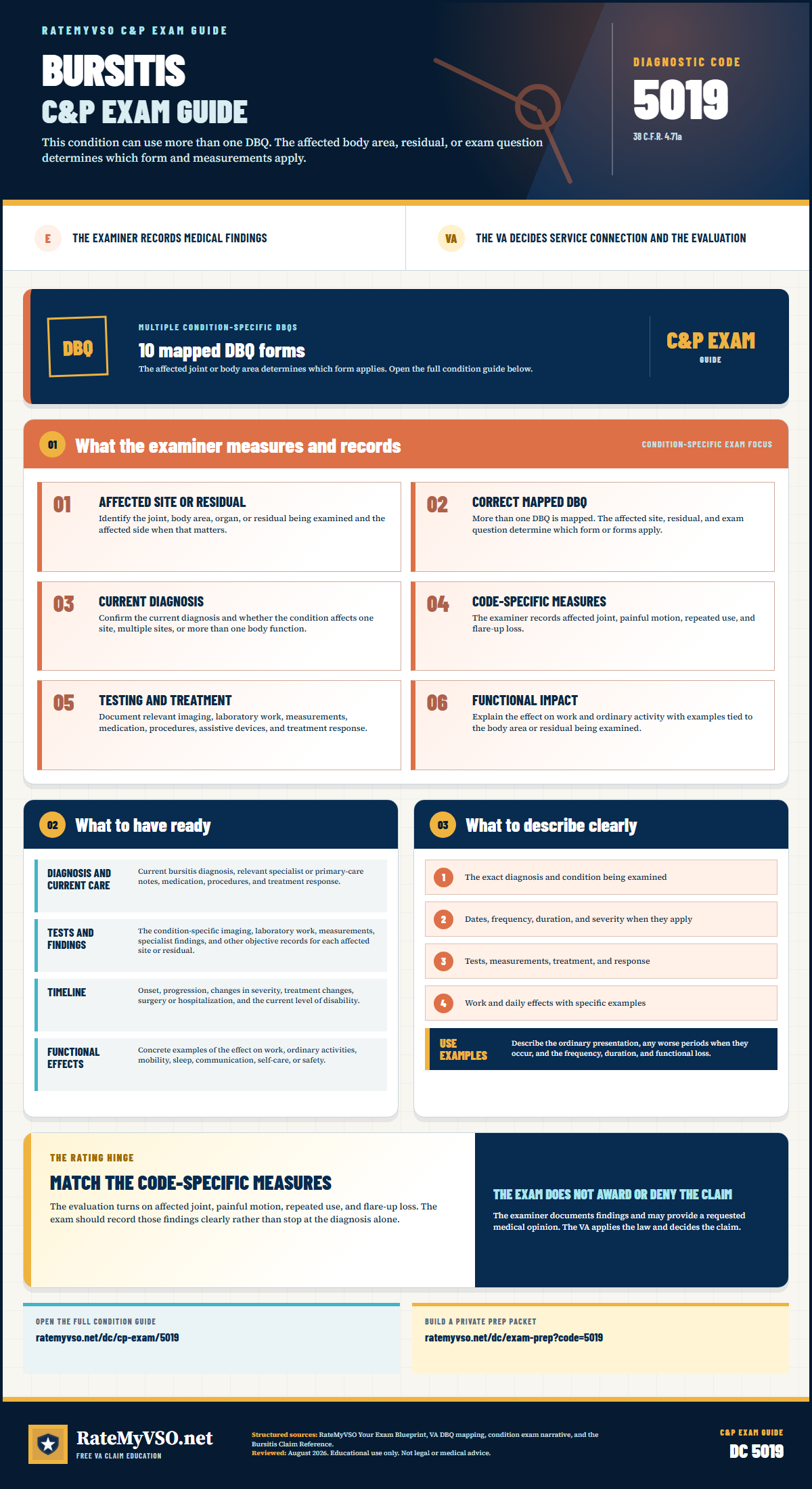
Disclaimer: This page reproduces public Department of Veterans Affairs forms (DBQs) and verbatim text from 38 CFR Part 4 (the VA Schedule for Rating Disabilities). It is informational only and is not legal or medical advice. For guidance on a specific claim, contact a VA-accredited representative.