HLR Informal Conference: What to Expect
You filed, or are thinking about filing, a Higher-Level Review and checking the box for the informal conference. A senior reviewer takes a fresh look at the same evidence, and you get one short phone call to point out where the VA got the facts or the law wrong. This is a plain-language walk-through of exactly how that call works, what it can and cannot do, and how to walk in prepared. At the end, you can follow one fictional veteran through an entire call from preparation to decision.

First, What a Higher-Level Review Actually Is
A Higher-Level Review (HLR) is one of three review lanes created by the Appeals Modernization Act of 2017. You file VA Form 20-0996, and a more senior adjudicator, someone who had no hand in your original decision, re-examines your claim. The catch that defines everything else: the reviewer looks only at the evidence that was already in your file on the date of the decision you are challenging. You cannot add anything new.
Think of it like asking a senior umpire to review a call using only the footage that already exists. You are not bringing a new camera angle. You are arguing that the footage everyone already has was read wrong.
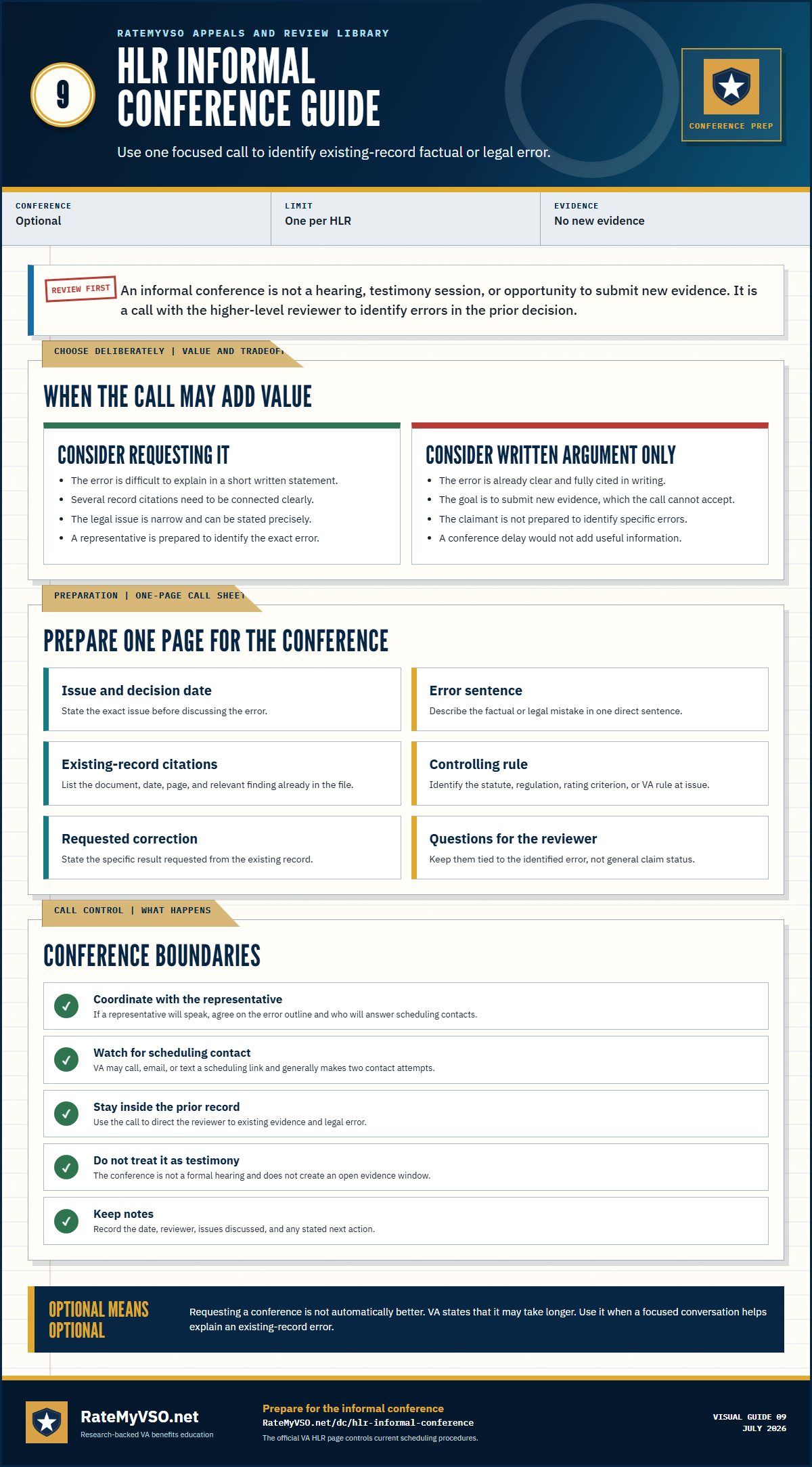
The informal conference is an optional, one-time phone call inside that process. You request it by checking the box on Form 20-0996 at the time you file. You cannot bolt it on later. On the call, you or your representative speak directly with the higher-level reviewer assigned to decide your case and point to errors of fact or law in the record.
The Single Rule That Decides Whether HLR Is Right for You
Everything else on this page follows from that rule. The call is oral argument about a closed record, not a chance to add to your file. Hold onto that and the rest makes sense.
The Timeline, Step by Step
Every case differs, but the sequence is predictable. The day-counts below reflect what veterans and practitioners have reported in 2026. Treat them as rough expectations, not promises.
You file Form 20-0996. Check the informal-conference box here, or you lose the option. The request must reach VA at the time it receives your HLR application.
Assignment (about 2 to 3 weeks). Your case goes to a higher-level reviewer or Decision Review Officer who did not touch the first decision. You get a confirmation letter.
Scheduling the call (often 2 to 3 months). The VA contacts the phone number you listed, or sends a text or email scheduling link. In-person conferences are rare.
The call itself (often 5 to 15 minutes). You point to errors already in the record. The reviewer listens and takes notes. They will usually not rule on the spot.
The decision. Weeks to months later you receive one of three outcomes: granted, denied, or returned for a duty-to-assist error.
The Three Ways It Can End
The reviewer changes the decision in your favor
This can happen through a difference of opinion: the senior reviewer simply weighs the same evidence differently and grants the benefit. A favorable finding made this way is binding on the VA going forward, and the reviewer cannot make your outcome worse based only on a difference of opinion.
Duty-to-assist error: a do-over, not a denial
If the reviewer finds the VA broke its duty to assist before the first decision (for example, failing to get records it should have, or ordering an inadequate exam) and cannot grant the full benefit outright, the claim is sent back for correction and re-adjudication. Practitioners report this is one of the most common HLR results. It is progress, not a loss.
The original decision stands
If the reviewer finds no error, the prior decision holds. You are not out of options: you can still file a Supplemental Claim (if you now have new and relevant evidence) or appeal to the Board of Veterans' Appeals. Note you cannot file a second HLR on the same issue.
Fifteen Minutes on a Tuesday
To make the call concrete, here is one fictional veteran's informal conference from the day he circles the date to the day the decision lands. Everything that happens on the call tracks the rules above.
The morning of the call
Ray had circled the date in pen, the old-fashioned way, on the paper calendar in the kitchen. The letter had said a reviewer would call between nine and noon. By 9:40 he had already refilled his coffee twice and set his folder square on the table: the denial letter on top, the nerve-study report underneath, three sticky tabs marking the pages he meant to talk about. He had practiced saying the words out loud the night before, which felt foolish until it didn't.
The phone rang at 9:52. An unknown number. He almost let it go, then remembered the line his buddy at the veterans' service office had repeated twice: answer the call, they only try a couple of times.
"Mr. Alvarez? This is the higher-level reviewer assigned to your case. I have about fifteen minutes blocked for us. I want to be upfront that I am not deciding anything on this call. I am listening, and I will take it back to the file." Ray had been warned about exactly this, that the reviewer would not rule on the spot, so the flat tone did not rattle him. He had also been warned about the harder possibility: that the reviewer might be hearing the details of his case for the first time, right now, on the phone. So he did not assume she knew the record cold. He laid it out like he was handing someone a map.
The four beats
"Thank you. I'll keep it to the one issue," Ray said. "My claim was rated as if the nerve damage in my legs was mild. But the nerve conduction study already in my file, the one dated before your office decided, shows the responses were absent, not reduced. Page four, the summary line. The exam the rating relied on never mentioned that study at all. I'm not bringing you anything new. I'm pointing to what was already there and was read wrong."
There was a pause, and the soft clatter of a keyboard. He resisted the urge to fill the silence with his life story. The service officer had been blunt about that too: this is not the place to explain how the injury changed your life. This is oral argument about a record. Issue, what they decided, what the record shows, what they should have done. Four beats. He had said his four beats.
"I see the study you mean," the reviewer said finally. "And I see the examination you're referring to. You're right that the two do not line up. I'm not going to characterize the outcome today, but I'm noting the inconsistency between the diagnostic evidence and the basis for the rating. That is the kind of thing this review exists to catch." It was over at 10:07. Fifteen minutes, near enough. No verdict, no handshake, no fireworks. Just a woman with a quiet voice telling him she had seen the thing he needed her to see.
The decision
The decision letter came eleven weeks later. It did not say he had won, exactly. It said the claim was being returned for correction and re-adjudication because the duty to assist had not been satisfied at the time of the original decision. Ray had to read it twice, and then call the service office to be sure. A do-over, they told him. Not a denial. The most common way these things land, and a good way, because the error was now on the record in the VA's own words.
He uncapped the pen and circled a new date, the day the letter arrived, and underneath it wrote one word in block letters so he would remember how it felt: HEARD.
How to Walk In Prepared
Practitioners who handle these calls converge on the same short discipline. The conference can only help you, it cannot make your rating worse based on a difference of opinion, so the only real risk is wasting the fifteen minutes.
- Pick one or two issues, not ten: a focused call beats a sprawling one. If you have several, write a clean one-paragraph outline for each so a combined call stays organized.
- Use the four-beat structure: for each issue, say (1) what you claimed, (2) what the VA decided, (3) what the record already shows, (4) what the VA should have done. Tie every point to a document and a page.
- Cite the record, not your feelings: the reviewer can only act on evidence that existed at decision time. "Page 4 of the 2019 nerve study" lands. "My life is harder now" does not, in this lane.
- Do not try to slip in new evidence: it will not be considered, and it signals you may be in the wrong lane. If you have genuinely new records, a Supplemental Claim is your tool instead.
- Be reachable: two missed attempts can cost you the conference entirely. Answer unknown numbers and return calls the same day.
- Expect silence, not a verdict: the reviewer almost never rules live. No decision on the call is normal and means nothing about your odds.
What to Cover on the Call: Pointing to the Specific Error
The informal conference is a review of a closed record. The reviewer cannot consider anything that was not in your file at the time of the prior decision. Every point you raise must tie to something that already exists in that record.
There are two categories of error you can raise:
Misapplied Regulation or Rating Criteria
If the rater had the right evidence but applied the wrong legal standard, the call is the place to name that specifically. Examples:
- Wrong diagnostic code: the rater rated your condition under a code that does not fit the documented symptoms when a more accurate code was available.
- DeLuca factors ignored: for musculoskeletal conditions, the rating schedule requires accounting for pain and flare-ups. If the examiner documented flare-ups and the rater did not apply that, you can point to the exact exam page and the regulation that requires it.
- Correct standard misread: the rater described the criteria for one rating tier but the evidence in the file meets a higher tier. Cite the page number in the evidence and the rating table.
In each case, the structure is the same: state what the regulation required, identify the specific evidence already in the file, and explain how the two do not match. You are not arguing about the facts themselves. You are pointing to a gap between the evidence on file and how the regulation was applied to it.
Duty-to-Assist Failure
The VA owes certain development obligations before it can decide a claim (see 38 CFR 3.2601 and 38 CFR 3.159). If required development never happened, the informal conference is where you name it. Examples:
- Federal records never given to the examiner: if service treatment records or VA medical records were not included in the evidence the examiner was authorized to review, any opinion based on that incomplete set is premature. This is a specific, documentable fact, not a general complaint about the outcome.
- No exam ordered when the evidence called for one: the VA orders a C&P exam case by case when the evidence in the file shows it is needed to decide the claim, not automatically for every condition of a given type. A denial without an exam the record called for can be a duty-to-assist error.
- Wrong opinion type requested: if you claimed a condition as secondary to a service-connected disability but the examiner was only asked for a direct-service-connection opinion, the secondary pathway was never developed.
For duty-to-assist arguments, the call is most effective when you can name a specific, concrete omission: "The exam request shows that my service treatment records were not given to the examiner." That is a fact the reviewer can verify in the file. A general statement that the VA did not do enough is harder to act on.
When Not to Use a Higher-Level Review
If the strongest thing you have is a record the VA never saw, an HLR will likely fail, because the reviewer is locked to the old evidence. A Supplemental Claim (Form 20-0995), which is built to accept new and relevant evidence, is usually the better lane. Choosing the wrong lane is the most common avoidable mistake. For how all three lanes compare, see the Appeals Overview.
The Numbers, in Context
These figures describe the HLR process as a whole. They are not a prediction about any individual case.
Requesting the informal conference adds time, because the call has to be scheduled before the review can finish. Practitioners report it can extend an HLR by two to three months. The trade-off is the chance to point a senior reviewer straight at the error before they decide. Whether that trade is worth it depends on your case, and is a question for you and your representative.
Frequently Asked Questions
Can I add new evidence on the call?
Will the reviewer decide my case on the call?
Can the informal conference make my rating worse?
How do I request the conference?
What is a "duty-to-assist" return?
What if I miss the call?
Can I have someone speak for me?
HLR or Supplemental Claim, which do I want?
Related Tools and Guides
Sources & official references: 38 CFR 3.2601, Higher-Level Review (eCFR) · 38 CFR 3.2601 full text (Cornell LII) · 38 CFR 3.159, duty to assist · 38 CFR 3.105, revision of decisions · VA.gov, Higher-Level Reviews · VA News, Informal conferences in higher-level decision reviews. Real-world expectations (call length, scheduling lag, frequency of duty-to-assist returns) are drawn from accredited-attorney commentary, including Avard Law, VetAid, and Vet Law Office (accessed May 2026), and are practitioner experience, not VA policy. This guide is general educational information about VA procedure, not legal advice, and does not create a representative relationship. Procedures and timelines change; confirm current rules on the official VA pages above. For help with your specific claim, consider a VA-accredited representative. Find a VSO representative. RateMyVSO is not affiliated with the U.S. Department of Veterans Affairs.