VA Supplemental Claim Guide
A Supplemental Claim is how a veteran refiles a denied claim under the Appeals Modernization Act (AMA). It is the right lane when there is new evidence to add. This guide explains what counts as new and relevant evidence, the 1-year rule that preserves the original effective date, how raters at the Regional Office actually decide these claims, and walked examples of what wins and what loses. Built for veterans who want to understand the process before they file VA Form 20-0995, not after.

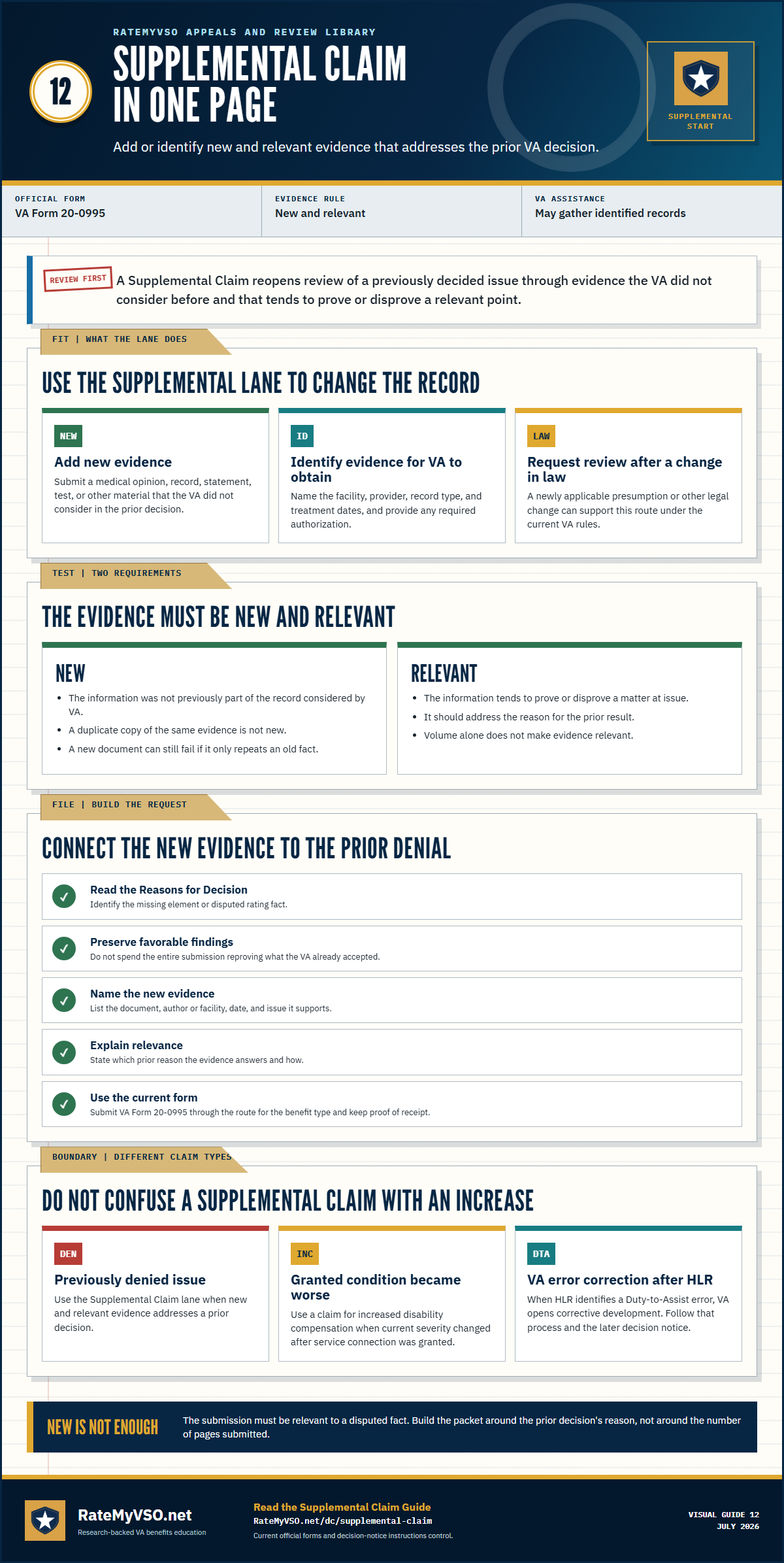 One-page guide: Supplemental Claim in One Page
Supplemental Claim in one page explaining new and relevant evidence, change-in-law review, evidence organization, filing controls, and the difference from an increase claim. Opens the full-size chart, free to save or print.
One-page guide: Supplemental Claim in One Page
Supplemental Claim in one page explaining new and relevant evidence, change-in-law review, evidence organization, filing controls, and the difference from an increase claim. Opens the full-size chart, free to save or print.
Section 1: What a Supplemental Claim Is
A Supplemental Claim is one of three review lanes available after VA denies a claim. Authority is at 38 U.S.C. § 5108 and procedure is at 38 CFR § 3.2500 (filing) and 38 CFR § 3.2501 (adjudication).
The other two lanes are Higher-Level Review (a senior reviewer re-decides the existing record) and a Board Appeal (a Veterans Law Judge reviews). The Supplemental Claim lane is the only one designed for new evidence.
New-and-relevant evidence and a worsening condition are different questions. The new-and-relevant standard in this guide reopens a claim VA already denied. If VA already granted service connection for a condition and that condition has since gotten worse, that is a claim for an increased rating, judged on current severity under the rating schedule, not on whether the file contains anything new. An increased-rating claim only lands in this lane once VA has denied that specific increase and the veteran wants it reconsidered with new evidence.
The form is VA Form 20-0995: Decision Review Request: Supplemental Claim. It is short, can be filed online for disability compensation claims, and there is no filing fee.
Download VA Form 20-0995 (PDF) →
Are You in the Right Lane?
Before you read further, make sure a Supplemental Claim fits your situation. Here are all five AMA appeal lanes side by side. If your problem is a VA legal error on otherwise strong evidence, a Higher-Level Review may fit better. If you want a Veterans Law Judge to weigh in, a Board Appeal is the path. A Supplemental Claim is the lane built for new evidence.
For VA decisions dated February 19, 2019 or later. The Appeals Modernization Act created five review lanes across two VA bodies. Here is how they differ.
| VA AMA appeal lanes |
Veterans Benefits AdministrationDecision Review lanes | Board of Veterans' AppealsNotice of Disagreement (NOD) lanes | |||
|---|---|---|---|---|---|
| Higher-Level Review | Supplemental Claim | Direct Review | Evidence Submission | Hearing | |
| Will new and relevant evidence be considered? | No | Yes | No | Yes | Yes |
| Will there be a hearing? | NoOptional informal phone conference | No | No | No | Yes |
| Who makes the decision? | A senior reviewer (DRO) at a VA regional office | A claims adjudicator at a VA regional office | A Veterans Law Judge at the Board | A Veterans Law Judge at the Board | A Veterans Law Judge at the Board |
| VA processing target | 125 days | 125 days | About 1 year | About 1 year | 1 to 2 years |
| Most recent published result | See latest | See latest | See latest | See latest | See latest |
| What form is needed? | Form 20-0996 | Form 20-0995 | Form 10182 | Form 10182 | Form 10182 |
Swipe the table sideways to see all five lanes.
Source: VA Appeals Modernization Act (AMA) review options. Processing targets are VA goals, not guarantees, and actual waits vary. The Board lanes (Direct Review, Evidence Submission, Hearing) all use VA Form 10182. An HLR also offers an optional informal phone conference with the reviewer. The "Most recent published result" row updates each month from the VA AMA compliance report; tap any figure to open the full Appeals Pulse.
Section 2: The "New and Relevant" Standard
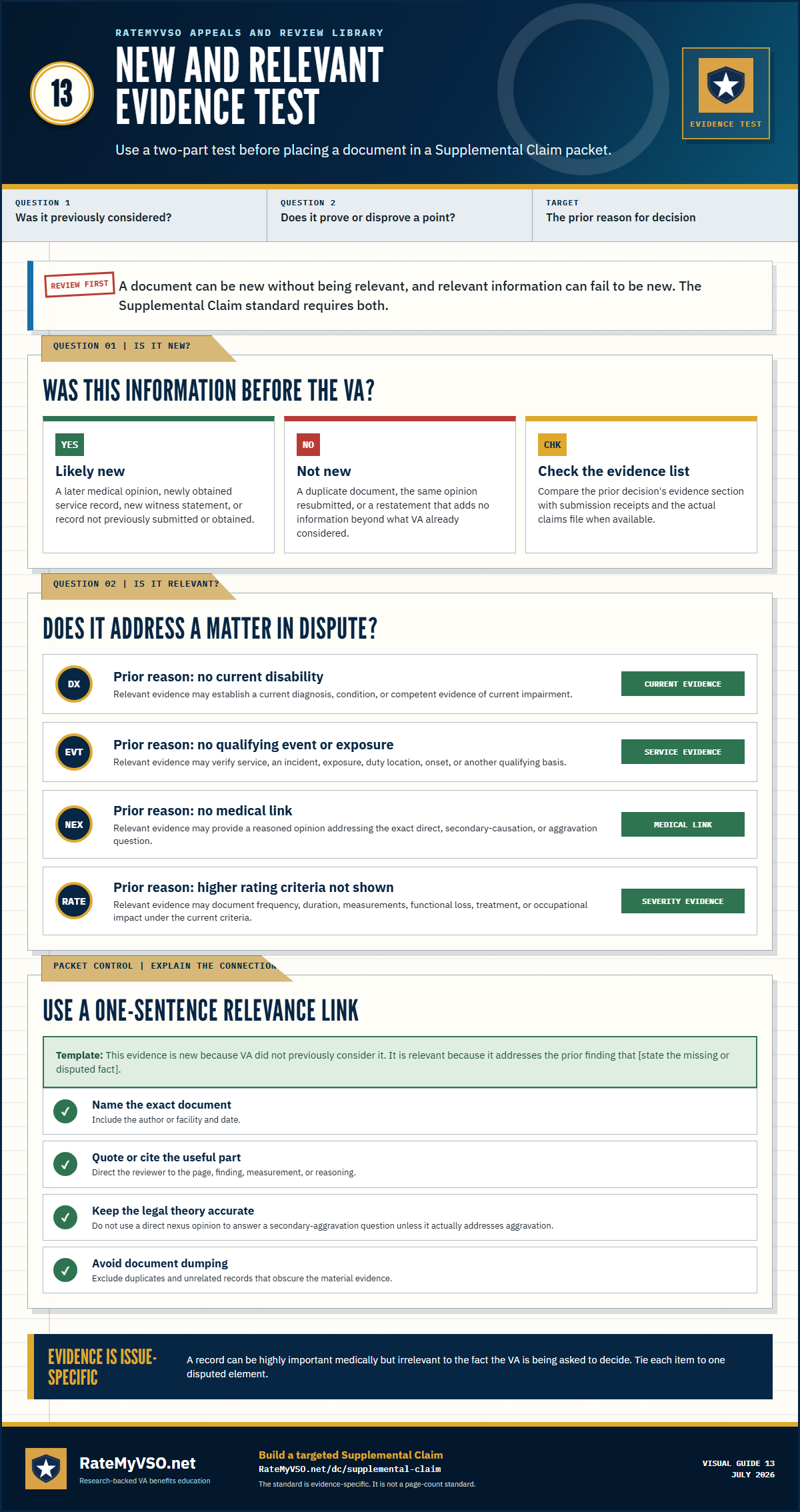
The evidence must satisfy both prongs (see 38 CFR § 3.2501(a)(1)).
Prong 1: "New"
Evidence is new if it was not previously part of the actual record before agency adjudicators. If a treatment record existed when the prior denial was decided but was never sent to VA, it is new the moment it enters the file. If the rater already had it, it is not new.
Prong 2: "Relevant"
Evidence is relevant if it tends to prove or disprove a matter at issue in the claim. The regulation expressly includes evidence that "raises a theory of entitlement that was not previously addressed." Relevance is judged against the actual denial reason in the prior decision.
The threshold is intentionally low
The same regulation states: "Such standard will not impose a higher evidentiary threshold than the new and material evidence standard previously applied in finally decided claims." This was a deliberate choice in the 2019 AMA rulemaking (84 FR 138) to keep the bar low. The pre-AMA case Shade v. Shinseki, 24 Vet. App. 110 (2010), held that the prior standard was satisfied by any evidence supporting an unestablished element, not evidence that would win the case on its own. That logic now applies to "relevant."
A change in law can supply the new theory, but it does not replace the evidence
A law that changed after your denial helps you through the "relevant" prong rather than around it. 38 CFR § 3.2501(a)(1) says relevant evidence "includes evidence that raises a theory of entitlement that was not previously addressed," and a new presumptive law is what raises that theory. The evidence requirement itself does not go away: § 3.2501(b) states the record "must include new and relevant evidence that was not of record as of the date of notice of the prior decision," and the regulation directs VA to issue a decision finding there was insufficient evidence to readjudicate when none is presented.
The PACT Act adding a presumptive condition is the common example (see Example 3 below). What the law change does is remove the nexus burden, not the evidence burden. For a presumptive claim that usually means the record still has to show a current diagnosis of the listed condition and the qualifying service or exposure. Filing with nothing but a citation to the law is the mistake to avoid: name the law, and attach the records that show you have the condition it covers.
Section 3: The 1-Year Effective-Date Rule
The effective date assigned on a granted Supplemental Claim turns primarily on whether the claim was filed within 1 year of the prior decision (see 38 CFR § 3.2500(h)). Two things sit alongside that window and can move the date. Both branches of (h) also look at the date entitlement arose, so a filing date is a floor rather than the answer when entitlement arose later. And both open with "except as otherwise provided," which is where the exceptions live, including 38 CFR § 3.156(c) for late-received service records.
| Filing window | Effective date if granted | Back pay impact |
|---|---|---|
| Within 1 year of prior decision notice | Date of the original claim (or date entitlement arose, whichever is later) | Full preservation. Back pay runs from the original claim. |
| More than 1 year after prior decision notice | Date of receipt of the Supplemental Claim, or the date entitlement arose if that is later | Original effective date lost in the ordinary case. Back pay runs from the Supplemental filing. |
Two exceptions to the bottom row. Under 38 CFR § 3.156(c), if VA later receives relevant service records that existed but were not associated with the file when it first decided the claim, the original effective date is preserved no matter when the Supplemental Claim was filed. And the receipt date is a floor, not the answer: if entitlement arose after you filed, the later date controls.
The continuous-pursuit chain
The 1-year clock resets after each adverse decision. A veteran who files a Supplemental Claim within 1 year of an HLR denial, or within 1 year of a Board denial, or within 120 days of a Court of Appeals for Veterans Claims (CAVC) decision (timely Notice of Appeal), preserves the original effective date through the entire chain. This is the "continuous pursuit" rule at 38 CFR § 3.2500(c).
If the veteran wins a Supplemental Claim 10 years after the original denial but the chain stayed unbroken, back pay runs to the original effective date. A successful 2014 claim that finally grants in 2026 pays back to 2014, not 2026.
Section 4: VA Form 20-0995 Walkthrough
The form is short. The structure tracks the regulation.
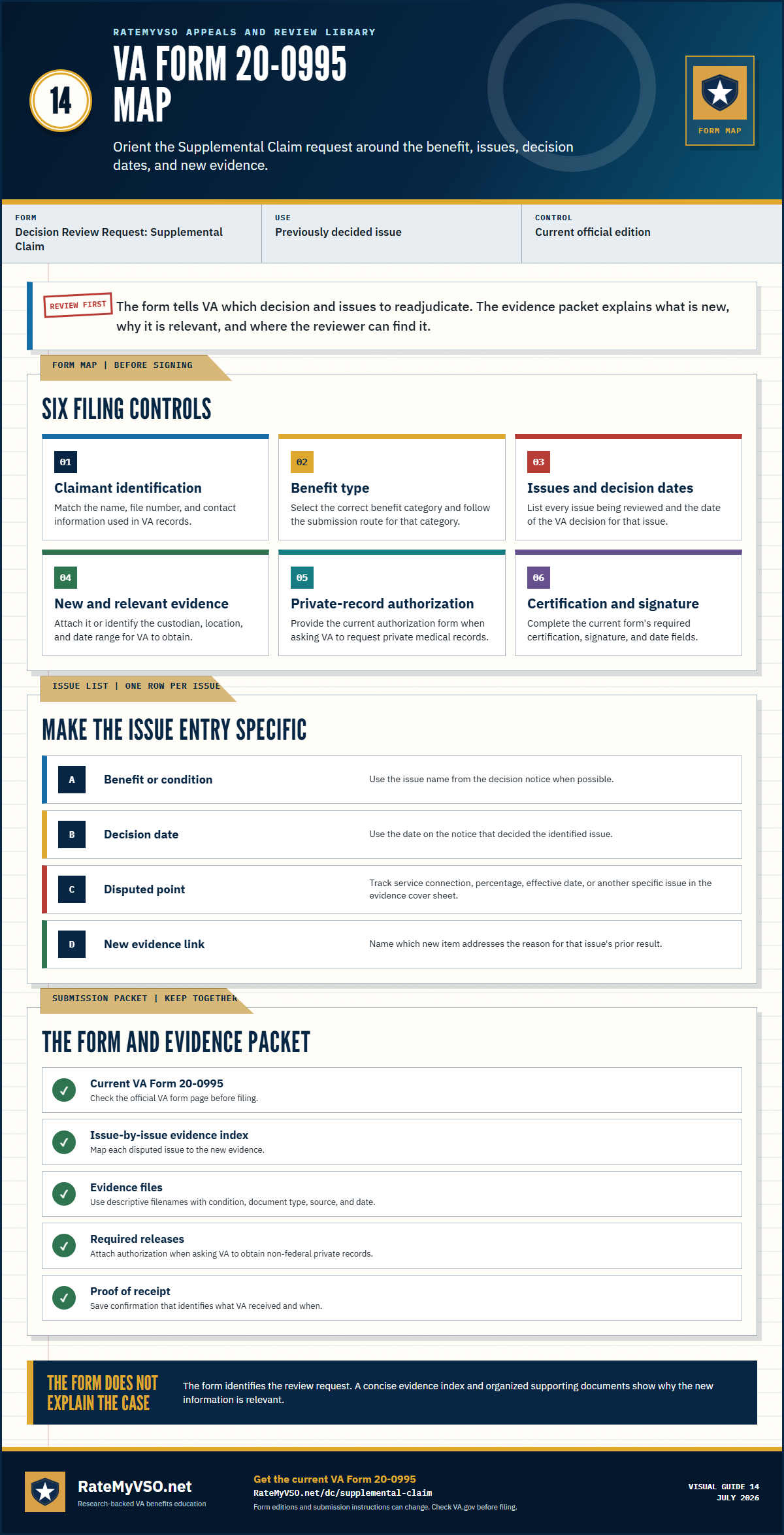 One-page guide: VA Form 20-0995 Map
VA Form 20-0995 map covering claimant information, benefit type, issues, decision dates, new evidence, authorizations, signature, and receipt proof. Opens the full-size chart, free to save or print.
One-page guide: VA Form 20-0995 Map
VA Form 20-0995 map covering claimant information, benefit type, issues, decision dates, new evidence, authorizations, signature, and receipt proof. Opens the full-size chart, free to save or print.
Section I: Veteran or claimant identification
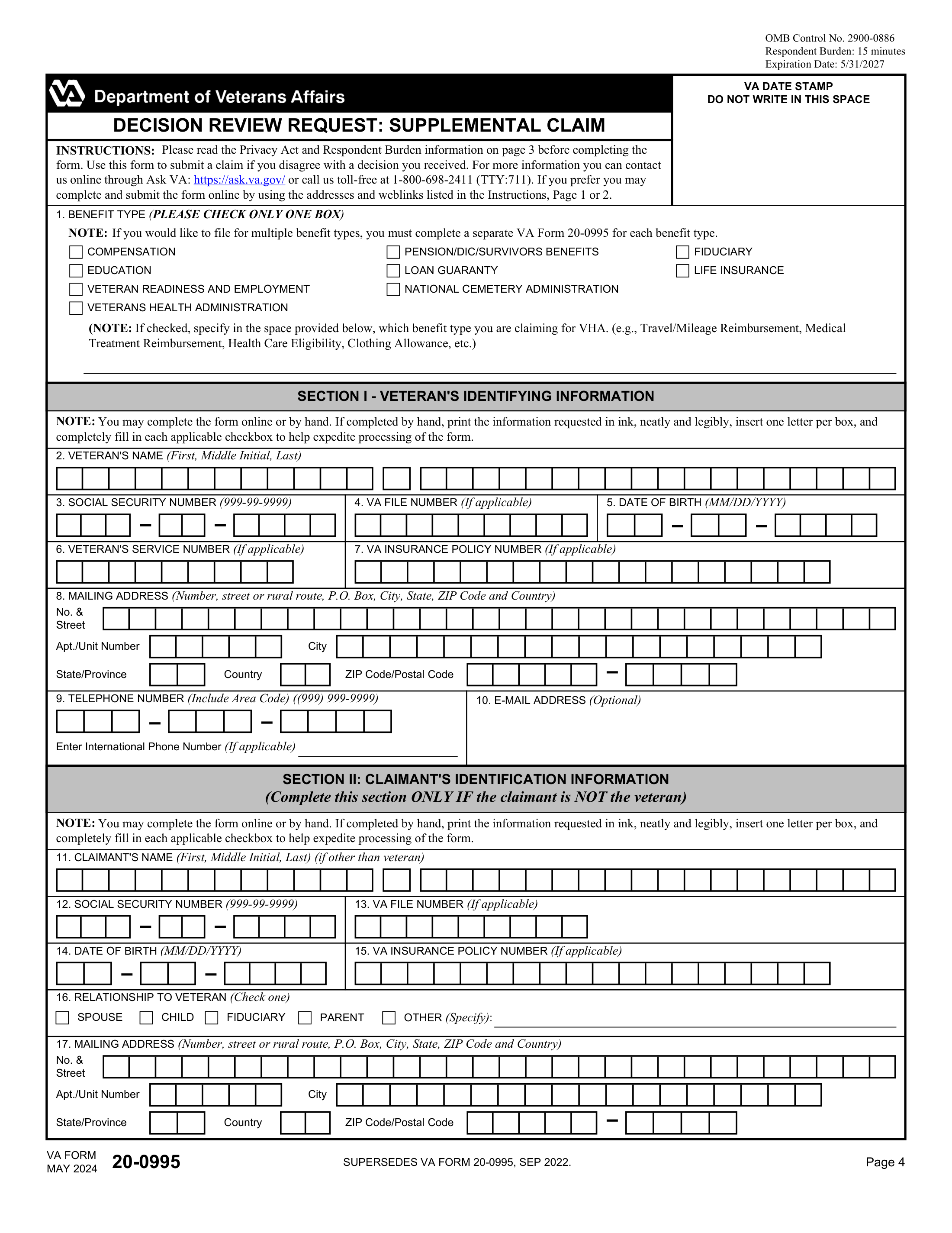
Name, SSN, file number, date of birth, contact information, and accredited representative if any. Standard fields.
Section II: Issues being supplemented
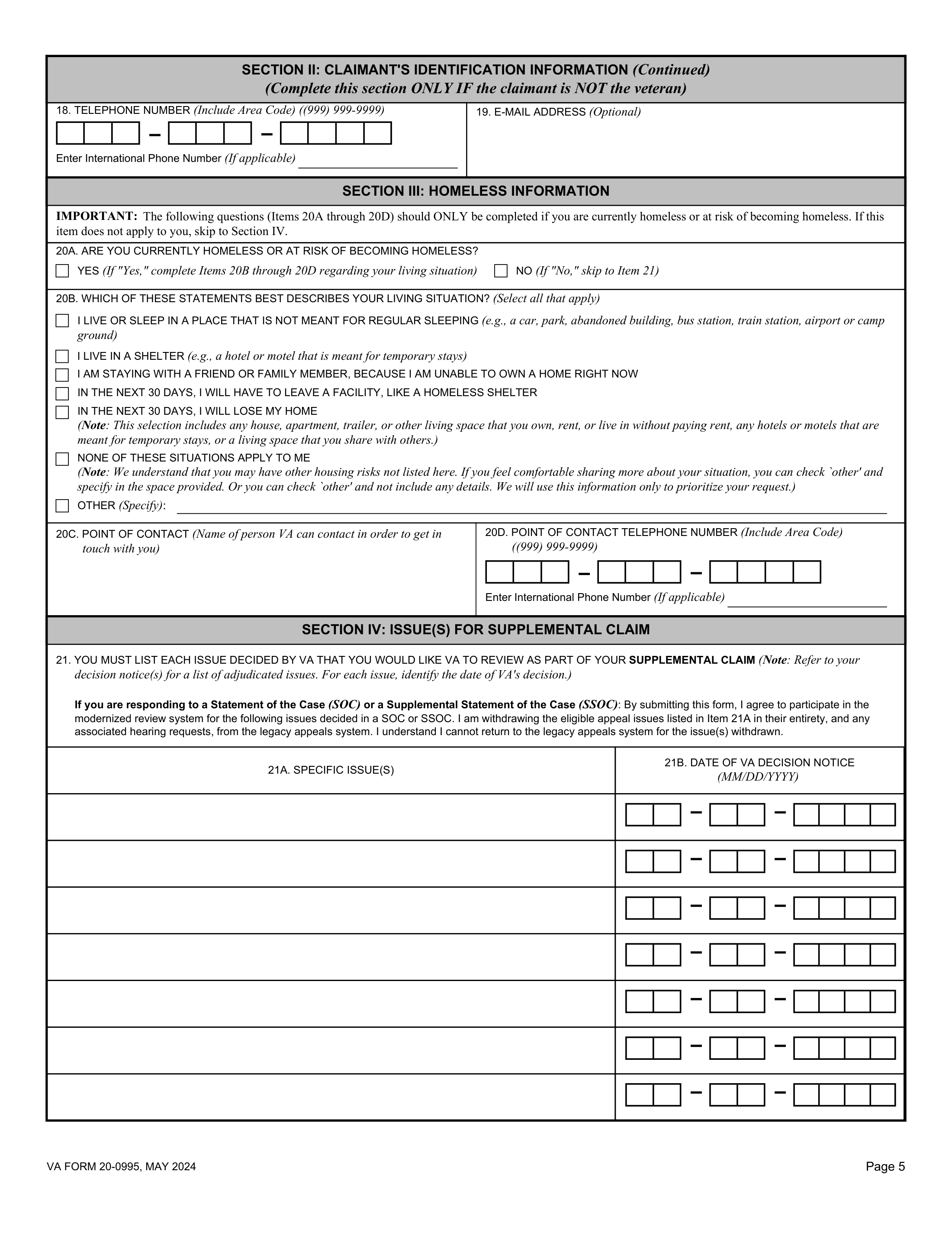
List each specific issue and the date of the decision being appealed. One form may cover multiple issues from the same decision. Be specific: "Service connection for left ankle, denied April 15, 2020" is correct. "My ankle" is not.
Section III: New and relevant evidence identified
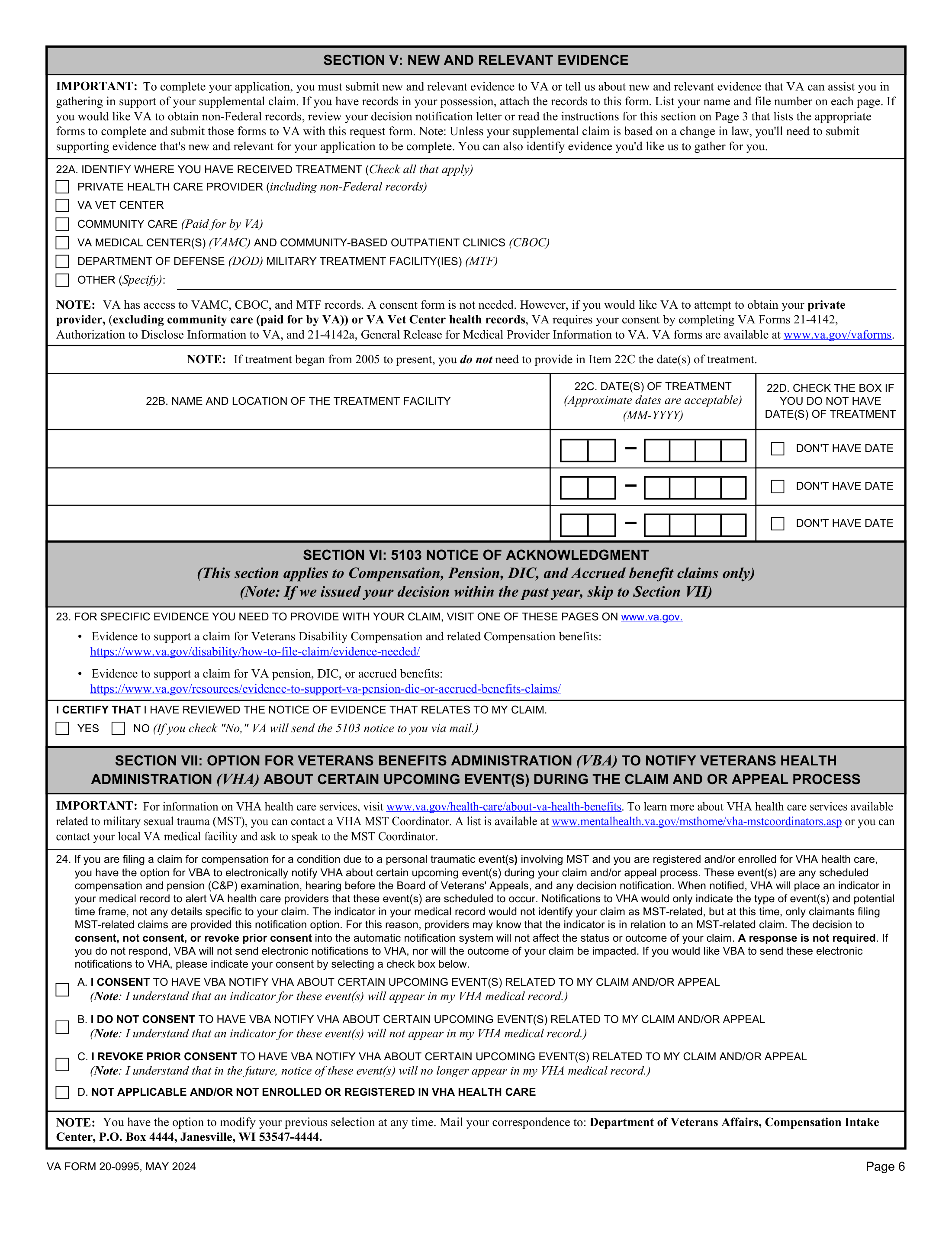
List what is being submitted with the form and what evidence sources VA needs to obtain. This is the field that triggers the duty to assist for evidence not yet in the file. Examples: "Civilian orthopedic records 2018-2026, Dr. Smith"; "Buddy statements from SGT Doe and PFC Roe, attached"; "Updated DBQ from private psychiatrist, attached."
Section IV: Treatment records
Federal sources (VA medical, DoD) require only identification. VA pulls them. Private sources require a signed VA Form 21-4142 authorization to disclose. Missing the 21-4142 is the most common mistake veterans make on this form.
Section V: Optional hearing election
Supplemental Claims do not include a Regional Office hearing right. Hearing requests route to other processes. Leave this blank in most cases.
Section VI: Certification and signature
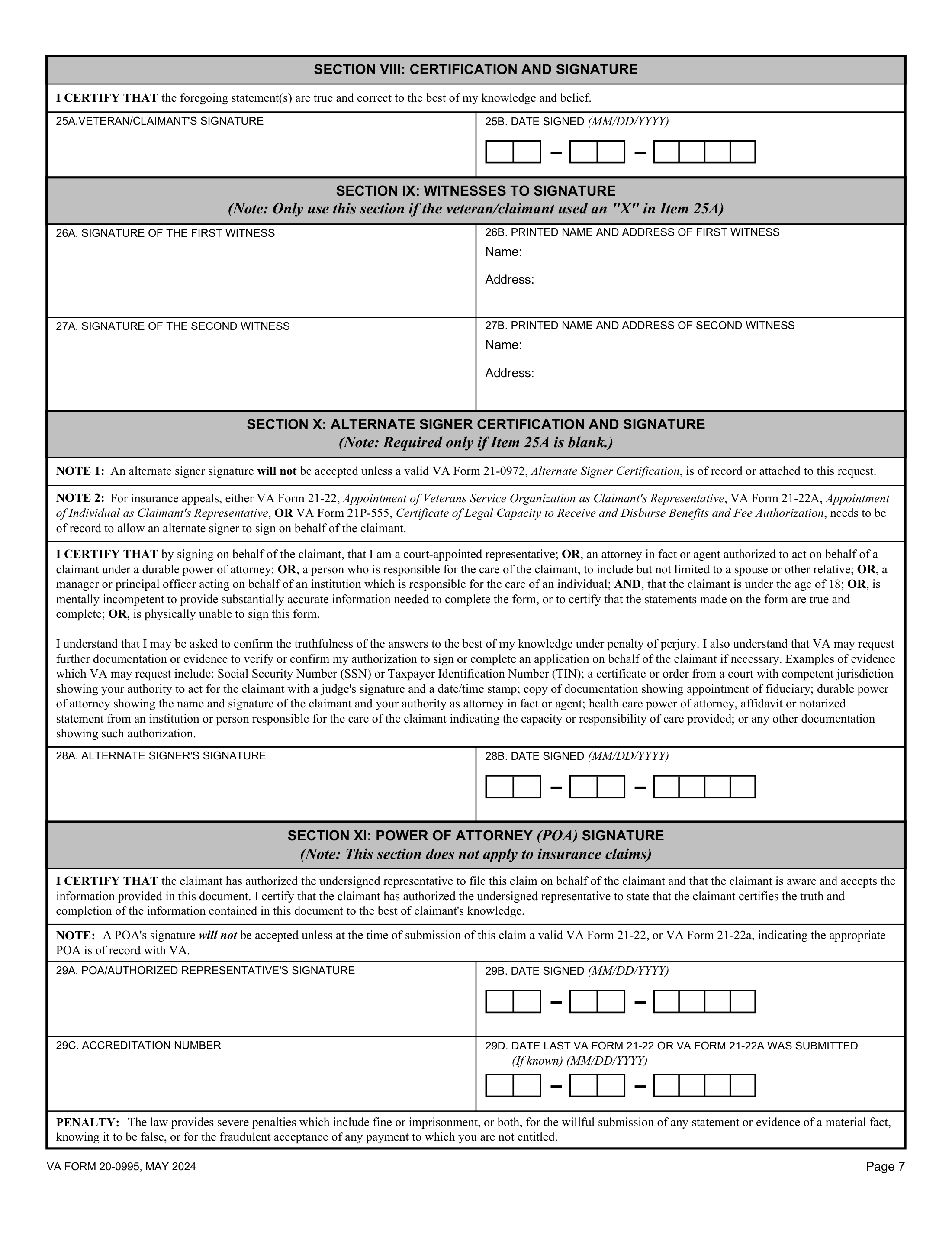
Your effective date locks in on the day you file a complete form, not the day you later go back and fix something you left out. One catch: unlike a first-time claim, a Supplemental Claim does not get the benefit of an early "intent to file" placeholder date (see 38 CFR § 3.2501(d)).
Where to mail Form 20-0995
If you file by mail, the address depends on the benefit the decision was about (VA, 2026):
- Disability compensation: Department of Veterans Affairs, Claims Intake Center, P.O. Box 4444, Janesville, WI 53547-4444
- Life insurance: Department of Veterans Affairs, Attention: Insurance Center, P.O. Box 5209, Janesville, WI 53547
- Pension and survivor benefits: Department of Veterans Affairs, Claims Intake Center, P.O. Box 5365, Janesville, WI 53547
- Caregiver program (PCAFC) eligibility decisions: follow the instructions on VA Form 10-305.
- All other benefit types: follow the instructions in the decision letter for your initial claim.
Section 5: The Duty to Assist on a Supplemental Claim
This is the most underused feature of the lane. 38 CFR § 3.159 applies to Supplemental Claims by express incorporation in 38 CFR § 3.2501(c). The duty to assist only reaches evidence the veteran identifies. VA does not go looking for evidence on its own; the veteran has to name the source, and then respond promptly if VA sends a follow-up request (for example, a records-release authorization VA cannot act on until it is signed and returned). That means:
- VA medical records: if the veteran identifies VHA care, VA must obtain those records.
- DoD records: service treatment records, personnel file, unit records the veteran identifies.
- Private medical records: with a signed VA Form 21-4142, VA must request from the private provider.
- New C&P exam: if the new evidence triggers a question the prior exam did not address, VA must order a fresh exam.
The hidden weapon: prior-decision duty-to-assist failure
M21-1 directs the rater on a Supplemental Claim to first review whether VA met its duty to assist on the prior decision. If the prior decision denied without ordering an indicated C&P, without requesting STRs the veteran identified, or without retrieving private records covered by a 21-4142 already on file, that prior failure is itself grounds to readjudicate, independent of any new evidence. This is called a prior-decision duty-to-assist error and it can cure a Supplemental Claim that is otherwise thin on new evidence.
Section 6: How the Rater Actually Decides It
The Rating Veterans Service Representative (RVSR) deciding a Supplemental Claim follows a defined sequence. Most denials are predictable from this workflow. Understanding it lets a veteran package the evidence so the rater can grant rather than has to deny.
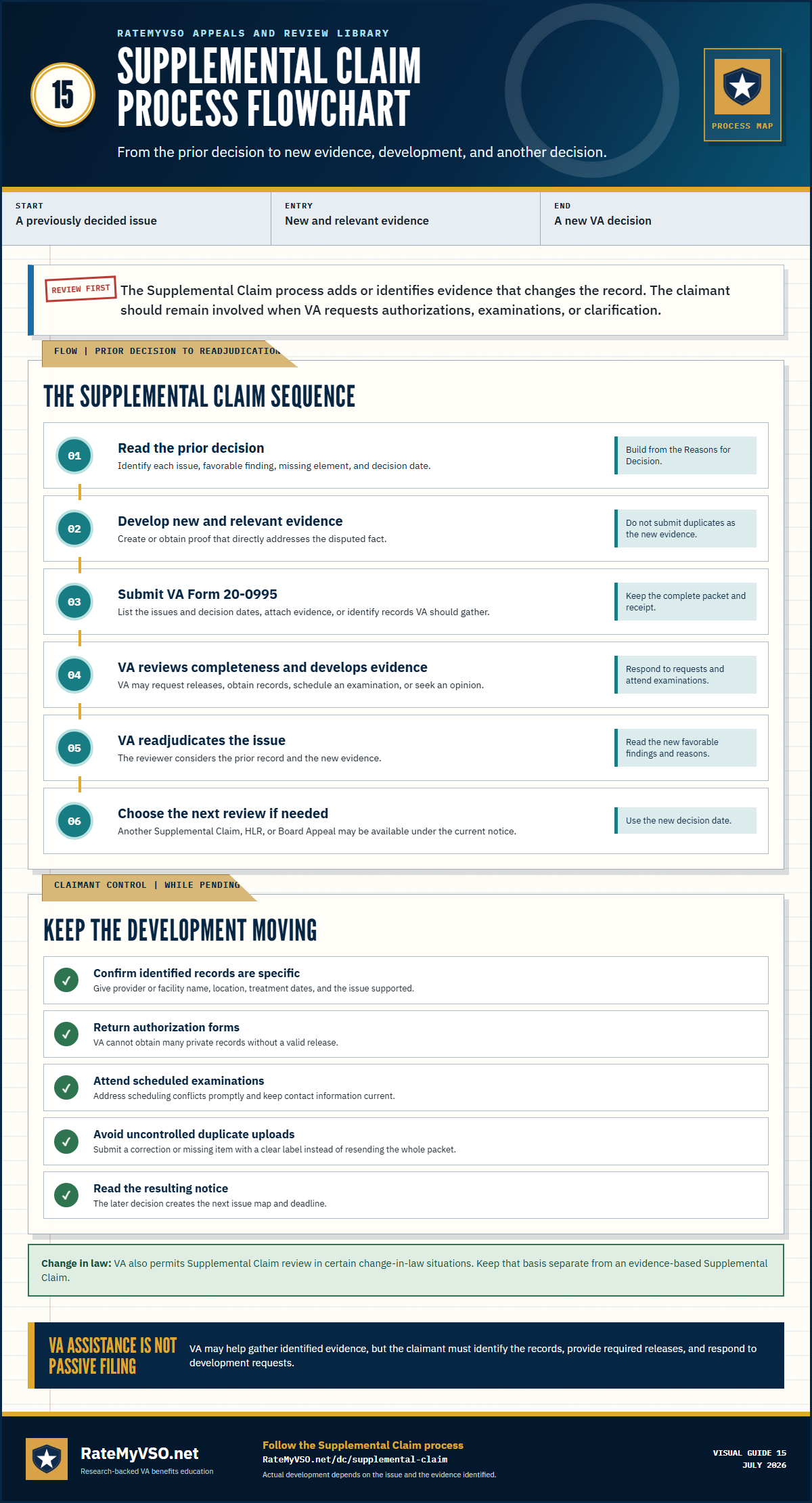
Threshold check: is the evidence new and relevant?
The rater opens the prior decision, reads the Reasons and Bases, and identifies the element(s) the prior decision found unestablished (nexus, current disability, in-service event, continuity of symptoms, severity for an increase, etc.). The rater then opens the newly submitted evidence and asks one question: does any of this address one of those unestablished elements? If yes, readjudicate the merits. If no, issue a no-new-and-relevant-evidence denial without reaching the merits. The prior denial stands.
Duty-to-assist review on the prior decision
Independent of new evidence, the rater verifies that the prior Regional Office did its job. If a prior-decision duty-to-assist failure is found (missing STRs not requested, indicated C&P not ordered, identified private records not retrieved), the rater cures the failure first, then decides. This effectively reopens the prior decision on procedural grounds.
Readjudicate the merits
On the full record (old plus new evidence), the rater re-applies the regulation. If the new evidence tips the balance under the preponderance-of-evidence standard or triggers the benefit-of-the-doubt rule (38 U.S.C. § 5107(b)), grant. Otherwise, deny.
Effective-date assignment
If granted, the rater applies 38 CFR 3.2500(h). Filed within 1 year of the prior denial: original effective date. Outside that window: the date the Supplemental Claim was received, or the date entitlement arose if that is later. Late-received service records are the exception that overrides the window entirely, under 38 CFR 3.156(c). The continuous-pursuit chain must be verified end-to-end across any HLR, Board, or court decisions in between.
Rating Decision narrative
Per M21-1 Part V, Subpart iv, Chapter 1, Section A, the rating narrative explicitly cites the new evidence considered, identifies which prior-decision element it cured, assigns the percentage under the appropriate diagnostic code, and states the effective date. A vague narrative is grounds for a follow-on HLR.
What the rater wants to see (in plain English)
The rater's job is faster and easier when the evidence package does the rater's first step for them. A short cover letter or Section III narrative that says, in effect: "the prior decision denied for X. Attached evidence Y is new (was not in the prior record) and relevant to X because Z" is the cleanest possible filing. It tells the rater exactly which element is being cured, which makes the threshold check at step 1 a yes.
Section 7: Worked Layman Examples
Five concrete scenarios. Three are typical wins. Two are typical losses. The difference is whether the new evidence addresses the actual denial reason in the prior decision.
Example 1: Ankle injury, continuity-of-symptoms gap Wins
Facts. Veteran injures left ankle in basic training 2005. One sick-call entry. No further in-service treatment. Files claim 2020. Denied because "veteran did not seek treatment again during or after service, so no continuity of symptoms established."
Supplemental package 2026. Buddy statements from three soldiers describing the ankle bothering the veteran 2005-present. A lay statement from the veteran explaining he self-treated with ibuprofen and avoided sick call because he didn't want a permanent profile. Civilian orthopedic records 2018-2026 showing chronic ankle pain, painful range of motion, and an MRI consistent with old-injury degenerative change.
Why it wins. The prior denial pinpointed continuity of symptoms as the failed element. Every piece of new evidence speaks to continuity. The civilian records show the post-service medical history that was missing. The buddy statements bridge the 2005-2018 gap. The lay statement explains why the file looks the way it does. Triple-counted under 38 CFR 3.303(b).
Bonus angle. If the prior C&P exam never tested painful motion, the rater may also find a prior-decision duty-to-assist failure under 38 CFR 4.59 (see the Painful Motion guide).
Example 2: Bad C&P exam, cured by private DBQ Wins
Facts. Veteran's PTSD claim denied 2022 because the C&P examiner found "stressor adequate but symptoms not consistent with PTSD; better explained by adjustment disorder."
Supplemental package. A private psychiatrist Disability Benefits Questionnaire with full DSM-5 PTSD diagnosis, explicit at-least-as-likely-as-not nexus to combat service, and a one-paragraph explanation of why the original examiner's adjustment-disorder framing missed Criterion B intrusion symptoms.
Why it wins. The private DBQ is new (not in the prior record) and relevant (directly contradicts the diagnostic finding the prior decision relied on). VA's duty to assist triggers a fresh C&P with a new examiner because the new evidence raises a question the prior exam did not address. High grant probability when the new C&P aligns with the private DBQ.
Example 3: PACT Act presumptive added after the denial Wins
Different pathway. This is the change-in-law exception (see Section 2), not the evidence-based new-and-relevant test used in Examples 1, 2, 4, and 5.
Facts. Veteran's bladder cancer claim denied 2019 because no nexus to Vietnam-era Agent Orange exposure was established. In 2022, the PACT Act adds bladder cancer to the 38 CFR § 3.309(e) presumptive list.
Supplemental package. A one-page Supplemental Claim citing the PACT Act change. No new medical evidence is required because the change in law itself is "a theory of entitlement that was not previously addressed."
Why it wins. 38 CFR 3.2501(a)(1) treats a new legal theory as relevant evidence. The veteran does not need to prove nexus because the presumption fills that gap. Effective-date assignment follows the PACT Act's own rules, which can be more generous than 3.2500(h). See the PACT Act hub for details.
Example 4: Severity record for a nexus denial Loses
Facts. Veteran's sleep apnea denied 2021 because no nexus to service was established. Veteran files Supplemental Claim 2024 with a current sleep study showing severe sleep apnea and CPAP compliance records.
Why it loses. The evidence is new but not relevant. The prior denial said nexus failed, not that severity was unproven. The sleep study and CPAP records prove current disability and severity, neither of which the prior decision questioned. The rater issues a no-new-and-relevant-evidence denial without reaching the merits.
The fix. A nexus letter from a treating physician explicitly linking the sleep apnea to a service-connected condition (PTSD, weight gain on chronic medications, or chronic rhinitis), or to direct in-service onset, is what addresses the actual denial reason. See the Nexus Letters guide and the Sleep Apnea Claims guide.
Example 5: Argument with no evidence Loses
Facts. Veteran's denial states "service treatment records show no complaint of knee pain in service." Veteran files Supplemental Claim with a multi-page narrative explaining why the rater was wrong to require contemporaneous complaints. No new documents.
Why it loses. The Supplemental lane requires evidence, not argument. Argument-only challenges to a prior decision are the job of a Higher-Level Review. A senior reviewer there can find that the prior rater misapplied the law. A Supplemental Claim rater cannot grant on argument alone, because the threshold check at step 1 fails: there is no new evidence to be relevant to anything.
The fix. File HLR instead, or pair the argument with at least one piece of new evidence (a lay statement from the veteran about why he didn't go to sick call, or a buddy statement) that supports the legal argument.
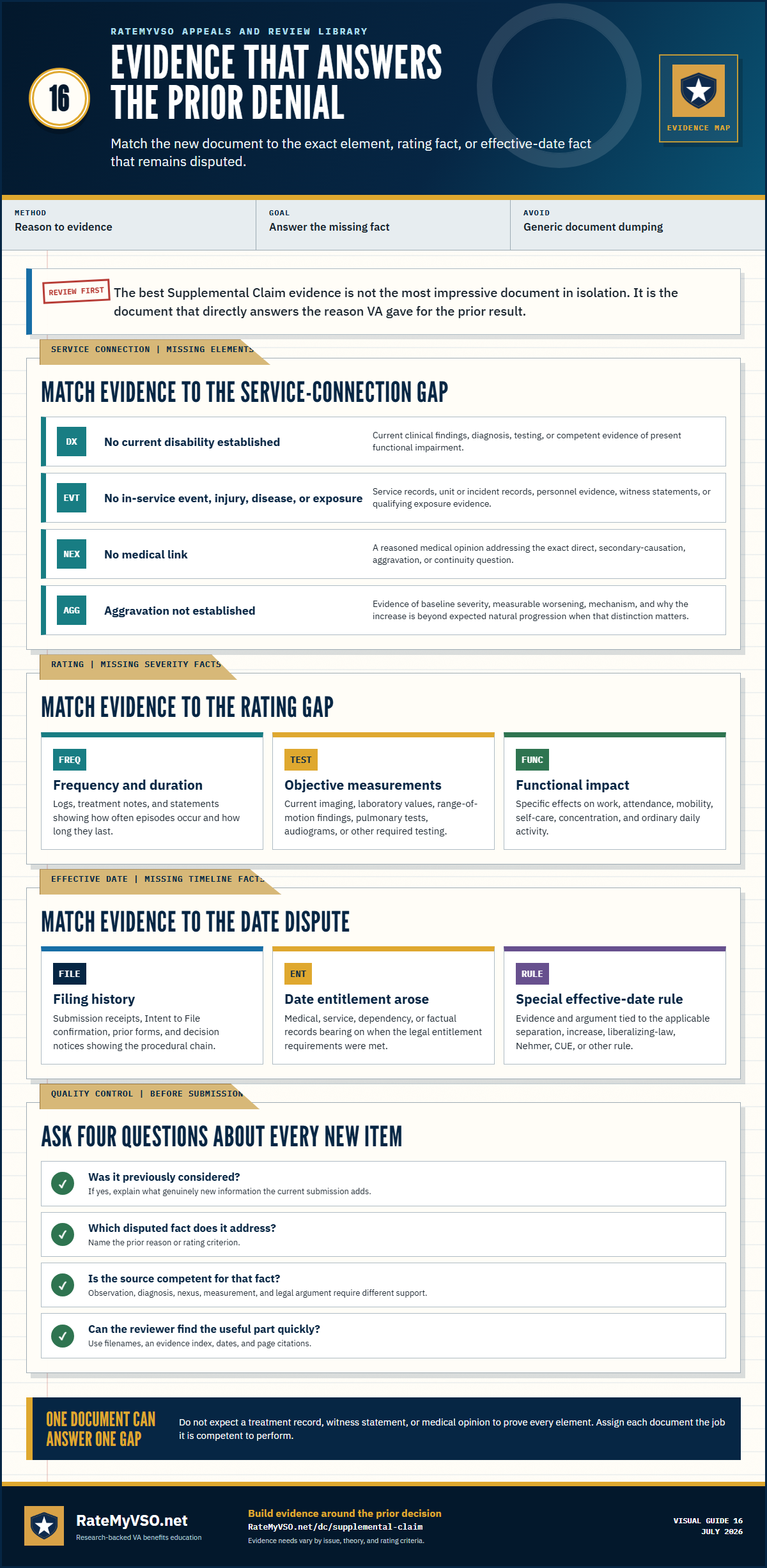 One-page guide: Evidence That Answers the Prior Denial
Evidence map matching new documents to prior service-connection, rating, and effective-date reasons, with a four-question quality check. Opens the full-size chart, free to save or print.
One-page guide: Evidence That Answers the Prior Denial
Evidence map matching new documents to prior service-connection, rating, and effective-date reasons, with a four-question quality check. Opens the full-size chart, free to save or print.
Section 8: Switching Lanes Between Decisions
Not sure a Supplemental Claim is your lane? Compare all five options in Are you in the right lane? near the top of this guide.
Lane-switching is allowed
Under the AMA, a veteran may switch lanes after each adverse decision. A Supplemental Claim denied at the RO can be sent to HLR, then to the Board, then back to Supplemental with new evidence after the Board denies. Each switch preserves the effective date as long as it happens within 1 year of the most recent decision.
Section 9: The Common Avoidable Mistakes
| Mistake | What happens | How to avoid |
|---|---|---|
| Filed Supplemental with no actually new evidence | Denied at threshold step. Prior denial stands. | Verify each piece of evidence post-dates or was absent from the prior decision date. |
| Evidence is new but does not address the prior denial reason | Denied at threshold step. | Read the prior Reasons and Bases. Match new evidence to the failed element by element. |
| Filed past day 365 | Effective date lost. Back pay starts from Supplemental filing. | File a substantially complete form before day 365 even if evidence isn't all ready. |
| No VA Form 21-4142 for private records | VA cannot request the records. Veteran must obtain and submit directly. | Sign and submit a 21-4142 with the Supplemental for each private provider. |
| Picked HLR for a missing-evidence problem | HLR reviewer cannot consider evidence outside the prior record. Year wasted. | If the problem is missing evidence, file Supplemental. |
| Picked Supplemental for an argument-only challenge | Denied at threshold step. | Argument-only challenges are HLR territory. |
| Did not flag prior-decision duty-to-assist failure | Cure path left on the table. | Add one line to Section III pointing to the specific procedural failure. |
| Missing or late STRs received later, not paired with 3.156(c) | 1-year rule controls effective date. | Cite 38 CFR 3.156(c) when service records are received late. Original effective date is preserved regardless of the 1-year rule. |
Section 10: BVA Outcomes on Supplemental Claims
From the RateMyVSO Board of Veterans' Appeals index, decisions 2022 to present that mention "supplemental claim": n = 143,714.
Granted + mixed totals 57%. Veterans receive a full or partial grant in more than half of supplemental-claim-flagged BVA decisions in this window.
Source: BVA Insights methodology page. Search the corpus at BVA Search.
Claim Quest: Quick Check
Five questions based only on this guide.
This checks what you understood from this guide. It is not a claim-readiness score, a prediction, an official test, or a record on your account.
Sources
- 38 U.S.C. § 5108: Supplemental claims statutory basis.
- 38 U.S.C. § 5107(b): Benefit-of-the-doubt rule.
- 38 CFR § 3.2500: Supplemental claim filing, effective-date preservation, continuous pursuit.
- 38 CFR § 3.2501: New-and-relevant standard, duty to assist, evidentiary record.
- 38 CFR § 3.156: Legacy new-and-material rule and 3.156(c) service-records exception.
- 38 CFR § 3.159: VA's duty to assist.
- 84 FR 138 (Jan. 18, 2019): AMA final rule establishing the new-and-relevant standard.
- M21-1 Part X, Subpart ii, Chapter 2, Section A: Revision Based on Specific Types of Submissions Including Supplemental Claims.
- M21-1 Part V, Subpart iv, Chapter 1, Section A: Completing the Rating Decision Narrative.
- M21-1 Part V, Subpart i, Chapter 1, Section C: Pre-Rating Review of Claims by the Rating Activity.
- M21-1 Part III, Subpart i, Chapter 2, Section D: Evidence Requested From the Claimant.
- VA.gov: Supplemental Claim landing page.
- VA.gov: Decision Reviews and Appeals overview.
- VA, Federal Benefits for Veterans, Dependents, Survivors, and Caregivers, 2026 edition (Pamphlet 80-26-1), va.gov/opa/publications: mailing addresses by benefit type (cited as VA, 2026).
- Shade v. Shinseki, 24 Vet. App. 110 (2010): legacy materiality threshold cited as AMA benchmark.