Migraines Secondary to Sleep Apnea
Migraine claimed as secondary to obstructive sleep apnea is one of the highest-win-rate secondary pairings in the Board's published record, granted in 81 percent of decided issues. A 2015 population cohort study backs the mechanism with real numbers, not just theory, and the Board has repeatedly thrown out VA exams that fixate on inconsistent lay-reported onset dates instead of answering the actual medical question. This guide covers the sleep-disruption mechanism, the legal standard, five recent Board decisions dissected, and the evidence that separates the wins.
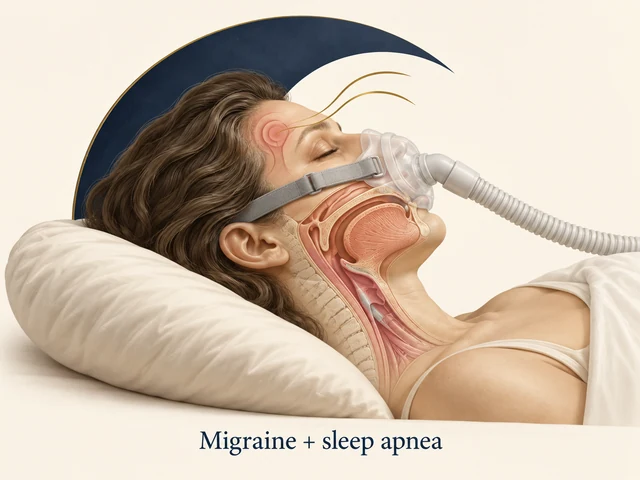
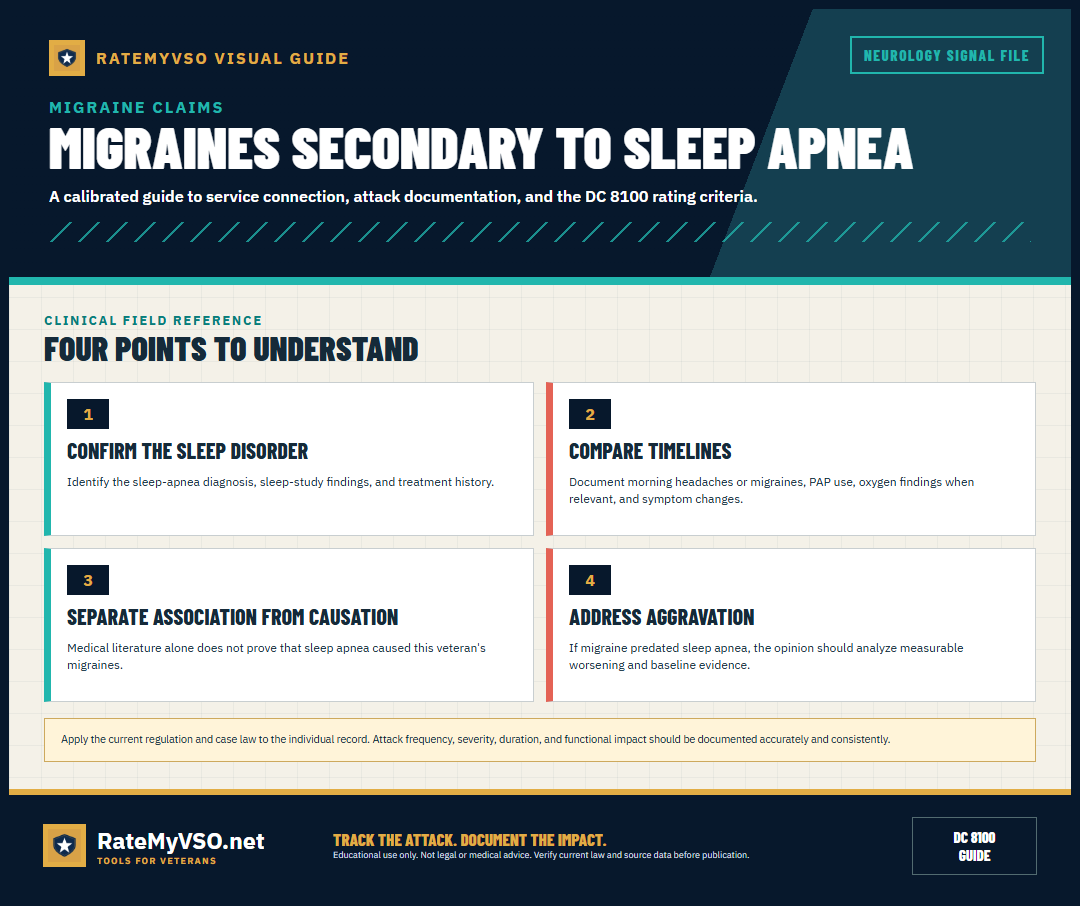 Visual guide: Migraines Secondary to Sleep Apnea
Board outcomes for this pairing, the three secondary service-connection elements, the medical theories, the evidence record, and the causation versus aggravation split. Opens the full-size chart, free to save or print.
Visual guide: Migraines Secondary to Sleep Apnea
Board outcomes for this pairing, the three secondary service-connection elements, the medical theories, the evidence record, and the causation versus aggravation split. Opens the full-size chart, free to save or print.
Start with the essentials
- 01Service Connection
The ways a secondary connection can be established for this pairing.
- 02Diagnosis and Evidence
Common symptoms and the evidence that supports this kind of claim.
- 03Your History
What you experienced, what others observed, and what treatment changed.
Understand the claim
ICD-10 Diagnosis Codes
The ICD-10 diagnosis codes most commonly used for DC 6847, Sleep Apnea Syndromes (Obstructive, Central, Mixed) (the kind on your medical records, decision letter, or C&P exam report). VA rates the disability and its residuals, not the diagnosis itself, so coding can vary.
The Legal Path: 38 CFR § 3.310, and Where the Lay-Competency Line Actually Falls
A secondary service connection claim needs three things (Allen v. Brown, 7 Vet. App. 439 (1995) (en banc)):
- A current disability: a diagnosed migraine headache condition, which for DC 8100 means a documented migraine diagnosis with attack frequency and whether attacks are prostrating.
- A service-connected primary: the sleep apnea rating itself.
- A nexus: medical evidence connecting the two.
Two points recur across these cases that are worth understanding before you read your own denial letter.
Symptoms and rating
If Granted: The Rating
Migraine is rated under DC 8100 (38 CFR § 4.124a) on a four-tier scale from 0 to 50 percent, driven by the frequency of prostrating attacks and, at the top tier, "very frequent completely prostrating and prolonged attacks productive of severe economic inadaptability." There is no higher schedular rating under this code alone. The secondary rating combines with your sleep apnea rating under VA math rather than adding, run it in the VA Math Calculator. Full rating detail and the case law defining "prostrating" are in the general Migraine Claims Guide.
Evidence and Board research
The Numbers, from 1.9M Appeals
In the Board's published decisions, migraine (DC 8100) claimed as secondary to obstructive sleep apnea (DC 6847) wins more often than almost any other secondary pairing this site tracks.
How those 160 issues came out
This is a smaller pool than the site's PTSD-secondary pairings, 160 issues rather than thousands, so treat the percentage as directionally strong rather than a precise population estimate. Every published grant reviewed for this guide turned on the same pattern: a private physician's opinion tying disrupted, fragmented sleep to migraine frequency, credited over a VA exam that either didn't address the theory at all or leaned on a reasoning error the Board caught. Compare the companion pairings: migraines secondary to PTSD wins 74 percent of decided issues, migraines secondary to tinnitus 73 percent. This pairing's 81 percent is the strongest migraine-secondary result the Board's published record shows.
Five Recent Board Decisions Dissected
All five decisions below granted service connection for migraine secondary to sleep apnea, decided June 2025 through January 2026 before four different Veterans Law Judges. Published Board decisions are not precedent, but the patterns repeat.
A private opinion nobody contradicted, because no VA opinion ever addressed the theory · Citation A26001096 (Jan. 6, 2026), Evidence Submission docket
The record: the veteran's OSA was newly service-connected when this claim was developed, so no VA exam had ever addressed whether migraines were secondary to it. A private clinician opined migraines were at least as likely as not caused or aggravated by both the OSA and a service-connected lumbar spine sprain, citing supporting studies.
Why it won: the Board found the private opinion well-reasoned and unopposed, "based on the evidence of record and the Veteran's reported history... and includes supporting studies," entitling it to great probative value. With nothing on the other side of the ledger, the evidence was at least in equipoise.
A VA examiner and a private doctor actually agree, and the current OSA rating doesn't already cover it · Citation A25101108 (Nov. 20, 2025), Direct Review docket
The record: the veteran's headaches surfaced as a claim the AOJ itself inferred while developing his OSA claim. A November 2020 private clinician and a March 2021 VA examiner both attributed the headaches to OSA, a rare instance of the VA's own exam siding with the veteran.
Why it won: beyond the shared medical opinion, the Board made a separate point: the veteran's 50 percent OSA rating under DC 6847 does not contemplate headache symptomatology, so granting a distinct migraine rating is not double-counting the same disability.
A named mechanism, no VA opinion to oppose it · Citation A24016446 (Apr. 4, 2024), Evidence Submission docket
The record: a private physician's nexus opinion, covering both a GERD-secondary-to-OSA claim and this migraine claim in the same letter, stated migraines "can be caused by any persistent disturbance of regular sleep, to include frequent interruptions of sleep through the night, a chronic illness that disturbs sleep quality, or the presence of a sleep disorder such as obstructive sleep apnea." Because OSA had not yet been service-connected at the time of the veteran's VA exam, no VA opinion on the secondary theory existed at all.
Why it won: the Board found no evidence of record contradicting the private opinion, calling it "necessarily the most probative evidence of record." An evidentiary gap left by VA's own exam timing did not count against the veteran.
Two VA opinions, one applying the wrong legal standard · Citation A25072719 (Aug. 28, 2025), Evidence Submission docket
The record: a May 2022 VA examiner found migraines "less likely than not" related to OSA. A November 2021 private nexus opinion, citing a journal article that "sleep disturbances caused by sleep apnea are associated with migraines and headaches and poor-quality sleep increases the odds for headaches," reached the opposite conclusion. A February 2023 VA addendum on aggravation was also negative but thin.
Why it won: the Board found the May 2022 VA examiner had required the record to show a link "with a greater than 50% probability," the wrong legal standard, rather than the equipoise standard the law actually requires. Neither VA opinion addressed the veteran's consistent reports of headaches upon awakening tied to sleep disruption. Both VA opinions were given limited weight; the private opinion prevailed on the benefit of the doubt.
A VA exam that argued the wrong thing entirely · Citation A25051248 (Jun. 11, 2025), Evidence Submission docket
The record: a June 2022 VA exam found migraines unrelated to OSA, reasoning that the veteran's light, sound, and smell sensitivity was inconsistent with "sleep apnea headaches" per medical literature, and separately flagging inconsistencies in the veteran's own lay-reported history of when symptoms began. A private opinion, submitted in the 90-day evidentiary window, cited multiple medical-literature mechanisms of connection.
Why it won: the Board gave the VA exam zero probative weight. A veteran is not competent to diagnose etiology in the first place, so an inconsistent lay account of onset timing doesn't undercut a reasoned private opinion, and the VA examiner never addressed whether the sensitivity symptoms could themselves stem from the sleep apnea rather than ruling out a connection. The private opinion, by contrast, was given significant probative weight.
The pattern across all five
- A private nexus opinion decided every one of these five cases, either as the sole basis or as the tiebreaker over a VA opinion.
- VA opinions lost for identifiable, fixable errors: applying a stricter-than-required probability standard, or fixating on lay-reported onset-date inconsistencies that were never competent evidence of etiology to begin with.
- A newly service-connected OSA claim can leave a genuine evidentiary gap where no VA opinion ever addresses the secondary theory at all, and the Board does not hold that gap against the veteran when an unopposed private opinion fills it.
- The current OSA rating not already covering headache symptoms is a distinct, useful argument separate from the medical nexus itself.
What the Board Said in Recent Grants
These are the Board's own words, quoted from the findings in 5 recent granted decisions on this pairing. Each sentence is the finding the grant rested on, not a summary of it. Click a citation to read the full decision.
“The Veteran's migraines are due to his service-connected obstructive sleep apnea and lumbar spine sprain”
“Resolving reasonable doubt in the Veteran's favor, his migraine headaches disability is due to his service-connected obstructive sleep apnea disability”
“The Veteran's migraine headaches are due to service-connected obstructive sleep apnea.”
“The competing lay and medical evidence is in approximate balance as to whether service connection for migraine is secondary to the Veteran's service-connected sleep apnea”
“The Veteran's migraines are due to his service-connected obstructive sleep apnea (OSA).”
Quoted from published Board decisions on this pairing, most recent first. Descriptive of the published record, not a prediction about any individual claim. Search the full decisions in BVA Decision Search.
The Evidence Checklist
What the winning files contained, item by item.
- A documented migraine diagnosis with frequency: how often attacks occur, whether they're prostrating, and when they started relative to your OSA diagnosis and treatment.
- A private nexus opinion naming the mechanism: sleep fragmentation, nocturnal hypoxia, or a persistent disturbance of regular sleep. Every grant above turned on an opinion like this, either alone or over a VA opinion.
- The anti-pyramiding point, addressed explicitly: if you already carry an OSA rating, note that DC 6847's criteria don't contemplate headache symptoms, so a separate migraine rating is not overlapping compensation.
- Don't lean on your own timeline for etiology: your lay statement establishes current disability and symptom history, not the medical cause. A private opinion has to do that work; an inconsistent memory of onset dates should not sink an otherwise solid medical opinion.
- Read your denial letter for the wrong legal standard: if a VA examiner's rationale reads like it demanded more than "at least as likely as not," that is a reasoning error the Board has caught before.
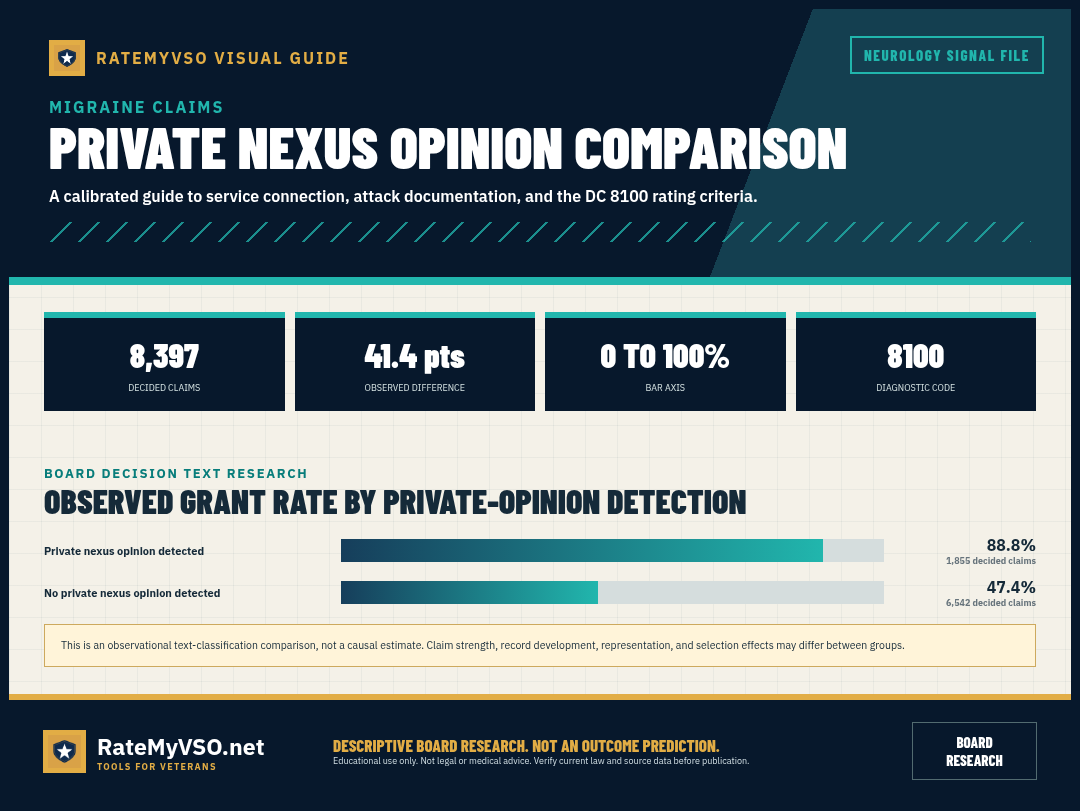
Across all published DC 8100 decisions, files with a private medical opinion track a different grant rate than VA-exam-only files, shown live below.
Why VA Denies These Claims, and What the Board Said Back
Each rationale below is drawn from the actual VA examinations in the cases above, alongside how the Board answered it.
| VA examiner's rationale | How the Board answered it |
|---|---|
| Required the record to show a link "with a greater than 50% probability." | Wrong legal standard. The bar is "at least as likely as not," an equipoise standard, not a stricter probability showing (A25072719). |
| Migraine symptoms (light/sound/smell sensitivity) are "inconsistent with sleep apnea headaches" per literature. | The opinion never addressed whether those symptoms could themselves stem from the sleep apnea; incomplete reasoning, given no probative weight (A25051248). |
| Veteran's lay-reported history of when headaches began is inconsistent. | A veteran was never competent to diagnose etiology in the first place (Jandreau, Grover), so an inconsistent lay account of onset timing doesn't defeat a reasoned medical nexus opinion (A25072719, A25051248). |
| No VA opinion addresses the secondary theory at all. | Usually because OSA wasn't yet service-connected when the exam occurred; not held against the veteran, an uncontradicted private opinion carries the claim (A26001096, A24016446). |
| (Implicit) the existing OSA rating already accounts for the veteran's symptoms. | A 50 percent OSA rating under DC 6847 does not contemplate headache symptomatology; a separate grant is not double-counting (A25101108). |
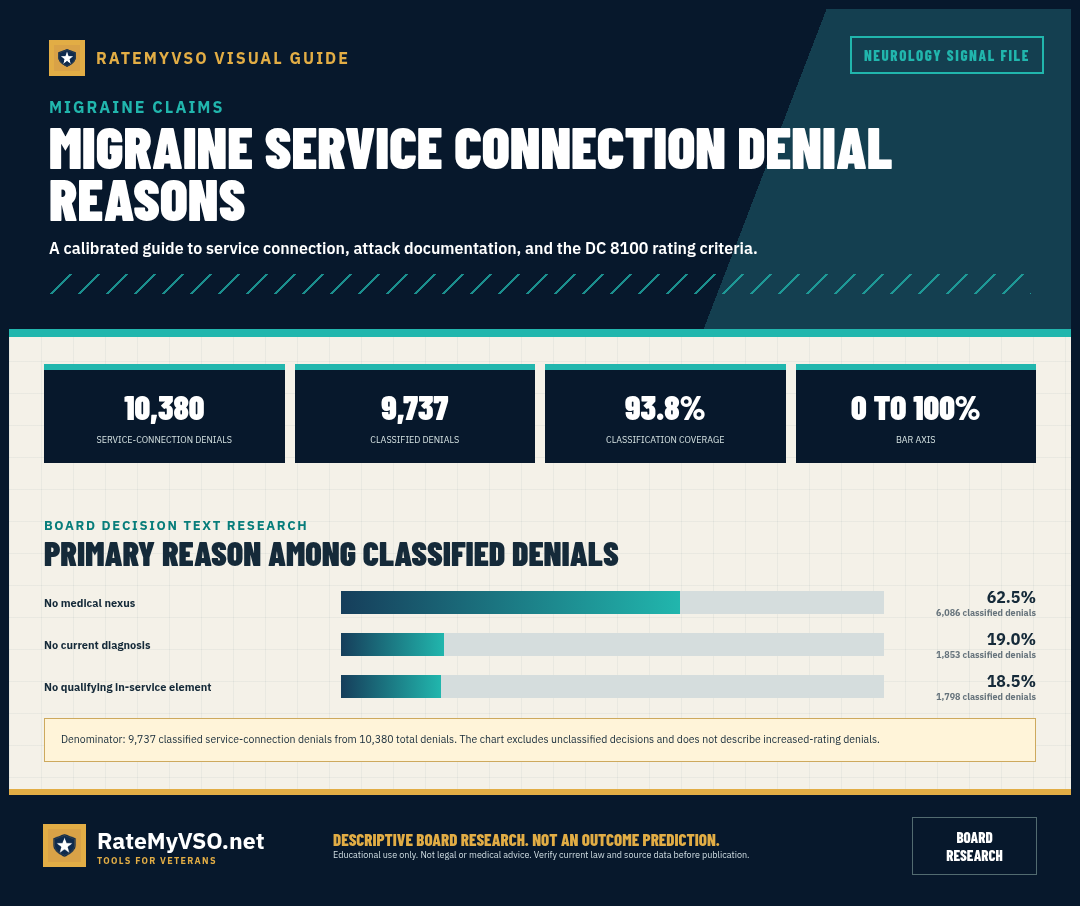
Across the Board's full record for migraine, the most common denial reason is shown live below.
Secondary relationships
The Mechanism: How Sleep Apnea Connects to Migraines
The theory argued in these cases is not that sleep apnea causes a single migraine directly, it's that the chronic sleep disruption OSA produces lowers the threshold for migraine attacks and can trigger the morning headaches and prostrating episodes veterans report.
1. Population-level evidence: a measured hazard ratio
A 2015 Taiwan National Health Insurance Research Database cohort study followed patients with a sleep-related breathing disorder diagnosis against matched controls. Adjusted hazard ratio for developing migraine: 2.43 (95% CI 1.72 to 3.44) in the sleep-related breathing disorder group. The effect held in adults but not in elderly patients; men carried a higher adjusted risk (2.71) than women (2.29). See Harnod, Wang & Kao, Association of Migraine and Sleep-Related Breathing Disorder: A Population-Based Cohort Study, Medicine (Baltimore) 2015, PMID 26356720.
2. Nocturnal hypoxia and morning headache
Repeated drops in blood oxygen during apnea events are the leading proposed physiological driver, changes tied to morning headache in the sleep-medicine literature more broadly, and one several of the private nexus opinions below cite directly.
3. Sleep fragmentation on its own
Migraine literature has long tied any persistent disturbance of regular sleep, frequent interruptions through the night, a chronic illness that disturbs sleep quality, or a sleep disorder like OSA specifically, to migraine frequency. Several of the Board's own credited opinions state this in almost that language.
4. Your OSA rating doesn't already cover this
A recurring, separate point in the winning decisions: a veteran's existing OSA rating under DC 6847 compensates the breathing disorder itself, not headache symptomatology. That distinction supported at least one grant below and is worth raising explicitly if a VA denial implies the conditions overlap.
Lay competency covers symptoms, not etiology
A veteran is competent to describe when headaches started and how they feel; a veteran is not competent to diagnose the medical cause. Jandreau v. Nicholson, 492 F.3d 1372, 1377 (Fed. Cir. 2007); Grover v. West, 12 Vet. App. 109, 112 (1999). Some VA exams have leaned on inconsistencies in a veteran's own lay-reported onset story to deny the claim, but the Board has repeatedly pointed out that a veteran's account of when symptoms started was never competent evidence of etiology to begin with, so inconsistency there doesn't defeat a well-reasoned private nexus opinion addressing the actual medical question.
Watch for the wrong legal standard
The correct bar for a nexus opinion is "at least as likely as not," an equipoise standard, not a "greater than 50 percent probability" showing. In one 2025 grant, the Board found a VA examiner had applied exactly that stricter, incorrect standard, and discounted the opinion for it (Bd. Vet. App. A25072719).
The Wider Data
Where sleep apnea sits among the conditions veterans claim as its secondary. Live from the Board's published decisions, refreshed weekly:
Bars are BVA grant rates among decided issues for each condition claimed as secondary to sleep apnea, with issue counts. Descriptive of the published record, not a prediction about any one claim. Explore the underlying decisions in BVA Decision Search.
Prepare and take the next step
Prepare: your own working pages
Optional. These are your own notes, in your own words. They are not a VA form, they are not sent to the VA, and nothing here is a medical finding or a prediction about your claim.
Three reminders while you prepare
- Keep the two conditions separate
Record the history, diagnosis, symptoms, and treatment for Sleep Apnea and Migraines separately before describing the possible relationship. Go to this part
- Ask about causing and worsening separately
A clinician may need to address whether Sleep Apnea caused Migraines, whether it worsened it, and what other explanations the record shows. Go to this part
- Build the timeline from records you have
Mark missing or unverified records honestly. Research from published Board decisions describes the record reviewed; it does not predict an individual claim. Go to this part
Sign in or create an account to save your answers and come back to them later. You can fill these in and print them without an account.
Two-condition timeline
Migraines: symptoms and daily function
Provider questions about the relationship
Records and unanswered questions
Decision-letter reading sheet
Quick Checklist Before You File
- Documented migraine diagnosis with attack frequency, and whether attacks are prostrating.
- Your OSA diagnosis and treatment records, including any CPAP compliance data and your DC 6847 rating if you already have one.
- A private nexus opinion naming a specific mechanism, sleep fragmentation, nocturnal hypoxia, or a persistent disturbance of regular sleep, matched to your record.
- If you already have an OSA rating, an explicit note that its criteria don't contemplate headache symptoms, so a separate migraine rating is not double-counting.
- Your denial or exam reviewed for the wrong legal standard, a demand for "greater than 50 percent probability" instead of "at least as likely as not."
- Your own timeline of symptom onset and history documented as lay evidence, not treated as the medical proof of cause.
For the mechanics of filing itself, see the Standard Claim Guide and the Fully Developed Claim Guide.
Do's and Don'ts
A condensed version of the pattern across the five grants and the denial rationales above.
- Get a private nexus opinion that names the mechanism, sleep fragmentation, nocturnal hypoxia, or a persistent disturbance of regular sleep, every grant above turned on an opinion like this.
- Note explicitly that your existing OSA rating under DC 6847 doesn't contemplate headache symptomatology, if you already carry one, that anti-pyramiding point supported at least one grant.
- Document your migraine frequency and whether attacks are prostrating, for the rating itself once service connection is granted.
- Read your denial letter closely for the wrong legal standard, "greater than 50 percent probability" instead of "at least as likely as not."
- Let the private opinion do the etiology work; your own statement is competent for symptoms and timing, not for the medical cause.
- Don't assume an inconsistent memory of when your migraines started defeats a reasoned nexus opinion, lay competency never covered etiology to begin with, and the Board has said so.
- Don't assume a newly service-connected OSA claim with no VA opinion on file hurts you, an unopposed private opinion carried two of the five grants above on exactly that gap.
- Don't let a VA exam's "symptoms are inconsistent with sleep apnea headaches" line stand unchallenged without checking whether it actually addressed the medical question.
- Don't wait for your OSA diagnosis to predate your migraines in the record, there is no requirement that the primary condition come first.
- Don't assume you need a neurologist or another specialist credential, the grants above ran on private clinicians and treating physicians citing general sleep-medicine literature.
The Claims Process, Step by Step
A secondary claim moves through the same pipeline as any other. Understanding who does what helps you know who to contact and what to expect.
- You file the claim, naming sleep apnea as the service-connected primary and migraine as secondary. Directly with VA, through VA.gov, or with an accredited representative's help.
- VA assigns a Veteran Service Representative (VSR) to develop the claim: gather your service treatment records, VA and private medical records, and order a C&P exam if needed.
- The C&P exam is conducted, usually with the examiner asked to address the specific secondary theory (causation and aggravation both).
- The file goes to a Rating Veteran Service Representative (RVSR), the "rater," who weighs the medical evidence and decides service connection and, if granted, the rating percentage.
- VA issues the decision letter stating the outcome and the reasoning.
- If denied or under-rated, you choose an appeal lane, Supplemental Claim, Higher-Level Review, or a Board appeal, covered below.
Who's who: VSO vs. VSR vs. Rater vs. C&P Examiner
Your VSO
An accredited representative, agent, or attorney. Not a VA employee. Helps prepare and file, and can represent you on appeal. Has no authority to decide your claim.
VSR
VA staff who develops the claim: gathers records and schedules the exam. Does not decide the rating.
Rater (RVSR)
VA staff who reviews the complete file and makes the actual decision on service connection and percentage.
C&P Examiner
Conducts the exam and, where asked, gives a nexus opinion. Does not decide the claim, but as the case dissections above show, the opinion's reasoning and legal framing carry real weight.
For the full walkthrough, see Inside Your Claim and Claim Stages.
DBQs and Your C&P Exam
A Disability Benefits Questionnaire (DBQ) is the standardized form the examiner completes for your condition. See the DBQ Guide for how these forms work and whether a private DBQ from your own doctor can be submitted instead of relying solely on a VA exam. For what to expect and how to prepare, see the C&P Exam Prep Guide, and be specific about your migraine frequency, whether attacks are prostrating, and how they track your sleep disruption or nocturnal hypoxia; several of the grants above turned on exactly that kind of detail being addressed, not skipped, in the exam.
Reading Your Decision Letter, and What to Do If Denied
Your decision letter has a narrative "reasons and bases" section and a codesheet with the rating and effective date. See the Reading Your Decision Letter Guide or use the Letter Interpreter tool to decode your own letter. If denied, or if the reasoning cites the wrong legal standard (see the probability-standard discussion above), you have three main lanes:
- Supplemental Claim: refile with new and relevant evidence, such as a nexus opinion naming the sleep-disruption mechanism VA never addressed. See Supplemental Claim Guide.
- Higher-Level Review (HLR): a senior reviewer looks at the same evidence again, useful if the denial rested on a legal error like the wrong probability standard. See HLR Guide.
- Board Appeal: your case goes to a Veterans Law Judge, with a direct review, evidence, or hearing docket. See Board Appeal Guide.
Not sure which lane fits? See the Appeals decision guide for a side-by-side comparison.
After You Win: Maintaining Your Rating
Keep your migraine and sleep apnea treatment consistent, ongoing CPAP compliance records, migraine frequency logs, and any follow-up visits, protects you if VA schedules a future reexamination. See Protect Your Rating for when a rating becomes protected and Future Reexaminations for what triggers one. If your migraines worsen, you can file for an increased rating, see the Rating Increase Guide.
References and related resources
Frequently Asked Questions
Why is this pairing's grant rate so high (81 percent)?
The published record is a smaller pool than some of the site's other secondary pairings (160 issues), so treat the percentage as directionally strong rather than a precise population figure. Within that pool, the mechanism has real population-level backing (a 2.43 adjusted hazard ratio from a 2015 cohort study), and VA's own exams in several of the denials reviewed here made identifiable, fixable reasoning errors that the Board caught, applying the wrong probability standard, or leaning on lay-history inconsistencies that were never competent evidence of etiology.
My VA exam said my migraine symptoms don't match "sleep apnea headaches." Is that a real denial?
Read it carefully. In one published grant, the Board gave that exact reasoning zero probative weight because the examiner never addressed whether the symptoms in question could themselves stem from the sleep apnea, incomplete reasoning rather than a real medical conclusion (A25051248).
My migraine diagnosis came before my sleep apnea diagnosis. Does that rule out a secondary claim?
Not on its own. Secondary service connection carries no requirement that the primary condition predate the secondary one in diagnosis date (Frost v. Shulkin, 29 Vet. App. 131 (2017), a related peripheral-neuropathy-secondary-to-diabetes case applying the same principle). What matters is the medical nexus, not the order the paperwork arrived in.
Does my existing sleep apnea rating already cover my headaches?
No. The Board has specifically addressed this: a 50 percent OSA rating under DC 6847 compensates the breathing disorder, not headache symptomatology, so a separate migraine rating is not double-counting the same disability (A25101108).
What if my sleep apnea was only recently service-connected, and no VA exam has ever addressed my headaches?
That gap does not count against you. In two of the grants above, no VA opinion existed on the secondary theory at all because the OSA claim was still new. An unopposed, well-reasoned private opinion carried the claim in both cases.
Do I need a neurologist to write my nexus letter?
Not on this record. The five grants ran on private clinicians and treating physicians citing general sleep-medicine literature and mechanisms, not a specific specialty credential. What mattered was a reasoned opinion naming the mechanism and addressing the veteran's actual facts.
Sources
- Bd. Vet. App. A26001096 (Jan. 6, 2026); A25101108 (Nov. 20, 2025); A24016446 (Apr. 4, 2024); A25072719 (Aug. 28, 2025); A25051248 (Jun. 11, 2025) (published, non-precedential).
- 38 U.S.C. §§ 1110, 1131, 5107; 38 CFR §§ 3.102, 3.303, 3.310, 4.124a (DC 8100), 4.97 (DC 6847).
- Allen v. Brown, 7 Vet. App. 439 (1995) (en banc); Shedden v. Principi, 381 F.3d 1163 (Fed. Cir. 2004); Lynch v. McDonough, 21 F.4th 776 (Fed. Cir. 2021) (en banc); Jandreau v. Nicholson, 492 F.3d 1372 (Fed. Cir. 2007); Grover v. West, 12 Vet. App. 109 (1999); Davidson v. Shinseki, 581 F.3d 1313 (Fed. Cir. 2009); Stefl v. Nicholson, 21 Vet. App. 120 (2007); Frost v. Shulkin, 29 Vet. App. 131 (2017).
- Harnod, Wang & Kao, Association of Migraine and Sleep-Related Breathing Disorder: A Population-Based Cohort Study, Medicine (Baltimore), Sept. 2015, PMID 26356720.
- Aggregate outcome counts: RateMyVSO index of published BVA decisions (as of July 2026 for the static chart; live widgets refresh weekly).