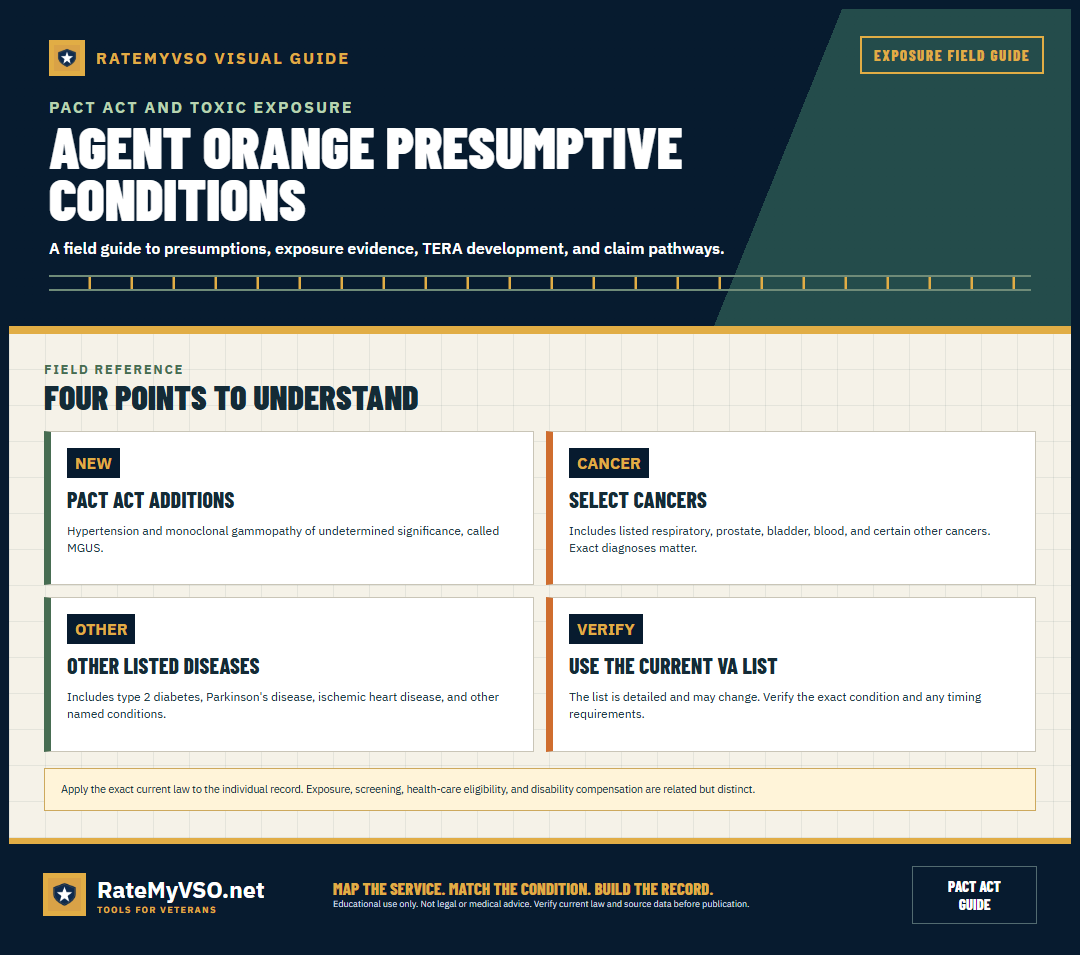
Veterans who served in specified locations during specified periods are presumed to have been exposed to herbicide agents, and a list of diseases is presumptively service-connected for those veterans (see 38 CFR 3.307(a)(6) and 38 CFR 3.309(e)). The PACT Act of 2022 (Pub. L. 117-168) added bladder cancer, hypertension, hypothyroidism, monoclonal gammopathy of undetermined significance (MGUS), and Parkinsonism. This page reproduces the regulation with plain-English context.
How the presumption works
The herbicide presumption has two parts:
Exposure presumption (3.307(a)(6)). A veteran who served in a covered location during a covered period is presumed to have been exposed to an herbicide agent (Agent Orange and the other tactical herbicides used during the Vietnam era), unless there is affirmative evidence to the contrary.
Disease presumption (3.309(e)). If the veteran later develops one of the listed diseases, that disease is presumed to be service-connected, even without proof of a direct nexus to a specific in-service event.
3.307(a)(6)(iii): A veteran who, during active military, naval, or air service, served in the Republic of Vietnam during the period beginning on January 9, 1962 and ending on May 7, 1975, shall be presumed to have been exposed during such service to an herbicide agent, unless there is affirmative evidence to establish that the veteran was not exposed to any such agent during that service.
Qualifying service
Republic of Vietnam (3.307(a)(6)(iii))
Active service in the Republic of Vietnam between January 9, 1962 and May 7, 1975. "In" includes service on the inland waterways and, after the Blue Water Navy Vietnam Veterans Act of 2019, service in the territorial seas of the Republic of Vietnam (within 12 nautical miles of the demarcated coastline).
Korean Demilitarized Zone (3.307(a)(6)(iv))
Active service in or near the Korean DMZ between April 1, 1968 and August 31, 1971, in a unit determined by the Department of Defense to have operated in or near the DMZ where herbicides were applied.
Thailand and other locations (PACT Act 2022)
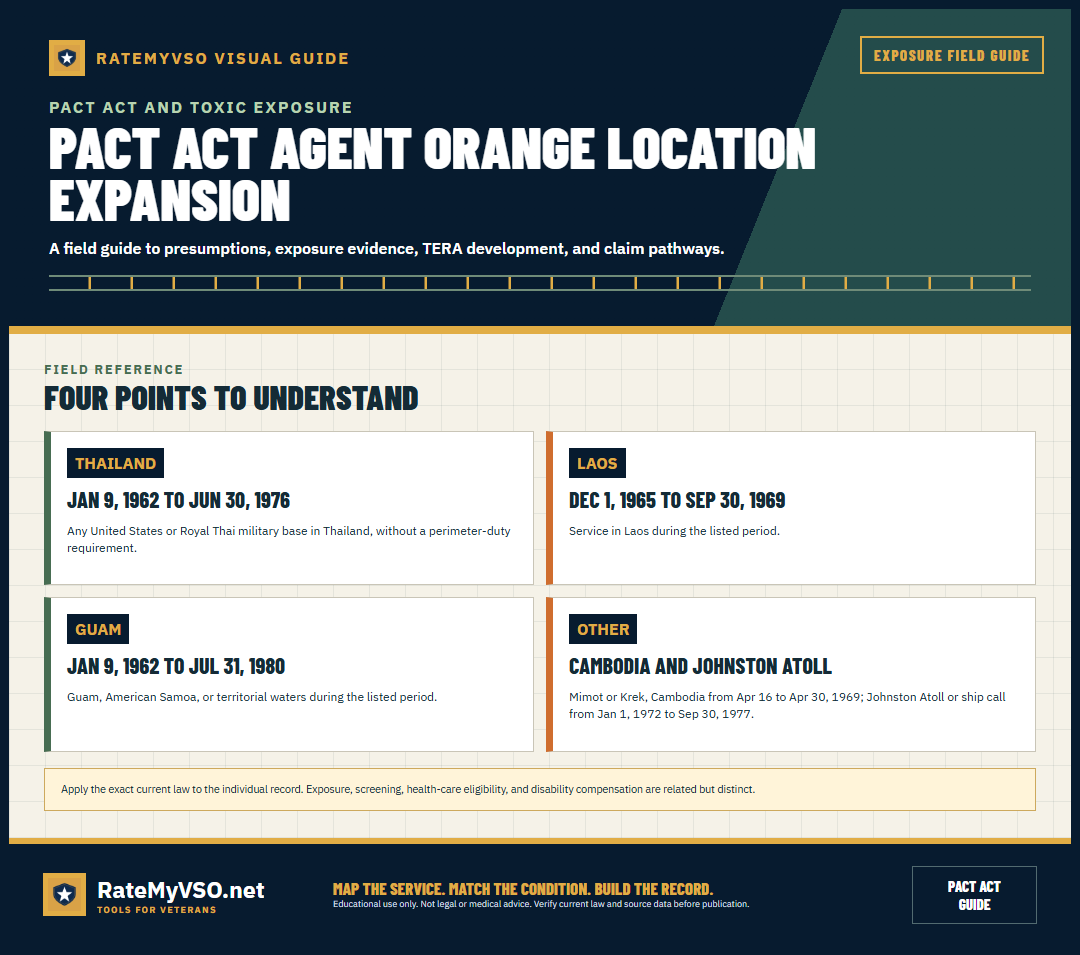
Service in Thailand at any U.S. or Royal Thai military base from January 9, 1962 through June 30, 1976, and service at certain locations in Laos, Cambodia, Guam, American Samoa, and Johnston Atoll during specified periods, are also covered. The PACT Act expanded these covered locations effective August 10, 2022.
Other in-service exposure
Veterans who handled, stored, or were otherwise exposed to herbicide agents during military service outside the listed locations may still establish service connection on a direct, non-presumptive basis if they can document the actual exposure.
The following diseases are presumptively service-connected for veterans who had qualifying service and developed the condition (subject to the manifestation rules below):
Soft-tissue sarcomas (other than osteosarcoma, chondrosarcoma, Kaposi's sarcoma, and mesothelioma)
Manifestation periods (3.307(a)(6)(ii))
Most conditions: any time after service
For most diseases on the list (cancers, diabetes, ischemic heart disease, Parkinson's disease, hypertension, etc.), the regulation imposes no time limit. The disease may manifest decades after the veteran's last exposure and still qualify.
Chloracne and porphyria cutanea tarda: within 1 year
Chloracne and porphyria cutanea tarda must become manifest to a degree of 10 percent or more within 1 year after the date of last exposure to an herbicide agent during active military, naval, or air service.
Early-onset peripheral neuropathy: within 1 year
Early-onset peripheral neuropathy must become manifest to a degree of 10 percent or more within 1 year after the last date on which the veteran was exposed to an herbicide agent during active service. (The "early-onset" qualifier was added in 2013; older claim materials sometimes refer to this as "acute and subacute peripheral neuropathy.")
The Honoring our PACT Act of 2022 (Pub. L. 117-168, signed August 10, 2022) added five conditions to the herbicide presumption that had previously required a direct service-connection theory:
Bladder cancer. Long sought after a 2018 National Academies report; previously denied as presumptive.
Hypertension. The most-claimed Vietnam-era condition; presumption was added after years of advocacy.
Hypothyroidism. Effective for claims pending or filed on or after August 10, 2022.
Monoclonal gammopathy of undetermined significance (MGUS). Pre-cancerous blood plasma condition.
Parkinsonism. Broader than Parkinson's disease (which was already presumptive). Includes parkinsonian syndromes that do not meet the full diagnostic criteria for Parkinson's disease.
Effective date: Per 38 CFR 3.114, the effective date for newly added presumptive conditions is generally the date of enactment of the legislation (August 10, 2022) or the date of claim, whichever is later, unless the claim was filed within one year of the regulation taking effect, in which case the effective date may be earlier.
Limitations
The presumption can be rebutted by:
Affirmative evidence that the veteran was not exposed to herbicide agents during the covered service.
Affirmative evidence that the disease did not result from in-service herbicide exposure (rarely succeeds in practice; the standard for rebuttal is high).
Evidence that the disease is the result of the veteran's own willful misconduct or the abuse of alcohol or drugs.
The presumption applies only to veterans, not to dependents (with the limited exception of certain birth-defect provisions for children of Vietnam veterans, codified separately at 38 CFR 3.814 and 3.815, which are outside the scope of this page).
Not the exclusive pathway. This page describes one specific presumption. Direct service connection (proving exposure and a medical nexus) remains available for conditions not on the presumptive list, and other regulations may apply for other toxic exposures.
Not legal advice, not a claim filing. This page provides factual reference only. It is not legal advice, does not establish representation, and does not constitute the filing of any claim. For case-specific guidance, find an accredited VSO representative.
Data vintage. Regulatory text reproduced from eCFR Title 38 snapshot. Always verify against the eCFR link above; regulations are amended periodically.
Current diagnosis and qualifying service still required. The presumption relieves the burden of proving the exposure-to-disease link. It does not eliminate the need for a current medical diagnosis and proof of qualifying service.