Sleep Apnea Secondary to Tinnitus
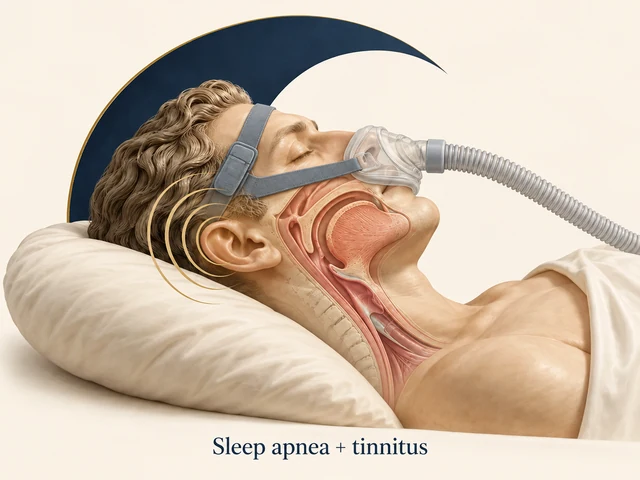
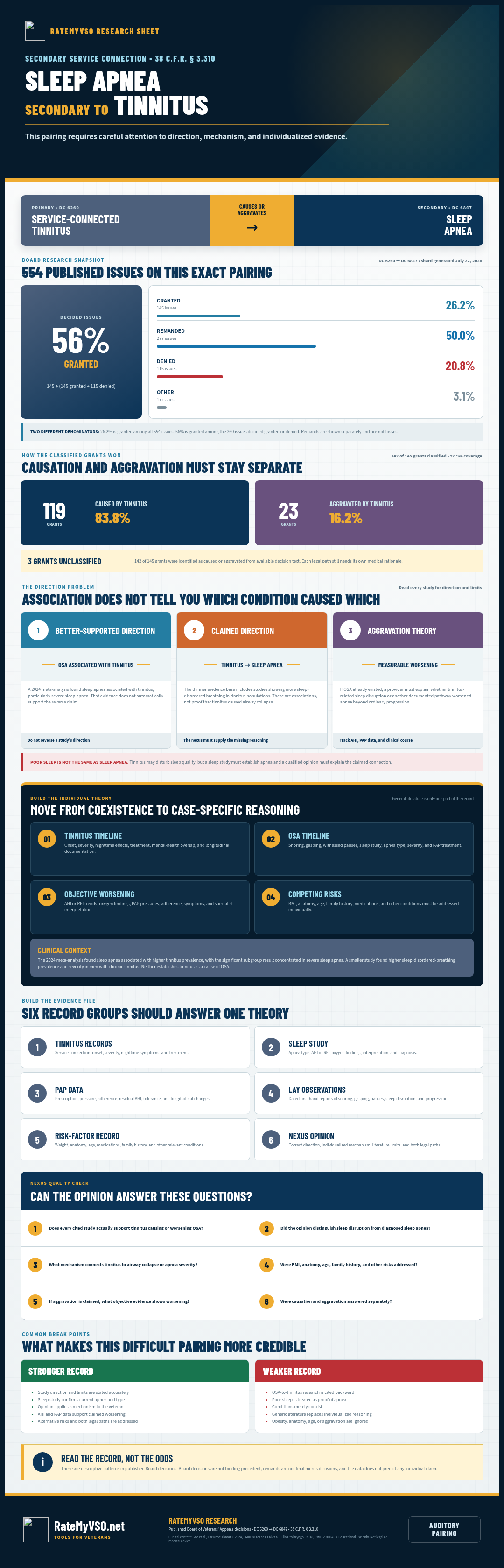
Sleep apnea claimed as secondary to tinnitus is granted in 56 percent of decided Board issues. This guide is upfront about something most nexus-letter marketing content isn't: the medical literature more consistently supports the opposite direction, severe sleep apnea causing tinnitus, than it does tinnitus causing sleep apnea. The theory that wins at the Board runs on correlational studies in tinnitus-patient populations and a plausible, not proven, neural-arousal mechanism. This guide covers the mechanism honestly, the causation-versus-aggravation split that decides these cases, five recent Board decisions dissected, and the evidence that wins.
Start with the essentials
- 01Service Connection
The ways a secondary connection can be established for this pairing.
- 02Diagnosis and Evidence
Common symptoms and the evidence that supports this kind of claim.
- 03Your History
What you experienced, what others observed, and what treatment changed.
Understand the claim
ICD-10 Diagnosis Codes
The ICD-10 diagnosis codes most commonly used for DC 6847, Sleep Apnea Syndromes (Obstructive, Central, Mixed) (the kind on your medical records, decision letter, or C&P exam report). VA rates the disability and its residuals, not the diagnosis itself, so coding can vary.
The Legal Path: Causation and Aggravation Are Separate Questions
A secondary service connection claim needs three things (Allen v. Brown, 7 Vet. App. 439 (1995) (en banc)):
- A current disability: a diagnosed sleep apnea, which for DC 6847 means a sleep study (polysomnography or a validated home sleep test).
- A service-connected primary: the tinnitus rating itself.
- A nexus: medical evidence connecting the two.
The controlling doctrine specific to this pairing is about keeping those two theories separate.
Symptoms and rating
If Granted: The Rating
Sleep apnea is rated under DC 6847 (38 CFR § 4.97) on a four-tier scale from 0 to 100 percent, driven mainly by whether a breathing device like a CPAP is required. The secondary rating combines with your tinnitus rating under VA math rather than adding, run it in the VA Math Calculator. Full rating detail is in the Sleep Apnea Claims Guide.
Evidence and Board research
The Numbers, from 1.9M Appeals
In the Board's published decisions, sleep apnea (DC 6847) claimed as secondary to tinnitus (DC 6260) is a mid-sized claim pool where more than half of decided issues are granted.
How those 529 issues came out
Remand is the single largest outcome, 51 percent of the full pool, more than either granted or denied alone, largely because VA opinions in this pairing so often recite generic OSA risk factors without addressing the veteran individually. All five decisions dissected below are grants, so treat the winning pattern as real but drawn from one side of the ledger.
Five Recent Board Decisions Dissected
All five decisions below granted service connection for sleep apnea secondary to tinnitus, decided December 2025 through March 2026 before five different Veterans Law Judges. Published Board decisions are not precedent, but the patterns repeat.
An aggravation theory, proven with AHI data over time · Citation A26028821 (Mar. 31, 2026), Evidence Submission docket
The record: a March 2017 private sleep study confirmed OSA. A prior 2024 Board remand had already found an earlier VA exam inadequate for reciting generic risk factors with no individualized rationale; a follow-up VA opinion was also given low weight for reciting literature without linking it to the veteran's facts. An August 2025 private opinion from a doctor of nursing practice cited the veteran's own CPAP and AHI data, showing initially controlled apnea (AHI 2.9) followed by progressive worsening despite compliance, and cited literature that organic sleep disorders are "frequently compounded with sleep disturbance caused by tinnitus."
Why it won: "the most probative medical evidence of record shows that the Veteran's service-connected tinnitus aggravated his obstructive sleep apnea," a grant built on the veteran's own objective CPAP data showing worsening over time, not a bare assertion of causation.
A long-treating doctor's opinion, general articles given little weight · Citation A26021731 (Mar. 10, 2026), Hearing docket
The record: a March 2019 sleep study diagnosed OSA. A VA exam gave a conclusory negative opinion that never applied the but-for standard and never addressed aggravation. Two opinions from the veteran's 15-year treating primary care physician offered a positive nexus but were given only moderate weight; general articles the veteran submitted himself were given little weight for being too generic and not fact-specific.
Why it won: the Board found "an approximate balance of evidence that the Veteran's sleep apnea was aggravated by or caused by his service-connected tinnitus," left the exact theory unresolved, and granted on equipoise once the VA opinion was discounted.
Causation, and an intermediate-step argument VA never engaged · Citation A26016177 (Feb. 23, 2026), Direct Review docket
The record: an October 2024 VA opinion was actually positive, finding the OSA began subsequent to the tinnitus and citing research that the two conditions "commonly co-exist." A February 2025 VA addendum reversed course, pointing to the veteran's weight gain as an alternate cause, but never addressed whether that weight gain was itself an intermediate step linked to tinnitus-driven sleep disturbance.
Why it won: the addendum was given minimal weight for ignoring the intermediate-step theory entirely. "The relevant, probative evidence of record tends to support a finding that the Veteran's current OSA is proximately due to his service-connected tinnitus disability on a causation basis," applying Atencio's requirement that causation be analyzed on its own terms.
A citation that actually runs the other direction, and three competing opinions in equipoise · Citation A26008682 (Jan. 29, 2026), Direct Review docket
The record: three VA opinions conflicted. A July 2023 opinion was positive, quoting literature that "OSA is closely related to auditory dysfunction, including hearing impairment, tinnitus... OSA may cause auditory dysfunction via multiple mechanisms," a citation that actually describes the reverse causal direction but was applied here through looser "proximity and association" reasoning. An August 2023 addendum was negative but applied the wrong causation standard; an October 2023 addendum found the OSA unrelated to a separately claimed PTSD theory.
Why it won: "the Board is faced with three equally adequate medical opinions... in approximate balance," an explicit equipoise grant despite the directional looseness in the cited literature, which this guide flags rather than glosses over.
Real tinnitus-population studies, obesity affirmatively ruled out · Citation A25108042 (Dec. 15, 2025), Direct Review docket
The record: a 2018 sleep study confirmed moderately severe OSA. Lay statements from the veteran, a service buddy, and his wife described snoring onset around 2002-03, worsening over 15-plus years, to the point his wife eventually asked him to sleep in another room. A June 2021 opinion from a PhD neuropsychologist cited three actual peer-reviewed studies on tinnitus-patient populations and their elevated OSA prevalence and severity, and affirmatively ruled out obesity and other risk factors for this specific veteran. Four separate VA opinions across 2021 to 2024 were all found inadequate, for ignoring the service treatment record entries, the lay statements, or the neuropsychologist's opinion, or for conclusory reasoning like "tinnitus not listed as a risk factor" with no further explanation.
Why it won: "at least an approximate balance of positive and negative evidence regarding the question of whether the Veteran's obstructive sleep apnea was incurred in or caused by his service-connected tinnitus." This is the most thoroughly supported grant in the sample, real literature, corroborating lay statements spanning over a decade, and an affirmative rule-out of the leading alternative cause.
The pattern across all five
- Causation and aggravation are litigated as genuinely separate theories, and an opinion that conflates or skips one is vulnerable regardless of what it concludes on the other.
- Objective data over time, AHI trends, sleep-study results, corroborating lay statements spanning years, consistently outweighs a bare assertion of connection.
- An intermediate-step argument (weight gain as the bridge) has to actually be engaged, not addressed in isolation.
- Watch cited literature for directional mismatches, a study genuinely about OSA causing tinnitus symptoms was used loosely to support the opposite claim in one file.
What the Board Said in Recent Grants
These are the Board's own words, quoted from the findings in 5 recent granted decisions on this pairing. Each sentence is the finding the grant rested on, not a summary of it. Click a citation to read the full decision.
“The Veteran's sleep apnea is proximately due to, or the result of his service-connected tinnitus.”
“The evidence is in approximate balance that the Veteran's OSA was aggravated by his PTSD and tinnitus.”
“The most probative and persuasive evidence is at least in approximate equipoise regarding whether the Veteran's OSA was caused by service-connected tinnitus.”
“Resolving reasonable doubt in the Veteran's favor, his obstructive sleep apnea is aggravated by his service-connected tinnitus and cholecystectomy residuals.”
“The Veteran's sleep apnea is proximately due to the Veteran's service-connected tinnitus.”
Quoted from published Board decisions on this pairing, most recent first. Descriptive of the published record, not a prediction about any individual claim. Search the full decisions in BVA Decision Search.
The Evidence Checklist
What the winning files contained, item by item.
- Decide whether you're arguing causation, aggravation, or both, and make sure your opinion addresses each separately: a conflated opinion is a recurring, discounted VA defect in this pairing.
- Objective data over time: AHI trends showing worsening despite CPAP compliance, or a long sleep-study history, carries more weight than a one-time assertion.
- Corroborating lay statements spanning years: a spouse or service buddy describing progressive snoring or symptom worsening over a decade or more strengthened the strongest grant in this sample.
- Cite the real tinnitus-population studies (Liu 2018, Lai 2018, Teixeira 2018) rather than looser "commonly co-exist" language, and check any literature your own file cites for a directional mismatch.
- If obesity or another risk factor is on the table, rule it out for your specific case, don't just assert the tinnitus theory alongside it.
Across all published DC 6847 decisions, files with a private medical opinion track a different grant rate than VA-exam-only files, shown live below.
Why VA Denies These Claims, and What the Board Said Back
Each rationale below is drawn from the actual VA examinations in the cases above, alongside how the Board answered it.
| VA examiner's rationale | How the Board answered it |
|---|---|
| Generic OSA risk factors (obesity, craniofacial anatomy, age, family history) listed without individualizing to the veteran. | Downgraded to little or no probative weight, appears across nearly every decision reviewed (A26028821, A25108042). |
| One conclusory statement covering both causation and aggravation together. | Inadequate under Atencio v. O'Rourke, the two are separate questions that require separate analysis (A26016177). |
| "Tinnitus is not an established cause of OSA in the literature," a bare assertion. | Conclusory, given low value where the opinion never engages contrary literature or the veteran's own private opinion (multiple decisions). |
| Weight gain identified as the true cause, addressed in isolation. | Fails to engage the intermediate-step theory, that the weight gain itself may be linked to tinnitus-driven sleep disturbance (A26016177). |
| Multiple competing VA opinions, none clearly stronger than the others. | Found "equally adequate... in approximate balance," resolved for the veteran on equipoise (A26008682). |
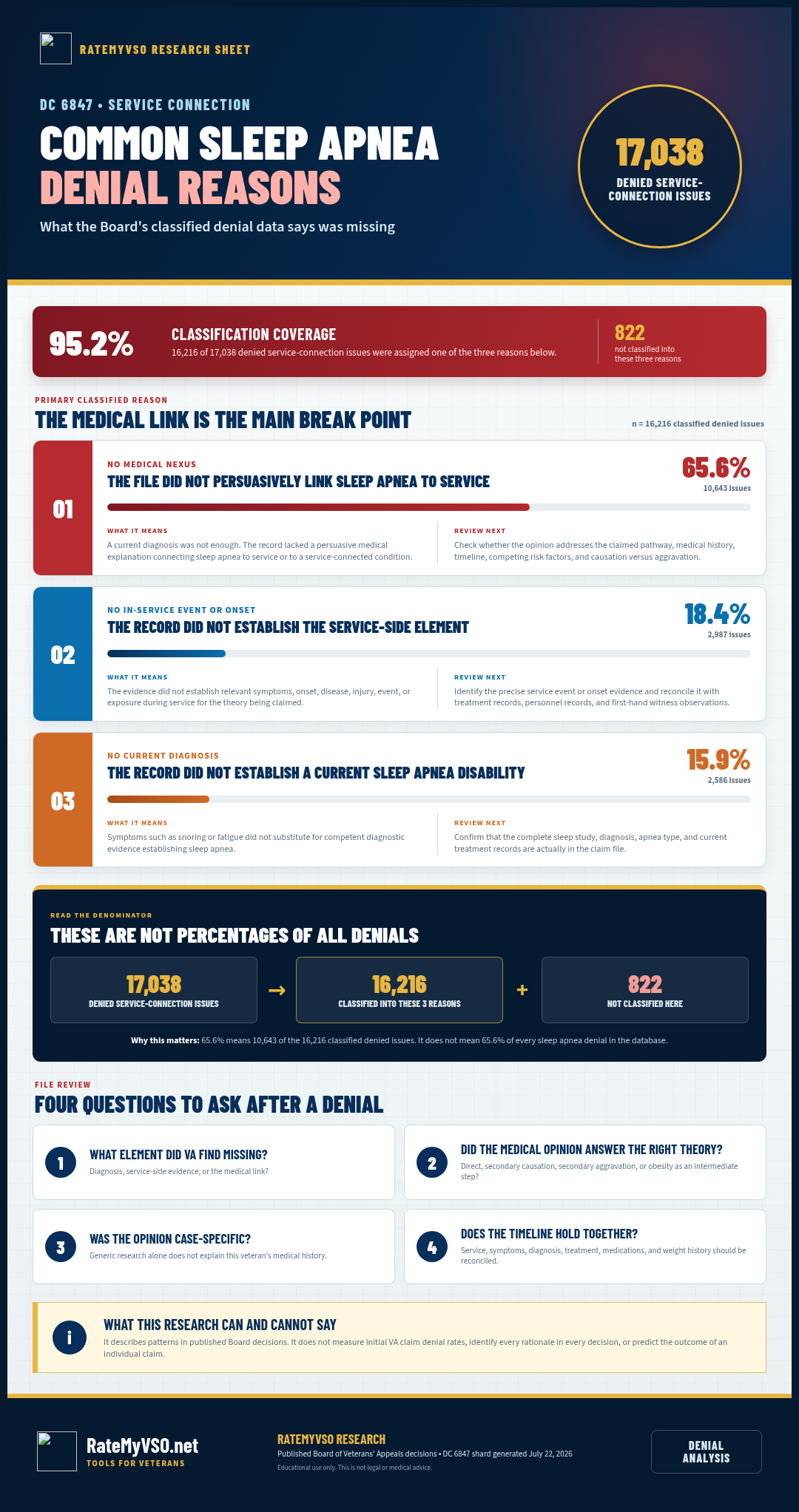
Across the Board's full record for sleep apnea, the most common denial reason is shown live below.
Secondary relationships
The Mechanism: How Tinnitus Connects to Sleep Apnea
This is the one pairing on this site where the underlying medical literature is more solid in the opposite direction than the one the claim actually argues. Read this section before you assume the science is settled.
The better-established direction runs the other way
A 2024 meta-analysis of eight studies covering 132,292 adults found severe obstructive sleep apnea correlated with tinnitus at more than twice the odds (OR 2.25) of those without severe OSA, with no significant association at mild or moderate severity. That is, the stronger, better-supported causal direction in the literature is sleep apnea causing tinnitus, through hypoxic or vibratory inner-ear damage, not the reverse. See Association Between Sleep Apnea and Tinnitus: A Meta-Analysis, Ear Nose Throat J. (2024), PMID 38321723.
What actually supports the winning theory here
The tinnitus-causes-OSA theory that wins at the Board rests on a different, thinner evidence base: studies finding elevated OSA prevalence and severity specifically within tinnitus-patient populations. See Liu et al. (2018) (correlation between obstructive sleep apnea/hypopnea syndrome and chronic tinnitus); Lai et al., Clin. Otolaryngol. (2018) (higher prevalence and severity of sleep-disordered breathing in men with chronic tinnitus); Teixeira et al., Ann. Otol. Rhinol. Laryngol. (2018) (polysomnographic findings in chronic tinnitus patients). These are correlational studies in a specific population, not a proven causal mechanism.
The proposed mechanism
Where a mechanism is stated at all, the theory is that chronic tinnitus disrupts sleep architecture and produces a state of hyperarousal, which in turn interferes with the neural control of the muscles that keep the upper airway open at night, letting them relax more easily and obstruct the airway. This is a plausible, but not settled, physiological chain.
Causation and aggravation must be addressed separately
Under Atencio v. O'Rourke, 30 Vet. App. 74 (2018), causation and aggravation are separate legal questions, and a medical opinion must treat them as such. An opinion that conflates the two, or addresses only one, is inadequate. This exact defect appears repeatedly in the VA opinions reviewed for this guide.
The "but-for" causation standard still applies
Spicer v. McDonough, 61 F.4th 1360 (Fed. Cir. 2023), the controlling recent authority, holds that secondary causation is a "but-for," multi-causal test, distinct from aggravation as a separate pathway. An opinion demanding tinnitus be the sole, isolated cause of the OSA, rather than a contributing but-for cause, has applied the wrong standard.
The Wider Data
Where sleep apnea sits among the conditions veterans claim as secondary to tinnitus. Live from the Board's published decisions, refreshed weekly:
Bars are BVA grant rates among decided issues for each condition claimed as secondary to tinnitus, with issue counts. Descriptive of the published record, not a prediction about any one claim. Explore the underlying decisions in BVA Decision Search.
Prepare and take the next step
Prepare: your own working pages
Optional. These are your own notes, in your own words. They are not a VA form, they are not sent to the VA, and nothing here is a medical finding or a prediction about your claim.
Three reminders while you prepare
- Keep the two conditions separate
Record the history, diagnosis, symptoms, and treatment for Tinnitus and Sleep Apnea separately before describing the possible relationship. Go to this part
- Ask about causing and worsening separately
A clinician may need to address whether Tinnitus caused Sleep Apnea, whether it worsened it, and what other explanations the record shows. Go to this part
- Build the timeline from records you have
Mark missing or unverified records honestly. Research from published Board decisions describes the record reviewed; it does not predict an individual claim. Go to this part
Sign in or create an account to save your answers and come back to them later. You can fill these in and print them without an account.
Two-condition timeline
Sleep Apnea: symptoms and daily function
Provider questions about the relationship
Records and unanswered questions
Decision-letter reading sheet
Quick Checklist Before You File
- A sleep study documenting your OSA diagnosis and AHI severity, ideally with more than one reading over time.
- CPAP compliance and AHI trend data, especially if you're arguing aggravation rather than causation.
- A clear decision on whether you're arguing causation, aggravation, or both, stated explicitly to your examiner or opinion writer.
- Corroborating lay statements from a spouse, family member, or service buddy describing when symptoms started and how they progressed.
- A nexus opinion citing the real tinnitus-population literature (Liu 2018, Lai 2018, Teixeira 2018), not just "commonly co-exist" language.
- Any competing risk factor (obesity, age, family history) named and addressed, ruled out or engaged, not ignored.
For the mechanics of filing itself, see the Standard Claim Guide and the Fully Developed Claim Guide.
Do's and Don'ts
A condensed version of the pattern across the five decisions and the denial rationales above.
- Decide upfront whether you're arguing causation, aggravation, or both, and make sure your nexus opinion addresses each one separately (Atencio).
- Pull your own AHI and CPAP-compliance data over time, worsening despite compliance was the strongest single piece of evidence in the strongest grant reviewed for this guide.
- Gather corroborating lay statements from a spouse or service buddy describing symptom onset and progression over years, they carried real weight alongside the medical opinion.
- Check any literature cited in your file, yours or VA's, for a directional mismatch: a study about OSA causing tinnitus symptoms does not automatically support the reverse claim.
- If obesity or another risk factor is in your file, get your opinion to affirmatively rule it out for your specific case rather than leaving it unaddressed.
- Don't assume the science is settled in your favor, the stronger, better-established literature runs the opposite direction. Build your opinion on the real tinnitus-population studies, not vague "commonly co-exist" language.
- Don't accept a VA opinion that treats causation and aggravation as one question, conflating them is an established defect under Atencio that has repeatedly failed for VA.
- Don't let a generic risk-factor list (age, obesity, craniofacial anatomy, family history) stand as though it addressed you specifically, that framing was downgraded to little or no weight in nearly every decision reviewed.
- Don't leave an intermediate-step argument (weight gain as the bridge from tinnitus-driven sleep disturbance) unaddressed, an opinion that blames weight gain in isolation without engaging that theory has been found inadequate.
- Don't assume you need an expensive specialist, one of the strongest grants in the sample ran on a 15-year treating primary care physician's opinion plus real literature.
The Claims Process, Step by Step
A secondary claim moves through the same pipeline as any other. Understanding who does what helps you know who to contact and what to expect.
- You file the claim, naming tinnitus as the service-connected primary and sleep apnea as secondary (causation, aggravation, or both). Directly with VA, through VA.gov, or with an accredited representative's help.
- VA assigns a Veteran Service Representative (VSR) to develop the claim: gather your service treatment records, sleep-study and CPAP records, and order a C&P exam if needed.
- The C&P exam is conducted, ideally with the examiner asked to address causation and aggravation as separate questions, not one conclusory statement.
- The file goes to a Rating Veteran Service Representative (RVSR), the "rater," who weighs the medical evidence and decides service connection and, if granted, the rating percentage.
- VA issues the decision letter stating the outcome and the reasoning.
- If denied or under-rated, you choose an appeal lane, Supplemental Claim, Higher-Level Review, or a Board appeal, covered below.
Who's who: VSO vs. VSR vs. Rater vs. C&P Examiner
Your VSO
An accredited representative, agent, or attorney. Not a VA employee. Helps prepare and file, and can represent you on appeal. Has no authority to decide your claim.
VSR
VA staff who develops the claim: gathers records and schedules the exam. Does not decide the rating.
Rater (RVSR)
VA staff who reviews the complete file and makes the actual decision on service connection and percentage.
C&P Examiner
Conducts the exam and, where asked, gives a nexus opinion. Does not decide the claim, but as the case dissections above show, whether the opinion engages your AHI data, your lay statements, and the causation/aggravation split separately carries real weight.
For the full walkthrough, see Inside Your Claim and Claim Stages.
DBQs and Your C&P Exam
A Disability Benefits Questionnaire (DBQ) is the standardized form the examiner completes for your condition. See the DBQ Guide for how these forms work and whether a private DBQ from your own doctor can be submitted instead of relying solely on a VA exam. For what to expect and how to prepare, see the C&P Exam Prep Guide, and be specific about your AHI trend over time, your CPAP compliance, and whether you're arguing causation, aggravation, or both; several of the decisions above turned on exactly that kind of detail being addressed head-on rather than glossed over.
Reading Your Decision Letter, and What to Do If Denied
Your decision letter has a narrative "reasons and bases" section and a codesheet with the rating and effective date. See the Reading Your Decision Letter Guide or use the Letter Interpreter tool to decode your own letter. If denied, or if the reasoning conflates causation and aggravation into one statement or leans on generic risk factors (see the discussion above), you have three main lanes:
- Supplemental Claim: refile with new and relevant evidence, such as an AHI trend, corroborating lay statements, or a nexus opinion that addresses causation and aggravation separately. See Supplemental Claim Guide.
- Higher-Level Review (HLR): a senior reviewer looks at the same evidence again, useful if the denial rested on a legal error like conflating causation and aggravation. See HLR Guide.
- Board Appeal: your case goes to a Veterans Law Judge, with a direct review, evidence, or hearing docket. See Board Appeal Guide.
Not sure which lane fits? See the Appeals decision guide for a side-by-side comparison.
After You Win: Maintaining Your Rating
Keep your sleep-study, CPAP-compliance, and AHI records current, they protect you if VA schedules a future reexamination, and the same data that won the claim is what a future rater will look at again. See Protect Your Rating for when a rating becomes protected and Future Reexaminations for what triggers one. If your sleep apnea worsens, you can file for an increased rating, see the Rating Increase Guide.
References and related resources
Frequently Asked Questions
Is it more scientifically supported that OSA causes tinnitus, or tinnitus causes OSA?
The stronger, better-established direction in the medical literature runs the other way, severe sleep apnea correlating with tinnitus, not the reverse. The theory this claim argues rests on thinner, correlational studies specifically in tinnitus-patient populations, plus a plausible but unproven neural-arousal mechanism. That's a real basis for a claim, but not a settled scientific fact.
Do I need to argue causation or aggravation, or both?
Whichever fits your facts, but address it explicitly and separately. Under Atencio v. O'Rourke, causation and aggravation are independent legal questions, and an opinion that conflates or skips one is inadequate, a recurring VA defect in the cases above.
My VA exam gave generic OSA risk factors without discussing me specifically. Is that a real denial?
Usually not a strong one. Generic risk-factor lists without individualized reasoning were downgraded to little or no weight in nearly every decision reviewed for this guide.
What if my VA opinion cites a study that actually describes the opposite direction?
Flag it. In one published grant, an opinion quoted literature about OSA causing auditory dysfunction, the reverse of the claim being argued, and used it loosely through "proximity and association" reasoning. The Board still granted on the overall balance of evidence, but a mismatched citation is worth pointing out in your own response.
Do lay statements from my spouse or a service buddy actually matter?
Yes. The most thoroughly supported grant in this sample combined real literature with corroborating statements from the veteran, a service buddy, and his wife describing progressive snoring and symptom worsening over more than 15 years.
Does weight gain ruin my claim, or can it be argued as part of the chain?
It depends on whether the weight gain itself is linked to your tinnitus. In one grant, a VA opinion blaming weight gain as an alternate cause was discounted for never addressing whether that weight gain was itself an intermediate step tied to tinnitus-driven sleep disturbance (A26016177).
Sources
- Bd. Vet. App. A26028821 (Mar. 31, 2026); A26021731 (Mar. 10, 2026); A26016177 (Feb. 23, 2026); A26008682 (Jan. 29, 2026); A25108042 (Dec. 15, 2025) (published, non-precedential).
- 38 U.S.C. §§ 1110, 5103, 5103A, 5107; 38 CFR §§ 3.102, 3.303, 3.304, 3.310, 4.97 (DC 6847), 4.87 (DC 6260).
- Allen v. Brown, 7 Vet. App. 439 (1995) (en banc); Spicer v. McDonough, 61 F.4th 1360 (Fed. Cir. 2023); Atencio v. O'Rourke, 30 Vet. App. 74 (2018); Nieves-Rodriguez v. Peake, 22 Vet. App. 295 (2008); Lynch v. McDonough, 21 F.4th 776 (Fed. Cir. 2021); Shedden v. Principi, 381 F.3d 1163 (Fed. Cir. 2004); Wallin v. West, 11 Vet. App. 509 (1998); Monzingo v. Shinseki, 26 Vet. App. 97 (2012).
- Association Between Sleep Apnea and Tinnitus: A Meta-Analysis, Ear Nose Throat J. (2024), PMID 38321723; Liu et al. (2018); Lai et al., Clin. Otolaryngol. (2018); Teixeira et al., Ann. Otol. Rhinol. Laryngol. (2018).
- Aggregate outcome counts: RateMyVSO index of published BVA decisions (as of July 2026 for the static chart; live widgets refresh weekly).