VA Hearing Loss & Tinnitus Guide
This guide explains how to file a hearing loss or tinnitus claim and how the VA evaluates it: how service connection works, how the VA tests and scores your hearing under 38 CFR § 4.85 with puretone audiometry and the Maryland CNC speech test, how tinnitus is rated separately under Diagnostic Code 6260, direct and secondary pathways, the evidence that wins, why these claims get denied, a checklist before you file, what the claims process looks like step by step, how to read your decision letter, and what to do whether you win or you're denied. You will also learn why hearing aid use does not affect your rating, how exceptional patterns of hearing loss are scored, and why tinnitus gets a single 10 percent rating whether it affects one ear or both.
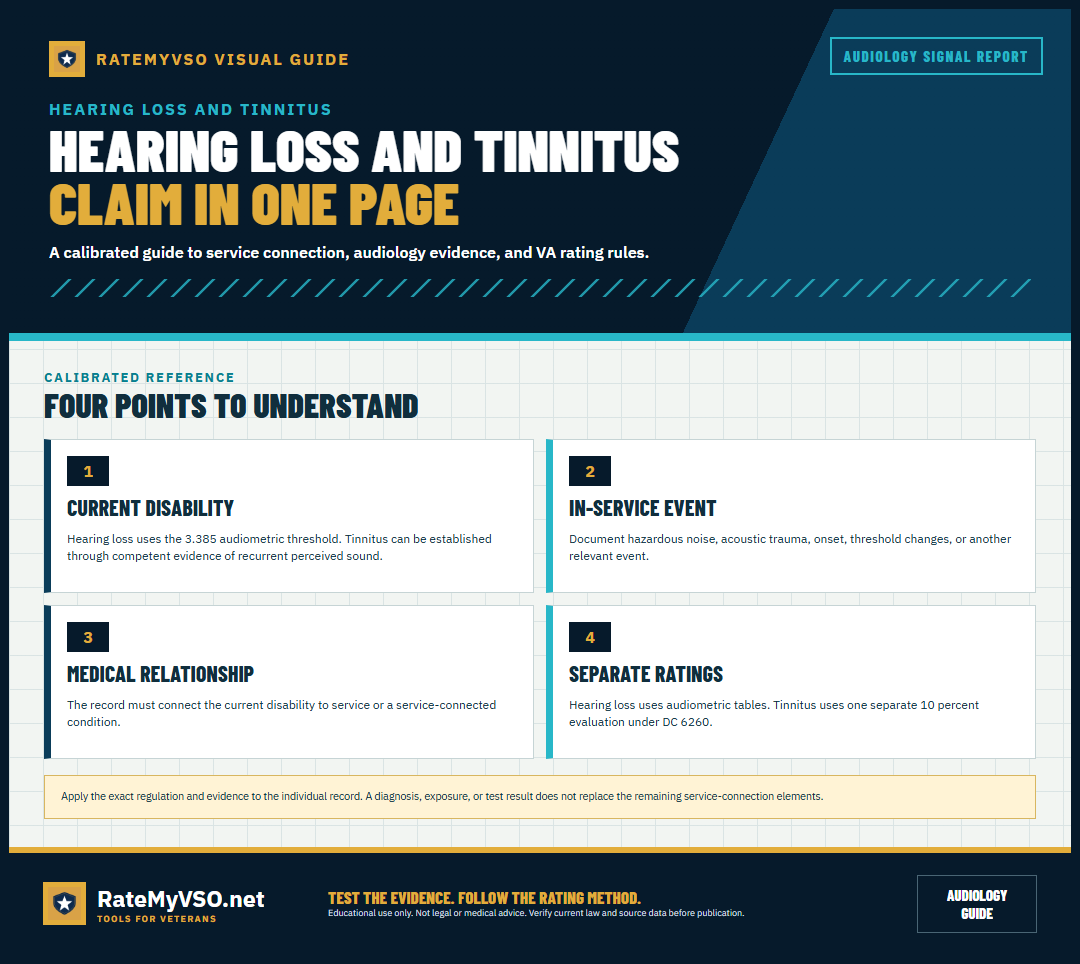 One-page guide: Hearing Loss and Tinnitus Claim in One Page
Five-part visual guide to hearing loss and tinnitus claims covering current disability, military noise, nexus evidence, required audiology tests, VA hearing tables, tinnitus rating, and a filing checklist. Opens the full-size chart, free to save or print.
One-page guide: Hearing Loss and Tinnitus Claim in One Page
Five-part visual guide to hearing loss and tinnitus claims covering current disability, military noise, nexus evidence, required audiology tests, VA hearing tables, tinnitus rating, and a filing checklist. Opens the full-size chart, free to save or print.
Start with the essentials
- 01Service Connection
The ways service connection can be established for this condition.
- 02Diagnosis and Evidence
Common symptoms and the evidence cited in published Board appeals.
- 03Your History
What you experienced, what others observed, and what treatment changed.
Understand the claim
Overview
Hearing loss and tinnitus are, together, the most commonly claimed VA disabilities: tinnitus is the single most common, and hearing loss runs a close second. Hearing loss is rated under DC 6100, which falls within 38 CFR § 4.85 and 38 CFR § 4.86 (Impairment of Auditory Acuity). Unlike most VA conditions, hearing loss ratings are not based primarily on subjective symptoms or functional limitations. They are derived from a mechanical three-step process using specific audiometric test results. Tinnitus, by contrast, is rated separately under DC 6260, 38 CFR § 4.87, at a single 10 percent rating. Tinnitus is also proved differently: because it can be observed only by the person experiencing it, a veteran's own credible report of the ringing is competent evidence that the condition exists, and no audiometric test can confirm or rule it out. That affects how the condition is established, not how likely any particular claim is to be granted.
VA's Annual Benefits Report for FY2025 counts about 5.5 million ear-category disabilities in payment status, and 69.1% of them are rated 10% while 25.3% are rated 0%. That figure is worth reading carefully before applying it to a hearing-loss claim: tinnitus alone makes up 64.7% of the category and carries a fixed 10% rating, so the pile-up at 10% mostly reflects tinnitus, not hearing acuity. The report does not publish a separate distribution for DC 6100. What the rating rules do tell you is that the percentage tracks tested acuity rather than reported difficulty: a high percentage requires audiometric evidence of severe impairment, and a service-connected hearing loss can be rated 0% when the measured thresholds and speech scores fall in the lower ranges of Table VII. Tinnitus and hearing loss are separate conditions under separate diagnostic codes; both can be service-connected and rated at the same time, and they do not pyramid.
ICD-10 Diagnosis Codes
The ICD-10 diagnosis codes most commonly used for DC 6260, Tinnitus, recurrent (the kind on your medical records, decision letter, or C&P exam report). VA rates the disability and its residuals, not the diagnosis itself, so coding can vary.
How Service Connection Works, At a High Level
Before getting into the specific tests and pathways below, it helps to understand the three things every hearing loss or tinnitus claim ultimately has to show. This is the same basic test that applies to any VA disability claim, just applied to these two conditions.
- A current diagnosis. For hearing loss, this means audiometric results meeting the thresholds in 38 CFR § 3.385. For tinnitus, this element is unusually easy: because ringing in the ears is something only the veteran can perceive, a veteran's own credible report that they currently experience it is generally enough, no clinical test can confirm or disprove tinnitus the way an audiogram confirms hearing loss.
- An in-service event, or a service-connected condition behind it. Usually in-service noise exposure (combat, weapons qualification, aircraft, machinery, or a documented MOS with a noise hazard), or a disability VA has already service-connected that caused or worsened the hearing loss or tinnitus.
- A medical nexus. A doctor's opinion, or in tinnitus's case sometimes the veteran's own competent, consistent account of continuous symptoms since service, connecting the condition to service or to the service-connected condition, and explaining the reasoning, not just stating a conclusion.
Service Connection Pathways: Direct and Secondary
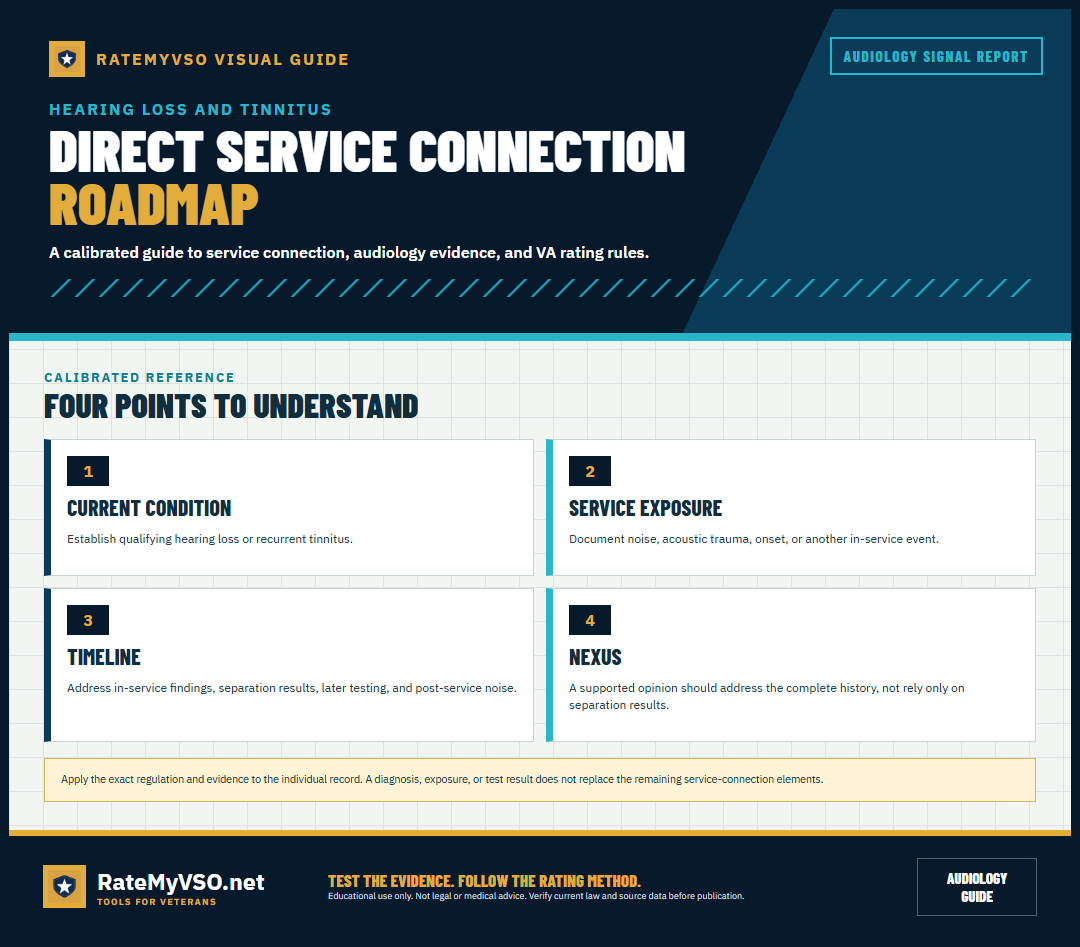 One-page guide: Direct Service Connection Roadmap
Four-step roadmap for direct hearing-loss or tinnitus service connection. Opens the full-size chart, free to save or print.
One-page guide: Direct Service Connection Roadmap
Four-step roadmap for direct hearing-loss or tinnitus service connection. Opens the full-size chart, free to save or print.
Direct Service Connection for Hearing Loss
The veteran demonstrates that hearing loss began during military service or was caused by in-service noise exposure. Noise-induced hearing loss is the most common pathway. Supporting evidence includes military occupational records, DoD Duty MOS Noise Exposure Listings (which document occupational noise hazard levels by MOS and branch), service treatment records documenting hearing complaints or in-service audiograms, and current audiometric results showing a pattern consistent with noise-induced loss (typically most pronounced at 4000 Hz, the "notch" frequency). See our Service Connection Guide.
Nexus for noise-induced hearing loss. A medical nexus opinion from a licensed audiologist or physician attributing the current hearing loss pattern to in-service noise exposure strengthens claims where the service treatment record lacks direct documentation.
Aggravation. Pre-existing hearing loss that was demonstrably worsened beyond natural progression by in-service noise exposure is ratable under 38 CFR § 3.306.
Presumptive service connection. Hearing loss is not a VA presumptive condition. Direct or aggravation pathways are required.
Threshold note. VA will not assign a compensable rating based on hearing difficulty that does not meet the audiometric thresholds in Table VII, even when the veteran credibly reports significant difficulty hearing in daily life. The rating criteria contemplate speech reception thresholds and Maryland CNC test performance only. (Lendenmann v. Principi, 3 Vet. App. 345 (1992))
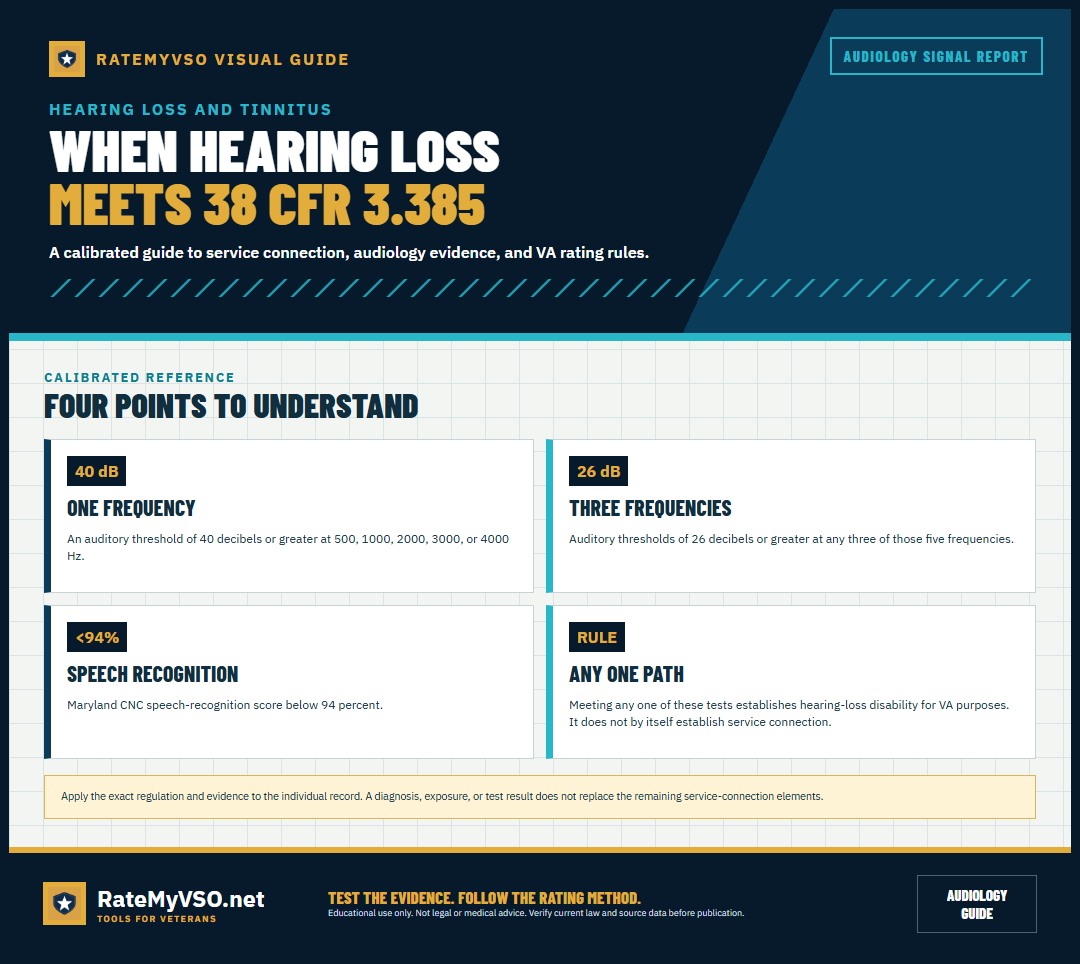
Hearing-loss SC threshold. Under 38 CFR § 3.385, hearing loss qualifies as a disability for VA purposes only when audiometric thresholds at certain frequencies meet specified decibel or speech-recognition floors. Below those floors, even a documented hearing loss is not service-connectable as a "disability" under VA standards.
Direct Service Connection for Tinnitus
Because a veteran's own credible report can establish the current diagnosis, and VA frequently concedes the in-service noise event based on a documented MOS, combat service, or weapon qualification, the pathway that most often decides a tinnitus claim is the nexus element: whether the ringing is tied to that in-service noise, either through a doctor's opinion or through the veteran's own account of symptoms that began in service and have continued ever since. Tinnitus is treated as a chronic disease of the nervous system for this purpose, so continuity of symptoms since service is itself an accepted way to prove the link.
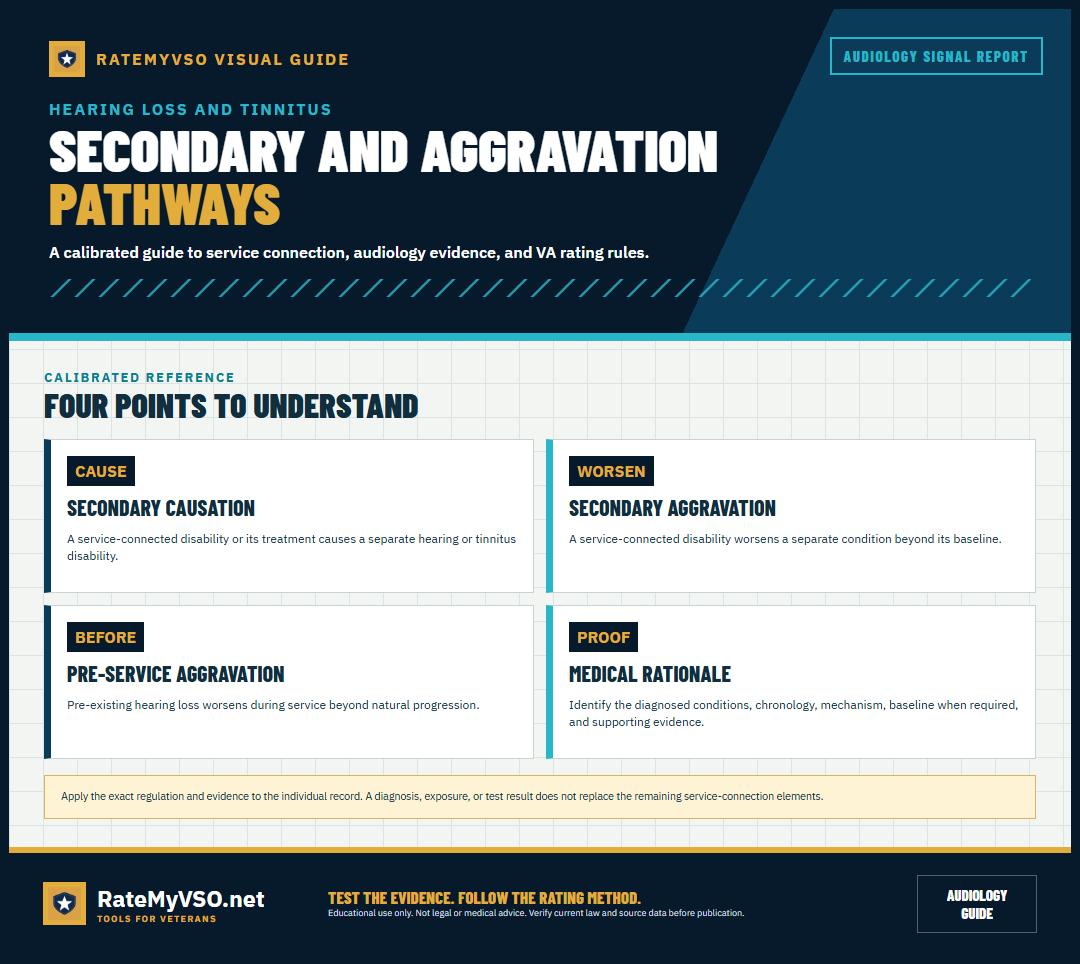 One-page guide: Secondary and Aggravation Pathways
Comparison of secondary causation, secondary aggravation, and pre-service aggravation. Opens the full-size chart, free to save or print.
One-page guide: Secondary and Aggravation Pathways
Comparison of secondary causation, secondary aggravation, and pre-service aggravation. Opens the full-size chart, free to save or print.
Secondary Service Connection (38 CFR § 3.310)
A veteran demonstrates that hearing loss or tinnitus was caused or chronically aggravated by an already service-connected condition. See our Secondary Service Connection Guide.
Documented secondary pathways for tinnitus include:
Secondary to migraines
Migraine and tinnitus share overlapping neurological pathways, and veterans with a service-connected migraine disorder have been recognized for tinnitus as a secondary condition where a medical opinion ties the two together. This is one of the highest-volume secondary pairings in the Board's published tinnitus decisions. See our dedicated Migraines Secondary to Tinnitus case dissection.
Secondary to sleep apnea
Some veterans have argued a link between service-connected sleep apnea and tinnitus, on the theory that disrupted oxygenation and sleep-cycle stress affect the auditory system. The science here is contested and the evidence is thinner than for migraines. See our honest look at the data in Sleep Apnea Secondary to Tinnitus before building a claim on this theory alone.
Secondary to hypertension
Chronic high blood pressure has been linked in some clinical literature to pulsatile and non-pulsatile tinnitus through its effect on blood flow near the inner ear. A nexus opinion for this theory should name the mechanism and address why the veteran's own hypertension history is severe or long-standing enough to plausibly affect hearing function, not just assert the link. See our DC 7101 hypertension breakdown.
Secondary to PTSD and other mental health conditions
Chronic stress and hypervigilance associated with service-connected PTSD have been raised as an aggravating factor for tinnitus perception, on the theory that stress heightens awareness of and distress from existing ringing. This pathway is more often argued as aggravation of an existing tinnitus diagnosis than as the sole cause. See our PTSD Claims Guide.
For hearing loss, the reverse direction is more commonly documented: a service-connected hearing loss aggravating a secondary mental health condition (covered in Conditions Commonly Associated below), rather than another condition causing the hearing loss itself. See the cond-bars data below for the specific conditions and grant rates the Board's published decisions actually show for each code.
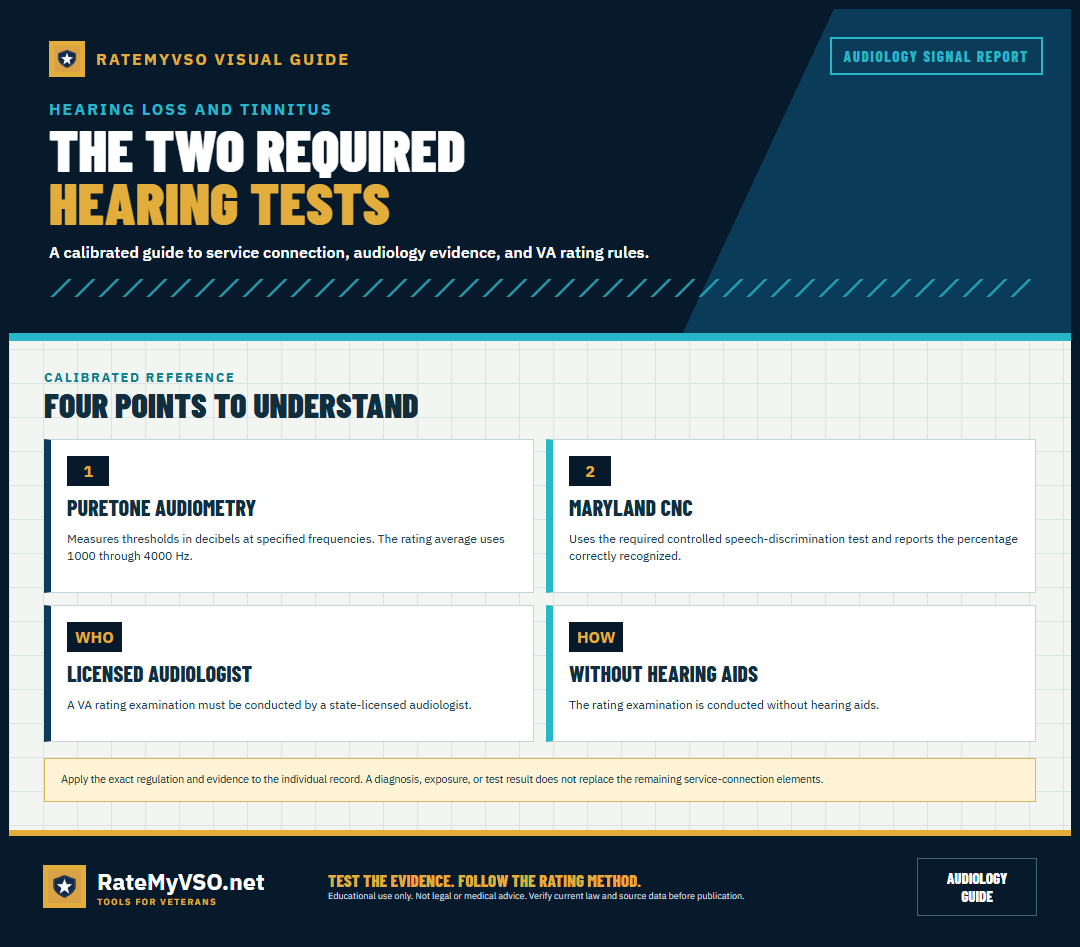
What VA Looks For: The Two Required Hearing Tests
A VA C&P examination for hearing impairment must be conducted by a state-licensed audiologist and must include both of the following tests (see 38 CFR § 4.85(a)). Examinations are conducted without the use of hearing aids.
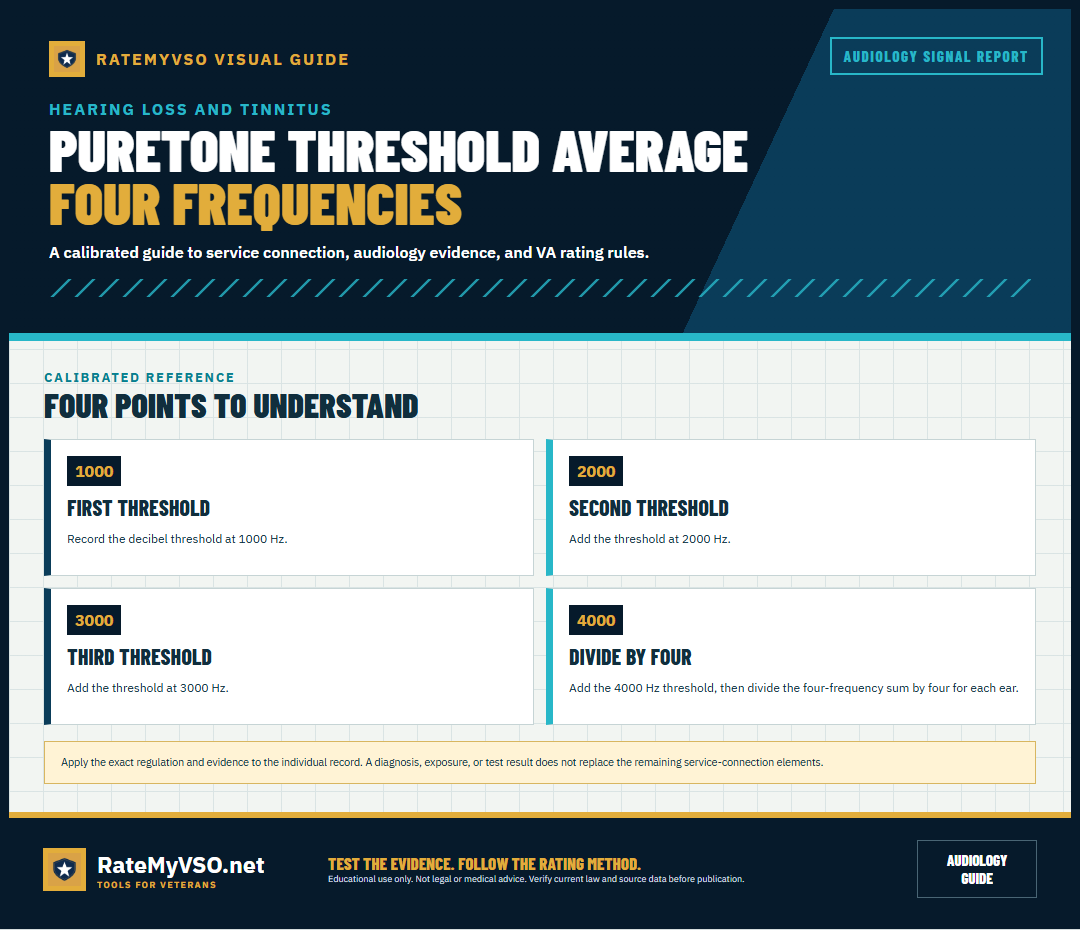 One-page guide: Puretone Average Calculation
Four-frequency calculation for the puretone threshold average in each ear. Opens the full-size chart, free to save or print.
One-page guide: Puretone Average Calculation
Four-frequency calculation for the puretone threshold average in each ear. Opens the full-size chart, free to save or print.
Test 1: Puretone Audiometry
Puretone audiometry measures the softest sounds a veteran can detect at specific frequencies. VA tests at four frequencies: 1000 Hz, 2000 Hz, 3000 Hz, and 4000 Hz. Results are recorded in decibels (dB), representing the lowest volume at which the veteran detected a tone at each frequency.
The Puretone Threshold Average (PTA) is calculated for each ear by adding the threshold values at 1000, 2000, 3000, and 4000 Hz and dividing by four. This single average number represents each ear's overall sensitivity loss and is one of the two inputs into Table VI.
Higher decibel values mean worse hearing. A PTA of 20 dB represents near-normal hearing. A PTA of 70 dB represents severe hearing loss.
Test 2: Maryland CNC Speech Discrimination Test
The Maryland CNC (Consonant-Nucleus-Consonant) test measures speech recognition ability. The audiologist presents a recorded list of 50 phonetically balanced, monosyllabic words at a calibrated volume. The veteran repeats each word as heard. The percentage of correctly identified words is the speech discrimination score.
Important: CID W-22 and NU-6 word lists are not Maryland CNC tests. A private audiology report using those tests is not an acceptable C&P substitution for determining the rating under 38 CFR § 4.85, although the decibel data from such exams may be usable under the exceptional pattern provisions of 38 CFR § 4.86 when the speech recognition component is not available.
The diagnostic codes involved: DC 6100 for hearing loss and DC 6260 for tinnitus, plus whatever code applies to a condition you're connecting either of them to secondarily, for example DC 9434 (depression), DC 9400 (anxiety), or DC 6204 (peripheral vestibular disorders).
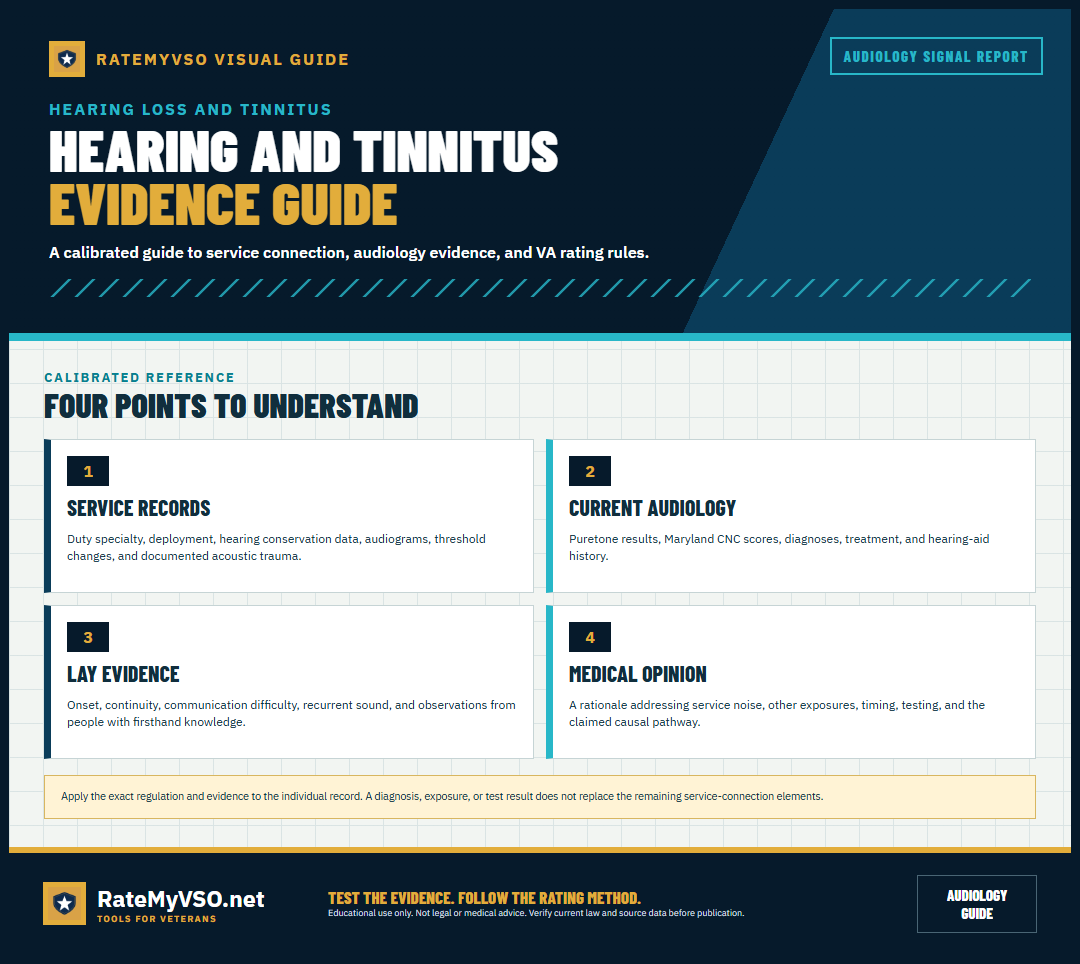 One-page guide: Hearing and Tinnitus Evidence Guide
Service records, audiology, lay evidence, and medical-opinion evidence for hearing claims. Opens the full-size chart, free to save or print.
One-page guide: Hearing and Tinnitus Evidence Guide
Service records, audiology, lay evidence, and medical-opinion evidence for hearing claims. Opens the full-size chart, free to save or print.
Bilateral vs. Unilateral Service Connection
When hearing loss is service-connected in both ears, both ears enter Table VII and combine into a single bilateral rating. When only one ear is service-connected, the non-service-connected ear is assigned Roman Numeral I (most favorable baseline) before Table VII is applied. This protects against veterans being penalized for having one serviceable ear.
A separate rule addresses the evaluation of disabilities in paired organs and extremities and may apply when one ear is entirely unaffected (see 38 CFR § 3.383).
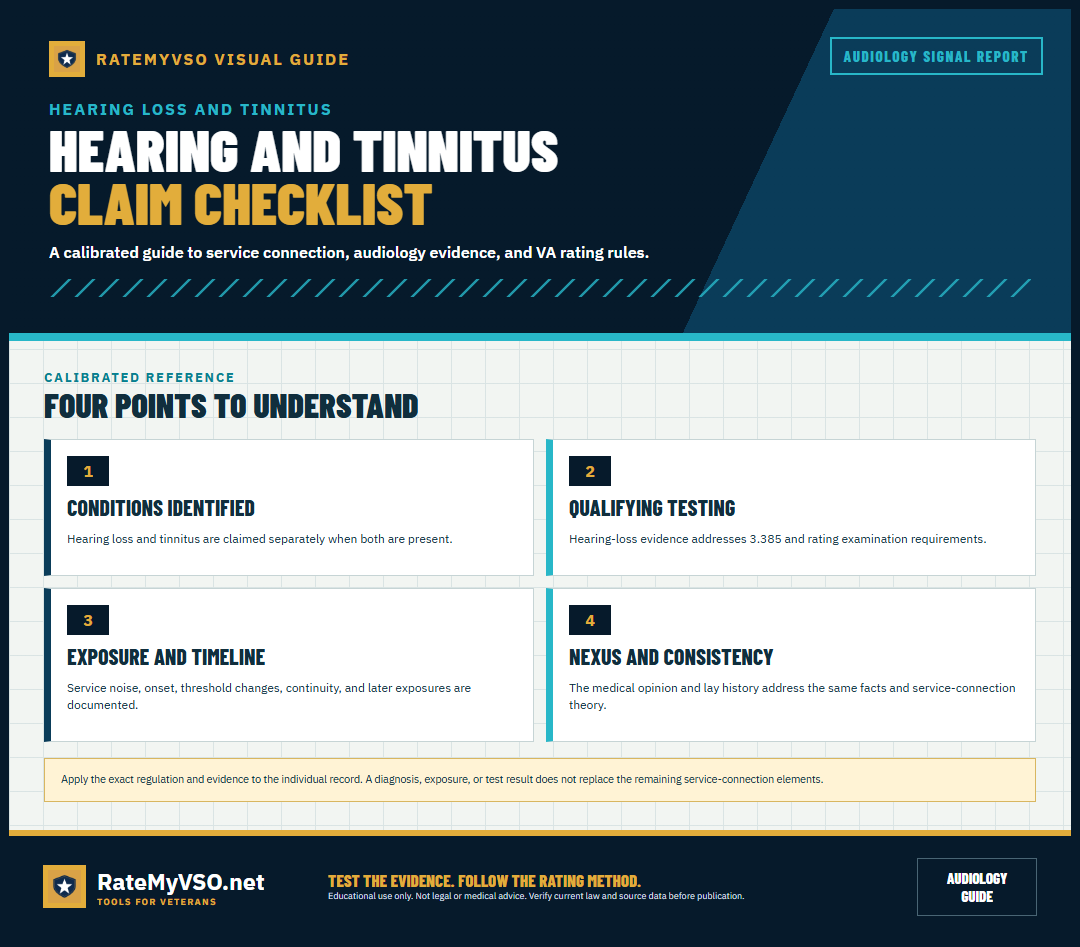 One-page guide: Hearing Loss and Tinnitus Claim Checklist
Four-part completeness check for hearing-loss and tinnitus claims. Opens the full-size chart, free to save or print.
One-page guide: Hearing Loss and Tinnitus Claim Checklist
Four-part completeness check for hearing-loss and tinnitus claims. Opens the full-size chart, free to save or print.
Symptoms and rating
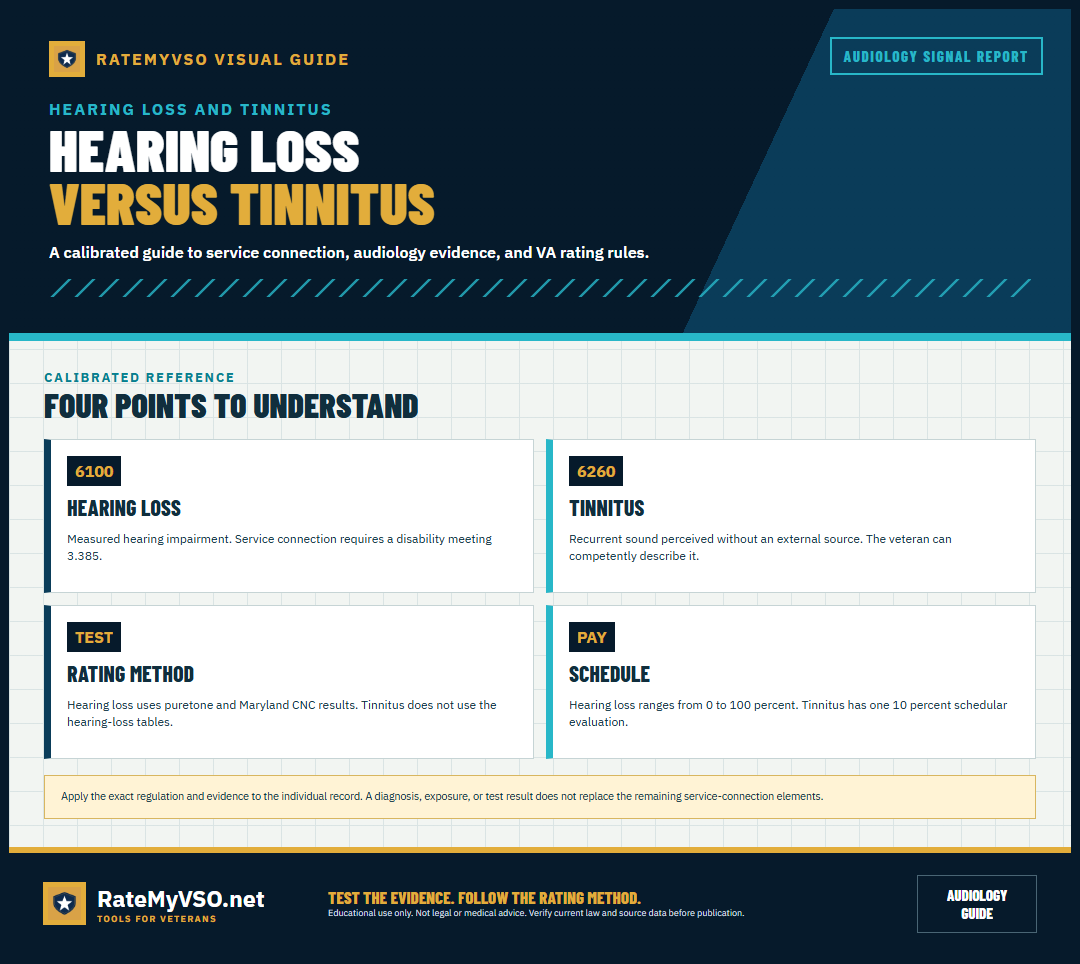 One-page guide: Hearing Loss vs Tinnitus
Comparison of DC 6100 hearing loss and DC 6260 tinnitus. Opens the full-size chart, free to save or print.
One-page guide: Hearing Loss vs Tinnitus
Comparison of DC 6100 hearing loss and DC 6260 tinnitus. Opens the full-size chart, free to save or print.
Exceptional Patterns of Hearing Loss
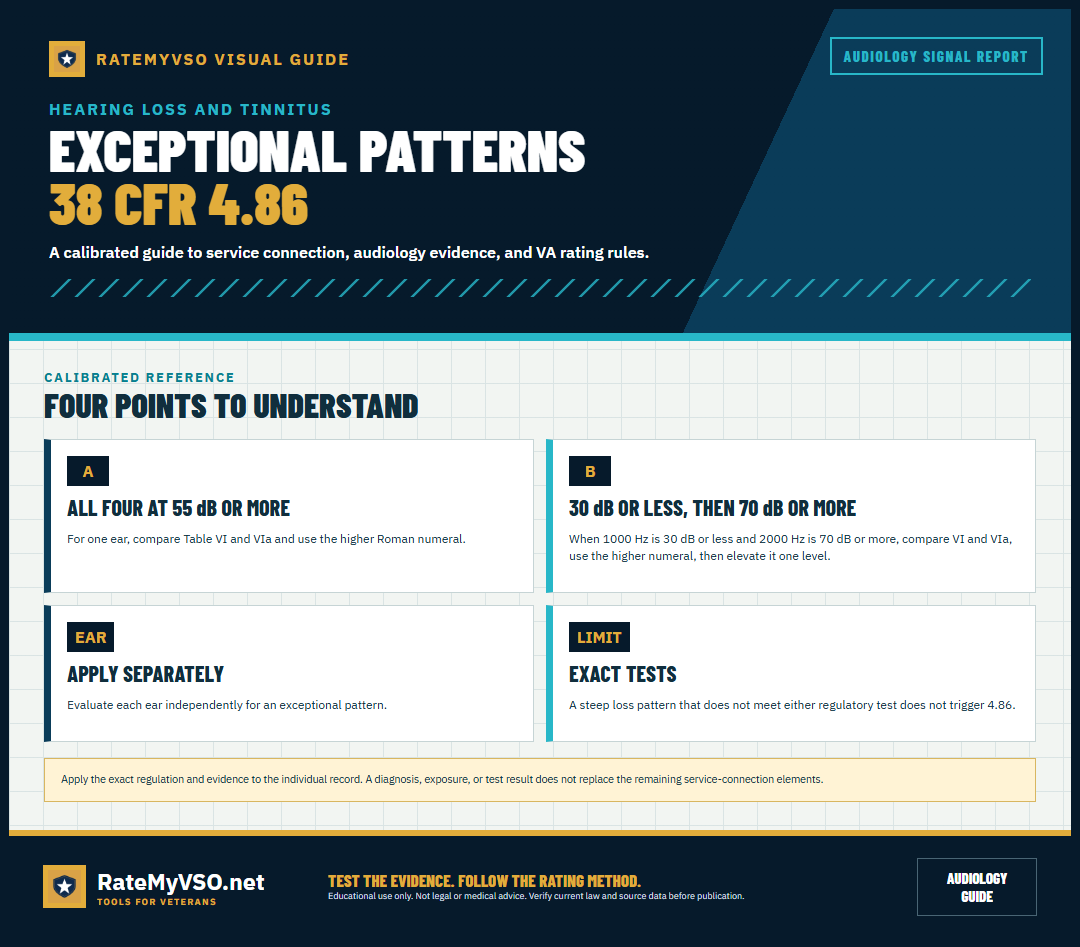
When certain extreme audiometric patterns exist, the standard Table VI formula may underrepresent the severity of hearing loss. Two exceptional patterns trigger modified evaluation procedures (see 38 CFR § 4.86).
Exceptional Pattern 1: High-Frequency Severe Loss
When the puretone threshold at each of the four tested frequencies (1000, 2000, 3000, and 4000 Hz) is 55 decibels or more in one ear, the rating specialist determines the Roman numeral from both Table VI and Table VIa and uses whichever produces the higher (more favorable to the veteran) numeral for that ear. (38 CFR § 4.86(a))
Exceptional Pattern 2: Sharp High-Frequency Drop
When the puretone threshold at 1000 Hz is 30 dB or less AND the threshold at 2000 Hz is 70 dB or more, the rating specialist determines the Roman numeral from both Table VI and Table VIa and then elevates the resulting numeral to the next higher Roman numeral. (38 CFR § 4.86(b))
When Table VIa applies instead of Table VI: Table VIa uses only the PTA (not the speech discrimination score) to assign a Roman numeral. The examiner certifies that the speech discrimination test is not appropriate, typically due to language difficulties or inconsistent speech discrimination scores. Table VIa is also used in the exceptional pattern analysis described above when it produces a more favorable result than Table VI.
Why Hearing Aid Use Does Not Affect the Rating
All hearing examinations for VA purposes are conducted without the use of hearing aids (see 38 CFR § 4.85(a)). This prevents the corrected hearing level from masking the underlying disability. A veteran who functions normally with hearing aids may still have severe hearing loss that produces a significant rating under the unaided audiometric results.
A related consequence: a veteran whose hearing is adequately corrected with aids and who therefore shows minimal symptoms in daily life may still hold a 10% or higher rating based on unaided test results. The VA rating reflects the organic impairment, not the corrected functional level.
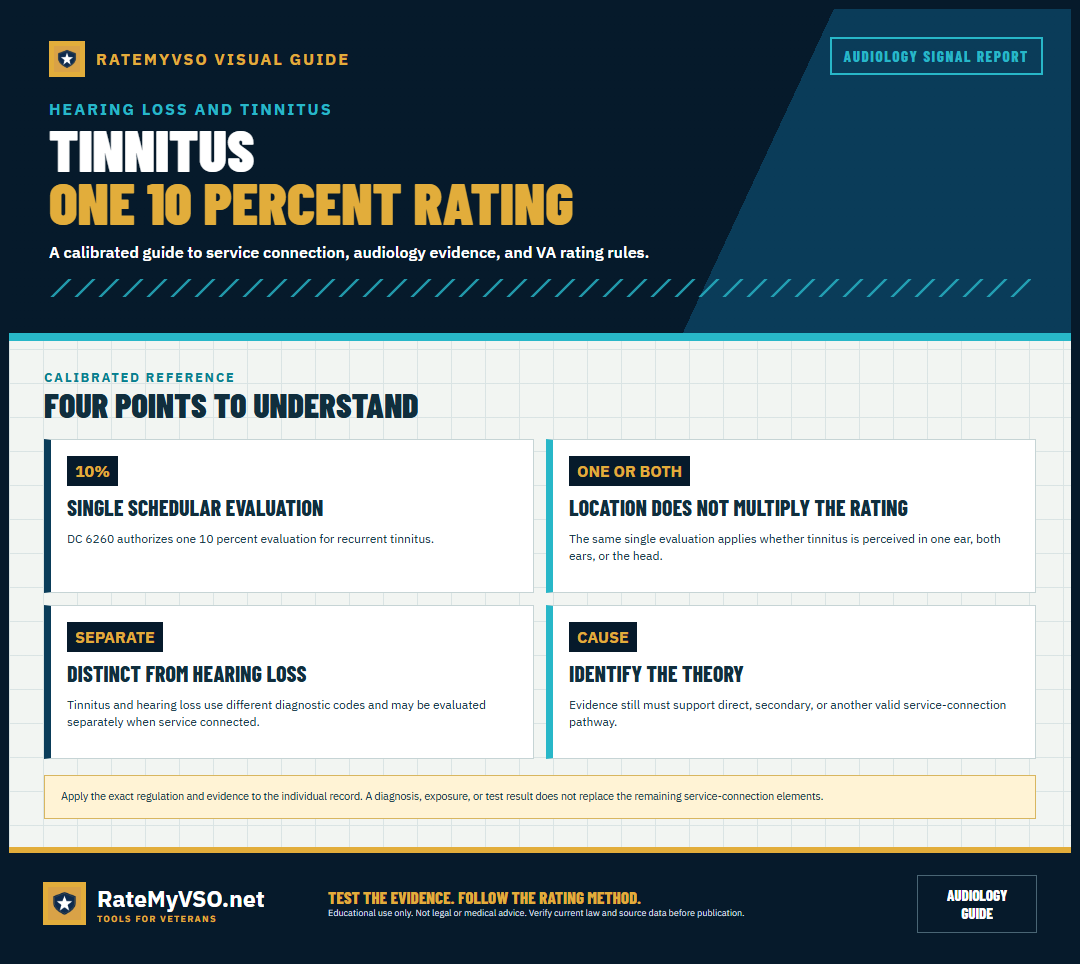 One-page guide: Tinnitus Rating Guide
Explanation of the single 10 percent schedular rating for recurrent tinnitus. Opens the full-size chart, free to save or print.
One-page guide: Tinnitus Rating Guide
Explanation of the single 10 percent schedular rating for recurrent tinnitus. Opens the full-size chart, free to save or print.
Tinnitus Rated Separately as DC 6260
Tinnitus (ringing or other persistent sounds in the ears without an external source) is the most commonly rated VA disability. It is rated separately from hearing loss under DC 6260, 38 CFR § 4.87. There is no higher schedular rating for tinnitus under DC 6260.
Tinnitus and hearing loss can both be service-connected and rated simultaneously. They are separate conditions under separate diagnostic codes and do not pyramid. See our Pyramiding Guide for more.
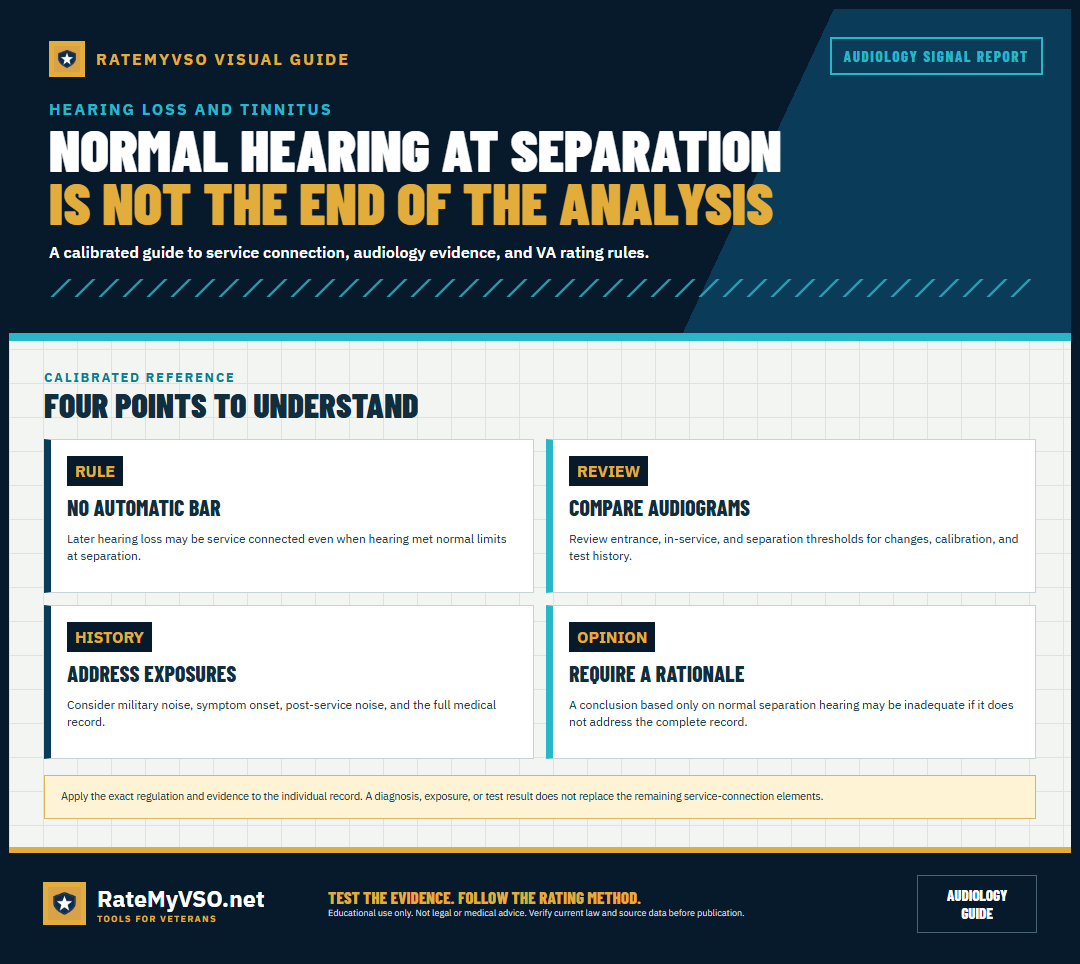 One-page guide: Normal Hearing at Separation
Why normal hearing at separation does not automatically bar later service connection. Opens the full-size chart, free to save or print.
One-page guide: Normal Hearing at Separation
Why normal hearing at separation does not automatically bar later service connection. Opens the full-size chart, free to save or print.
Evidence and Board research
Evidence That Wins These Claims
We analyzed the Board's published decisions and found a private medical opinion is high-yield evidence for both conditions. The bars below compare the grant rate when the file has a private opinion against when it does not, refreshed weekly.
DC 6100 (Hearing Loss)
DC 6260 (Tinnitus)
Audiogram and Maryland CNC results: For hearing loss, the puretone thresholds and speech discrimination score are the foundational evidence; without them VA cannot assign any rating under DC 6100.
Documented noise exposure: Military occupational records, the DoD MOS noise exposure listings, combat service, and weapon qualification badges all support the in-service event for both conditions.
A threshold shift in service. A measurable change between an entrance hearing test and a later in-service test is strong objective evidence of an in-service injury. Even a single in-service note of ringing or hearing complaints can help establish onset.
Consistency of your account. A tinnitus claim in particular can be won largely on the veteran's own competent, believable testimony that the ringing began in service and never stopped. Because tinnitus can be observed only by the person experiencing it, that consistency across every statement and exam carries real weight, and a VA examiner may not reject the account solely because service records are silent on the issue.
Nexus opinion: For secondary claims and for hearing loss claims lacking an in-service audiogram, a medical opinion from a treating provider or qualified clinician explaining the causal or aggravating relationship is the clearest path to a grant when it spells out how the connection works and applies the reasoning to your own facts, rather than a bare conclusion with no rationale. See our Nexus Letters Guide.
Lay statements: First-person descriptions of when symptoms began and how they've progressed, along with statements from people who served alongside you who observed you complaining of ringing or hearing difficulty, contribute to the record. Tinnitus symptoms are the kind of thing lay evidence is competent to establish because they come through the senses and require no specialized medical knowledge. See our Buddy & Lay Statements Guide.
Evidence Cited in Published Hearing loss Decisions
We analyzed 163,265 published Board decisions involving hearing loss for condition-specific evidence, counting only case-specific mentions (boilerplate recitations excluded). "Favorable" is the share of decisions citing that evidence where every issue was granted or the outcome was mixed; the baseline across all these decisions is 57%. Evidence appearing in a decision does not mean it decided the case. Descriptive of the published record, not a prediction.
Bar length shows decisions citing the evidence.
Evidence Cited in Published Tinnitus Decisions
We analyzed 94,954 published Board decisions involving tinnitus for condition-specific evidence, counting only case-specific mentions (boilerplate recitations excluded). "Favorable" is the share of decisions citing that evidence where every issue was granted or the outcome was mixed; the baseline across all these decisions is 65%. Evidence appearing in a decision does not mean it decided the case. Descriptive of the published record, not a prediction.
Bar length shows decisions citing the evidence.
Detected by phrase-reading the decision text with condition-specific vocabularies. Source: Board of Veterans' Appeals decisions, RateMyVSO analysis.
Board Grants, Dissected
The Board decisions below all involve veterans seeking direct service connection for tinnitus. Each case shows the Board granting the claim based on a combination of conceded in-service noise exposure, a current tinnitus diagnosis, and credible lay statements about when the ringing started. In several cases the Board found the VA examiner's negative opinion inadequate or unpersuasive, even though these decisions are not binding precedent and each case turns on its own facts.
Lay statements about in-service onset outweighed two inadequate VA opinions Citation A26039420 (April 28, 2026), Hearing docket
The record: The veteran served in the Army from 1980 to 2006 and reported tinnitus onset after being around artillery fire for six hours a day, often without hearing protection. A VA examiner in October 2012 relied on a noise manual stating tinnitus rarely occurs without hearing loss, and concluded the veteran's tinnitus was not related to service. A second VA examiner in July 2021 conceded noise exposure but found no nexus because hearing stayed within normal limits throughout service.
Why it won: The Board found both VA opinions inadequate because neither examiner explained why tinnitus without hearing loss would not apply to this veteran, and the absence of documented hearing loss in service is not fatal to a tinnitus claim. The Board found the veteran competent and credible in describing onset and continuity of tinnitus since service, and resolved reasonable doubt in his favor.
Competing VA opinions found in approximate balance Citation A26039407 (April 28, 2026), Evidence Submission docket
The record: The veteran served from 1992 to 1995 and 2009 to 2010, with noise exposure conceded based on his fuels journeyman job. A September 2023 VA examiner found tinnitus at least as likely as not related to noise exposure. A January 2025 VA examiner found the opposite, relying on the lack of a significant hearing threshold shift in service.
Why it won: The Board found the veteran competently and credibly described tinnitus beginning in service and continuing since, clarifying that an examiner's note of a later onset date actually reflected when he first sought treatment, not when symptoms began. The Board found the negative January 2025 opinion of lesser value partly because the record lacked entrance and separation exams for his second period of service.
Board rejected examiner's demand for a sole cause Citation A26039337 (April 28, 2026), Direct Review docket
The record: The veteran served in the Army from 1967 to 1970 as a helicopter repairman, with noise exposure conceded. A VA audiologist diagnosed tinnitus and hearing loss but gave a negative opinion, reasoning that service treatment records did not show tinnitus within a year of separation and that "delayed onset tinnitus is not consistent with acoustic trauma."
Why it won: The Board found the examiner's reasoning flawed because tinnitus does not need to be diagnosed within a year of service to be service connected, and the law does not require noise exposure to be the sole cause of tinnitus. The Board found the veteran's lay statements about onset and continuity credible and consistent with his military duties, and declined to remand for another opinion because that would only serve to help deny the claim.
Tinnitus granted alongside back and neck strains built on the same theory Citation A26039270 (April 28, 2026), Hearing docket (missed hearing)
The record: The veteran served in the Navy from 1989 to 1992 as an electronic/mechanical equipment repairman. A VA examiner diagnosed tinnitus but gave a negative opinion based on "no decreased hearing" and no in-service complaints of tinnitus in his records.
Why it won: The Board called the examiner's rationale flawed, explaining that hearing loss and tinnitus are separate and distinct disabilities, so hearing loss does not need to be shown to service connect tinnitus. The Board wrote, "a persistence of symptoms since service may be sufficient to establish a causal link (nexus), absent clear and convincing medical evidence to the contrary. A lack of medical evidence is not clear and convincing." The veteran's lay testimony of gradual, increasing tinnitus since service satisfied the nexus element.
Multiple grants stemming from conceded noise and credible reports of continuity Citation A26039198 (April 27, 2026), Direct Review docket
The record: The veteran served in the Army as a cannon crewmember from 1986 to 1990. A June 2024 VA examiner conceded high probability of noise exposure but found tinnitus less likely than not related to service because there was no "objectively verifiable noise injury" shown by threshold shifts. A second February 2025 exam was given no weight because the examiner failed to even note a tinnitus diagnosis despite the veteran's known history.
Why it won: The Board found the veteran's report that his tinnitus began in basic training and never went away to be competent and credible. It applied the chronic disease presumption for organic diseases of the nervous system, finding that once tinnitus is shown as chronic in service, later manifestations remain service connected absent evidence of an intercurrent cause. No such intercurrent cause was shown here.
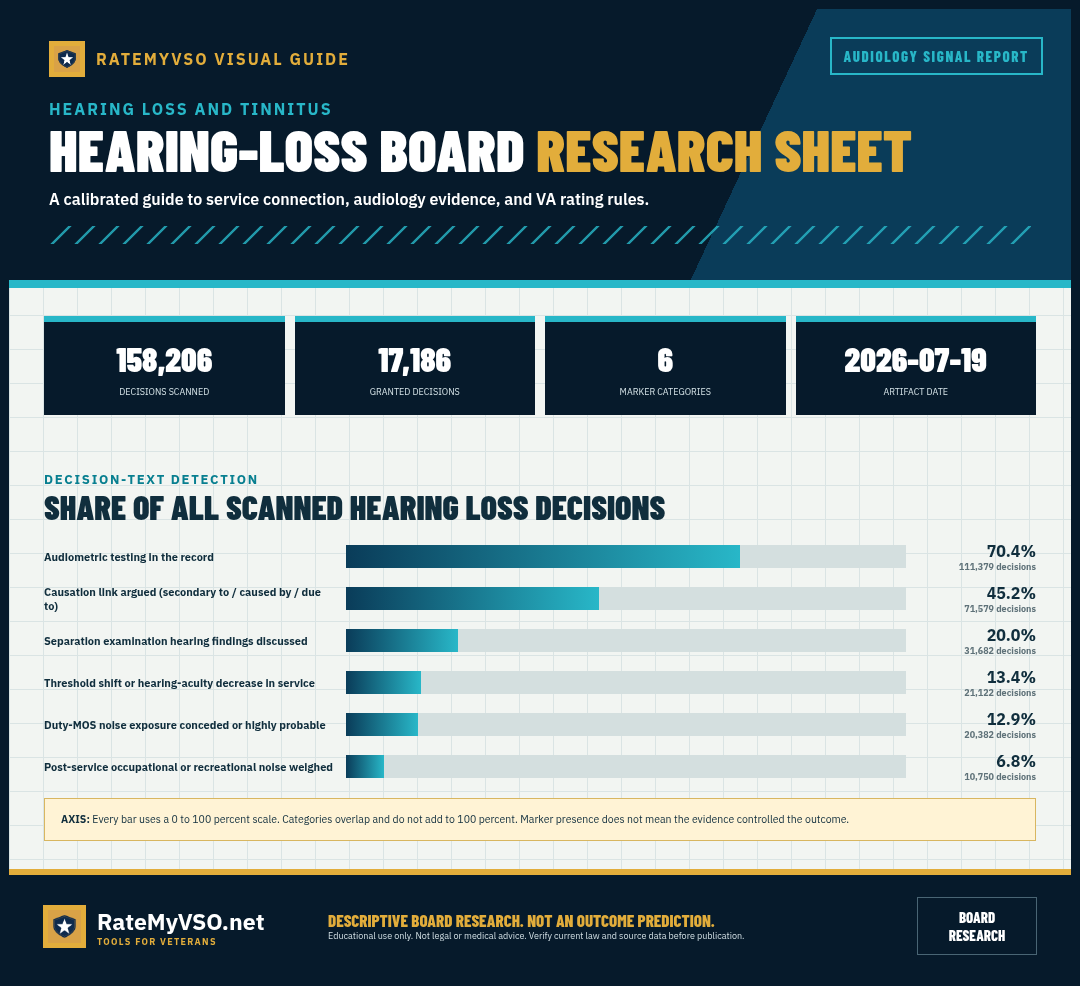 One-page guide: Hearing-Loss Board Research Sheet
Frequency of six evidence markers across 163,265 scanned hearing-loss Board decisions. Opens the full-size chart, free to save or print.
One-page guide: Hearing-Loss Board Research Sheet
Frequency of six evidence markers across 163,265 scanned hearing-loss Board decisions. Opens the full-size chart, free to save or print.
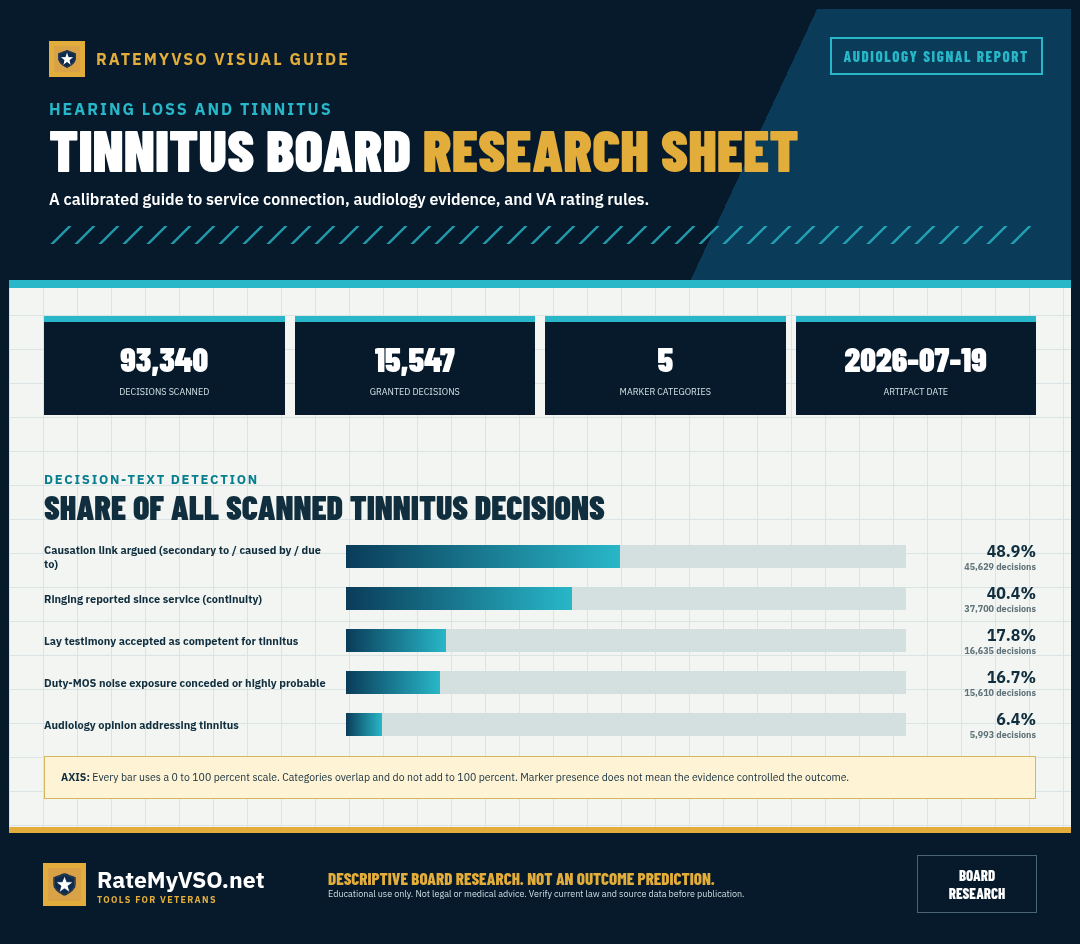 One-page guide: Tinnitus Board Research Sheet
Frequency of five evidence markers across 94,954 scanned tinnitus Board decisions. Opens the full-size chart, free to save or print.
One-page guide: Tinnitus Board Research Sheet
Frequency of five evidence markers across 94,954 scanned tinnitus Board decisions. Opens the full-size chart, free to save or print.
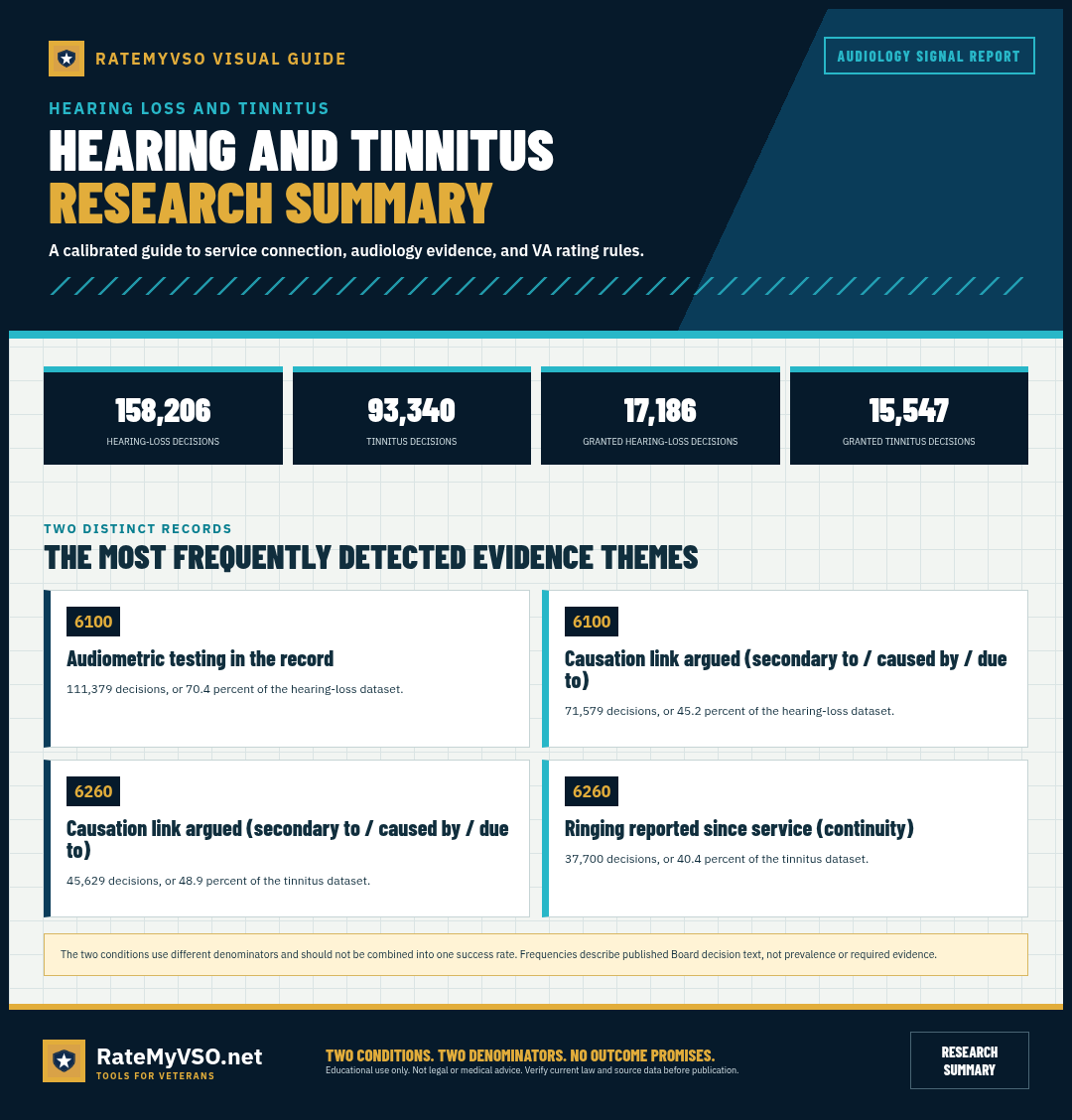 One-page guide: Hearing and Tinnitus Research Summary
Separate dataset sizes and frequently detected evidence themes: 163,265 hearing-loss and 94,954 tinnitus Board decisions, never pooled. Opens the full-size chart, free to save or print.
One-page guide: Hearing and Tinnitus Research Summary
Separate dataset sizes and frequently detected evidence themes: 163,265 hearing-loss and 94,954 tinnitus Board decisions, never pooled. Opens the full-size chart, free to save or print.
Why These Claims Get Denied
Beyond the normal-audiogram rationale covered above, a few specific denial patterns show up often enough in the Board's published hearing loss and tinnitus decisions to call out on their own.
- An onset story that shifts between statements. The single fastest way to lose a tinnitus claim is inconsistency about when the ringing started. Claims have been denied where a veteran reported service onset to one provider, an earlier decade to an exam, and a different year still later; the shifting account itself undercuts credibility. Keep your onset date the same everywhere you report it.
- Denying ear trouble at separation, then claiming it years later. If a veteran denied ear problems on a separation exam, or told a provider the ringing was recent, that contemporaneous record usually outweighs a later claim that it started in service. A documented denial or a recent-onset statement close in time to service carries more weight than a recollection offered years afterward.
- A confirmed diagnosis with no connection to service. Having tinnitus or hearing loss, even a clearly documented case, is not enough by itself. A long gap with no complaints after service, and no military occupational record supporting noise exposure, weighs against the claim.
- A private nexus opinion that ignores the veteran's own unfavorable history. A private letter carries little weight if it skips over records that cut against the claim, for example a documented recent onset, or an assumption of no civilian noise exposure that the record contradicts. An opinion that is internally inconsistent about the onset date is discounted the same way.
- Ignoring post-service noise and family history. Civilian noise exposure and a family history of hearing loss can explain a current diagnosis instead of service. Address these facts directly in your evidence rather than leaving them for the examiner to raise against you.
- Confusing a higher rating with winning service connection. Tinnitus is capped at a single 10 percent rating regardless of how many ears are affected. Appeals asking for a rating above that cap are denied as a matter of law; that is a separate question from whether service connection itself is granted.
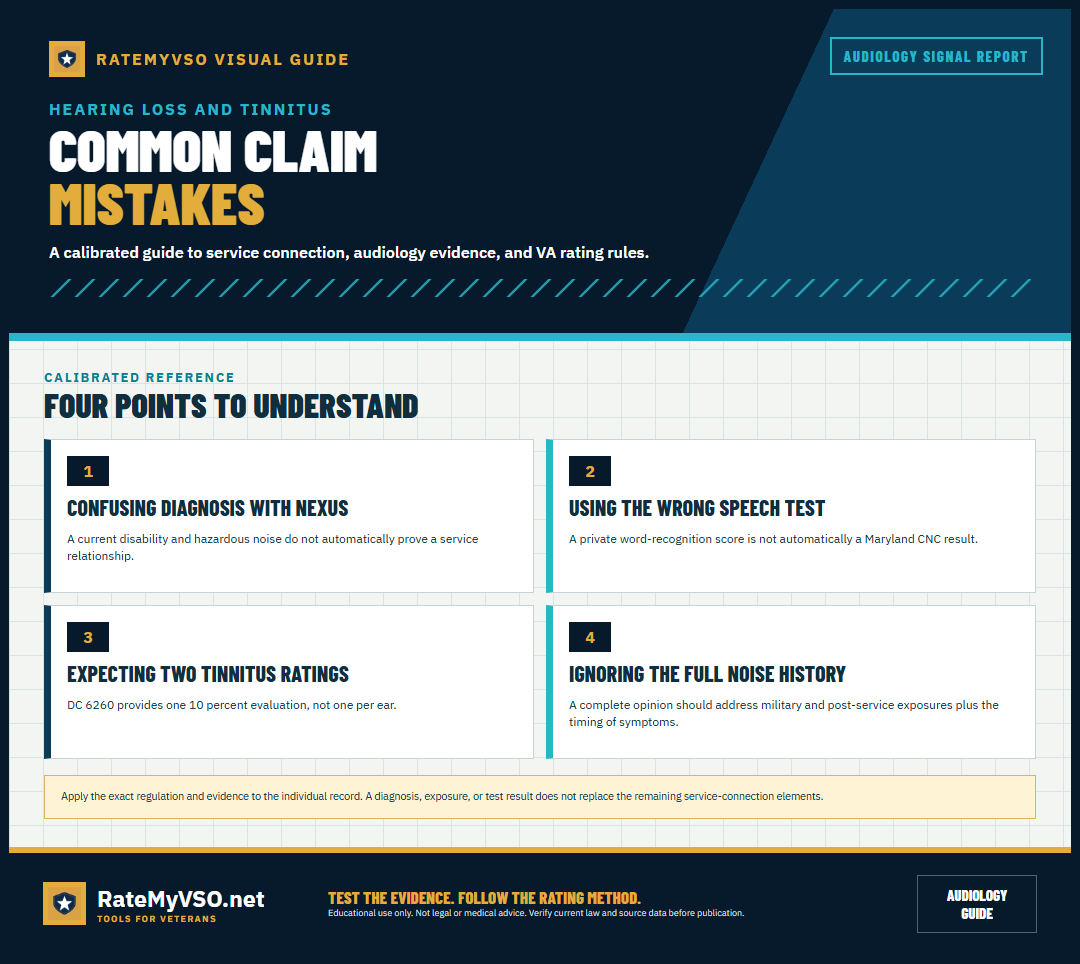 One-page guide: Common Hearing and Tinnitus Claim Mistakes
Common mistakes involving nexus, speech tests, tinnitus ratings, and noise history. Opens the full-size chart, free to save or print.
One-page guide: Common Hearing and Tinnitus Claim Mistakes
Common mistakes involving nexus, speech tests, tinnitus ratings, and noise history. Opens the full-size chart, free to save or print.
Common Mistakes
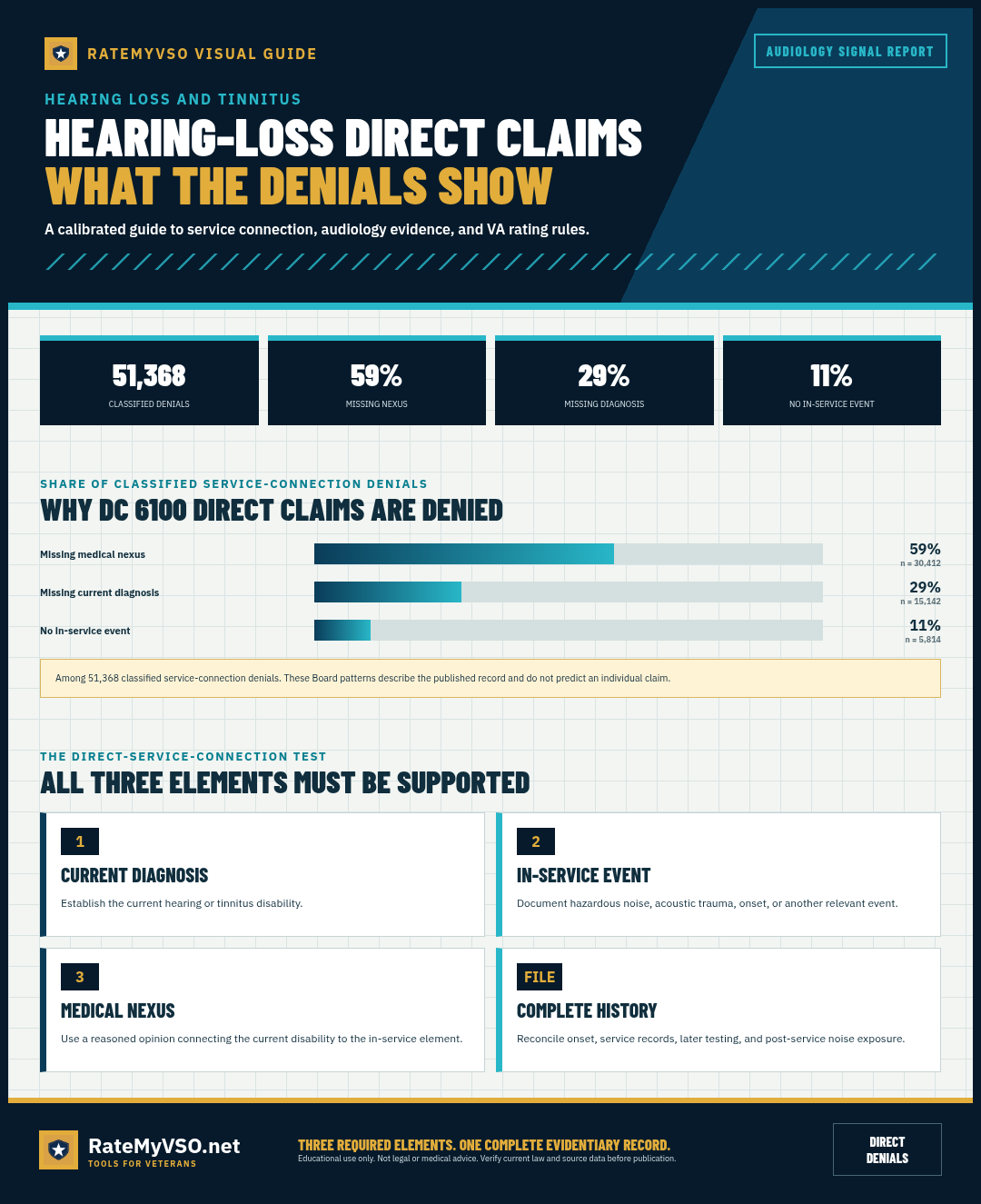 One-page guide: Hearing-Loss Direct-Claim Denials
50,219 classified hearing-loss service-connection denials split by the missing element, with the three required direct-claim elements. Opens the full-size chart, free to save or print.
One-page guide: Hearing-Loss Direct-Claim Denials
50,219 classified hearing-loss service-connection denials split by the missing element, with the three required direct-claim elements. Opens the full-size chart, free to save or print.
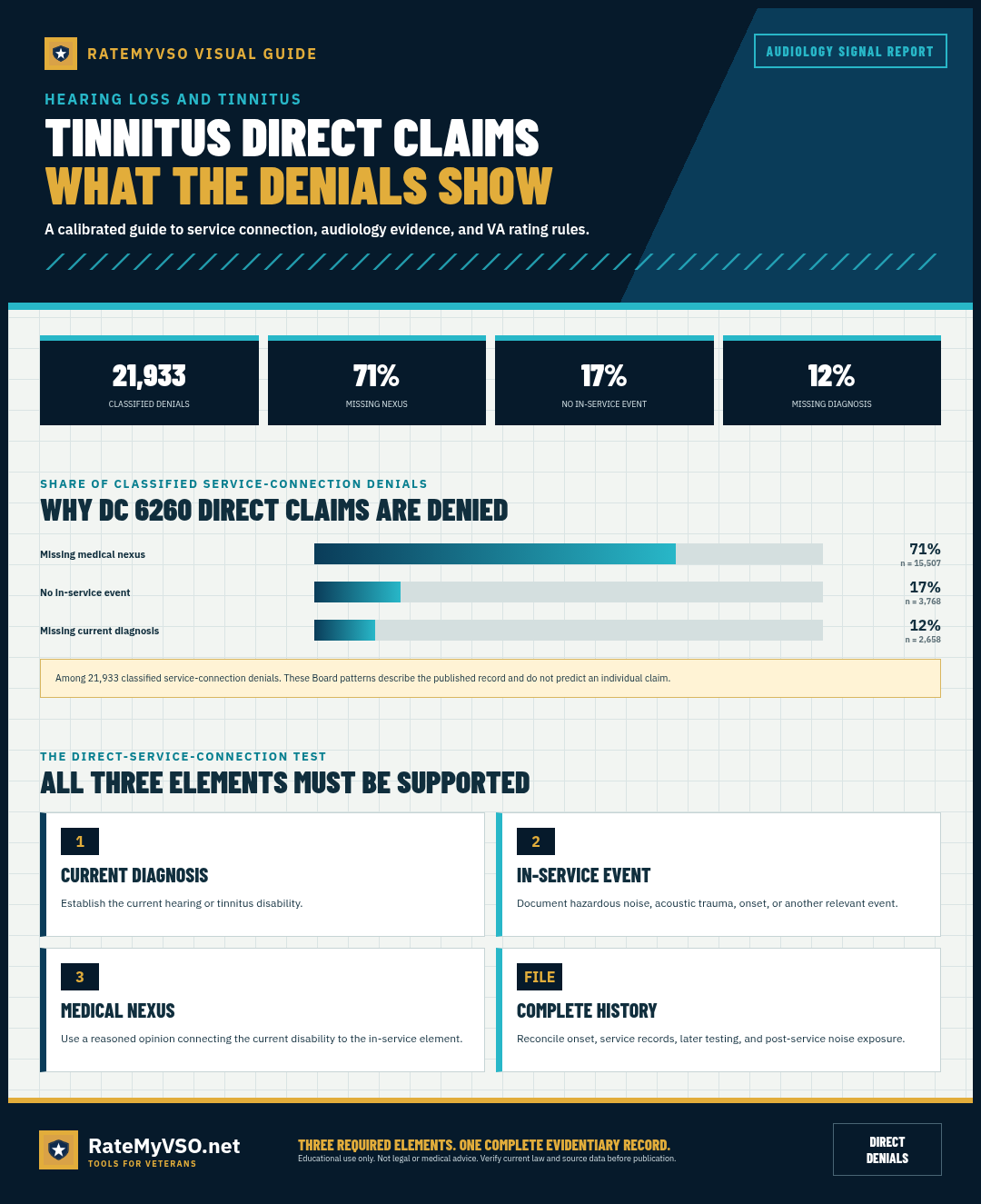 One-page guide: Tinnitus Direct-Claim Denials
21,322 classified tinnitus service-connection denials split by the missing element, with the three required direct-claim elements. Opens the full-size chart, free to save or print.
One-page guide: Tinnitus Direct-Claim Denials
21,322 classified tinnitus service-connection denials split by the missing element, with the three required direct-claim elements. Opens the full-size chart, free to save or print.
- No nexus opinion in the file. A missing medical nexus is the leading reason tinnitus claims are denied; for hearing loss, a missing current diagnosis leads instead. Either way, a useful opinion names the in-service noise exposure or the service-connected primary and explains the link.
- Expecting a rating above 10 percent for tinnitus. Tinnitus carries a single 10% rating under DC 6260 whether it affects one ear or both. There is no higher schedular rating regardless of severity.
- Treating tinnitus and hearing loss as one claim. They are separate conditions under separate diagnostic codes and do not pyramid. Both can be service-connected and rated at the same time.
- Leaving the in-service noise exposure undocumented. Military occupational records and the DoD MOS noise exposure listings support the in-service event. Without that record, the claim leans on a nexus opinion alone.
- Relying only on your representative's brief to make the medical argument. Citing general audiology or medical literature in an appeal brief, without a treating or examining clinician applying that literature to your specific facts, is not medical evidence on its own.
Do's and Don'ts
A condensed version of everything above, in the order it actually matters when you sit down to build your file.
- Write down when your tinnitus or hearing loss started and keep that date consistent everywhere you report it, on forms, at exams, and in statements.
- Gather proof of noise exposure: your MOS, combat service, and any weapon qualification badges.
- Request your service records and look for hearing test (audiogram) threshold shifts between entrance and separation.
- Get a nexus opinion from a doctor or audiologist that explains its reasoning and reviews your full record, not just your favorable facts.
- Be upfront about any civilian noise exposure or family history so your doctor can explain why service is still the cause.
- If a VA exam denied you only because the service records are silent, say so directly and point to your own account and the Hensley and Dalton principles.
- Identify every service-connected condition that could plausibly connect to your tinnitus, for example migraines, hypertension, or a mental health condition.
- If you were denied before, file a Supplemental Claim with new and relevant evidence rather than starting over.
- Don't give different onset dates to different people; inconsistency is the fastest way to lose a tinnitus claim.
- Don't deny ear trouble at separation and then claim years later it started in service, without addressing that contradiction head on.
- Don't assume a diagnosis alone wins the claim, you still need the connection to service.
- Don't rely on a private opinion that skips over your unfavorable facts, an examiner will find and use them against you.
- Don't ignore your post-service noise exposure or family history, address it rather than hoping it stays hidden.
- Don't expect a rating above 10 percent for tinnitus regardless of how severe or bilateral it is.
- Don't treat hearing loss and tinnitus as a single claim, file and support each on its own diagnostic code.
- Don't rely on your representative's brief alone to make the medical argument, a clinician has to apply the reasoning to your facts.
When a Denial Relies on "Normal Hearing at Separation"
A large share of hearing-loss and tinnitus denials rest on a single line: the entrance and separation audiograms were both within normal limits, so the examiner concludes the condition is not related to service. Standing alone, that rationale runs against settled VA law.
"Normal" at separation does not bar service connection
The Court held in Hensley v. Brown that normal hearing at separation does not preclude service connection for a current hearing disability. The threshold for normal hearing is 0 to 20 decibels, and readings above 20 dB reflect some degree of loss. A veteran can establish service connection by showing the current hearing condition is linked to service, even when the separation audiogram read within normal limits. (Hensley v. Brown, 5 Vet. App. 155 (1993))
Why a "normal audiograms" opinion is an inadequate rationale
A negative nexus opinion that rests only on normal results at enlistment and separation, without analyzing the etiology of the current loss across the whole record, is an insufficient rationale. A medical opinion based solely on the absence of documentation in the file is inadequate, and the correct step is to return the examination to the examiner for a complete opinion, not to deny on it (Dalton v. Peake, 21 Vet. App. 23 (2007)). The same rule reaches tinnitus, which follows the hearing-loss examination provisions. (VA Adjudication Procedures Manual M21-1, Part III, Subpart iv, Chapter 4, Section B)
The threshold-shift analysis
Because nearly every veteran had some noise exposure, examiners weigh whether a measurable threshold shift occurred between the entrance and separation audiograms rather than relying on exposure alone. A documented worsening across the tested frequencies between entry and exit is strong objective evidence of an in-service injury. A veteran whose audiograms show that shift has the more direct case. A veteran missing one of those exams, or whose audiograms look similar, relies more on the Hensley principle and a well-reasoned nexus opinion.
Who can examine for tinnitus, and what a private opinion must show
A tinnitus-only examination may be done by an audiologist or a non-audiologist clinician, but only when a hearing-loss examination is of record and available for review. A private tinnitus opinion or DBQ that does not show the clinician reviewed the hearing-loss audiogram can be rejected on that basis. Hearing-loss DBQs themselves may be completed only by a state-licensed audiologist. A private tinnitus opinion should state the date and source of the hearing examination it reviewed.
Secondary relationships
Conditions Commonly Associated with Hearing Loss
Tinnitus (DC 6260). Frequently co-occurs with noise-induced sensorineural hearing loss. Rated separately at 10%.
Depression and anxiety (DC 9434, DC 9400). Chronic hearing loss is associated with social isolation, communication frustration, and reduced quality of life. Secondary mental health conditions are ratable when a documented causal link exists. See our Mental Health Rating Formula Guide for how those ratings are scored.
Balance disorders / vestibular dysfunction. The inner ear structures responsible for hearing and balance are anatomically adjacent. Noise or trauma affecting cochlear function may also affect vestibular function. Rated under DC 6204 (peripheral vestibular disorders) or analogously.
Social isolation and occupational limitations. Not separately ratable on their own, but contribute to the evidence record for mental health secondary claims.
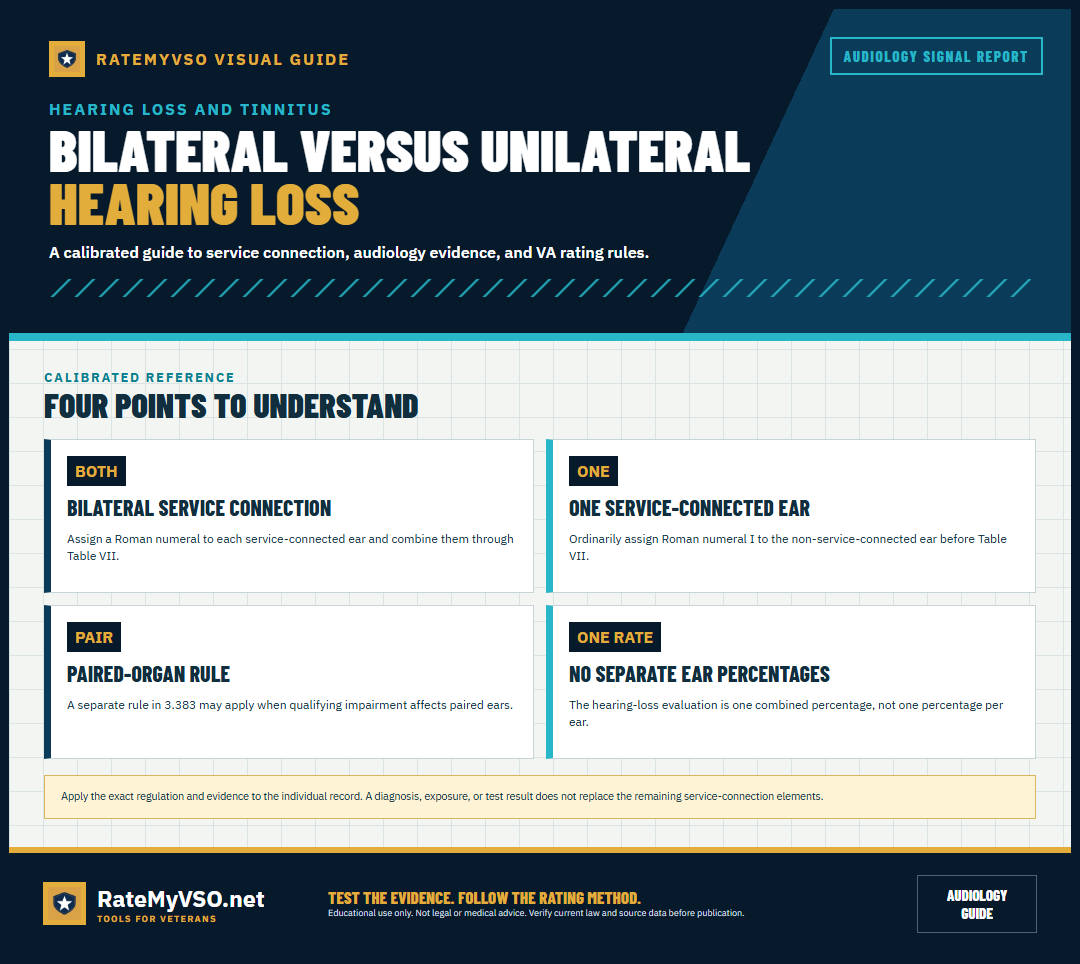 One-page guide: Bilateral vs Unilateral Hearing Loss
How VA combines bilateral hearing loss and ordinarily handles one non-service-connected ear. Opens the full-size chart, free to save or print.
One-page guide: Bilateral vs Unilateral Hearing Loss
How VA combines bilateral hearing loss and ordinarily handles one non-service-connected ear. Opens the full-size chart, free to save or print.
Common Secondary Conditions
We found these are the conditions most often linked with hearing loss and tinnitus in the Board's published decisions. Each bar is the BVA grant rate for the code, with the number of decisions below it. They describe what the Board's record shows across many veterans, not a prediction about any one claim.
Conditions that can cause tinnitus (tinnitus as the secondary)
Claims where tinnitus was argued as secondary to an already service-connected condition:
Conditions tinnitus can cause (tinnitus as the primary)
Conditions veterans have claimed as caused or aggravated by a service-connected tinnitus:
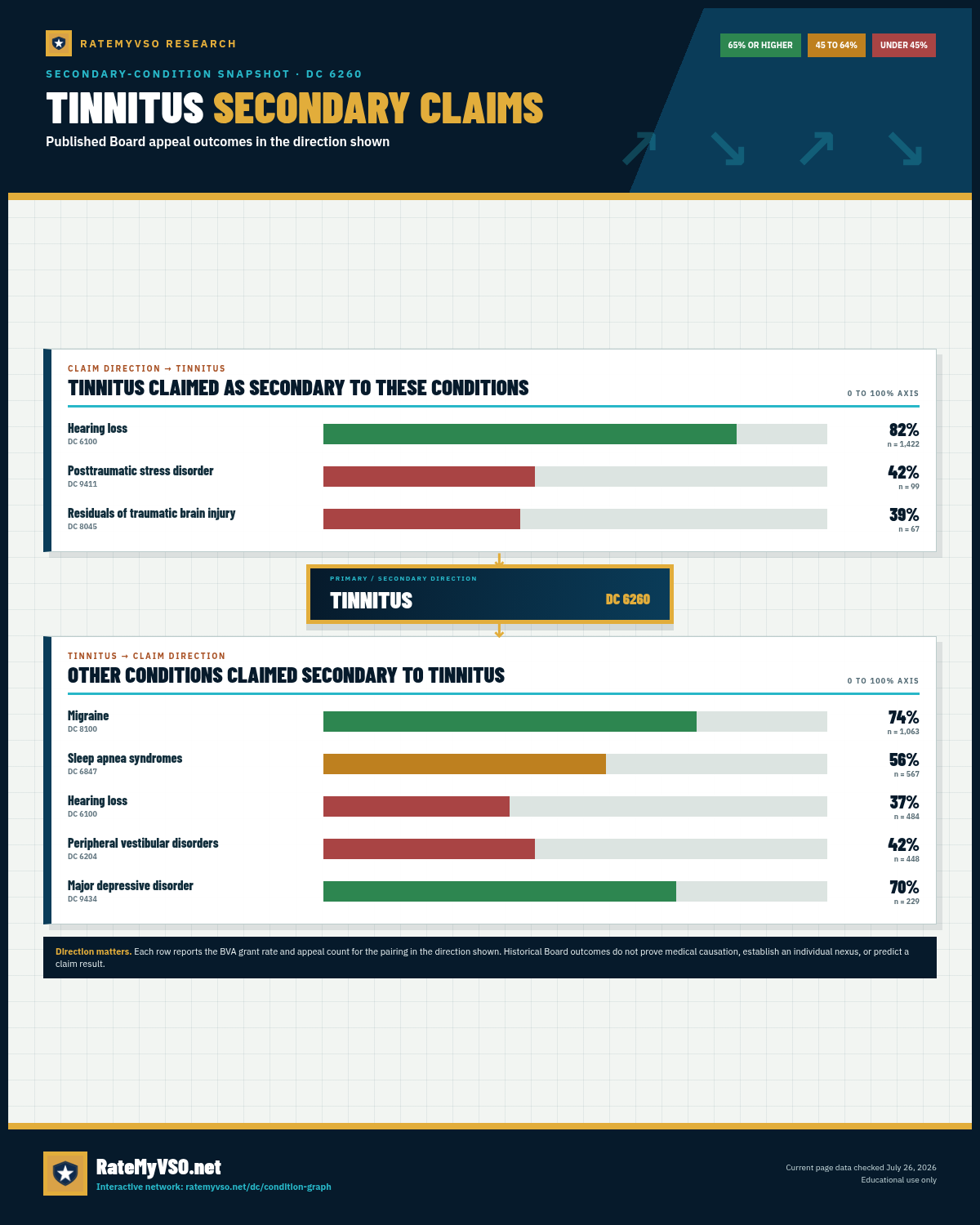 One-page guide: Tinnitus Secondary-Claim Snapshot
Two-direction secondary-claim snapshot for TINNITUS, showing BVA grant rates and appeal counts for conditions claimed toward and away from TINNITUS. Opens the full-size chart, free to save or print.
One-page guide: Tinnitus Secondary-Claim Snapshot
Two-direction secondary-claim snapshot for TINNITUS, showing BVA grant rates and appeal counts for conditions claimed toward and away from TINNITUS. Opens the full-size chart, free to save or print.
Conditions that can cause hearing loss (hearing loss as the secondary)
Claims where hearing loss was argued as secondary to an already service-connected condition:
Conditions hearing loss can cause (hearing loss as the primary)
Conditions veterans have claimed as caused or aggravated by a service-connected hearing loss, most often the mental health and vestibular conditions discussed below:
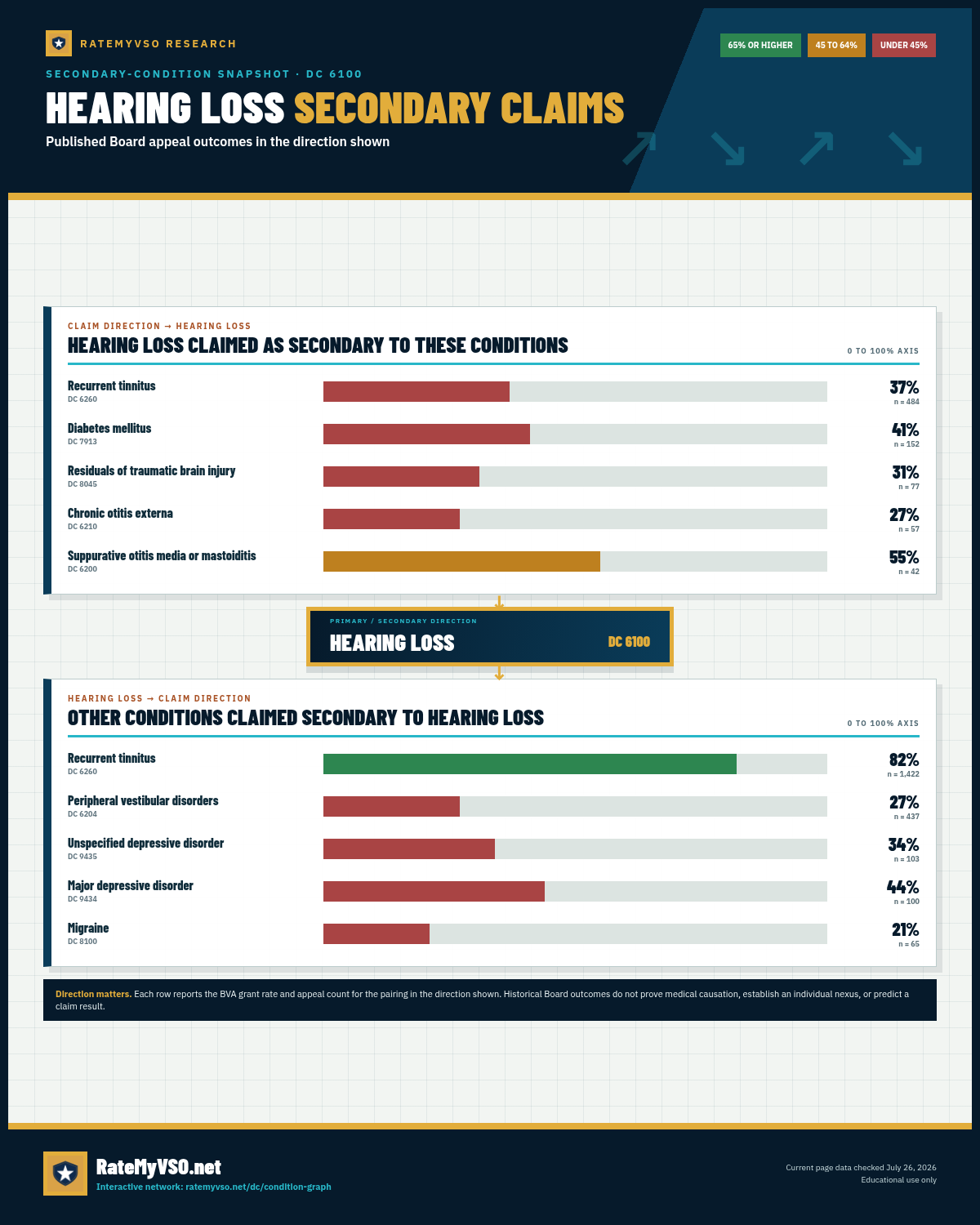 One-page guide: Hearing-Loss Secondary-Claim Snapshot
Two-direction secondary-claim snapshot for HEARING LOSS, showing BVA grant rates and appeal counts for conditions claimed toward and away from HEARING LOSS. Opens the full-size chart, free to save or print.
One-page guide: Hearing-Loss Secondary-Claim Snapshot
Two-direction secondary-claim snapshot for HEARING LOSS, showing BVA grant rates and appeal counts for conditions claimed toward and away from HEARING LOSS. Opens the full-size chart, free to save or print.
Prepare and take the next step
Prepare: your own working pages
Optional. These are your own notes, in your own words. They are not a VA form, they are not sent to the VA, and nothing here is a medical finding or a prediction about your claim.
Three reminders while you prepare
- Separate each diagnosis and affected function
Record the diagnosed condition, side or functional area, onset, testing, and treatment without combining distinct residuals. Go to this part
- Describe symptoms and practical effects
Note frequency, duration, sensory or cognitive changes, communication, safety, and what the condition interrupts. Go to this part
- Use objective testing and your account together
Keep test findings and clinician conclusions distinct from your own description. Do not assign yourself a severity category. Go to this part
Sign in or create an account to save your answers and come back to them later. You can fill these in and print them without an account.
Symptoms and functional effects
Testing, diagnosis, and treatment
Connection and examination questions
Records and unanswered questions
Decision-letter reading sheet
Rating Hearing Loss: The Three-Step Process
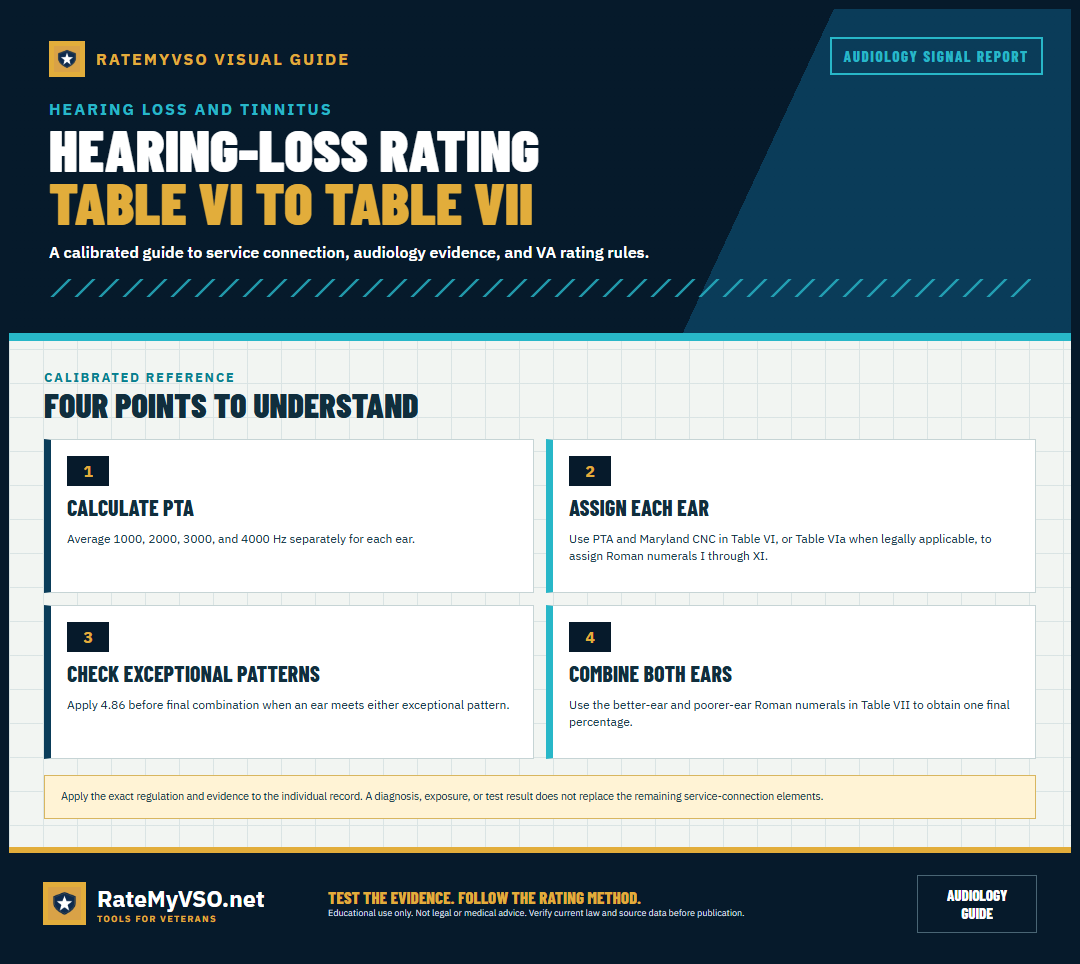
1Assign a Roman Numeral to Each Ear Using Table VI
Table VI is titled "Numeric Designation of Hearing Impairment Based on Puretone Threshold Average and Speech Discrimination." The horizontal rows represent speech discrimination percentages and the vertical columns represent the PTA. The Roman numeral designation (I through XI) is found at the intersection. Roman numeral I represents the least severe hearing loss and Roman numeral XI represents the most severe (essentially total deafness). This step is done separately for each ear, producing two Roman numeral designations.
2Combine Both Ears Using Table VII
Table VII is titled "Percentage Evaluations for Hearing Impairment." The horizontal rows represent the ear with better hearing (lower Roman numeral) and the vertical columns represent the ear with worse hearing (higher Roman numeral). The percentage rating is found at the intersection. Both ears combine into a single rating. Hearing loss in one ear and hearing loss in the other ear do not produce two separate percentages.
Special rule for one-ear service connection: When hearing impairment is service-connected in only one ear, the non-service-connected ear is assigned Roman Numeral I (the most favorable designation) before entering Table VII. (38 CFR § 4.85(f))
3Read the Final Percentage from Table VII
The percentage found in Table VII is the disability rating. Ratings range from 0% to 100% and may include values at every 10% interval. The table is what decides it: there is no separate judgment call at this step, so two veterans with the same Roman numerals get the same percentage.
Quick Checklist Before You File
Bring these together before you submit anything.
- Write down when your tinnitus or hearing loss started, and keep that date consistent everywhere you report it.
- Gather proof of noise exposure: your MOS, combat service, and any weapon qualification badges.
- Request your service records and look for hearing test (audiogram) threshold shifts between entrance and separation.
- A recent audiogram, if you have hearing loss symptoms. A private audiologist's report helps document the loss, but check which word list it used: only a Maryland CNC score counts for the rating tables, so VA will still order its own exam if the private report used a different test.
- A nexus opinion from a doctor or audiologist that explains its reasoning and reviews your full record, including any unfavorable facts.
- Be upfront about any civilian noise exposure or family history so your doctor can address it directly.
- A list of any service-connected condition that could plausibly connect to your tinnitus, for example migraines, hypertension, or a mental health condition.
- If you were denied before: new and relevant evidence for a Supplemental Claim, not just a repeat of what was already considered.
- Remember tinnitus maxes out at 10 percent; put your energy into winning service connection rather than a higher rating.
For the mechanics of actually submitting the claim, see the Standard Claim Guide and the Fully Developed Claim Guide (filing with all your evidence up front can speed up the decision).
The Claims Process, Step by Step
Once you file, your claim moves through a series of hand-offs. Understanding who does what helps you know who to contact, and what to expect, at each stage.
- You file the claim. Directly with VA, through VA.gov, or with the help of an accredited representative.
- VA acknowledges the claim and assigns it for development. A Veteran Service Representative (VSR) is assigned to gather your service treatment records, VA and private medical records, and any other evidence needed.
- The VSR orders a Compensation & Pension (C&P) exam if one is needed. Most hearing loss and tinnitus claims require an audiology exam, especially secondary claims where a nexus opinion is required.
- The C&P exam is conducted. By a state-licensed audiologist (for hearing loss) or an audiologist or non-audiologist clinician with a hearing-loss exam of record (for tinnitus), who completes a Disability Benefits Questionnaire (DBQ) documenting the diagnosis, severity, and, where relevant, a nexus opinion.
- The file goes to a Rating Veteran Service Representative (RVSR), the "rater." The rater reviews the complete file, including the audiogram and exam results, and decides whether service connection is warranted and at what percentage.
- A senior reviewer may review the decision before it's finalized, depending on the complexity of the claim.
- VA issues the decision letter. This states whether the claim is granted or denied, the rating percentage if granted, and the reasons behind the decision.
- If you disagree, you choose an appeal lane. Higher-Level Review, Supplemental Claim, or a Board appeal, covered later in this guide.
Who's who: VSO vs. VSR vs. Rater vs. C&P Examiner
Your VSO
An accredited representative from a veterans service organization, or an accredited attorney or claims agent. Not a VA employee. Helps you prepare, gather evidence, and file, and can represent you through an appeal. Has no authority to decide your claim.
VSR (Veteran Service Representative)
VA staff who "develops" your claim: requests records, schedules the C&P exam, and assembles the file. Does not decide the rating.
Rater (RVSR)
VA staff who reviews the completed file and makes the actual decision, service connection or denial, and the percentage. This is the person whose judgment the decision letter reflects.
C&P Examiner
A state-licensed audiologist or other qualified clinician who conducts the audiometric testing and completes the DBQ. Documents findings and, where asked, a nexus opinion. Does not decide the claim.
For the full walkthrough of every stage with more detail, see Inside Your Claim and Claim Stages.
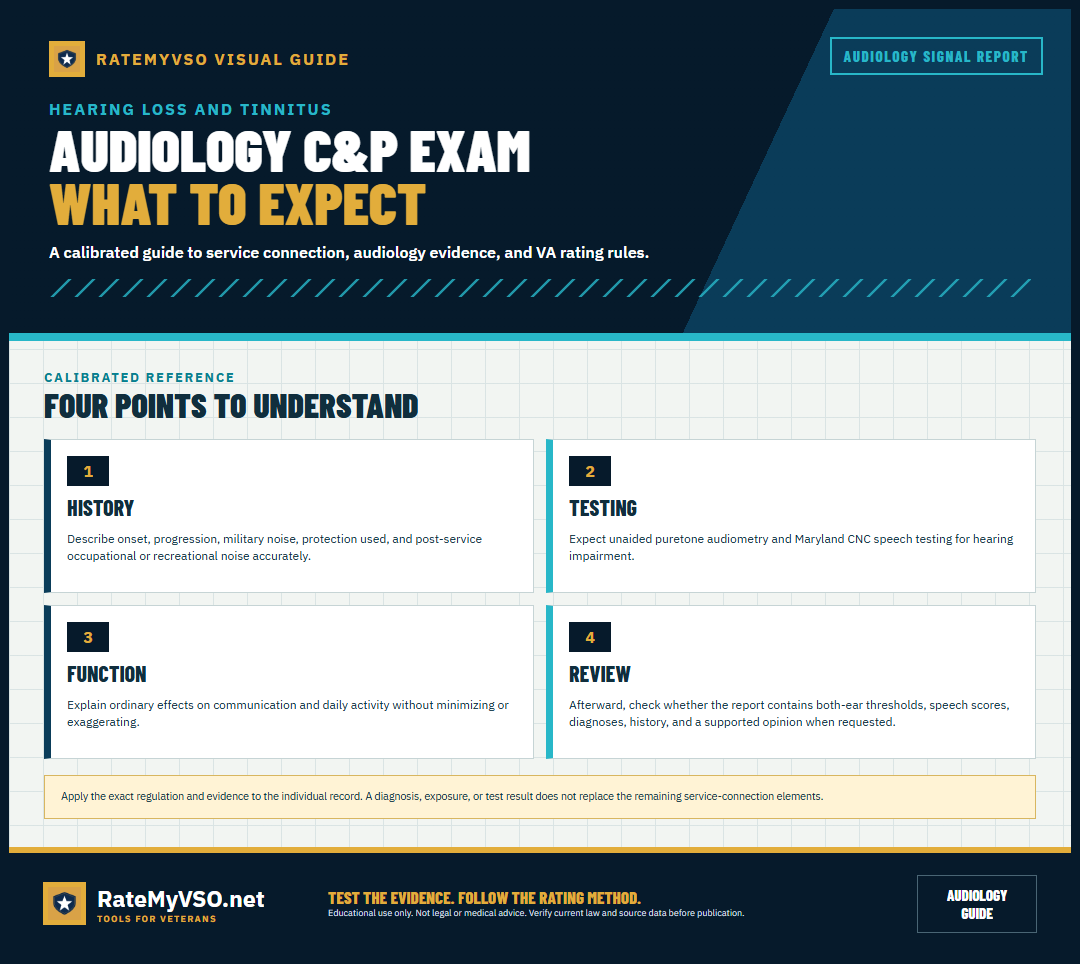 One-page guide: Audiology C&P Exam Guide
History, testing, functional effects, and report review for an audiology claim examination. Opens the full-size chart, free to save or print.
One-page guide: Audiology C&P Exam Guide
History, testing, functional effects, and report review for an audiology claim examination. Opens the full-size chart, free to save or print.
DBQs and Your C&P Exam
A Disability Benefits Questionnaire (DBQ) is the standardized form an examiner completes for your condition, it structures the exam findings into the specific data points VA's rating schedule requires (for hearing loss, that includes the puretone thresholds at each frequency and the Maryland CNC speech discrimination score for each ear; for tinnitus, the presence and onset). See the DBQ Guide for how these forms work, including whether a private DBQ completed by your own audiologist can be submitted instead of relying solely on a VA exam, subject to the Maryland CNC requirement described above.
Before your C&P exam, do not wear hearing aids to the appointment, since testing is conducted unaided. Bring a clear, specific account of when your symptoms started and how they've progressed, and be consistent with what's already in your medical records and prior statements. For a full walkthrough of what to expect and how to prepare, see the C&P Exam Prep Guide.
Reading Your Decision Letter, and What to Do If Denied
Your decision letter has two parts: a narrative section explaining the reasoning (often called "reasons and bases"), and a codesheet showing the actual rating percentage, the effective date, and the diagnostic code used. See the Reading Your Decision Letter Guide for how to find and interpret each part, or use the Letter Interpreter tool to upload your own letter and get a plain-English breakdown.
If your claim is denied, or the rating is lower than you expected, you have three main lanes:
- Supplemental Claim: refile with new and relevant evidence, such as a new nexus opinion or updated audiogram. See Supplemental Claim Guide.
- Higher-Level Review (HLR): a senior reviewer looks at the same evidence again for a difference of opinion, no new evidence is added. See HLR Guide.
- Board Appeal: your case goes to a Veterans Law Judge at the Board of Veterans' Appeals, with options for a direct review, an evidence docket, or a hearing. See Board Appeal Guide.
Not sure which lane fits your situation? See the Appeals decision guide for a side-by-side comparison of all three.
What to do if the effective date is wrong. Your effective date, when back pay starts, is usually the date VA received your claim. An intent to file only preserves an earlier date if the completed claim is submitted within one year, and a representative's filing mistake does not extend that window. If you believe VA used the wrong date, that is a separate, and often harder, fight from the service-connection question itself; see Reading Your Decision Letter for how effective dates are explained in your letter.
After You Win: Maintaining Your Rating
A grant is not always the end of the story. Keep your treatment consistent, continued follow-up with an audiologist for hearing loss, and documentation of any change in your tinnitus, protects you if VA schedules a future reexamination. Not every rating gets reexamined; understand when a rating becomes protected from future review (including Permanent and Total status) and what to do if VA proposes to reduce it. See Protect Your Rating and Future Reexaminations for the specifics.
If your hearing loss worsens after the initial grant, you can file for an increased rating with updated audiometric testing. Tinnitus, by contrast, is capped at 10 percent regardless of severity, so there is no increased-rating path for tinnitus alone. See the Rating Increase Guide.
References and related resources
Quick Reference Tables
DC 6100 Rating Pathway
| Step | What Happens | Regulatory Reference |
|---|---|---|
| 1 | Audiologist performs puretone test and Maryland CNC test (without hearing aids) | 38 CFR § 4.85(a) |
| 2 | PTA calculated per ear (avg of 1000, 2000, 3000, 4000 Hz) | 38 CFR § 4.85(d) |
| 3 | Roman numeral assigned per ear from Table VI (or VIa) | 38 CFR § 4.85(b), (c) |
| 4 | Check for exceptional pattern: all 4 freqs ≥55 dB or 1000 Hz ≤30 / 2000 Hz ≥70 | 38 CFR § 4.86 |
| 5 | Combine both ear numerals using Table VII for final percentage | 38 CFR § 4.85(e) |
| 6 | If only one ear is SC, non-SC ear assigned Roman Numeral I before Table VII | 38 CFR § 4.85(f) |
Key Audiometric Concepts
| Term | Definition |
|---|---|
| PTA (Puretone Threshold Average) | Average of thresholds at 1000, 2000, 3000, and 4000 Hz per ear |
| Maryland CNC | 50-word speech recognition test; VA-required specific test |
| Roman Numeral I | Least severe designation (near-normal hearing) |
| Roman Numeral XI | Most severe designation (profound deafness) |
| Table VI | Assigns Roman numeral using PTA plus speech discrimination score |
| Table VIa | Assigns Roman numeral using PTA only (no speech discrimination) |
| Table VII | Converts both-ear Roman numerals into a final percentage rating |
Secondary Connection Pathways for Tinnitus
| Primary Condition | Mechanism | Evidence Needed |
|---|---|---|
| Migraines | Overlapping neurological pathways | Nexus opinion tying migraine disorder to tinnitus onset or worsening |
| Sleep apnea | Contested theory; disrupted oxygenation and sleep-cycle stress | Nexus opinion addressing the mechanism directly; thinner evidentiary base |
| Hypertension (DC 7101) | Blood-flow effect near the inner ear | Nexus opinion naming the mechanism and the veteran's hypertension history |
| PTSD / mental health (DC 9411) | Stress and hypervigilance heightening perceived severity | Nexus opinion, usually framed as aggravation rather than causation |
From Filing to Decision: Who Does What
| Role | Does | Decides your rating? |
|---|---|---|
| VSO / accredited representative | Helps prepare, gather evidence, and file; represents you on appeal | No |
| VSR | Develops the claim: orders records and the C&P exam | No |
| C&P Examiner (audiologist) | Conducts the audiometric testing, completes the DBQ, may give a nexus opinion | No / but has a strong impact |
| Rater (RVSR) | Reviews the full file and decides service connection and percentage | Yes |
Related Tools and Guides
Sources
- 38 CFR § 4.85, Evaluation of Hearing Impairment (Tables VI, VIa, VII)
- 38 CFR § 4.86, Exceptional Patterns of Hearing Impairment
- 38 CFR § 4.87, DC 6260, Tinnitus (single 10 percent maximum rating)
- 38 CFR § 3.303, basic rules for direct service connection, including § 3.303(b) continuity of symptoms for chronic diseases
- 38 CFR § 3.306, Aggravation of Pre-Service Disability
- 38 CFR §§ 3.307, 3.309, presumptive service connection; tinnitus as an organic disease of the nervous system for continuity-of-symptoms purposes
- 38 CFR § 3.310, Secondary Service Connection
- 38 CFR § 3.383, Benefits for Disabilities of Paired Organs / Extremities
- 38 CFR § 3.385, Service connection for impaired hearing (audiometric thresholds)
- 38 CFR § 3.102, benefit of the doubt; 38 CFR §§ 3.400, 3.155, effective dates and intent to file
- 38 U.S.C. §§ 1110, 1131, basic service connection; 38 U.S.C. § 5107(b), benefit of the doubt; 38 U.S.C. § 5110, effective dates
- Shedden v. Principi, 381 F.3d 1163 (Fed. Cir. 2004), the three-element test for service connection
- Lendenmann v. Principi, 3 Vet. App. 345 (1992), hearing disability ratings derived mechanically from audiometric testing; lay reports of difficulty alone insufficient
- Hensley v. Brown, 5 Vet. App. 155 (1993), normal hearing at separation does not bar service connection; the threshold for normal hearing is 0 to 20 dB
- Charles v. Principi, 16 Vet. App. 370 (2002), tinnitus is capable of lay observation
- Barr v. Nicholson, 21 Vet. App. 303 (2007), a condition with unique, readily identifiable features, such as tinnitus, is not a medical determination and is competent for lay observation
- Dalton v. Peake, 21 Vet. App. 23 (2007), a VA exam is inadequate if it relies solely on the absence of records and ignores the veteran's lay statements
- Smith v. Nicholson, 451 F.3d 1344 (Fed. Cir. 2006), affirming VA's interpretation of DC 6260 as authorizing only a single 10 percent rating for tinnitus regardless of whether it is perceived in one ear, both ears, or the head
- Lynch v. McDonough, 21 F.4th 776 (Fed. Cir. 2021) (en banc), clarifying the benefit-of-the-doubt standard: it applies when the evidence is in approximate balance, not merely when it fails to persuasively favor one side
- VA Adjudication Procedures Manual (M21-1), Part III, Subpart iv, Chapter 4, Section B, Rating hearing impairment and tinnitus; examination-adequacy and opinion-rationale requirements
- DoD Duty MOS Noise Exposure Listing, Occupational noise hazard data by MOS and branch